INTRODUCTION TO
NERVOUS SYSTEM
Prepared by,
Abhay Shripad Joshi
Assistant Professor
Yash Institute of Pharmacy, Aurangabad
abhay.joshirss@gmail.com
NERVOUS SYSTEM
Organization of nervous system
• CNS: (central nervous system)
- brain
- spinal cord
• (PNS) Peripheral Nervous System
- cranial nerves (12 pairs)
- spinal nerves (31 pairs)
Communication lines between CNS and the rest of body
NERVOUS SYSTEM
• Divisions:
- Sensory (afferent) division
• Somatic (skin, muscle, joints) and visceral (organs) sensory
neurons
• Conducts impulses from receptors to the CNS
- Motor (efferent) division
• Motor neurons
• Conducts impulses from the CNS to effectors (muscles and glands)
NERVOUS SYSTEM
• Motor Divisions:
• Somatic Nervous System
- Voluntary
- Conducts impulses from CNS to skeletal muscles
• Autonomic Nervous System
- Involuntary
- Conducts impulses from CNS to cardiac muscles, smooth
muscles, and glands.
- Divisions:
- Sympathetic
- Parasympathetic
ORGANIZATION OF NERVOUS SYSTEM
Nervous Tissue
• Comprise of 2 types of cells
• Neuroglia = supporting cells
• The insulators, adhesive, protectors and nourishers
• Neurons = nerve cells that transmit impulses
Nervous Tissue: Support Cells (Neuroglia)
• Astrocytes :
– Abundant, star-shaped cells
– Brace neurons
– Form barrier
between capillaries
and neurons
– Control the chemical
environment of
the brain
Nervous Tissue: Support Cells (Neuroglia)
• Microglia
- Spider-like phagocytes
- Dispose of debris
• Ependymal cells
- Line cavities of the
brain and spinal cord
- Circulate
cerebrospinal
fluid
Nervous Tissue: Support Cells (Neuroglia)
• Oligodendrocytes:
• Produce myelin sheath around nerve fibers in the central
nervous system
Figure 7.3e
Nervous Tissue: Support Cells (Neuroglia)
• Satellite cells:
• Protect neuron cell bodies
• Schwann cells:
• Form myelin sheath in the peripheral nervous system
NEURON
•The nervous system is
made up of more cells
than any other system.
•For instance, the brain
has about 100 billion
cells.
• There are also a
number of different
cell types, the most
important is the
neuron.
NEURON
• A neuron is a cell shaped like a
starfish with a long tail called an
axon. The axon of each neuron is
surrounded by a sheath called
the endoneurium. Some axons
have an additional sheath called
myelin.
• A bundle of neurons travel
together in a fascicle, and are
surrounded by perineurium.
• A bundle of fascicles is
surrounded by epineurium
NEURON
• All neurons do three things:
• Receive a signal: Can be any type of stimulus, depending on
what type of neuron it is (touch, vibration, light, sound,
chemicals, signal from another neuron, etc).
• Transmit a signal to another location: E.g. finger touching
something  signal to spinal cord or brain.
• Stimulate another cell:
• Another neuron  transmit signal
• Muscle  contraction
• Gland  secretion
• Blood vessel  constriction
Functional Classification of Neurons
• Sensory (afferent) neurons:
•Carry impulses from the sensory receptors
•Cutaneous sense organs
•Proprioceptors – detect stretch or tension
• Motor (efferent) neurons:
•Carry impulses from the central nervous system
Functional Classification of Neurons
• Interneurons (association neurons) :
• Found in neural pathways in the central nervous
system
• Connect sensory and motor neurons
Structural Classification of Neurons
• Multipolar neurons: – many extensions from the cell
body
Figure 7.8a
Structural Classification of Neurons
• Bipolar neurons: – one axon and one dendrite
Figure 7.8b
Structural Classification of Neurons
• Unipolar neurons: – have a short single process leaving the
cell body
Figure 7.8c
SYNAPSE
• The connection between 2 or more nerves and they are
separated by a space or cleft.
SYNAPTIC TERMINOLOGY
• Synapse – site where two nerves communicate with each
other.
• Presynaptic neuron – neuron that is conducting information
toward the next neuron
• Postsynaptic neuron – transmits information away from
synapse
• Most synaptic communication is via chemical messengers
(e.g. acetylcholine, serotonin, norepinephrine, dopamine,
endorphins, GABA, glycine, glutamic acid, etc.)
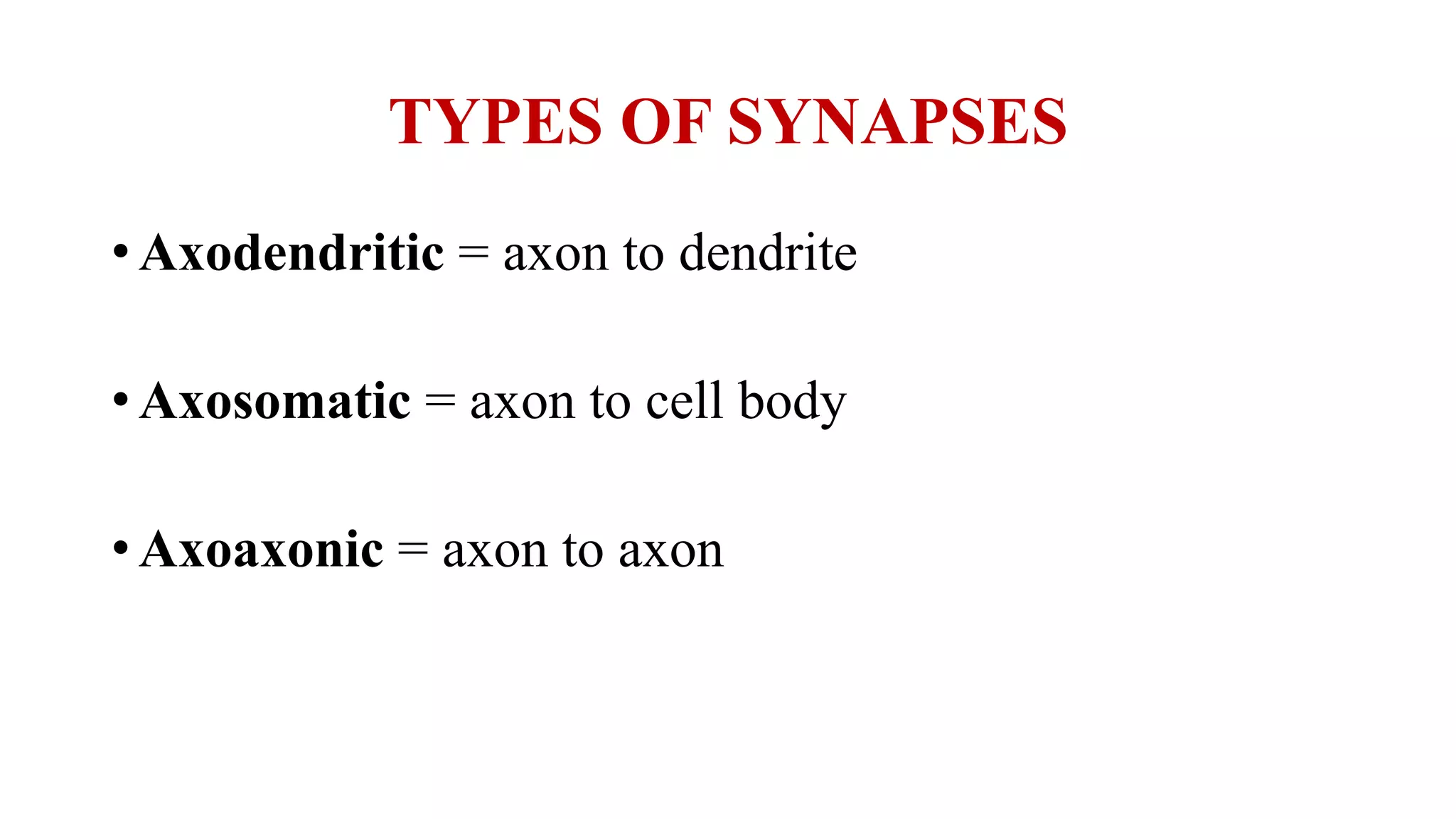
TYPES OF SYNAPSES
• Axodendritic = axon to dendrite
• Axosomatic = axon to cell body
• Axoaxonic = axon to axon
TYPES OF SYNAPSES
THANK YOU

Nervous system

  • 1.
    INTRODUCTION TO NERVOUS SYSTEM Preparedby, Abhay Shripad Joshi Assistant Professor Yash Institute of Pharmacy, Aurangabad abhay.joshirss@gmail.com
  • 2.
    NERVOUS SYSTEM Organization ofnervous system • CNS: (central nervous system) - brain - spinal cord • (PNS) Peripheral Nervous System - cranial nerves (12 pairs) - spinal nerves (31 pairs) Communication lines between CNS and the rest of body
  • 3.
    NERVOUS SYSTEM • Divisions: -Sensory (afferent) division • Somatic (skin, muscle, joints) and visceral (organs) sensory neurons • Conducts impulses from receptors to the CNS - Motor (efferent) division • Motor neurons • Conducts impulses from the CNS to effectors (muscles and glands)
  • 4.
    NERVOUS SYSTEM • MotorDivisions: • Somatic Nervous System - Voluntary - Conducts impulses from CNS to skeletal muscles • Autonomic Nervous System - Involuntary - Conducts impulses from CNS to cardiac muscles, smooth muscles, and glands. - Divisions: - Sympathetic - Parasympathetic
  • 5.
  • 6.
    Nervous Tissue • Compriseof 2 types of cells • Neuroglia = supporting cells • The insulators, adhesive, protectors and nourishers • Neurons = nerve cells that transmit impulses
  • 7.
    Nervous Tissue: SupportCells (Neuroglia) • Astrocytes : – Abundant, star-shaped cells – Brace neurons – Form barrier between capillaries and neurons – Control the chemical environment of the brain
  • 8.
    Nervous Tissue: SupportCells (Neuroglia) • Microglia - Spider-like phagocytes - Dispose of debris • Ependymal cells - Line cavities of the brain and spinal cord - Circulate cerebrospinal fluid
  • 9.
    Nervous Tissue: SupportCells (Neuroglia) • Oligodendrocytes: • Produce myelin sheath around nerve fibers in the central nervous system
  • 10.
    Figure 7.3e Nervous Tissue:Support Cells (Neuroglia) • Satellite cells: • Protect neuron cell bodies • Schwann cells: • Form myelin sheath in the peripheral nervous system
  • 11.
    NEURON •The nervous systemis made up of more cells than any other system. •For instance, the brain has about 100 billion cells. • There are also a number of different cell types, the most important is the neuron.
  • 12.
    NEURON • A neuronis a cell shaped like a starfish with a long tail called an axon. The axon of each neuron is surrounded by a sheath called the endoneurium. Some axons have an additional sheath called myelin. • A bundle of neurons travel together in a fascicle, and are surrounded by perineurium. • A bundle of fascicles is surrounded by epineurium
  • 13.
    NEURON • All neuronsdo three things: • Receive a signal: Can be any type of stimulus, depending on what type of neuron it is (touch, vibration, light, sound, chemicals, signal from another neuron, etc). • Transmit a signal to another location: E.g. finger touching something  signal to spinal cord or brain. • Stimulate another cell: • Another neuron  transmit signal • Muscle  contraction • Gland  secretion • Blood vessel  constriction
  • 14.
    Functional Classification ofNeurons • Sensory (afferent) neurons: •Carry impulses from the sensory receptors •Cutaneous sense organs •Proprioceptors – detect stretch or tension • Motor (efferent) neurons: •Carry impulses from the central nervous system
  • 15.
    Functional Classification ofNeurons • Interneurons (association neurons) : • Found in neural pathways in the central nervous system • Connect sensory and motor neurons
  • 16.
    Structural Classification ofNeurons • Multipolar neurons: – many extensions from the cell body Figure 7.8a
  • 17.
    Structural Classification ofNeurons • Bipolar neurons: – one axon and one dendrite Figure 7.8b
  • 18.
    Structural Classification ofNeurons • Unipolar neurons: – have a short single process leaving the cell body Figure 7.8c
  • 19.
    SYNAPSE • The connectionbetween 2 or more nerves and they are separated by a space or cleft.
  • 20.
    SYNAPTIC TERMINOLOGY • Synapse– site where two nerves communicate with each other. • Presynaptic neuron – neuron that is conducting information toward the next neuron • Postsynaptic neuron – transmits information away from synapse • Most synaptic communication is via chemical messengers (e.g. acetylcholine, serotonin, norepinephrine, dopamine, endorphins, GABA, glycine, glutamic acid, etc.)
  • 21.
    TYPES OF SYNAPSES •Axodendritic = axon to dendrite • Axosomatic = axon to cell body • Axoaxonic = axon to axon
  • 22.
  • 23.