NanoRobot
Presented By
Sweta Leena Panda
IIIT BBSR
Overview
 Nanotechnology
 Introduction to Robotics
 Nanorobotics
 Applications using Nanorobots
 Fractal Robots
 Conclusion
Some nanohistory
 A nanometer is one billionth of a meter
 Nanotechnolgy is building machines one atom at a time
 First described by Nobel lauriate physicist Richard Feynman
 In 1959 he gave a lecture called "There's plenty of room at the
bottom" in which he suggested that the laws of physics would allow
people to use small machines to make smaller machines eventually
onto the atomic level
 The first one to coin the term is K. Eric Drexler, one time student of
Feynman's
 With the invention of the scanning tunneling microscope and the
atomic force microscope, scientists were allowed to not only take
photographs of single atoms but also to move atoms one by one.
Introduction to Nanorobotics
 It deals with the controlled manipulation of objects with
nanometer scale dimensions
 Nanomanipulation is most effective process.
 It is concerned with construction and programming of
robots with overall dimensions at the nanoscale.
Continue
 A nanorobot is a specialized nanomachine.
 It has dimensions on the order of nanometers.
 Typically 0.5 to 3 microns large with 1-100 nm parts.
 The possibility of nanorobots was first proposed by Richard
Feyman in his talk “There’s Plenty of Room at the Bottom”
in 1959.
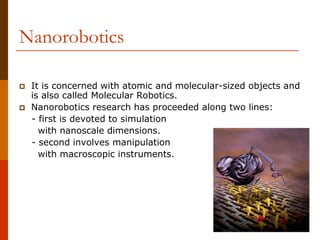
Nanorobotics
 It is concerned with atomic and molecular-sized objects and
is also called Molecular Robotics.
 Nanorobotics research has proceeded along two lines:
- first is devoted to simulation
with nanoscale dimensions.
- second involves manipulation
with macroscopic instruments.
Nanotechnology
Nanotechnology is the manipulation of matter at the
molecular level, with the aim of creating new products with
atom-by-atom precision.
Two categories of nanotechnology
 Strong nanotechnology: It focuses on the general-
purpose assembler: a microrobot that, with the proper
programming, can build anything.
 Weak nanotechnology: It is anything up to "strong,"
including the manipulation of matter at the atomic level
Applications using Nanorobots
 To cure skin disease and as cosmetic cream.
 Can be used a a mouthwash to do all brushing and flossing.
 Would augment immune system by finding and killing
bacteria and viruses.
 It would prevent heart attack , kill cancer cells etc.
 To monitor potentially dangerous microorganisms in the
ocean.
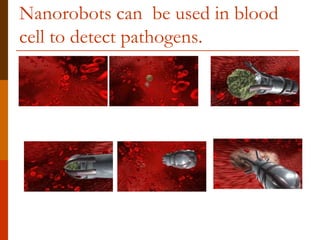
Nanorobots can be used in blood
cell to detect pathogens.
Fractal Robots
 Fractal robot is a new kind of robot made from motorized
cubic bricks that move under computer control.
 These cubic motorized bricks can be programmed to move
and shuffle themselves to change shape to make objects
likes a house potentially in a few seconds because of their
motorized internal mechanisms.
Fractal Robots & Nanotechnology
Compatible Computers
 The design of a fractal nanocomputer is not an easy task
using conventional principles.
 However, using fractal nanotechnology principles, the
exercise reduces to a fairly simple exercise where you build
a fractal nanocomputer at the large scale and providing you
followed fractal principles, the computer technology scales
downward to whatever resolution limit imposed by the
technology you are using.
SELF-REPAIR IN FRACTAL
ROBOTS.
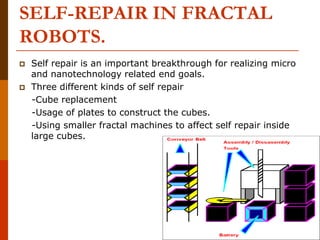
 Self repair is an important breakthrough for realizing micro
and nanotechnology related end goals.
 Three different kinds of self repair
-Cube replacement
-Usage of plates to construct the cubes.
-Using smaller fractal machines to affect self repair inside
large cubes.
Features of fractal robots
 Communication of Power & Data
 Internal Battery
 Technology today
 Costs - feasible
 Guaranteed Sales
 Increased demand
Nanocomputing
 Computer technology seems to be where nanotechnology
will first be exploited
 Computers with circuits that are nothing more than
individual atoms would mean processor speeds measured
not in megahertz, but in terahertz (million megahertz )
 A nanotech computer the size of a current laptop, by some
accounts, could conceivably hold as much computing power
as now exists on the entire planet
 A nanochip is an integrated circuit (IC) that is so small, in
physical terms, such that more processing power can fit
into a given physical volume, it runs faster and requires
less energy
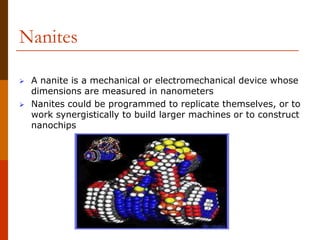
Nanites
 A nanite is a mechanical or electromechanical device whose
dimensions are measured in nanometers
 Nanites could be programmed to replicate themselves, or to
work synergistically to build larger machines or to construct
nanochips
Challenges in building nanites
 Some interesting challenges plague the fabrication of nanites
with moving parts
 An important challenge to overcome is one of engineering
 How to reduce friction and sticking nature of small
devices
 How to supply power
 How would a self-replicating nanite store and use
information
 How to program nanites
Functioning nanite
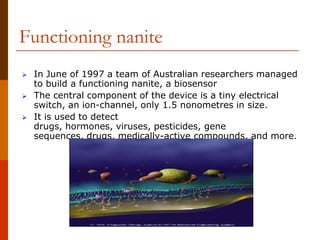
 In June of 1997 a team of Australian researchers managed
to build a functioning nanite, a biosensor
 The central component of the device is a tiny electrical
switch, an ion-channel, only 1.5 nonometres in size.
 It is used to detect
drugs, hormones, viruses, pesticides, gene
sequences, drugs, medically-active compounds, and more.
Applications of nanites
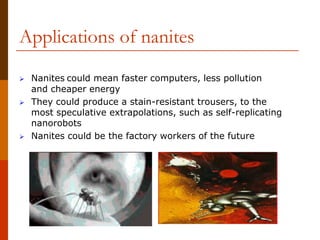
 Nanites could mean faster computers, less pollution
and cheaper energy
 They could produce a stain-resistant trousers, to the
most speculative extrapolations, such as self-replicating
nanorobots
 Nanites could be the factory workers of the future
In the Field of medicine
 To cure skin diseases and
augment the immune system by
hunting down any virus or
cancer in the cell
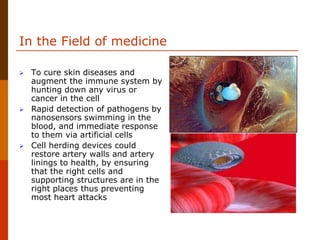
 Rapid detection of pathogens by
nanosensors swimming in the
blood, and immediate response
to them via artificial cells
 Cell herding devices could
restore artery walls and artery
linings to health, by ensuring
that the right cells and
supporting structures are in the
right places thus preventing
most heart attacks
 It is possible to clone body parts and put them into
diseased human bodies.
 Nanites can be inserted into people to repair aging skin
cells or possibly diseased cells or organs.
 Nanites can create new sorts of construction
materials, chemical compounds, electronics components
 They could be used to turn material into food
 Starvation and illness could quickly come to an end
 Environmental problems such as ozone depletion and global
warming could be solved
Ongoing Research
 Current focus of USC interdisciplinary Laboratory for Molecular
Robotics
 Development of high-level systems for programming a Scanning
Probe Microscope (SPM) as a sensory robot
 Developing and integrating the various component technologies
needed for nanomanipulation
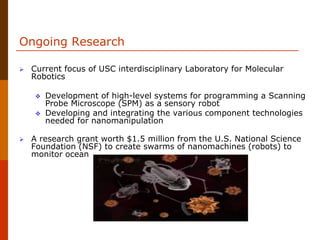
 A research grant worth $1.5 million from the U.S. National Science
Foundation (NSF) to create swarms of nanomachines (robots) to
monitor ocean
 A multidisciplinary team from NorthEastern
University, Rutgers, Lucent Technologies' Bell Laboratories
and other universities has been assembled to study the
development of protein-based nanorobots.
 Collaborators from a federal laboratory (NASA - Jet
Propulsion Laboratory) and others will provide technical
consulting and advising
 The long term goal of this project is to develop nanodevices
 That can manipulate objects in the nanoworld,
 Transfer information from the nano to the macro world
also be able to travel in the nanoenvironment
 Bottom-Up Nanomachines project
 This project is funded by the FET - Proactive Initiative
1999 on Nanotechnology Information Devices of the
European Union
 The objectives of BUN are to
design, synthesise, interconnect, assemble and test
nanomachines (with critical dimensions well below 1 nm)
and circuits to build an information processing machine in
a bottom up approach
Dark side of the force
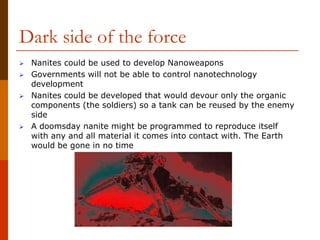
 Nanites could be used to develop Nanoweapons
 Governments will not be able to control nanotechnology
development
 Nanites could be developed that would devour only the organic
components (the soldiers) so a tank can be reused by the enemy
side
 A doomsday nanite might be programmed to reproduce itself
with any and all material it comes into contact with. The Earth
would be gone in no time
Conclusion
 All of the current developments in technology directs human a
step closer to nanorobots production.
 Nanorobots can theoretically destroy all common diseases of the
20th century, thereby ending much of the pain and suffering.
 Although research into nanorobots is in its preliminary stages,
the promise of such technology is endless.
References
 http://www.cjmag.co.jp/online/0597wnanites.html
 http://www.imm.org/SciAmDebate2/whitesides.html
 http://www.smalltimes.com/document_display.cfm?docum
ent_id=5148
 http://www.def-logic.com/articles/nanomachines.html
 http://www.fractal-robots.com/
 http://www.me.cmu.edu/faculty1/sitti/nano/
 http://www.links999.net/robotics/robots/robots_introductio
n.html
 http://www.ifr.mavt.ethz.ch/photo/nanorobotics
 http://www.cheme.cornell.edu/%7Esaltzman/Classes/ENGR
I_120/Research_Papers/paper47.PDF
 http://www.medicaldesignonline.com/
ANY QUESTIONS ???
Any
Questions?

NANOROBOT

  • 1.
  • 2.
    Overview  Nanotechnology  Introductionto Robotics  Nanorobotics  Applications using Nanorobots  Fractal Robots  Conclusion
  • 3.
    Some nanohistory  Ananometer is one billionth of a meter  Nanotechnolgy is building machines one atom at a time  First described by Nobel lauriate physicist Richard Feynman  In 1959 he gave a lecture called "There's plenty of room at the bottom" in which he suggested that the laws of physics would allow people to use small machines to make smaller machines eventually onto the atomic level  The first one to coin the term is K. Eric Drexler, one time student of Feynman's  With the invention of the scanning tunneling microscope and the atomic force microscope, scientists were allowed to not only take photographs of single atoms but also to move atoms one by one.
  • 4.
    Introduction to Nanorobotics It deals with the controlled manipulation of objects with nanometer scale dimensions  Nanomanipulation is most effective process.  It is concerned with construction and programming of robots with overall dimensions at the nanoscale.
  • 5.
    Continue  A nanorobotis a specialized nanomachine.  It has dimensions on the order of nanometers.  Typically 0.5 to 3 microns large with 1-100 nm parts.  The possibility of nanorobots was first proposed by Richard Feyman in his talk “There’s Plenty of Room at the Bottom” in 1959.
  • 6.
    Nanorobotics  It isconcerned with atomic and molecular-sized objects and is also called Molecular Robotics.  Nanorobotics research has proceeded along two lines: - first is devoted to simulation with nanoscale dimensions. - second involves manipulation with macroscopic instruments.
  • 7.
    Nanotechnology Nanotechnology is themanipulation of matter at the molecular level, with the aim of creating new products with atom-by-atom precision. Two categories of nanotechnology  Strong nanotechnology: It focuses on the general- purpose assembler: a microrobot that, with the proper programming, can build anything.  Weak nanotechnology: It is anything up to "strong," including the manipulation of matter at the atomic level
  • 8.
    Applications using Nanorobots To cure skin disease and as cosmetic cream.  Can be used a a mouthwash to do all brushing and flossing.  Would augment immune system by finding and killing bacteria and viruses.  It would prevent heart attack , kill cancer cells etc.  To monitor potentially dangerous microorganisms in the ocean.
  • 9.
    Nanorobots can beused in blood cell to detect pathogens.
  • 10.
    Fractal Robots  Fractalrobot is a new kind of robot made from motorized cubic bricks that move under computer control.  These cubic motorized bricks can be programmed to move and shuffle themselves to change shape to make objects likes a house potentially in a few seconds because of their motorized internal mechanisms.
  • 11.
    Fractal Robots &Nanotechnology Compatible Computers  The design of a fractal nanocomputer is not an easy task using conventional principles.  However, using fractal nanotechnology principles, the exercise reduces to a fairly simple exercise where you build a fractal nanocomputer at the large scale and providing you followed fractal principles, the computer technology scales downward to whatever resolution limit imposed by the technology you are using.
  • 12.
    SELF-REPAIR IN FRACTAL ROBOTS. Self repair is an important breakthrough for realizing micro and nanotechnology related end goals.  Three different kinds of self repair -Cube replacement -Usage of plates to construct the cubes. -Using smaller fractal machines to affect self repair inside large cubes.
  • 13.
    Features of fractalrobots  Communication of Power & Data  Internal Battery  Technology today  Costs - feasible  Guaranteed Sales  Increased demand
  • 14.
    Nanocomputing  Computer technologyseems to be where nanotechnology will first be exploited  Computers with circuits that are nothing more than individual atoms would mean processor speeds measured not in megahertz, but in terahertz (million megahertz )  A nanotech computer the size of a current laptop, by some accounts, could conceivably hold as much computing power as now exists on the entire planet  A nanochip is an integrated circuit (IC) that is so small, in physical terms, such that more processing power can fit into a given physical volume, it runs faster and requires less energy
  • 15.
    Nanites  A naniteis a mechanical or electromechanical device whose dimensions are measured in nanometers  Nanites could be programmed to replicate themselves, or to work synergistically to build larger machines or to construct nanochips
  • 16.
    Challenges in buildingnanites  Some interesting challenges plague the fabrication of nanites with moving parts  An important challenge to overcome is one of engineering  How to reduce friction and sticking nature of small devices  How to supply power  How would a self-replicating nanite store and use information  How to program nanites
  • 17.
    Functioning nanite  InJune of 1997 a team of Australian researchers managed to build a functioning nanite, a biosensor  The central component of the device is a tiny electrical switch, an ion-channel, only 1.5 nonometres in size.  It is used to detect drugs, hormones, viruses, pesticides, gene sequences, drugs, medically-active compounds, and more.
  • 18.
    Applications of nanites Nanites could mean faster computers, less pollution and cheaper energy  They could produce a stain-resistant trousers, to the most speculative extrapolations, such as self-replicating nanorobots  Nanites could be the factory workers of the future
  • 19.
    In the Fieldof medicine  To cure skin diseases and augment the immune system by hunting down any virus or cancer in the cell  Rapid detection of pathogens by nanosensors swimming in the blood, and immediate response to them via artificial cells  Cell herding devices could restore artery walls and artery linings to health, by ensuring that the right cells and supporting structures are in the right places thus preventing most heart attacks
  • 20.
     It ispossible to clone body parts and put them into diseased human bodies.  Nanites can be inserted into people to repair aging skin cells or possibly diseased cells or organs.  Nanites can create new sorts of construction materials, chemical compounds, electronics components  They could be used to turn material into food  Starvation and illness could quickly come to an end  Environmental problems such as ozone depletion and global warming could be solved
  • 21.
    Ongoing Research  Currentfocus of USC interdisciplinary Laboratory for Molecular Robotics  Development of high-level systems for programming a Scanning Probe Microscope (SPM) as a sensory robot  Developing and integrating the various component technologies needed for nanomanipulation  A research grant worth $1.5 million from the U.S. National Science Foundation (NSF) to create swarms of nanomachines (robots) to monitor ocean
  • 22.
     A multidisciplinaryteam from NorthEastern University, Rutgers, Lucent Technologies' Bell Laboratories and other universities has been assembled to study the development of protein-based nanorobots.  Collaborators from a federal laboratory (NASA - Jet Propulsion Laboratory) and others will provide technical consulting and advising  The long term goal of this project is to develop nanodevices  That can manipulate objects in the nanoworld,  Transfer information from the nano to the macro world also be able to travel in the nanoenvironment
  • 23.
     Bottom-Up Nanomachinesproject  This project is funded by the FET - Proactive Initiative 1999 on Nanotechnology Information Devices of the European Union  The objectives of BUN are to design, synthesise, interconnect, assemble and test nanomachines (with critical dimensions well below 1 nm) and circuits to build an information processing machine in a bottom up approach
  • 24.
    Dark side ofthe force  Nanites could be used to develop Nanoweapons  Governments will not be able to control nanotechnology development  Nanites could be developed that would devour only the organic components (the soldiers) so a tank can be reused by the enemy side  A doomsday nanite might be programmed to reproduce itself with any and all material it comes into contact with. The Earth would be gone in no time
  • 25.
    Conclusion  All ofthe current developments in technology directs human a step closer to nanorobots production.  Nanorobots can theoretically destroy all common diseases of the 20th century, thereby ending much of the pain and suffering.  Although research into nanorobots is in its preliminary stages, the promise of such technology is endless.
  • 26.
    References  http://www.cjmag.co.jp/online/0597wnanites.html  http://www.imm.org/SciAmDebate2/whitesides.html http://www.smalltimes.com/document_display.cfm?docum ent_id=5148  http://www.def-logic.com/articles/nanomachines.html  http://www.fractal-robots.com/  http://www.me.cmu.edu/faculty1/sitti/nano/  http://www.links999.net/robotics/robots/robots_introductio n.html  http://www.ifr.mavt.ethz.ch/photo/nanorobotics  http://www.cheme.cornell.edu/%7Esaltzman/Classes/ENGR I_120/Research_Papers/paper47.PDF  http://www.medicaldesignonline.com/
  • 27.