NANOWIRES

Msc Physics
INTRODUCTION




Nanoscale electronics could hold the promise of
powering future electronic devices that can
outperform existing devices and open up totally
new opportunities.

It will require conceptually new device building
blocks, scalable circuit architectures, and
fundamentally different fabrication strategies.
1D nanostructures represent the smallest
dimension structure that can efficiently transport
electrical carriers




1D nanostructures can also exhibit critical device
function, and thus can be exploited as both the
wiring and device elements in future
architectures for functional nanosystems
In this regard, two material classes:
semiconductor nanowires (NWs)
carbon nanotubes (NTs)
have shown particular promise
NTs have been used to fabricate field effect
transistors, diodes, and logic circuits.

Problems with Nanotubes to made devices:
 Difficulties to control whether building blocks are
semiconducting or metallic
 Difficulties in manipulating individual NTs
So, to date, device fabrication by NT largely is a
random event, thus pose a significant barrier to
achieving highly integrated nanocircuits
Advantages of Nanowires







NW devices can be assembled in a rational and
predictable because:
 Nanowires can be precisely controlled during
synthesis,
 chemical composition,
 diameter,
 length,
 doping/electronic properties
It is possible to combine distinct NW building
blocks in ways not possible in conventional
electronics.
NWs thus represent the best-defined class of
nanoscale building blocks, and this precise
control over key variables has correspondingly
enabled a wide range of devices and integration
strategies to be pursued
WHAT ARE NANOWIRES?
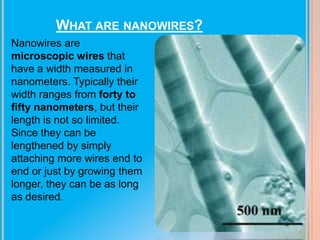
Nanowires are
microscopic wires that
have a width measured in
nanometers. Typically their
width ranges from forty to
fifty nanometers, but their
length is not so limited.
Since they can be
lengthened by simply
attaching more wires end to
end or just by growing them
longer, they can be as long
as desired.


Diameter of nanowires range from a single atom
to a few hundreds of nanometers.



Length varies from a few atoms to many microns



Different name of nanowires in literature:
 Whiskers, fibers: 1D structures ranging from
several nanometers to several hundred
microns
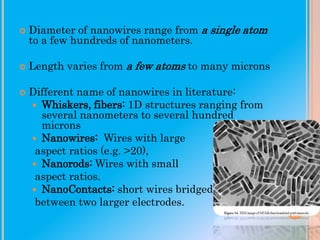
 Nanowires: Wires with large
aspect ratios (e.g. >20),
 Nanorods: Wires with small
aspect ratios.
 NanoContacts: short wires bridged
between two larger electrodes.
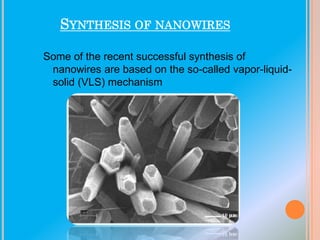
SYNTHESIS OF NANOWIRES
Some of the recent successful synthesis of
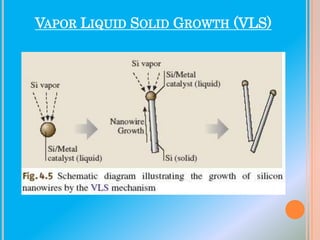
nanowires are based on the so-called vapor-liquidsolid (VLS) mechanism
VAPOR LIQUID SOLID GROWTH (VLS)

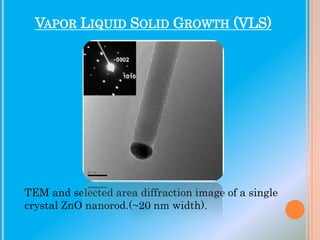
TEM and selected area diffraction image of a single
crystal ZnO nanorod.(~20 nm width).
PROPERTIES AND APPLICATION OF
NANOWIRES
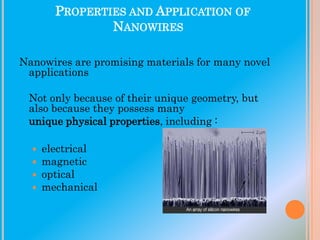
Nanowires are promising materials for many novel
applications
Not only because of their unique geometry, but
also because they possess many
unique physical properties, including :





electrical
magnetic
optical
mechanical
MAGNETIC PROPERTIES

•

Actually the magnetic properties of nanowires depend
on the wire diameter and aspect ratio

•

It is possible to control the magnetic properties of the
nanowires by controlling the fabrication parameters

•

Remanence ratio, which measures the remanence
magnetization after switching off the external magnetic
field

•

Coercivity, which is the coercive field required to
demagnetize the magnet after full magnetization.

•

Giant Magnetoresistance (GMR)
OPTICAL

PROPERTIES

•

Controlling the flow of optically encoded
information with nanometer-scale accuracy over
distances of many microns, which may find
applications in future high-density optical
computing.

•

Silicon nanowires coated with SiC show stable
photoluminescence at room temperature
STRIPED NANOWIRES
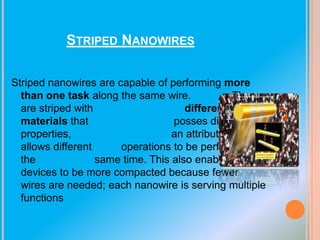
Striped nanowires are capable of performing more
than one task along the same wire.
They
are striped with
different
materials that
posses different
properties,
an attribute which
allows different
operations to be performed at
the
same time. This also enables
devices to be more compacted because fewer
wires are needed; each nanowire is serving multiple
functions
WHY ARE NANOWIRES NOT BEING
IMPLEMENTED?
Nanowires are not being heavily manufactured because they are
still in the development stage and are only produced in the
laboratory. Until production has been streamlined,
made easier and faster, they will not be heavily
manufactured for commercial purposes.

Furthermore, though they are 4 or 5 times more
effective than current technology, an industry-wide
technology overhaul is not cost effective at the moment
WHAT USES ARE NANOWIRES BEING
DEVELOPED FOR?
IBM has been doing research on forming U-shaped
nanowires to create a “racetrack memory”. This
method would allow IBM to create a memory
system with no moving parts and far greater
storage than flash memory. This U-shape is formed
with closely arranged nanowires, allowing fast
transmissions and increasing storage size without
adding to the overall size of the device.
 Nanowires are also being developed for prototype
sensors. These sensors will be used on gases and
biological molecules

WHAT GOOD ARE NANOWIRES?

Some uses of nanowires include:


Data storage/transfer



Batteries/generators



Transistors



LED’s



Optoelectronic devices



Biochemical sensors



Heat-pumping Thermoelectric devices
INVISIBLE STREETLIGHT
CONCLUSION

•
•
•


•

•
•

Challenges:
The insufficient control of the properties of individual
building blocks
Low device-to-device reproducibility
Lack of reliable methods for assembling and
integrating building blocks into circuits

Advances:
Synthesis of nanoscale building blocks with precisely
controlled chemical composition, physical
dimension, and electronic, optical properties
Some strategies for the assembly of building blocks
into increasingly complex structures
New nanodevice concepts that can be implemented in
high yield by assembly approaches
REFERENCE
Essentials of nanotechnology; Jeremy ramsdan
 Nanotubes& Nanowires; C N Ram Rao
 Nanotubes& Nanowires; Peter John Burke
 Wikipedia
 Nanowires: A Platform for Nanoscience&
Nanotechnology; Charles M. Lieber


nano wire

  • 1.
  • 2.
    INTRODUCTION   Nanoscale electronics couldhold the promise of powering future electronic devices that can outperform existing devices and open up totally new opportunities. It will require conceptually new device building blocks, scalable circuit architectures, and fundamentally different fabrication strategies.
  • 3.
    1D nanostructures representthe smallest dimension structure that can efficiently transport electrical carriers   1D nanostructures can also exhibit critical device function, and thus can be exploited as both the wiring and device elements in future architectures for functional nanosystems In this regard, two material classes: semiconductor nanowires (NWs) carbon nanotubes (NTs) have shown particular promise
  • 4.
    NTs have beenused to fabricate field effect transistors, diodes, and logic circuits. Problems with Nanotubes to made devices:  Difficulties to control whether building blocks are semiconducting or metallic  Difficulties in manipulating individual NTs So, to date, device fabrication by NT largely is a random event, thus pose a significant barrier to achieving highly integrated nanocircuits
  • 5.
    Advantages of Nanowires    NWdevices can be assembled in a rational and predictable because:  Nanowires can be precisely controlled during synthesis,  chemical composition,  diameter,  length,  doping/electronic properties It is possible to combine distinct NW building blocks in ways not possible in conventional electronics. NWs thus represent the best-defined class of nanoscale building blocks, and this precise control over key variables has correspondingly enabled a wide range of devices and integration strategies to be pursued
  • 6.
    WHAT ARE NANOWIRES? Nanowiresare microscopic wires that have a width measured in nanometers. Typically their width ranges from forty to fifty nanometers, but their length is not so limited. Since they can be lengthened by simply attaching more wires end to end or just by growing them longer, they can be as long as desired.
  • 7.
     Diameter of nanowiresrange from a single atom to a few hundreds of nanometers.  Length varies from a few atoms to many microns  Different name of nanowires in literature:  Whiskers, fibers: 1D structures ranging from several nanometers to several hundred microns  Nanowires: Wires with large aspect ratios (e.g. >20),  Nanorods: Wires with small aspect ratios.  NanoContacts: short wires bridged between two larger electrodes.
  • 8.
    SYNTHESIS OF NANOWIRES Someof the recent successful synthesis of nanowires are based on the so-called vapor-liquidsolid (VLS) mechanism
  • 9.
    VAPOR LIQUID SOLIDGROWTH (VLS)
  • 11.
    VAPOR LIQUID SOLIDGROWTH (VLS) TEM and selected area diffraction image of a single crystal ZnO nanorod.(~20 nm width).
  • 12.
    PROPERTIES AND APPLICATIONOF NANOWIRES Nanowires are promising materials for many novel applications Not only because of their unique geometry, but also because they possess many unique physical properties, including :     electrical magnetic optical mechanical
  • 13.
    MAGNETIC PROPERTIES • Actually themagnetic properties of nanowires depend on the wire diameter and aspect ratio • It is possible to control the magnetic properties of the nanowires by controlling the fabrication parameters • Remanence ratio, which measures the remanence magnetization after switching off the external magnetic field • Coercivity, which is the coercive field required to demagnetize the magnet after full magnetization. • Giant Magnetoresistance (GMR)
  • 14.
    OPTICAL PROPERTIES • Controlling the flowof optically encoded information with nanometer-scale accuracy over distances of many microns, which may find applications in future high-density optical computing. • Silicon nanowires coated with SiC show stable photoluminescence at room temperature
  • 15.
    STRIPED NANOWIRES Striped nanowiresare capable of performing more than one task along the same wire. They are striped with different materials that posses different properties, an attribute which allows different operations to be performed at the same time. This also enables devices to be more compacted because fewer wires are needed; each nanowire is serving multiple functions
  • 16.
    WHY ARE NANOWIRESNOT BEING IMPLEMENTED? Nanowires are not being heavily manufactured because they are still in the development stage and are only produced in the laboratory. Until production has been streamlined, made easier and faster, they will not be heavily manufactured for commercial purposes. Furthermore, though they are 4 or 5 times more effective than current technology, an industry-wide technology overhaul is not cost effective at the moment
  • 17.
    WHAT USES ARENANOWIRES BEING DEVELOPED FOR? IBM has been doing research on forming U-shaped nanowires to create a “racetrack memory”. This method would allow IBM to create a memory system with no moving parts and far greater storage than flash memory. This U-shape is formed with closely arranged nanowires, allowing fast transmissions and increasing storage size without adding to the overall size of the device.  Nanowires are also being developed for prototype sensors. These sensors will be used on gases and biological molecules 
  • 18.
    WHAT GOOD ARENANOWIRES? Some uses of nanowires include:  Data storage/transfer  Batteries/generators  Transistors  LED’s  Optoelectronic devices  Biochemical sensors  Heat-pumping Thermoelectric devices
  • 19.
  • 20.
  • 21.
    CONCLUSION  • • •  • • • Challenges: The insufficient controlof the properties of individual building blocks Low device-to-device reproducibility Lack of reliable methods for assembling and integrating building blocks into circuits Advances: Synthesis of nanoscale building blocks with precisely controlled chemical composition, physical dimension, and electronic, optical properties Some strategies for the assembly of building blocks into increasingly complex structures New nanodevice concepts that can be implemented in high yield by assembly approaches
  • 22.
    REFERENCE Essentials of nanotechnology;Jeremy ramsdan  Nanotubes& Nanowires; C N Ram Rao  Nanotubes& Nanowires; Peter John Burke  Wikipedia  Nanowires: A Platform for Nanoscience& Nanotechnology; Charles M. Lieber 