
By,
HRISHIKESH MOHAN
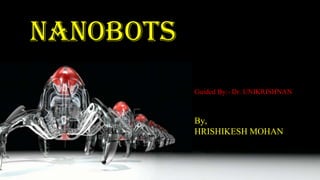
NANOBOTS
Guided By:- Dr. UNIKRISHNAN
1. FLOW OF PRESENTATION
Introduction
Design and construction
Mechanism
Applications
Advantages & disadvantages
Conclusion
References
1.
2.
3.
4.
5.
6.
7.
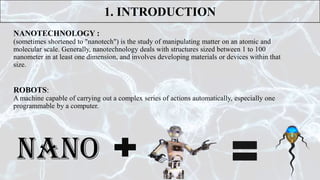
NANOTECHNOLOGY :
(sometimes shortened to "nanotech") is the study of manipulating matter on an atomic and
molecular scale. Generally, nanotechnology deals with structures sized between 1 to 100
nanometer in at least one dimension, and involves developing materials or devices within that
size.
ROBOTS:
A machine capable of carrying out a complex series of actions automatically, especially one
programmable by a computer.
1. INTRODUCTION
NANO
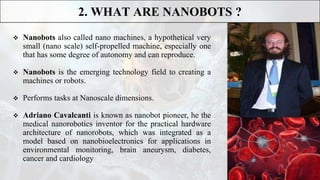
 Nanobots also called nano machines, a hypothetical very
small (nano scale) self-propelled machine, especially one
that has some degree of autonomy and can reproduce.
 Nanobots is the emerging technology field to creating a
machines or robots.
 Performs tasks at Nanoscale dimensions.
 Adriano Cavalcanti is known as nanobot pioneer, he the
medical nanorobotics inventor for the practical hardware
architecture of nanorobots, which was integrated as a
model based on nanobioelectronics for applications in
environmental monitoring, brain aneurysm, diabetes,
cancer and cardiology
2. WHAT ARE NANOBOTS ?
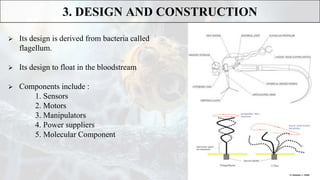
 Its design is derived from bacteria called
flagellum.
 Its design to float in the bloodstream
 Components include :
1. Sensors
2. Motors
3. Manipulators
4. Power suppliers
5. Molecular Component
3. DESIGN AND CONSTRUCTION
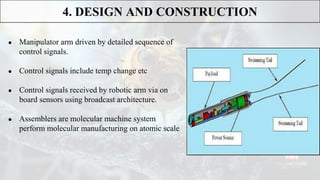
● Manipulator arm driven by detailed sequence of
control signals.
● Control signals include temp change etc
● Control signals received by robotic arm via on
board sensors using broadcast architecture.
● Assemblers are molecular machine system
perform molecular manufacturing on atomic scale
4. DESIGN AND CONSTRUCTION
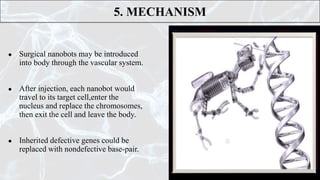
● Surgical nanobots may be introduced
into body through the vascular system.
● After injection, each nanobot would
travel to its target cell,enter the
nucleus and replace the chromosomes,
then exit the cell and leave the body.
● Inherited defective genes could be
replaced with nondefective base-pair.
5. MECHANISM
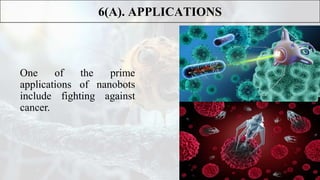
One of the prime
applications of nanobots
include fighting against
cancer.
6(A). APPLICATIONS
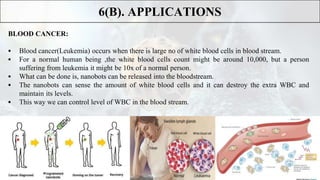
BLOOD CANCER:
 Blood cancer(Leukemia) occurs when there is large no of white blood cells in blood stream.
 For a normal human being ,the white blood cells count might be around 10,000, but a person
suffering from leukemia it might be 10x of a normal person.
 What can be done is, nanobots can be released into the bloodstream.
 The nanobots can sense the amount of white blood cells and it can destroy the extra WBC and
maintain its levels.
 This way we can control level of WBC in the blood stream.
6(B). APPLICATIONS
6(C). APPLICATION
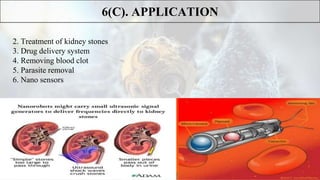
2. Treatment of kidney stones
3. Drug delivery system
4. Removing blood clot
5. Parasite removal
6. Nano sensors
7. NON MEDICAL APPLICATION
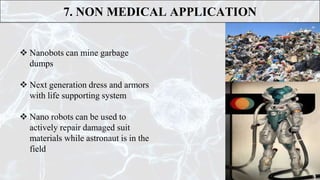
 Nanobots can mine garbage
dumps
 Next generation dress and armors
with life supporting system
 Nano robots can be used to
actively repair damaged suit
materials while astronaut is in the
field
● The microscopic size of nanomachines translates into high operational
speed.
● Individual units require only a tiny amount of energy to operate.
● Rapid elimination of disease.
● Nanites might last for centuries before breaking down.
● Speed up medical treatment.
● It might also produce copies of themselves to replace worn out.
8. ADVANTAGES
● May affect human health by introducing toxicity in blood.
● Replication may become out of control.
● The nanobots should be accurate, otherwise harmful effects may occur.
● Very costly for installation purpose.
● Complicatedmaintenance.
9. DISADVANTAGES
REFERENCE
• A.A.G. Requicha, "Nanorobots, NEMS, and nanoassembly", 10.1109/JPROC.2003.818333,IEEE Nov 2003
• Sylvain Martel, Mahmood Mohammadi, Ouajdi Felfoul, Zhao Lu, Pierre Pouponneau, "Flagellated
Magnetotactic Bacteria as Controlled MRI-trackable Propulsion and Steering Systems for Medical Nanorobots
Operating in the Human Microvasculature", Vol 28, Issue 4, 2009
• Samudra Sengupta, Dr. Micheal E. Ibele, Dr. Ayusman Sen, “Fantastic Voyage: Designing Self-Powered
Nanorobots”,09 August 2012 https:/doi.org/10.1002/anie.201202044
CITATION
• https://www.azonano.com/article.aspx?ArticleID=4679
• https://moneyinc.com/10-ways-nanobots-will-change-the-future/
• http://www.steveaoki.com/health/are-we-about-have-nanobots-in-brains/
• https://www.jverse.com/galleries/art-gallery/bad-ideas-101-super-fans-design-nanotech-from-plague-year/
• https://sites.google.com/site/fictiontoreality/nanobots-the-next-cure-for-cancer
• http://www.immortality.foundation/nanorobots
Any Questions!
Nanobots

Nanobots

  • 1.
  • 2.
    1. FLOW OFPRESENTATION Introduction Design and construction Mechanism Applications Advantages & disadvantages Conclusion References 1. 2. 3. 4. 5. 6. 7.
  • 3.
    NANOTECHNOLOGY : (sometimes shortenedto "nanotech") is the study of manipulating matter on an atomic and molecular scale. Generally, nanotechnology deals with structures sized between 1 to 100 nanometer in at least one dimension, and involves developing materials or devices within that size. ROBOTS: A machine capable of carrying out a complex series of actions automatically, especially one programmable by a computer. 1. INTRODUCTION NANO
  • 4.
     Nanobots alsocalled nano machines, a hypothetical very small (nano scale) self-propelled machine, especially one that has some degree of autonomy and can reproduce.  Nanobots is the emerging technology field to creating a machines or robots.  Performs tasks at Nanoscale dimensions.  Adriano Cavalcanti is known as nanobot pioneer, he the medical nanorobotics inventor for the practical hardware architecture of nanorobots, which was integrated as a model based on nanobioelectronics for applications in environmental monitoring, brain aneurysm, diabetes, cancer and cardiology 2. WHAT ARE NANOBOTS ?
  • 5.
     Its designis derived from bacteria called flagellum.  Its design to float in the bloodstream  Components include : 1. Sensors 2. Motors 3. Manipulators 4. Power suppliers 5. Molecular Component 3. DESIGN AND CONSTRUCTION
  • 6.
    ● Manipulator armdriven by detailed sequence of control signals. ● Control signals include temp change etc ● Control signals received by robotic arm via on board sensors using broadcast architecture. ● Assemblers are molecular machine system perform molecular manufacturing on atomic scale 4. DESIGN AND CONSTRUCTION
  • 7.
    ● Surgical nanobotsmay be introduced into body through the vascular system. ● After injection, each nanobot would travel to its target cell,enter the nucleus and replace the chromosomes, then exit the cell and leave the body. ● Inherited defective genes could be replaced with nondefective base-pair. 5. MECHANISM
  • 8.
    One of theprime applications of nanobots include fighting against cancer. 6(A). APPLICATIONS
  • 9.
    BLOOD CANCER:  Bloodcancer(Leukemia) occurs when there is large no of white blood cells in blood stream.  For a normal human being ,the white blood cells count might be around 10,000, but a person suffering from leukemia it might be 10x of a normal person.  What can be done is, nanobots can be released into the bloodstream.  The nanobots can sense the amount of white blood cells and it can destroy the extra WBC and maintain its levels.  This way we can control level of WBC in the blood stream. 6(B). APPLICATIONS
  • 10.
    6(C). APPLICATION 2. Treatmentof kidney stones 3. Drug delivery system 4. Removing blood clot 5. Parasite removal 6. Nano sensors
  • 11.
    7. NON MEDICALAPPLICATION  Nanobots can mine garbage dumps  Next generation dress and armors with life supporting system  Nano robots can be used to actively repair damaged suit materials while astronaut is in the field
  • 12.
    ● The microscopicsize of nanomachines translates into high operational speed. ● Individual units require only a tiny amount of energy to operate. ● Rapid elimination of disease. ● Nanites might last for centuries before breaking down. ● Speed up medical treatment. ● It might also produce copies of themselves to replace worn out. 8. ADVANTAGES
  • 13.
    ● May affecthuman health by introducing toxicity in blood. ● Replication may become out of control. ● The nanobots should be accurate, otherwise harmful effects may occur. ● Very costly for installation purpose. ● Complicatedmaintenance. 9. DISADVANTAGES
  • 14.
    REFERENCE • A.A.G. Requicha,"Nanorobots, NEMS, and nanoassembly", 10.1109/JPROC.2003.818333,IEEE Nov 2003 • Sylvain Martel, Mahmood Mohammadi, Ouajdi Felfoul, Zhao Lu, Pierre Pouponneau, "Flagellated Magnetotactic Bacteria as Controlled MRI-trackable Propulsion and Steering Systems for Medical Nanorobots Operating in the Human Microvasculature", Vol 28, Issue 4, 2009 • Samudra Sengupta, Dr. Micheal E. Ibele, Dr. Ayusman Sen, “Fantastic Voyage: Designing Self-Powered Nanorobots”,09 August 2012 https:/doi.org/10.1002/anie.201202044 CITATION • https://www.azonano.com/article.aspx?ArticleID=4679 • https://moneyinc.com/10-ways-nanobots-will-change-the-future/ • http://www.steveaoki.com/health/are-we-about-have-nanobots-in-brains/ • https://www.jverse.com/galleries/art-gallery/bad-ideas-101-super-fans-design-nanotech-from-plague-year/ • https://sites.google.com/site/fictiontoreality/nanobots-the-next-cure-for-cancer • http://www.immortality.foundation/nanorobots
  • 15.