NANOTECHNOLOGY
Topics of the day
•   Introduction
•   Defination
•   History
•   Timeline
•   Tools & techniques
    ▫ Carbon nanotubes
    ▫ Nanorods
    ▫ Nanobots
• Approaches used
    ▫ Top-down
    ▫ Bottom-up
• Materials used
• Application
    ▫   Drugs
    ▫   Fabrics
    ▫   Mobiles
    ▫   Electronics
    ▫   Computers
    ▫   Other uses
• Nanotechnology in INDIA
• Possiblities for future
• Pitfalls of nanotechnology.
NANO & TECHNOLOGY
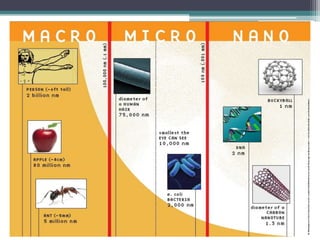
• A Nanometre is a unit of length in the metric
  system, equal to one billionth of a metre(10-9).

• Technology is the making, usage, and
  knowledge of tools, machines and techniques, in
  order to solve a problem or perform a specific
  function.
Defination
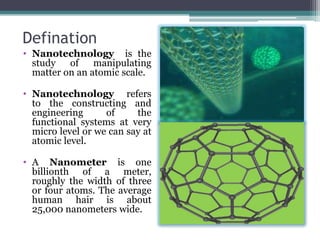
• Nanotechnology is the
  study of manipulating
  matter on an atomic scale.

• Nanotechnology refers
  to the constructing and
  engineering      of     the
  functional systems at very
  micro level or we can say at
  atomic level.

• A Nanometer is one
  billionth of a meter,
  roughly the width of three
  or four atoms. The average
  human hair is about
  25,000 nanometers wide.
History
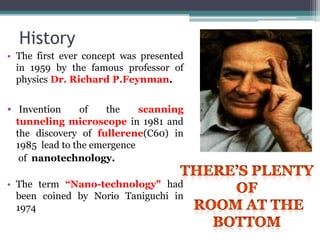
• The first ever concept was presented
  in 1959 by the famous professor of
  physics Dr. Richard P.Feynman.


• Invention     of   the    scanning
 tunneling microscope in 1981 and
 the discovery of fullerene(C60) in
 1985 lead to the emergence
  of nanotechnology.

• The term “Nano-technology" had
  been coined by Norio Taniguchi in
  1974
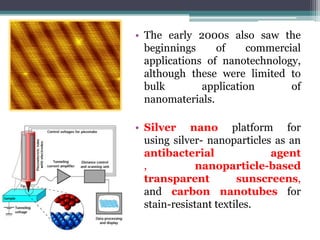
• The early 2000s also saw the
  beginnings     of    commercial
  applications of nanotechnology,
  although these were limited to
  bulk        application      of
  nanomaterials.

• Silver nano platform for
  using silver- nanoparticles as an
  antibacterial              agent
  ,          nanoparticle-based
  transparent          sunscreens,
  and carbon nanotubes for
  stain-resistant textiles.
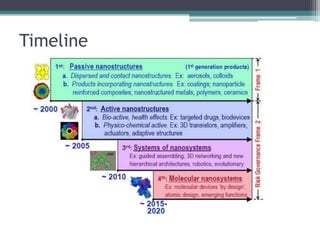
Timeline
Tools & Technology
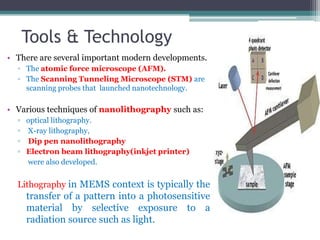
• There are several important modern developments.
  ▫ The atomic force microscope (AFM).
  ▫ The Scanning Tunneling Microscope (STM) are
    scanning probes that launched nanotechnology.

• Various techniques of nanolithography such as:
  ▫ optical lithography.
  ▫ X-ray lithography,
  ▫ Dip pen nanolithography
  ▫ Electron beam lithography(inkjet printer)
    were also developed.


  Lithography in MEMS context is typically the
    transfer of a pattern into a photosensitive
    material by selective exposure to a
    radiation source such as light.
Carbon Nanotube
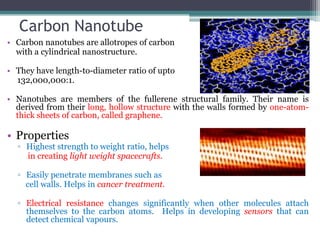
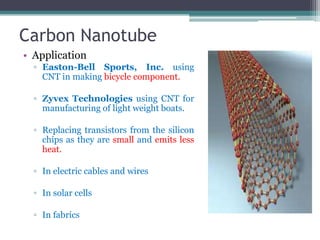
• Carbon nanotubes are allotropes of carbon
  with a cylindrical nanostructure.

• They have length-to-diameter ratio of upto
  132,000,000:1.

• Nanotubes are members of the fullerene structural family. Their name is
  derived from their long, hollow structure with the walls formed by one-atom-
  thick sheets of carbon, called graphene.

• Properties
  ▫ Highest strength to weight ratio, helps
    in creating light weight spacecrafts.

  ▫ Easily penetrate membranes such as
    cell walls. Helps in cancer treatment.

  ▫ Electrical resistance changes significantly when other molecules attach
    themselves to the carbon atoms. Helps in developing sensors that can
    detect chemical vapours.
Carbon Nanotube
• Application
  ▫ Easton-Bell Sports, Inc. using
    CNT in making bicycle component.

  ▫ Zyvex Technologies using CNT for
    manufacturing of light weight boats.

  ▫ Replacing transistors from the silicon
    chips as they are small and emits less
    heat.

  ▫ In electric cables and wires

  ▫ In solar cells

  ▫ In fabrics
Nanorods(quantum dots)
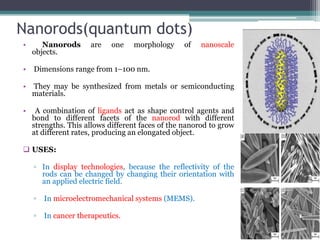
•      Nanorods       are   one   morphology     of   nanoscale
    objects.

•   Dimensions range from 1–100 nm.

•   They may be synthesized from metals or semiconducting
    materials.

•    A combination of ligands act as shape control agents and
    bond to different facets of the nanorod with different
    strengths. This allows different faces of the nanorod to grow
    at different rates, producing an elongated object.

 USES:

    ▫ In display technologies, because the reflectivity of the
      rods can be changed by changing their orientation with
      an applied electric field.

    ▫   In microelectromechanical systems (MEMS).

    ▫   In cancer therapeutics.
Nanobots
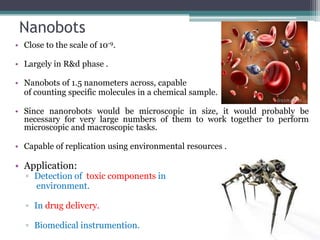
• Close to the scale of 10-9.

• Largely in R&d phase .

• Nanobots of 1.5 nanometers across, capable
  of counting specific molecules in a chemical sample.

• Since nanorobots would be microscopic in size, it would probably be
  necessary for very large numbers of them to work together to perform
  microscopic and macroscopic tasks.

• Capable of replication using environmental resources .

• Application:
   ▫ Detection of toxic components in
     environment.

   ▫ In drug delivery.

   ▫ Biomedical instrumention.
Approaches in nanotechnology
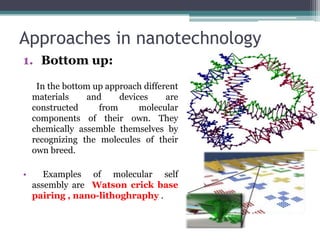
1. Bottom up:
     In the bottom up approach different
    materials     and     devices    are
    constructed      from      molecular
    components of their own. They
    chemically assemble themselves by
    recognizing the molecules of their
    own breed.

•      Examples of molecular self
    assembly are Watson crick base
    pairing , nano-lithoghraphy .
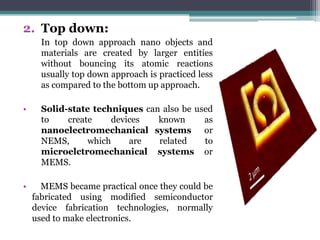
2. Top down:
      In top down approach nano objects and
      materials are created by larger entities
      without bouncing its atomic reactions
      usually top down approach is practiced less
      as compared to the bottom up approach.

•     Solid-state techniques can also be used
      to    create     devices  known      as
      nanoelectromechanical systems or
      NEMS,      which     are  related    to
      microelctromechanical systems or
      MEMS.

•     MEMS became practical once they could be
    fabricated using modified semiconductor
    device fabrication technologies, normally
    used to make electronics.
Materials used
• Zinc oxide:
  ▫ Dirt repellent, hydrophobic , cosmetics & stain
    resistant.

• Silver ion:
  ▫ Healing property

• Aluminum silicate:
  ▫ Scratch resistance

• Gold ion:
  ▫ Chip fabrication, drug delivery.
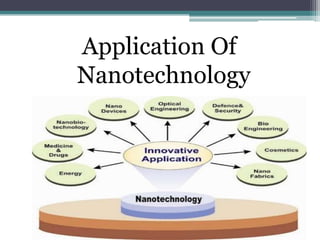
Application Of
Nanotechnology
Nanotechnology in Drugs(Cancer)
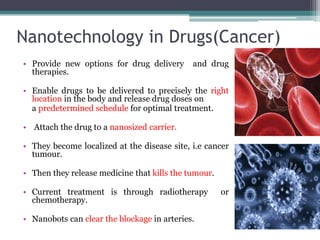
• Provide new options for drug delivery      and drug
  therapies.

• Enable drugs to be delivered to precisely the right
  location in the body and release drug doses on
  a predetermined schedule for optimal treatment.

• Attach the drug to a nanosized carrier.

• They become localized at the disease site, i.e cancer
  tumour.

• Then they release medicine that kills the tumour.

• Current treatment is through radiotherapy           or
  chemotherapy.

• Nanobots can clear the blockage in arteries.
Nanotechnology in Fabrics
• The properties of familiar materials are
  being changed by manufacturers who are
  adding   nano-sized    components     to
  conventional materials to improve
  performance.

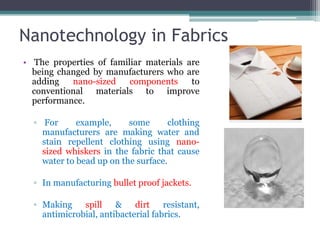
  ▫ For      example,     some      clothing
    manufacturers are making water and
    stain repellent clothing using nano-
    sized whiskers in the fabric that cause
    water to bead up on the surface.

  ▫ In manufacturing bullet proof jackets.

  ▫ Making spill       & dirt       resistant,
    antimicrobial, antibacterial fabrics.
Nanotechnology in Mobile
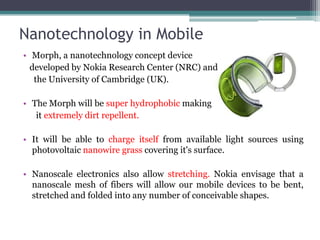
• Morph, a nanotechnology concept device
  developed by Nokia Research Center (NRC) and
   the University of Cambridge (UK).

• The Morph will be super hydrophobic making
   it extremely dirt repellent.

• It will be able to charge itself from available light sources using
  photovoltaic nanowire grass covering it's surface.

• Nanoscale electronics also allow stretching. Nokia envisage that a
  nanoscale mesh of fibers will allow our mobile devices to be bent,
  stretched and folded into any number of conceivable shapes.
Nanotechnology in Electronics
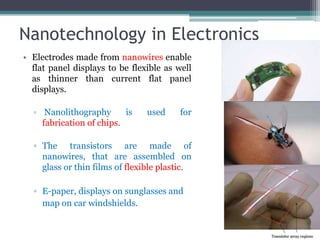
• Electrodes made from nanowires enable
  flat panel displays to be flexible as well
  as thinner than current flat panel
  displays.

  ▫ Nanolithography          is   used   for
     fabrication of chips.

  ▫ The transistors are made of
    nanowires, that are assembled on
    glass or thin films of flexible plastic.

  ▫ E-paper, displays on sunglasses and
    map on car windshields.
Nanotechnology in computers
• The silicon transistors in your computer may be
  replaced by transistors based on carbon nanotubes.

• A carbon nanotube is a molecule in form of a hollow
  cylinder with a diameter of around a nanometer
  which consists of pure carbon.

• Nanorods is a upcoming technology in the displays
  techniques due to less consumption of electricity and
  less heat emission.

• Size of the microprocessors are reduced to greater
  extend.

• Researchers at North Carolina State University says
  that growing arrays of magnetic nanoparticles, called
  nanodots.
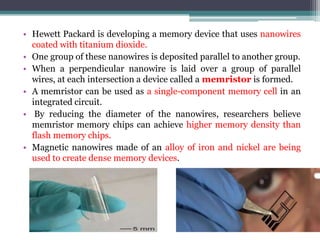
• Hewett Packard is developing a memory device that uses nanowires
  coated with titanium dioxide.
• One group of these nanowires is deposited parallel to another group.
• When a perpendicular nanowire is laid over a group of parallel
  wires, at each intersection a device called a memristor is formed.
• A memristor can be used as a single-component memory cell in an
  integrated circuit.
• By reducing the diameter of the nanowires, researchers believe
  memristor memory chips can achieve higher memory density than
  flash memory chips.
• Magnetic nanowires made of an alloy of iron and nickel are being
  used to create dense memory devices.
• Chips produced by Intel before “i” series processors were between
  65nm -45nm.
• Later with the help of nanotechnolgy 22nm chips were made which
  itself is a milestone.

• Advantages of using carbon nanotubes:

  ▫ Faster and smaller- carbon nanotubes can be used to produce
    smaller and faster components.

  ▫ This will also result in computers that consume less energy.

  ▫ High speed and high capacity memory.

  ▫ Allows circuits to be more accurate on the atomic level.
Other uses
 • Cutting tools made of nanocrystalline materials, such as tungsten
   carbide, tantalum carbide and titanium carbide, are more wear and
   erosion-resistant, and last longer than their conventional
   counterparts.

 • Silver nanocrystals have been embedded in bandages to kill bacteria
   and prevent infection.

 • Nanoparticulate-based synthetic bone
   ▫ Formed by manipulating calcium and phosphate at the molecular level.

 • Aerogels lightest known solid due to good insulating properties is
   used in space suits and are proposed to use in space craft.
Nanotechnology in India
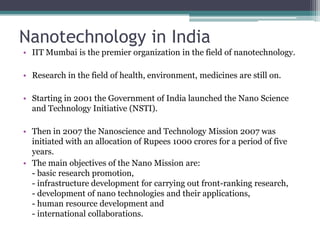
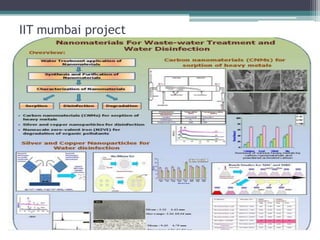
• IIT Mumbai is the premier organization in the field of nanotechnology.

• Research in the field of health, environment, medicines are still on.

• Starting in 2001 the Government of India launched the Nano Science
  and Technology Initiative (NSTI).

• Then in 2007 the Nanoscience and Technology Mission 2007 was
  initiated with an allocation of Rupees 1000 crores for a period of five
  years.
• The main objectives of the Nano Mission are:
  - basic research promotion,
  - infrastructure development for carrying out front-ranking research,
  - development of nano technologies and their applications,
  - human resource development and
  - international collaborations.
IIT mumbai project
Possibilities for the future
• Nanotechnology may make it possible to manufacture lighter,
  stronger, and programmable materials that
  ▫ require less energy to produce than conventional material

  ▫ and that promise greater fuel efficiency in land transportation,
    ships, aircraft, and space vehicles.

• The future of nanotechnology could very well include the use of
  nanorobotics.

• These nanorobots have the potential to take on human tasks as well
  as tasks that humans could never complete. The rebuilding of the
  depleted ozone layer could potentially be able to be performed.
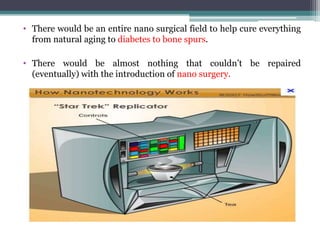
• There would be an entire nano surgical field to help cure everything
  from natural aging to diabetes to bone spurs.

• There would be almost nothing that couldn’t be repaired
  (eventually) with the introduction of nano surgery.
Pitfalls of nanotechnology
 ▫ Nano-particles can get into the body through the skin, lungs and
   digestive system, thus creating free radicals that can cause cell
   damage.
 ▫ Once nano-particles are in the bloodstream, they will be able to
   cross the blood-brain barrier.

 ▫ The most dangerous Nano-application use for military purposes is
   the Nano-bomb that contain engineered self multiplying deadly
   viruses that can continue to wipe out a community, country or even
   a civilization.

 ▫ Nanobots because of their replicating behavior can be big threat
   for GRAY GOO.
Bottom Line


    "The Next Big Thing Is Really Small”
References
1.   http://science.howstuffworks.com/nanotechnology3.htm
2.   http://en.wikipedia.org/wiki/Carbon_nanotube
3.   http://en.wikipedia.org/wiki/Nanotechnology
4.   http://crnano.org/whatis.htm
5.   http://www.wifinotes.com/nanotechnology/introduction-to-
     nanotechnology.html
6.   www.iitb.ac.in/~crnts/
7.   www.nafenindia.com/Final_Report_Nano_OK.pd
8.   www.sciencedaily.com/releases/2010/05/100531082857.ht
     m
9.   http://www.nanostart.de/index.php/en/nanotechnology/nan
     otechnology-information/610-schneller-sparsamer-robuster-
     nanotechnologie-in-computer-handy-a-co
Thank You
Nanotechnology ppt

Editor's Notes

  • #22 A nanowire is a nanostructure, with the diameter of the order of a nanometer (10−9 meters).