 INTRODUCTION
 NANOROBOTICS
 WHAT ARE NANO ROBOTS?
 STRUCTURE OF NANO ROBOTS
 NANO ROBOT COMPONENTS
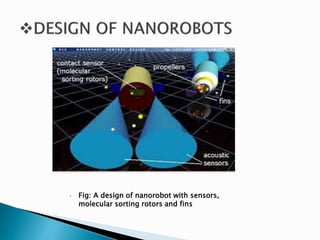
 DESIGN OF NANO ROBOTS
 APPLICATIONS
 CONCLUSION
• ROBOTICS:
• Robotics is the branch of technology that deals with the
design, construction and operations of robot, as well as
computer systems for their control, sensory feedback and
information processing.
• This technology deals with the automated machines that can
take place of humans in hazardous or manufacturing process.
• Today robotics is rapidly growing field , as we continue to
research design and build new robots that serve various
practical purposes.
• It is the emerging technology fields creating machines, robots
whose components are at or close to the scale of nanometers.
• Nanorobotics refers to the nanotechnology engineering
discipline of designing and building nanorobots with devices
ranging in size from 0.1-10 micrometers and constructed of
nanoscale or molecular components.
• The names nanobots, nanoids, nanites or nanomites have also
been used to describe these devices currently under research and
development.
• Nano robots are the result of combination of two
technologies: robotics and nanotechnology. It is a tiny
machine which is designed to perform specific task or tasks
repeatedly and with precision at nanoscale dimensions.
• Nano robot is any active structure which is capable of either
one or a combination of two or more of the following:
actuation, sensing, manipulation, propulsion, signalling and
information processing at the nano scale.
• Nano robots can function at the atomic or molecular level to
build devices, machines or circuits , a process known as
molecular manufacturing. Moreover they can produce copies
of themselves to replace worn out units, a process called self
replication.
• Nanorobots are of special interest to the researchers in the
medical industry, which finally lead to the development of
field of Nano medicine.
• It has been suggested that a fleet of nanorobots might serve as
antibodies or antiviral agents in patients with compromised
immune systems or in the diseases that do not respond to
more conventional measures.
• They have potential applications in the assembly and
maintenance of sophisticated systems
• There are numerous other potential medical applications which
includes unblocking of arteries affected by plaques, repair of
damaged tissue and perhaps the construction of complete
replacement of body organs.
• A major advantage of nanorobots is thought to be their
durability. In theory, they can remain operational for years or
decades. These systems can also operate much faster than
their larger counterparts because displacements are smaller;
this allows mechanical and electrical events to occur in less
time at a given speed.
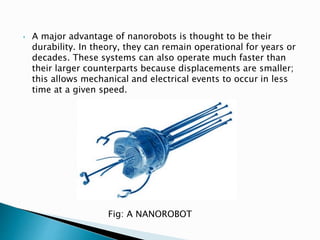
Fig: A NANOROBOT
 In order to explore the possibilities of molecular
manufacturing it is necessary that first the nano components
be created, analyzed and tested.
 In 2007, a design for these components using carbon
nanotubes was proposed.
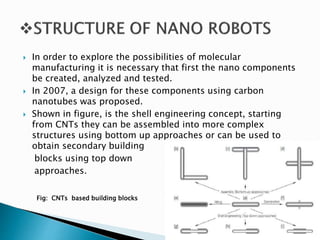
 Shown in figure, is the shell engineering concept, starting
from CNTs they can be assembled into more complex
structures using bottom up approaches or can be used to
obtain secondary building
blocks using top down
approaches.
Fig: CNTs based building blocks
 Nanobearings :
• Nanobearings are the most convenient classes of
components to design because of their straightforward
structure and operation.
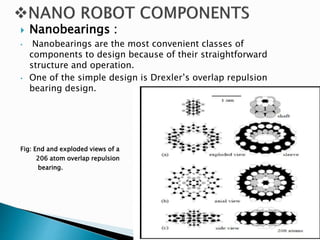
• One of the simple design is Drexler’s overlap repulsion
bearing design.
Fig: End and exploded views of a
206 atom overlap repulsion
bearing.
• This bearing is composed of a small shaft that rotates within
a ring sleeve of 2.2 nm in diameter, has 206 atoms of carbon,
silicon, oxygen and hydrogen.
 Nanogears:
• Nanogears are another convenient component system for
molecular manufacturing design.
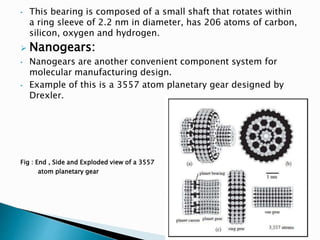
• Example of this is a 3557 atom planetary gear designed by
Drexler.
Fig : End , Side and Exploded view of a 3557
atom planetary gear
• This entire assembly has 12 moving parts and is 4.3 nm in
diameter and 4.4 nm in length.
• The central shaft rotates rapidly and the peripheral output
shaft rotates slowly.
• The small planetary gears, rotating around the central shaft,
are surrounded by a ring gear that holds the planets in place
and ensures that all components move in proper fashion.
 Nanocomputers :
• A nanorobot, before taking any action, must collect, analyze
and if required transmit the data. This it must do so to ensure
proper control and monitoring and prevent unwanted
damages.
• Thus a computer is required for data storage.
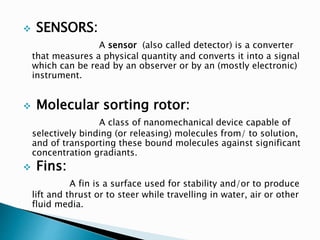
• Fig: A design of nanorobot with sensors,
molecular sorting rotors and fins
 SENSORS:
A sensor (also called detector) is a converter
that measures a physical quantity and converts it into a signal
which can be read by an observer or by an (mostly electronic)
instrument.
 Molecular sorting rotor:
A class of nanomechanical device capable of
selectively binding (or releasing) molecules from/ to solution,
and of transporting these bound molecules against significant
concentration gradiants.
 Fins:
A fin is a surface used for stability and/or to produce
lift and thrust or to steer while travelling in water, air or other
fluid media.
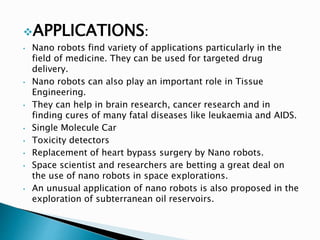
APPLICATIONS:
• Nano robots find variety of applications particularly in the
field of medicine. They can be used for targeted drug
delivery.
• Nano robots can also play an important role in Tissue
Engineering.
• They can help in brain research, cancer research and in
finding cures of many fatal diseases like leukaemia and AIDS.
• Single Molecule Car
• Toxicity detectors
• Replacement of heart bypass surgery by Nano robots.
• Space scientist and researchers are betting a great deal on
the use of nano robots in space explorations.
• An unusual application of nano robots is also proposed in the
exploration of subterranean oil reservoirs.
 The most challenging task to create a nano robot is to be able to
create a whole set of specialized machine tools in order to speed
up the process of nano robot building.
 According to the researchers, nano robot is an efficient machine
suitably shaped for the introduction into human blood vessels.
 It is also anticipated that most of the applications of nano robots
would be in medical field as it can interact with materials on
molecular and atomic level.
 Although the nano robot production is still at a nascent stage,
scientists are working hard to develop these tiny systems and
hopefully come up with functional autonomous nano robots
sometime in the next two decades.
 www.wisegeek.com/what-are-nanorobots.htm
 www.crossbowtechnology.com
 Nanorobots: Current State and Future Perspectives
International Journal of Research Development
 www.nanogloss.com/nanobots/how-nanorobots-are-
made/#axzz3muymVRKe
 www.ijbps.net
 Drexler KE, The Coming Era of Nanotechnology, Engines of
Creation , Anchor Press, New York, 1986 updated in 2007
Nanorobotics

Nanorobotics

  • 2.
     INTRODUCTION  NANOROBOTICS WHAT ARE NANO ROBOTS?  STRUCTURE OF NANO ROBOTS  NANO ROBOT COMPONENTS  DESIGN OF NANO ROBOTS  APPLICATIONS  CONCLUSION
  • 3.
    • ROBOTICS: • Roboticsis the branch of technology that deals with the design, construction and operations of robot, as well as computer systems for their control, sensory feedback and information processing. • This technology deals with the automated machines that can take place of humans in hazardous or manufacturing process. • Today robotics is rapidly growing field , as we continue to research design and build new robots that serve various practical purposes.
  • 4.
    • It isthe emerging technology fields creating machines, robots whose components are at or close to the scale of nanometers. • Nanorobotics refers to the nanotechnology engineering discipline of designing and building nanorobots with devices ranging in size from 0.1-10 micrometers and constructed of nanoscale or molecular components. • The names nanobots, nanoids, nanites or nanomites have also been used to describe these devices currently under research and development.
  • 5.
    • Nano robotsare the result of combination of two technologies: robotics and nanotechnology. It is a tiny machine which is designed to perform specific task or tasks repeatedly and with precision at nanoscale dimensions. • Nano robot is any active structure which is capable of either one or a combination of two or more of the following: actuation, sensing, manipulation, propulsion, signalling and information processing at the nano scale. • Nano robots can function at the atomic or molecular level to build devices, machines or circuits , a process known as molecular manufacturing. Moreover they can produce copies of themselves to replace worn out units, a process called self replication.
  • 6.
    • Nanorobots areof special interest to the researchers in the medical industry, which finally lead to the development of field of Nano medicine. • It has been suggested that a fleet of nanorobots might serve as antibodies or antiviral agents in patients with compromised immune systems or in the diseases that do not respond to more conventional measures. • They have potential applications in the assembly and maintenance of sophisticated systems • There are numerous other potential medical applications which includes unblocking of arteries affected by plaques, repair of damaged tissue and perhaps the construction of complete replacement of body organs.
  • 7.
    • A majoradvantage of nanorobots is thought to be their durability. In theory, they can remain operational for years or decades. These systems can also operate much faster than their larger counterparts because displacements are smaller; this allows mechanical and electrical events to occur in less time at a given speed. Fig: A NANOROBOT
  • 8.
     In orderto explore the possibilities of molecular manufacturing it is necessary that first the nano components be created, analyzed and tested.  In 2007, a design for these components using carbon nanotubes was proposed.  Shown in figure, is the shell engineering concept, starting from CNTs they can be assembled into more complex structures using bottom up approaches or can be used to obtain secondary building blocks using top down approaches. Fig: CNTs based building blocks
  • 9.
     Nanobearings : •Nanobearings are the most convenient classes of components to design because of their straightforward structure and operation. • One of the simple design is Drexler’s overlap repulsion bearing design. Fig: End and exploded views of a 206 atom overlap repulsion bearing.
  • 10.
    • This bearingis composed of a small shaft that rotates within a ring sleeve of 2.2 nm in diameter, has 206 atoms of carbon, silicon, oxygen and hydrogen.  Nanogears: • Nanogears are another convenient component system for molecular manufacturing design. • Example of this is a 3557 atom planetary gear designed by Drexler. Fig : End , Side and Exploded view of a 3557 atom planetary gear
  • 11.
    • This entireassembly has 12 moving parts and is 4.3 nm in diameter and 4.4 nm in length. • The central shaft rotates rapidly and the peripheral output shaft rotates slowly. • The small planetary gears, rotating around the central shaft, are surrounded by a ring gear that holds the planets in place and ensures that all components move in proper fashion.  Nanocomputers : • A nanorobot, before taking any action, must collect, analyze and if required transmit the data. This it must do so to ensure proper control and monitoring and prevent unwanted damages. • Thus a computer is required for data storage.
  • 12.
    • Fig: Adesign of nanorobot with sensors, molecular sorting rotors and fins
  • 13.
     SENSORS: A sensor(also called detector) is a converter that measures a physical quantity and converts it into a signal which can be read by an observer or by an (mostly electronic) instrument.  Molecular sorting rotor: A class of nanomechanical device capable of selectively binding (or releasing) molecules from/ to solution, and of transporting these bound molecules against significant concentration gradiants.  Fins: A fin is a surface used for stability and/or to produce lift and thrust or to steer while travelling in water, air or other fluid media.
  • 14.
    APPLICATIONS: • Nano robotsfind variety of applications particularly in the field of medicine. They can be used for targeted drug delivery. • Nano robots can also play an important role in Tissue Engineering. • They can help in brain research, cancer research and in finding cures of many fatal diseases like leukaemia and AIDS. • Single Molecule Car • Toxicity detectors • Replacement of heart bypass surgery by Nano robots. • Space scientist and researchers are betting a great deal on the use of nano robots in space explorations. • An unusual application of nano robots is also proposed in the exploration of subterranean oil reservoirs.
  • 15.
     The mostchallenging task to create a nano robot is to be able to create a whole set of specialized machine tools in order to speed up the process of nano robot building.  According to the researchers, nano robot is an efficient machine suitably shaped for the introduction into human blood vessels.  It is also anticipated that most of the applications of nano robots would be in medical field as it can interact with materials on molecular and atomic level.  Although the nano robot production is still at a nascent stage, scientists are working hard to develop these tiny systems and hopefully come up with functional autonomous nano robots sometime in the next two decades.
  • 16.
     www.wisegeek.com/what-are-nanorobots.htm  www.crossbowtechnology.com Nanorobots: Current State and Future Perspectives International Journal of Research Development  www.nanogloss.com/nanobots/how-nanorobots-are- made/#axzz3muymVRKe  www.ijbps.net  Drexler KE, The Coming Era of Nanotechnology, Engines of Creation , Anchor Press, New York, 1986 updated in 2007