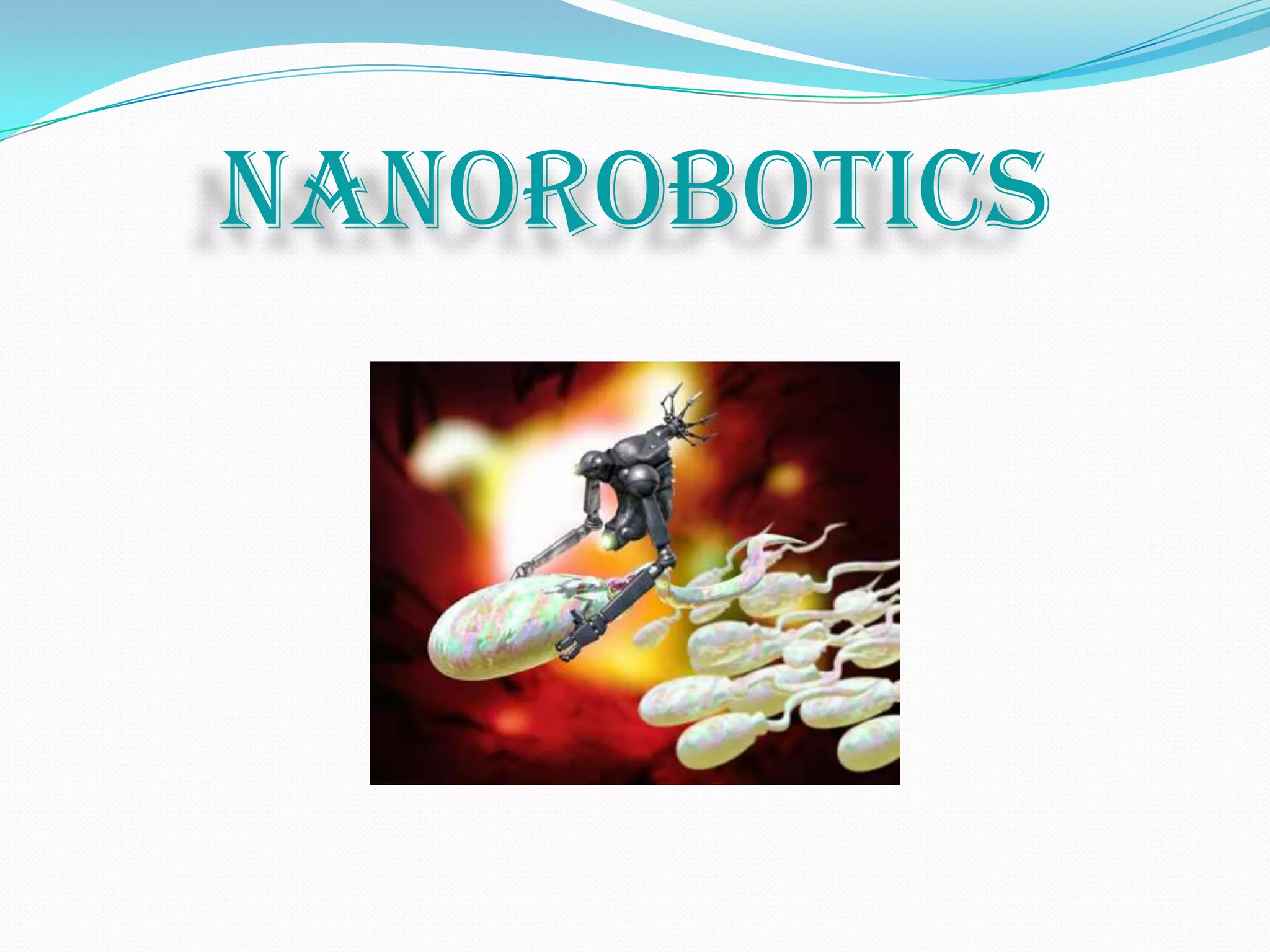
NANOROBOTICS
CONTENTS:
 Introduction to Robots
 Robotics
 Nanotechnology
 Nanorobotics

 Nanorobots
 Types of making Nanorobots
 Applications

 Replacement of heart bypass surgery by Nanorobots
ROBOTS:
 It is a mechanical or virtual artificial agent usually an

electromechanical machine that is guided by computer
program or electronic circuitry.
 Examples: ASIMO , TOPIO, Nanorobots, Swarm robots
and Industrial robots.
 Types:
1. Mobile robots
2. Rolling robots
3. Walking robots
4.Stationary robots
5. Autonomous robots 6. Beam robots
7. Virtual robots
8. Remote control robots
ROBOTICS:
 It deals with design, construction, operation and

application of robots and computer systems for their
control, sensory feedback and information processing.
 These technologies deal with automated machines that can
take place of humans in hazardous or manufacturing
processes.
 Today, robotics is rapidly growing field, as we continue to
research, design, and build new robots that serve various
practical purpose.
NANOTECHNOLOGY:
 It is the manipulation of matter on an atomic and

molecular scale.
 It works with materials, devices and other structures
with at least one dimension sized from 1 to 100
nanometers.
 With a variety of potential applications,
nanotechnology is a key technology for the future.
NANOROBOTICS:
 It is the emerging technology field creating machines or

robots whose components are at or close to the scale of a
nanometer (10-9 meters).
 Nanorobotics refers to the nanotechnology engineering
discipline of designing and building nanorobots, with
devices ranging in size from 0.1–10 micrometers and
constructed of nanoscale or molecular components.
 Other names: nanobots, nanoids, nanites, nano-machines ,
nanomites
NANOROBOTS:
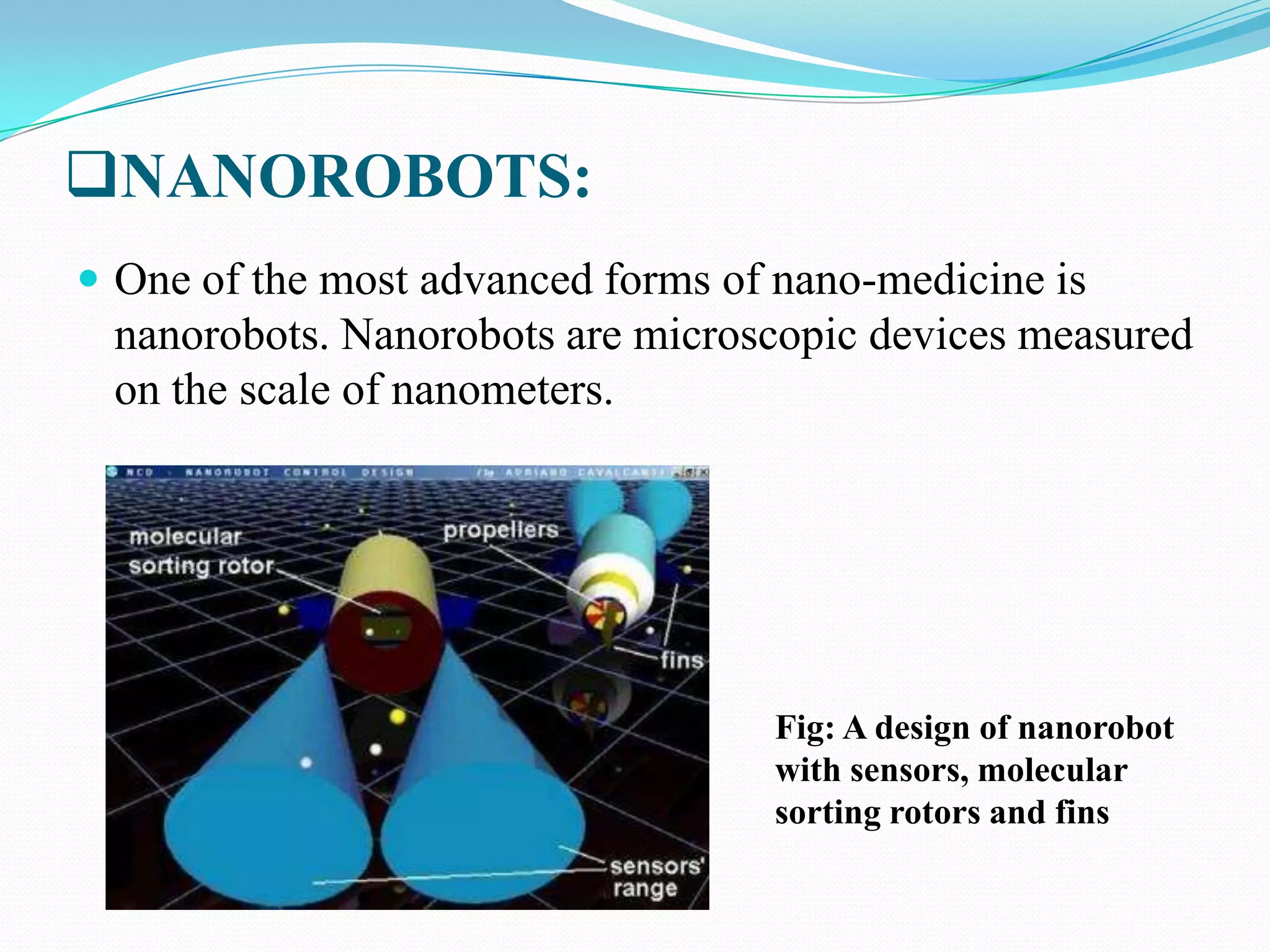
 One of the most advanced forms of nano-medicine is

nanorobots. Nanorobots are microscopic devices measured
on the scale of nanometers.

Fig: A design of nanorobot
with sensors, molecular
sorting rotors and fins
 SENSORS:
A sensor (also called detector) is a converter that measures
a physical quantity and converts it into a signal which can be read
by an observer or by an (mostly electronic) instrument.

 Molecular sorting rotor:
A class of nanomechanical device capable of selectively binding
(or releasing) molecules from/ to solution, and of transporting
these bound molecules against significant concentration gradients.

Fins:
A fin is a surface used for stability and/or to produce lift and
thrust or to steer while traveling in water, air, or other fluid media.
TYPES OF MAKING NANOROBOTS:
 1. Nubots
 2. Bacteria based

1. Nubots:
 The first approach is through nubots. Nubot is an abbreviation
for „nucleic acid robots.‟ Nubots are organic molecular
machines at the nanoscale. DNA structure can provide means
to assemble 2D and 3D nanomechanical devices.
2. Bacteria based:
 This approach proposes the use of biological microorganisms,
like the bacterium E- coli. Thus the model uses a flagellum for
propulsion purposes. The uses of electromagnetic fields are
normally applied to control the motion of this kind of
biological integrated device.
APPLICATIONS:
 Atomic force microscope

 Nano macro/microscale robots
 Nanomachines
 Toxicity detectors

 Single molecule car
 Nubots
 Medicine
 Dentistry
 Diagnosis and treatment of Diabetes
INTRODUCTION TO HEART BYPASS SURGERY:
• It reroutes the blood supply around clogged arteries to improve

blood flow and oxygen to the heart.
• It involves an incision in the middle of the chest and separation
of the breastbone and detouring ,the breastbone is joined using
wire and the incision sewed.
 Side effects of normal heart bypass surgery:
1.loss of appetite, constipation
2.swelling in the area from which the segment of blood vessel
was removed
3.fatigue,mood swings, feelings of depression, difficulty
sleeping
4.muscle pain or tightness in the shoulders and upper back
PROPERTIES OF NANOROBOT USED:
 It has 2 spaces-interior and exterior

 An electric motor is attached for it‟s propagation inside






the circulatory system in the blood vessels
The microprocessor, artery thermometer, camera, rotating
needle are incorporated
The microprocessor based control unit is used to control
the overall operations of nanorobot
Radioactive material is used as a part of exterior surface,
which helps to nanorobot at any period of time
Magnetic switch is used to provide to switch on and off
nanorobot at any point of time
Introduction of nanorobot into human
body:
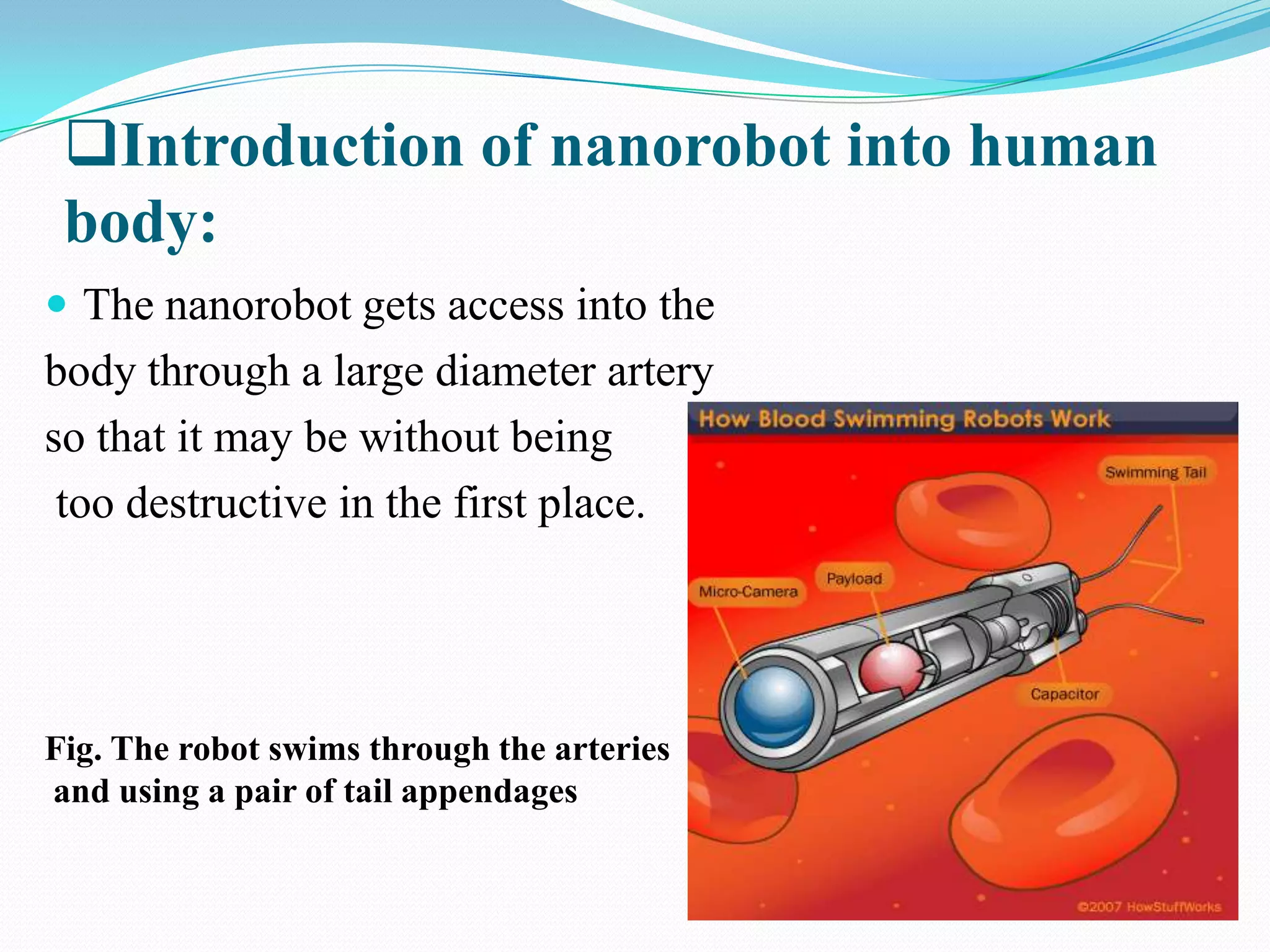
 The nanorobot gets access into the

body through a large diameter artery
so that it may be without being
too destructive in the first place.

Fig. The robot swims through the arteries
and using a pair of tail appendages
Driving of nanorobot to the site of plaque:
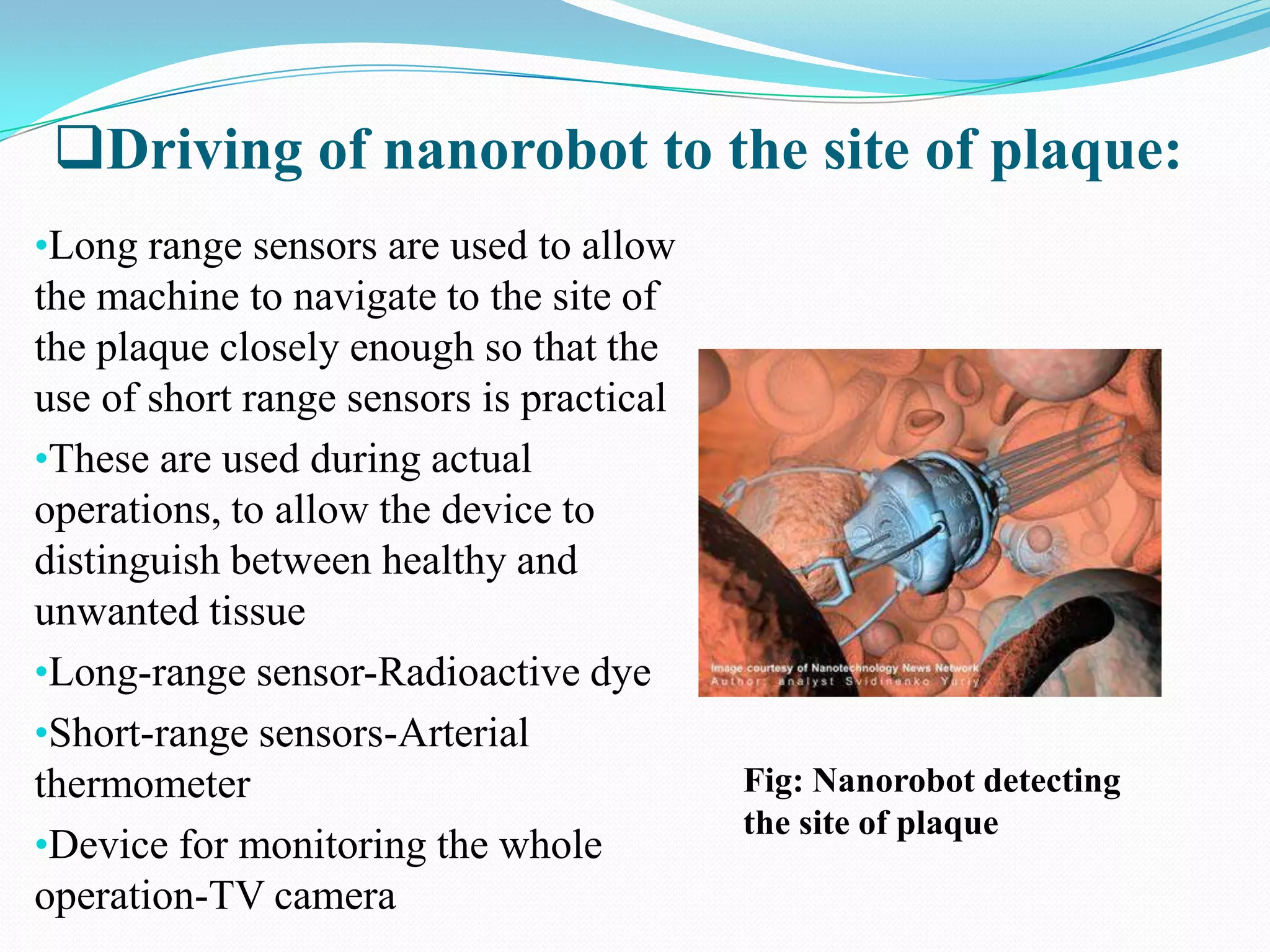
•Long range sensors are used to allow

the machine to navigate to the site of
the plaque closely enough so that the
use of short range sensors is practical
•These are used during actual
operations, to allow the device to
distinguish between healthy and
unwanted tissue
•Long-range sensor-Radioactive dye
•Short-range sensors-Arterial
thermometer
•Device for monitoring the whole
operation-TV camera

Fig: Nanorobot detecting
the site of plaque
Source of power and means of recovery:
• The nuclear power is carried onboard to supply required

amount of energy for the operation of the device
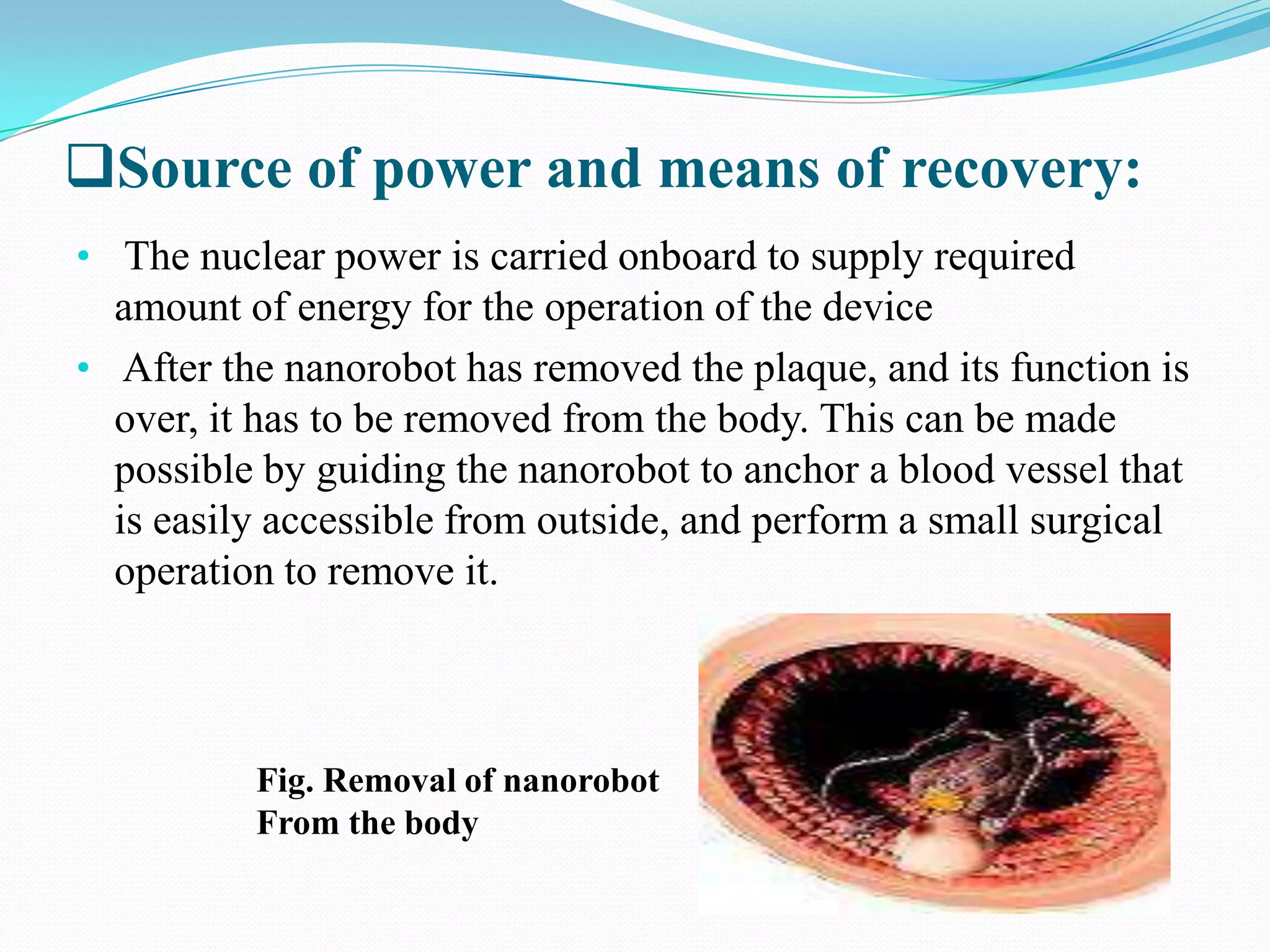
• After the nanorobot has removed the plaque, and its function is
over, it has to be removed from the body. This can be made
possible by guiding the nanorobot to anchor a blood vessel that
is easily accessible from outside, and perform a small surgical
operation to remove it.

Fig. Removal of nanorobot
From the body
CONCLUSION:
 From this seminar report we conclude that, NANOROBOTICS is one

of the emerging fields in technology and robotics. Nanorobotics is the
technology of creating machines or robots at or close to the scale of a
nanometer (10-9 meters). More specifically, nanorobotics refers to the
still largely theoretical nanotechnology engineering discipline of
designing and building nanorobots. Nanorobots (nanobots or nanoids)
are typically devices constructed of nanoscale or molecular
components. This paper describes the design of nanorobots and
application of nanorobot in heart bypass surgery that involves so many
risks to the patient. However, no matter how highly trained the
specialists may be, surgery can still be dangerous. So nanorobot is not
only the safest but also fast and better technique to remove the plaque
deposited on the internal walls of arteries. This is also an efficient
method to remove these hard plaques without any surgical procedure
involved.
REFERENCES:
1. Nocks, Lisa (2007). The robot : the life story of a technology. Westport, CT: Greenwood
Publishing Group
2. Nanorobot “International Journal of Pharma and Bio Sciences”.
[Online] Available: http://www.ijpbs.net/51.pdf
3. "What Nanobots Are Made Out Of." How Nanorobots Are Made.
[Online] Available: http://nanogloss.com/nanobots/how-nanorobots-are-made/
4. (2011,April 12). H.Wang. "Basic Properties of Diamond." Diamond Blade Select.
[Online] Available: http://www.diamondbladeselect.com/knowledge/basic-properties-ofdiamond/
5. (2012, February 22). J. Malone."Advanced Nanobots Deliver Targeted Drugs." COSMOS.
[Online]Available:http://www.cosmosmagazine.com/news/5321/dna-nanobots-delivertargetted-drugs
6. (2009, January 7). "Nanorobots to Fight Cancer, Diagnose Disease - Health - CBC
News." CBC.ca - Canadian News Sports Entertainment Kids Docs Radio TV.
[Online]Available:http://www.cbc.ca/news/health/story/2009/01/07/nanomedicine.html
7. S. Hede and N. Huilgol.(2006) ""Nano": The New Nemesis of Cancer ." Journal of Cancer
Research and Therapeutics: Free Full Text Articles from JCRT, India.
[Online]Available:http://www.cancerjournal.net/article.asp?issn=09731482;year=2006;volume=2;issue=4;spage=186;epage=195;aulast=Hede
Presented by:

POOJA MOTE

ANJALI JADHAV
T.E. (E & TC)

A seminar on Nanorobotics

  • 1.
  • 2.
    CONTENTS:  Introduction toRobots  Robotics  Nanotechnology  Nanorobotics  Nanorobots  Types of making Nanorobots  Applications  Replacement of heart bypass surgery by Nanorobots
  • 3.
    ROBOTS:  It isa mechanical or virtual artificial agent usually an electromechanical machine that is guided by computer program or electronic circuitry.  Examples: ASIMO , TOPIO, Nanorobots, Swarm robots and Industrial robots.  Types: 1. Mobile robots 2. Rolling robots 3. Walking robots 4.Stationary robots 5. Autonomous robots 6. Beam robots 7. Virtual robots 8. Remote control robots
  • 4.
    ROBOTICS:  It dealswith design, construction, operation and application of robots and computer systems for their control, sensory feedback and information processing.  These technologies deal with automated machines that can take place of humans in hazardous or manufacturing processes.  Today, robotics is rapidly growing field, as we continue to research, design, and build new robots that serve various practical purpose.
  • 6.
    NANOTECHNOLOGY:  It isthe manipulation of matter on an atomic and molecular scale.  It works with materials, devices and other structures with at least one dimension sized from 1 to 100 nanometers.  With a variety of potential applications, nanotechnology is a key technology for the future.
  • 7.
    NANOROBOTICS:  It isthe emerging technology field creating machines or robots whose components are at or close to the scale of a nanometer (10-9 meters).  Nanorobotics refers to the nanotechnology engineering discipline of designing and building nanorobots, with devices ranging in size from 0.1–10 micrometers and constructed of nanoscale or molecular components.  Other names: nanobots, nanoids, nanites, nano-machines , nanomites
  • 8.
    NANOROBOTS:  One ofthe most advanced forms of nano-medicine is nanorobots. Nanorobots are microscopic devices measured on the scale of nanometers. Fig: A design of nanorobot with sensors, molecular sorting rotors and fins
  • 9.
     SENSORS: A sensor(also called detector) is a converter that measures a physical quantity and converts it into a signal which can be read by an observer or by an (mostly electronic) instrument.  Molecular sorting rotor: A class of nanomechanical device capable of selectively binding (or releasing) molecules from/ to solution, and of transporting these bound molecules against significant concentration gradients. Fins: A fin is a surface used for stability and/or to produce lift and thrust or to steer while traveling in water, air, or other fluid media.
  • 10.
    TYPES OF MAKINGNANOROBOTS:  1. Nubots  2. Bacteria based 1. Nubots:  The first approach is through nubots. Nubot is an abbreviation for „nucleic acid robots.‟ Nubots are organic molecular machines at the nanoscale. DNA structure can provide means to assemble 2D and 3D nanomechanical devices. 2. Bacteria based:  This approach proposes the use of biological microorganisms, like the bacterium E- coli. Thus the model uses a flagellum for propulsion purposes. The uses of electromagnetic fields are normally applied to control the motion of this kind of biological integrated device.
  • 11.
    APPLICATIONS:  Atomic forcemicroscope  Nano macro/microscale robots  Nanomachines  Toxicity detectors  Single molecule car  Nubots  Medicine  Dentistry  Diagnosis and treatment of Diabetes
  • 13.
    INTRODUCTION TO HEARTBYPASS SURGERY: • It reroutes the blood supply around clogged arteries to improve blood flow and oxygen to the heart. • It involves an incision in the middle of the chest and separation of the breastbone and detouring ,the breastbone is joined using wire and the incision sewed.  Side effects of normal heart bypass surgery: 1.loss of appetite, constipation 2.swelling in the area from which the segment of blood vessel was removed 3.fatigue,mood swings, feelings of depression, difficulty sleeping 4.muscle pain or tightness in the shoulders and upper back
  • 14.
    PROPERTIES OF NANOROBOTUSED:  It has 2 spaces-interior and exterior  An electric motor is attached for it‟s propagation inside     the circulatory system in the blood vessels The microprocessor, artery thermometer, camera, rotating needle are incorporated The microprocessor based control unit is used to control the overall operations of nanorobot Radioactive material is used as a part of exterior surface, which helps to nanorobot at any period of time Magnetic switch is used to provide to switch on and off nanorobot at any point of time
  • 15.
    Introduction of nanorobotinto human body:  The nanorobot gets access into the body through a large diameter artery so that it may be without being too destructive in the first place. Fig. The robot swims through the arteries and using a pair of tail appendages
  • 16.
    Driving of nanorobotto the site of plaque: •Long range sensors are used to allow the machine to navigate to the site of the plaque closely enough so that the use of short range sensors is practical •These are used during actual operations, to allow the device to distinguish between healthy and unwanted tissue •Long-range sensor-Radioactive dye •Short-range sensors-Arterial thermometer •Device for monitoring the whole operation-TV camera Fig: Nanorobot detecting the site of plaque
  • 17.
    Source of powerand means of recovery: • The nuclear power is carried onboard to supply required amount of energy for the operation of the device • After the nanorobot has removed the plaque, and its function is over, it has to be removed from the body. This can be made possible by guiding the nanorobot to anchor a blood vessel that is easily accessible from outside, and perform a small surgical operation to remove it. Fig. Removal of nanorobot From the body
  • 18.
    CONCLUSION:  From thisseminar report we conclude that, NANOROBOTICS is one of the emerging fields in technology and robotics. Nanorobotics is the technology of creating machines or robots at or close to the scale of a nanometer (10-9 meters). More specifically, nanorobotics refers to the still largely theoretical nanotechnology engineering discipline of designing and building nanorobots. Nanorobots (nanobots or nanoids) are typically devices constructed of nanoscale or molecular components. This paper describes the design of nanorobots and application of nanorobot in heart bypass surgery that involves so many risks to the patient. However, no matter how highly trained the specialists may be, surgery can still be dangerous. So nanorobot is not only the safest but also fast and better technique to remove the plaque deposited on the internal walls of arteries. This is also an efficient method to remove these hard plaques without any surgical procedure involved.
  • 19.
    REFERENCES: 1. Nocks, Lisa(2007). The robot : the life story of a technology. Westport, CT: Greenwood Publishing Group 2. Nanorobot “International Journal of Pharma and Bio Sciences”. [Online] Available: http://www.ijpbs.net/51.pdf 3. "What Nanobots Are Made Out Of." How Nanorobots Are Made. [Online] Available: http://nanogloss.com/nanobots/how-nanorobots-are-made/ 4. (2011,April 12). H.Wang. "Basic Properties of Diamond." Diamond Blade Select. [Online] Available: http://www.diamondbladeselect.com/knowledge/basic-properties-ofdiamond/ 5. (2012, February 22). J. Malone."Advanced Nanobots Deliver Targeted Drugs." COSMOS. [Online]Available:http://www.cosmosmagazine.com/news/5321/dna-nanobots-delivertargetted-drugs 6. (2009, January 7). "Nanorobots to Fight Cancer, Diagnose Disease - Health - CBC News." CBC.ca - Canadian News Sports Entertainment Kids Docs Radio TV. [Online]Available:http://www.cbc.ca/news/health/story/2009/01/07/nanomedicine.html 7. S. Hede and N. Huilgol.(2006) ""Nano": The New Nemesis of Cancer ." Journal of Cancer Research and Therapeutics: Free Full Text Articles from JCRT, India. [Online]Available:http://www.cancerjournal.net/article.asp?issn=09731482;year=2006;volume=2;issue=4;spage=186;epage=195;aulast=Hede
  • 20.
    Presented by: POOJA MOTE ANJALIJADHAV T.E. (E & TC)