

Presented By-
Chandan Kumar Satapathy
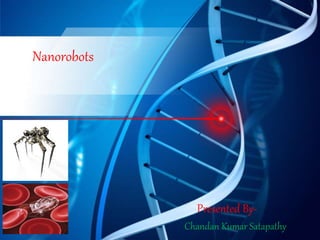
Nanorobots
• Introduction.
• What is Nanorobots ?
• Structure of Nanorobots.
• Injection of Nanorobots.
• Applications.
• Future Nanorobotics.
• Advantages & Disadvantages.
• Conclusion.
CONTENTS
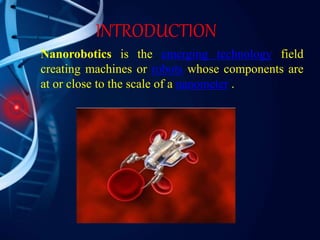
Nanorobotics is the emerging technology field
creating machines or robots whose components are
at or close to the scale of a nanometer .
INTRODUCTION
What is Nanorobots?
• Nanorobots are the tiny machines
designed to perform a specific task
whose components are at or close to
the scale of a nanometer.
• 1nm = 10−9 meters
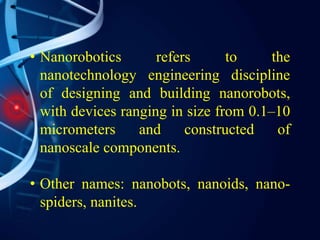
• Nanorobotics refers to the
nanotechnology engineering discipline
of designing and building nanorobots,
with devices ranging in size from 0.1–10
micrometers and constructed of
nanoscale components.
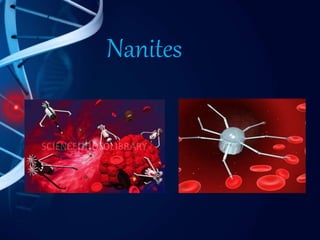
• Other names: nanobots, nanoids, nano-
spiders, nanites.
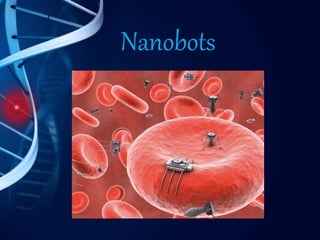
Nanobots
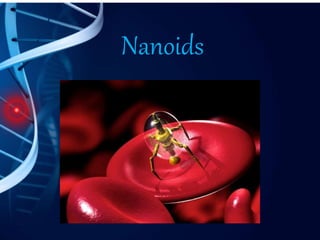
Nanoids
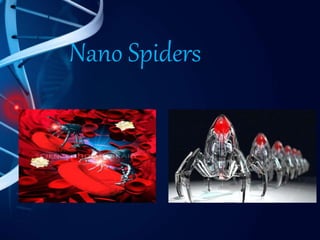
Nano Spiders
Nanites
• Nanorobots are largely in the research-and-
development phase, but some primitive
molecular machines and nanorobots have
been tested.
• The first useful applications of nanorobots
might be in medical technology, which
could be used to identify and destroy
cancer cells.
The development of nanorobots is done by
using various approaches such as:
• Biochip
• Nubots
• Usage of Bacteria
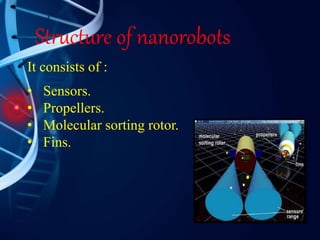
Structure of nanorobots
It consists of :
• Sensors.
• Propellers.
• Molecular sorting rotor.
• Fins.
 SENSORS:
A sensor (also called detector) is a converter that
measures a physical quantity and converts it into a signal which
can be read by an observer or by an (mostly electronic)
instrument.
Molecular sorting rotor:
A class of nanomechanical device capable of selectively
binding (or releasing) molecules from/ to solution, and of
transporting these bound molecules against significant
concentration gradients.
Fins:
A fin is a surface used for stability and/or to produce lift
and thrust or to steer while traveling in water, air, or other fluid
media.
 Propeller:
Like that in nanorobots it is used to drive forward
against the blood stream
Injection Of Nanorobots
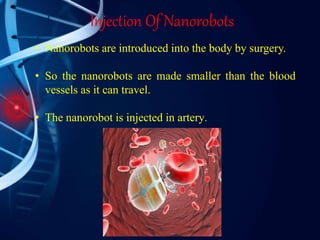
• Nanorobots are introduced into the body by surgery.
• So the nanorobots are made smaller than the blood
vessels as it can travel.
• The nanorobot is injected in artery.
Applications
 In Medical Field:-
• Nanorobotics in Surgery.
• Diagnosis and Testing.
• Nanorobotics in Gene Therapy.
• Nanorobots in Cancer Detection and treatment.
 In Space Technology.
 In Environmental Use.
 In Industry Manufacturing.
Nanorobots in surgery
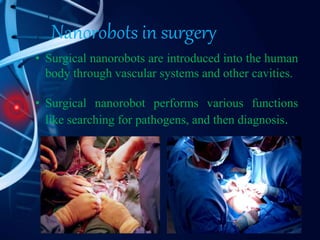
• Surgical nanorobots are introduced into the human
body through vascular systems and other cavities.
• Surgical nanorobot performs various functions
like searching for pathogens, and then diagnosis.
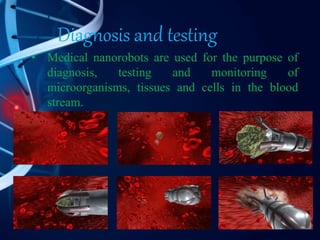
Diagnosis and testing
• Medical nanorobots are used for the purpose of
diagnosis, testing and monitoring of
microorganisms, tissues and cells in the blood
stream.
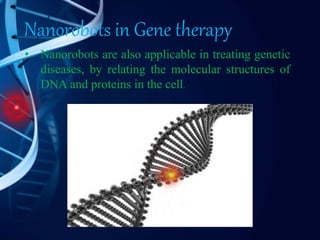
Nanorobots in Gene therapy
• Nanorobots are also applicable in treating genetic
diseases, by relating the molecular structures of
DNA and proteins in the cell.
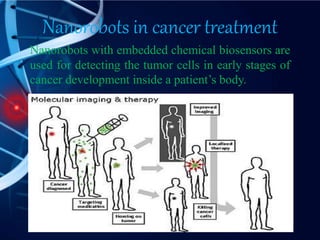
Nanorobots in cancer treatment
Nanorobots with embedded chemical biosensors are
used for detecting the tumor cells in early stages of
cancer development inside a patient’s body.
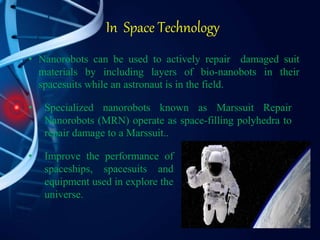
In Space Technology
• Improve the performance of
spaceships, spacesuits and
equipment used in explore the
universe.
• Nanorobots can be used to actively repair damaged suit
materials by including layers of bio-nanobots in their
spacesuits while an astronaut is in the field.
• Specialized nanorobots known as Marssuit Repair
Nanorobots (MRN) operate as space-filling polyhedra to
repair damage to a Marssuit..
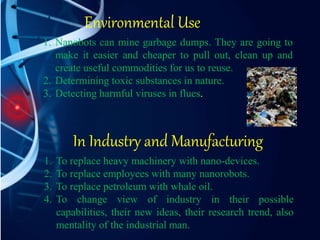
Environmental Use
1. Nanobots can mine garbage dumps. They are going to
make it easier and cheaper to pull out, clean up and
create useful commodities for us to reuse.
2. Determining toxic substances in nature.
3. Detecting harmful viruses in flues.
In Industry and Manufacturing
1. To replace heavy machinery with nano-devices.
2. To replace employees with many nanorobots.
3. To replace petroleum with whale oil.
4. To change view of industry in their possible
capabilities, their new ideas, their research trend, also
mentality of the industrial man.
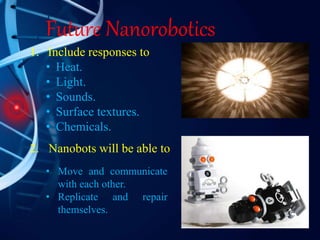
Future Nanorobotics
1. Include responses to
• Heat.
• Light.
• Sounds.
• Surface textures.
• Chemicals.
2. Nanobots will be able to
• Move and communicate
with each other.
• Replicate and repair
themselves.
Future Nanorobotics
3. In industry and manufacturing.
4. In supercomputer.
5. In brain’s growth.
6. To improve healthcare.
Are Nanobots Realistic
Today?
• We are some years away……..
• New advances are being produced........
• Medical experiments are testing……..
• However the future is now……..
Advantage
1. The microscopic size of nanorobts translates into
high operational speed.
2. Individual units require only a tiny amount of
energy to operate.
3. Speed up of medical treatment.
4. Verification of progress and treatment.
5. Nano-specification is expected to bring about
lighter, stronger and programmable materials.
6. Non degradation of treatment agents.
7. Nanaobots might also produce copies of
themselves to replace worn-outs units called
self-replication.
Advantage
7. The major advantage of nanobots is thought
to be their durability in theory, where they
can remain operational for years, decades
or centuries.
8. Involves less psychological strain.
9. Faster and More Precise Diagnosis.
10. Easily communicate with other organic
systems.
11. Rapid elimination of diseases.
12. Minimum side effects.
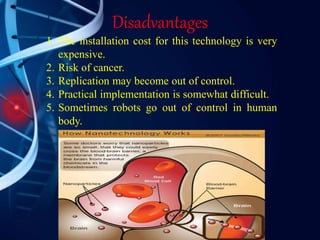
Disadvantages
1. The installation cost for this technology is very
expensive.
2. Risk of cancer.
3. Replication may become out of control.
4. Practical implementation is somewhat difficult.
5. Sometimes robots go out of control in human
body.
Conclusion
Nanomachines are largely in the search and development
phase. As the construction of nanorobots is under progress,
the ideas explained here could not be implemented at
present. This will be implemented soon in future. It gives
the hope of the effective use of this technology in medical
field. This is the beginning of nano-era and we could
expect further improvements such as medicine to AIDS.
Nanorobots can theoretically destroy all common diseases
of the 20th century, thereby ending much of the pain and
suffering. From these types of inventions, it will be useful
for us to cure diseases and lead to a fantastic life. Within
ten years, several advancement technologies should be
made from this nanorobotics.
Nanorobots
Nanorobots

Nanorobots

  • 1.
    Presented By- Chandan KumarSatapathy Nanorobots
  • 2.
    • Introduction. • Whatis Nanorobots ? • Structure of Nanorobots. • Injection of Nanorobots. • Applications. • Future Nanorobotics. • Advantages & Disadvantages. • Conclusion. CONTENTS
  • 3.
    Nanorobotics is theemerging technology field creating machines or robots whose components are at or close to the scale of a nanometer . INTRODUCTION
  • 4.
    What is Nanorobots? •Nanorobots are the tiny machines designed to perform a specific task whose components are at or close to the scale of a nanometer. • 1nm = 10−9 meters
  • 5.
    • Nanorobotics refersto the nanotechnology engineering discipline of designing and building nanorobots, with devices ranging in size from 0.1–10 micrometers and constructed of nanoscale components. • Other names: nanobots, nanoids, nano- spiders, nanites.
  • 6.
  • 7.
  • 8.
  • 9.
  • 10.
    • Nanorobots arelargely in the research-and- development phase, but some primitive molecular machines and nanorobots have been tested. • The first useful applications of nanorobots might be in medical technology, which could be used to identify and destroy cancer cells.
  • 11.
    The development ofnanorobots is done by using various approaches such as: • Biochip • Nubots • Usage of Bacteria
  • 12.
    Structure of nanorobots Itconsists of : • Sensors. • Propellers. • Molecular sorting rotor. • Fins.
  • 13.
     SENSORS: A sensor(also called detector) is a converter that measures a physical quantity and converts it into a signal which can be read by an observer or by an (mostly electronic) instrument. Molecular sorting rotor: A class of nanomechanical device capable of selectively binding (or releasing) molecules from/ to solution, and of transporting these bound molecules against significant concentration gradients. Fins: A fin is a surface used for stability and/or to produce lift and thrust or to steer while traveling in water, air, or other fluid media.  Propeller: Like that in nanorobots it is used to drive forward against the blood stream
  • 14.
    Injection Of Nanorobots •Nanorobots are introduced into the body by surgery. • So the nanorobots are made smaller than the blood vessels as it can travel. • The nanorobot is injected in artery.
  • 15.
    Applications  In MedicalField:- • Nanorobotics in Surgery. • Diagnosis and Testing. • Nanorobotics in Gene Therapy. • Nanorobots in Cancer Detection and treatment.  In Space Technology.  In Environmental Use.  In Industry Manufacturing.
  • 16.
    Nanorobots in surgery •Surgical nanorobots are introduced into the human body through vascular systems and other cavities. • Surgical nanorobot performs various functions like searching for pathogens, and then diagnosis.
  • 17.
    Diagnosis and testing •Medical nanorobots are used for the purpose of diagnosis, testing and monitoring of microorganisms, tissues and cells in the blood stream.
  • 18.
    Nanorobots in Genetherapy • Nanorobots are also applicable in treating genetic diseases, by relating the molecular structures of DNA and proteins in the cell.
  • 19.
    Nanorobots in cancertreatment Nanorobots with embedded chemical biosensors are used for detecting the tumor cells in early stages of cancer development inside a patient’s body.
  • 20.
    In Space Technology •Improve the performance of spaceships, spacesuits and equipment used in explore the universe. • Nanorobots can be used to actively repair damaged suit materials by including layers of bio-nanobots in their spacesuits while an astronaut is in the field. • Specialized nanorobots known as Marssuit Repair Nanorobots (MRN) operate as space-filling polyhedra to repair damage to a Marssuit..
  • 21.
    Environmental Use 1. Nanobotscan mine garbage dumps. They are going to make it easier and cheaper to pull out, clean up and create useful commodities for us to reuse. 2. Determining toxic substances in nature. 3. Detecting harmful viruses in flues. In Industry and Manufacturing 1. To replace heavy machinery with nano-devices. 2. To replace employees with many nanorobots. 3. To replace petroleum with whale oil. 4. To change view of industry in their possible capabilities, their new ideas, their research trend, also mentality of the industrial man.
  • 22.
    Future Nanorobotics 1. Includeresponses to • Heat. • Light. • Sounds. • Surface textures. • Chemicals. 2. Nanobots will be able to • Move and communicate with each other. • Replicate and repair themselves.
  • 23.
    Future Nanorobotics 3. Inindustry and manufacturing. 4. In supercomputer. 5. In brain’s growth. 6. To improve healthcare.
  • 24.
    Are Nanobots Realistic Today? •We are some years away…….. • New advances are being produced........ • Medical experiments are testing…….. • However the future is now……..
  • 25.
    Advantage 1. The microscopicsize of nanorobts translates into high operational speed. 2. Individual units require only a tiny amount of energy to operate. 3. Speed up of medical treatment. 4. Verification of progress and treatment. 5. Nano-specification is expected to bring about lighter, stronger and programmable materials. 6. Non degradation of treatment agents. 7. Nanaobots might also produce copies of themselves to replace worn-outs units called self-replication.
  • 26.
    Advantage 7. The majoradvantage of nanobots is thought to be their durability in theory, where they can remain operational for years, decades or centuries. 8. Involves less psychological strain. 9. Faster and More Precise Diagnosis. 10. Easily communicate with other organic systems. 11. Rapid elimination of diseases. 12. Minimum side effects.
  • 27.
    Disadvantages 1. The installationcost for this technology is very expensive. 2. Risk of cancer. 3. Replication may become out of control. 4. Practical implementation is somewhat difficult. 5. Sometimes robots go out of control in human body.
  • 28.
    Conclusion Nanomachines are largelyin the search and development phase. As the construction of nanorobots is under progress, the ideas explained here could not be implemented at present. This will be implemented soon in future. It gives the hope of the effective use of this technology in medical field. This is the beginning of nano-era and we could expect further improvements such as medicine to AIDS. Nanorobots can theoretically destroy all common diseases of the 20th century, thereby ending much of the pain and suffering. From these types of inventions, it will be useful for us to cure diseases and lead to a fantastic life. Within ten years, several advancement technologies should be made from this nanorobotics.