GEETA Engineering
College
Naultha Panipat
Presented By: Zulafqar Ahmed
Roll No: 4913121
Dept.: Computer Science and Engineering
Batch: (2013-17)
Submitted to: Ms. Shweta Malhotra
Assistant Professor in CSE
Geeta Engineering College Panipat
Presentation Overview
• Nanotechnology
• Introduction to Robotics
• Nanorobotics
• Applications using Nanorobotics
• Fractal Robots
• Conclusion
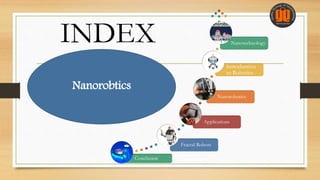
INDEX
Conclusion
Fractal Robots
Applications
Nanorobotics
Introduction
to Robotics
Nanotechnology
Nanorobtics
• Nanotechnology is molecular manufacturing or, more simply,
building things one atom or molecule at a time with
programmed nanoscopic robot arms.
• A nanometer is one billionth of a meter (3 - 4 atoms wide).
• The trick is to manipulate atoms individually and place them
exactly where needed to produce the desired structure.
Nanotechnology
Introduction of
Robotics
Robotics is the branch of technology that deals with the design,
construction, operation, structural disposition, manufacture and
application of robots.
Robotics is related to the sciences of, engineering, electronics,
mechanics and software.
Like nanotechnology, Robotics is the use of technology to design and
manufacture (intelligent) machines, built for specific purposes,
programmed to perform specific tasks.
Introduction to robotics
What is a
Robot?
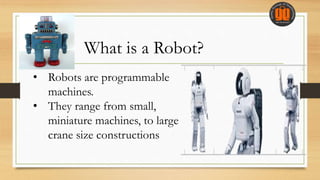
• Robots are programmable
machines.
• They range from small,
miniature machines, to large
crane size constructions
What is a Robot?
Types of
Robot
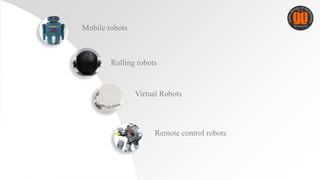
Mobile robots
Rolling robots
Virtual Robots
Remote control robots
Introduction of
Nanorobotics
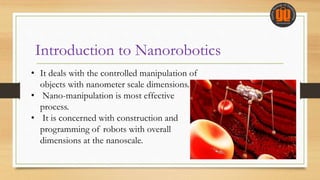
Introduction to Nanorobotics
• It deals with the controlled manipulation of
objects with nanometer scale dimensions.
• Nano-manipulation is most effective
process.
• It is concerned with construction and
programming of robots with overall
dimensions at the nanoscale.
What is Nanorobotics?
• Programmable assembly of nm-scale components either by
manipulation with macro or micro devices, or by directed self-
assembly.
• Design and fabrication of robots with overall dimensions at or
below the mm range and made of nm-scale components.
• Programming and coordination of large numbers (swarms) of
such nanorobots.
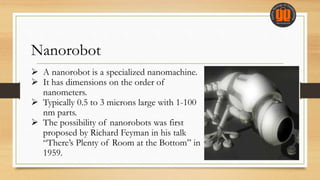
Nanorobot
 A nanorobot is a specialized nanomachine.
 It has dimensions on the order of
nanometers.
 Typically 0.5 to 3 microns large with 1-100
nm parts.
 The possibility of nanorobots was first
proposed by Richard Feyman in his talk
“There’s Plenty of Room at the Bottom” in
1959.
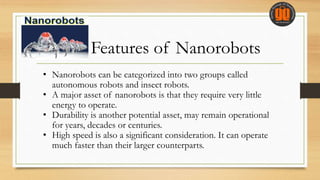
• Nanorobots can be categorized into two groups called
autonomous robots and insect robots.
• A major asset of nanorobots is that they require very little
energy to operate.
• Durability is another potential asset, may remain operational
for years, decades or centuries.
• High speed is also a significant consideration. It can operate
much faster than their larger counterparts.
Features of Nanorobots
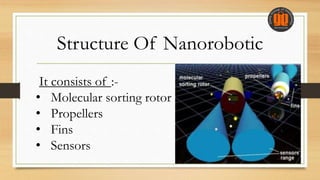
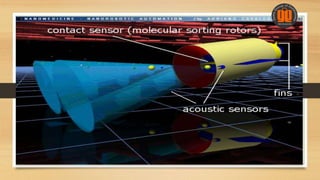
Structure Of Nanorobotic
It consists of :-
• Molecular sorting rotor
• Propellers
• Fins
• Sensors
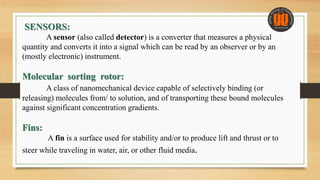
SENSORS:
A sensor (also called detector) is a converter that measures a physical
quantity and converts it into a signal which can be read by an observer or by an
(mostly electronic) instrument.
Molecular sorting rotor:
A class of nanomechanical device capable of selectively binding (or
releasing) molecules from/ to solution, and of transporting these bound molecules
against significant concentration gradients.
Fins:
A fin is a surface used for stability and/or to produce lift and thrust or to
steer while traveling in water, air, or other fluid media.
NANOROBOT ISSUE
• Sensors
• Computers and Control
• Actuators and Propulsion
• Power
• Communications
• Interfaces and Integration
• nano/micro/macro
• organic/inorganic
• biotic/abiotic
• Programming and Coordination
Nanorobots raise all the issues that are important for
NEMS
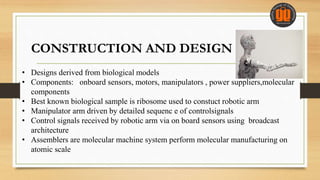
CONSTRUCTION AND DESIGN
• Designs derived from biological models
• Components: onboard sensors, motors, manipulators , power suppliers,molecular
components
• Best known biological sample is ribosome used to constuct robotic arm
• Manipulator arm driven by detailed sequenc e of controlsignals
• Control signals received by robotic arm via on board sensors using broadcast
architecture
• Assemblers are molecular machine system perform molecular manufacturing on
atomic scale
Applications
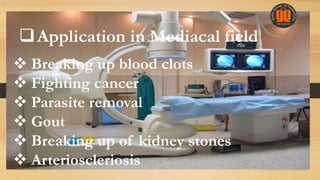
 Breaking up blood clots
 Fighting cancer
 Parasite removal
 Gout
 Breaking up of kidney stones
 Arterioscleriosis
Application in Mediacal field
IN SPACE TECHNOLOGY
Nanorobots can be used to actively repair damaged suit
materials while an astronaut is in the field
specialized Marssuit Repair Nanorobots (MRN). MRN
nanorobots operate as space-fillingpolyhedra to repair
damage to a Marssuit
Measurement of toxic elements in environment
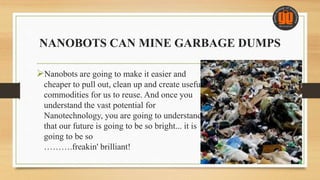
NANOBOTS CAN MINE GARBAGE DUMPS
Nanobots are going to make it easier and
cheaper to pull out, clean up and create useful
commodities for us to reuse. And once you
understand the vast potential for
Nanotechnology, you are going to understand
that our future is going to be so bright... it is
going to be so
……….freakin' brilliant!
Applications using Nanorobots
 To cure skin disease and as cosmetic cream.
 Can be used a a mouthwash to do all brushing and flossing.
 Would augment immune system by finding and killing bacteria
and viruses.
 It would prevent heart attack , kill cancer cells etc.
 To monitor potentially dangerous microorganisms in the
ocean.
Future of nanorobotic
In industry and manufacturing
In supercomputer
In brain’s growth
To improve healthcare
Advantages
and
Disadvantages
of Robots
Advantages of Nanorobot
 The microscopic size of nanomachines translates
into high operational speed
 individual units require only a tiny amount of
energy to operate
 Durability is another potential asset nanites might
last for centuries before breaking down
Disadvantages of Nanorobot
 Nanorobot particals will penetrate living cells and accumulate in
animal organs and can perhaps enter the food chain.
 There is no regulatory body dedicated to check this potents &
powerful invasion.
 Changing in the proteins due to presence of nanoparticals in the
blood stream could trigger dangerous effects like blood clotting.
 Reactance of humans and existing environment to these
nanoparticals and their acceptance is not known.
Nanorobots: Today and Tomorrow
Teams around the world are working on creating the first practical medical nanorobot.
robot ranging from a millimeter in diameter to a relatively hefty two centimeters long
already exist, though they are all still in the testing phase of development and haven't
been used on people. We're probably several years away from seeing nanorobots enter
the medical market. Today's microrobots are just prototypes that lack the ability to
perform medical tasks.
In the future, nanorobots could revolutionize medicine. Doctors could treat everything
from heart disease to cancer using tiny robots the size of bacteria, a scale much smaller
than today's robots. Robots might work alone or in teams to eradicate disease and treat
other conditions.. Unlike acute treatment, these robots would stay in the patient's body
forever.
Another potential future application of nanorobot technology is to re-engineer our bodies
to become resistant to disease, increase our strength or even improve our intelligence.
Will we one day have thousands of microscopic robots rushing around in our veins,
making corrections and healing our cuts, bruises and illnesses? With nanotechnology, it
seems like anything is possible
Conclusion
 From these types of inventions, it will be useful for man to cure many diseases & to
lead a fantastic life.
 The nanorobots are used in heart surgery, due to this number of risks and side
effects behind is reduced.
 A nanostructured data storage device about the size of a human live cell is
implanted in the brain could store a large amount of data and provides extremely
rapid access to this information.
 But perhaps the most long-term benefit to human society as a whole could be the
drawing of a new era of peace. We could hope that the people who are
independently well fed ,well housed , smart , well educated , healthy & happy will
have little motivation to make war. Human being who have reasonable prospect of
living “normal” lifetime will learn patience from experience, and will be extremely
unlikely to risk those “many lifetimes” for any but most of compelling reasons.
Thank You
Presented By: Zulafqar Ahmed
Course: B.Tech (CSE)
Roll No.: 4913121

Nano-Robotics Technology

  • 1.
  • 2.
    Presented By: ZulafqarAhmed Roll No: 4913121 Dept.: Computer Science and Engineering Batch: (2013-17) Submitted to: Ms. Shweta Malhotra Assistant Professor in CSE Geeta Engineering College Panipat
  • 3.
    Presentation Overview • Nanotechnology •Introduction to Robotics • Nanorobotics • Applications using Nanorobotics • Fractal Robots • Conclusion
  • 4.
  • 5.
    • Nanotechnology ismolecular manufacturing or, more simply, building things one atom or molecule at a time with programmed nanoscopic robot arms. • A nanometer is one billionth of a meter (3 - 4 atoms wide). • The trick is to manipulate atoms individually and place them exactly where needed to produce the desired structure. Nanotechnology
  • 6.
  • 7.
    Robotics is thebranch of technology that deals with the design, construction, operation, structural disposition, manufacture and application of robots. Robotics is related to the sciences of, engineering, electronics, mechanics and software. Like nanotechnology, Robotics is the use of technology to design and manufacture (intelligent) machines, built for specific purposes, programmed to perform specific tasks. Introduction to robotics
  • 8.
  • 9.
    • Robots areprogrammable machines. • They range from small, miniature machines, to large crane size constructions What is a Robot?
  • 10.
  • 11.
    Mobile robots Rolling robots VirtualRobots Remote control robots
  • 12.
  • 13.
    Introduction to Nanorobotics •It deals with the controlled manipulation of objects with nanometer scale dimensions. • Nano-manipulation is most effective process. • It is concerned with construction and programming of robots with overall dimensions at the nanoscale.
  • 14.
    What is Nanorobotics? •Programmable assembly of nm-scale components either by manipulation with macro or micro devices, or by directed self- assembly. • Design and fabrication of robots with overall dimensions at or below the mm range and made of nm-scale components. • Programming and coordination of large numbers (swarms) of such nanorobots.
  • 15.
    Nanorobot  A nanorobotis a specialized nanomachine.  It has dimensions on the order of nanometers.  Typically 0.5 to 3 microns large with 1-100 nm parts.  The possibility of nanorobots was first proposed by Richard Feyman in his talk “There’s Plenty of Room at the Bottom” in 1959.
  • 16.
    • Nanorobots canbe categorized into two groups called autonomous robots and insect robots. • A major asset of nanorobots is that they require very little energy to operate. • Durability is another potential asset, may remain operational for years, decades or centuries. • High speed is also a significant consideration. It can operate much faster than their larger counterparts. Features of Nanorobots
  • 17.
    Structure Of Nanorobotic Itconsists of :- • Molecular sorting rotor • Propellers • Fins • Sensors
  • 18.
    SENSORS: A sensor (alsocalled detector) is a converter that measures a physical quantity and converts it into a signal which can be read by an observer or by an (mostly electronic) instrument. Molecular sorting rotor: A class of nanomechanical device capable of selectively binding (or releasing) molecules from/ to solution, and of transporting these bound molecules against significant concentration gradients. Fins: A fin is a surface used for stability and/or to produce lift and thrust or to steer while traveling in water, air, or other fluid media.
  • 19.
    NANOROBOT ISSUE • Sensors •Computers and Control • Actuators and Propulsion • Power • Communications • Interfaces and Integration • nano/micro/macro • organic/inorganic • biotic/abiotic • Programming and Coordination Nanorobots raise all the issues that are important for NEMS
  • 20.
    CONSTRUCTION AND DESIGN •Designs derived from biological models • Components: onboard sensors, motors, manipulators , power suppliers,molecular components • Best known biological sample is ribosome used to constuct robotic arm • Manipulator arm driven by detailed sequenc e of controlsignals • Control signals received by robotic arm via on board sensors using broadcast architecture • Assemblers are molecular machine system perform molecular manufacturing on atomic scale
  • 23.
  • 24.
     Breaking upblood clots  Fighting cancer  Parasite removal  Gout  Breaking up of kidney stones  Arterioscleriosis Application in Mediacal field
  • 25.
    IN SPACE TECHNOLOGY Nanorobotscan be used to actively repair damaged suit materials while an astronaut is in the field specialized Marssuit Repair Nanorobots (MRN). MRN nanorobots operate as space-fillingpolyhedra to repair damage to a Marssuit Measurement of toxic elements in environment
  • 26.
    NANOBOTS CAN MINEGARBAGE DUMPS Nanobots are going to make it easier and cheaper to pull out, clean up and create useful commodities for us to reuse. And once you understand the vast potential for Nanotechnology, you are going to understand that our future is going to be so bright... it is going to be so ……….freakin' brilliant!
  • 27.
    Applications using Nanorobots To cure skin disease and as cosmetic cream.  Can be used a a mouthwash to do all brushing and flossing.  Would augment immune system by finding and killing bacteria and viruses.  It would prevent heart attack , kill cancer cells etc.  To monitor potentially dangerous microorganisms in the ocean.
  • 28.
    Future of nanorobotic Inindustry and manufacturing In supercomputer In brain’s growth To improve healthcare
  • 29.
  • 30.
    Advantages of Nanorobot The microscopic size of nanomachines translates into high operational speed  individual units require only a tiny amount of energy to operate  Durability is another potential asset nanites might last for centuries before breaking down
  • 31.
    Disadvantages of Nanorobot Nanorobot particals will penetrate living cells and accumulate in animal organs and can perhaps enter the food chain.  There is no regulatory body dedicated to check this potents & powerful invasion.  Changing in the proteins due to presence of nanoparticals in the blood stream could trigger dangerous effects like blood clotting.  Reactance of humans and existing environment to these nanoparticals and their acceptance is not known.
  • 32.
    Nanorobots: Today andTomorrow Teams around the world are working on creating the first practical medical nanorobot. robot ranging from a millimeter in diameter to a relatively hefty two centimeters long already exist, though they are all still in the testing phase of development and haven't been used on people. We're probably several years away from seeing nanorobots enter the medical market. Today's microrobots are just prototypes that lack the ability to perform medical tasks. In the future, nanorobots could revolutionize medicine. Doctors could treat everything from heart disease to cancer using tiny robots the size of bacteria, a scale much smaller than today's robots. Robots might work alone or in teams to eradicate disease and treat other conditions.. Unlike acute treatment, these robots would stay in the patient's body forever. Another potential future application of nanorobot technology is to re-engineer our bodies to become resistant to disease, increase our strength or even improve our intelligence. Will we one day have thousands of microscopic robots rushing around in our veins, making corrections and healing our cuts, bruises and illnesses? With nanotechnology, it seems like anything is possible
  • 33.
    Conclusion  From thesetypes of inventions, it will be useful for man to cure many diseases & to lead a fantastic life.  The nanorobots are used in heart surgery, due to this number of risks and side effects behind is reduced.  A nanostructured data storage device about the size of a human live cell is implanted in the brain could store a large amount of data and provides extremely rapid access to this information.  But perhaps the most long-term benefit to human society as a whole could be the drawing of a new era of peace. We could hope that the people who are independently well fed ,well housed , smart , well educated , healthy & happy will have little motivation to make war. Human being who have reasonable prospect of living “normal” lifetime will learn patience from experience, and will be extremely unlikely to risk those “many lifetimes” for any but most of compelling reasons.

  • 34.
    Thank You Presented By:Zulafqar Ahmed Course: B.Tech (CSE) Roll No.: 4913121