










Technology
vs
Cancer
There is a lot of cancer ‘moonshotting’ going on but what are the
main ways that technology can help the fight against cancer?
This presentation is focused on how technological hardware,
software, data and algorithms can help win the war against
cancer. It also touches lightly on some of the exciting advances
in therapies that directly target cancer cells. These are often
made more powerful and specific with the related advances in
technology
Mobile
Health
The following example is powerful as it proves the efficacy of
‘digital therapy’ via a randomized clinical trial
The online follow up extended the median survival time from 12
months to 19 months, in advanced lung cancer patients.
Quality of life also improved
READ MORE
Recruiting cancer patients can be a challenge, for trial centers
but also patients who may miss out on a chance to trial a life
saving drug due to complex recruitment processes
The next example is in cardiology but the same principle applies
in oncology
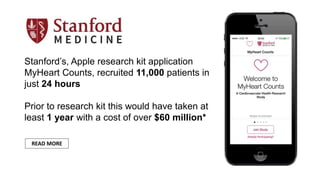
Stanford’s, Apple research kit application
MyHeart Counts, recruited 11,000 patients in
just 24 hours
Prior to research kit this would have taken at
least 1 year with a cost of over $60 million*
*based on $5500 per patient for phase 1 recruitment
READ MORE
Wearables &
Sensors
3D
Printing
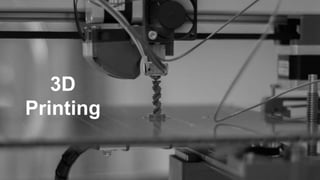
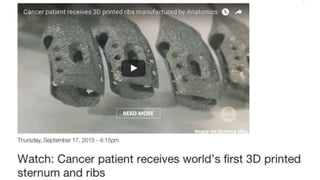
3D Printing is proving a powerful tool to create replacement body
parts including those lost due to cancer, as the next example
shows
READ MORE
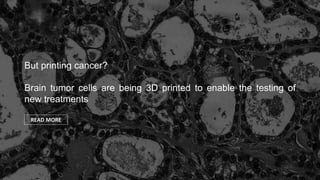
But printing cancer?
Brain tumor cells are being 3D printed to enable the testing of
new treatments
READ MORE
Wearables &
Sensors
3D PrintingVirtual
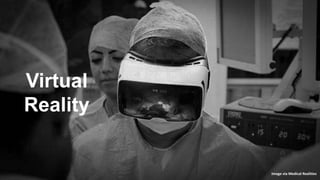
Reality
Image via Medical Realities
Wearables &
Sensors
3D Printing
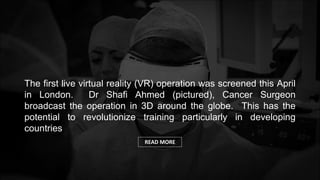
The first live virtual reality (VR) operation was screened this April
in London. Dr Shafi Ahmed (pictured), Cancer Surgeon
broadcast the operation in 3D around the globe. This has the
potential to revolutionize training particularly in developing
countries
READ MORE
3D Visualization and Augmented Reality are being used in the
operating room to widen the teams field of view. This example
was featured as number 8 in the Cleveland Clinic Top 10
innovations 2017
READ MORE
Wearables
MSK are using wearables in a trial to learn about the quality of
life of Multiple Myeloma patients. These patients are subject to
bone pain and fractures. The interesting hypothesis is that
activity and sleep patterns will correlate with self-reported
pain levels.
Memorial Sloan Kettering tests wearables
in cancer trial
READ MORE
Wearable technology can also be used to detect cancer for
example the ‘smart bra’ to detect breast cancer. They are also
being used in prevention, for example the MC10 / Loreal UV
patch that tells you when enough sun is enough!
READ MORE
Wearables &
Sensors
3D Printing Big Data
Microsoft scientists have demonstrated by analysing large
volumes of search data that they are able to identify those
suffering from pancreatic cancer before they have been
diagnosed with the condition
Microsoft finds cancer clues in search queries
READ MORE
Flatiron are using big data to fight cancer, this includes a recent
partnership with the FDA to use real world data to assess the
efficacy of immunotherapies and other anti-cancer drugs
Flatiron health turn the power of big data on cancer
READ MORE
You can donate your mobile phone data while you are sleeping (if
you live in Australia and own an Android phone) via an app called
Dreamlab. This extra processing power has slashed the initial
project timelines by 9 months
Donate your mobile phone data?
READ MORE
Wearables &
Sensors
3D Printing Machine
Learning
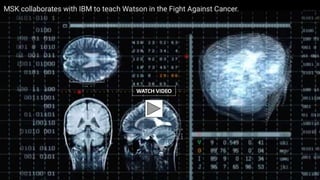
Machine learning and artificial intelligence tend to get linked with
IBM Watson. The next example illustrates the partnership
between Memorial Sloane Kettering Cancer Center and IBM
Watson. Large volumes of data from different patient profiles and
treatments are analysed by Watson. Watson can recommend
personalized treatments with ever increasing accuracy as it
learns from more data
WATCH VIDEO
Wired Magazine – Sept 20th 2016
IBM are not the only player in the Artificial Intelligence (AI) space
when it comes to cancer. Microsoft have a lofty goal to ‘solve ‘
cancer in the next 10 years using AI.
READ MORE
Wearables &
Sensors
3D Printing
Big
Data
Robotics
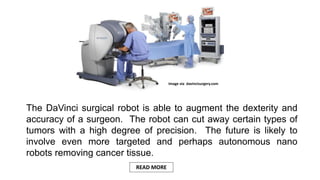
Photo Credit: Roger Schultz
The DaVinci surgical robot is able to augment the dexterity and
accuracy of a surgeon. The robot can cut away certain types of
tumors with a high degree of precision. The future is likely to
involve even more targeted and perhaps autonomous nano
robots removing cancer tissue.
Image via davincisurgery.com
READ MORE
Wearables &
Sensors
3D Printing
Big
Data
Gaming
Games can be used, particularly with young cancer patients to
improve adherence and boost self-efficacy
READ MORE
Genes in Space was the world’s first mobile game dedicated to
analyzing cancer data. Gamers contributed to the analysis
simply by playing the game. The entire genomes of 1980
patients were checked 50 times for accuracy
READ MORE
Nanomedicine
Google Nano Particles
Google are working on a pill containing nano particles that
circulate the bloodstream and detect cancer. The idea is the
particles report back to a wristband to indicate if cancer is
detected
The vision is that these nano particles could eventually become
active fighters of the disease rather than just passive messenger
particles
READ MORE
Image via Wired Magazine
Health
Technology
Saliva Testing and Liquid Biopsies
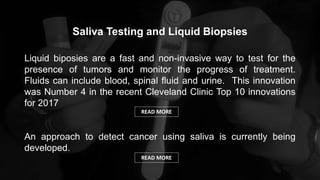
Liquid biposies are a fast and non-invasive way to test for the
presence of tumors and monitor the progress of treatment.
Fluids can include blood, spinal fluid and urine. This innovation
was Number 4 in the recent Cleveland Clinic Top 10 innovations
for 2017
An approach to detect cancer using saliva is currently being
developed.
READ MORE
READ MORE
CRISPR and Cancer
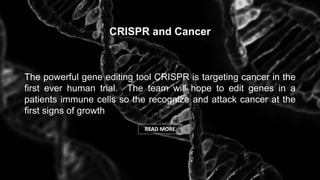
The powerful gene editing tool CRISPR is targeting cancer in the
first ever human trial. The team will hope to edit genes in a
patients immune cells so the recognize and attack cancer at the
first signs of growth
READ MORE
Thank you
@garymonk
+1-917-689-6053
linkedin.com/in/garywmonk

Technology versus Cancer (How can technology help?)

  • 1.
  • 2.
    There is alot of cancer ‘moonshotting’ going on but what are the main ways that technology can help the fight against cancer?
  • 3.
    This presentation isfocused on how technological hardware, software, data and algorithms can help win the war against cancer. It also touches lightly on some of the exciting advances in therapies that directly target cancer cells. These are often made more powerful and specific with the related advances in technology
  • 4.
  • 5.
    The following exampleis powerful as it proves the efficacy of ‘digital therapy’ via a randomized clinical trial The online follow up extended the median survival time from 12 months to 19 months, in advanced lung cancer patients. Quality of life also improved
  • 6.
  • 7.
    Recruiting cancer patientscan be a challenge, for trial centers but also patients who may miss out on a chance to trial a life saving drug due to complex recruitment processes The next example is in cardiology but the same principle applies in oncology
  • 8.
    Stanford’s, Apple researchkit application MyHeart Counts, recruited 11,000 patients in just 24 hours Prior to research kit this would have taken at least 1 year with a cost of over $60 million* *based on $5500 per patient for phase 1 recruitment READ MORE
  • 9.
  • 10.
    3D Printing isproving a powerful tool to create replacement body parts including those lost due to cancer, as the next example shows
  • 11.
  • 12.
    But printing cancer? Braintumor cells are being 3D printed to enable the testing of new treatments READ MORE
  • 13.
  • 14.
    Wearables & Sensors 3D Printing Thefirst live virtual reality (VR) operation was screened this April in London. Dr Shafi Ahmed (pictured), Cancer Surgeon broadcast the operation in 3D around the globe. This has the potential to revolutionize training particularly in developing countries READ MORE
  • 15.
    3D Visualization andAugmented Reality are being used in the operating room to widen the teams field of view. This example was featured as number 8 in the Cleveland Clinic Top 10 innovations 2017 READ MORE
  • 16.
  • 17.
    MSK are usingwearables in a trial to learn about the quality of life of Multiple Myeloma patients. These patients are subject to bone pain and fractures. The interesting hypothesis is that activity and sleep patterns will correlate with self-reported pain levels. Memorial Sloan Kettering tests wearables in cancer trial READ MORE
  • 18.
    Wearable technology canalso be used to detect cancer for example the ‘smart bra’ to detect breast cancer. They are also being used in prevention, for example the MC10 / Loreal UV patch that tells you when enough sun is enough! READ MORE
  • 19.
  • 20.
    Microsoft scientists havedemonstrated by analysing large volumes of search data that they are able to identify those suffering from pancreatic cancer before they have been diagnosed with the condition Microsoft finds cancer clues in search queries READ MORE
  • 21.
    Flatiron are usingbig data to fight cancer, this includes a recent partnership with the FDA to use real world data to assess the efficacy of immunotherapies and other anti-cancer drugs Flatiron health turn the power of big data on cancer READ MORE
  • 22.
    You can donateyour mobile phone data while you are sleeping (if you live in Australia and own an Android phone) via an app called Dreamlab. This extra processing power has slashed the initial project timelines by 9 months Donate your mobile phone data? READ MORE
  • 23.
  • 24.
    Machine learning andartificial intelligence tend to get linked with IBM Watson. The next example illustrates the partnership between Memorial Sloane Kettering Cancer Center and IBM Watson. Large volumes of data from different patient profiles and treatments are analysed by Watson. Watson can recommend personalized treatments with ever increasing accuracy as it learns from more data
  • 25.
  • 26.
    Wired Magazine –Sept 20th 2016 IBM are not the only player in the Artificial Intelligence (AI) space when it comes to cancer. Microsoft have a lofty goal to ‘solve ‘ cancer in the next 10 years using AI. READ MORE
  • 27.
  • 28.
    The DaVinci surgicalrobot is able to augment the dexterity and accuracy of a surgeon. The robot can cut away certain types of tumors with a high degree of precision. The future is likely to involve even more targeted and perhaps autonomous nano robots removing cancer tissue. Image via davincisurgery.com READ MORE
  • 29.
  • 30.
    Games can beused, particularly with young cancer patients to improve adherence and boost self-efficacy READ MORE
  • 31.
    Genes in Spacewas the world’s first mobile game dedicated to analyzing cancer data. Gamers contributed to the analysis simply by playing the game. The entire genomes of 1980 patients were checked 50 times for accuracy READ MORE
  • 32.
  • 33.
    Google Nano Particles Googleare working on a pill containing nano particles that circulate the bloodstream and detect cancer. The idea is the particles report back to a wristband to indicate if cancer is detected The vision is that these nano particles could eventually become active fighters of the disease rather than just passive messenger particles READ MORE Image via Wired Magazine
  • 34.
  • 35.
    Saliva Testing andLiquid Biopsies Liquid biposies are a fast and non-invasive way to test for the presence of tumors and monitor the progress of treatment. Fluids can include blood, spinal fluid and urine. This innovation was Number 4 in the recent Cleveland Clinic Top 10 innovations for 2017 An approach to detect cancer using saliva is currently being developed. READ MORE READ MORE
  • 36.
    CRISPR and Cancer Thepowerful gene editing tool CRISPR is targeting cancer in the first ever human trial. The team will hope to edit genes in a patients immune cells so the recognize and attack cancer at the first signs of growth READ MORE
  • 37.

Editor's Notes

  • #7 http://www.cancernetwork.com/asco-2016-lung-cancer/web-application-extends-lung-cancer-survival https://www.asco.org/about-asco/press-center/news-releases/mobile-friendly-web-application-extends-lung-cancer-survival
  • #9 http://www.macworld.com/article/2895941/stanfords-researchkit-app-gained-more-users-in-24-hours-than-most-medical-studies-find-in-a-year.html http://bionewsservices.com/2015/02/13/recruit/
  • #13 http://www.digitaltrends.com/cool-tech/brain-cancer-3d-printing/
  • #14 Also Add #8 http://www.cleveland.com/healthfit/index.ssf/2016/10/cleveland_clinic_unveils_its_t.html#8 http://www.hitcentral.eu/british-journal-healthcare-computing/first-virtual-reality-cancer-op-beamed-globally
  • #15 Also Add #8 http://www.cleveland.com/healthfit/index.ssf/2016/10/cleveland_clinic_unveils_its_t.html#8 http://www.hitcentral.eu/british-journal-healthcare-computing/first-virtual-reality-cancer-op-beamed-globally
  • #16 http://www.cleveland.com/healthfit/index.ssf/2016/10/cleveland_clinic_unveils_its_t.html#3
  • #25 http://www.cleveland.com/healthfit/index.ssf/2016/10/cleveland_clinic_unveils_its_t.html#3 https://www.youtube.com/watch?v=TuxL3yzXxJo
  • #26 http://www.ibm.com/watson/health/oncology/ https://www.youtube.com/watch?v=TuxL3yzXxJo
  • #27 http://www.wired.co.uk/article/microsoft-solve-cancer-computer-science
  • #29 http://www.roboticoncology.com/da-vinci-robotic-prostatectomy/ http://www.cancercenter.com/head-and-neck-cancer/da-vinci-surgical-system/ https://www.theguardian.com/technology/2016/apr/14/cutting-edge-theatre-worlds-first-virtual-reality-operation-goes-live?0p19G=c
  • #34 https://www.wired.com/2014/10/google-developing-pill-detect-cancer-diseases/
  • #37 http://singularityhub.com/2016/06/26/75-crispr-targets-cancer-in-first-human-trial-what-you-need-to-know/
  • #38 http://singularityhub.com/2016/06/26/75-crispr-targets-cancer-in-first-human-trial-what-you-need-to-know/ linkedin.com/in/garywmonk