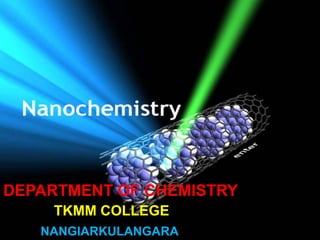
DEPARTMENT OF CHEMISTRY
TKMM COLLEGE
NANGIARKULANGARA
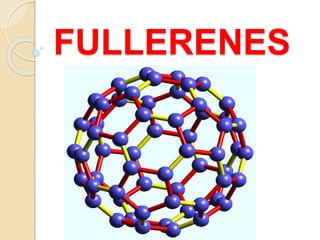
FULLERENES
FULLERENE
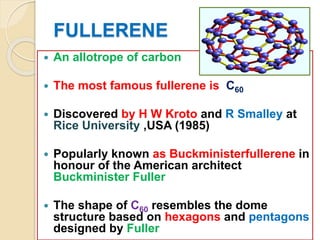
 An allotrope of carbon
 The most famous fullerene is C60
 Discovered by H W Kroto and R Smalley at
Rice University ,USA (1985)
 Popularly known as Buckministerfullerene in
honour of the American architect
Buckminister Fuller
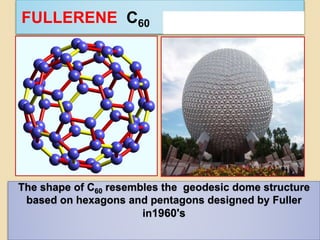
 The shape of C60 resembles the dome
structure based on hexagons and pentagons
designed by Fuller
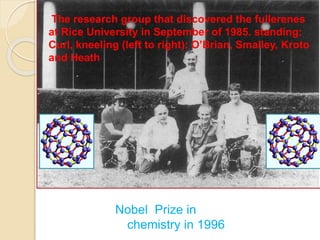
The research group that discovered the fullerenes
at Rice University in September of 1985. standing:
Curl, kneeling (left to right): O’Brian, Smalley, Kroto
and Heath
Nobel Prize in
chemistry in 1996
The shape of C60 resembles the geodesic dome structure
based on hexagons and pentagons designed by Fuller
in1960's
FULLERENE C60
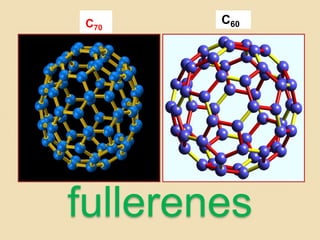
fullerenes
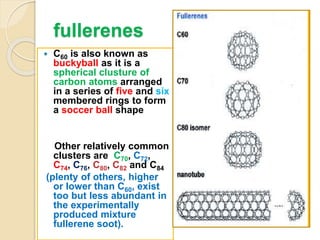
 C60 is also known as
buckyball as it is a
spherical clusture of
carbon atoms arranged
in a series of five and six
membered rings to form
a soccer ball shape
Other relatively common
clusters are C70, C72,
C74, C76, C80, C82 and C84
(plenty of others, higher
or lower than C60, exist
too but less abundant in
the experimentally
produced mixture
fullerene soot).
fullerenes
C70
C60
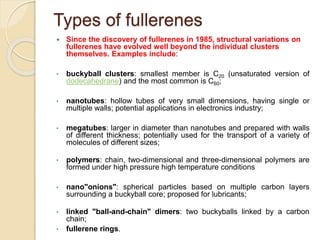
Types of fullerenes
 Since the discovery of fullerenes in 1985, structural variations on
fullerenes have evolved well beyond the individual clusters
themselves. Examples include:
• buckyball clusters: smallest member is C20 (unsaturated version of
dodecahedrane) and the most common is C60;
• nanotubes: hollow tubes of very small dimensions, having single or
multiple walls; potential applications in electronics industry;
• megatubes: larger in diameter than nanotubes and prepared with walls
of different thickness; potentially used for the transport of a variety of
molecules of different sizes;
• polymers: chain, two-dimensional and three-dimensional polymers are
formed under high pressure high temperature conditions
• nano"onions": spherical particles based on multiple carbon layers
surrounding a buckyball core; proposed for lubricants;
• linked "ball-and-chain" dimers: two buckyballs linked by a carbon
chain;
• fullerene rings.
STRUCTURE OF C60
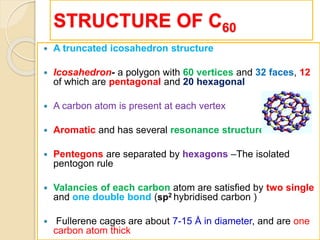
 A truncated icosahedron structure
 Icosahedron- a polygon with 60 vertices and 32 faces, 12
of which are pentagonal and 20 hexagonal
 A carbon atom is present at each vertex
 Aromatic and has several resonance structures
 Pentegons are separated by hexagons –The isolated
pentogon rule
 Valancies of each carbon atom are satisfied by two single
and one double bond (sp2 hybridised carbon )
 Fullerene cages are about 7-15 Å in diameter, and are one
carbon atom thick
Bond Structure and Reactivity
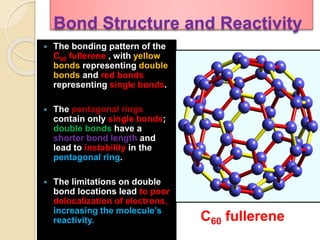
 The bonding pattern of the
C60 fullerene , with yellow
bonds representing double
bonds and red bonds
representing single bonds.
 The pentagonal rings
contain only single bonds;
double bonds have a
shorter bond length and
lead to instability in the
pentagonal ring.
 The limitations on double
bond locations lead to poor
delocalization of electrons,
increasing the molecule’s
reactivity. C60 fullerene
C60 fullerene
 C60 form a normal face-centred cubic lattice
 The solid state NMR spectrum of shows that the solid is
acting like a liquid and the molecules are tumbling on
their lattice sites (gives a sharp line at 143ppm without
any magic angle spinning , instead of a broad line as
expected for a solid)
 X-ray diffraction shows this to be true
 C60 fullerene show selectivity for intercalated ions as
the tetrahedral and octahedral holes have significant size
differences
 Cesium fits comfortably into octahedral holes but it is
large to be accommodated in the tetrahedral holes
SYNTHESIS AND PURIFICATION
OF FULLERENES
 Fullerenes are prepared by vapourising
a graphite rod in a helium atmosphere
 Mixtures of fullerenes like C60 , C70 are
formed which are separated by solvent
extraction
 pure C60 is isolated from this mixture by
column chromatography
SYNTHESIS AND
PURIFICATION OF
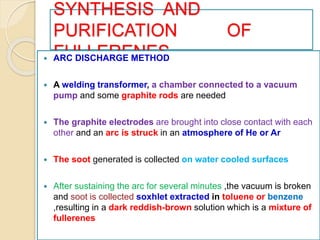
FULLERENES ARC DISCHARGE METHOD
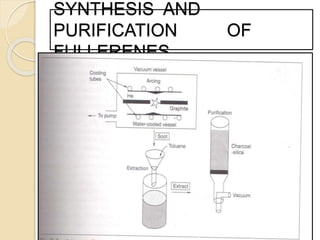
 A welding transformer, a chamber connected to a vacuum
pump and some graphite rods are needed
 The graphite electrodes are brought into close contact with each
other and an arc is struck in an atmosphere of He or Ar
 The soot generated is collected on water cooled surfaces
 After sustaining the arc for several minutes ,the vacuum is broken
and soot is collected soxhlet extracted in toluene or benzene
,resulting in a dark reddish-brown solution which is a mixture of
fullerenes
SYNTHESIS AND PURIFICATION
OF FULLERENES
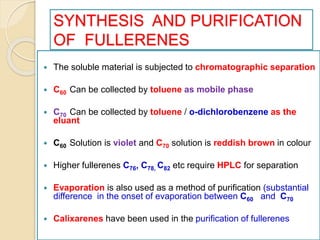
 The soluble material is subjected to chromatographic separation
 C60 Can be collected by toluene as mobile phase
 C70 Can be collected by toluene / o-dichlorobenzene as the
eluant
 C60 Solution is violet and C70 solution is reddish brown in colour
 Higher fullerenes C76, C78, C82 etc require HPLC for separation
 Evaporation is also used as a method of purification (substantial
difference in the onset of evaporation between C60 and C70
 Calixarenes have been used in the purification of fullerenes
SYNTHESIS AND
PURIFICATION OF
FULLERENES
SYNTHESIS AND
PURIFICATION OF
FULLERENES
 Fullerenes have been found in flames ,upon
chemical vapor deposition used to
produce diamond
 Fullerenes can be synthesised from
camphor
 Upon laser evaporation , highly unsaturted
carbonaceous ring system produce C60
 There are several other exotic means of
producing C60
CHARACTERISTION OF
FULLERENES
 Synthesis and purification were followed by the characterization of
fullerenes in a veriety of technique
 XRD
 Mass spectrometry
 NMR spectroscopy
 UV/VIS spectroscopy
 IR spectroscopy
 RAMAN spectroscopy
 The predicted electronic structure was confirmed by HeI and HeII
photoelectron spectroscopies
PROPERTIES OF
FULLERENES
 Quite stable from chemical and physical
points of view (breaking the balls requires
temperatures of about 1000 °C).
 Highest tensile strength of any known 2D
structure or element.
 Highest packing density of all known
structures
 Impenetrable to all elements under normal
circumstances, even to a helium atom with
PROPERTIES OF
FULLERENES
 A black powdery material
 Forms deep magenta solution in benzene
 Very tough and thermally stable
 Exists as a discrete molecule unlike the
other two allotropes of carbon (graphite and
diamond)
 Can be compressed to lose 30% of its
APPLIATIONS OF
FULLERENES
 As a lubricant due to its sherical structure -the bucky
balls act as a molecular ball bearings
 As a superconductor when mixed with alkali metals
 Used as a soft ferromagnet (TDAE C60 )
 Used in electronic, microelectronic and non-linear
optical devices
 Researchers have found that water-soluble derivatives
of fullerenes inhibit the HIV-1 protease (enzyme
responsible for the development of the virus) and are
therefore useful in fighting the HIV virus that leads to AIDS
.

Fullerenes

  • 1.
    DEPARTMENT OF CHEMISTRY TKMMCOLLEGE NANGIARKULANGARA
  • 2.
  • 3.
    FULLERENE  An allotropeof carbon  The most famous fullerene is C60  Discovered by H W Kroto and R Smalley at Rice University ,USA (1985)  Popularly known as Buckministerfullerene in honour of the American architect Buckminister Fuller  The shape of C60 resembles the dome structure based on hexagons and pentagons designed by Fuller
  • 4.
    The research groupthat discovered the fullerenes at Rice University in September of 1985. standing: Curl, kneeling (left to right): O’Brian, Smalley, Kroto and Heath Nobel Prize in chemistry in 1996
  • 5.
    The shape ofC60 resembles the geodesic dome structure based on hexagons and pentagons designed by Fuller in1960's FULLERENE C60
  • 6.
    fullerenes  C60 isalso known as buckyball as it is a spherical clusture of carbon atoms arranged in a series of five and six membered rings to form a soccer ball shape Other relatively common clusters are C70, C72, C74, C76, C80, C82 and C84 (plenty of others, higher or lower than C60, exist too but less abundant in the experimentally produced mixture fullerene soot).
  • 7.
  • 8.
    Types of fullerenes Since the discovery of fullerenes in 1985, structural variations on fullerenes have evolved well beyond the individual clusters themselves. Examples include: • buckyball clusters: smallest member is C20 (unsaturated version of dodecahedrane) and the most common is C60; • nanotubes: hollow tubes of very small dimensions, having single or multiple walls; potential applications in electronics industry; • megatubes: larger in diameter than nanotubes and prepared with walls of different thickness; potentially used for the transport of a variety of molecules of different sizes; • polymers: chain, two-dimensional and three-dimensional polymers are formed under high pressure high temperature conditions • nano"onions": spherical particles based on multiple carbon layers surrounding a buckyball core; proposed for lubricants; • linked "ball-and-chain" dimers: two buckyballs linked by a carbon chain; • fullerene rings.
  • 9.
    STRUCTURE OF C60 A truncated icosahedron structure  Icosahedron- a polygon with 60 vertices and 32 faces, 12 of which are pentagonal and 20 hexagonal  A carbon atom is present at each vertex  Aromatic and has several resonance structures  Pentegons are separated by hexagons –The isolated pentogon rule  Valancies of each carbon atom are satisfied by two single and one double bond (sp2 hybridised carbon )  Fullerene cages are about 7-15 Å in diameter, and are one carbon atom thick
  • 10.
    Bond Structure andReactivity  The bonding pattern of the C60 fullerene , with yellow bonds representing double bonds and red bonds representing single bonds.  The pentagonal rings contain only single bonds; double bonds have a shorter bond length and lead to instability in the pentagonal ring.  The limitations on double bond locations lead to poor delocalization of electrons, increasing the molecule’s reactivity. C60 fullerene
  • 11.
    C60 fullerene  C60form a normal face-centred cubic lattice  The solid state NMR spectrum of shows that the solid is acting like a liquid and the molecules are tumbling on their lattice sites (gives a sharp line at 143ppm without any magic angle spinning , instead of a broad line as expected for a solid)  X-ray diffraction shows this to be true  C60 fullerene show selectivity for intercalated ions as the tetrahedral and octahedral holes have significant size differences  Cesium fits comfortably into octahedral holes but it is large to be accommodated in the tetrahedral holes
  • 12.
    SYNTHESIS AND PURIFICATION OFFULLERENES  Fullerenes are prepared by vapourising a graphite rod in a helium atmosphere  Mixtures of fullerenes like C60 , C70 are formed which are separated by solvent extraction  pure C60 is isolated from this mixture by column chromatography
  • 13.
    SYNTHESIS AND PURIFICATION OF FULLERENESARC DISCHARGE METHOD  A welding transformer, a chamber connected to a vacuum pump and some graphite rods are needed  The graphite electrodes are brought into close contact with each other and an arc is struck in an atmosphere of He or Ar  The soot generated is collected on water cooled surfaces  After sustaining the arc for several minutes ,the vacuum is broken and soot is collected soxhlet extracted in toluene or benzene ,resulting in a dark reddish-brown solution which is a mixture of fullerenes
  • 14.
    SYNTHESIS AND PURIFICATION OFFULLERENES  The soluble material is subjected to chromatographic separation  C60 Can be collected by toluene as mobile phase  C70 Can be collected by toluene / o-dichlorobenzene as the eluant  C60 Solution is violet and C70 solution is reddish brown in colour  Higher fullerenes C76, C78, C82 etc require HPLC for separation  Evaporation is also used as a method of purification (substantial difference in the onset of evaporation between C60 and C70  Calixarenes have been used in the purification of fullerenes
  • 15.
  • 16.
    SYNTHESIS AND PURIFICATION OF FULLERENES Fullerenes have been found in flames ,upon chemical vapor deposition used to produce diamond  Fullerenes can be synthesised from camphor  Upon laser evaporation , highly unsaturted carbonaceous ring system produce C60  There are several other exotic means of producing C60
  • 17.
    CHARACTERISTION OF FULLERENES  Synthesisand purification were followed by the characterization of fullerenes in a veriety of technique  XRD  Mass spectrometry  NMR spectroscopy  UV/VIS spectroscopy  IR spectroscopy  RAMAN spectroscopy  The predicted electronic structure was confirmed by HeI and HeII photoelectron spectroscopies
  • 18.
    PROPERTIES OF FULLERENES  Quitestable from chemical and physical points of view (breaking the balls requires temperatures of about 1000 °C).  Highest tensile strength of any known 2D structure or element.  Highest packing density of all known structures  Impenetrable to all elements under normal circumstances, even to a helium atom with
  • 19.
    PROPERTIES OF FULLERENES  Ablack powdery material  Forms deep magenta solution in benzene  Very tough and thermally stable  Exists as a discrete molecule unlike the other two allotropes of carbon (graphite and diamond)  Can be compressed to lose 30% of its
  • 20.
    APPLIATIONS OF FULLERENES  Asa lubricant due to its sherical structure -the bucky balls act as a molecular ball bearings  As a superconductor when mixed with alkali metals  Used as a soft ferromagnet (TDAE C60 )  Used in electronic, microelectronic and non-linear optical devices  Researchers have found that water-soluble derivatives of fullerenes inhibit the HIV-1 protease (enzyme responsible for the development of the virus) and are therefore useful in fighting the HIV virus that leads to AIDS .