Introduction to Nanomaterials
Historical background
● Nobel Prize winner Richard Feynman said in 1959in
conference, «The principlesof physics, as faras I can
see, do not speak against the possibility of
manoeuvring things atom byatom»
● Theword « nanotechnology » was first used by Norio
Taniguchi in 1974 to refer to precise and accurate
tolerance required for machining and finishing of
materials
● In 1981, Drexlerdescribea new « bottomup »
technique instead of « top down»
● The term nanoderives from the Greek word fordwarf
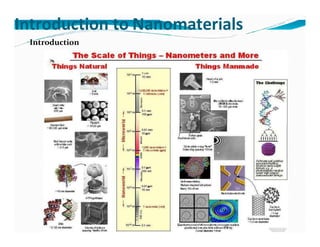
● A nanometer (nm) is a billionthof a meter, or 10−9
meters.
Introduction to Nanomaterials
Introduction
Introduction to Nanomaterials
Introduction
What arenanomaterials?
● The materials having at leastone dimensions in
nanometric scale are callednanomaterials
● Nanotechnology is the understanding and control of
matteratdimensions of roughly 1 to 100 nanometers, where
unique phenomena enable novelapplications
● Encompassing nanoscale science, engineering and
technology, nanotechnology involves imaging, measuring,
modeling, and manipulating matter at this lengthscale.”
● The term is reallyan “umbrella term” thatcovers
disciplines that haveveryold historicroots.
Introduction to Nanomaterials
Introduction
What is sospecial about nanotechnology?
● First, it is an incredibly broad, interdisciplinaryfield.
● It requires expertise in physics, chemistry, materials
science, biology, mechanical and electrical
engineering, medicine, and their collectiveknowledge.
● The boundary between atomsand moleculesand the
macroworld.
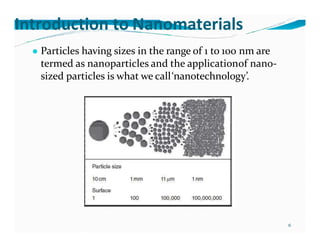
● Particles having sizes in the range of 1 to 100 nm are
termed as nanoparticles and the applicationof nano-
sized particles is what we call‘nanotechnology’.
Introduction to Nanomaterials
6
Introduction to Nanomaterials
What is special innanomaterials?
● At the nanoscale, the physical, chemical, and biological
propertiesof materialsdiffer in fundamental and valuable
ways from the properties of individual atoms and
molecules or bulkmatter.
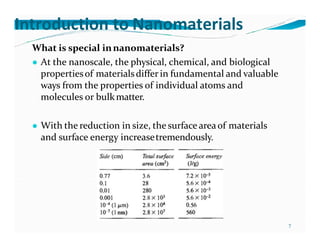
● With the reduction in size, the surface areaof materials
and surface energy increasetremendously.
7
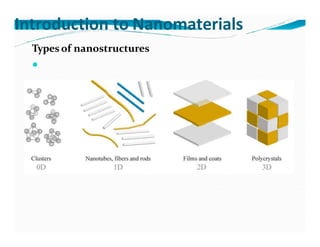
Types of nanostructures
●
Introduction to Nanomaterials
Introduction
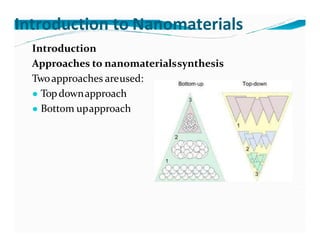
Approaches to nanomaterialssynthesis
Twoapproaches areused:
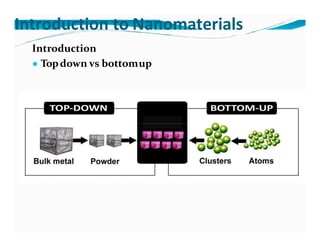
● Topdownapproach
● Bottom upapproach
Introduction to Nanomaterials
Introduction
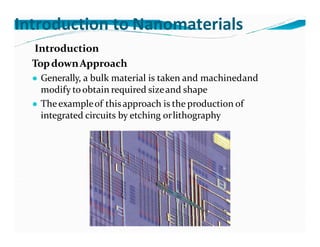
TopdownApproach
● Generally, a bulk material is taken and machinedand
modify toobtain required sizeand shape
● Theexampleof thisapproach is the production of
integrated circuits by etching orlithography
Introduction to Nanomaterials
Introduction
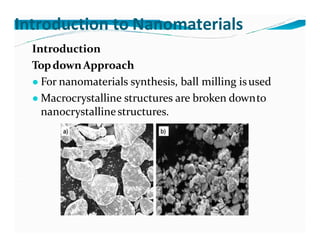
TopdownApproach
● For nanomaterials synthesis, ball milling isused
● Macrocrystalline structures are broken downto
nanocrystallinestructures.
Introduction to Nanomaterials
Introduction
Bottom upApproach
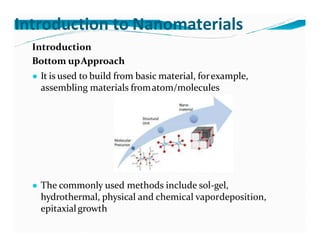
● It is used to build from basic material, forexample,
assembling materials fromatom/molecules
● The commonly used methods include sol-gel,
hydrothermal, physical and chemical vapordeposition,
epitaxialgrowth
Introduction to Nanomaterials
Introduction
● Topdown vs bottomup
Introduction to Nanomaterials
Introduction
Nanomaterials in Nature
● The nature is the best manufucturerof nanomaterials
and nanostructures
● By natural nanomaterials means, the materials that
belong to the natural world (plants, animal and
mineral), without human modification orprocessing
● Due to their structures, they have remarkable
properties because of their inherentnanostructure.
Introduction to Nanomaterials
Introduction
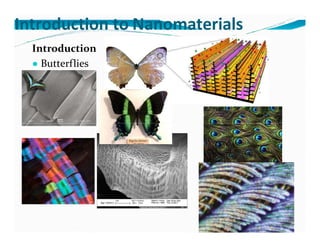
● Butterflies
Introduction to Nanomaterials
Introduction
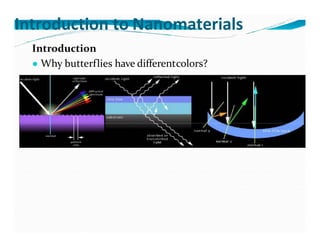
● Why butterflies have differentcolors?
● Introduction
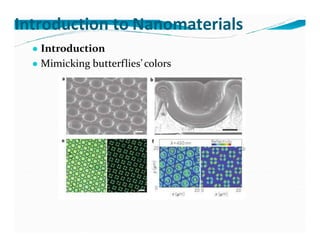
● Mimicking butterflies’colors
Introduction to Nanomaterials
Introduction
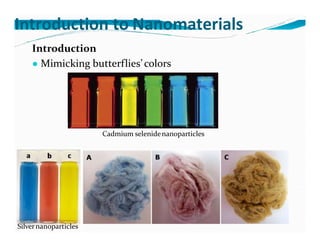
● Mimicking butterflies’colors
Introduction to Nanomaterials
Cadmium selenidenanoparticles
Silvernanoparticles
Introduction to Nanomaterials
● Introduction
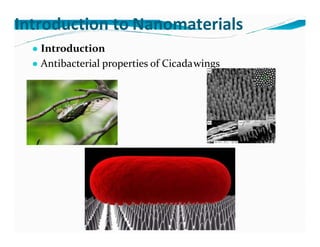
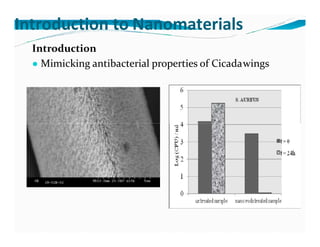
● Antibacterial properties of Cicadawings
Introduction to Nanomaterials
Introduction
● Mimicking antibacterial properties of Cicadawings
Introduction to Nanomaterials
Introduction
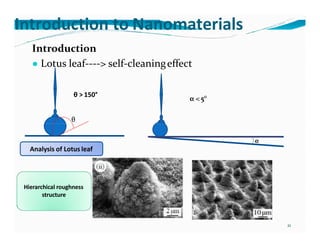
● Lotus leaf----> self-cleaningeffect
α <5°
θ > 150°
21
θ
α
Analysis of Lotus leaf
Hierarchical roughness
structure
Introduction
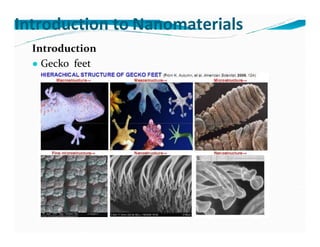
● Gecko feet
Introduction to Nanomaterials
Introduction
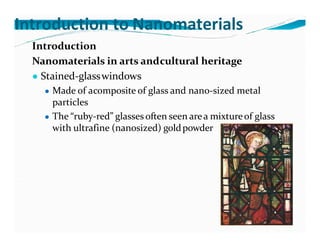
Nanomaterials in arts andcultural heritage
● Stained-glasswindows
● Made of acomposite of glass and nano-sized metal
particles
● The “ruby-red” glasses often seen area mixtureof glass
with ultrafine (nanosized) goldpowder
Introduction to Nanomaterials
Introduction
Nanomaterials in arts andcultural heritage
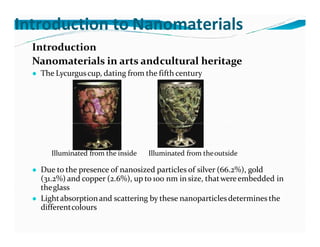
● The Lycurguscup, dating from the fifth century
Illuminated from the inside Illuminated from theoutside
● Due to the presence of nanosized particles of silver (66.2%), gold
(31.2%) and copper (2.6%), up to 100 nm in size, thatwereembedded in
theglass
● Lightabsorptionand scattering by these nanoparticlesdetermines the
differentcolours
Introduction to Nanomaterials
Introduction
Application of nanomaterials
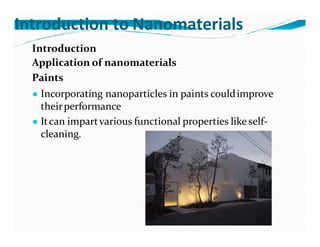
Paints
● Incorporating nanoparticles in paints couldimprove
theirperformance
● Itcan impartvarious functional properties like self-
cleaning.
Introduction to Nanomaterials
Introduction
Application of nanomaterials
● Sunscreens and Cosmetics
● The traditional chemical UV protection approachsuffers
from its poor long-termstability
● Nanosized titaniumdioxideand zincoxide arecurrently
used in some sunscreens, as they absorb and reflect
ultraviolet (UV)rays.
● Transparent tovisible lightand so are moreappealing to
theconsumer.
● Nanosized iron oxide is present in some lipsticksas a
pigment.
Introduction to Nanomaterials
Introduction
Application of nanomaterials
Effluenttreatment
● Nanophotocatalystsare much moreefficient than
micro and macrophotocatalysts.
● Theydegrade the toxiccolorantsand otherorganic
species
Introduction to Nanomaterials
Introduction
Application of nanomaterials
Medicine
● Nanotechnology has beena boon in medical field by
delivering drugs to specificcells using nanoparticles.
● Theoverall drug consumptionand sideeffectscan be
lowered significantly by depositing the agent in the
morbid region only and in no higher dose than
needed.
Introduction to Nanomaterials
Introduction
Application of nanomaterials
Sensors forgases
● Sensorsemploy theirsensitivity to thechanges in various
parameterstheyaredesigned to measure.
● The measured parameters includeelectrical resistivity, chemical
activity, magnetic permeability, thermal conductivity, and
capacitance
● acarbon monoxidesensormadeof zirconium oxide (zirconia)
uses its chemical stability to detect the presence of carbon
monoxide.
● Theoxygenatoms in zirconiumoxide reactwith thecarbon in
carbon monoxide to partially reduce zirconiumoxide.
● This reaction triggersachange in the sensor’scharacteristics,
such asconductivity
● Thegases like NO 2 and NH 3 can bedetected on the basis of
increase in electrical conductivity ofnanomaterials.
Introduction to Nanomaterials
Introduction
Application of nanomaterials
Food
● Nanotechnologycan beapplied in the production,
processing, safety and packaging of food.
● A nanocomposite coating process could improve food
packaging by placing anti-microbial agents directlyon
the surface of thecoated film.
Introduction to Nanomaterials
Introduction
Application of nanomaterials
Construction
● Nanotechnology has the potential tomake
construction faster, cheaper andsafer.
● The Silica (SiO 2 ) is present in conventionalconcrete
as part of the normalmix
● When nanosilica is added toconcrete the particle
packing can be improved mechanicalproperties.
● The nanosize steel producestrongersteel cables
which can be used in bridgeconstruction.
● NanoTiO2 coated glass have properties of anti-fouling
and glaze.
Introduction to Nanomaterials
Introduction
Application of nanomaterials
Energy
● Nanomaterials have thecapacity tostore hugeamount
of energy.
● Today’ssolarcells use multiple layers of different
semiconductors in nanometricrange
● Theyare much moreefficient than theone 20 years.
Introduction to Nanomaterials
Introduction
Application of nanomaterials
Better InsulationMaterials
● Nanocrystalline materials synthesised by thesol-gel
technique result in foam like structures called
"aerogels.“
● These aerogelsare porousand extremely lightweight
● Aerogels are composed of three-dimensional,
continuous networksof particleswith air trapped at
their interstices.
Introduction to Nanomaterials
Introduction
Application of nanomaterials
Tougherand Harder CuttingTools
● Cutting tools made of nanocrystalline materials,such
as tungsten carbide, tantalum carbide, and titanium
carbide, are much harder, much more wear-resistant,
erosion-resistant.
● These tools are required formicroelectronics
Introduction to Nanomaterials
Introduction
Application of nanomaterials
High-PowerMagnets
● The magnetic powerdependson the specific surface
area
● The magnets made of nanocrystalline grainspossess
very unusual magnetic properties due to their
extremely large surfacearea
● They are used in ultra-sensitiveanalytical instruments,
and magnetic resonance imaging (MRI) in medical
diagnostics.
● Motors forships
Introduction to Nanomaterials
Introduction
Application of nanomaterials
Enhanced performance ofcomponents
● The fatiguestrength is an important parameterthat
determines the component’slife
● The fatiguestrength increases with a reduction in the
grain size of thematerial.
● By using nanomaterials, the fatiguestrengthcan be
increased by an average of 200-300%.
Introduction to Nanomaterials
● Introduction

Nanomaterials

  • 2.
    Introduction to Nanomaterials Historicalbackground ● Nobel Prize winner Richard Feynman said in 1959in conference, «The principlesof physics, as faras I can see, do not speak against the possibility of manoeuvring things atom byatom» ● Theword « nanotechnology » was first used by Norio Taniguchi in 1974 to refer to precise and accurate tolerance required for machining and finishing of materials ● In 1981, Drexlerdescribea new « bottomup » technique instead of « top down» ● The term nanoderives from the Greek word fordwarf ● A nanometer (nm) is a billionthof a meter, or 10−9 meters.
  • 3.
  • 4.
    Introduction to Nanomaterials Introduction Whatarenanomaterials? ● The materials having at leastone dimensions in nanometric scale are callednanomaterials ● Nanotechnology is the understanding and control of matteratdimensions of roughly 1 to 100 nanometers, where unique phenomena enable novelapplications ● Encompassing nanoscale science, engineering and technology, nanotechnology involves imaging, measuring, modeling, and manipulating matter at this lengthscale.” ● The term is reallyan “umbrella term” thatcovers disciplines that haveveryold historicroots.
  • 5.
    Introduction to Nanomaterials Introduction Whatis sospecial about nanotechnology? ● First, it is an incredibly broad, interdisciplinaryfield. ● It requires expertise in physics, chemistry, materials science, biology, mechanical and electrical engineering, medicine, and their collectiveknowledge. ● The boundary between atomsand moleculesand the macroworld.
  • 6.
    ● Particles havingsizes in the range of 1 to 100 nm are termed as nanoparticles and the applicationof nano- sized particles is what we call‘nanotechnology’. Introduction to Nanomaterials 6
  • 7.
    Introduction to Nanomaterials Whatis special innanomaterials? ● At the nanoscale, the physical, chemical, and biological propertiesof materialsdiffer in fundamental and valuable ways from the properties of individual atoms and molecules or bulkmatter. ● With the reduction in size, the surface areaof materials and surface energy increasetremendously. 7
  • 8.
  • 9.
    Introduction to Nanomaterials Introduction Approachesto nanomaterialssynthesis Twoapproaches areused: ● Topdownapproach ● Bottom upapproach
  • 10.
    Introduction to Nanomaterials Introduction TopdownApproach ●Generally, a bulk material is taken and machinedand modify toobtain required sizeand shape ● Theexampleof thisapproach is the production of integrated circuits by etching orlithography
  • 11.
    Introduction to Nanomaterials Introduction TopdownApproach ●For nanomaterials synthesis, ball milling isused ● Macrocrystalline structures are broken downto nanocrystallinestructures.
  • 12.
    Introduction to Nanomaterials Introduction BottomupApproach ● It is used to build from basic material, forexample, assembling materials fromatom/molecules ● The commonly used methods include sol-gel, hydrothermal, physical and chemical vapordeposition, epitaxialgrowth
  • 13.
  • 14.
    Introduction to Nanomaterials Introduction Nanomaterialsin Nature ● The nature is the best manufucturerof nanomaterials and nanostructures ● By natural nanomaterials means, the materials that belong to the natural world (plants, animal and mineral), without human modification orprocessing ● Due to their structures, they have remarkable properties because of their inherentnanostructure.
  • 15.
  • 16.
    Introduction to Nanomaterials Introduction ●Why butterflies have differentcolors?
  • 17.
    ● Introduction ● Mimickingbutterflies’colors Introduction to Nanomaterials
  • 18.
    Introduction ● Mimicking butterflies’colors Introductionto Nanomaterials Cadmium selenidenanoparticles Silvernanoparticles
  • 19.
    Introduction to Nanomaterials ●Introduction ● Antibacterial properties of Cicadawings
  • 20.
    Introduction to Nanomaterials Introduction ●Mimicking antibacterial properties of Cicadawings
  • 21.
    Introduction to Nanomaterials Introduction ●Lotus leaf----> self-cleaningeffect α <5° θ > 150° 21 θ α Analysis of Lotus leaf Hierarchical roughness structure
  • 22.
  • 23.
    Introduction to Nanomaterials Introduction Nanomaterialsin arts andcultural heritage ● Stained-glasswindows ● Made of acomposite of glass and nano-sized metal particles ● The “ruby-red” glasses often seen area mixtureof glass with ultrafine (nanosized) goldpowder
  • 24.
    Introduction to Nanomaterials Introduction Nanomaterialsin arts andcultural heritage ● The Lycurguscup, dating from the fifth century Illuminated from the inside Illuminated from theoutside ● Due to the presence of nanosized particles of silver (66.2%), gold (31.2%) and copper (2.6%), up to 100 nm in size, thatwereembedded in theglass ● Lightabsorptionand scattering by these nanoparticlesdetermines the differentcolours
  • 25.
    Introduction to Nanomaterials Introduction Applicationof nanomaterials Paints ● Incorporating nanoparticles in paints couldimprove theirperformance ● Itcan impartvarious functional properties like self- cleaning.
  • 26.
    Introduction to Nanomaterials Introduction Applicationof nanomaterials ● Sunscreens and Cosmetics ● The traditional chemical UV protection approachsuffers from its poor long-termstability ● Nanosized titaniumdioxideand zincoxide arecurrently used in some sunscreens, as they absorb and reflect ultraviolet (UV)rays. ● Transparent tovisible lightand so are moreappealing to theconsumer. ● Nanosized iron oxide is present in some lipsticksas a pigment.
  • 27.
    Introduction to Nanomaterials Introduction Applicationof nanomaterials Effluenttreatment ● Nanophotocatalystsare much moreefficient than micro and macrophotocatalysts. ● Theydegrade the toxiccolorantsand otherorganic species
  • 28.
    Introduction to Nanomaterials Introduction Applicationof nanomaterials Medicine ● Nanotechnology has beena boon in medical field by delivering drugs to specificcells using nanoparticles. ● Theoverall drug consumptionand sideeffectscan be lowered significantly by depositing the agent in the morbid region only and in no higher dose than needed.
  • 29.
    Introduction to Nanomaterials Introduction Applicationof nanomaterials Sensors forgases ● Sensorsemploy theirsensitivity to thechanges in various parameterstheyaredesigned to measure. ● The measured parameters includeelectrical resistivity, chemical activity, magnetic permeability, thermal conductivity, and capacitance ● acarbon monoxidesensormadeof zirconium oxide (zirconia) uses its chemical stability to detect the presence of carbon monoxide. ● Theoxygenatoms in zirconiumoxide reactwith thecarbon in carbon monoxide to partially reduce zirconiumoxide. ● This reaction triggersachange in the sensor’scharacteristics, such asconductivity ● Thegases like NO 2 and NH 3 can bedetected on the basis of increase in electrical conductivity ofnanomaterials.
  • 30.
    Introduction to Nanomaterials Introduction Applicationof nanomaterials Food ● Nanotechnologycan beapplied in the production, processing, safety and packaging of food. ● A nanocomposite coating process could improve food packaging by placing anti-microbial agents directlyon the surface of thecoated film.
  • 31.
    Introduction to Nanomaterials Introduction Applicationof nanomaterials Construction ● Nanotechnology has the potential tomake construction faster, cheaper andsafer. ● The Silica (SiO 2 ) is present in conventionalconcrete as part of the normalmix ● When nanosilica is added toconcrete the particle packing can be improved mechanicalproperties. ● The nanosize steel producestrongersteel cables which can be used in bridgeconstruction. ● NanoTiO2 coated glass have properties of anti-fouling and glaze.
  • 32.
    Introduction to Nanomaterials Introduction Applicationof nanomaterials Energy ● Nanomaterials have thecapacity tostore hugeamount of energy. ● Today’ssolarcells use multiple layers of different semiconductors in nanometricrange ● Theyare much moreefficient than theone 20 years.
  • 33.
    Introduction to Nanomaterials Introduction Applicationof nanomaterials Better InsulationMaterials ● Nanocrystalline materials synthesised by thesol-gel technique result in foam like structures called "aerogels.“ ● These aerogelsare porousand extremely lightweight ● Aerogels are composed of three-dimensional, continuous networksof particleswith air trapped at their interstices.
  • 34.
    Introduction to Nanomaterials Introduction Applicationof nanomaterials Tougherand Harder CuttingTools ● Cutting tools made of nanocrystalline materials,such as tungsten carbide, tantalum carbide, and titanium carbide, are much harder, much more wear-resistant, erosion-resistant. ● These tools are required formicroelectronics
  • 35.
    Introduction to Nanomaterials Introduction Applicationof nanomaterials High-PowerMagnets ● The magnetic powerdependson the specific surface area ● The magnets made of nanocrystalline grainspossess very unusual magnetic properties due to their extremely large surfacearea ● They are used in ultra-sensitiveanalytical instruments, and magnetic resonance imaging (MRI) in medical diagnostics. ● Motors forships
  • 36.
    Introduction to Nanomaterials Introduction Applicationof nanomaterials Enhanced performance ofcomponents ● The fatiguestrength is an important parameterthat determines the component’slife ● The fatiguestrength increases with a reduction in the grain size of thematerial. ● By using nanomaterials, the fatiguestrengthcan be increased by an average of 200-300%.
  • 37.