Nanomaterials
BCHE 111L
Nanotechnology
 Nanotechnology can be defined
as the design, synthesis, and
application of materials and
devices whose size and shape
have been engineered at the
nanoscale. It exploits unique
chemical, physical, electrical,
and mechanical properties that
emerge when matter is structured
at the nanoscale.
Nanomaterials
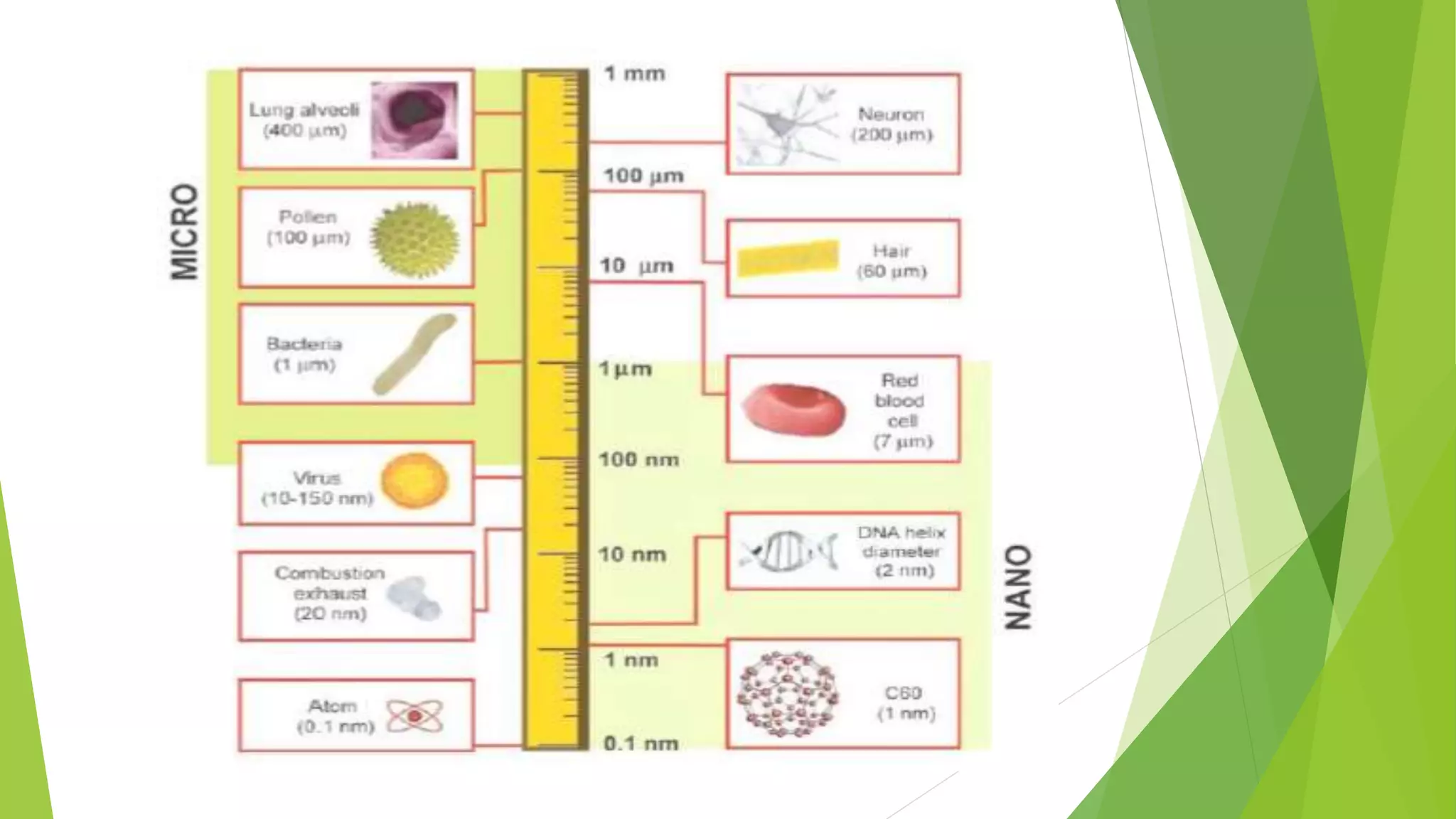
 Nanomaterials are materials
that have structural components
smaller than 1 micrometer in at
least one dimension. While the
atomic and molecular building
blocks (~0.2 nm) of matter are
considered nanomaterials,
examples such as bulk crystals
with lattice spacing of
nanometers but macroscopic
dimensions overall, are
commonly excluded.
Nanoparticles
 Nanoparticles are particles
with at least one dimension
smaller than 1 micron and
potentially as small as atomic
and molecular length scales
(~0.2 nm). Nanoparticles can
have amorphous or
crystalline form and their
surfaces can act as carriers
for liquid droplets or gases.
Nanoparticle
Classification
 Nanoparticles are generally
classified based on their
dimensionality, morphology,
composition, uniformity and
agglomeration.
Dimensionality
 1D nanomaterials. Materials
with one dimension in the
nanometer scale are typically
thin films or surface coatings,
and include the circuitry of
computer chips and the
antireflection and hard coatings
on eyeglasses. Thin films have
been developed and used for
decades in various fields, such as
electronics, chemistry, and
engineering.
Dimensionality
 2D nanomaterials. Two-dimensional
nanomaterials have two dimensions
in the nanometer scale. These
include 2D nanostructured films, with
nanostructures firmly attached to a
substrate, or nanopore filters used
for small particle separation and
filtration. Free particles with a large
aspect ratio, with dimensions in the
nanoscale range, are also considered
2D nanomaterials. Asbestos fibers are
an example of 2D nanoparticles.
Dimensionality
 3D nanomaterials. Materials
that are nano-scaled in all
three dimensions are
considered 3D nanomaterials.
These include thin films
deposited under conditions that
generate atomic-scale porosity,
colloids, and free nanoparticles
with various morphologies.
Nanoparticle
Morphology
 Morphological characteristics to be
taken into account are: flatness,
sphericity, and aspect ratio.
 A general classification exists
between high- and low-aspect ratio
particles. High aspect ratio
nanoparticles include nanotubes
and nanowires, with various shapes,
such as helices, zigzags, belts, or
perhaps nanowires with diameter
that varies with length.
 Small-aspect ratio morphologies
include spherical, oval, cubic,
prism, helical, or pillar. Collections
of many particles exist as powders,
suspension, or colloids.
Nanoparticle
Composition
 Nanoparticles can be composed
of a single constituent material
or be a composite of several
materials. The nanoparticles
found in nature are often
agglomerations of materials
with various compositions,
while pure single-composition
materials can be easily
synthesized today by a variety
of methods.
Nanoparticle
Uniformity and
Agglomeration
 Based on their chemistry and
electro-magnetic properties,
nanoparticles can exist as
dispersed aerosols, as
suspensions/colloids, or in an
agglomerate state.
 In an agglomerate state,
nanoparticles may behave as
larger particles, depending on
the size of the agglomerate.
Sources of
Nanomaterials
 1. Engineered
 2. Incidental
 3. Natural
Engineered
Nanomaterials
 Engineered nanomaterials have
been deliberately engineered
and manufactured by humans to
have certain required
properties.
 Legacy nanomaterials are those
that were in commercial
production prior to the
development of nanotechnology
as incremental advancements
over other colloidal or
particulate materials. They
include carbon
black and titanium dioxide
nanoparticles.
Incidental
source
 Nanomaterials may be
incidentally produced as a
byproduct of mechanical or
industrial processes. Sources of
incidental nanoparticles include
vehicle engine exhausts, welding
fumes, combustion processes
from domestic solid fuel heating
and cooking. Incidental
atmospheric nanoparticles are
often referred to as ultrafine
particles, and are a contributor
to air pollution.
Natural source
 Natural sources of
nanoparticles include
combustion products forest
fires, volcanic ash, ocean
spray, and the radioactive
decay of radon gas. Natural
nanomaterials can also be
formed through weathering
processes of metal- or anion-
containing rocks, as well as
at acid mine drainage sites.
Applications of
Nanomaterials
Electronics
 Microelectronics. By achieving a
significant reduction in the size
of circuit elements, the
microprocessors (or better said,
nanoprocessors) that contain
these components could run
faster and incorporate more
logic gates, thereby enabling
computations at far higher
speeds.
Applications of
Nanomaterials
Electronics
 Displays. The resolution of a
television or a monitor
improves with reduction of
pixel size. The use of
nanocrystalline materials can
greatly enhance resolution and
may significantly reduce cost.
Applications of
Nanomaterials
Electronics
 Data storage. Devices, such as
computer hard-disks function
based on their ability to magnetize
a small area of a spinning disk to
record information, are
established nano-applications.
Discs and tapes containing
engineered nanomaterials can
store large amounts of
information.
Applications of
Nanomaterials
Electronics
 High energy density batteries.
New nanomaterials show promising
properties as anode and cathode
materials in lithium-ion batteries,
having higher capacity and better
cycle life than their larger-particle
equivalents. Among them are:
aerogel intercalation electrode
materials, nanocrystalline alloys,
nanosized composite materials,
carbon nanotubes, and nanosized
transition metal oxides.
Applications of
Nanomaterials
Electronics
 High-sensitivity sensors. Due to
their high surface area an
increased reactivity, nanomaterials
could be employed as sensors for
detecting various parameters, such
as electrical resistivity, chemical
activity, magnetic permeability,
thermal conductivity, and
capacitance.
Application of
Nanomaterials
Transportation and
Telecommunication
 Car tires. Nanoparticles of
carbon black ranging
between 10 nm - 500 nm act
as a filler in the polymer
matrix of tires, and are used
for mechanical
reinforcement.
Application of
Nanomaterials
Transportation and
Telecommunication
 Car bumpers. Clay particle
based composites containing
plastics and nano-sized clay
are used to make car
exteriors that are lighter and
twice as resistant to
scratches than usual
materials
Application of
Nanomaterials
Pollution Remediation
 Elimination of pollutants. Due
to their enhanced chemical
activity, nanomaterials can be
used as catalysts to react with
toxic gases (such as carbon
monoxide and nitrogen oxide) in
automobile catalytic converters
and power generation
equipment.
Application of
Nanomaterials
Pollution Remediation
 Water Remediation. Iron
nanoparticles with a small
content of palladium are tested
to transform harmful products in
groundwater into less harmful
end products. The nanoparticles
are able to remove organic
chlorine (a carcinogen) from
water and soil contaminated
with the chlorine-based organic
solvents (used in dry cleaners)
and convert the solvents to
benign hydrocarbons.
Application of
Nanomaterials
Cosmetics
 Titanium dioxide and zinc oxide
become transparent to visible
light when formed at the
nanoscale, however are able to
absorb and reflect UV light,
being currently used in
sunscreens and in the cosmetic
industry
Application of
Nanomaterials
Coatings
 Self-cleaning windows. Self-
cleaning windows have been
demonstrated that are coated in
highly hydrophobic titanium
dioxide. The titanium dioxide
nanoparticles speed up, in the
presence of water and sunlight,
the breakdown of dirt and
bacteria that can then be
washed off the glass more easily.
Application of
Nanomaterials
Coatings
 Scratch resistant materials.
Nanoscale intermediate layers
between the hard outer layer
and the substrate material
significantly improve wear and
scratch resistant coatings. The
intermediate layers are designed
to give a good bonding and
graded matching of mechanical
and thermal properties, leading
to improved adhesion.
Application of
Nanomaterials
Coatings
 Textiles. Nanoparticles have
already been used in coating
textiles such as nylon, to provide
antimicrobial characteristics.
Also the control of porosity at
the nanoscale and surface
roughness in a variety of
polymers and inorganic materials
led to ultrahydrophobic -
waterproof and stain resistant
fabrics.
Application of
Nanomaterials
Materials
 Insulation materials.
Nanocrystalline materials
synthesized by the sol-gel
technique exhibit a foam-like
structure called an "aerogel".
Aerogels are composed of three-
dimensional, continuous
networks of particles and voids.
Aerogels are porous, extremely
lightweight, and have low
thermal conductivity.
Application of
Nanomaterials
Materials
 Nanocomposites. Composites
are materials that combine two
or more components and are
designed to exhibit overall the
best properties of each
component (mechanical,
biological, optical, electric, or
magnetic)
Application of
Nanomaterials
Materials
 Paints. Nanoparticles confer
enhanced desired mechanical
properties to composites, such as
scratch resistant paints based on
encapsulated nanoparticles. The
wear resistance of the coatings is
claimed to be ten times greater
than that for conventional acrylic
paints.
Application of
Nanomaterials
Mechanical Engineering
 Cutting tools made of
nanocrystalline materials (such
as tungsten carbide, WC) are
much harder than their
conventional due to the fact that
the microhardness of nanosized
composites is increased
compared to that of microsized
composites.
Application of
Nanomaterials
Mechanical Engineering
 Lubricants. Nanospheres of
inorganic materials could be used
as lubricants, acting as nanosized
ball bearings.
Synthesis of
Nanomaterials
 Bottom-up approach
These approaches include the
miniaturization of materials
components (up to atomic level) with
further selfassembly process leading
to the formation of nanostructures.
During self-assembly the physical
forces operating at nanoscale are used
to combine basic units into larger
stable structures. Typical examples
are quantum dot formation during
epitaxial growth and formation of
nanoparticles from colloidal
dispersion.
Synthesis of
Nanomaterials
 Top-down approach
These approaches use larger
(macroscopic) initial structures, which
can be externally-controlled in the
processing of nanostructures. Typical
examples are etching through the
mask, ball milling, and application of
severe plastic deformation.

Nanomaterials 3

  • 1.
  • 2.
    Nanotechnology  Nanotechnology canbe defined as the design, synthesis, and application of materials and devices whose size and shape have been engineered at the nanoscale. It exploits unique chemical, physical, electrical, and mechanical properties that emerge when matter is structured at the nanoscale.
  • 3.
    Nanomaterials  Nanomaterials arematerials that have structural components smaller than 1 micrometer in at least one dimension. While the atomic and molecular building blocks (~0.2 nm) of matter are considered nanomaterials, examples such as bulk crystals with lattice spacing of nanometers but macroscopic dimensions overall, are commonly excluded.
  • 4.
    Nanoparticles  Nanoparticles areparticles with at least one dimension smaller than 1 micron and potentially as small as atomic and molecular length scales (~0.2 nm). Nanoparticles can have amorphous or crystalline form and their surfaces can act as carriers for liquid droplets or gases.
  • 6.
    Nanoparticle Classification  Nanoparticles aregenerally classified based on their dimensionality, morphology, composition, uniformity and agglomeration.
  • 7.
    Dimensionality  1D nanomaterials.Materials with one dimension in the nanometer scale are typically thin films or surface coatings, and include the circuitry of computer chips and the antireflection and hard coatings on eyeglasses. Thin films have been developed and used for decades in various fields, such as electronics, chemistry, and engineering.
  • 8.
    Dimensionality  2D nanomaterials.Two-dimensional nanomaterials have two dimensions in the nanometer scale. These include 2D nanostructured films, with nanostructures firmly attached to a substrate, or nanopore filters used for small particle separation and filtration. Free particles with a large aspect ratio, with dimensions in the nanoscale range, are also considered 2D nanomaterials. Asbestos fibers are an example of 2D nanoparticles.
  • 9.
    Dimensionality  3D nanomaterials.Materials that are nano-scaled in all three dimensions are considered 3D nanomaterials. These include thin films deposited under conditions that generate atomic-scale porosity, colloids, and free nanoparticles with various morphologies.
  • 10.
    Nanoparticle Morphology  Morphological characteristicsto be taken into account are: flatness, sphericity, and aspect ratio.  A general classification exists between high- and low-aspect ratio particles. High aspect ratio nanoparticles include nanotubes and nanowires, with various shapes, such as helices, zigzags, belts, or perhaps nanowires with diameter that varies with length.  Small-aspect ratio morphologies include spherical, oval, cubic, prism, helical, or pillar. Collections of many particles exist as powders, suspension, or colloids.
  • 11.
    Nanoparticle Composition  Nanoparticles canbe composed of a single constituent material or be a composite of several materials. The nanoparticles found in nature are often agglomerations of materials with various compositions, while pure single-composition materials can be easily synthesized today by a variety of methods.
  • 12.
    Nanoparticle Uniformity and Agglomeration  Basedon their chemistry and electro-magnetic properties, nanoparticles can exist as dispersed aerosols, as suspensions/colloids, or in an agglomerate state.  In an agglomerate state, nanoparticles may behave as larger particles, depending on the size of the agglomerate.
  • 14.
    Sources of Nanomaterials  1.Engineered  2. Incidental  3. Natural
  • 15.
    Engineered Nanomaterials  Engineered nanomaterialshave been deliberately engineered and manufactured by humans to have certain required properties.  Legacy nanomaterials are those that were in commercial production prior to the development of nanotechnology as incremental advancements over other colloidal or particulate materials. They include carbon black and titanium dioxide nanoparticles.
  • 16.
    Incidental source  Nanomaterials maybe incidentally produced as a byproduct of mechanical or industrial processes. Sources of incidental nanoparticles include vehicle engine exhausts, welding fumes, combustion processes from domestic solid fuel heating and cooking. Incidental atmospheric nanoparticles are often referred to as ultrafine particles, and are a contributor to air pollution.
  • 17.
    Natural source  Naturalsources of nanoparticles include combustion products forest fires, volcanic ash, ocean spray, and the radioactive decay of radon gas. Natural nanomaterials can also be formed through weathering processes of metal- or anion- containing rocks, as well as at acid mine drainage sites.
  • 18.
    Applications of Nanomaterials Electronics  Microelectronics.By achieving a significant reduction in the size of circuit elements, the microprocessors (or better said, nanoprocessors) that contain these components could run faster and incorporate more logic gates, thereby enabling computations at far higher speeds.
  • 19.
    Applications of Nanomaterials Electronics  Displays.The resolution of a television or a monitor improves with reduction of pixel size. The use of nanocrystalline materials can greatly enhance resolution and may significantly reduce cost.
  • 20.
    Applications of Nanomaterials Electronics  Datastorage. Devices, such as computer hard-disks function based on their ability to magnetize a small area of a spinning disk to record information, are established nano-applications. Discs and tapes containing engineered nanomaterials can store large amounts of information.
  • 21.
    Applications of Nanomaterials Electronics  Highenergy density batteries. New nanomaterials show promising properties as anode and cathode materials in lithium-ion batteries, having higher capacity and better cycle life than their larger-particle equivalents. Among them are: aerogel intercalation electrode materials, nanocrystalline alloys, nanosized composite materials, carbon nanotubes, and nanosized transition metal oxides.
  • 22.
    Applications of Nanomaterials Electronics  High-sensitivitysensors. Due to their high surface area an increased reactivity, nanomaterials could be employed as sensors for detecting various parameters, such as electrical resistivity, chemical activity, magnetic permeability, thermal conductivity, and capacitance.
  • 23.
    Application of Nanomaterials Transportation and Telecommunication Car tires. Nanoparticles of carbon black ranging between 10 nm - 500 nm act as a filler in the polymer matrix of tires, and are used for mechanical reinforcement.
  • 24.
    Application of Nanomaterials Transportation and Telecommunication Car bumpers. Clay particle based composites containing plastics and nano-sized clay are used to make car exteriors that are lighter and twice as resistant to scratches than usual materials
  • 25.
    Application of Nanomaterials Pollution Remediation Elimination of pollutants. Due to their enhanced chemical activity, nanomaterials can be used as catalysts to react with toxic gases (such as carbon monoxide and nitrogen oxide) in automobile catalytic converters and power generation equipment.
  • 26.
    Application of Nanomaterials Pollution Remediation Water Remediation. Iron nanoparticles with a small content of palladium are tested to transform harmful products in groundwater into less harmful end products. The nanoparticles are able to remove organic chlorine (a carcinogen) from water and soil contaminated with the chlorine-based organic solvents (used in dry cleaners) and convert the solvents to benign hydrocarbons.
  • 27.
    Application of Nanomaterials Cosmetics  Titaniumdioxide and zinc oxide become transparent to visible light when formed at the nanoscale, however are able to absorb and reflect UV light, being currently used in sunscreens and in the cosmetic industry
  • 28.
    Application of Nanomaterials Coatings  Self-cleaningwindows. Self- cleaning windows have been demonstrated that are coated in highly hydrophobic titanium dioxide. The titanium dioxide nanoparticles speed up, in the presence of water and sunlight, the breakdown of dirt and bacteria that can then be washed off the glass more easily.
  • 29.
    Application of Nanomaterials Coatings  Scratchresistant materials. Nanoscale intermediate layers between the hard outer layer and the substrate material significantly improve wear and scratch resistant coatings. The intermediate layers are designed to give a good bonding and graded matching of mechanical and thermal properties, leading to improved adhesion.
  • 30.
    Application of Nanomaterials Coatings  Textiles.Nanoparticles have already been used in coating textiles such as nylon, to provide antimicrobial characteristics. Also the control of porosity at the nanoscale and surface roughness in a variety of polymers and inorganic materials led to ultrahydrophobic - waterproof and stain resistant fabrics.
  • 31.
    Application of Nanomaterials Materials  Insulationmaterials. Nanocrystalline materials synthesized by the sol-gel technique exhibit a foam-like structure called an "aerogel". Aerogels are composed of three- dimensional, continuous networks of particles and voids. Aerogels are porous, extremely lightweight, and have low thermal conductivity.
  • 32.
    Application of Nanomaterials Materials  Nanocomposites.Composites are materials that combine two or more components and are designed to exhibit overall the best properties of each component (mechanical, biological, optical, electric, or magnetic)
  • 33.
    Application of Nanomaterials Materials  Paints.Nanoparticles confer enhanced desired mechanical properties to composites, such as scratch resistant paints based on encapsulated nanoparticles. The wear resistance of the coatings is claimed to be ten times greater than that for conventional acrylic paints.
  • 34.
    Application of Nanomaterials Mechanical Engineering Cutting tools made of nanocrystalline materials (such as tungsten carbide, WC) are much harder than their conventional due to the fact that the microhardness of nanosized composites is increased compared to that of microsized composites.
  • 35.
    Application of Nanomaterials Mechanical Engineering Lubricants. Nanospheres of inorganic materials could be used as lubricants, acting as nanosized ball bearings.
  • 36.
    Synthesis of Nanomaterials  Bottom-upapproach These approaches include the miniaturization of materials components (up to atomic level) with further selfassembly process leading to the formation of nanostructures. During self-assembly the physical forces operating at nanoscale are used to combine basic units into larger stable structures. Typical examples are quantum dot formation during epitaxial growth and formation of nanoparticles from colloidal dispersion.
  • 37.
    Synthesis of Nanomaterials  Top-downapproach These approaches use larger (macroscopic) initial structures, which can be externally-controlled in the processing of nanostructures. Typical examples are etching through the mask, ball milling, and application of severe plastic deformation.