NANOSCIENCE AND
NANOTECHNOLOGY
Presented by
Suja Devi V
AssistantProfessor
Dept.of Applied Science,
SCT college
Nanoscience and Nanotechnology
The origin of nanotechnology is from the lectures
delivered by Richard Feynmann which is entitled as
“There is plenty of room at the bottom”.
The word “nano” is derived from a Greek word meaning
dwarf and 1nm=10-9 m.
Nanoscience is the study of fundamental principles of
molecules and structures with atleast one dimension
roughly between 1nm and 100nm.
Application of nanoscience to productive
scale/manufacturing scale is nanotechnology.
*Two main factors that causes significant
change in the properties of nanomaterials from
their bulk counterpart
• Increased surface area to volume ratio
and
• Quantum effects
• These factors can enhance properties
such as strength, reactivity, electrical
optical,mechanical etc..
Increase in surface to volume ratio for
nanomaterials
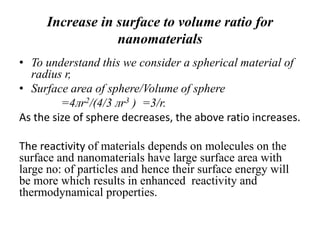
• To understand this we consider a spherical material of
radius r,
• Surface area of sphere/Volume of sphere
=4ᴫr2/(4/3 ᴫr3 ) =3/r.
As the size of sphere decreases, the above ratio increases.
The reactivity of materials depends on molecules on the
surface and nanomaterials have large surface area with
large no: of particles and hence their surface energy will
be more which results in enhanced reactivity and
thermodynamical properties.
Quantum confinement
• The quantum effects dominate the behaviour of
matter at nanoscale affecting optical, electrical
and magnetic properties.
• According to band theory,solid materials have
energy bands and isolated atoms possess
discrete energy levels.For nanomaterials,if the
dimensions of potential wells or boxes are of the
order of the deBroglie wavelength of
electrons,then the energy levels of electron
change and the electron will remain confined to
a small region of the material.This is called
quantum confinement.
Properties of nanomaterials
• Nano materials shows specific properties different from their
bulk counterpart due to large surface area to volume ratio, large
surface energy ,spatial confinement and reduced imperfections.
Mechanical properties.
• The mechanicalstrength of nanostructures is enhanced due to less
surface defects.
• Due to large surface to volume ratio nanomaterials have lower
melting point and reduced lattice constant
• In nanoscale level -hardness and toughness of metals and alloys
are increased.
• The transition from bulk to nanophase reduces elastic strength
and increases plastic behaviour
• Some brittle materials becomes ductile by reducing their grain
size.
Optical properties
• Optical properties are due to increase in energy level
spacing and surface plasmon resonance
• Different sized nanoparticles scatter different
wavelengths of light incident on it ( they have different
absorption spectra)and hence they appear with different
colours.For eg:nano gold appears in purple,red,green
etc. depending on their grain size.
• The bulk copper is opaque whereas in nanoscale it is
transparent.
• In nanoparticles of semiconductor elements such as
Ge,Si etc.. – a shift in optical absorption spectra is
seen.
Electrical properties
• The electrical conductivity and energy bandwidth of
some materials change when they pass from bulk to
nanophase.Eg: bulk silicon is a semiconductor whereas
in nanophase it is conductor.
• Electrical conductivity of nanomaterials depends on
increased perfection, reduced impurity and
dislocations.
• In metals Conductivity decreases with reduced size as
their energy bands become narrower and hence the
ionisation potential energy increases.
• Also conductivity may be enhanced due to better
ordering in microstructure and decreased due to
increased surface scattering.
Applications
• In microelectronics- the reduction in size of electronic
components leads to faster switching times.
• The magnetic strength of material is directly proportional to
the surface to volume ratio.The nanocrystalline high power
rare earth magnet finds applications in submarines,electric
motors,MRI instruments and in ultrasensitive analytical
instruments.
• In computers- Quantum computers use fast quantum
algorithms and have quantum bit memory space(qubit),so it
involves in several computations at the same time.
• Energy efficiency-Nanostructures with a continuum of energy
band gaps have an increased solar energy conversion efficiency
as compared to ordinary semiconductor solar cells.
Other applications
• Medical field--Nano materials are used for the
development of diagnostic devices,drug delivery
systems etc.
• Magnetic nanoparticles are used to label
molecules,structures or micro organism of an antibody.
• Iron nanoparticles are used in cancer treatment.
• Nanotechnology is used to reproduce or repair damaged
tissues.
• The genetic sequence of a sample can bedetected by
tagging gold nanoparticles with small segment of DNA.
• In textile industry- clothes made of nanofibres are water
and stain resistant and wrinkle free.
Answer the following questions .
1.Explain the significance of nanoscale?
Key:Explain the factors responsible for
change in properties at nanorange.
2.Give some medical applications applications
of nanomaterials
3.List the classifications of nanomaterials.
4.Describe the mechanical,electrical and
optical properties of nanomaterials.(essay
qn.part)
Refer Text also.
ThankYou

Nanoscience and nanotechnology

  • 1.
    NANOSCIENCE AND NANOTECHNOLOGY Presented by SujaDevi V AssistantProfessor Dept.of Applied Science, SCT college
  • 2.
    Nanoscience and Nanotechnology Theorigin of nanotechnology is from the lectures delivered by Richard Feynmann which is entitled as “There is plenty of room at the bottom”. The word “nano” is derived from a Greek word meaning dwarf and 1nm=10-9 m. Nanoscience is the study of fundamental principles of molecules and structures with atleast one dimension roughly between 1nm and 100nm. Application of nanoscience to productive scale/manufacturing scale is nanotechnology.
  • 3.
    *Two main factorsthat causes significant change in the properties of nanomaterials from their bulk counterpart • Increased surface area to volume ratio and • Quantum effects • These factors can enhance properties such as strength, reactivity, electrical optical,mechanical etc..
  • 4.
    Increase in surfaceto volume ratio for nanomaterials • To understand this we consider a spherical material of radius r, • Surface area of sphere/Volume of sphere =4ᴫr2/(4/3 ᴫr3 ) =3/r. As the size of sphere decreases, the above ratio increases. The reactivity of materials depends on molecules on the surface and nanomaterials have large surface area with large no: of particles and hence their surface energy will be more which results in enhanced reactivity and thermodynamical properties.
  • 5.
    Quantum confinement • Thequantum effects dominate the behaviour of matter at nanoscale affecting optical, electrical and magnetic properties. • According to band theory,solid materials have energy bands and isolated atoms possess discrete energy levels.For nanomaterials,if the dimensions of potential wells or boxes are of the order of the deBroglie wavelength of electrons,then the energy levels of electron change and the electron will remain confined to a small region of the material.This is called quantum confinement.
  • 6.
    Properties of nanomaterials •Nano materials shows specific properties different from their bulk counterpart due to large surface area to volume ratio, large surface energy ,spatial confinement and reduced imperfections. Mechanical properties. • The mechanicalstrength of nanostructures is enhanced due to less surface defects. • Due to large surface to volume ratio nanomaterials have lower melting point and reduced lattice constant • In nanoscale level -hardness and toughness of metals and alloys are increased. • The transition from bulk to nanophase reduces elastic strength and increases plastic behaviour • Some brittle materials becomes ductile by reducing their grain size.
  • 7.
    Optical properties • Opticalproperties are due to increase in energy level spacing and surface plasmon resonance • Different sized nanoparticles scatter different wavelengths of light incident on it ( they have different absorption spectra)and hence they appear with different colours.For eg:nano gold appears in purple,red,green etc. depending on their grain size. • The bulk copper is opaque whereas in nanoscale it is transparent. • In nanoparticles of semiconductor elements such as Ge,Si etc.. – a shift in optical absorption spectra is seen.
  • 8.
    Electrical properties • Theelectrical conductivity and energy bandwidth of some materials change when they pass from bulk to nanophase.Eg: bulk silicon is a semiconductor whereas in nanophase it is conductor. • Electrical conductivity of nanomaterials depends on increased perfection, reduced impurity and dislocations. • In metals Conductivity decreases with reduced size as their energy bands become narrower and hence the ionisation potential energy increases. • Also conductivity may be enhanced due to better ordering in microstructure and decreased due to increased surface scattering.
  • 9.
    Applications • In microelectronics-the reduction in size of electronic components leads to faster switching times. • The magnetic strength of material is directly proportional to the surface to volume ratio.The nanocrystalline high power rare earth magnet finds applications in submarines,electric motors,MRI instruments and in ultrasensitive analytical instruments. • In computers- Quantum computers use fast quantum algorithms and have quantum bit memory space(qubit),so it involves in several computations at the same time. • Energy efficiency-Nanostructures with a continuum of energy band gaps have an increased solar energy conversion efficiency as compared to ordinary semiconductor solar cells.
  • 10.
    Other applications • Medicalfield--Nano materials are used for the development of diagnostic devices,drug delivery systems etc. • Magnetic nanoparticles are used to label molecules,structures or micro organism of an antibody. • Iron nanoparticles are used in cancer treatment. • Nanotechnology is used to reproduce or repair damaged tissues. • The genetic sequence of a sample can bedetected by tagging gold nanoparticles with small segment of DNA. • In textile industry- clothes made of nanofibres are water and stain resistant and wrinkle free.
  • 11.
    Answer the followingquestions . 1.Explain the significance of nanoscale? Key:Explain the factors responsible for change in properties at nanorange. 2.Give some medical applications applications of nanomaterials 3.List the classifications of nanomaterials. 4.Describe the mechanical,electrical and optical properties of nanomaterials.(essay qn.part) Refer Text also.
  • 12.

Editor's Notes

  • #6 The classification of nanostructured materials is based on quantum confinement. If confinement is in one dimension we get nanosheets. Two dimensional confinement gives quantum wires Three dimensional confinemnet gives quantum dots
  • #11 *Nanoparticles of titanium dioxide is used in making sunscreens and they provide UV protection *Certain nanomaterials act as sensors to detect and remove pollutants from soil,groundwater etc. *Aerogels are nanocrystalline materials used for more effective electrical insulation and used to make smart windows.