NANOTECHNOLOGY AND
ADVANCE MATERIALS
DR. RUCHI TIWARI
RESEARCH CO-ORDINATOR &
PROFESSOR, PSIT, KANPUR, INDIA
 Introduction
 History
 Types of Nanomaterials
 Properties of Nanomaterials
 Synthesis and processing of
Nanomaterials
 Advance nanomaterials
o Fullerenes
o Carbon nanotubes
o Nanowires
o Polymer nanostructures
o Quantum dots
 Nanotechnology in Drugs (Cancer)
 Nanotechnology in Health
 Nanotechnology in INDIA
 Recent trends of Nanotechnology
 Possibilities for future
CONTENTS
Nanoscale materials are defined
as a set of substances where at
least one dimension is less than
approximately 100 nanometers.
“Nano”- derived from a Greek
word “Nanos” meaning DWARF
or small.
A nanometer is one millionth
of a millimeter –
approximately 100,000 times
smaller than the diameter of a
human hair.
A Nanometer is one billionth of
a meter (10-9), roughly the width
of three or four atoms. The
average human hair is about
25,000 nanometers wide.
Nanotechnology is the study of
manipulating matter on an
atomic scale.
Nanotechnology refers to the
constructing and engineering
of the functional systems at
very micro level or we can say
at atomic level.
What
is
Nanotechnology?
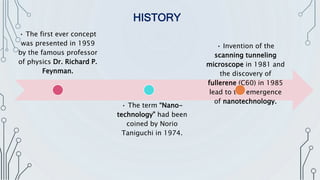
• The first ever concept
was presented in 1959
by the famous professor
of physics Dr. Richard P.
Feynman.
• Invention of the
scanning tunneling
microscope in 1981 and
the discovery of
fullerene (C60) in 1985
lead to the emergence
of nanotechnology.
• The term “Nano-
technology" had been
coined by Norio
Taniguchi in 1974.
HISTORY
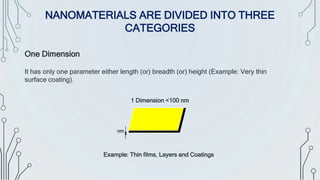
NANOMATERIALS ARE DIVIDED INTO THREE
CATEGORIES
One Dimension
It has only one parameter either length (or) breadth (or) height (Example: Very thin
surface coating).
nm
1 Dimension <100 nm
Example: Thin films, Layers and Coatings
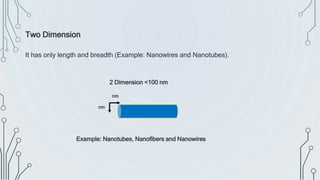
It has only length and breadth (Example: Nanowires and Nanotubes).
2 Dimension <100 nm
nm
nm
Example: Nanotubes, Nanofibers and Nanowires
Two Dimension
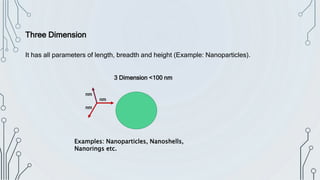
It has all parameters of length, breadth and height (Example: Nanoparticles).
nm
nm
nm
3 Dimension <100 nm
Examples: Nanoparticles, Nanoshells,
Nanorings etc.
Three Dimension
• First, nanomaterials have a very large surface area when
compared to same mass of material produced in a large form.
• Nanoparticles can make materials more chemically reactive and
affect their strength or electrical properties.
• Second, quantum effects can begin to dominate the behaviour of
matter at nanoscale.
• A bulk material should have constant physical properties
regardless of its size but at the nanoscale this is often not the
case.
• Size-dependant properties are observed such as quantum
confinement semiconductor particles and superparamagnetism
in magnetic materials etc.
The properties
of
nanomaterials
can be
different at the
nanoscale for
two main
reasons:
NANOMATERIAL PROPERTIES
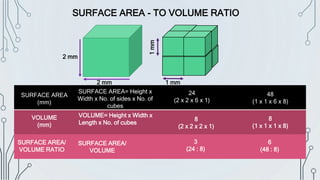
SURFACE AREA - TO VOLUME RATIO
SURFACE AREA
(mm)
SURFACE AREA= Height x
Width x No. of sides x No. of
cubes
24
(2 x 2 x 6 x 1)
48
(1 x 1 x 6 x 8)
VOLUME
(mm)
VOLUME= Height x Width x
Length x No. of cubes
8
(2 x 2 x 2 x 1)
8
(1 x 1 x 1 x 8)
SURFACE AREA/
VOLUME RATIO
SURFACE AREA/
VOLUME
3
(24 : 8)
6
(48 : 8)
2 mm
2 mm
1
mm
1 mm
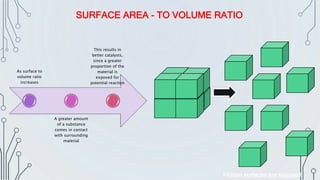
As surface to
volume ratio
increases
A greater amount
of a substance
comes in contact
with surrounding
material
This results in
better catalysts,
since a greater
proportion of the
material is
exposed for
potential reaction
Hidden surfaces are exposed
SURFACE AREA - TO VOLUME RATIO
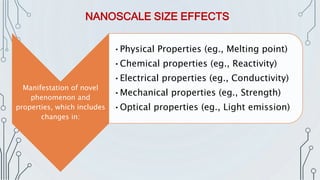
Manifestation of novel
phenomenon and
properties, which includes
changes in:
•Physical Properties (eg., Melting point)
•Chemical properties (eg., Reactivity)
•Electrical properties (eg., Conductivity)
•Mechanical properties (eg., Strength)
•Optical properties (eg., Light emission)
NANOSCALE SIZE EFFECTS
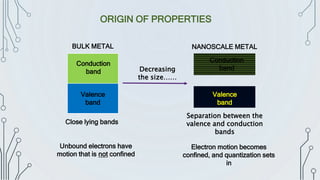
ORIGIN OF PROPERTIES
Conduction
band
Valence
band
BULK METAL
Close lying bands
Unbound electrons have
motion that is not confined
Separation between the
valence and conduction
bands
Electron motion becomes
confined, and quantization sets
in
NANOSCALE METAL
Decreasing
the size……
Conduction
band
Valence
band
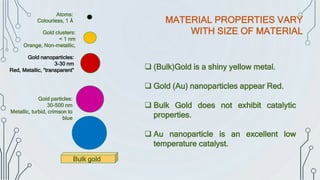
MATERIAL PROPERTIES VARY
WITH SIZE OF MATERIAL
Bulk gold
Gold particles:
30-500 nm
Metallic, turbid, crimson to
blue
Gold nanoparticles:
3-30 nm
Red, Metallic, “transparent”
Gold clusters:
< 1 nm
Orange, Non-metallic,
Atoms:
Colourless, 1 Å
 (Bulk)Gold is a shiny yellow metal.
 Gold (Au) nanoparticles appear Red.
 Bulk Gold does not exhibit catalytic
properties.
 Au nanoparticle is an excellent low
temperature catalyst.
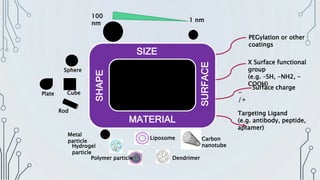
NANOPARTICLE
SIZE
SURFACE
SHAPE
MATERIAL
100
nm
1 nm
PEGylation or other
coatings
X Surface functional
group
(e.g. –SH, -NH2, -
COOH)
-
/+
Surface charge
Targeting Ligand
(e.g. antibody, peptide,
aptamer)
Metal
particle
Hydrogel
particle
Polymer particle
Liposome Carbon
nanotube
Dendrimer
Sphere
Cube
Rod
Plate
o We are dealing with very fine structures: a nanometer is a billionth of a meter.
o This indeed allows us to think in both the ‘bottom up’ or the ‘top down’
approaches to synthesize nanomaterials, i.e. either to assemble atoms
together or to dis-assemble (break, or dissociate) bulk solids into finer pieces
until they are constituted of only a few atoms.
o This domain is a pure example of interdisciplinary work encompassing
physics, chemistry, and engineering up to medicine.
NANOMATERIAL SYNTHESIS AND PROCESSING
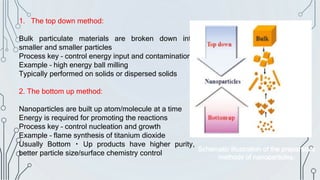
1. The top down method:
Bulk particulate materials are broken down into
smaller and smaller particles
Process key – control energy input and contamination
Example – high energy ball milling
Typically performed on solids or dispersed solids
2. The bottom up method:
Nanoparticles are built up atom/molecule at a time
Energy is required for promoting the reactions
Process key – control nucleation and growth
Example – flame synthesis of titanium dioxide
Usually Bottom Up products have higher purity,
better particle size/surface chemistry control
Schematic illustration of the preparative
methods of nanoparticles.
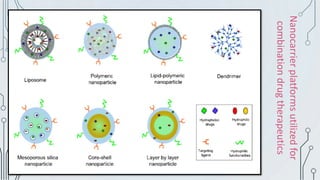
Nanocarrier
platforms
utilized
for
combination
drug
therapeutics
NANOMATERIALS
Nano-composites
• A broad class of materials, with microstructures modulated in zero to
three dimensions on length scales less than 100 nm.
• Materials with atoms arranged in nanosized clusters, which become the
constituent grains or building blocks of the material.
• Any material with at least one dimension in the 1-100 nm range.
• Small filler size and distance between fillers - high surface to volume
ratio
• Mechanical Properties :
- Increased ductility with no decrease of strength,
- Scratching resistance
• Optical properties: - Light transmission characteristics particle size
dependent
Titanium dioxide is awidely used white pigment.
•Titanium dioxide exhibits good photo catalytic properties, hence is used in
antiseptic and antibacterial compositions
•Degrading organic contaminants and germs
•As a UV-resistant material
•Manufacture of printing ink, self-cleaning ceramics and glass, coating, etc.
•Making of cosmetic products such as sunscreen creams, whitening creams,
morning and night creams, skin milks, etc.
•Used in the paper industry for improving the opacity of paper.
TITANIUM DIOXIDE
o Carbon nanostructures have been the focus of much interest and
research since they were first observed in the mid- 1980s.
 FULLERENES
 CARBON NANOTUBES
 NANOWIRES
 POLYMER NANOSTRUCTURES
 QUANTUM DOTS
FULLERENES
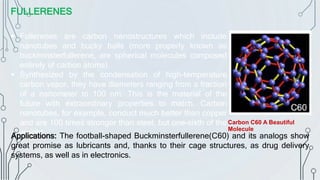
 Fullerenes are carbon nanostructures which include
nanotubes and bucky balls (more properly known as
buckminsterfullerene, are spherical molecules composed
entirely of carbon atoms).
 Synthesized by the condensation of high-temperature
carbon vapor, they have diameters ranging from a fraction
of a nanometer to 100 nm. This is the material of the
future with extraordinary properties to match. Carbon
nanotubes, for example, conduct much better than copper
and are 100 times stronger than steel, but one-sixth of the
weight.
Applications: The football-shaped Buckminsterfullerene(C60) and its analogs show
great promise as lubricants and, thanks to their cage structures, as drug delivery
systems, as well as in electronics.
Carbon C60 A Beautiful
Molecule
Carbon Nanotube
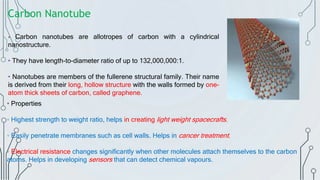
• Carbon nanotubes are allotropes of carbon with a cylindrical
nanostructure.
• They have length-to-diameter ratio of up to 132,000,000:1.
• Nanotubes are members of the fullerene structural family. Their name
is derived from their long, hollow structure with the walls formed by one-
atom thick sheets of carbon, called graphene.
• Properties
▫ Highest strength to weight ratio, helps in creating light weight spacecrafts.
▫ Easily penetrate membranes such as cell walls. Helps in cancer treatment.
▫ Electrical resistance changes significantly when other molecules attach themselves to the carbon
atoms. Helps in developing sensors that can detect chemical vapours.
NANOWIRES
o Nanotubes of the length longer than 1 nm are usually called nanowires or
nanofibers. Nanowires are especially attractive for nanoscience studies as well
as for nanotechnology applications. They can be prepared by physics,
chemistry or the mixture to produce metallic wires, and semiconductors.
o Increased surface areas, very high density of electronic states and joint density
of states near the energies of their van Hove singularities, enhanced excitation
binding energy, diameter-dependent bandgap, and increased surface scattering
for electrons and phonons are just some of the ways in which nanowires differ
from their corresponding bulk materials.
o Due to the enhanced surface-to-volume ratio in nanowires, their properties may
depend sensitively on their surface condition and geometrical configuration.
1. Transport properties
Important factors that determine the transport properties of nanowires include the
wire diameter, material composition, surface conditions, crystal quality, and the
crystallographic orientation of the wire axis.
2. Optical Properties
Optical methods provide an easy and sensitive tool for measuring the electronic
structure of nanowires since optical measurements require minimal sample
preparation and the measurements are sensitive to quantum effects.
NANO DRUG ENCAPSULATION
Using a chemical process, drugs are encapsulated in biodegradable-
polymer capsules 100 to 200 nm in diameter. Due to their small size the
capsules are taken up by cells. The benefit is a reduction in dose
frequency of medication due to the slow release of the drug.
Applications: delivery of TB, HIV/Aids and malaria drugs.
NANO DRUG ENCAPSULATION
Using a chemical process, drugs are encapsulated in biodegradable-
polymer capsules 100 to 200 nm in diameter. Due to their small size the
capsules are taken up by cells. The benefit is a reduction in dose
frequency of medication due to the slow release of the drug.
Applications: delivery of TB, HIV/Aids and malaria drugs.
QUANTUM DOTS
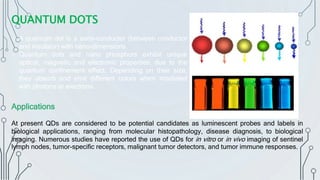
o A quantum dot is a semi-conductor (between conductor
and insulator) with nano-dimensions.
o Quantum dots and nano phosphors exhibit unique
optical, magnetic and electronic properties, due to the
quantum confinement effect. Depending on their size,
they absorb and emit different colors when irradiated
with photons or electrons.
Applications
At present QDs are considered to be potential candidates as luminescent probes and labels in
biological applications, ranging from molecular histopathology, disease diagnosis, to biological
imaging. Numerous studies have reported the use of QDs for in vitro or in vivo imaging of sentinel
lymph nodes, tumor-specific receptors, malignant tumor detectors, and tumor immune responses.
• Small in size
• Broad absorption spectra & size tunable narrow emission spectra
• Resistant to photo bleaching.
• Shows fluorescence intermittency.
• They are made of many of the same materials as ordinary semiconductors,
Ex.- CdSe, CdS, GaAs, GaP (mainly combinations of transition metals and/or
metalloids).
• Unlike ordinary bulk semiconductors, which are generally macroscopic
objects, quantum dots are extremely small, on the order of a few nanometers
(2-10 nm, 10-50 atoms).
• They are very nearly zero-dimensional in comparison to bulk semiconductor.
PROPERTIES OF QDs
Nanobots
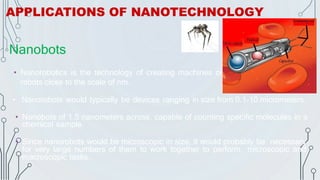
• Nanorobotics is the technology of creating machines or
robots close to the scale of nm.
• Nanorobots would typically be devices ranging in size from 0.1-10 micrometers.
• Nanobots of 1.5 nanometers across, capable of counting specific molecules in a
chemical sample.
• Since nanorobots would be microscopic in size, it would probably be necessary
for very large numbers of them to work together to perform microscopic and
macroscopic tasks.
APPLICATIONS OF NANOTECHNOLOGY
MEDICAL NANOROBOTICSAPPLICATIONS
• Breaking up blood clots
• Cancertherapy
• Parasiteremoval
• Targeted drug delivery
• Breaking up of kidneystones
• In treatment ofArteriosclerosis
• Neuron replacement
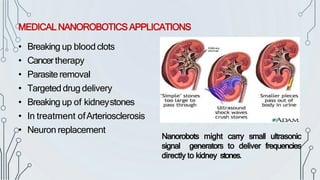
Nanorobots might carry small ultrasonic
signal generators to deliver frequencies
directly to kidney stones.
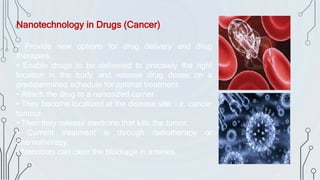
Nanotechnology in Drugs (Cancer)
• Provide new options for drug delivery and drug
therapies.
• Enable drugs to be delivered to precisely the right
location in the body and release drug doses on a
predetermined schedule for optimal treatment.
• Attach the drug to a nanosized carrier.
• They become localized at the disease site, i.e. cancer
tumour.
• Then they release medicine that kills the tumor.
• Current treatment is through radiotherapy or
chemotherapy.
• Nanobots can clear the blockage in arteries.
Other uses
• Silver nanocrystals have been embedded in bandages to kill bacteria and prevent
infection.
• Nanoparticulate-based synthetic bone formed by manipulating calcium and
phosphate at the molecular level.
• Aerogels lightest known solid due to good insulating properties is used in space
suits and are proposed to use in space craft.
Sunscreens • UVB exposure sunburn, carcinomas
• UVA exposure melanoma, premature aging
• Nanoscale TiO2 and ZnO particles provide broad
spectrum UV protection in a transparent formulation
• Sunscreens, also daily wear products
NANOTECHNOLOGY IN HEALTH
Portable, but highly sensitive point-of-care test kits are under development which
will offer all the diagnostic functions of a medical laboratory.
Also known as the “lab-on-a-chip” because of their ability to emulate the services
of a complete medical laboratory.
According to Robert Tshikudo, Head of nanotechnology at Mintek, research on
using the kits for infectious diseases is in the “final stages” and the ultimate goal
is to make the kits available to government hospitals and clinics where they can
“reach those who need it”.
Biomedical imaging – Nanotechnology applications are in development that
will radically improve medical imaging techniques.
For example, gold and silver nanoparticles have optical properties which
make them extremely effective as contrast agents.
Quantum dots which are brighter than organic dyes and need only one light
source for excitation, when used in conjunction with magnetic resonance
imaging, can produce exceptional images of tumour sites.
Nanomaterials are also used in therapeutics or treatment:
Targeted drug delivery systems – Nanostructures can be used to recognize
diseased cells and to deliver drugs to the affected areas to combat cancerous
tumors, for example, without harming healthy cells. In obesity, nanoparticles
can target and inhibit the growth of fat deposits.
Slow-release drug therapy – Research shows that nano-sized biodegradable
polymer capsules containing drugs for tuberculosis treatment are effectively
taken up by the body’s cells. The effect is a slower release of the drug into the
body and a reduction in the frequency with which TB patients need to take his
or her medication.
Photothermal and hypothermal destruction of cancer – Some nanoparticles,
such as gold, possess therapeutic properties based on their magnetic
wavelength or optical properties. They absorb light and heat up the surrounding
area, killing the cancer cells.
Nanotechnology in India
• IIT Mumbai is the premier organization in the field of nanotechnology.
• Starting in 2001 the Government of India launched the Nano Science and Technology
Initiative (NSTI).
• Then in 2007 the Nanoscience and Technology Mission 2007 was initiated with an
allocation of Rupees 1000 crores for a period of five years.
• The main objectives of the Nano Mission are:
- basic research promotion,
- infrastructure development for carrying out front-ranking research,
- development of nano technologies and their applications,
- human resource development and
- international collaborations.
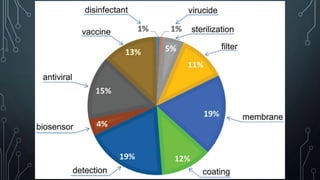
Nano-based products are currently being developed and deployed for the
containment, diagnosis, and treatment of COVID-19.
Nanotechnology and nanomaterials promise:
o Improved and virus disabling air filtration.
o Low-cost, scalable detection methods for the detection of viral particles
o Enhanced personal protection equipment (PPE) including facemasks.
o New antiviral vaccine and drug delivery platforms.
o New therapeutic solutions.
DRDO laboratories have applied their technical know-how and expertise in textile,
coating and nanotechnology to develop Personal Protective Equipment (PPE)
having specific type of fabric with coating.
POSSIBLE CONTRIBUTION OF NANOTECHNOLOGY TO COVID-19
 Nanotechnology strategies for disinfection of surfaces and PPE
 Nanomaterials for surface decontamination
 Development of nanomaterials for PPE
 Carriers and drug delivery systems with potential to control viral infection
 Nano-based vaccines
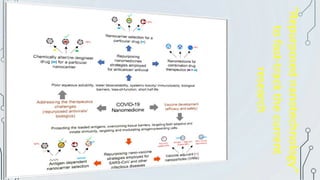
 Nanomedicine Approach for COVID-19 Therapeutics (Rational Selection of Drug-
Nanocarrier Combination)
Strategy 1. Nanocarrier Selection to Bypass the Conventional Limitations of a
Drug Candidate.
Strategy 2. Chemically Alter/(Re)engineer Drugs.
Strategy 3. Nanomedicine for Combination Drug Therapeutics.
 Nanomedicine Approach for COVID-19 Vaccine.
Strategy 1. Antigen-Dependent Nanocarrier Selection.
Strategy 2. Vaccine Adjuvant Nanoparticles.
How can nanotechnology help to
combat
COVID-19?
“Repurposed
nanotechnology”
to
fast-track
the
current
research
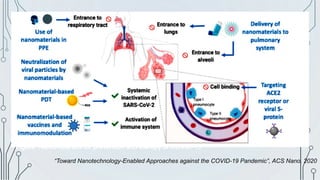
Nanomedicine Approach for COVID-19 Therapeutics
(Rational Selection of Drug-Nanocarrier Combination)
“Toward Nanotechnology-Enabled Approaches against the COVID-19 Pandemic”, ACS Nano, 2020
Figure: Nanomaterials for prevention and therapy of COVID-19
POSSIBILITIES FOR THE FUTURE
• Nanotechnology may make it possible to manufacture lighter, stronger, and
programmable materials that
▫ require less energy to produce than conventional material
▫ and that promise greater fuel efficiency in land transportation, ships, aircraft,
and space vehicles.
• The future of nanotechnology could very well include the use of nanorobotics.
• There would be an entire nano surgical field to help cure everything from
natural aging to diabetes to bone spurs.
PITFALLS OF NANOTECHNOLOGY
▫ Nano-particles can get into the body through the skin, lungs and digestive system,
thus creating free radicals that can cause cell damage.
▫ Once nano-particles are in the bloodstream, they will be able to cross the blood-
brain barrier.
▫ The most dangerous Nano-application use for military purposes is the Nano-bomb
that contain engineered self multiplying deadly viruses that can continue to wipe out
a community, country or even a civilization.
▫ Nanobots because of their replicating behavior can be big threat for GRAY GOO.
THANK YOU

NANOTECHNOLOGY AND ADVANCE MATERIALS.pptx

  • 1.
    NANOTECHNOLOGY AND ADVANCE MATERIALS DR.RUCHI TIWARI RESEARCH CO-ORDINATOR & PROFESSOR, PSIT, KANPUR, INDIA
  • 2.
     Introduction  History Types of Nanomaterials  Properties of Nanomaterials  Synthesis and processing of Nanomaterials  Advance nanomaterials o Fullerenes o Carbon nanotubes o Nanowires o Polymer nanostructures o Quantum dots  Nanotechnology in Drugs (Cancer)  Nanotechnology in Health  Nanotechnology in INDIA  Recent trends of Nanotechnology  Possibilities for future CONTENTS
  • 3.
    Nanoscale materials aredefined as a set of substances where at least one dimension is less than approximately 100 nanometers. “Nano”- derived from a Greek word “Nanos” meaning DWARF or small. A nanometer is one millionth of a millimeter – approximately 100,000 times smaller than the diameter of a human hair. A Nanometer is one billionth of a meter (10-9), roughly the width of three or four atoms. The average human hair is about 25,000 nanometers wide. Nanotechnology is the study of manipulating matter on an atomic scale. Nanotechnology refers to the constructing and engineering of the functional systems at very micro level or we can say at atomic level. What is Nanotechnology?
  • 4.
    • The firstever concept was presented in 1959 by the famous professor of physics Dr. Richard P. Feynman. • Invention of the scanning tunneling microscope in 1981 and the discovery of fullerene (C60) in 1985 lead to the emergence of nanotechnology. • The term “Nano- technology" had been coined by Norio Taniguchi in 1974. HISTORY
  • 5.
    NANOMATERIALS ARE DIVIDEDINTO THREE CATEGORIES One Dimension It has only one parameter either length (or) breadth (or) height (Example: Very thin surface coating). nm 1 Dimension <100 nm Example: Thin films, Layers and Coatings
  • 6.
    It has onlylength and breadth (Example: Nanowires and Nanotubes). 2 Dimension <100 nm nm nm Example: Nanotubes, Nanofibers and Nanowires Two Dimension
  • 7.
    It has allparameters of length, breadth and height (Example: Nanoparticles). nm nm nm 3 Dimension <100 nm Examples: Nanoparticles, Nanoshells, Nanorings etc. Three Dimension
  • 8.
    • First, nanomaterialshave a very large surface area when compared to same mass of material produced in a large form. • Nanoparticles can make materials more chemically reactive and affect their strength or electrical properties. • Second, quantum effects can begin to dominate the behaviour of matter at nanoscale. • A bulk material should have constant physical properties regardless of its size but at the nanoscale this is often not the case. • Size-dependant properties are observed such as quantum confinement semiconductor particles and superparamagnetism in magnetic materials etc. The properties of nanomaterials can be different at the nanoscale for two main reasons: NANOMATERIAL PROPERTIES
  • 9.
    SURFACE AREA -TO VOLUME RATIO SURFACE AREA (mm) SURFACE AREA= Height x Width x No. of sides x No. of cubes 24 (2 x 2 x 6 x 1) 48 (1 x 1 x 6 x 8) VOLUME (mm) VOLUME= Height x Width x Length x No. of cubes 8 (2 x 2 x 2 x 1) 8 (1 x 1 x 1 x 8) SURFACE AREA/ VOLUME RATIO SURFACE AREA/ VOLUME 3 (24 : 8) 6 (48 : 8) 2 mm 2 mm 1 mm 1 mm
  • 10.
    As surface to volumeratio increases A greater amount of a substance comes in contact with surrounding material This results in better catalysts, since a greater proportion of the material is exposed for potential reaction Hidden surfaces are exposed SURFACE AREA - TO VOLUME RATIO
  • 11.
    Manifestation of novel phenomenonand properties, which includes changes in: •Physical Properties (eg., Melting point) •Chemical properties (eg., Reactivity) •Electrical properties (eg., Conductivity) •Mechanical properties (eg., Strength) •Optical properties (eg., Light emission) NANOSCALE SIZE EFFECTS
  • 12.
    ORIGIN OF PROPERTIES Conduction band Valence band BULKMETAL Close lying bands Unbound electrons have motion that is not confined Separation between the valence and conduction bands Electron motion becomes confined, and quantization sets in NANOSCALE METAL Decreasing the size…… Conduction band Valence band
  • 13.
    MATERIAL PROPERTIES VARY WITHSIZE OF MATERIAL Bulk gold Gold particles: 30-500 nm Metallic, turbid, crimson to blue Gold nanoparticles: 3-30 nm Red, Metallic, “transparent” Gold clusters: < 1 nm Orange, Non-metallic, Atoms: Colourless, 1 Å  (Bulk)Gold is a shiny yellow metal.  Gold (Au) nanoparticles appear Red.  Bulk Gold does not exhibit catalytic properties.  Au nanoparticle is an excellent low temperature catalyst.
  • 14.
    NANOPARTICLE SIZE SURFACE SHAPE MATERIAL 100 nm 1 nm PEGylation orother coatings X Surface functional group (e.g. –SH, -NH2, - COOH) - /+ Surface charge Targeting Ligand (e.g. antibody, peptide, aptamer) Metal particle Hydrogel particle Polymer particle Liposome Carbon nanotube Dendrimer Sphere Cube Rod Plate
  • 15.
    o We aredealing with very fine structures: a nanometer is a billionth of a meter. o This indeed allows us to think in both the ‘bottom up’ or the ‘top down’ approaches to synthesize nanomaterials, i.e. either to assemble atoms together or to dis-assemble (break, or dissociate) bulk solids into finer pieces until they are constituted of only a few atoms. o This domain is a pure example of interdisciplinary work encompassing physics, chemistry, and engineering up to medicine. NANOMATERIAL SYNTHESIS AND PROCESSING
  • 16.
    1. The topdown method: Bulk particulate materials are broken down into smaller and smaller particles Process key – control energy input and contamination Example – high energy ball milling Typically performed on solids or dispersed solids 2. The bottom up method: Nanoparticles are built up atom/molecule at a time Energy is required for promoting the reactions Process key – control nucleation and growth Example – flame synthesis of titanium dioxide Usually Bottom Up products have higher purity, better particle size/surface chemistry control Schematic illustration of the preparative methods of nanoparticles.
  • 17.
  • 18.
    NANOMATERIALS Nano-composites • A broadclass of materials, with microstructures modulated in zero to three dimensions on length scales less than 100 nm. • Materials with atoms arranged in nanosized clusters, which become the constituent grains or building blocks of the material. • Any material with at least one dimension in the 1-100 nm range. • Small filler size and distance between fillers - high surface to volume ratio • Mechanical Properties : - Increased ductility with no decrease of strength, - Scratching resistance • Optical properties: - Light transmission characteristics particle size dependent
  • 19.
    Titanium dioxide isawidely used white pigment. •Titanium dioxide exhibits good photo catalytic properties, hence is used in antiseptic and antibacterial compositions •Degrading organic contaminants and germs •As a UV-resistant material •Manufacture of printing ink, self-cleaning ceramics and glass, coating, etc. •Making of cosmetic products such as sunscreen creams, whitening creams, morning and night creams, skin milks, etc. •Used in the paper industry for improving the opacity of paper. TITANIUM DIOXIDE
  • 20.
    o Carbon nanostructureshave been the focus of much interest and research since they were first observed in the mid- 1980s.  FULLERENES  CARBON NANOTUBES  NANOWIRES  POLYMER NANOSTRUCTURES  QUANTUM DOTS
  • 21.
    FULLERENES  Fullerenes arecarbon nanostructures which include nanotubes and bucky balls (more properly known as buckminsterfullerene, are spherical molecules composed entirely of carbon atoms).  Synthesized by the condensation of high-temperature carbon vapor, they have diameters ranging from a fraction of a nanometer to 100 nm. This is the material of the future with extraordinary properties to match. Carbon nanotubes, for example, conduct much better than copper and are 100 times stronger than steel, but one-sixth of the weight. Applications: The football-shaped Buckminsterfullerene(C60) and its analogs show great promise as lubricants and, thanks to their cage structures, as drug delivery systems, as well as in electronics. Carbon C60 A Beautiful Molecule
  • 22.
    Carbon Nanotube • Carbonnanotubes are allotropes of carbon with a cylindrical nanostructure. • They have length-to-diameter ratio of up to 132,000,000:1. • Nanotubes are members of the fullerene structural family. Their name is derived from their long, hollow structure with the walls formed by one- atom thick sheets of carbon, called graphene. • Properties ▫ Highest strength to weight ratio, helps in creating light weight spacecrafts. ▫ Easily penetrate membranes such as cell walls. Helps in cancer treatment. ▫ Electrical resistance changes significantly when other molecules attach themselves to the carbon atoms. Helps in developing sensors that can detect chemical vapours.
  • 23.
    NANOWIRES o Nanotubes ofthe length longer than 1 nm are usually called nanowires or nanofibers. Nanowires are especially attractive for nanoscience studies as well as for nanotechnology applications. They can be prepared by physics, chemistry or the mixture to produce metallic wires, and semiconductors. o Increased surface areas, very high density of electronic states and joint density of states near the energies of their van Hove singularities, enhanced excitation binding energy, diameter-dependent bandgap, and increased surface scattering for electrons and phonons are just some of the ways in which nanowires differ from their corresponding bulk materials. o Due to the enhanced surface-to-volume ratio in nanowires, their properties may depend sensitively on their surface condition and geometrical configuration.
  • 24.
    1. Transport properties Importantfactors that determine the transport properties of nanowires include the wire diameter, material composition, surface conditions, crystal quality, and the crystallographic orientation of the wire axis. 2. Optical Properties Optical methods provide an easy and sensitive tool for measuring the electronic structure of nanowires since optical measurements require minimal sample preparation and the measurements are sensitive to quantum effects.
  • 25.
    NANO DRUG ENCAPSULATION Usinga chemical process, drugs are encapsulated in biodegradable- polymer capsules 100 to 200 nm in diameter. Due to their small size the capsules are taken up by cells. The benefit is a reduction in dose frequency of medication due to the slow release of the drug. Applications: delivery of TB, HIV/Aids and malaria drugs.
  • 26.
    NANO DRUG ENCAPSULATION Usinga chemical process, drugs are encapsulated in biodegradable- polymer capsules 100 to 200 nm in diameter. Due to their small size the capsules are taken up by cells. The benefit is a reduction in dose frequency of medication due to the slow release of the drug. Applications: delivery of TB, HIV/Aids and malaria drugs.
  • 27.
    QUANTUM DOTS o Aquantum dot is a semi-conductor (between conductor and insulator) with nano-dimensions. o Quantum dots and nano phosphors exhibit unique optical, magnetic and electronic properties, due to the quantum confinement effect. Depending on their size, they absorb and emit different colors when irradiated with photons or electrons. Applications At present QDs are considered to be potential candidates as luminescent probes and labels in biological applications, ranging from molecular histopathology, disease diagnosis, to biological imaging. Numerous studies have reported the use of QDs for in vitro or in vivo imaging of sentinel lymph nodes, tumor-specific receptors, malignant tumor detectors, and tumor immune responses.
  • 28.
    • Small insize • Broad absorption spectra & size tunable narrow emission spectra • Resistant to photo bleaching. • Shows fluorescence intermittency. • They are made of many of the same materials as ordinary semiconductors, Ex.- CdSe, CdS, GaAs, GaP (mainly combinations of transition metals and/or metalloids). • Unlike ordinary bulk semiconductors, which are generally macroscopic objects, quantum dots are extremely small, on the order of a few nanometers (2-10 nm, 10-50 atoms). • They are very nearly zero-dimensional in comparison to bulk semiconductor. PROPERTIES OF QDs
  • 29.
    Nanobots • Nanorobotics isthe technology of creating machines or robots close to the scale of nm. • Nanorobots would typically be devices ranging in size from 0.1-10 micrometers. • Nanobots of 1.5 nanometers across, capable of counting specific molecules in a chemical sample. • Since nanorobots would be microscopic in size, it would probably be necessary for very large numbers of them to work together to perform microscopic and macroscopic tasks. APPLICATIONS OF NANOTECHNOLOGY
  • 30.
    MEDICAL NANOROBOTICSAPPLICATIONS • Breakingup blood clots • Cancertherapy • Parasiteremoval • Targeted drug delivery • Breaking up of kidneystones • In treatment ofArteriosclerosis • Neuron replacement Nanorobots might carry small ultrasonic signal generators to deliver frequencies directly to kidney stones.
  • 31.
    Nanotechnology in Drugs(Cancer) • Provide new options for drug delivery and drug therapies. • Enable drugs to be delivered to precisely the right location in the body and release drug doses on a predetermined schedule for optimal treatment. • Attach the drug to a nanosized carrier. • They become localized at the disease site, i.e. cancer tumour. • Then they release medicine that kills the tumor. • Current treatment is through radiotherapy or chemotherapy. • Nanobots can clear the blockage in arteries.
  • 32.
    Other uses • Silvernanocrystals have been embedded in bandages to kill bacteria and prevent infection. • Nanoparticulate-based synthetic bone formed by manipulating calcium and phosphate at the molecular level. • Aerogels lightest known solid due to good insulating properties is used in space suits and are proposed to use in space craft. Sunscreens • UVB exposure sunburn, carcinomas • UVA exposure melanoma, premature aging • Nanoscale TiO2 and ZnO particles provide broad spectrum UV protection in a transparent formulation • Sunscreens, also daily wear products
  • 33.
    NANOTECHNOLOGY IN HEALTH Portable,but highly sensitive point-of-care test kits are under development which will offer all the diagnostic functions of a medical laboratory. Also known as the “lab-on-a-chip” because of their ability to emulate the services of a complete medical laboratory. According to Robert Tshikudo, Head of nanotechnology at Mintek, research on using the kits for infectious diseases is in the “final stages” and the ultimate goal is to make the kits available to government hospitals and clinics where they can “reach those who need it”.
  • 34.
    Biomedical imaging –Nanotechnology applications are in development that will radically improve medical imaging techniques. For example, gold and silver nanoparticles have optical properties which make them extremely effective as contrast agents. Quantum dots which are brighter than organic dyes and need only one light source for excitation, when used in conjunction with magnetic resonance imaging, can produce exceptional images of tumour sites. Nanomaterials are also used in therapeutics or treatment: Targeted drug delivery systems – Nanostructures can be used to recognize diseased cells and to deliver drugs to the affected areas to combat cancerous tumors, for example, without harming healthy cells. In obesity, nanoparticles can target and inhibit the growth of fat deposits.
  • 35.
    Slow-release drug therapy– Research shows that nano-sized biodegradable polymer capsules containing drugs for tuberculosis treatment are effectively taken up by the body’s cells. The effect is a slower release of the drug into the body and a reduction in the frequency with which TB patients need to take his or her medication. Photothermal and hypothermal destruction of cancer – Some nanoparticles, such as gold, possess therapeutic properties based on their magnetic wavelength or optical properties. They absorb light and heat up the surrounding area, killing the cancer cells.
  • 36.
    Nanotechnology in India •IIT Mumbai is the premier organization in the field of nanotechnology. • Starting in 2001 the Government of India launched the Nano Science and Technology Initiative (NSTI). • Then in 2007 the Nanoscience and Technology Mission 2007 was initiated with an allocation of Rupees 1000 crores for a period of five years. • The main objectives of the Nano Mission are: - basic research promotion, - infrastructure development for carrying out front-ranking research, - development of nano technologies and their applications, - human resource development and - international collaborations.
  • 37.
    Nano-based products arecurrently being developed and deployed for the containment, diagnosis, and treatment of COVID-19. Nanotechnology and nanomaterials promise: o Improved and virus disabling air filtration. o Low-cost, scalable detection methods for the detection of viral particles o Enhanced personal protection equipment (PPE) including facemasks. o New antiviral vaccine and drug delivery platforms. o New therapeutic solutions. DRDO laboratories have applied their technical know-how and expertise in textile, coating and nanotechnology to develop Personal Protective Equipment (PPE) having specific type of fabric with coating. POSSIBLE CONTRIBUTION OF NANOTECHNOLOGY TO COVID-19
  • 38.
     Nanotechnology strategiesfor disinfection of surfaces and PPE  Nanomaterials for surface decontamination  Development of nanomaterials for PPE  Carriers and drug delivery systems with potential to control viral infection  Nano-based vaccines  Nanomedicine Approach for COVID-19 Therapeutics (Rational Selection of Drug- Nanocarrier Combination) Strategy 1. Nanocarrier Selection to Bypass the Conventional Limitations of a Drug Candidate. Strategy 2. Chemically Alter/(Re)engineer Drugs. Strategy 3. Nanomedicine for Combination Drug Therapeutics.  Nanomedicine Approach for COVID-19 Vaccine. Strategy 1. Antigen-Dependent Nanocarrier Selection. Strategy 2. Vaccine Adjuvant Nanoparticles. How can nanotechnology help to combat COVID-19?
  • 40.
  • 41.
    Nanomedicine Approach forCOVID-19 Therapeutics (Rational Selection of Drug-Nanocarrier Combination)
  • 42.
    “Toward Nanotechnology-Enabled Approachesagainst the COVID-19 Pandemic”, ACS Nano, 2020 Figure: Nanomaterials for prevention and therapy of COVID-19
  • 44.
    POSSIBILITIES FOR THEFUTURE • Nanotechnology may make it possible to manufacture lighter, stronger, and programmable materials that ▫ require less energy to produce than conventional material ▫ and that promise greater fuel efficiency in land transportation, ships, aircraft, and space vehicles. • The future of nanotechnology could very well include the use of nanorobotics. • There would be an entire nano surgical field to help cure everything from natural aging to diabetes to bone spurs.
  • 45.
    PITFALLS OF NANOTECHNOLOGY ▫Nano-particles can get into the body through the skin, lungs and digestive system, thus creating free radicals that can cause cell damage. ▫ Once nano-particles are in the bloodstream, they will be able to cross the blood- brain barrier. ▫ The most dangerous Nano-application use for military purposes is the Nano-bomb that contain engineered self multiplying deadly viruses that can continue to wipe out a community, country or even a civilization. ▫ Nanobots because of their replicating behavior can be big threat for GRAY GOO.
  • 46.