Exchange-Correlation
Functionals
Shyue Ping Ong
What’s next?
LDA uses local density ρ from homogenous
electron gas
Next step: Let’s add a gradient of the density!
Generalized gradient approximation (GGA)
NANO266
2
Exc
GGA
[ρ↑
,ρ↓
]= drρ(r)εxc (∫ ρ↑
,ρ↓
, ∇ρ↑
, ∇ρ↓
)
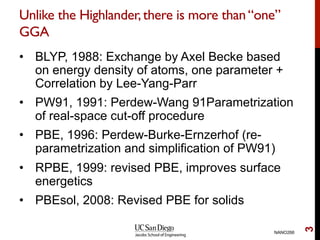
Unlike the Highlander,there is more than“one”
GGA
•  BLYP, 1988: Exchange by Axel Becke based
on energy density of atoms, one parameter +
Correlation by Lee-Yang-Parr
•  PW91, 1991: Perdew-Wang 91Parametrization
of real-space cut-off procedure
•  PBE, 1996: Perdew-Burke-Ernzerhof (re-
parametrization and simplification of PW91)
•  RPBE, 1999: revised PBE, improves surface
energetics
•  PBEsol, 2008: Revised PBE for solids
NANO266
3
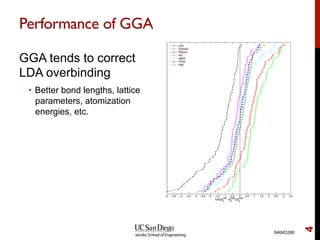
Performance of GGA
GGA tends to correct
LDA overbinding
•  Better bond lengths, lattice
parameters, atomization
energies, etc.
NANO266
4
Why stop at the first derivative?
Meta-GGA
Example: TPSS functional
NANO266
5
Exc
meta−GGA
[ρ↑
,ρ↓
]= drρ(r)εxc (∫ ρ↑
,ρ↓
, ∇ρ↑
, ∇ρ↓
,∇2
ρ↑
,∇2
ρ↓
)
Tao, J.; Perdew, J. P.; Staroverov, V. N.; Scuseria, G. E. Climbing the density functional ladder: nonempirical meta-generalized gradient
approximation designed for molecules and solids., Phys. Rev. Lett., 2003, 91, 146401, doi:10.1103/PhysRevLett.91.146401.
Orbital-dependent methods
DFT+U1,2,3
•  Treat strong on-site Coulomb interaction of localized electrons,
e.g., d and f electrons (incorrectly described by LDA or GGA) with
an additional Hubbard-like term.
•  Strength of on-site interactions usually described by U (on site
Coulomb) and J (on site exchange), which can be extracted from
ab-initio calculations,4 but usually are obtained semi-empirically,
e.g., fitting to experimental formation energies or band gaps.
NANO266
6
(1)  Anisimov, V. I.; Zaanen, J.; Andersen, O. K. Phys. Rev. B, 1991, 44, 943–954.
(2)  Anisimov, V. I.; Solovyev, I. V; Korotin, M. A.; Czyzyk, M. T.; Sawatzky, G. A. Phys. Rev. B, 1993, 48, 16929–16934.
(3)  Dudarev, S. L.; Botton, G. A.; Savrasov, S. Y.; Humphreys, C. J.; Sutton, A. P., Phys. Rev. B, 1998, 57, 1505–1509.
(4)  Cococcioni, M.; de Gironcoli, S., Phys. Rev. B, 2005, 71, 035105, doi:10.1103/PhysRevB.71.035105.
EDFT+U = EDFT +
Ueff
2
ρσ
m1,m1
m1
∑
"
#
$$
%
&
''− ρσ
m1,m2
m1m2
∑ ρσ
m2,m1
"
#
$$
%
&
''
)
*
+
+
,
-
.
.σ
∑
Penalty term to force on-site occupancy in the
direction of of idempotency, i.e. to either fully
occupied or fully unoccupied levels
Where do I get U values
1.  Fit it yourself, either using linear response approach or to some
experimental data that you have for your problem at hand
2.  Use well-tested values in the literature, e.g., for high-throughput
calculations (though you should use caution!)
NANO266
7
U values used in the Materials
Project, fitted by a UCSD
NanoEngineering Professor
Hybrids
NANO266
8
Chimera from God of War
(memories of times when I was still a carefree graduate student)
HF
DFT
Rationale for Hybrids
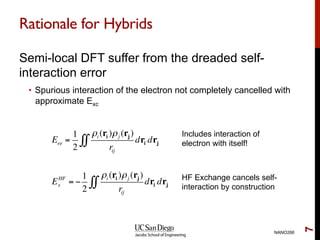
Semi-local DFT suffer from the dreaded self-
interaction error
•  Spurious interaction of the electron not completely cancelled with
approximate Exc
NANO266
9
Eee =
1
2
ρi (ri )ρj (rj)
rij
dri drj∫∫
Ex
HF
= −
1
2
ρi (ri )ρj (rj)
rij
dri drj∫∫
Includes interaction of
electron with itself!
HF Exchange cancels self-
interaction by construction
Typical Hybrid Functionals
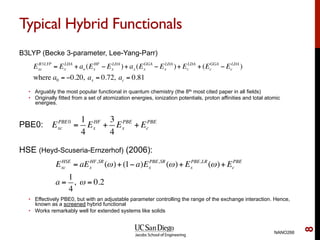
B3LYP (Becke 3-parameter, Lee-Yang-Parr)
•  Arguably the most popular functional in quantum chemistry (the 8th most cited paper in all
fields)
•  Originally fitted from a set of atomization energies, ionization potentials, proton affinities and
total atomic energies.
PBE0:
HSE (Heyd-Scuseria-Ernzerhof) (2006):
•  Effectively PBE0, but with an adjustable parameter controlling the range of the exchange
interaction. Hence, known as a screened hybrid functional
•  Works remarkably well for extended systems like solids
NANO266
10
Exc
B3LYP
= Ex
LDA
+ ao (Ex
HF
− Ex
LDA
)+ ax (Ex
GGA
− Ex
LDA
)+ Ec
LDA
+(Ec
GGA
− Ec
LDA
)
where a0 = −0.20, ax = 0.72, ac = 0.81
Exc
PBE0
=
1
4
Ex
HF
+
3
4
Ex
PBE
+ Ec
PBE
Exc
HSE
= aEx
HF,SR
(ω)+(1− a)Ex
PBE,SR
(ω)+ Ex
PBE,LR
(ω)+ Ec
PBE
a =
1
4
, ω = 0.2
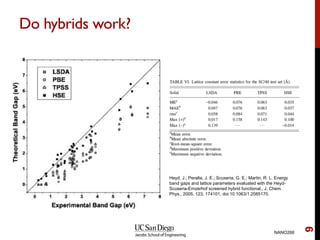
Do hybrids work?
NANO266
11
Heyd, J.; Peralta, J. E.; Scuseria, G. E.; Martin, R. L. Energy
band gaps and lattice parameters evaluated with the Heyd-
Scuseria-Ernzerhof screened hybrid functional., J. Chem.
Phys., 2005, 123, 174101, doi:10.1063/1.2085170.
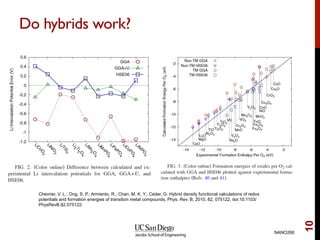
Do hybrids work?
NANO266
12
Chevrier, V. L.; Ong, S. P.; Armiento, R.; Chan, M. K. Y.; Ceder, G. Hybrid density functional calculations of redox
potentials and formation energies of transition metal compounds, Phys. Rev. B, 2010, 82, 075122, doi:10.1103/
PhysRevB.82.075122.
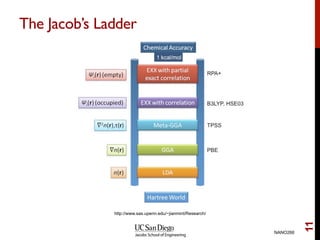
The Jacob’s Ladder
NANO266
13
http://www.sas.upenn.edu/~jianmint/Research/
Which functional to use?
NANO266
14
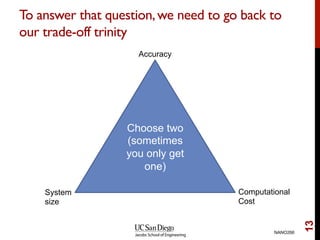
To answer that question,we need to go back to
our trade-off trinity
NANO266
15
Choose two
(sometimes
you only get
one)
Accuracy
Computational
Cost
System
size
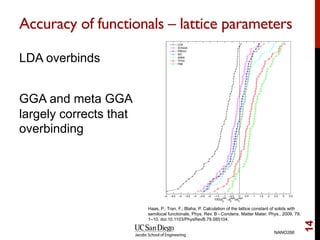
Accuracy of functionals – lattice parameters
LDA overbinds
GGA and meta GGA
largely corrects that
overbinding
NANO266
16
Haas, P.; Tran, F.; Blaha, P. Calculation of the lattice constant of solids with
semilocal functionals, Phys. Rev. B - Condens. Matter Mater. Phys., 2009, 79,
1–10, doi:10.1103/PhysRevB.79.085104.
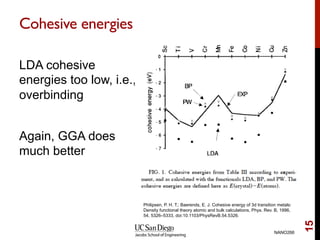
Cohesive energies
LDA cohesive
energies too low, i.e.,
overbinding
Again, GGA does
much better
NANO266
17
Philipsen, P. H. T.; Baerends, E. J. Cohesive energy of 3d transition metals:
Density functional theory atomic and bulk calculations, Phys. Rev. B, 1996,
54, 5326–5333, doi:10.1103/PhysRevB.54.5326.
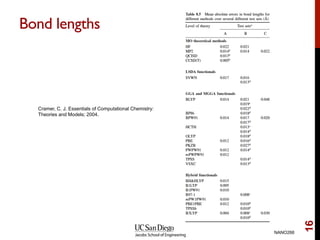
Bond lengths
NANO266
18
Cramer, C. J. Essentials of Computational Chemistry:
Theories and Models; 2004.
Conclusion – LDA vs GGA
LDA almost always underpredicts bond lengths, lattice
parameters and overbinds
GGA error is smaller, but less systematic.
Error in GGA < 1% in many cases
Conclusion
•  Very little reason to choose LDA over GGA since computational cost are similar
Note: In all cases, we assume that LDA and GGA refers to
spin-polarized versions.
NANO266
19
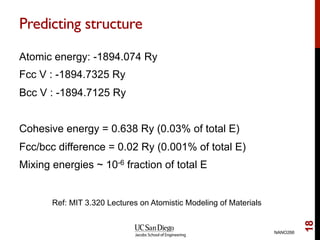
Predicting structure
Atomic energy: -1894.074 Ry
Fcc V : -1894.7325 Ry
Bcc V : -1894.7125 Ry
Cohesive energy = 0.638 Ry (0.03% of total E)
Fcc/bcc difference = 0.02 Ry (0.001% of total E)
Mixing energies ~ 10-6 fraction of total E
NANO266
20
Ref: MIT 3.320 Lectures on Atomistic Modeling of Materials
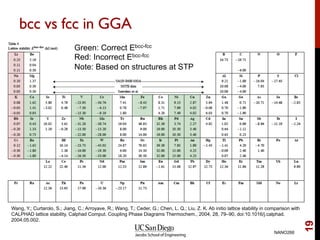
bcc vs fcc in GGA
NANO266
21
Green: Correct Ebcc-fcc
Red: Incorrect Ebcc-fcc
Note: Based on structures at STP
Wang, Y.; Curtarolo, S.; Jiang, C.; Arroyave, R.; Wang, T.; Ceder, G.; Chen, L. Q.; Liu, Z. K. Ab initio lattice stability in comparison with CALPHAD
lattice stability, Calphad Comput. Coupling Phase Diagrams Thermochem., 2004, 28, 79–90, doi:10.1016/j.calphad.2004.05.002.
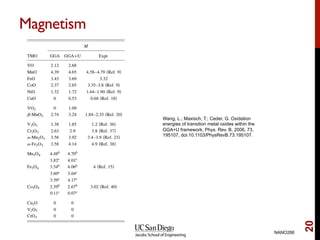
Magnetism
NANO266
22
Wang, L.; Maxisch, T.; Ceder, G. Oxidation
energies of transition metal oxides within the
GGA+U framework, Phys. Rev. B, 2006, 73,
195107, doi:10.1103/PhysRevB.73.195107.
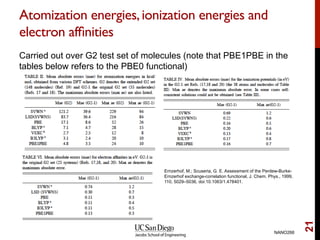
Atomization energies,ionization energies and
electron affinities
Carried out over G2 test set of molecules (note that PBE1PBE in the
tables below refers to the PBE0 functional)
NANO266
23
Ernzerhof, M.; Scuseria, G. E. Assessment of the Perdew-Burke-
Ernzerhof exchange-correlation functional, J. Chem. Phys., 1999,
110, 5029–5036, doi:10.1063/1.478401.
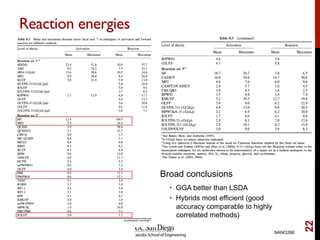
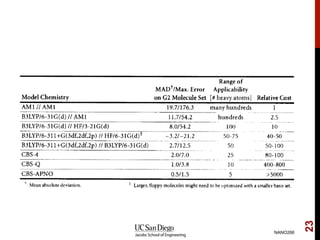
Reaction energies
Broad conclusions
•  GGA better than LSDA
•  Hybrids most efficient (good
accuracy comparable to highly
correlated methods)
NANO266
24
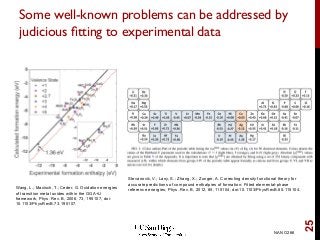
Some well-known problems can be addressed by
judicious fitting to experimental data
NANO266
25
Wang, L.; Maxisch, T.; Ceder, G. Oxidation energies
of transition metal oxides within the GGA+U
framework, Phys. Rev. B, 2006, 73, 195107, doi:
10.1103/PhysRevB.73.195107.
Stevanović, V.; Lany, S.; Zhang, X.; Zunger, A. Correcting density functional theory for
accurate predictions of compound enthalpies of formation: Fitted elemental-phase
reference energies, Phys. Rev. B, 2012, 85, 115104, doi:10.1103/PhysRevB.85.115104.
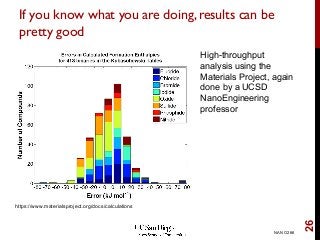
If you know what you are doing,results can be
pretty good
High-throughput
analysis using the
Materials Project, again
done by a UCSD
NanoEngineering
professor
NANO266
26
https://www.materialsproject.org/docs/calculations
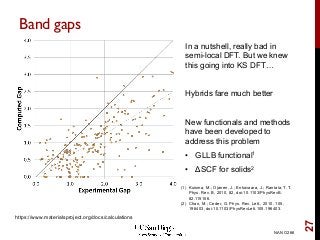
Band gaps
In a nutshell, really bad in
semi-local DFT. But we knew
this going into KS DFT…
Hybrids fare much better
New functionals and methods
have been developed to
address this problem
•  GLLB functional1
•  ΔSCF for solids2
NANO266
27
https://www.materialsproject.org/docs/calculations
(1)  Kuisma, M.; Ojanen, J.; Enkovaara, J.; Rantala, T. T.
Phys. Rev. B, 2010, 82, doi:10.1103/PhysRevB.
82.115106.
(2)  Chan, M.; Ceder, G. Phys. Rev. Lett., 2010, 105,
196403, doi:10.1103/PhysRevLett.105.196403.

NANO266 - Lecture 5 - Exchange-Correlation Functionals

  • 1.
  • 2.
    What’s next? LDA useslocal density ρ from homogenous electron gas Next step: Let’s add a gradient of the density! Generalized gradient approximation (GGA) NANO266 2 Exc GGA [ρ↑ ,ρ↓ ]= drρ(r)εxc (∫ ρ↑ ,ρ↓ , ∇ρ↑ , ∇ρ↓ )
  • 3.
    Unlike the Highlander,thereis more than“one” GGA •  BLYP, 1988: Exchange by Axel Becke based on energy density of atoms, one parameter + Correlation by Lee-Yang-Parr •  PW91, 1991: Perdew-Wang 91Parametrization of real-space cut-off procedure •  PBE, 1996: Perdew-Burke-Ernzerhof (re- parametrization and simplification of PW91) •  RPBE, 1999: revised PBE, improves surface energetics •  PBEsol, 2008: Revised PBE for solids NANO266 3
  • 4.
    Performance of GGA GGAtends to correct LDA overbinding •  Better bond lengths, lattice parameters, atomization energies, etc. NANO266 4
  • 5.
    Why stop atthe first derivative? Meta-GGA Example: TPSS functional NANO266 5 Exc meta−GGA [ρ↑ ,ρ↓ ]= drρ(r)εxc (∫ ρ↑ ,ρ↓ , ∇ρ↑ , ∇ρ↓ ,∇2 ρ↑ ,∇2 ρ↓ ) Tao, J.; Perdew, J. P.; Staroverov, V. N.; Scuseria, G. E. Climbing the density functional ladder: nonempirical meta-generalized gradient approximation designed for molecules and solids., Phys. Rev. Lett., 2003, 91, 146401, doi:10.1103/PhysRevLett.91.146401.
  • 6.
    Orbital-dependent methods DFT+U1,2,3 •  Treatstrong on-site Coulomb interaction of localized electrons, e.g., d and f electrons (incorrectly described by LDA or GGA) with an additional Hubbard-like term. •  Strength of on-site interactions usually described by U (on site Coulomb) and J (on site exchange), which can be extracted from ab-initio calculations,4 but usually are obtained semi-empirically, e.g., fitting to experimental formation energies or band gaps. NANO266 6 (1)  Anisimov, V. I.; Zaanen, J.; Andersen, O. K. Phys. Rev. B, 1991, 44, 943–954. (2)  Anisimov, V. I.; Solovyev, I. V; Korotin, M. A.; Czyzyk, M. T.; Sawatzky, G. A. Phys. Rev. B, 1993, 48, 16929–16934. (3)  Dudarev, S. L.; Botton, G. A.; Savrasov, S. Y.; Humphreys, C. J.; Sutton, A. P., Phys. Rev. B, 1998, 57, 1505–1509. (4)  Cococcioni, M.; de Gironcoli, S., Phys. Rev. B, 2005, 71, 035105, doi:10.1103/PhysRevB.71.035105. EDFT+U = EDFT + Ueff 2 ρσ m1,m1 m1 ∑ " # $$ % & ''− ρσ m1,m2 m1m2 ∑ ρσ m2,m1 " # $$ % & '' ) * + + , - . .σ ∑ Penalty term to force on-site occupancy in the direction of of idempotency, i.e. to either fully occupied or fully unoccupied levels
  • 7.
    Where do Iget U values 1.  Fit it yourself, either using linear response approach or to some experimental data that you have for your problem at hand 2.  Use well-tested values in the literature, e.g., for high-throughput calculations (though you should use caution!) NANO266 7 U values used in the Materials Project, fitted by a UCSD NanoEngineering Professor
  • 8.
    Hybrids NANO266 8 Chimera from Godof War (memories of times when I was still a carefree graduate student) HF DFT
  • 9.
    Rationale for Hybrids Semi-localDFT suffer from the dreaded self- interaction error •  Spurious interaction of the electron not completely cancelled with approximate Exc NANO266 9 Eee = 1 2 ρi (ri )ρj (rj) rij dri drj∫∫ Ex HF = − 1 2 ρi (ri )ρj (rj) rij dri drj∫∫ Includes interaction of electron with itself! HF Exchange cancels self- interaction by construction
  • 10.
    Typical Hybrid Functionals B3LYP(Becke 3-parameter, Lee-Yang-Parr) •  Arguably the most popular functional in quantum chemistry (the 8th most cited paper in all fields) •  Originally fitted from a set of atomization energies, ionization potentials, proton affinities and total atomic energies. PBE0: HSE (Heyd-Scuseria-Ernzerhof) (2006): •  Effectively PBE0, but with an adjustable parameter controlling the range of the exchange interaction. Hence, known as a screened hybrid functional •  Works remarkably well for extended systems like solids NANO266 10 Exc B3LYP = Ex LDA + ao (Ex HF − Ex LDA )+ ax (Ex GGA − Ex LDA )+ Ec LDA +(Ec GGA − Ec LDA ) where a0 = −0.20, ax = 0.72, ac = 0.81 Exc PBE0 = 1 4 Ex HF + 3 4 Ex PBE + Ec PBE Exc HSE = aEx HF,SR (ω)+(1− a)Ex PBE,SR (ω)+ Ex PBE,LR (ω)+ Ec PBE a = 1 4 , ω = 0.2
  • 11.
    Do hybrids work? NANO266 11 Heyd,J.; Peralta, J. E.; Scuseria, G. E.; Martin, R. L. Energy band gaps and lattice parameters evaluated with the Heyd- Scuseria-Ernzerhof screened hybrid functional., J. Chem. Phys., 2005, 123, 174101, doi:10.1063/1.2085170.
  • 12.
    Do hybrids work? NANO266 12 Chevrier,V. L.; Ong, S. P.; Armiento, R.; Chan, M. K. Y.; Ceder, G. Hybrid density functional calculations of redox potentials and formation energies of transition metal compounds, Phys. Rev. B, 2010, 82, 075122, doi:10.1103/ PhysRevB.82.075122.
  • 13.
  • 14.
    Which functional touse? NANO266 14
  • 15.
    To answer thatquestion,we need to go back to our trade-off trinity NANO266 15 Choose two (sometimes you only get one) Accuracy Computational Cost System size
  • 16.
    Accuracy of functionals– lattice parameters LDA overbinds GGA and meta GGA largely corrects that overbinding NANO266 16 Haas, P.; Tran, F.; Blaha, P. Calculation of the lattice constant of solids with semilocal functionals, Phys. Rev. B - Condens. Matter Mater. Phys., 2009, 79, 1–10, doi:10.1103/PhysRevB.79.085104.
  • 17.
    Cohesive energies LDA cohesive energiestoo low, i.e., overbinding Again, GGA does much better NANO266 17 Philipsen, P. H. T.; Baerends, E. J. Cohesive energy of 3d transition metals: Density functional theory atomic and bulk calculations, Phys. Rev. B, 1996, 54, 5326–5333, doi:10.1103/PhysRevB.54.5326.
  • 18.
    Bond lengths NANO266 18 Cramer, C.J. Essentials of Computational Chemistry: Theories and Models; 2004.
  • 19.
    Conclusion – LDAvs GGA LDA almost always underpredicts bond lengths, lattice parameters and overbinds GGA error is smaller, but less systematic. Error in GGA < 1% in many cases Conclusion •  Very little reason to choose LDA over GGA since computational cost are similar Note: In all cases, we assume that LDA and GGA refers to spin-polarized versions. NANO266 19
  • 20.
    Predicting structure Atomic energy:-1894.074 Ry Fcc V : -1894.7325 Ry Bcc V : -1894.7125 Ry Cohesive energy = 0.638 Ry (0.03% of total E) Fcc/bcc difference = 0.02 Ry (0.001% of total E) Mixing energies ~ 10-6 fraction of total E NANO266 20 Ref: MIT 3.320 Lectures on Atomistic Modeling of Materials
  • 21.
    bcc vs fccin GGA NANO266 21 Green: Correct Ebcc-fcc Red: Incorrect Ebcc-fcc Note: Based on structures at STP Wang, Y.; Curtarolo, S.; Jiang, C.; Arroyave, R.; Wang, T.; Ceder, G.; Chen, L. Q.; Liu, Z. K. Ab initio lattice stability in comparison with CALPHAD lattice stability, Calphad Comput. Coupling Phase Diagrams Thermochem., 2004, 28, 79–90, doi:10.1016/j.calphad.2004.05.002.
  • 22.
    Magnetism NANO266 22 Wang, L.; Maxisch,T.; Ceder, G. Oxidation energies of transition metal oxides within the GGA+U framework, Phys. Rev. B, 2006, 73, 195107, doi:10.1103/PhysRevB.73.195107.
  • 23.
    Atomization energies,ionization energiesand electron affinities Carried out over G2 test set of molecules (note that PBE1PBE in the tables below refers to the PBE0 functional) NANO266 23 Ernzerhof, M.; Scuseria, G. E. Assessment of the Perdew-Burke- Ernzerhof exchange-correlation functional, J. Chem. Phys., 1999, 110, 5029–5036, doi:10.1063/1.478401.
  • 24.
    Reaction energies Broad conclusions • GGA better than LSDA •  Hybrids most efficient (good accuracy comparable to highly correlated methods) NANO266 24
  • 25.
    Some well-known problemscan be addressed by judicious fitting to experimental data NANO266 25 Wang, L.; Maxisch, T.; Ceder, G. Oxidation energies of transition metal oxides within the GGA+U framework, Phys. Rev. B, 2006, 73, 195107, doi: 10.1103/PhysRevB.73.195107. Stevanović, V.; Lany, S.; Zhang, X.; Zunger, A. Correcting density functional theory for accurate predictions of compound enthalpies of formation: Fitted elemental-phase reference energies, Phys. Rev. B, 2012, 85, 115104, doi:10.1103/PhysRevB.85.115104.
  • 26.
    If you knowwhat you are doing,results can be pretty good High-throughput analysis using the Materials Project, again done by a UCSD NanoEngineering professor NANO266 26 https://www.materialsproject.org/docs/calculations
  • 27.
    Band gaps In anutshell, really bad in semi-local DFT. But we knew this going into KS DFT… Hybrids fare much better New functionals and methods have been developed to address this problem •  GLLB functional1 •  ΔSCF for solids2 NANO266 27 https://www.materialsproject.org/docs/calculations (1)  Kuisma, M.; Ojanen, J.; Enkovaara, J.; Rantala, T. T. Phys. Rev. B, 2010, 82, doi:10.1103/PhysRevB. 82.115106. (2)  Chan, M.; Ceder, G. Phys. Rev. Lett., 2010, 105, 196403, doi:10.1103/PhysRevLett.105.196403.