Computational Chemistry:
A DFT crash course
Useful Material
Books
 A chemist’s guide to density-functional theory
Wolfram Koch and Max C. Holthausen (second edition,
Wiley)
 The theory of the cohesive energies of solids
G. P. Srivastava and D. Weaire
Advances in Physics 36 (1987) 463-517
 Gulliver among the atoms
Mike Gillan, New Scientist 138 (1993) 34
Web
 www.nobel.se/chemistry/laureates/1998/
 www.abinit.org
Version 4.2.3 compiled for windows, install and good
tutorial
Outline: Part 1,
The Framework of DFT
DFT: the theory
 Schroedinger’s equation
 Hohenberg-Kohn Theorem
 Kohn-Sham Theorem
 Simplifying Schroedinger’s
 LDA, GGA
Elements of Solid State Physics
 Reciprocal space
 Band structure
 Plane waves
And then ?
 Forces (Hellmann-Feynman theorem)
 E.O., M.D., M.C. …
Outline: Part2
Using DFT
Practical Issues
 Input File(s)
 Output files
 Configuration
 K-points mesh
 Pseudopotentials
 Control Parameters
 LDA/GGA
 ‘Diagonalisation’
Applications
 Isolated molecule
 Bulk
 Surface
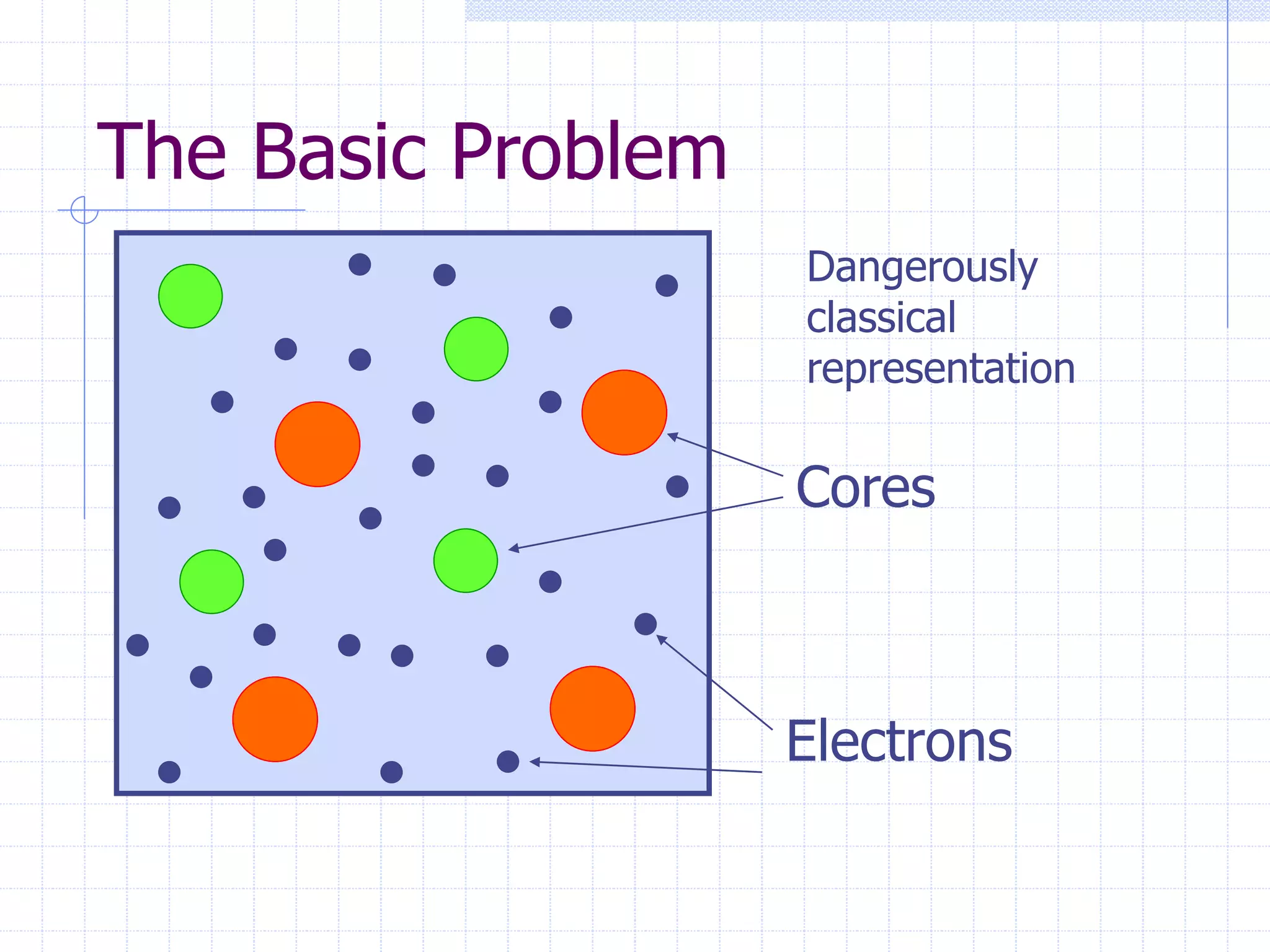
The Basic Problem
Dangerously
classical
representation
Cores
Electrons
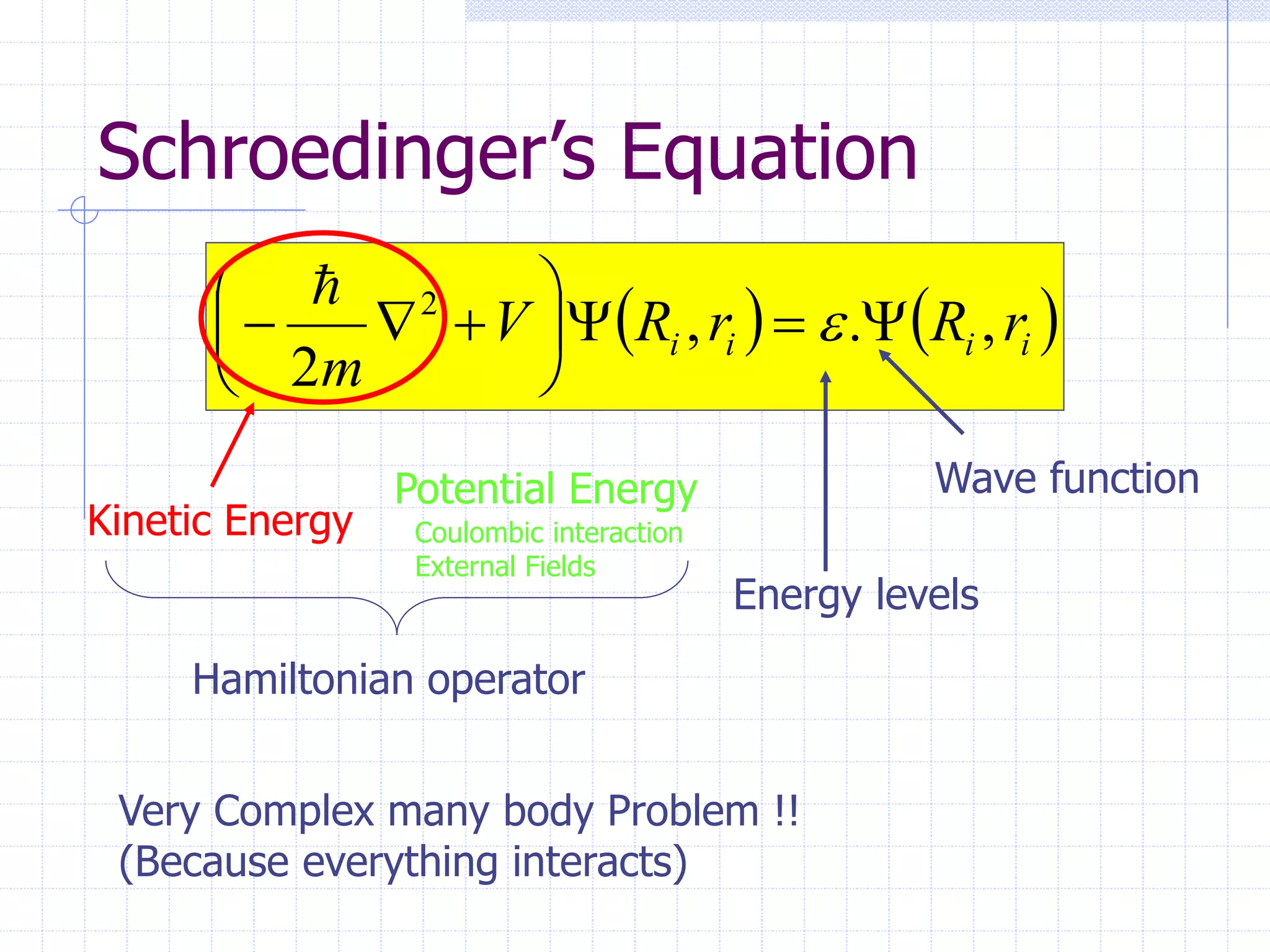
Schroedinger’s Equation
   
i
i
i
i r
R
r
R
V
m
,
.
,
2
2











 

Hamiltonian operator
Kinetic Energy
Potential Energy
Coulombic interaction
External Fields
Very Complex many body Problem !!
(Because everything interacts)
Wave function
Energy levels
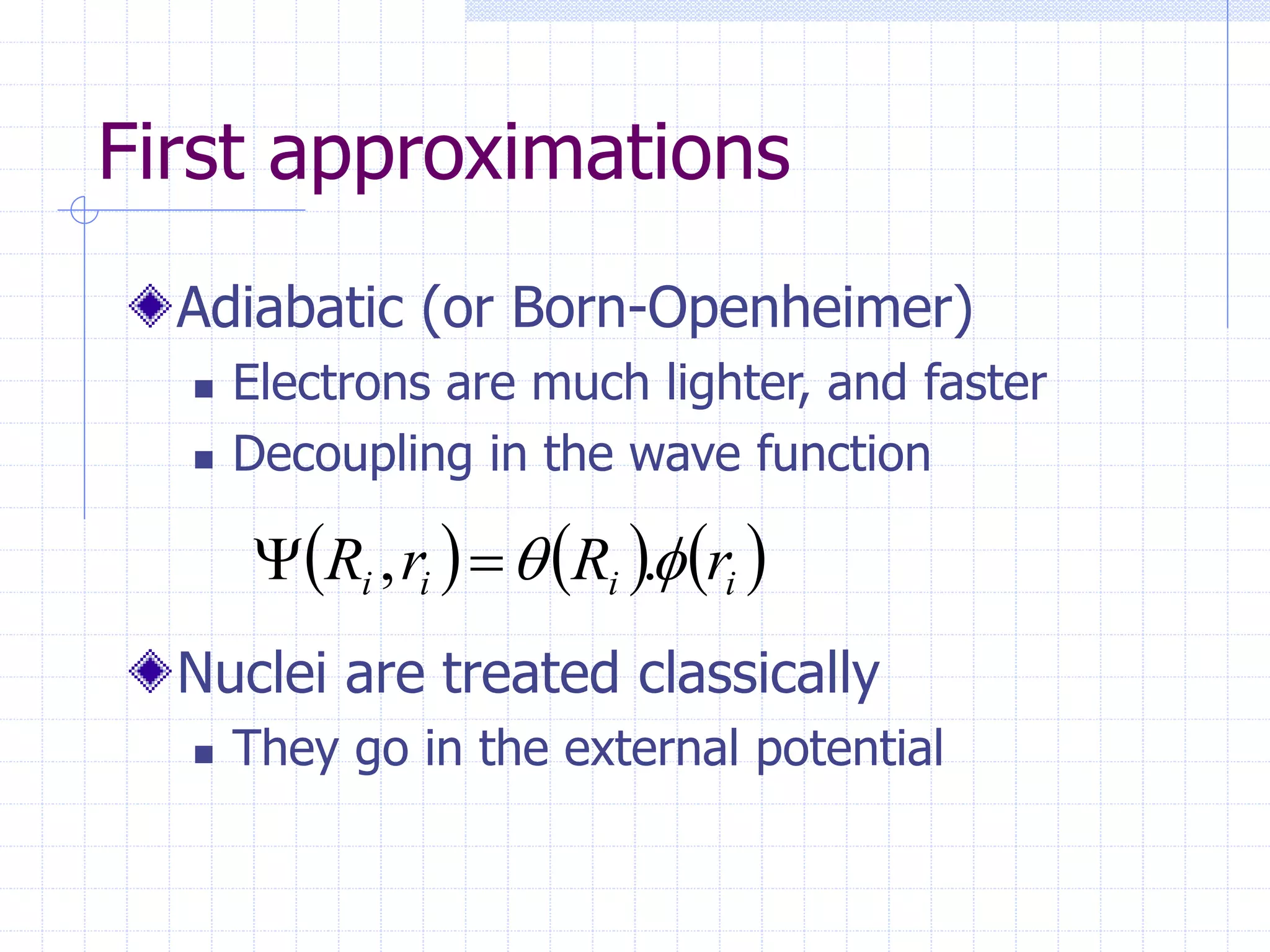
First approximations
Adiabatic (or Born-Openheimer)
 Electrons are much lighter, and faster
 Decoupling in the wave function
Nuclei are treated classically
 They go in the external potential
     
i
i
i
i r
R
r
R 
 .
, 

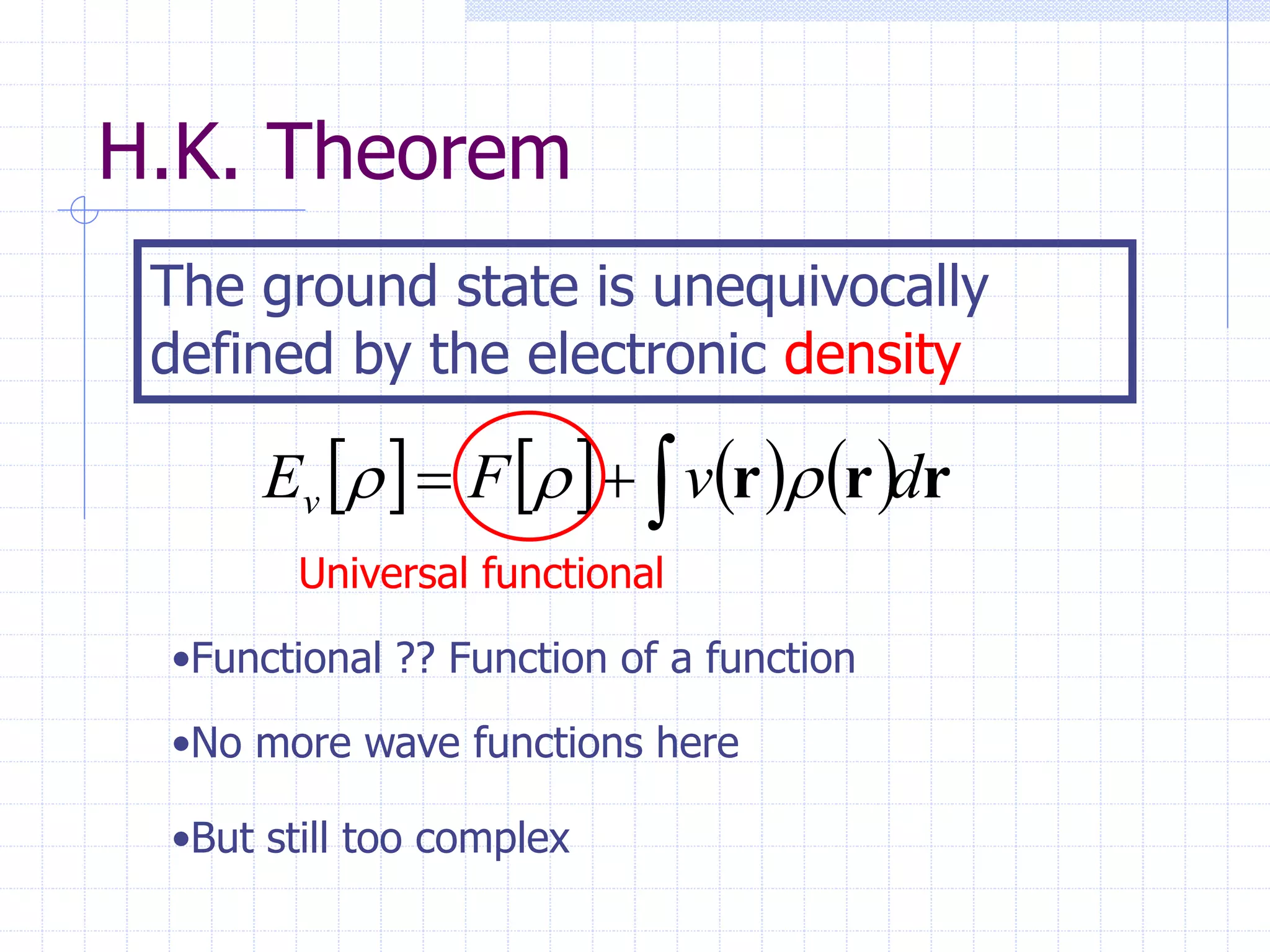
H.K. Theorem
The ground state is unequivocally
defined by the electronic density
        r
r
r d
v
F
Ev 

 


Universal functional
•Functional ?? Function of a function
•No more wave functions here
•But still too complex
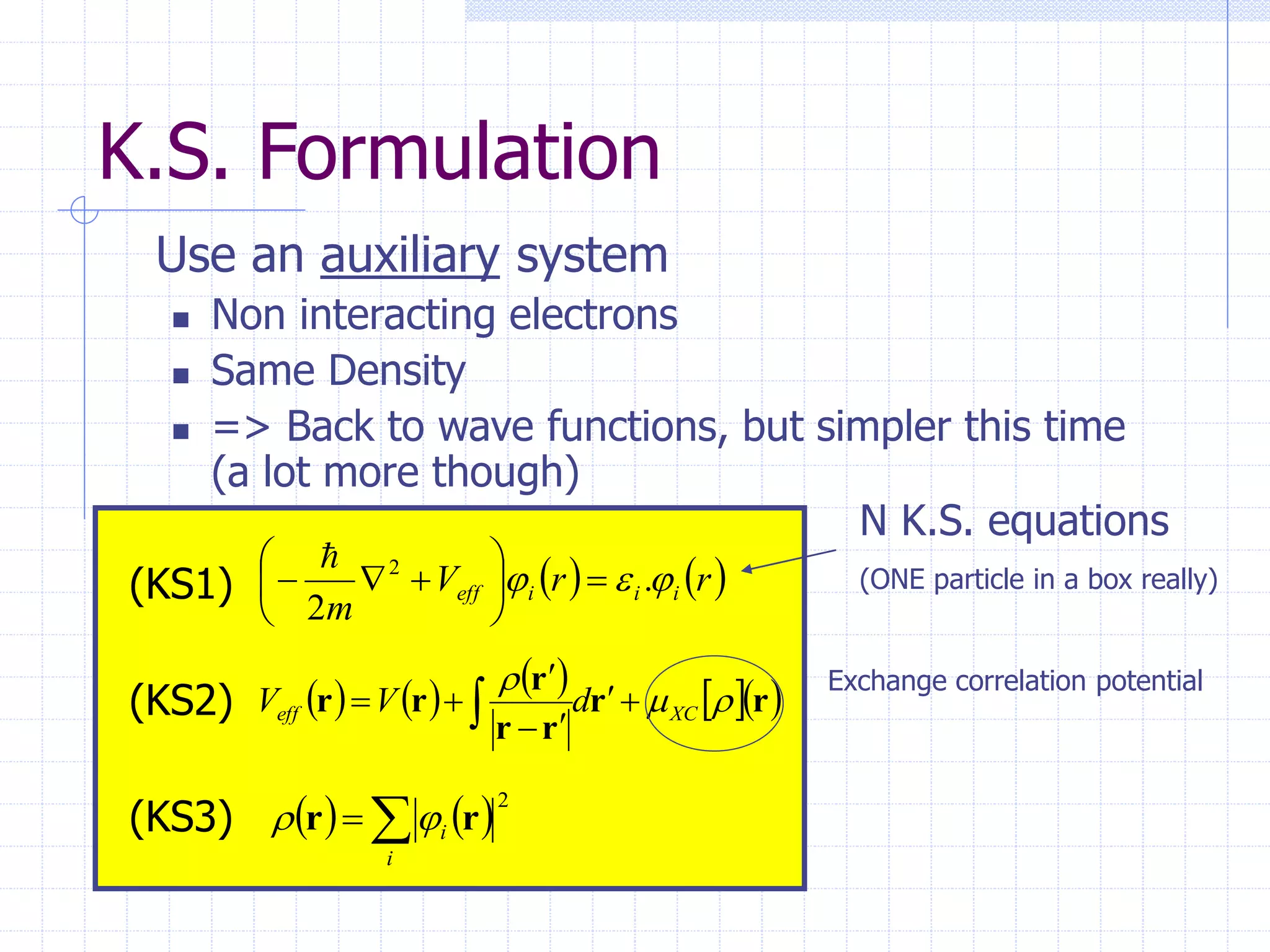
K.S. Formulation
Use an auxiliary system
 Non interacting electrons
 Same Density
 => Back to wave functions, but simpler this time
(a lot more though)
   
r
r
V
m
i
i
i
eff 

 .
2
2











        
r
r
r
r
r
r
r 


XC
eff d
V
V 





 
   


i
i
2
r
r 

N K.S. equations
(ONE particle in a box really)
(KS3)
(KS2)
(KS1)
Exchange correlation potential
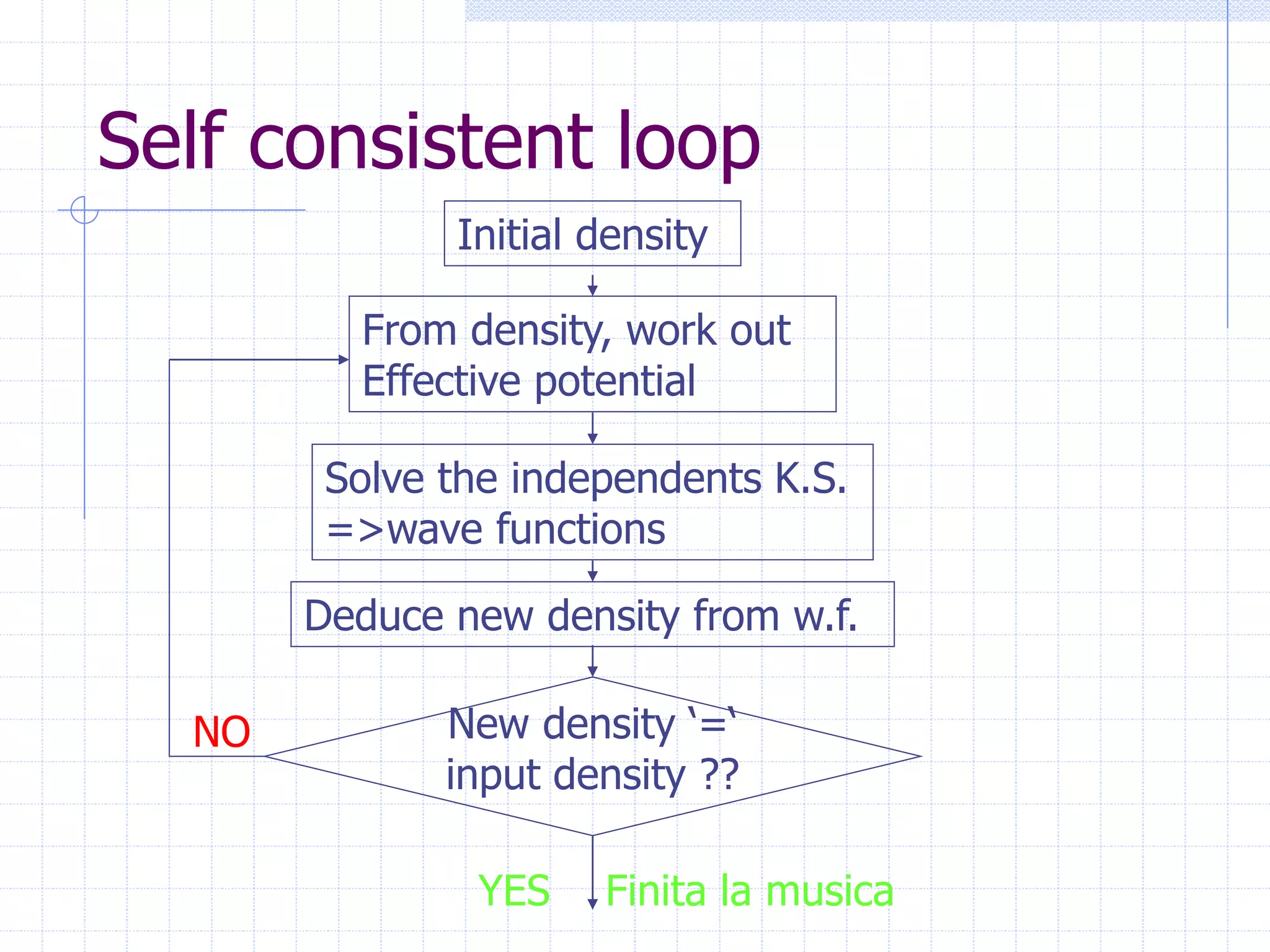
Self consistent loop
Solve the independents K.S.
=>wave functions
From density, work out
Effective potential
New density ‘=‘
input density ??
Deduce new density from w.f.
Initial density
Finita la musica
YES
NO
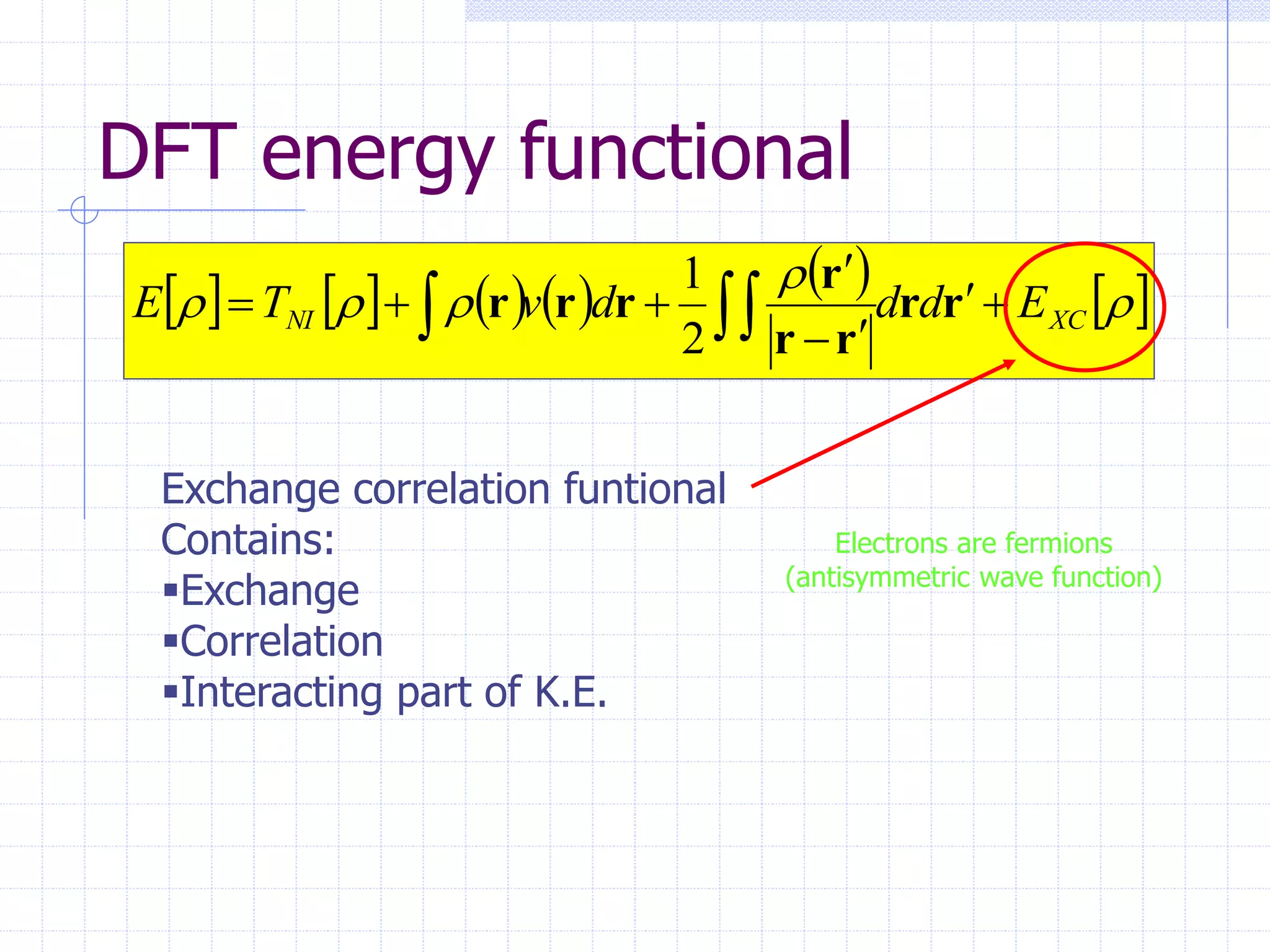
DFT energy functional
           




 XC
NI E
d
d
d
v
T
E 






 
 r
r
r
r
r
r
r
r
2
1
Exchange correlation funtional
Contains:
Exchange
Correlation
Interacting part of K.E.
Electrons are fermions
(antisymmetric wave function)
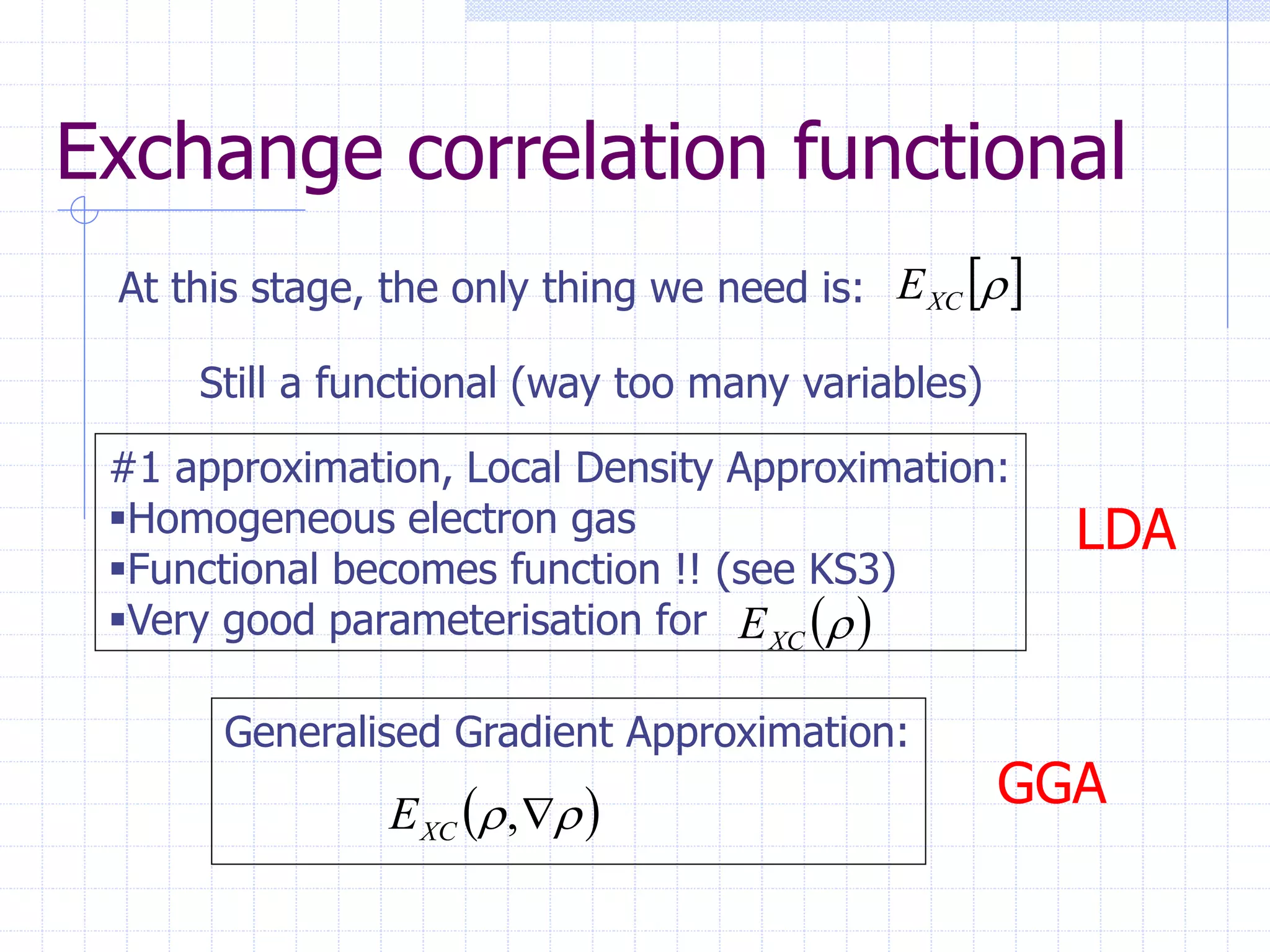
Exchange correlation functional
At this stage, the only thing we need is:  

XC
E
Still a functional (way too many variables)
#1 approximation, Local Density Approximation:
Homogeneous electron gas
Functional becomes function !! (see KS3)
Very good parameterisation for  

XC
E
Generalised Gradient Approximation:
 

 
,
XC
E
GGA
LDA
DFT: Summary
The ground state energy depends only on
the electronic density (H.K.)
One can formally replace the SE for the
system by a set of SE for non-interacting
electrons (K.S.)
Everything hard is dumped into Exc
Simplistic approximations of Exc work !
LDA or GGA
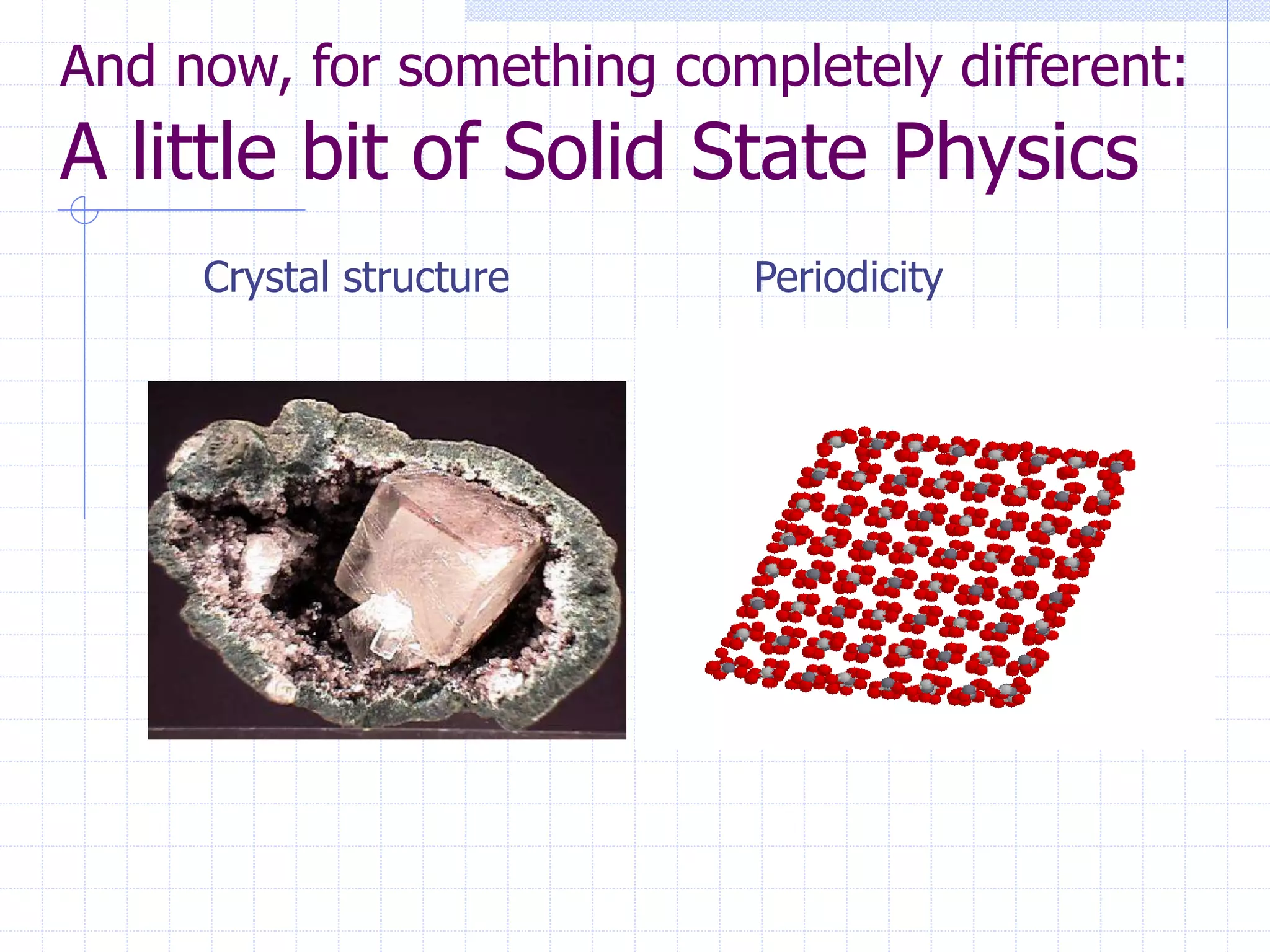
And now, for something completely different:
A little bit of Solid State Physics
Crystal structure Periodicity
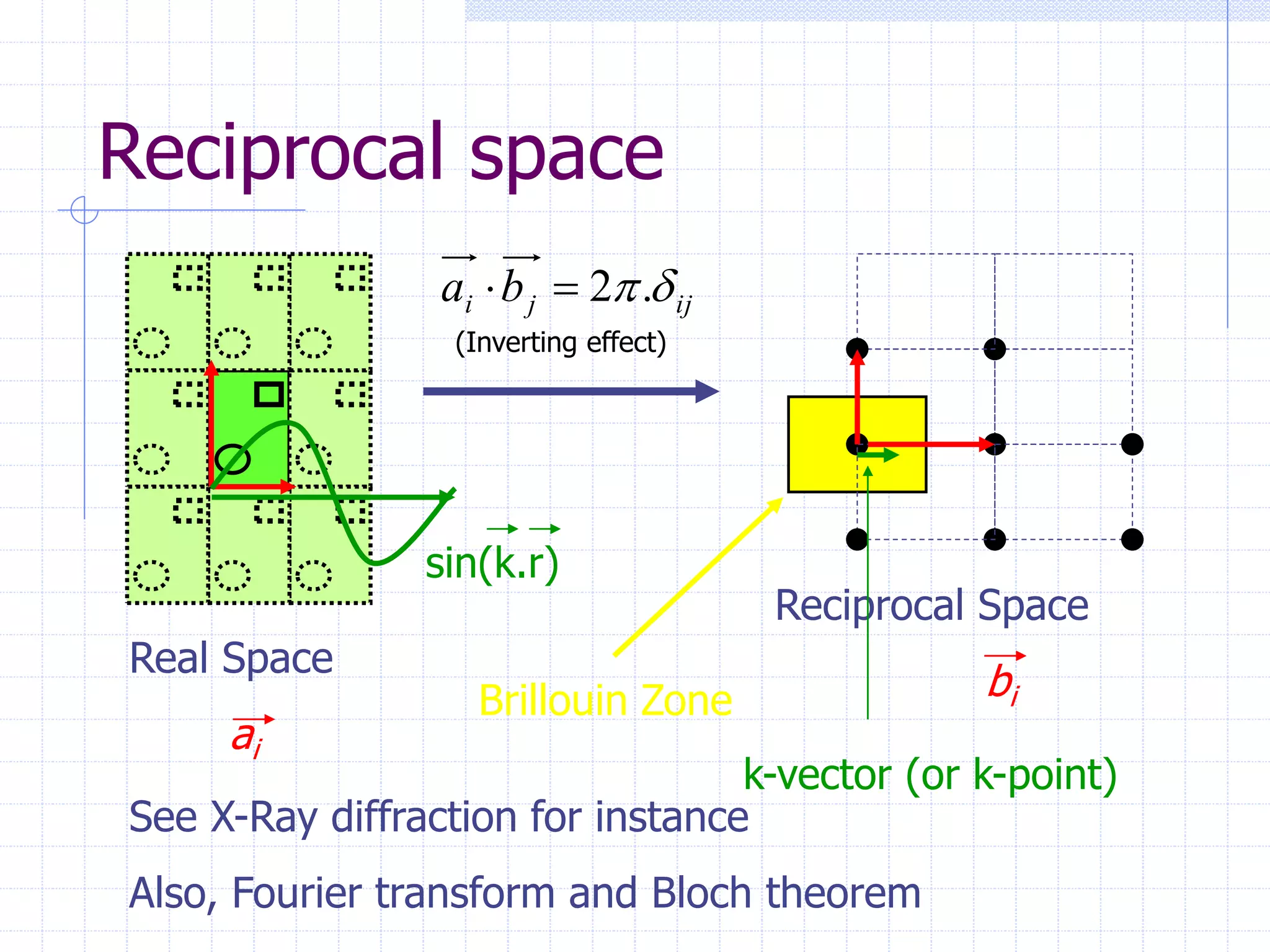
Reciprocal space
Real Space
ai
ij
j
i b
a 
.
2


Reciprocal Space
bi
Brillouin Zone
(Inverting effect)
k-vector (or k-point)
sin(k.r)
See X-Ray diffraction for instance
Also, Fourier transform and Bloch theorem
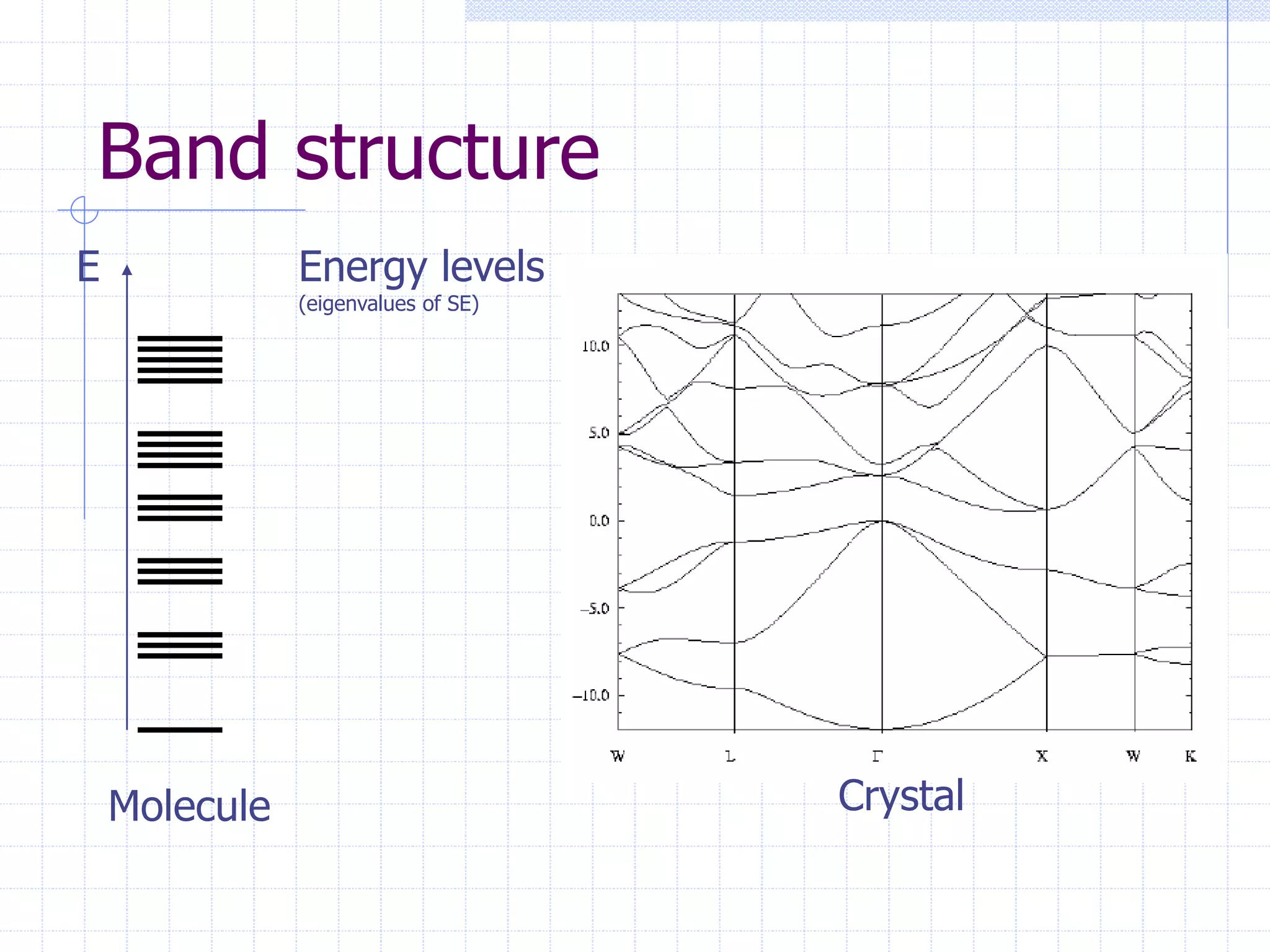
Band structure
Molecule
E
Crystal
Energy levels
(eigenvalues of SE)
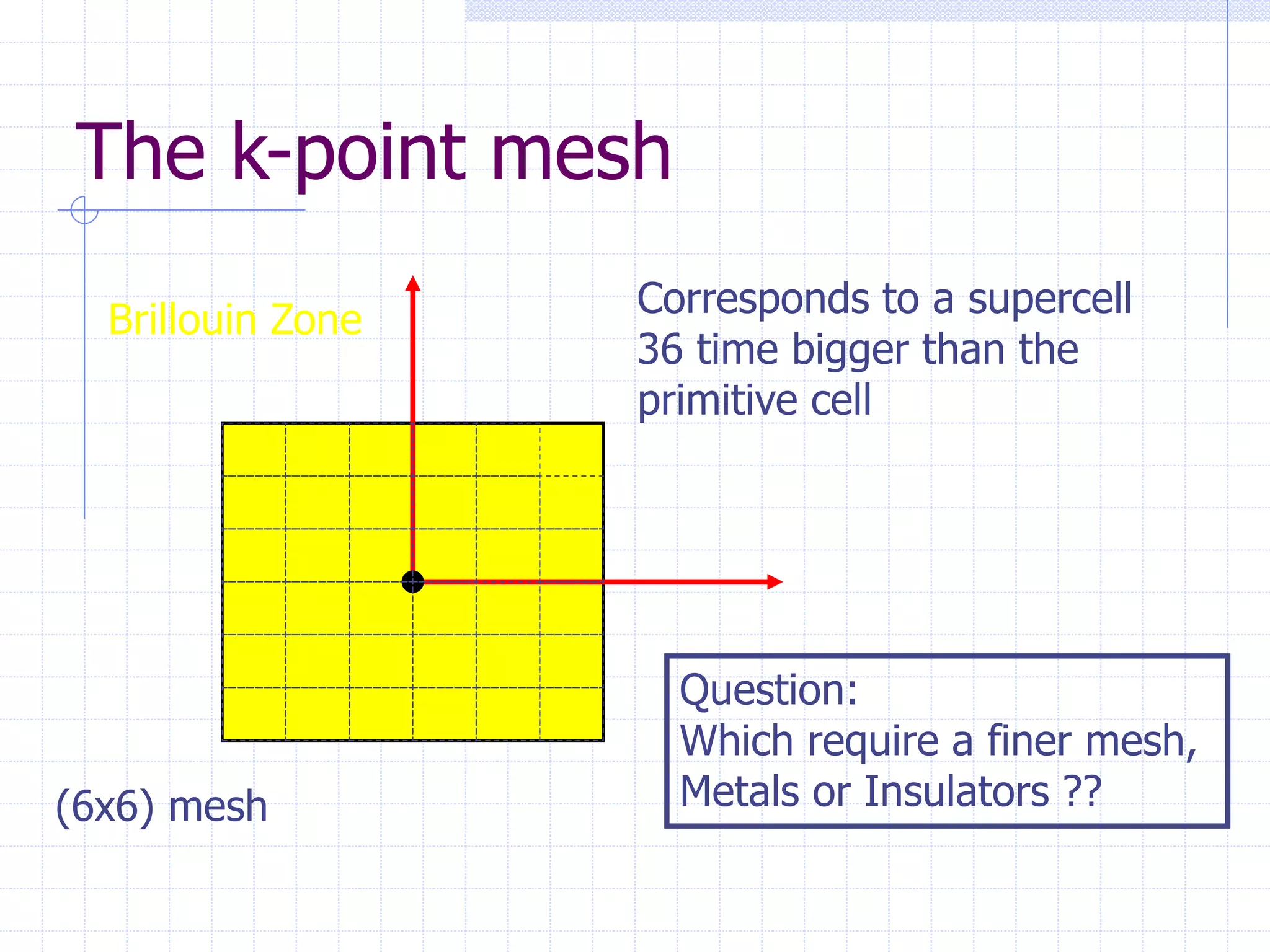
The k-point mesh
Brillouin Zone
(6x6) mesh
Corresponds to a supercell
36 time bigger than the
primitive cell
Question:
Which require a finer mesh,
Metals or Insulators ??
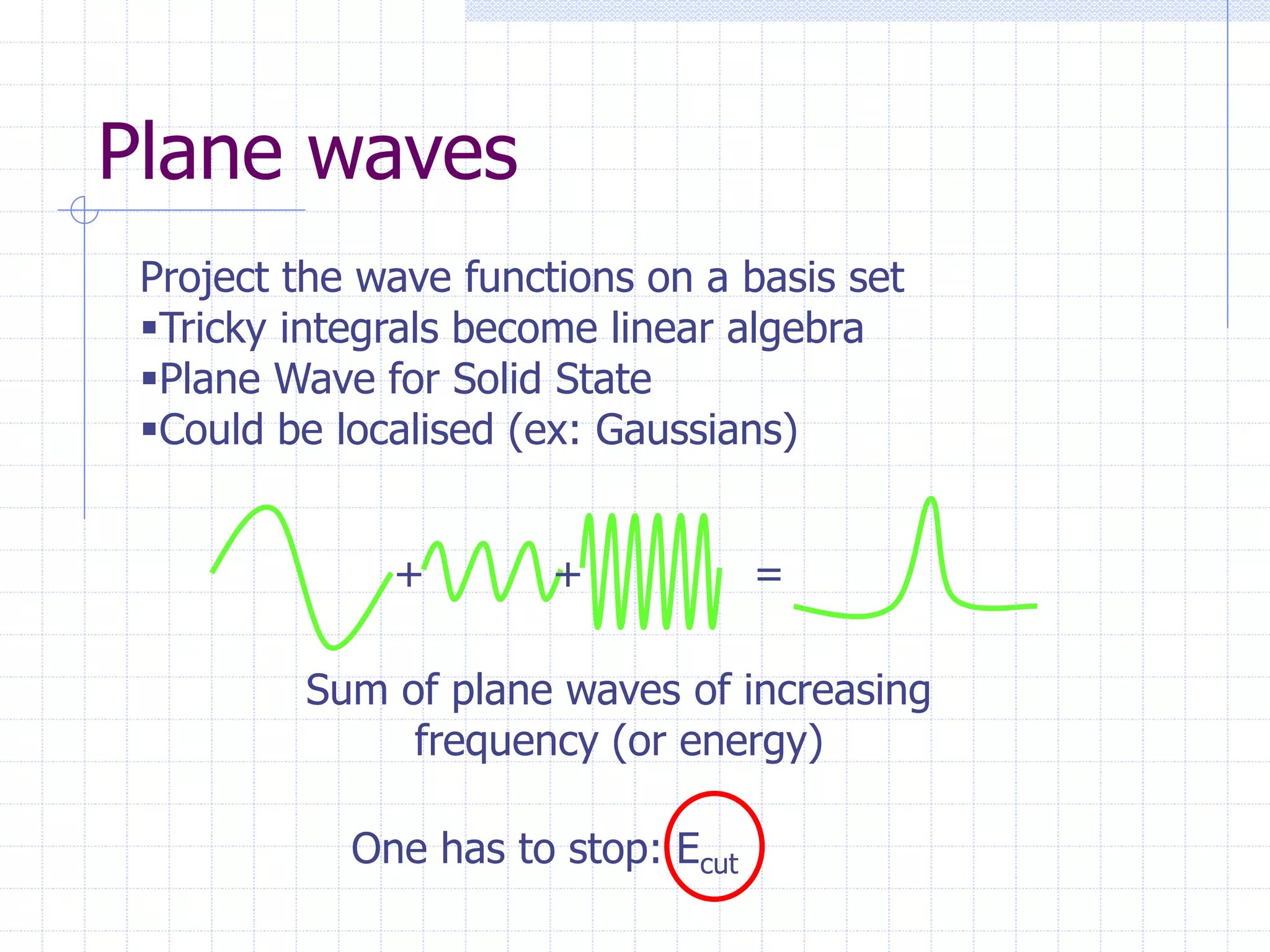
Plane waves
Project the wave functions on a basis set
Tricky integrals become linear algebra
Plane Wave for Solid State
Could be localised (ex: Gaussians)
+ + =
Sum of plane waves of increasing
frequency (or energy)
One has to stop: Ecut
Solid State: Summary
Quantities can be calculated in the
direct or reciprocal space
k-point Mesh
Plane wave basis set, Ecut
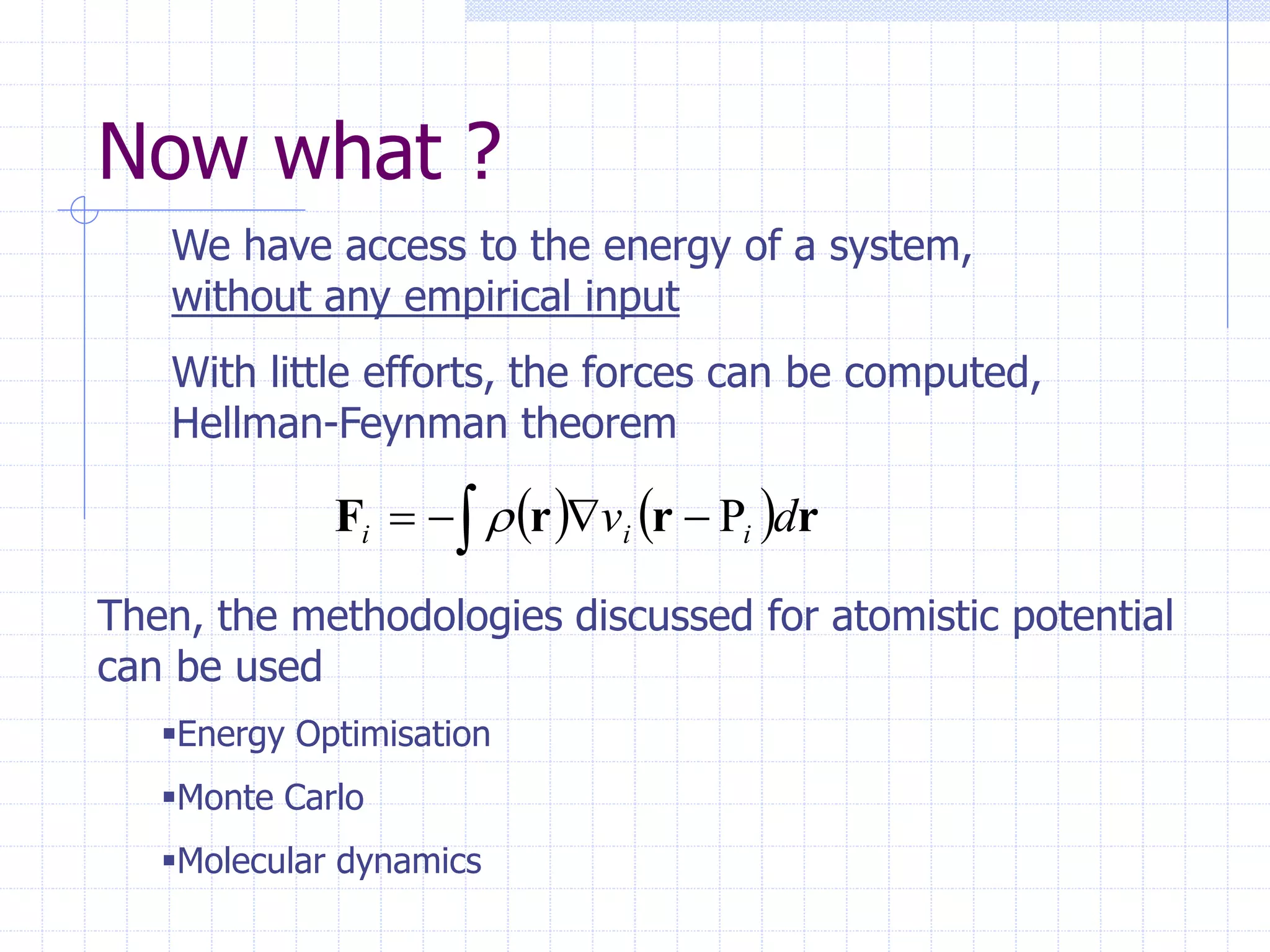
Now what ?
We have access to the energy of a system,
without any empirical input
With little efforts, the forces can be computed,
Hellman-Feynman theorem
Then, the methodologies discussed for atomistic potential
can be used
Energy Optimisation
Monte Carlo
Molecular dynamics
   
 



 r
r
r
F d
v i
i
i 

lecture1.ppt

  • 1.
  • 2.
    Useful Material Books  Achemist’s guide to density-functional theory Wolfram Koch and Max C. Holthausen (second edition, Wiley)  The theory of the cohesive energies of solids G. P. Srivastava and D. Weaire Advances in Physics 36 (1987) 463-517  Gulliver among the atoms Mike Gillan, New Scientist 138 (1993) 34 Web  www.nobel.se/chemistry/laureates/1998/  www.abinit.org Version 4.2.3 compiled for windows, install and good tutorial
  • 3.
    Outline: Part 1, TheFramework of DFT DFT: the theory  Schroedinger’s equation  Hohenberg-Kohn Theorem  Kohn-Sham Theorem  Simplifying Schroedinger’s  LDA, GGA Elements of Solid State Physics  Reciprocal space  Band structure  Plane waves And then ?  Forces (Hellmann-Feynman theorem)  E.O., M.D., M.C. …
  • 4.
    Outline: Part2 Using DFT PracticalIssues  Input File(s)  Output files  Configuration  K-points mesh  Pseudopotentials  Control Parameters  LDA/GGA  ‘Diagonalisation’ Applications  Isolated molecule  Bulk  Surface
  • 5.
  • 6.
    Schroedinger’s Equation    i i i i r R r R V m , . , 2 2               Hamiltonian operator Kinetic Energy Potential Energy Coulombic interaction External Fields Very Complex many body Problem !! (Because everything interacts) Wave function Energy levels
  • 7.
    First approximations Adiabatic (orBorn-Openheimer)  Electrons are much lighter, and faster  Decoupling in the wave function Nuclei are treated classically  They go in the external potential       i i i i r R r R   . ,  
  • 8.
    H.K. Theorem The groundstate is unequivocally defined by the electronic density         r r r d v F Ev       Universal functional •Functional ?? Function of a function •No more wave functions here •But still too complex
  • 9.
    K.S. Formulation Use anauxiliary system  Non interacting electrons  Same Density  => Back to wave functions, but simpler this time (a lot more though)     r r V m i i i eff    . 2 2                     r r r r r r r    XC eff d V V               i i 2 r r   N K.S. equations (ONE particle in a box really) (KS3) (KS2) (KS1) Exchange correlation potential
  • 10.
    Self consistent loop Solvethe independents K.S. =>wave functions From density, work out Effective potential New density ‘=‘ input density ?? Deduce new density from w.f. Initial density Finita la musica YES NO
  • 11.
    DFT energy functional                 XC NI E d d d v T E           r r r r r r r r 2 1 Exchange correlation funtional Contains: Exchange Correlation Interacting part of K.E. Electrons are fermions (antisymmetric wave function)
  • 12.
    Exchange correlation functional Atthis stage, the only thing we need is:    XC E Still a functional (way too many variables) #1 approximation, Local Density Approximation: Homogeneous electron gas Functional becomes function !! (see KS3) Very good parameterisation for    XC E Generalised Gradient Approximation:      , XC E GGA LDA
  • 13.
    DFT: Summary The groundstate energy depends only on the electronic density (H.K.) One can formally replace the SE for the system by a set of SE for non-interacting electrons (K.S.) Everything hard is dumped into Exc Simplistic approximations of Exc work ! LDA or GGA
  • 14.
    And now, forsomething completely different: A little bit of Solid State Physics Crystal structure Periodicity
  • 15.
    Reciprocal space Real Space ai ij j ib a  . 2   Reciprocal Space bi Brillouin Zone (Inverting effect) k-vector (or k-point) sin(k.r) See X-Ray diffraction for instance Also, Fourier transform and Bloch theorem
  • 16.
  • 17.
    The k-point mesh BrillouinZone (6x6) mesh Corresponds to a supercell 36 time bigger than the primitive cell Question: Which require a finer mesh, Metals or Insulators ??
  • 18.
    Plane waves Project thewave functions on a basis set Tricky integrals become linear algebra Plane Wave for Solid State Could be localised (ex: Gaussians) + + = Sum of plane waves of increasing frequency (or energy) One has to stop: Ecut
  • 19.
    Solid State: Summary Quantitiescan be calculated in the direct or reciprocal space k-point Mesh Plane wave basis set, Ecut
  • 20.
    Now what ? Wehave access to the energy of a system, without any empirical input With little efforts, the forces can be computed, Hellman-Feynman theorem Then, the methodologies discussed for atomistic potential can be used Energy Optimisation Monte Carlo Molecular dynamics           r r r F d v i i i 