A presentation About Supercapacitor
PRESENTED BY
MD. RASHIDUL ALAM
CONTENTS
 What is Capacitor
 What is Supercapacitor
 Construction of Supercapacitor
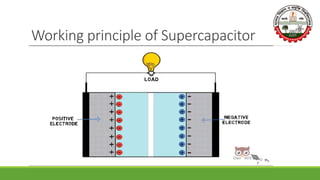
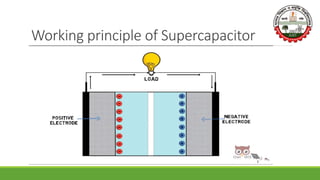
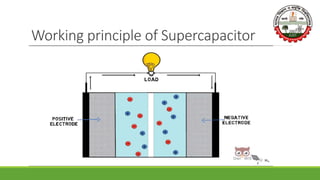
 Working Principle of Supercapacitor
 Required properties of Electrode Material
 Supercapacitor Electrode Material
 Application of Supercapacitor
 Current Progress of Supercapacitor
 Research Gap of Supercapacitor
 Suggestion to overcome existing limitations of supercapacitor
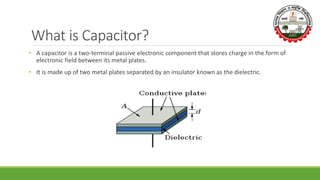
What is Capacitor?
• A capacitor is a two-terminal passive electronic component that stores charge in the form of
electronic field between its metal plates.
• It is made up of two metal plates separated by an insulator known as the dielectric.
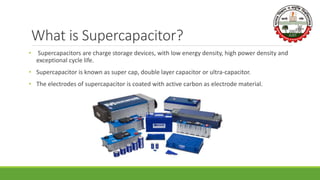
What is Supercapacitor?
• Supercapacitors are charge storage devices, with low energy density, high power density and
exceptional cycle life.
• Supercapacitor is known as super cap, double layer capacitor or ultra-capacitor.
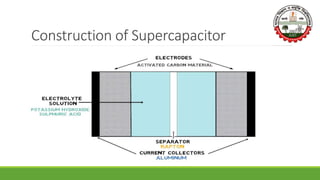
• The electrodes of supercapacitor is coated with active carbon as electrode material.
Construction of Supercapacitor
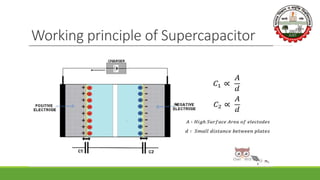
Working principle of Supercapacitor
Required properties of Electrode
Material
Good conductivity
High temperature stability
Long-term chemical stability (inertness)
High corrosion resistance
High surface areas per unit volume and mass
Supercapacitor Electrode Material
Activated carbon
Activated carbon fibers
Carbon aerogel
Carbide-derived carbon
Graphene
Carbon nanotube
Application of Supercapacitor
Voltage stabilizer
Consumer electronics such as laptop computers, PDAs, GPS, portable media players, hand-held
devices, and photovoltaic systems
Military
Automotive
Bus/tram
Railway
Cranes, forklifts and tractors
Motor racing
Hybrid electric vehicles etc.
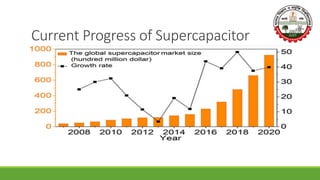
Current Progress of Supercapacitor
Research Gap of Supercapacitor
Energy densities of supercapacitors are not very high. At present, there is still a certain gap
between supercapacitors (<20 Wh kg−1) and batteries (30–200 Wh kg−1) in terms of energy
densities, how to improve the energy density is still the research focus and difficulty in the field
of supercapacitor.(Huang, Zhu et al. 2019)
The supercapacitor model can be equivalent to the ideal model, but in military applications,
especially in power supply applications of satellites and spacecraft, some nonideal parameters
may bring potential risks, which cannot be unheeded. Resonance caused by ordinary signal,
filter, and energy storage capacitor has a mature solution because of its limited energy.
Supercapacitors have the ability of instantaneous throughput and huge energy because of its
high energy. Therefore, it is very important to have a reliable design to study the impact on load
nature, load fluctuation or external environment, and accidental disturbance on the system
stability.
Research Gap of Supercapacitor
The rated voltage of a supercapacitor is very low (less than 2.7 V)(Yu, Lu et al. 2018)
Stable and effective electrode and electrolyte materials to improve the performance,
and at the same time to reduce the cost is also the research focus in this field(Zhou, Jin
et al. 2018)
Suggestion to overcome existing
limitations of supercapacitor
 Improvement of manufacturing process and technology is an effective way to improve
the storage capacity of supercapacitors, but in the long run, it is essential and difficult to
find new electrolyte and electrode active materials with higher corresponding
electrochemical performance. Low energy density supercapacitors result in bulkier
devices and hence they are not compact. Energy densities of supercapacitors can be
enhanced by increasing the effective surface area of electrode materials in double layer
capacitors or increasing the operation voltage window or both.(Huang, Zhu et al. 2019)
It requires a lot of series connection for practical applications. Because of the need for high
current charging and discharging in applications, and overcharging has a serious impact on the
life of capacitors, it is very important whether the voltages on individual capacitors in series are
consistent or not.(Yu, Lu et al. 2018)
Suggestion to overcome existing
limitations of supercapacitor
Find new low-cost raw materials, such as natural mineral resources.(Ayman, Rasheed et
al. 2020)
 Seek the combination of low price raw materials and high price raw materials, so as to
realize the purpose of complementary performance and low overall price
 Improve the production process (such as simplifying the process) and the production
equipment, at the same time achieve low cost. Therefore, this will also be the main
direction and strategic goal of the product’s future development
 Pay attention to the industrialization prospects of the materials and the cost issues on
application of new electrode materials, such as carbon fiber graphene.(Yang 2020)
Suggestion to overcome existing
limitations of supercapacitor
 Matching research of existing electrode materials, such as matching of existing
electrode materials with the electrolyte
The research of group module should pay more attention to the overall service life
characteristics and capacitors and the management system to enhance reliability and
security.
References
Huang, S., et al. (2019). "Challenges and opportunities for supercapacitors." APL Materials 7(10): 100901.
Yu, M., et al. (2018). "New insights into the operating voltage of aqueous supercapacitors." Chemistry–A European Journal 24(15): 3639-3649.
Zhou, Y., et al. (2018). "High-performance symmetric supercapacitors based on carbon nanotube/graphite nanofiber nanocomposites." Sci Rep 8(1):
9005.
This work reports the nanocomposites of graphitic nanofibers (GNFs) and carbon nanotubes (CNTs) as the electrode material for supercapacitors.
The hybrid CNTs/GNFs was prepared via a synthesis route that involved catalytic chemical vapor deposition (CVD) method. The structure and
morphology of CNTs/GNFs can be precisely controlled by adjusting the flow rates of reactant gases. The nest shape entanglement of CNTs and GNFs
which could not only have high conductivity to facilitate ion transmission, but could also increase surface area for more electrolyte ions access.
When assembled in a symmetric two-electrode system, the CNTs/GNFs-based supercapacitor showed a very good cycling stability of 96% after 10
000 charge/discharge cycles. Moreover, CNTs/GNFs-based symmetric device can deliver a maximum specific energy of 72.2 Wh kg(-1) at a power
density of 686.0 W kg(-1). The high performance of the hybrid performance can be attributed to the wheat like GNFs which provide sufficient
accessible sites for charge storage, and the CNTs skeleton which provide channels for charge transport.
References
Yang, H. (2020). "A comparative study of supercapacitor capacitance characterization methods."
J Energy Storage 29.
Ayman, I., et al. (2020). "CoFe2O4 Nanoparticle-Decorated 2D MXene: A Novel Hybrid Material
for Supercapacitor Applications." Energy & Fuels 34(6): 7622-7630.

supercapacitor.pptx

  • 1.
    A presentation AboutSupercapacitor PRESENTED BY MD. RASHIDUL ALAM
  • 2.
    CONTENTS  What isCapacitor  What is Supercapacitor  Construction of Supercapacitor  Working Principle of Supercapacitor  Required properties of Electrode Material  Supercapacitor Electrode Material  Application of Supercapacitor  Current Progress of Supercapacitor  Research Gap of Supercapacitor  Suggestion to overcome existing limitations of supercapacitor
  • 3.
    What is Capacitor? •A capacitor is a two-terminal passive electronic component that stores charge in the form of electronic field between its metal plates. • It is made up of two metal plates separated by an insulator known as the dielectric.
  • 4.
    What is Supercapacitor? •Supercapacitors are charge storage devices, with low energy density, high power density and exceptional cycle life. • Supercapacitor is known as super cap, double layer capacitor or ultra-capacitor. • The electrodes of supercapacitor is coated with active carbon as electrode material.
  • 5.
  • 6.
    Working principle ofSupercapacitor
  • 7.
    Working principle ofSupercapacitor
  • 8.
    Working principle ofSupercapacitor
  • 9.
    Working principle ofSupercapacitor
  • 10.
    Working principle ofSupercapacitor
  • 11.
    Working principle ofSupercapacitor
  • 12.
    Working principle ofSupercapacitor
  • 13.
    Working principle ofSupercapacitor
  • 14.
    Working principle ofSupercapacitor
  • 15.
    Working principle ofSupercapacitor
  • 16.
    Working principle ofSupercapacitor
  • 17.
    Required properties ofElectrode Material Good conductivity High temperature stability Long-term chemical stability (inertness) High corrosion resistance High surface areas per unit volume and mass
  • 18.
    Supercapacitor Electrode Material Activatedcarbon Activated carbon fibers Carbon aerogel Carbide-derived carbon Graphene Carbon nanotube
  • 19.
    Application of Supercapacitor Voltagestabilizer Consumer electronics such as laptop computers, PDAs, GPS, portable media players, hand-held devices, and photovoltaic systems Military Automotive Bus/tram Railway Cranes, forklifts and tractors Motor racing Hybrid electric vehicles etc.
  • 20.
    Current Progress ofSupercapacitor
  • 21.
    Current Progress ofSupercapacitor
  • 22.
    Research Gap ofSupercapacitor
  • 23.
    Research Gap ofSupercapacitor Energy densities of supercapacitors are not very high. At present, there is still a certain gap between supercapacitors (<20 Wh kg−1) and batteries (30–200 Wh kg−1) in terms of energy densities, how to improve the energy density is still the research focus and difficulty in the field of supercapacitor.(Huang, Zhu et al. 2019) The supercapacitor model can be equivalent to the ideal model, but in military applications, especially in power supply applications of satellites and spacecraft, some nonideal parameters may bring potential risks, which cannot be unheeded. Resonance caused by ordinary signal, filter, and energy storage capacitor has a mature solution because of its limited energy. Supercapacitors have the ability of instantaneous throughput and huge energy because of its high energy. Therefore, it is very important to have a reliable design to study the impact on load nature, load fluctuation or external environment, and accidental disturbance on the system stability.
  • 24.
    Research Gap ofSupercapacitor The rated voltage of a supercapacitor is very low (less than 2.7 V)(Yu, Lu et al. 2018) Stable and effective electrode and electrolyte materials to improve the performance, and at the same time to reduce the cost is also the research focus in this field(Zhou, Jin et al. 2018)
  • 25.
    Suggestion to overcomeexisting limitations of supercapacitor  Improvement of manufacturing process and technology is an effective way to improve the storage capacity of supercapacitors, but in the long run, it is essential and difficult to find new electrolyte and electrode active materials with higher corresponding electrochemical performance. Low energy density supercapacitors result in bulkier devices and hence they are not compact. Energy densities of supercapacitors can be enhanced by increasing the effective surface area of electrode materials in double layer capacitors or increasing the operation voltage window or both.(Huang, Zhu et al. 2019) It requires a lot of series connection for practical applications. Because of the need for high current charging and discharging in applications, and overcharging has a serious impact on the life of capacitors, it is very important whether the voltages on individual capacitors in series are consistent or not.(Yu, Lu et al. 2018)
  • 26.
    Suggestion to overcomeexisting limitations of supercapacitor Find new low-cost raw materials, such as natural mineral resources.(Ayman, Rasheed et al. 2020)  Seek the combination of low price raw materials and high price raw materials, so as to realize the purpose of complementary performance and low overall price  Improve the production process (such as simplifying the process) and the production equipment, at the same time achieve low cost. Therefore, this will also be the main direction and strategic goal of the product’s future development  Pay attention to the industrialization prospects of the materials and the cost issues on application of new electrode materials, such as carbon fiber graphene.(Yang 2020)
  • 27.
    Suggestion to overcomeexisting limitations of supercapacitor  Matching research of existing electrode materials, such as matching of existing electrode materials with the electrolyte The research of group module should pay more attention to the overall service life characteristics and capacitors and the management system to enhance reliability and security.
  • 28.
    References Huang, S., etal. (2019). "Challenges and opportunities for supercapacitors." APL Materials 7(10): 100901. Yu, M., et al. (2018). "New insights into the operating voltage of aqueous supercapacitors." Chemistry–A European Journal 24(15): 3639-3649. Zhou, Y., et al. (2018). "High-performance symmetric supercapacitors based on carbon nanotube/graphite nanofiber nanocomposites." Sci Rep 8(1): 9005. This work reports the nanocomposites of graphitic nanofibers (GNFs) and carbon nanotubes (CNTs) as the electrode material for supercapacitors. The hybrid CNTs/GNFs was prepared via a synthesis route that involved catalytic chemical vapor deposition (CVD) method. The structure and morphology of CNTs/GNFs can be precisely controlled by adjusting the flow rates of reactant gases. The nest shape entanglement of CNTs and GNFs which could not only have high conductivity to facilitate ion transmission, but could also increase surface area for more electrolyte ions access. When assembled in a symmetric two-electrode system, the CNTs/GNFs-based supercapacitor showed a very good cycling stability of 96% after 10 000 charge/discharge cycles. Moreover, CNTs/GNFs-based symmetric device can deliver a maximum specific energy of 72.2 Wh kg(-1) at a power density of 686.0 W kg(-1). The high performance of the hybrid performance can be attributed to the wheat like GNFs which provide sufficient accessible sites for charge storage, and the CNTs skeleton which provide channels for charge transport.
  • 29.
    References Yang, H. (2020)."A comparative study of supercapacitor capacitance characterization methods." J Energy Storage 29. Ayman, I., et al. (2020). "CoFe2O4 Nanoparticle-Decorated 2D MXene: A Novel Hybrid Material for Supercapacitor Applications." Energy & Fuels 34(6): 7622-7630.