Quantum Mechanical
Modeling of Periodic
Structures
Shyue Ping Ong
The MaterialsWorld
NANO266
2
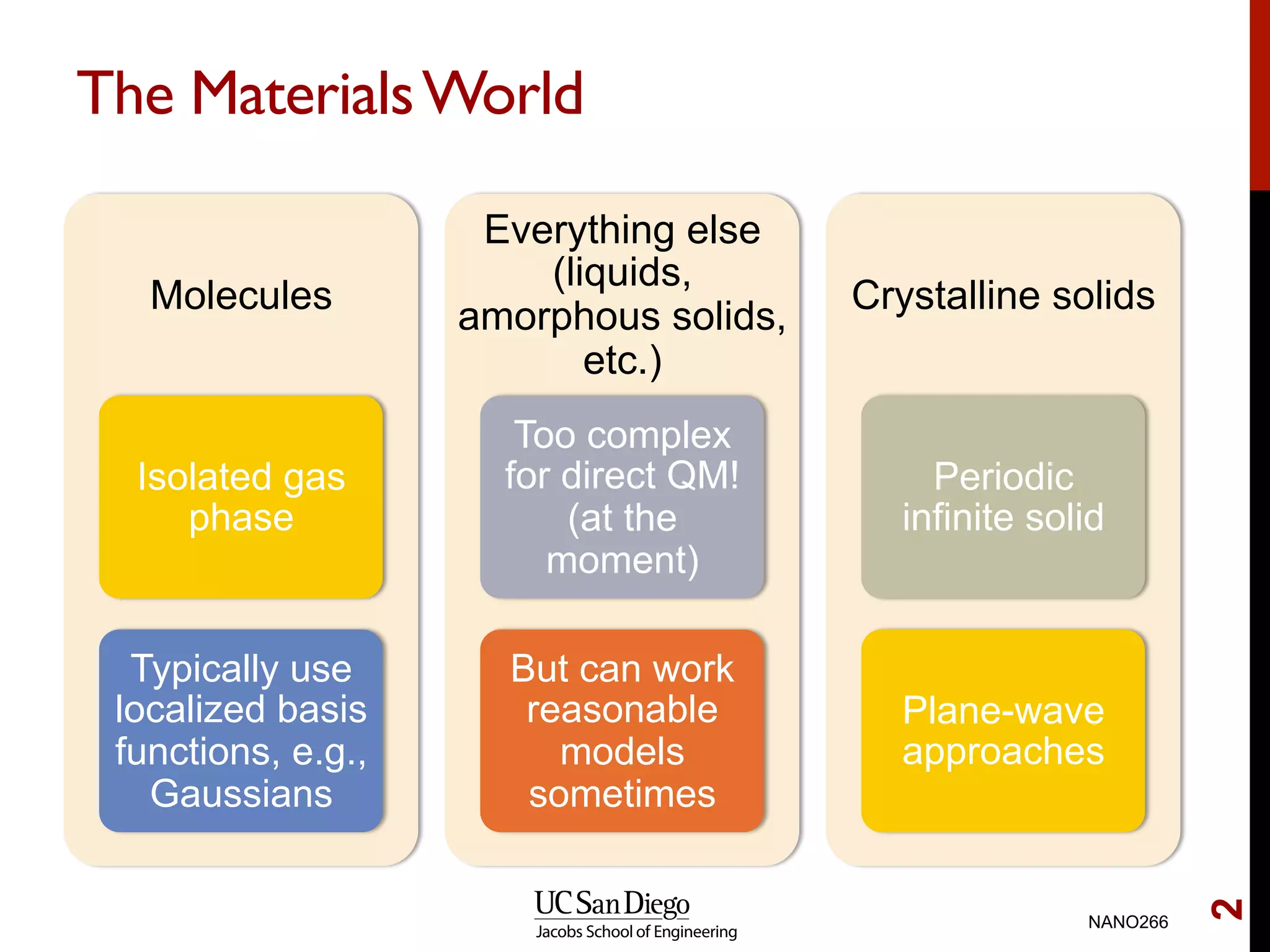
Molecules
Isolated gas
phase
Typically use
localized basis
functions, e.g.,
Gaussians
Everything else
(liquids,
amorphous solids,
etc.)
Too complex
for direct QM!
(at the
moment)
But can work
reasonable
models
sometimes
Crystalline solids
Periodic
infinite solid
Plane-wave
approaches
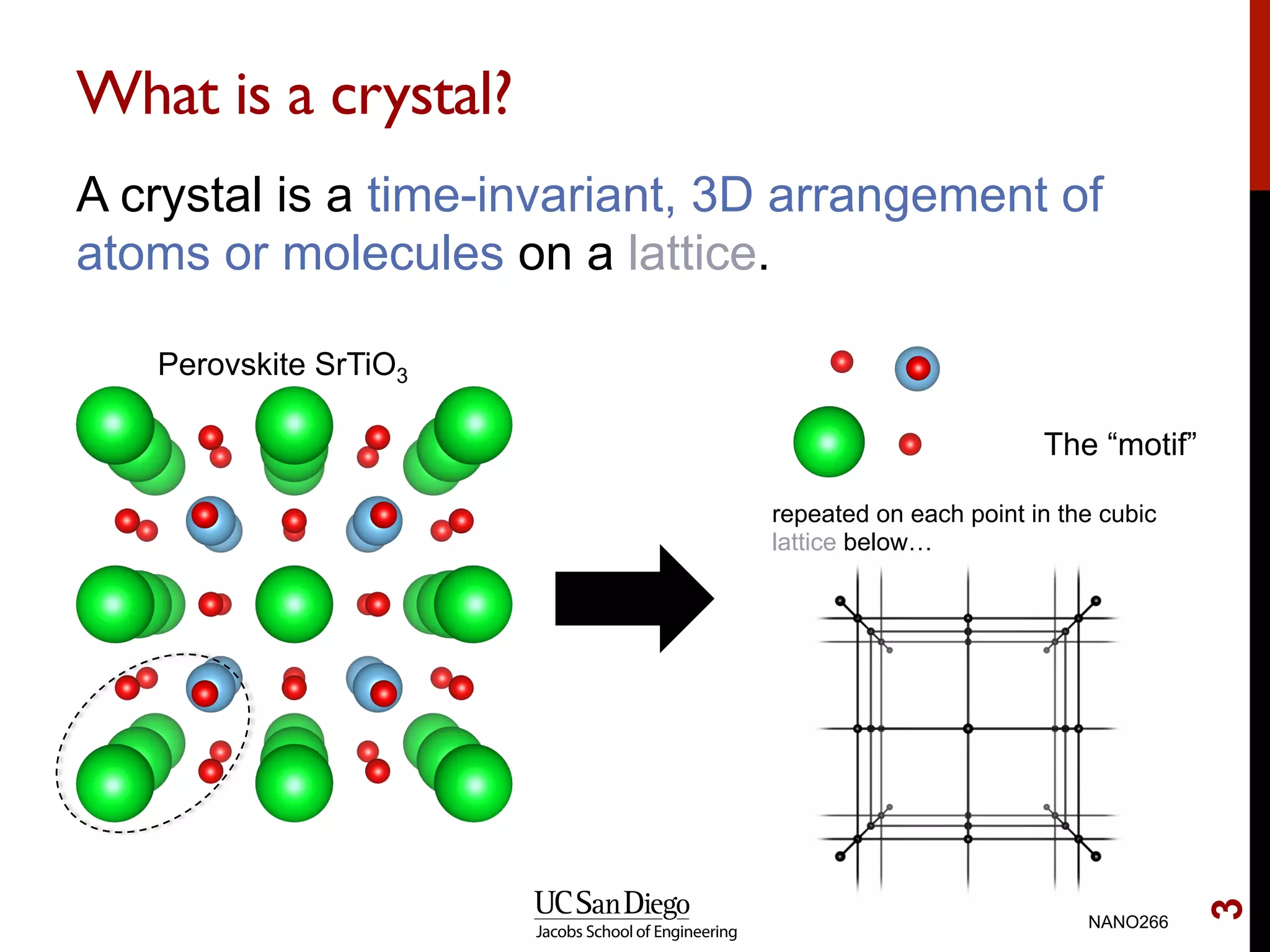
What is a crystal?
A crystal is a time-invariant, 3D arrangement of
atoms or molecules on a lattice.
NANO266
Perovskite SrTiO3
The “motif”
repeated on each point in the cubic
lattice below…
3
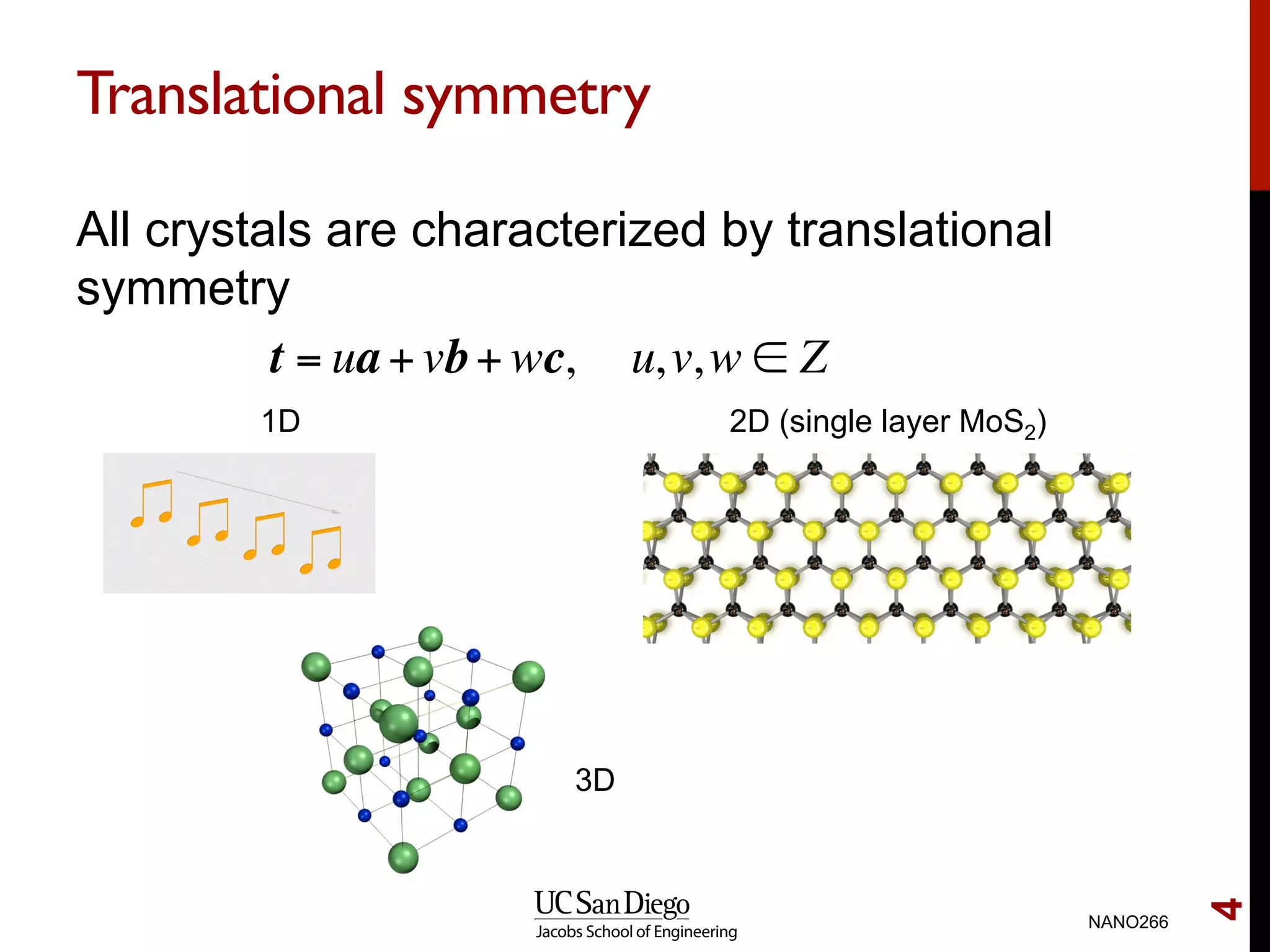
Translational symmetry
All crystals are characterized by translational
symmetry
NANO266
4
t = ua + vb + wc, u,v,w ∈ Z
1D 2D (single layer MoS2)
3D
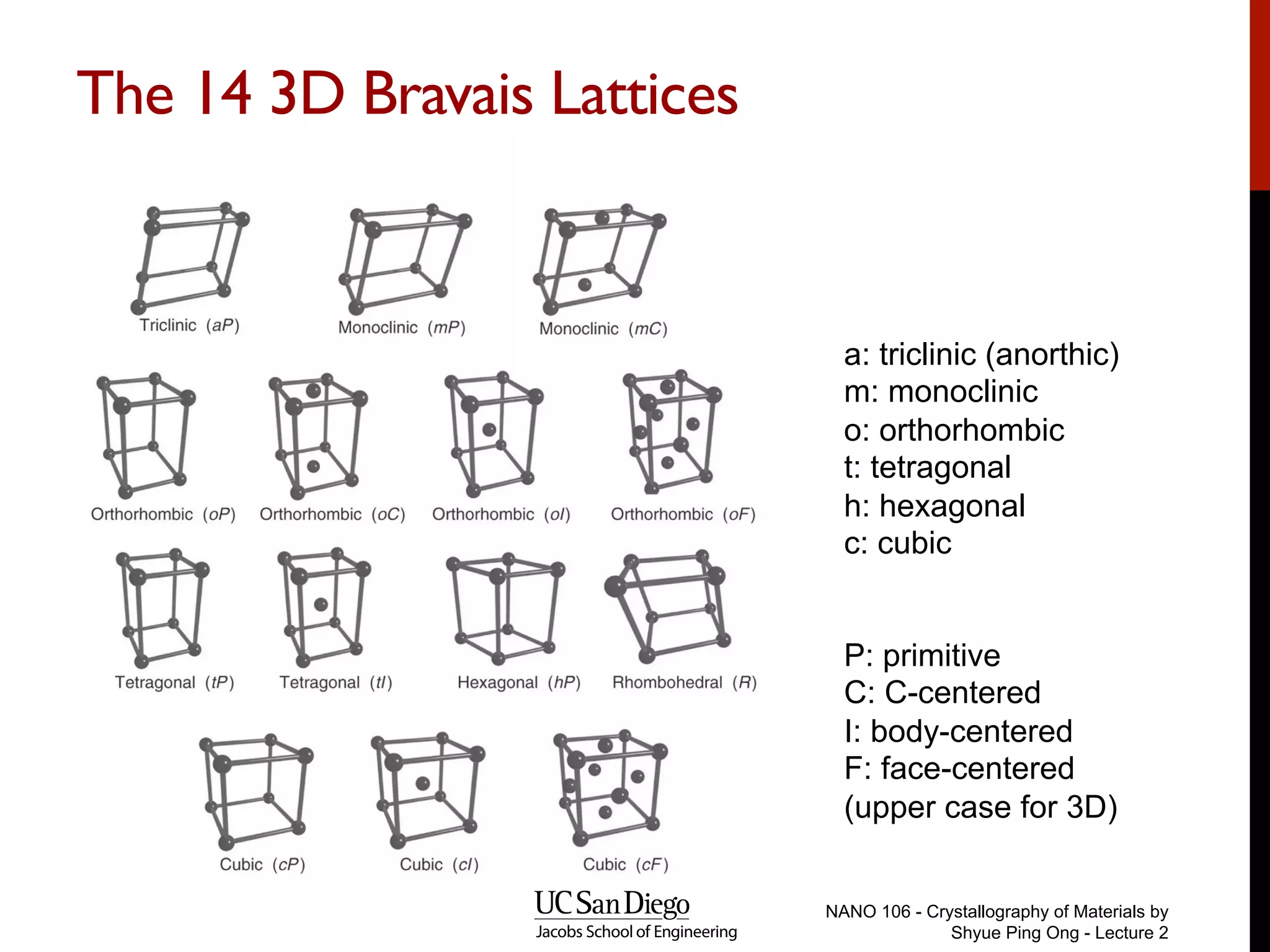
The 14 3D Bravais Lattices
NANO 106 - Crystallography of Materials by
Shyue Ping Ong - Lecture 2
P: primitive
C: C-centered
I: body-centered
F: face-centered
(upper case for 3D)
a: triclinic (anorthic)
m: monoclinic
o: orthorhombic
t: tetragonal
h: hexagonal
c: cubic
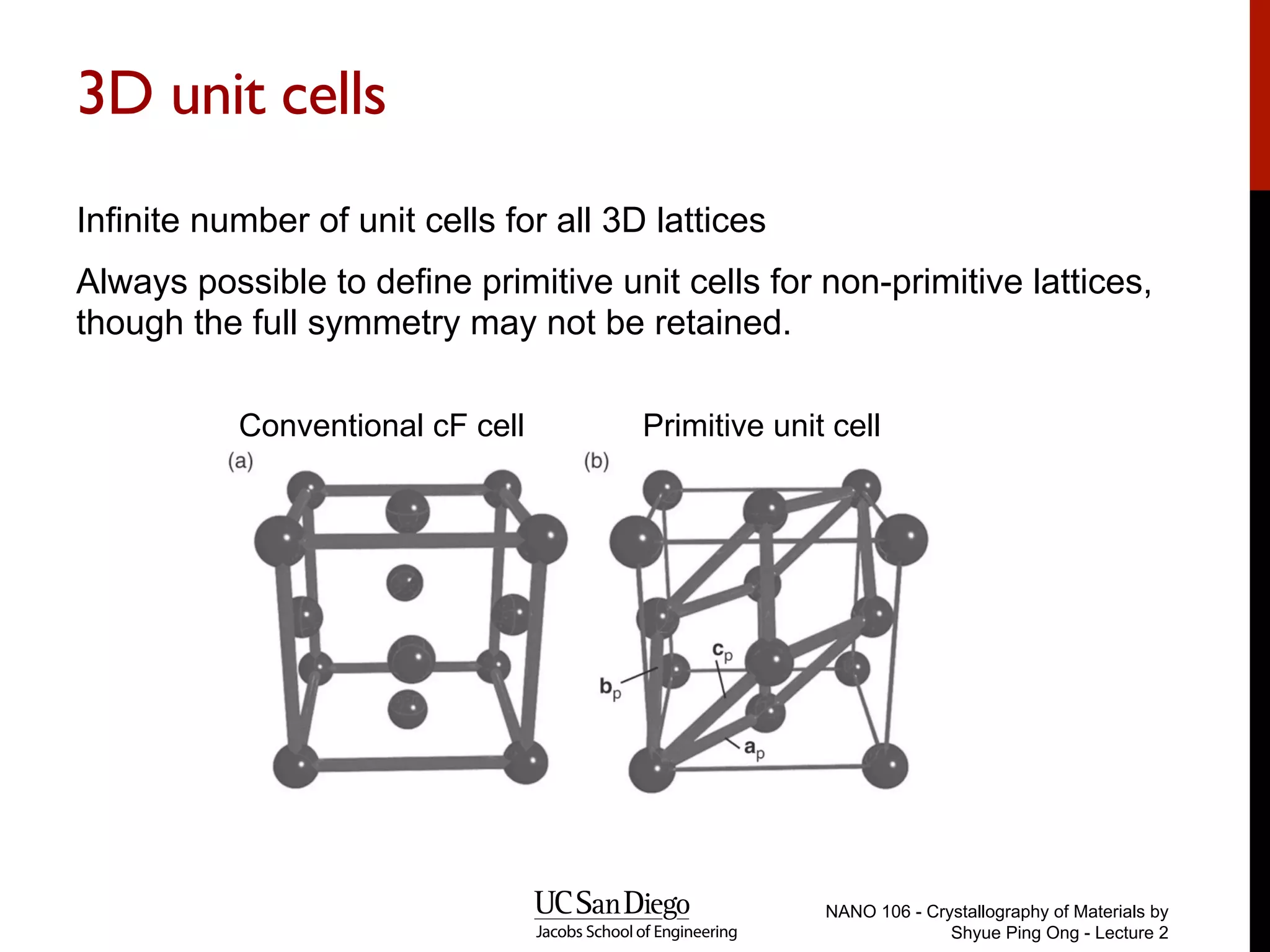
3D unit cells
Infinite number of unit cells for all 3D lattices
Always possible to define primitive unit cells for non-primitive lattices,
though the full symmetry may not be retained.
NANO 106 - Crystallography of Materials by
Shyue Ping Ong - Lecture 2
Conventional cF cell Primitive unit cell
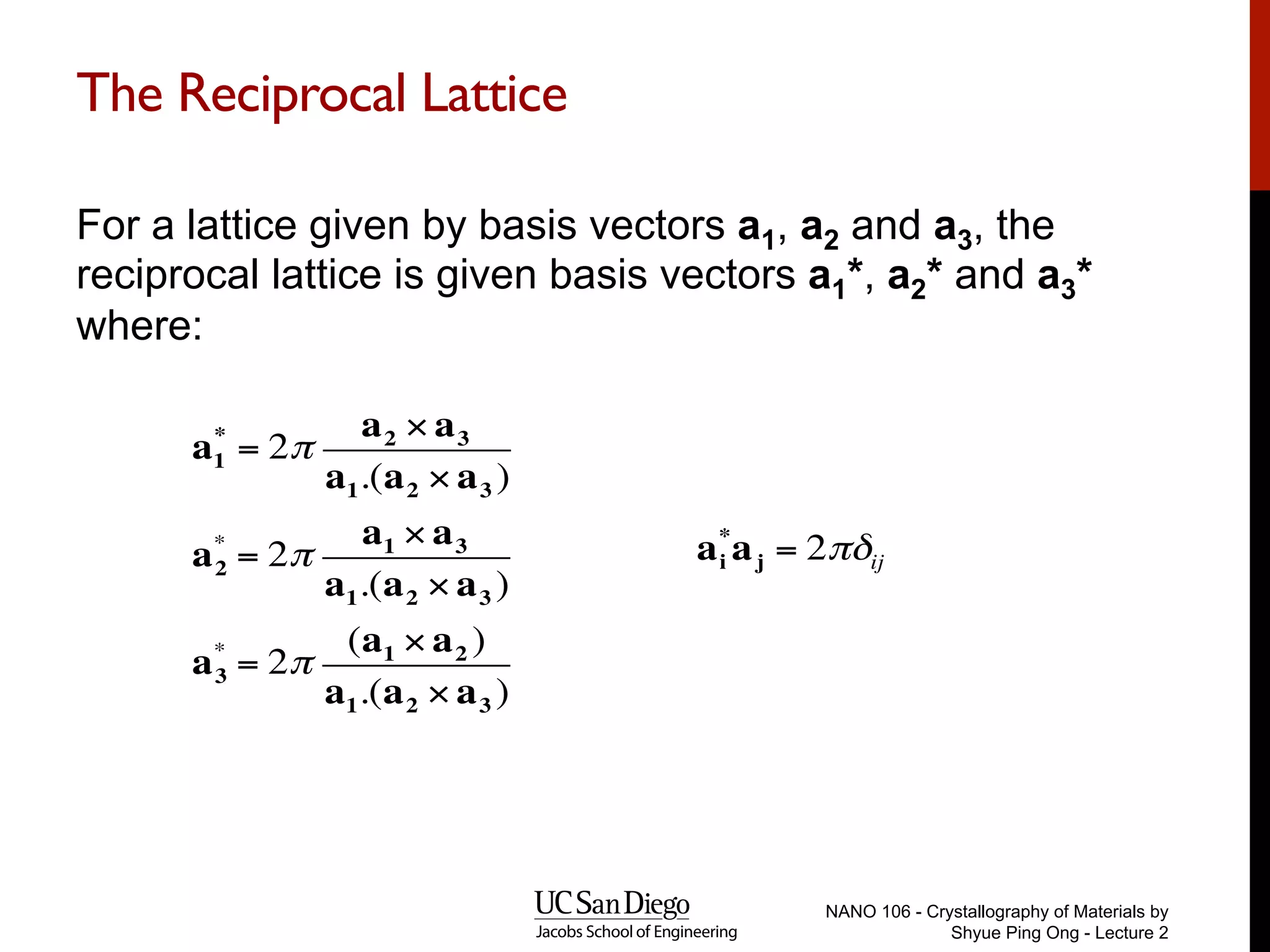
The Reciprocal Lattice
For a lattice given by basis vectors a1, a2 and a3, the
reciprocal lattice is given basis vectors a1*, a2* and a3*
where:
NANO 106 - Crystallography of Materials by
Shyue Ping Ong - Lecture 2
a1
*
= 2π
a2 × a3
a1.(a2 × a3 )
a2
*
= 2π
a1 × a3
a1.(a2 × a3 )
a3
*
= 2π
(a1 × a2 )
a1.(a2 × a3 )
ai
*
aj = 2πδij
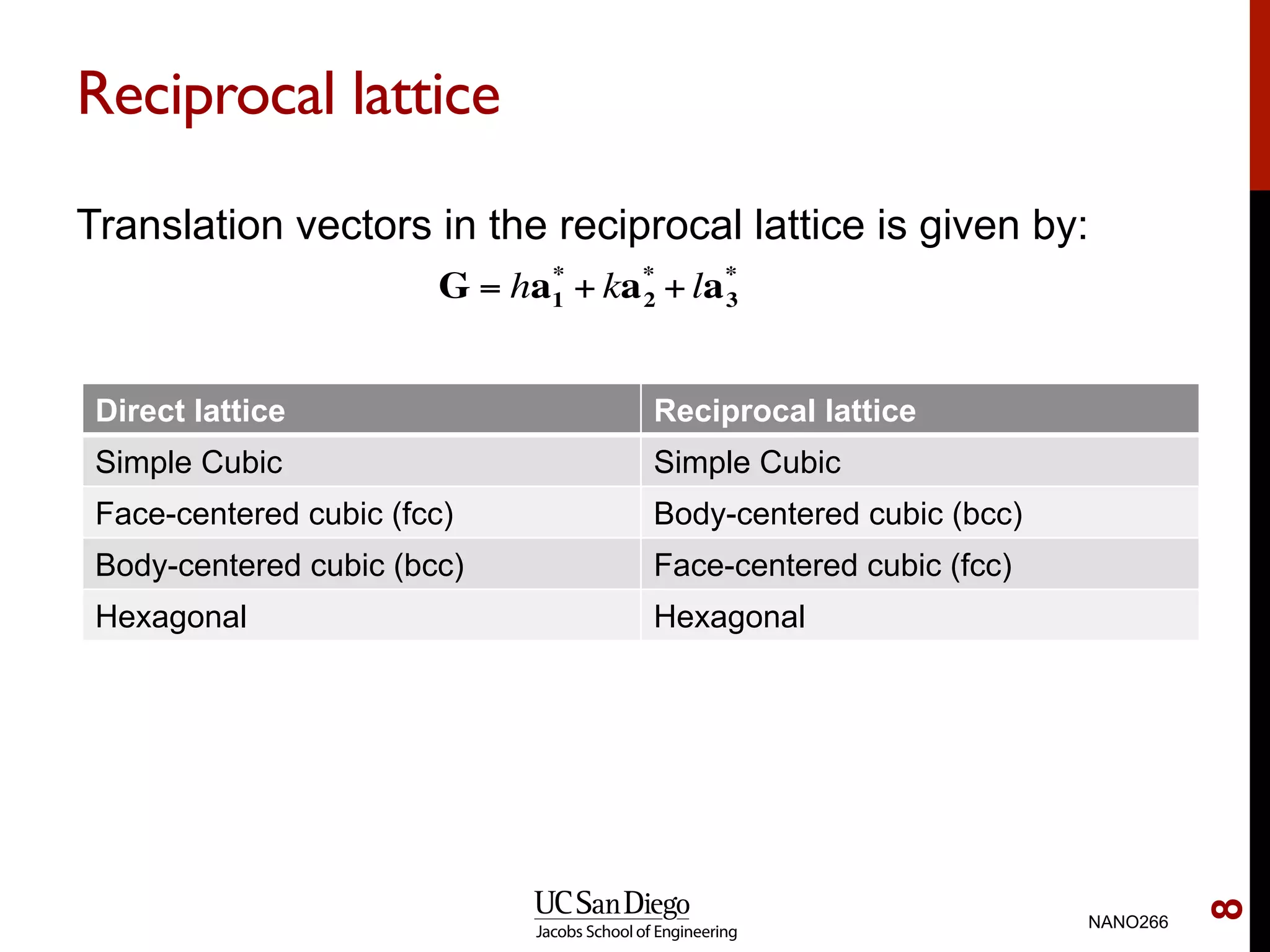
Reciprocal lattice
Translation vectors in the reciprocal lattice is given by:
NANO266
8
G = ha1
*
+ ka2
*
+la3
*
Direct lattice Reciprocal lattice
Simple Cubic Simple Cubic
Face-centered cubic (fcc) Body-centered cubic (bcc)
Body-centered cubic (bcc) Face-centered cubic (fcc)
Hexagonal Hexagonal
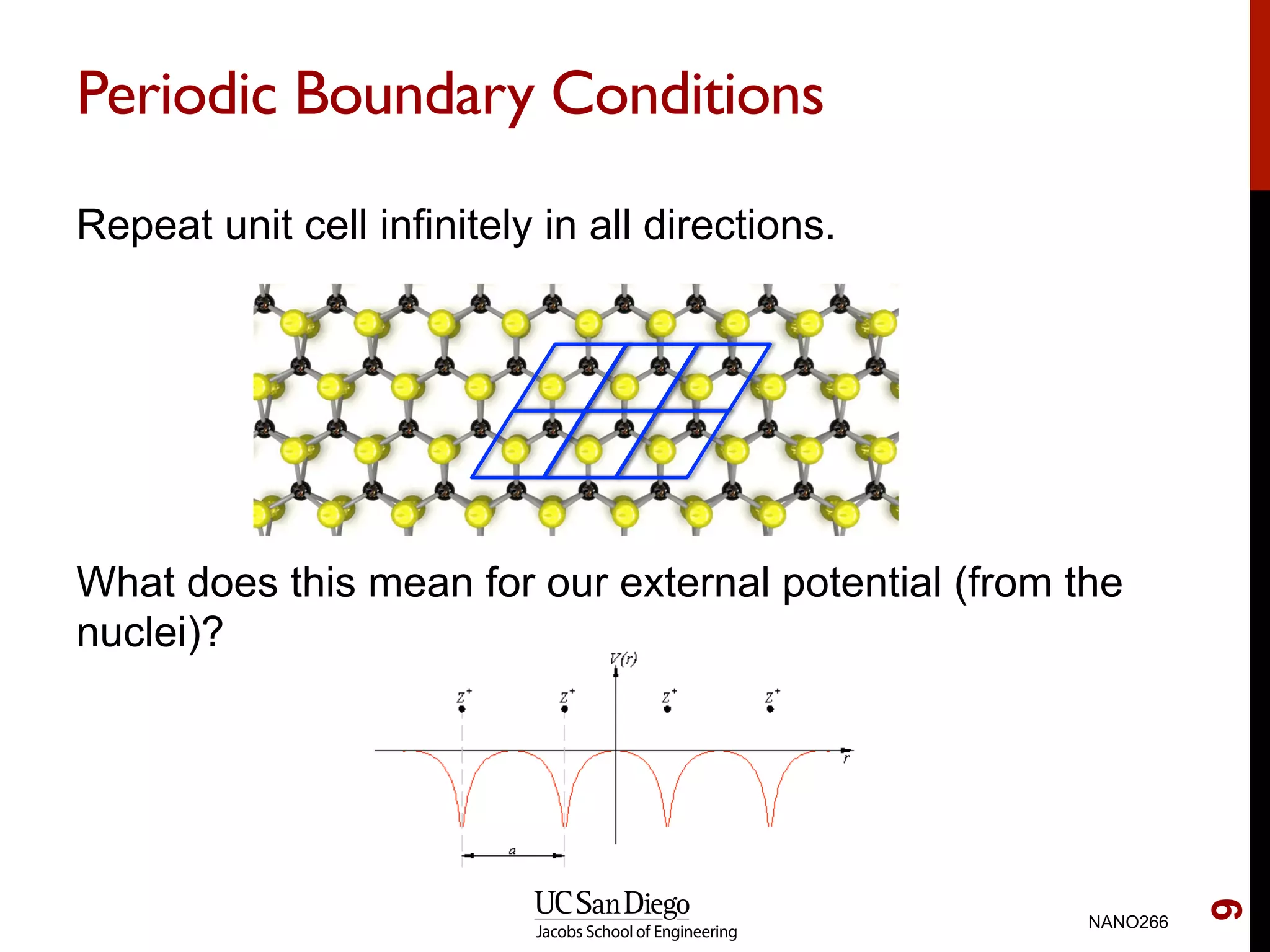
Periodic Boundary Conditions
Repeat unit cell infinitely in all directions.
What does this mean for our external potential (from the
nuclei)?
NANO266
9
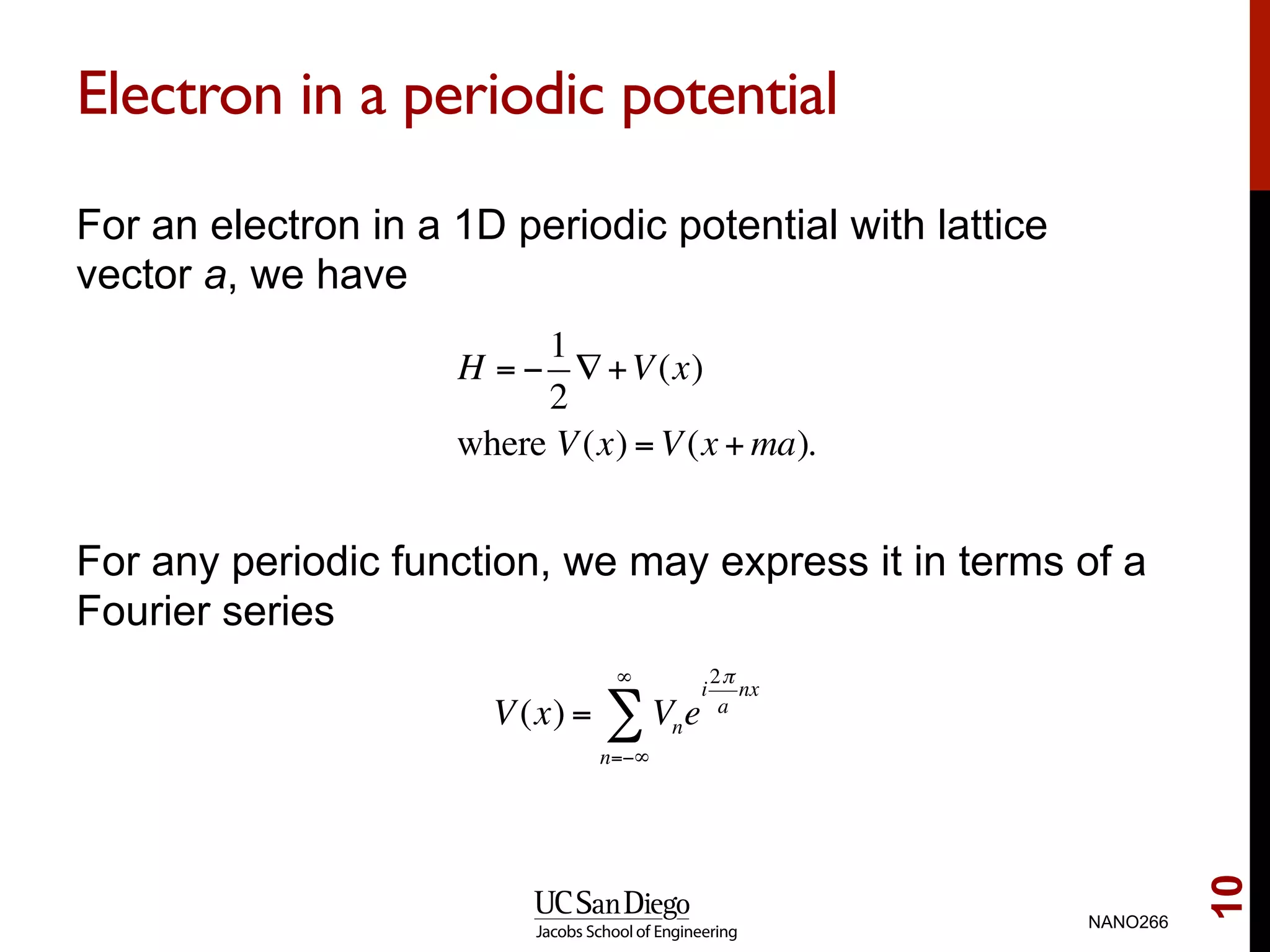
Electron in a periodic potential
For an electron in a 1D periodic potential with lattice
vector a, we have
For any periodic function, we may express it in terms of a
Fourier series
NANO266
10
H = −
1
2
∇+V(x)
where V(x) =V(x + ma).
V(x) = Vne
i
2π
a
nx
n=−∞
∞
∑
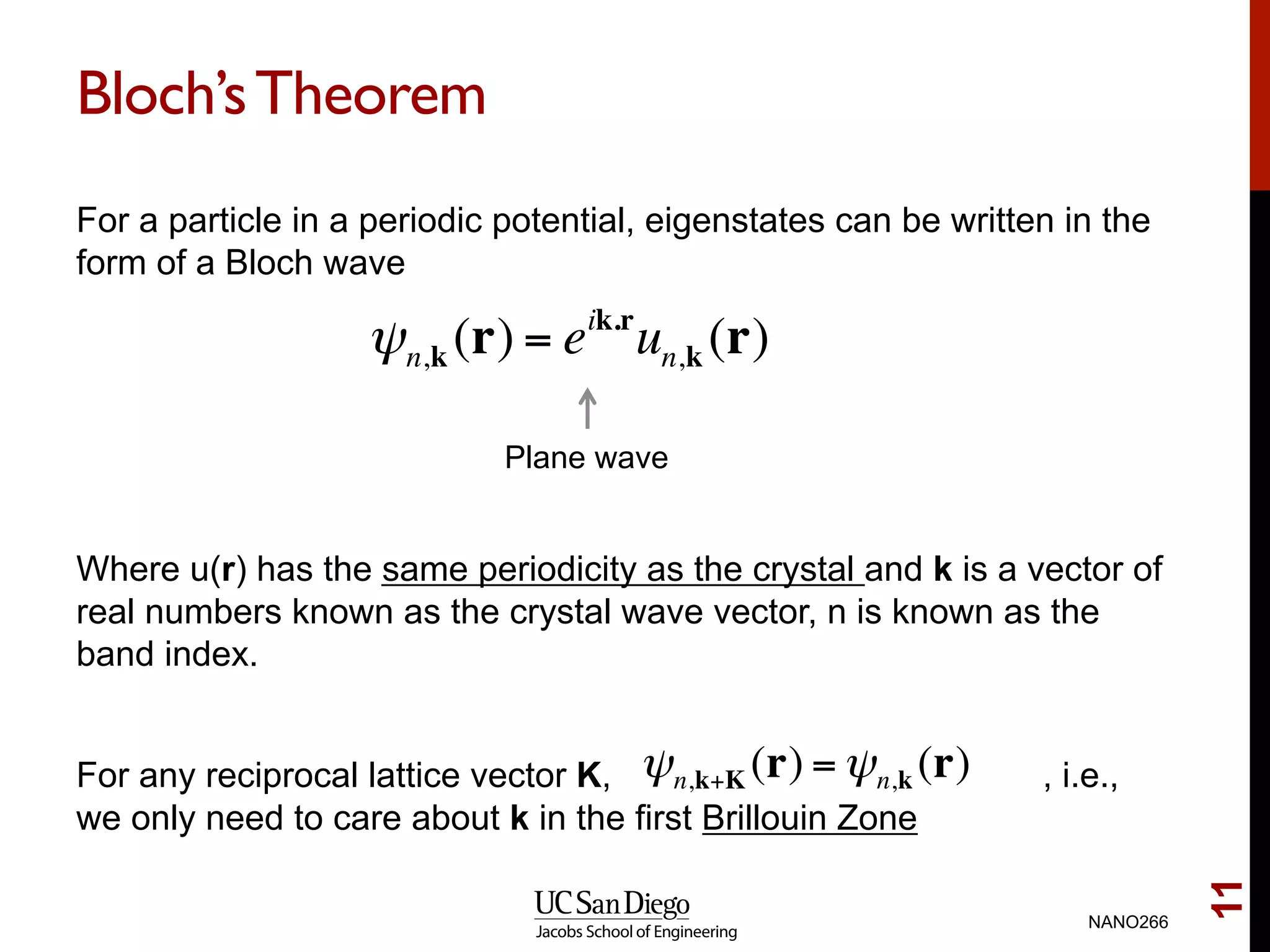
Bloch’sTheorem
For a particle in a periodic potential, eigenstates can be written in the
form of a Bloch wave
Where u(r) has the same periodicity as the crystal and k is a vector of
real numbers known as the crystal wave vector, n is known as the
band index.
For any reciprocal lattice vector K, , i.e.,
we only need to care about k in the first Brillouin Zone
NANO266
11
ψn,k (r) = eik.r
un,k (r)
Plane wave
ψn,k+K (r) =ψn,k (r)
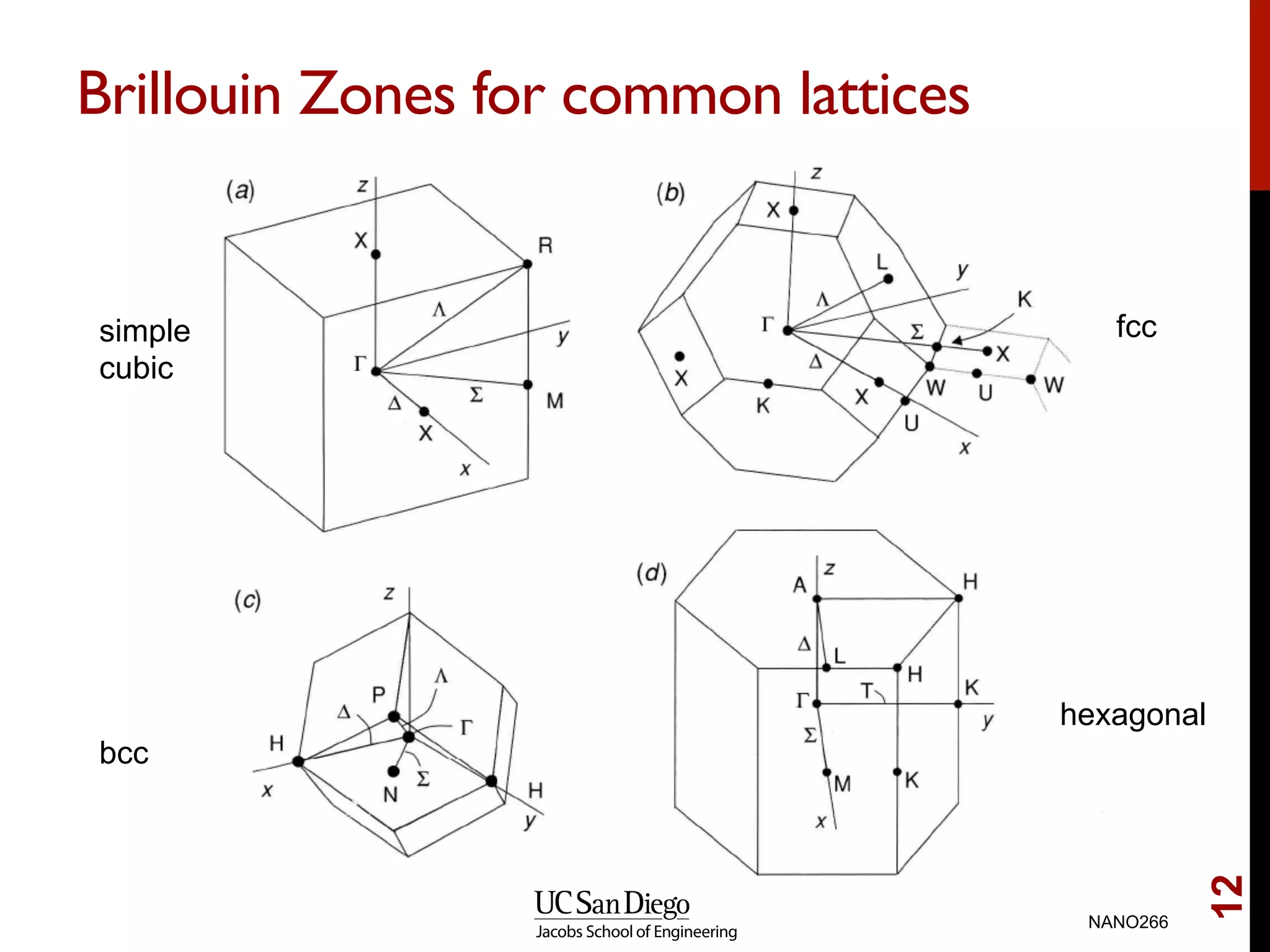
Brillouin Zones for common lattices
NANO266
12
simple
cubic
fcc
bcc
hexagonal
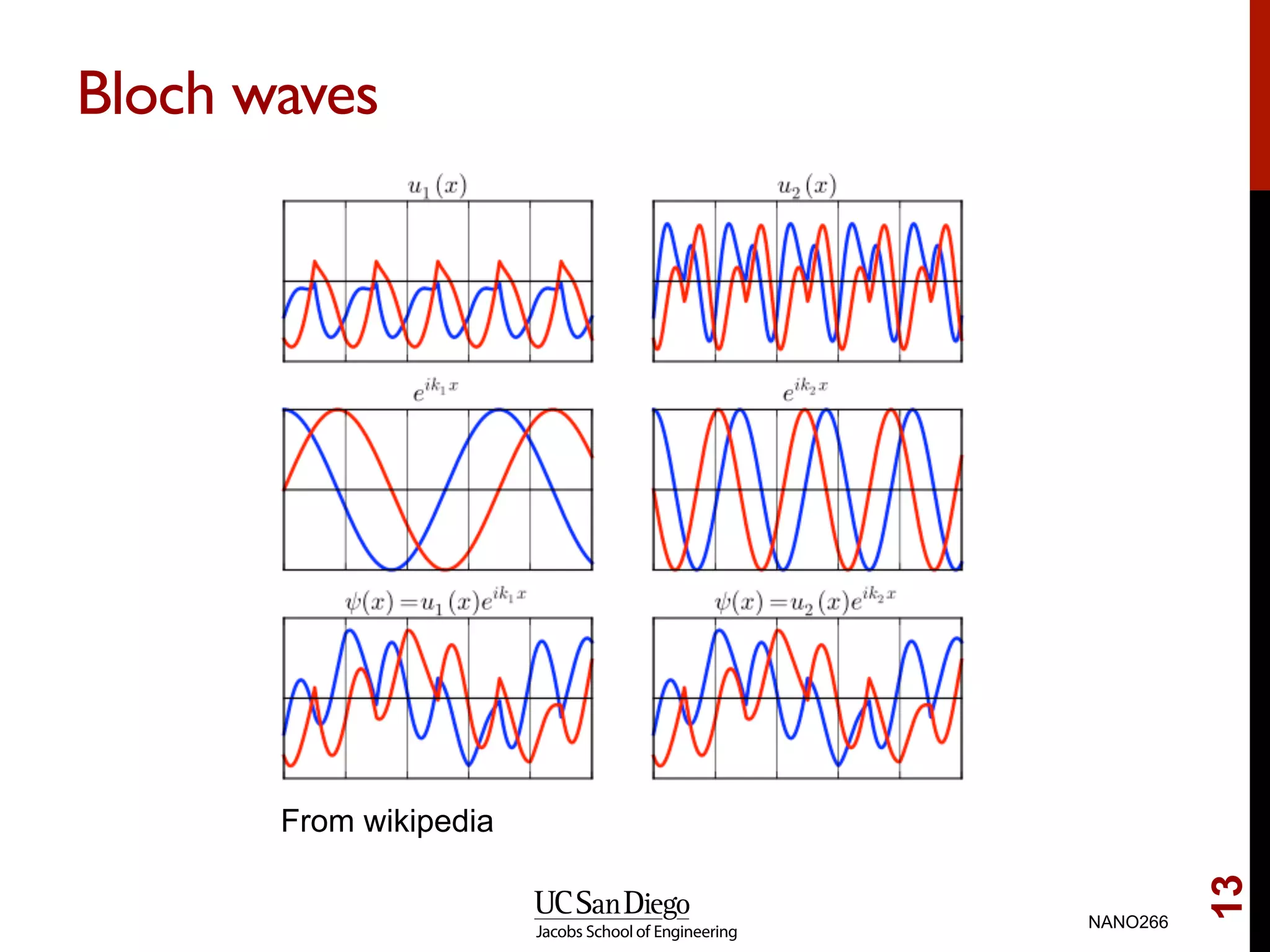
Bloch waves
NANO266
13
From wikipedia
Plane waves as a basis
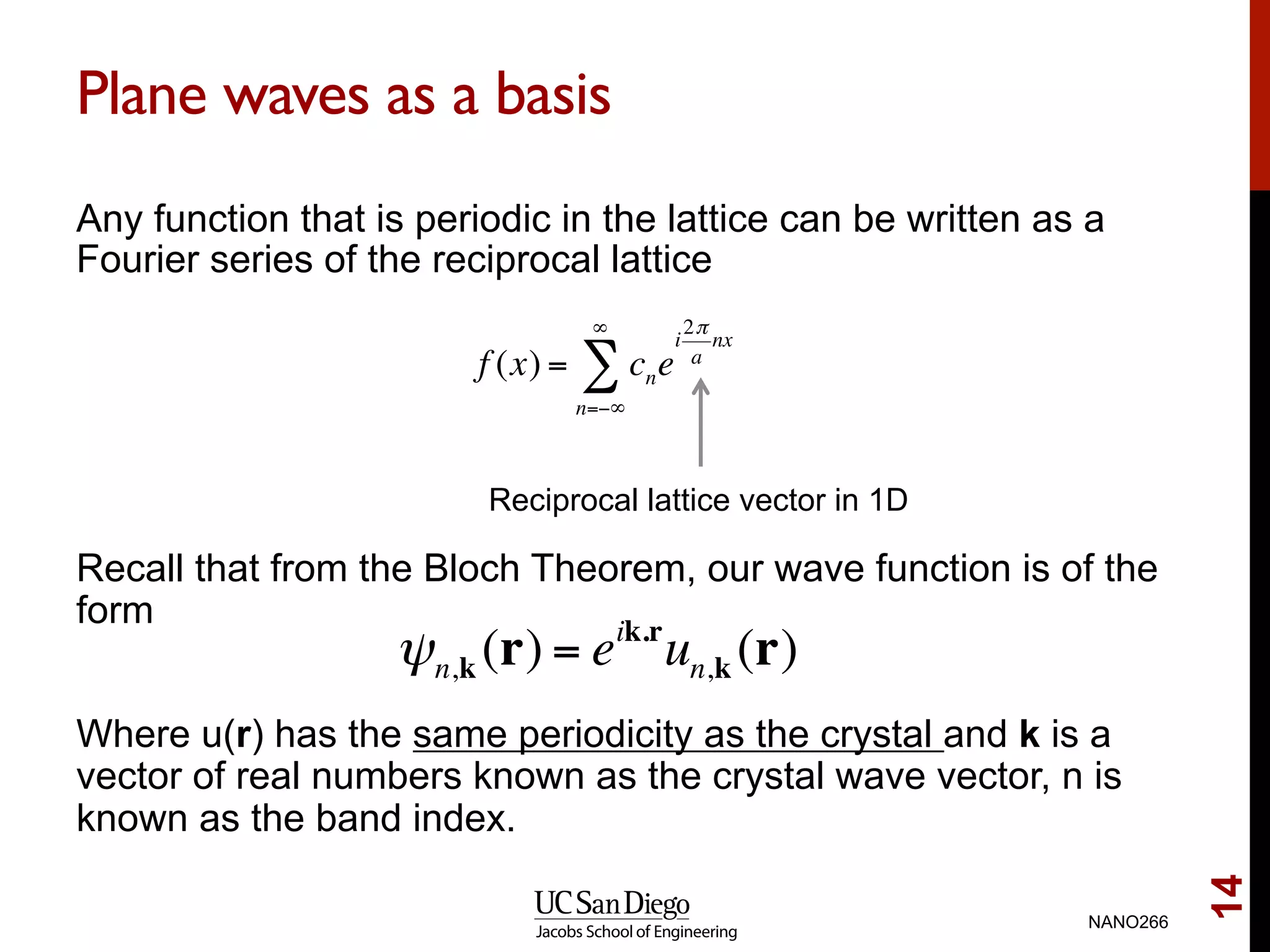
Any function that is periodic in the lattice can be written as a
Fourier series of the reciprocal lattice
Recall that from the Bloch Theorem, our wave function is of the
form
Where u(r) has the same periodicity as the crystal and k is a
vector of real numbers known as the crystal wave vector, n is
known as the band index.
NANO266
14
ψn,k (r) = eik.r
un,k (r)
f (x) = cne
i
2π
a
nx
n=−∞
∞
∑
Reciprocal lattice vector in 1D
Plane waves as a basis
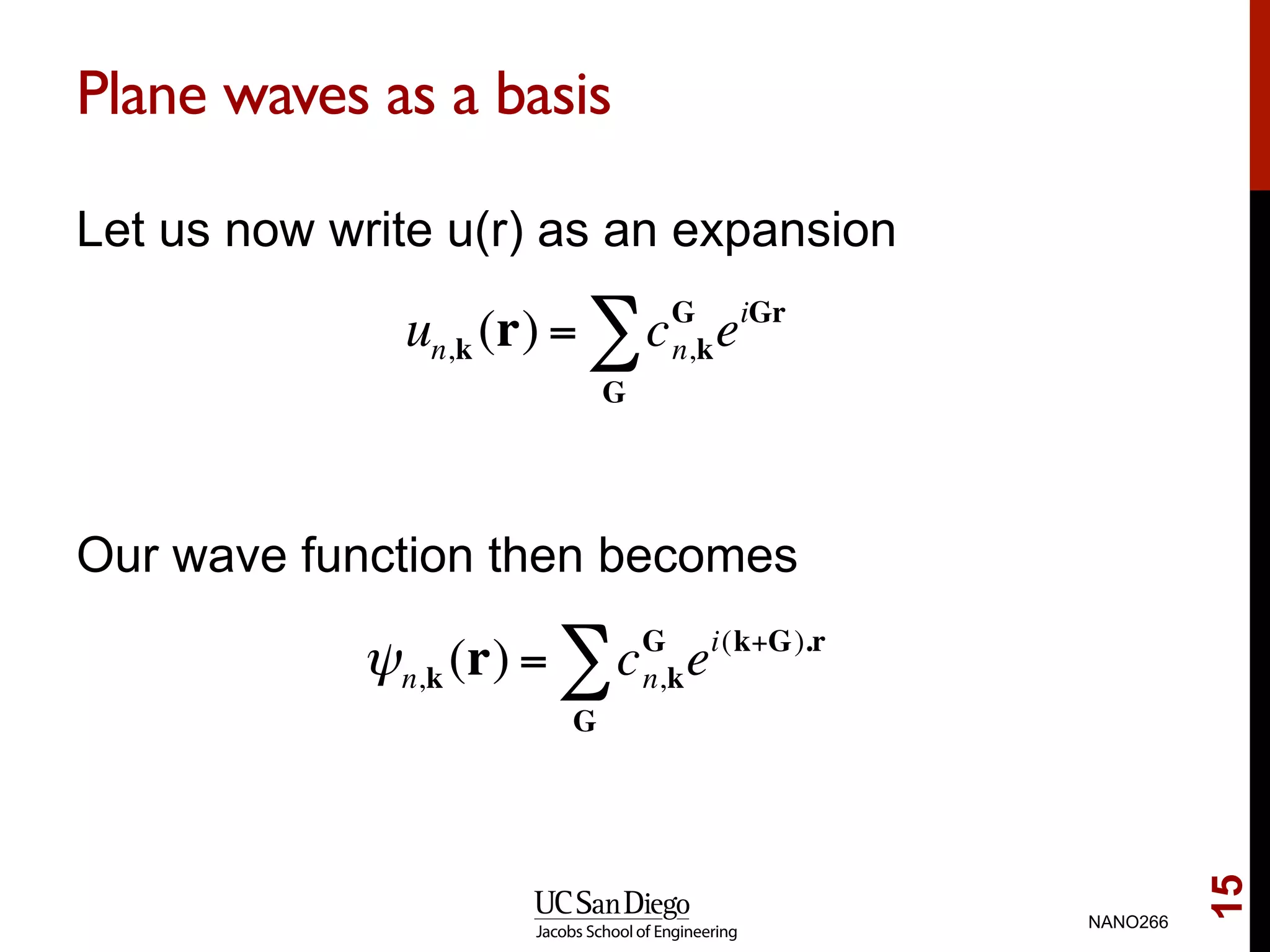
Let us now write u(r) as an expansion
Our wave function then becomes
NANO266
15
un,k (r) = cG
n,keiGr
G
∑
ψn,k (r) = cG
n,kei(k+G).r
G
∑
Using the plane waves as basis
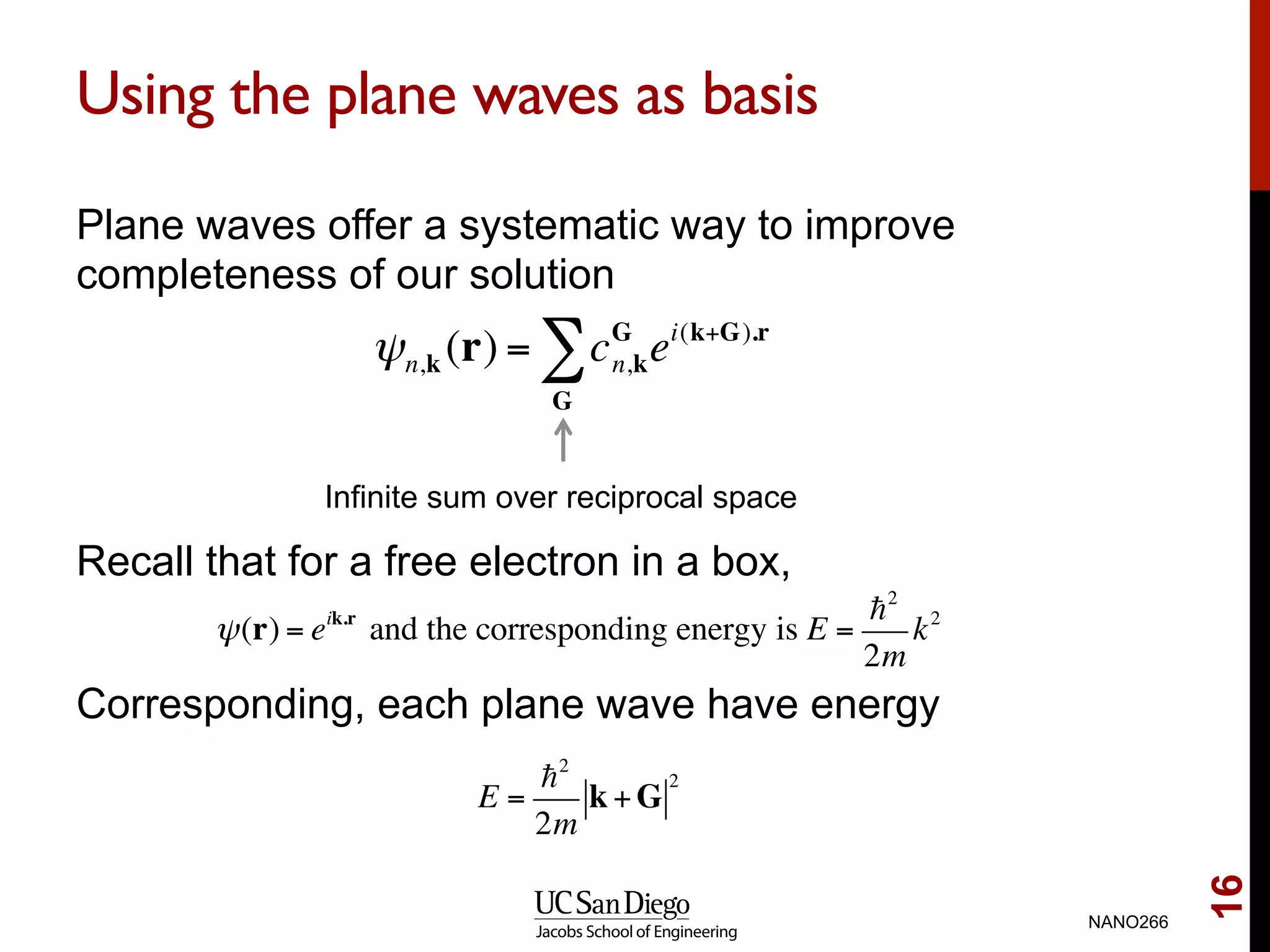
Plane waves offer a systematic way to improve
completeness of our solution
Recall that for a free electron in a box,
Corresponding, each plane wave have energy
NANO266
16
ψn,k (r) = cG
n,kei(k+G).r
G
∑
Infinite sum over reciprocal space
ψ(r) = eik.r
and the corresponding energy is E =
!2
2m
k2
E =
!2
2m
k+G
2
Energy cutoff
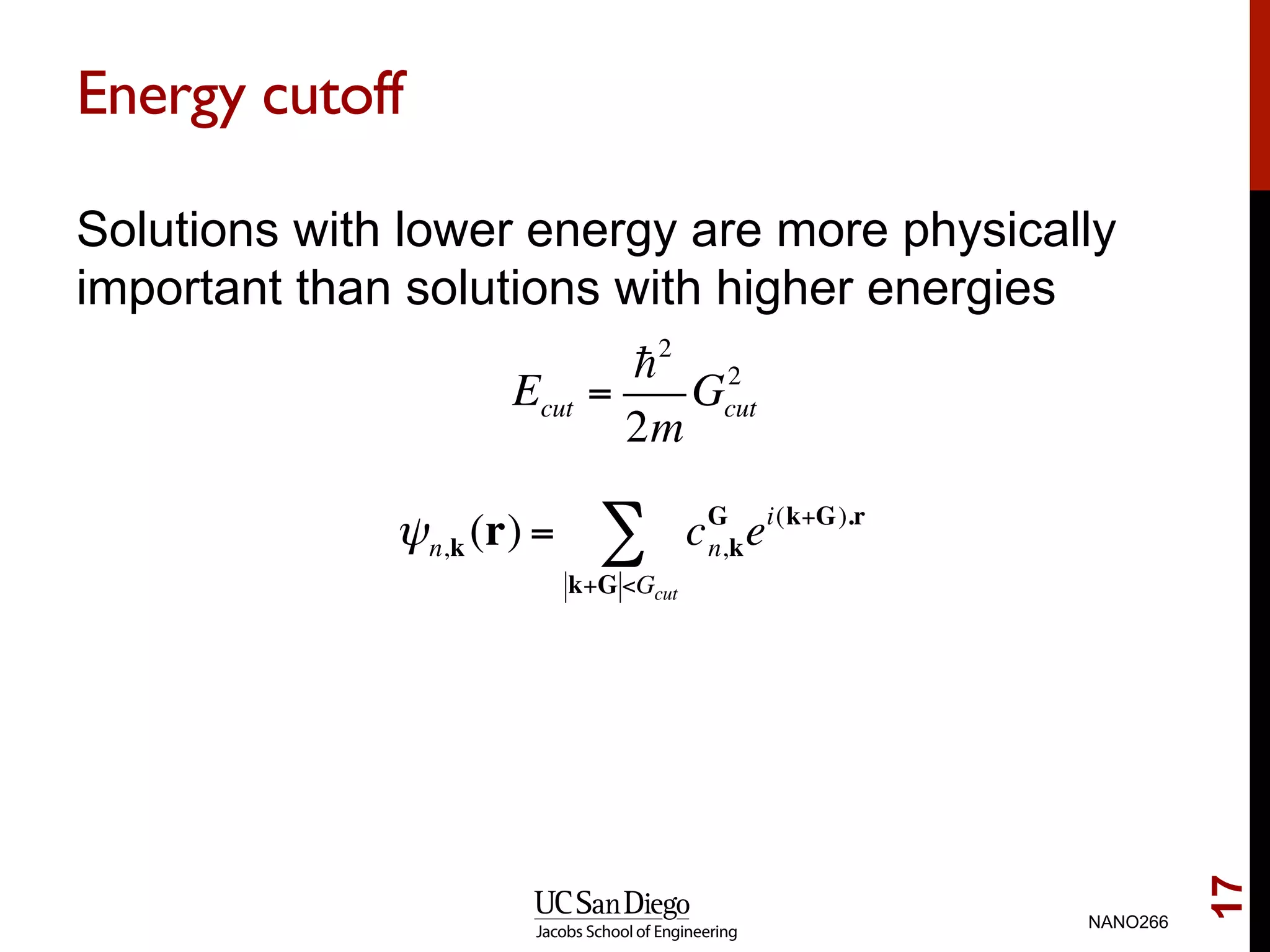
Solutions with lower energy are more physically
important than solutions with higher energies
NANO266
17
Ecut =
!2
2m
Gcut
2
ψn,k (r) = cG
n,kei(k+G).r
k+G<Gcut
∑
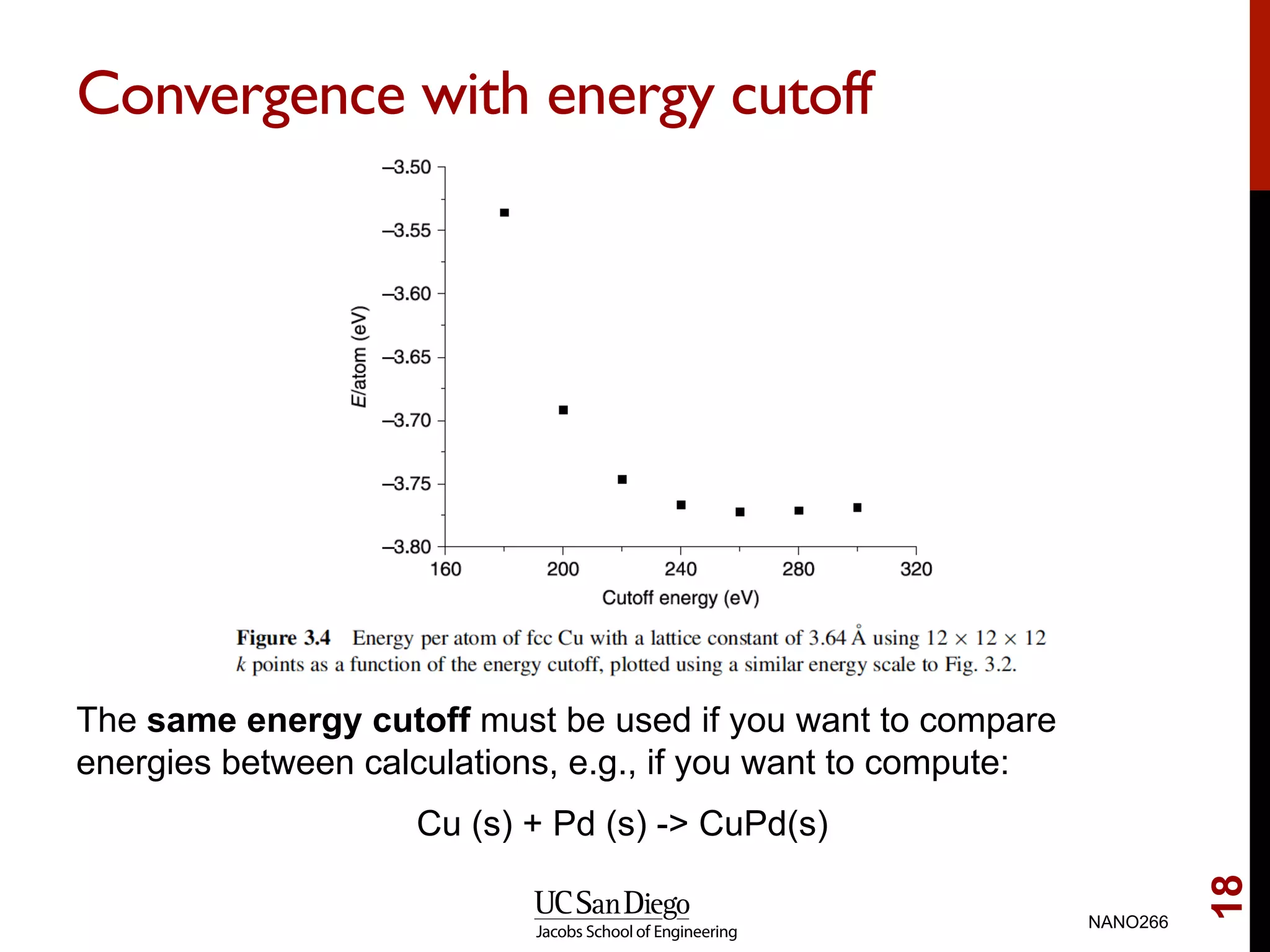
Convergence with energy cutoff
The same energy cutoff must be used if you want to compare
energies between calculations, e.g., if you want to compute:
Cu (s) + Pd (s) -> CuPd(s)
NANO266
18
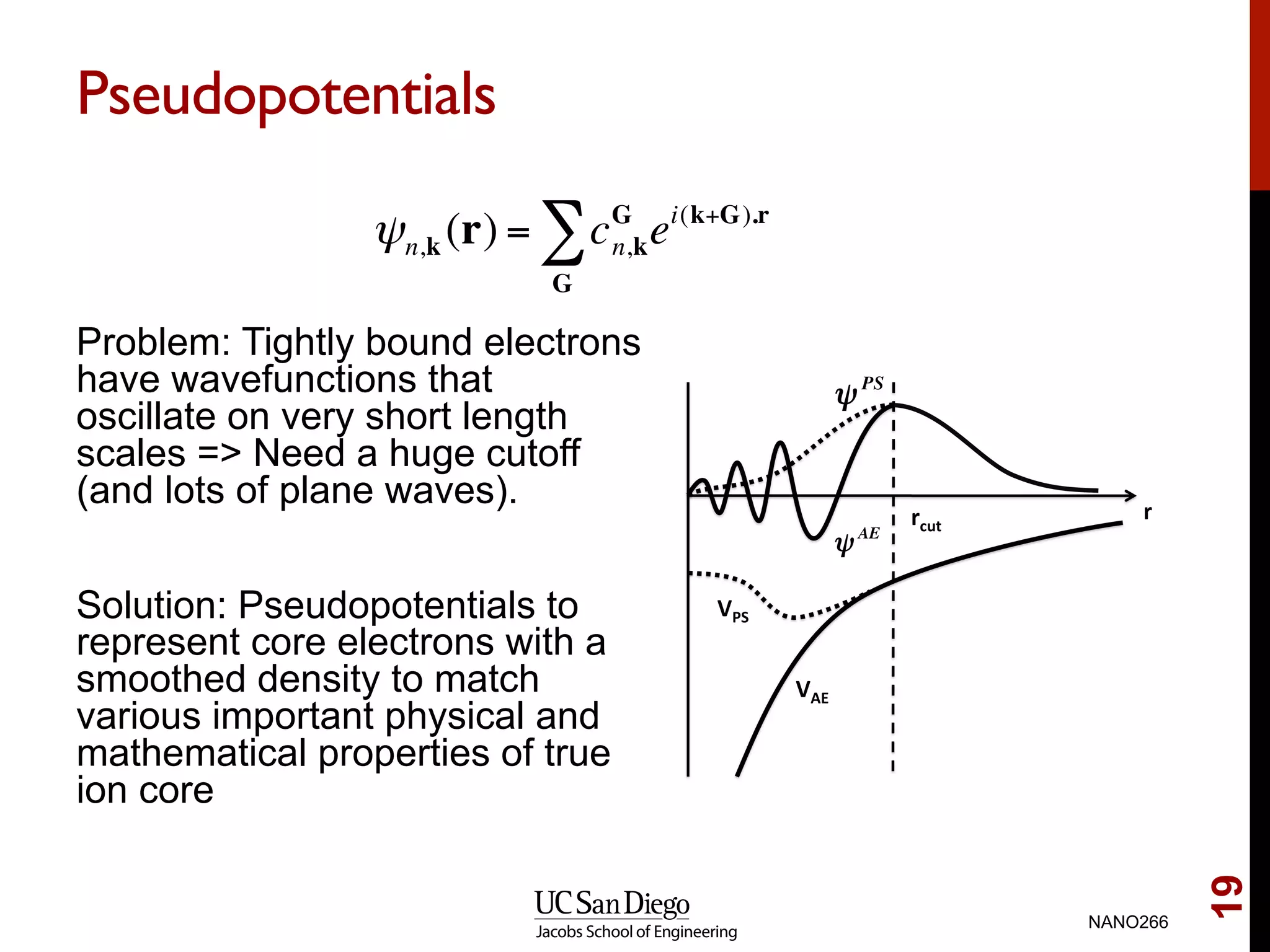
Pseudopotentials
Problem: Tightly bound electrons
have wavefunctions that
oscillate on very short length
scales => Need a huge cutoff
(and lots of plane waves).
Solution: Pseudopotentials to
represent core electrons with a
smoothed density to match
various important physical and
mathematical properties of true
ion core
NANO266
19
ψn,k (r) = cG
n,kei(k+G).r
G
∑
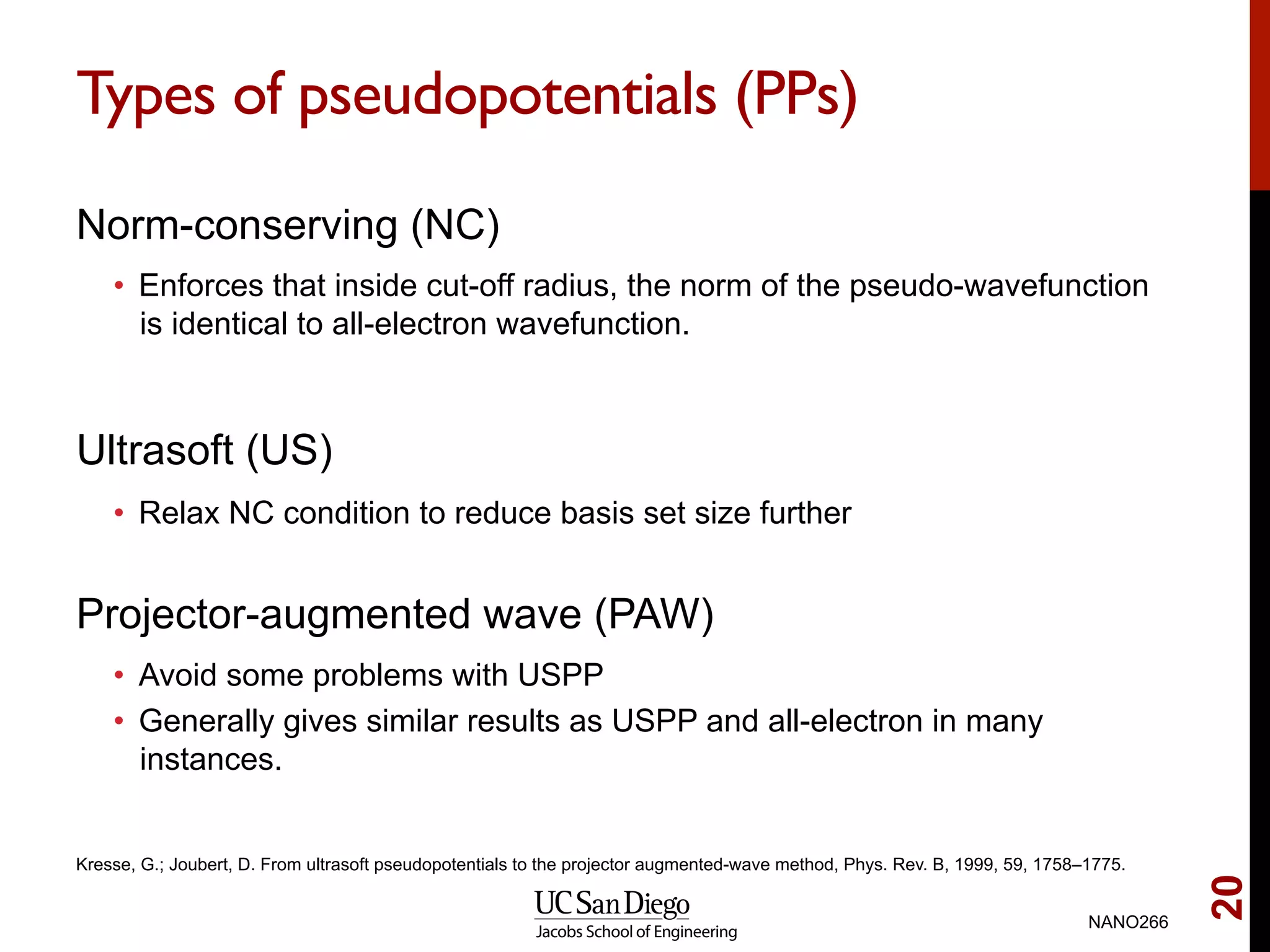
Types of pseudopotentials (PPs)
Norm-conserving (NC)
•  Enforces that inside cut-off radius, the norm of the pseudo-wavefunction
is identical to all-electron wavefunction.
Ultrasoft (US)
•  Relax NC condition to reduce basis set size further
Projector-augmented wave (PAW)
•  Avoid some problems with USPP
•  Generally gives similar results as USPP and all-electron in many
instances.
NANO266
20
Kresse, G.; Joubert, D. From ultrasoft pseudopotentials to the projector augmented-wave method, Phys. Rev. B, 1999, 59, 1758–1775.
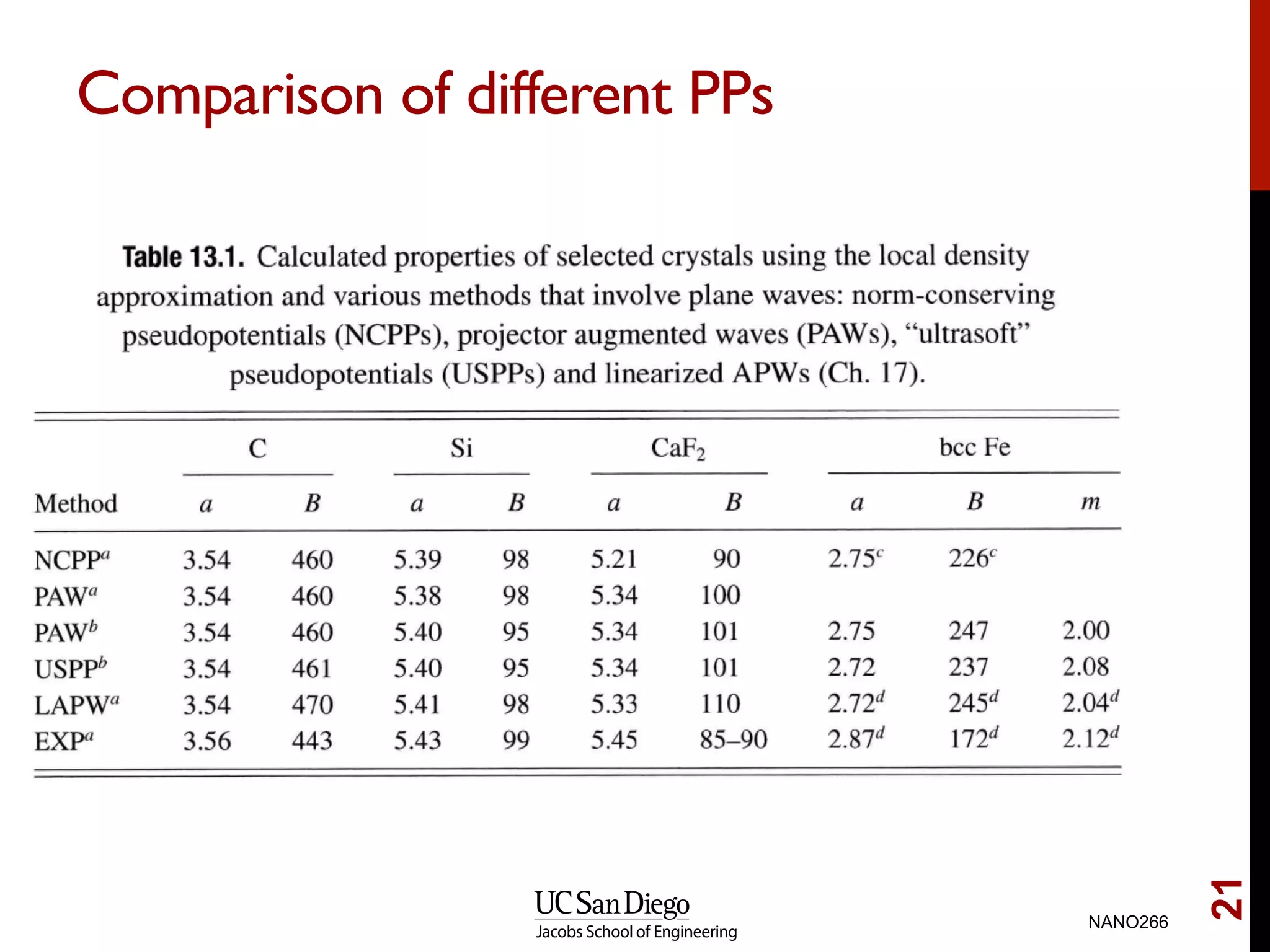
Comparison of different PPs
NANO266
21
How do you choose PPs?
Sometimes, several PPs are available with different
number of “valence” electrons, i.e., electrons not in
the core.
Choice depends on research problem – if you are
studying problems where more (semi-core) electrons
are required, choose PP with more electrons
But more electrons != better results! (e.g., Rare-earth
elements)
NANO266
22
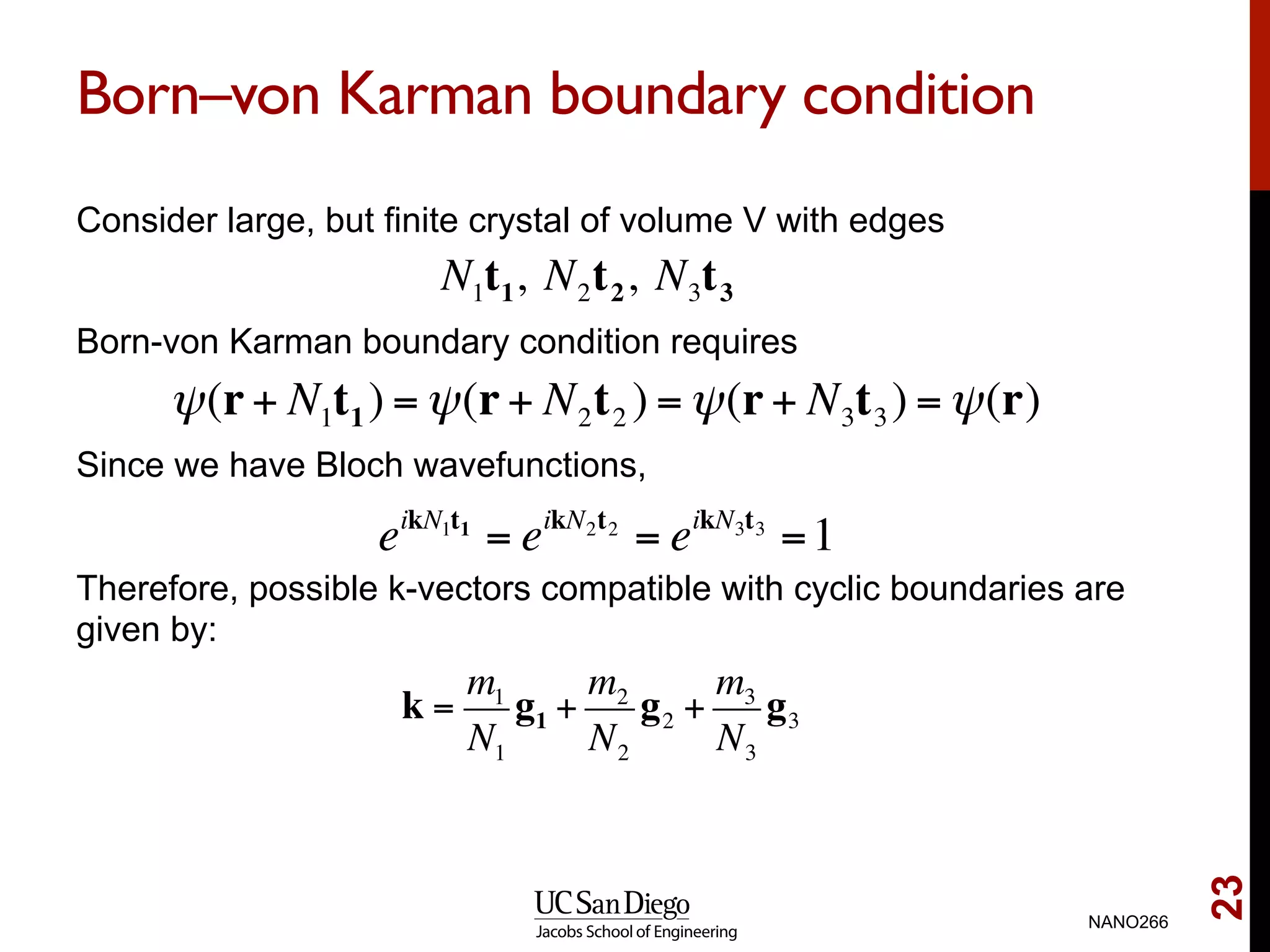
Born–von Karman boundary condition
Consider large, but finite crystal of volume V with edges
Born-von Karman boundary condition requires
Since we have Bloch wavefunctions,
Therefore, possible k-vectors compatible with cyclic boundaries are
given by:
NANO266
23
N1t1, N2t2, N3t3
ψ(r+ N1t1 ) =ψ(r+ N2t2 ) =ψ(r+ N3t3) =ψ(r)
eikN1t1
= eikN2t2
= eikN3t3
=1
k =
m1
N1
g1 +
m2
N2
g2 +
m3
N3
g3
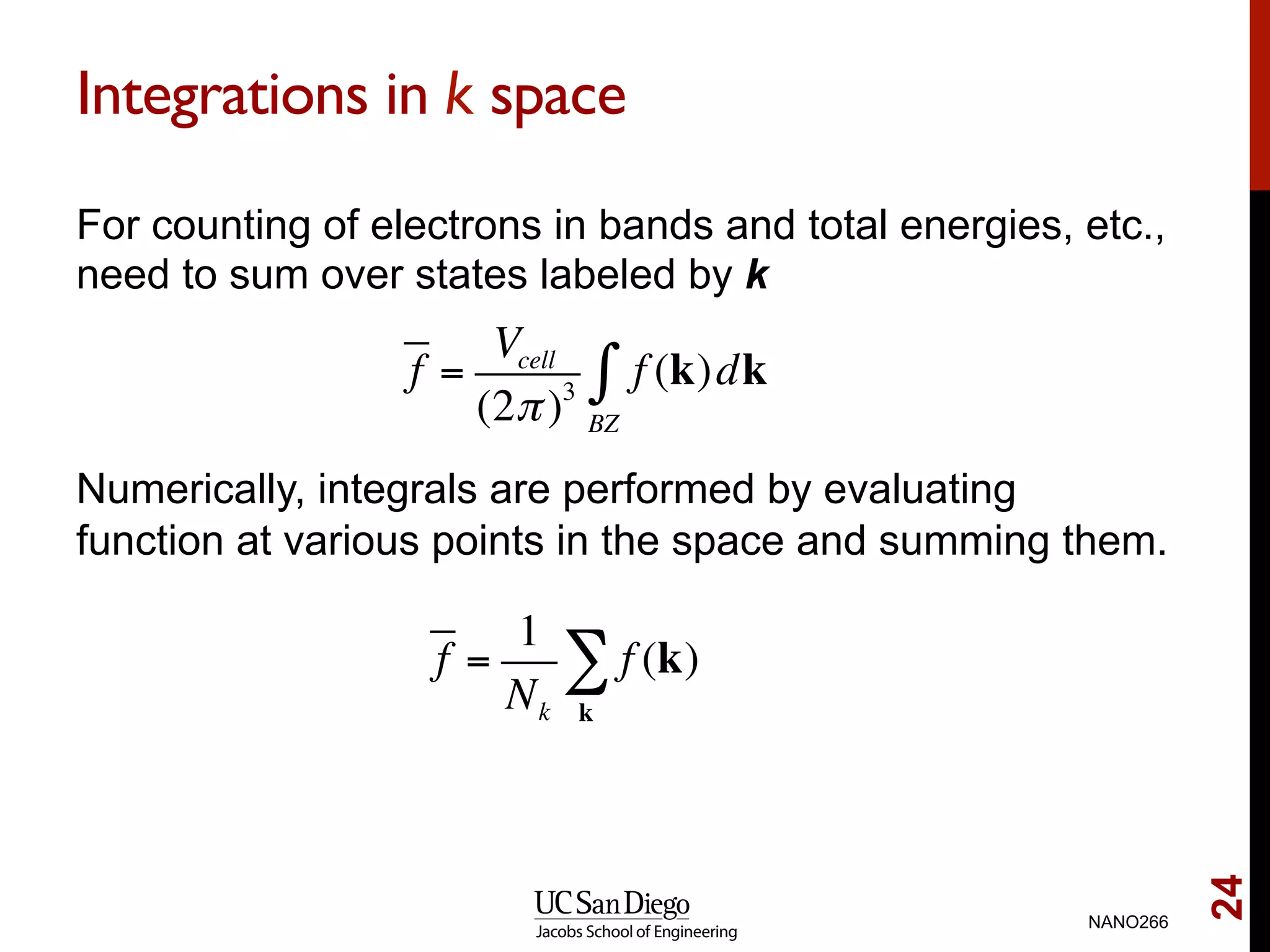
Integrations in k space
For counting of electrons in bands and total energies, etc.,
need to sum over states labeled by k
Numerically, integrals are performed by evaluating
function at various points in the space and summing them.
NANO266
24
f =
Vcell
(2π)3
f (k)dk
BZ
∫
f =
1
Nk
f (k)
k
∑
Choice of k-points
1.  Sampling at one point (Baldereschi point, or
Gamma point)
2.  Monkhorst-Pack – Sampling at regular
meshes
NANO266
25
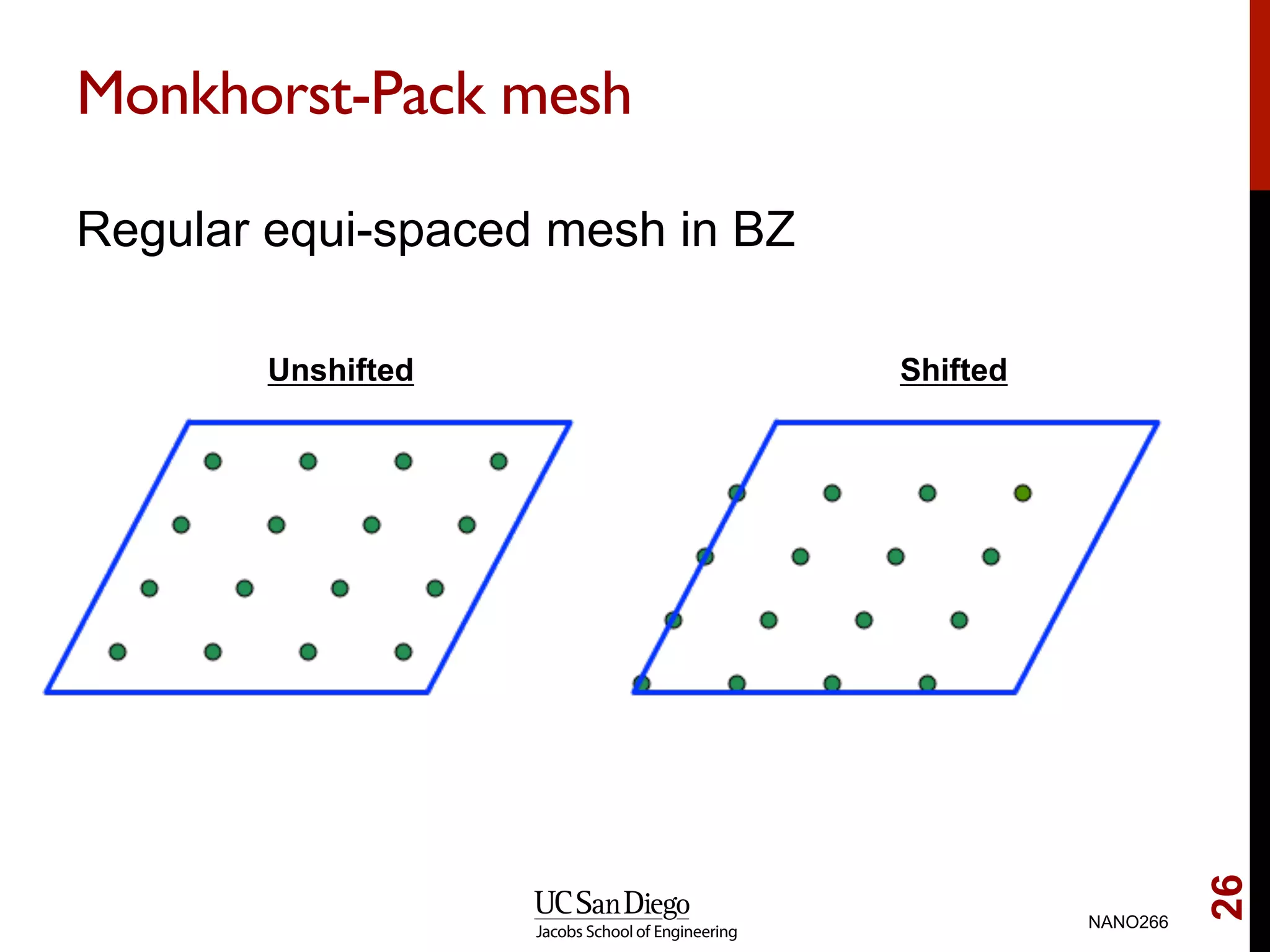
Monkhorst-Pack mesh
Regular equi-spaced mesh in BZ
NANO266
26
Unshifted Shifted
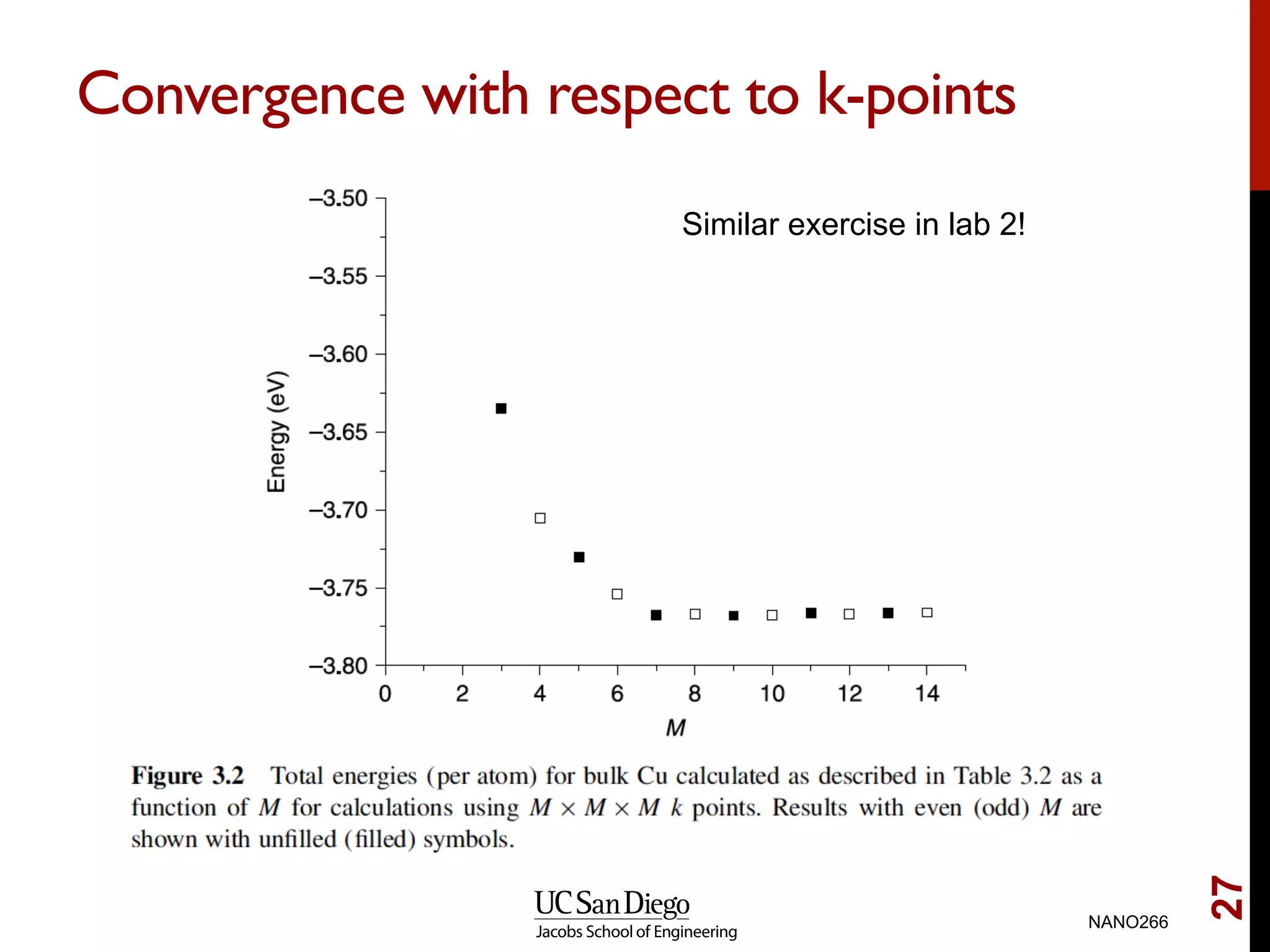
Convergence with respect to k-points
NANO266
27
Similar exercise in lab 2!
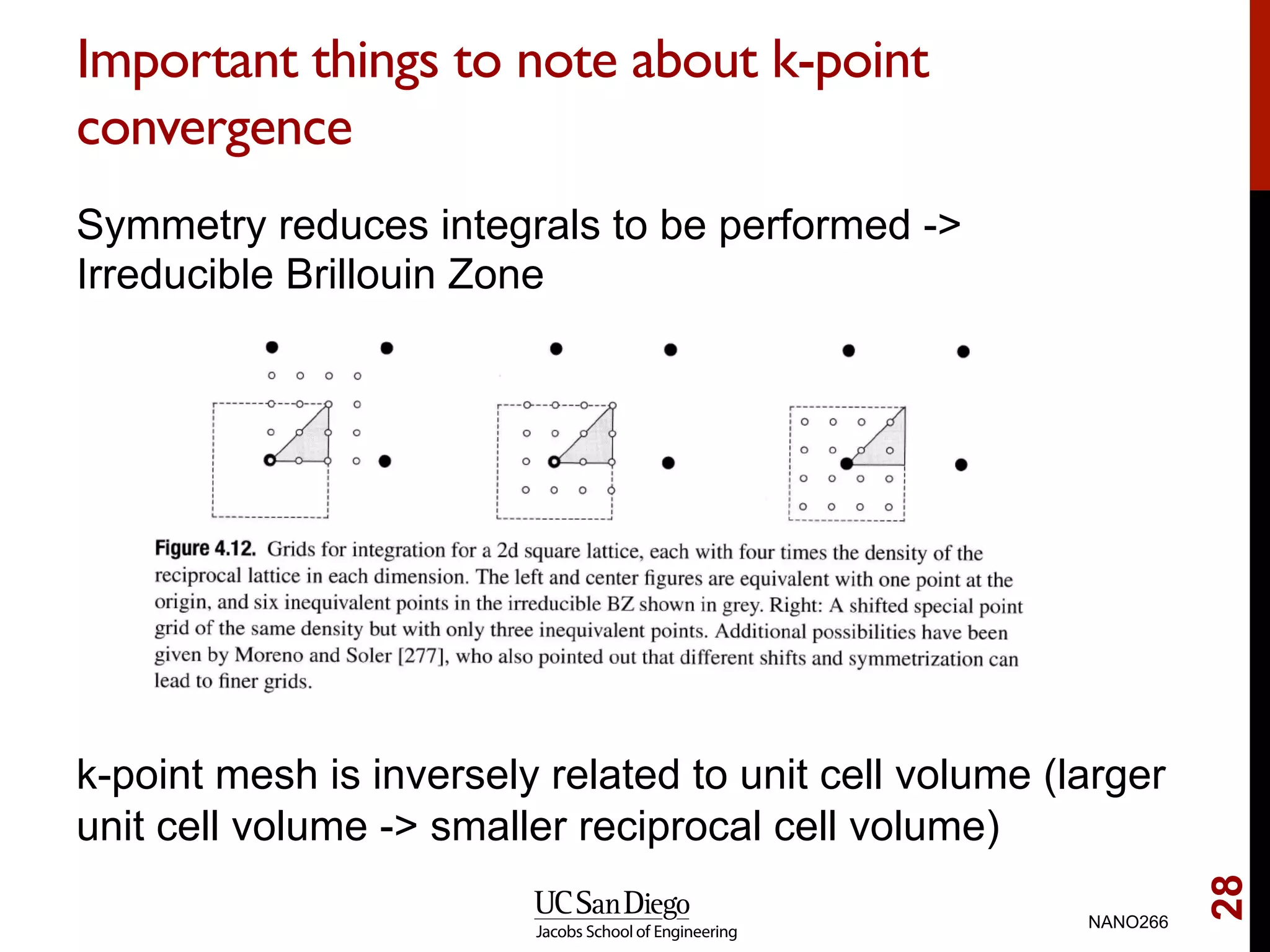
Important things to note about k-point
convergence
Symmetry reduces integrals to be performed ->
Irreducible Brillouin Zone
k-point mesh is inversely related to unit cell volume (larger
unit cell volume -> smaller reciprocal cell volume)
NANO266
28
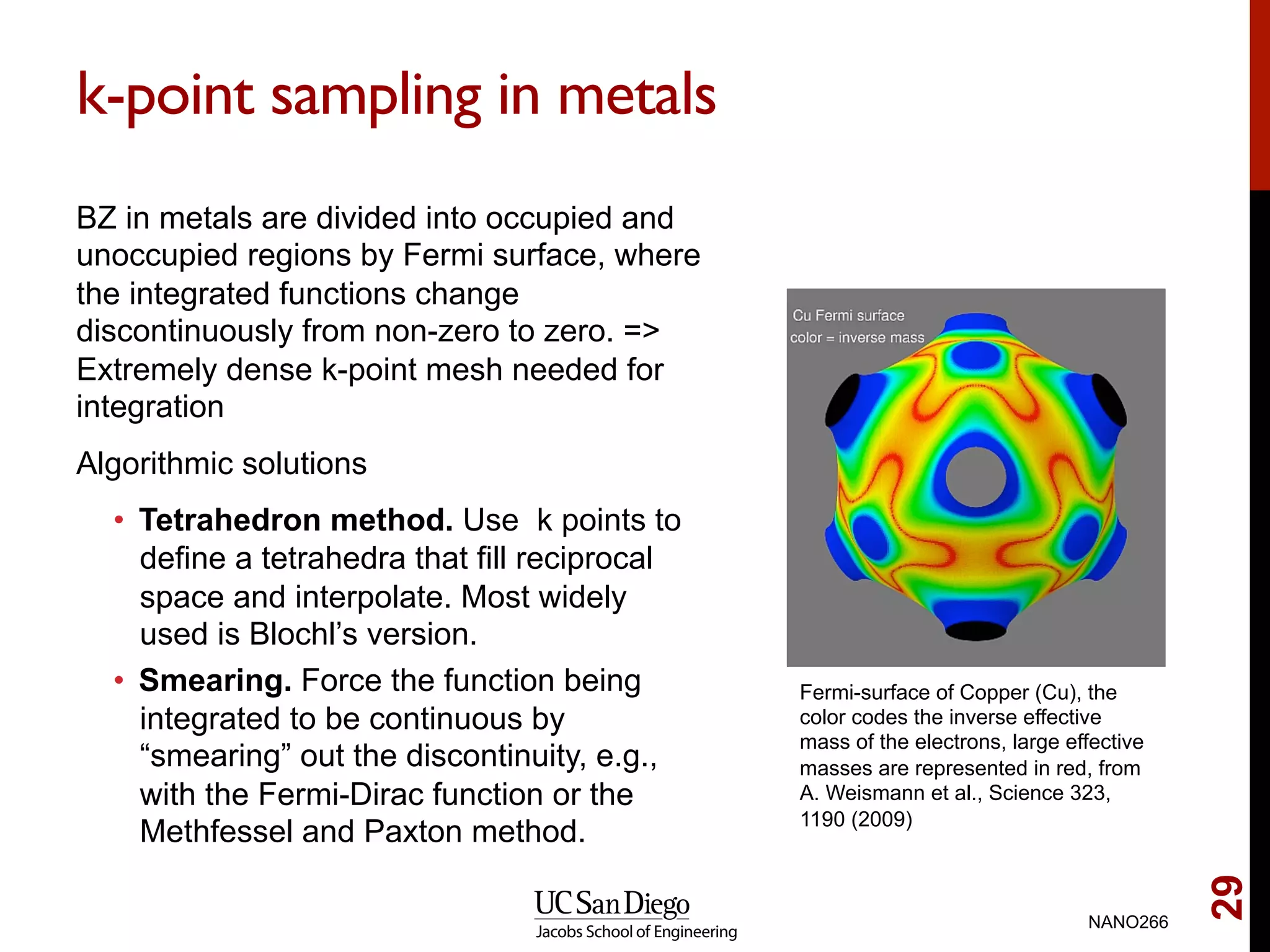
k-point sampling in metals
BZ in metals are divided into occupied and
unoccupied regions by Fermi surface, where
the integrated functions change
discontinuously from non-zero to zero. =>
Extremely dense k-point mesh needed for
integration
Algorithmic solutions
•  Tetrahedron method. Use k points to
define a tetrahedra that fill reciprocal
space and interpolate. Most widely
used is Blochl’s version.
•  Smearing. Force the function being
integrated to be continuous by
“smearing” out the discontinuity, e.g.,
with the Fermi-Dirac function or the
Methfessel and Paxton method.
NANO266
29
Fermi-surface of Copper (Cu), the
color codes the inverse effective
mass of the electrons, large effective
masses are represented in red, from
A. Weismann et al., Science 323,
1190 (2009)
References
Martin, R. M. Electronic Structure: Basic Theory
and Practical Methods (Vol 1); Cambridge
University Press, 2004.
Grosso, G.; Parravicini, G. P. Solid State
Physics: : 9780123044600: Amazon.com: Books;
1st ed.; Academic Press, 2000.
NANO266
30

NANO266 - Lecture 7 - QM Modeling of Periodic Structures

  • 1.
    Quantum Mechanical Modeling ofPeriodic Structures Shyue Ping Ong
  • 2.
    The MaterialsWorld NANO266 2 Molecules Isolated gas phase Typicallyuse localized basis functions, e.g., Gaussians Everything else (liquids, amorphous solids, etc.) Too complex for direct QM! (at the moment) But can work reasonable models sometimes Crystalline solids Periodic infinite solid Plane-wave approaches
  • 3.
    What is acrystal? A crystal is a time-invariant, 3D arrangement of atoms or molecules on a lattice. NANO266 Perovskite SrTiO3 The “motif” repeated on each point in the cubic lattice below… 3
  • 4.
    Translational symmetry All crystalsare characterized by translational symmetry NANO266 4 t = ua + vb + wc, u,v,w ∈ Z 1D 2D (single layer MoS2) 3D
  • 5.
    The 14 3DBravais Lattices NANO 106 - Crystallography of Materials by Shyue Ping Ong - Lecture 2 P: primitive C: C-centered I: body-centered F: face-centered (upper case for 3D) a: triclinic (anorthic) m: monoclinic o: orthorhombic t: tetragonal h: hexagonal c: cubic
  • 6.
    3D unit cells Infinitenumber of unit cells for all 3D lattices Always possible to define primitive unit cells for non-primitive lattices, though the full symmetry may not be retained. NANO 106 - Crystallography of Materials by Shyue Ping Ong - Lecture 2 Conventional cF cell Primitive unit cell
  • 7.
    The Reciprocal Lattice Fora lattice given by basis vectors a1, a2 and a3, the reciprocal lattice is given basis vectors a1*, a2* and a3* where: NANO 106 - Crystallography of Materials by Shyue Ping Ong - Lecture 2 a1 * = 2π a2 × a3 a1.(a2 × a3 ) a2 * = 2π a1 × a3 a1.(a2 × a3 ) a3 * = 2π (a1 × a2 ) a1.(a2 × a3 ) ai * aj = 2πδij
  • 8.
    Reciprocal lattice Translation vectorsin the reciprocal lattice is given by: NANO266 8 G = ha1 * + ka2 * +la3 * Direct lattice Reciprocal lattice Simple Cubic Simple Cubic Face-centered cubic (fcc) Body-centered cubic (bcc) Body-centered cubic (bcc) Face-centered cubic (fcc) Hexagonal Hexagonal
  • 9.
    Periodic Boundary Conditions Repeatunit cell infinitely in all directions. What does this mean for our external potential (from the nuclei)? NANO266 9
  • 10.
    Electron in aperiodic potential For an electron in a 1D periodic potential with lattice vector a, we have For any periodic function, we may express it in terms of a Fourier series NANO266 10 H = − 1 2 ∇+V(x) where V(x) =V(x + ma). V(x) = Vne i 2π a nx n=−∞ ∞ ∑
  • 11.
    Bloch’sTheorem For a particlein a periodic potential, eigenstates can be written in the form of a Bloch wave Where u(r) has the same periodicity as the crystal and k is a vector of real numbers known as the crystal wave vector, n is known as the band index. For any reciprocal lattice vector K, , i.e., we only need to care about k in the first Brillouin Zone NANO266 11 ψn,k (r) = eik.r un,k (r) Plane wave ψn,k+K (r) =ψn,k (r)
  • 12.
    Brillouin Zones forcommon lattices NANO266 12 simple cubic fcc bcc hexagonal
  • 13.
  • 14.
    Plane waves asa basis Any function that is periodic in the lattice can be written as a Fourier series of the reciprocal lattice Recall that from the Bloch Theorem, our wave function is of the form Where u(r) has the same periodicity as the crystal and k is a vector of real numbers known as the crystal wave vector, n is known as the band index. NANO266 14 ψn,k (r) = eik.r un,k (r) f (x) = cne i 2π a nx n=−∞ ∞ ∑ Reciprocal lattice vector in 1D
  • 15.
    Plane waves asa basis Let us now write u(r) as an expansion Our wave function then becomes NANO266 15 un,k (r) = cG n,keiGr G ∑ ψn,k (r) = cG n,kei(k+G).r G ∑
  • 16.
    Using the planewaves as basis Plane waves offer a systematic way to improve completeness of our solution Recall that for a free electron in a box, Corresponding, each plane wave have energy NANO266 16 ψn,k (r) = cG n,kei(k+G).r G ∑ Infinite sum over reciprocal space ψ(r) = eik.r and the corresponding energy is E = !2 2m k2 E = !2 2m k+G 2
  • 17.
    Energy cutoff Solutions withlower energy are more physically important than solutions with higher energies NANO266 17 Ecut = !2 2m Gcut 2 ψn,k (r) = cG n,kei(k+G).r k+G<Gcut ∑
  • 18.
    Convergence with energycutoff The same energy cutoff must be used if you want to compare energies between calculations, e.g., if you want to compute: Cu (s) + Pd (s) -> CuPd(s) NANO266 18
  • 19.
    Pseudopotentials Problem: Tightly boundelectrons have wavefunctions that oscillate on very short length scales => Need a huge cutoff (and lots of plane waves). Solution: Pseudopotentials to represent core electrons with a smoothed density to match various important physical and mathematical properties of true ion core NANO266 19 ψn,k (r) = cG n,kei(k+G).r G ∑
  • 20.
    Types of pseudopotentials(PPs) Norm-conserving (NC) •  Enforces that inside cut-off radius, the norm of the pseudo-wavefunction is identical to all-electron wavefunction. Ultrasoft (US) •  Relax NC condition to reduce basis set size further Projector-augmented wave (PAW) •  Avoid some problems with USPP •  Generally gives similar results as USPP and all-electron in many instances. NANO266 20 Kresse, G.; Joubert, D. From ultrasoft pseudopotentials to the projector augmented-wave method, Phys. Rev. B, 1999, 59, 1758–1775.
  • 21.
  • 22.
    How do youchoose PPs? Sometimes, several PPs are available with different number of “valence” electrons, i.e., electrons not in the core. Choice depends on research problem – if you are studying problems where more (semi-core) electrons are required, choose PP with more electrons But more electrons != better results! (e.g., Rare-earth elements) NANO266 22
  • 23.
    Born–von Karman boundarycondition Consider large, but finite crystal of volume V with edges Born-von Karman boundary condition requires Since we have Bloch wavefunctions, Therefore, possible k-vectors compatible with cyclic boundaries are given by: NANO266 23 N1t1, N2t2, N3t3 ψ(r+ N1t1 ) =ψ(r+ N2t2 ) =ψ(r+ N3t3) =ψ(r) eikN1t1 = eikN2t2 = eikN3t3 =1 k = m1 N1 g1 + m2 N2 g2 + m3 N3 g3
  • 24.
    Integrations in kspace For counting of electrons in bands and total energies, etc., need to sum over states labeled by k Numerically, integrals are performed by evaluating function at various points in the space and summing them. NANO266 24 f = Vcell (2π)3 f (k)dk BZ ∫ f = 1 Nk f (k) k ∑
  • 25.
    Choice of k-points 1. Sampling at one point (Baldereschi point, or Gamma point) 2.  Monkhorst-Pack – Sampling at regular meshes NANO266 25
  • 26.
    Monkhorst-Pack mesh Regular equi-spacedmesh in BZ NANO266 26 Unshifted Shifted
  • 27.
    Convergence with respectto k-points NANO266 27 Similar exercise in lab 2!
  • 28.
    Important things tonote about k-point convergence Symmetry reduces integrals to be performed -> Irreducible Brillouin Zone k-point mesh is inversely related to unit cell volume (larger unit cell volume -> smaller reciprocal cell volume) NANO266 28
  • 29.
    k-point sampling inmetals BZ in metals are divided into occupied and unoccupied regions by Fermi surface, where the integrated functions change discontinuously from non-zero to zero. => Extremely dense k-point mesh needed for integration Algorithmic solutions •  Tetrahedron method. Use k points to define a tetrahedra that fill reciprocal space and interpolate. Most widely used is Blochl’s version. •  Smearing. Force the function being integrated to be continuous by “smearing” out the discontinuity, e.g., with the Fermi-Dirac function or the Methfessel and Paxton method. NANO266 29 Fermi-surface of Copper (Cu), the color codes the inverse effective mass of the electrons, large effective masses are represented in red, from A. Weismann et al., Science 323, 1190 (2009)
  • 30.
    References Martin, R. M.Electronic Structure: Basic Theory and Practical Methods (Vol 1); Cambridge University Press, 2004. Grosso, G.; Parravicini, G. P. Solid State Physics: : 9780123044600: Amazon.com: Books; 1st ed.; Academic Press, 2000. NANO266 30