Mihir
IIT,Bhubaneswar
Quantum Mechanical Wave Function gives all information about a
given system.
For a Hydrogen Atom, We can solve Schrodinger Equation exactly and
determine the allowed energy state of the System.
It is difficult to solve Schrodinger Equation for N- body System. We must
involve some approximation for the solution .
. It is a method of obtaining an approximate solution
to Schrodinger Equation for many body system.

. It is Primarily a theory of Electronic ground state
structure in terms of electronic density distribution
n(r).
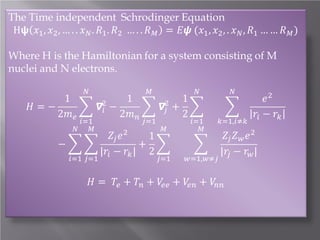
The Time independent Schrodinger Equation
H𝞇𝞇 𝑥𝑥1 , 𝑥𝑥2 , … . . 𝑥𝑥 𝑁𝑁 . 𝑅𝑅1 . 𝑅𝑅2 … . . 𝑅𝑅 𝑀𝑀 = 𝐸𝐸𝐸𝐸 (𝑥𝑥1 , 𝑥𝑥2 , . 𝑥𝑥 𝑁𝑁 , 𝑅𝑅1 … … 𝑅𝑅 𝑀𝑀 )
Where H is the Hamiltonian for a system consisting of M
nuclei and N electrons.
1
1
1
2
2
𝐻𝐻 = −
� 𝞩𝞩 𝑖𝑖 −
� 𝞩𝞩𝑗𝑗 + �
2𝑚𝑚 𝑒𝑒
2𝑚𝑚 𝑛𝑛
2
𝑁𝑁

𝑖𝑖=1
𝑁𝑁 𝑀𝑀

𝑀𝑀

𝑗𝑗=1

𝑍𝑍𝑗𝑗 𝑒𝑒
1
+ �
−��
|𝑟𝑟𝑖𝑖 − 𝑟𝑟𝑘𝑘 | 2
𝑖𝑖=1 𝑗𝑗=1

2

𝑀𝑀

𝑗𝑗=1

𝑁𝑁

𝑖𝑖=1
𝑀𝑀

�

𝑤𝑤=1,𝑤𝑤≠𝑗𝑗

𝑁𝑁

�

𝑘𝑘=1,𝑖𝑖≠𝑘𝑘

𝑒𝑒 2
𝑟𝑟𝑖𝑖 − 𝑟𝑟𝑘𝑘

𝑍𝑍𝑗𝑗 𝑍𝑍 𝑤𝑤 𝑒𝑒 2
|𝑟𝑟𝑗𝑗 − 𝑟𝑟𝑤𝑤 |

𝐻𝐻 = 𝑇𝑇𝑒𝑒 + 𝑇𝑇𝑛𝑛 + 𝑉𝑉𝑒𝑒𝑒𝑒 + 𝑉𝑉𝑒𝑒𝑒𝑒 + 𝑉𝑉𝑛𝑛𝑛𝑛
First two terms of the above equation are Kinetic Energy of Electrons
and nuclei respectively.
Third term is electron- electron Potential Energy.
Fourth term is the Potential energy between electrons and nuclei.

Last term is nuclei-nuclei potential energy.
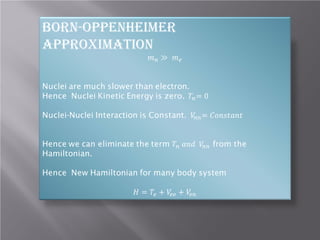
Born-Oppenheimer
Approximation

𝑚𝑚 𝑛𝑛 ≫ 𝑚𝑚 𝑒𝑒

Nuclei are much slower than electron.
Hence Nuclei Kinetic Energy is zero. 𝑇𝑇𝑛𝑛 = 0

Nuclei-Nuclei Interaction is Constant. 𝑉𝑉𝑛𝑛𝑛𝑛 = 𝐶𝐶𝐶𝐶𝐶𝐶𝐶𝐶𝐶𝐶𝐶𝐶𝐶𝐶𝐶𝐶

Hence we can eliminate the term 𝑇𝑇𝑛𝑛 𝑎𝑎𝑎𝑎𝑎𝑎 𝑉𝑉𝑛𝑛𝑛𝑛 from the
Hamiltonian.
Hence New Hamiltonian for many body system
𝐻𝐻 = 𝑇𝑇𝑒𝑒 + 𝑉𝑉𝑒𝑒 𝑒𝑒 + 𝑉𝑉𝑒𝑒 𝑒𝑒










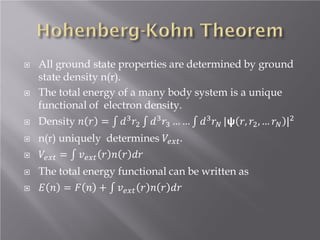
All ground state properties are determined by ground
state density n(r).
The total energy of a many body system is a unique
functional of electron density.

Density 𝑛𝑛 𝑟𝑟 = ∫ 𝑑𝑑 3 𝑟𝑟2 ∫ 𝑑𝑑 3 𝑟𝑟3 … … ∫ 𝑑𝑑 3 𝑟𝑟 𝑁𝑁 |𝞇𝞇 𝑟𝑟, 𝑟𝑟2 , … 𝑟𝑟 𝑁𝑁 |2
n(r) uniquely determines 𝑉𝑉𝑒𝑒𝑒𝑒𝑒𝑒 .
𝑉𝑉𝑒𝑒𝑒𝑒𝑒𝑒 = ∫ 𝑣𝑣 𝑒𝑒𝑒𝑒𝑒𝑒 𝑟𝑟 𝑛𝑛 𝑟𝑟 𝑑𝑑𝑑𝑑

𝐸𝐸 𝑛𝑛 = 𝐹𝐹 𝑛𝑛 + ∫ 𝑣𝑣 𝑒𝑒𝑒𝑒𝑒𝑒 𝑟𝑟 𝑛𝑛 𝑟𝑟 𝑑𝑑𝑑𝑑

The total energy functional can be written as


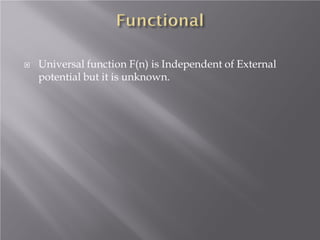
Universal function F(n) is Independent of External
potential but it is unknown.
INPUT





INCAR
POSCAR
POTCAR
KPOINTS

OUTPUT










OUTCAR
OSCZICAR
CONTCAR
CHGCAR
EIGENVAL
WAVECAR
PROCAR
XDATCAR
DOSCAR
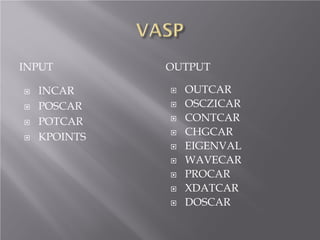
INCAR: Central Input file.
:Different parameters for different properties.
. POSCAR: Position of Ions
: Lattice Constant
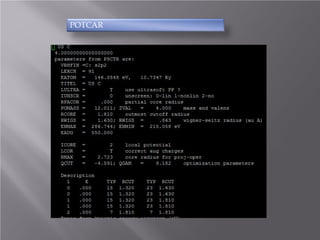
.POTCAR : Psuedopotential from VASP
.KPOINTS: Kpoint meshes










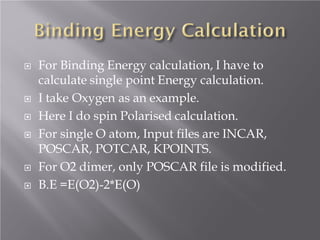
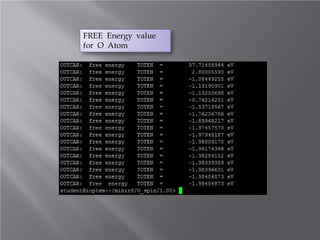
For Binding Energy calculation, I have to
calculate single point Energy calculation.
I take Oxygen as an example.
Here I do spin Polarised calculation.
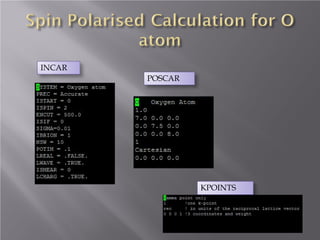
For single O atom, Input files are INCAR,
POSCAR, POTCAR, KPOINTS.
For O2 dimer, only POSCAR file is modified.
B.E =E(O2)-2*E(O)
INCAR

POSCAR

KPOINTS
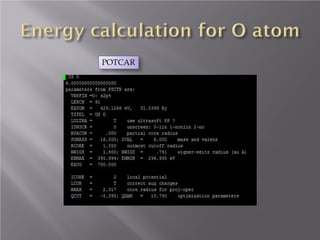
POTCAR
FREE Energy value
for O Atom






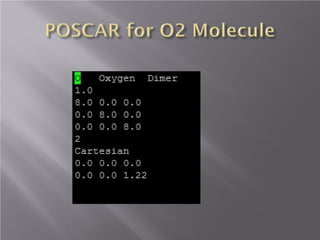
Here all the Input files are same as those for
Oxygen Atom.
Only POSCAR File is slightly changed.
Here No. of atoms is 2
Hence two co-ordinate points are required for
describing the position of atoms in the
molecule.
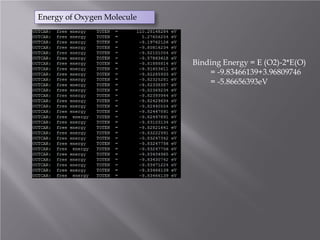
Energy of Oxygen Molecule

Binding Energy = E (O2)-2*E(O)
= -9.83466139+3.96809746
= -5.86656393eV
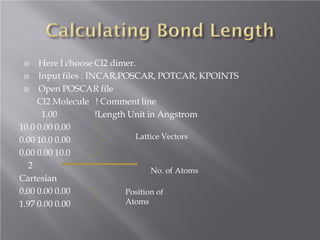
Here I choose Cl2 dimer.

Input files : INCAR,POSCAR, POTCAR, KPOINTS

Open POSCAR file
Cl2 Molecule ! Comment line
1.00
!Length Unit in Angstrom
10.0 0.00 0.00
Lattice Vectors
0.00 10.0 0.00
0.00 0.00 10.0
2
No. of Atoms
Cartesian
0.00 0.00 0.00
Position of
Atoms
1.97 0.00 0.00










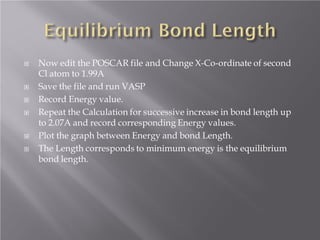
Now edit the POSCAR file and Change X-Co-ordinate of second
Cl atom to 1.99A
Save the file and run VASP
Record Energy value.
Repeat the Calculation for successive increase in bond length up
to 2.07A and record corresponding Energy values.
Plot the graph between Energy and bond Length.
The Length corresponds to minimum energy is the equilibrium
bond length.




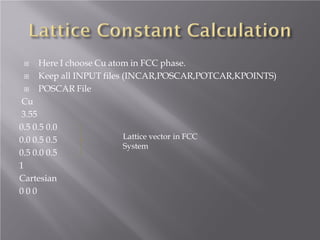
Here I choose Cu atom in FCC phase.
Keep all INPUT files (INCAR,POSCAR,POTCAR,KPOINTS)
POSCAR File

Cu
3.55
0.5 0.5 0.0
0.0 0.5 0.5
0.5 0.0 0.5
1
Cartesian
000

Lattice vector in FCC
System







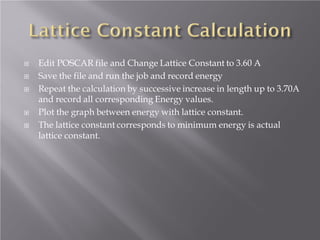
Edit POSCAR file and Change Lattice Constant to 3.60 A
Save the file and run the job and record energy
Repeat the calculation by successive increase in length up to 3.70A
and record all corresponding Energy values.
Plot the graph between energy with lattice constant.
The lattice constant corresponds to minimum energy is actual
lattice constant.







The silicon Crystal structure is FCC .
FCC primitive unit cell with 2 atoms in the
unit cell.
For band structure calculation first run selfconsistency calculation to get the charge
density.
Then fix the charge density and run a non self
consistency calculation for desired K points to
get band structure.
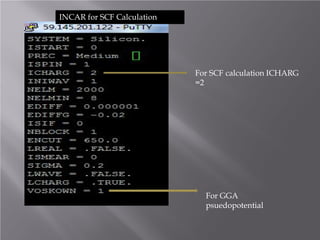
INCAR for SCF Calculation

For SCF calculation ICHARG
=2

For GGA
psuedopotential
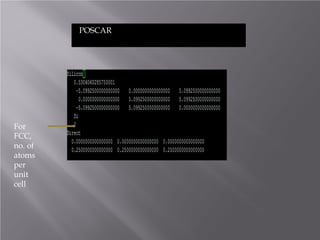
POSCAR

For
FCC,
no. of
atoms
per
unit
cell
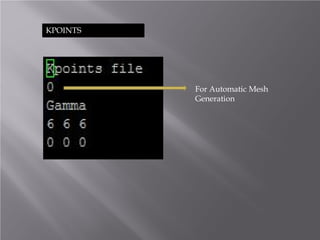
KPOINTS

For Automatic Mesh
Generation






POTCAR file is provided by VASP
Then run VASP
After job is completed, we get charge density in
CHGCAR file
To get band structure, run non-self consistence
calculation for each desired k points.






Input files are INCAR, POSCAR, POTCAR,
KPOINTS, CHGCAR.
INCAR and KPOINTS files will be modified.
In INCAR file, we change ICHARG=11
We modify KPOINTS file, to specify along
some high symmetry direction to calculate
energy.
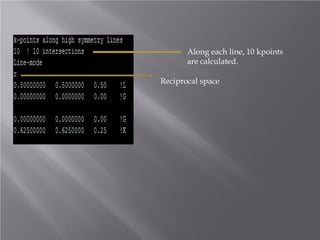
Along each line, 10 kpoints
are calculated.
Reciprocal space







Run VASP
The above KPOINTS file instructs vasp to
calculate the Energy at each k point between L
point and Gamma point, gamma point and K
point.
Along each line 10 Kpoints are calculated.
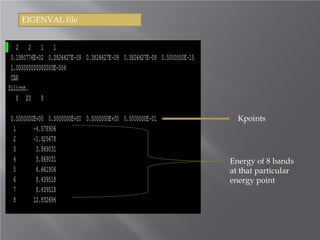
In output, we find EIGENVAL file.
From this we find all information to plot band
structure.
EIGENVAL file

Kpoints

Energy of 8 bands
at that particular
energy point




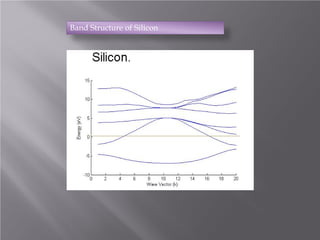
Since energy of bands at each k points, we get
information about band structure.
I Plot band structure using MATLAB.
Band Structure of Silicon







Graphene is a 2-dimensional crystalline
allotrope of carbon.
In graphene, Carbon atoms are densely packed
in a regular hexagonal pattern.
It is one atom thick layer of graphite.
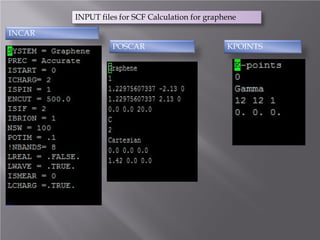
Input files INCAR, POSCAR, POTCAR,
KPOINTS
INPUT files for SCF Calculation for graphene
INCAR
POSCAR

KPOINTS
POTCAR
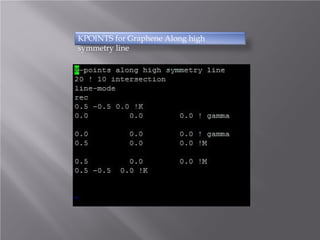
KPOINTS for Graphene Along high
symmetry line
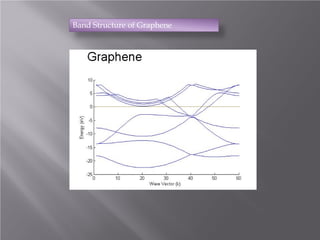
Band Structure of Graphene






W.Kohn. L.J.Sham, physical rev.
140,A1133(1965)
H.J. Monkhrost and J.Pack, Phys. Rev.B
13,5188(1976)
W.Kohn,
A.D.Becke,R.G.Parr,J.Phys.Chem.1996, 100,
12974-12980
Dft calculation by vasp

Dft calculation by vasp

  • 1.
  • 3.
    Quantum Mechanical WaveFunction gives all information about a given system. For a Hydrogen Atom, We can solve Schrodinger Equation exactly and determine the allowed energy state of the System. It is difficult to solve Schrodinger Equation for N- body System. We must involve some approximation for the solution .
  • 4.
    . It isa method of obtaining an approximate solution to Schrodinger Equation for many body system. . It is Primarily a theory of Electronic ground state structure in terms of electronic density distribution n(r).
  • 5.
    The Time independentSchrodinger Equation H𝞇𝞇 𝑥𝑥1 , 𝑥𝑥2 , … . . 𝑥𝑥 𝑁𝑁 . 𝑅𝑅1 . 𝑅𝑅2 … . . 𝑅𝑅 𝑀𝑀 = 𝐸𝐸𝐸𝐸 (𝑥𝑥1 , 𝑥𝑥2 , . 𝑥𝑥 𝑁𝑁 , 𝑅𝑅1 … … 𝑅𝑅 𝑀𝑀 ) Where H is the Hamiltonian for a system consisting of M nuclei and N electrons. 1 1 1 2 2 𝐻𝐻 = − � 𝞩𝞩 𝑖𝑖 − � 𝞩𝞩𝑗𝑗 + � 2𝑚𝑚 𝑒𝑒 2𝑚𝑚 𝑛𝑛 2 𝑁𝑁 𝑖𝑖=1 𝑁𝑁 𝑀𝑀 𝑀𝑀 𝑗𝑗=1 𝑍𝑍𝑗𝑗 𝑒𝑒 1 + � −�� |𝑟𝑟𝑖𝑖 − 𝑟𝑟𝑘𝑘 | 2 𝑖𝑖=1 𝑗𝑗=1 2 𝑀𝑀 𝑗𝑗=1 𝑁𝑁 𝑖𝑖=1 𝑀𝑀 � 𝑤𝑤=1,𝑤𝑤≠𝑗𝑗 𝑁𝑁 � 𝑘𝑘=1,𝑖𝑖≠𝑘𝑘 𝑒𝑒 2 𝑟𝑟𝑖𝑖 − 𝑟𝑟𝑘𝑘 𝑍𝑍𝑗𝑗 𝑍𝑍 𝑤𝑤 𝑒𝑒 2 |𝑟𝑟𝑗𝑗 − 𝑟𝑟𝑤𝑤 | 𝐻𝐻 = 𝑇𝑇𝑒𝑒 + 𝑇𝑇𝑛𝑛 + 𝑉𝑉𝑒𝑒𝑒𝑒 + 𝑉𝑉𝑒𝑒𝑒𝑒 + 𝑉𝑉𝑛𝑛𝑛𝑛
  • 6.
    First two termsof the above equation are Kinetic Energy of Electrons and nuclei respectively. Third term is electron- electron Potential Energy. Fourth term is the Potential energy between electrons and nuclei. Last term is nuclei-nuclei potential energy.
  • 7.
    Born-Oppenheimer Approximation 𝑚𝑚 𝑛𝑛 ≫𝑚𝑚 𝑒𝑒 Nuclei are much slower than electron. Hence Nuclei Kinetic Energy is zero. 𝑇𝑇𝑛𝑛 = 0 Nuclei-Nuclei Interaction is Constant. 𝑉𝑉𝑛𝑛𝑛𝑛 = 𝐶𝐶𝐶𝐶𝐶𝐶𝐶𝐶𝐶𝐶𝐶𝐶𝐶𝐶𝐶𝐶 Hence we can eliminate the term 𝑇𝑇𝑛𝑛 𝑎𝑎𝑎𝑎𝑎𝑎 𝑉𝑉𝑛𝑛𝑛𝑛 from the Hamiltonian. Hence New Hamiltonian for many body system 𝐻𝐻 = 𝑇𝑇𝑒𝑒 + 𝑉𝑉𝑒𝑒 𝑒𝑒 + 𝑉𝑉𝑒𝑒 𝑒𝑒
  • 8.
           All ground stateproperties are determined by ground state density n(r). The total energy of a many body system is a unique functional of electron density. Density 𝑛𝑛 𝑟𝑟 = ∫ 𝑑𝑑 3 𝑟𝑟2 ∫ 𝑑𝑑 3 𝑟𝑟3 … … ∫ 𝑑𝑑 3 𝑟𝑟 𝑁𝑁 |𝞇𝞇 𝑟𝑟, 𝑟𝑟2 , … 𝑟𝑟 𝑁𝑁 |2 n(r) uniquely determines 𝑉𝑉𝑒𝑒𝑒𝑒𝑒𝑒 . 𝑉𝑉𝑒𝑒𝑒𝑒𝑒𝑒 = ∫ 𝑣𝑣 𝑒𝑒𝑒𝑒𝑒𝑒 𝑟𝑟 𝑛𝑛 𝑟𝑟 𝑑𝑑𝑑𝑑 𝐸𝐸 𝑛𝑛 = 𝐹𝐹 𝑛𝑛 + ∫ 𝑣𝑣 𝑒𝑒𝑒𝑒𝑒𝑒 𝑟𝑟 𝑛𝑛 𝑟𝑟 𝑑𝑑𝑑𝑑 The total energy functional can be written as
  • 9.
     Universal function F(n)is Independent of External potential but it is unknown.
  • 10.
  • 11.
    INCAR: Central Inputfile. :Different parameters for different properties. . POSCAR: Position of Ions : Lattice Constant .POTCAR : Psuedopotential from VASP .KPOINTS: Kpoint meshes 
  • 12.
          For Binding Energycalculation, I have to calculate single point Energy calculation. I take Oxygen as an example. Here I do spin Polarised calculation. For single O atom, Input files are INCAR, POSCAR, POTCAR, KPOINTS. For O2 dimer, only POSCAR file is modified. B.E =E(O2)-2*E(O)
  • 13.
  • 14.
  • 15.
  • 16.
        Here all theInput files are same as those for Oxygen Atom. Only POSCAR File is slightly changed. Here No. of atoms is 2 Hence two co-ordinate points are required for describing the position of atoms in the molecule.
  • 18.
    Energy of OxygenMolecule Binding Energy = E (O2)-2*E(O) = -9.83466139+3.96809746 = -5.86656393eV
  • 19.
    Here I chooseCl2 dimer.  Input files : INCAR,POSCAR, POTCAR, KPOINTS  Open POSCAR file Cl2 Molecule ! Comment line 1.00 !Length Unit in Angstrom 10.0 0.00 0.00 Lattice Vectors 0.00 10.0 0.00 0.00 0.00 10.0 2 No. of Atoms Cartesian 0.00 0.00 0.00 Position of Atoms 1.97 0.00 0.00 
  • 20.
          Now edit thePOSCAR file and Change X-Co-ordinate of second Cl atom to 1.99A Save the file and run VASP Record Energy value. Repeat the Calculation for successive increase in bond length up to 2.07A and record corresponding Energy values. Plot the graph between Energy and bond Length. The Length corresponds to minimum energy is the equilibrium bond length.
  • 21.
       Here I chooseCu atom in FCC phase. Keep all INPUT files (INCAR,POSCAR,POTCAR,KPOINTS) POSCAR File Cu 3.55 0.5 0.5 0.0 0.0 0.5 0.5 0.5 0.0 0.5 1 Cartesian 000 Lattice vector in FCC System
  • 22.
         Edit POSCAR fileand Change Lattice Constant to 3.60 A Save the file and run the job and record energy Repeat the calculation by successive increase in length up to 3.70A and record all corresponding Energy values. Plot the graph between energy with lattice constant. The lattice constant corresponds to minimum energy is actual lattice constant.
  • 23.
        The silicon Crystalstructure is FCC . FCC primitive unit cell with 2 atoms in the unit cell. For band structure calculation first run selfconsistency calculation to get the charge density. Then fix the charge density and run a non self consistency calculation for desired K points to get band structure.
  • 24.
    INCAR for SCFCalculation For SCF calculation ICHARG =2 For GGA psuedopotential
  • 25.
  • 26.
  • 27.
        POTCAR file isprovided by VASP Then run VASP After job is completed, we get charge density in CHGCAR file To get band structure, run non-self consistence calculation for each desired k points.
  • 28.
        Input files areINCAR, POSCAR, POTCAR, KPOINTS, CHGCAR. INCAR and KPOINTS files will be modified. In INCAR file, we change ICHARG=11 We modify KPOINTS file, to specify along some high symmetry direction to calculate energy.
  • 29.
    Along each line,10 kpoints are calculated. Reciprocal space
  • 30.
         Run VASP The aboveKPOINTS file instructs vasp to calculate the Energy at each k point between L point and Gamma point, gamma point and K point. Along each line 10 Kpoints are calculated. In output, we find EIGENVAL file. From this we find all information to plot band structure.
  • 31.
    EIGENVAL file Kpoints Energy of8 bands at that particular energy point
  • 32.
      Since energy ofbands at each k points, we get information about band structure. I Plot band structure using MATLAB.
  • 33.
  • 34.
        Graphene is a2-dimensional crystalline allotrope of carbon. In graphene, Carbon atoms are densely packed in a regular hexagonal pattern. It is one atom thick layer of graphite. Input files INCAR, POSCAR, POTCAR, KPOINTS
  • 35.
    INPUT files forSCF Calculation for graphene INCAR POSCAR KPOINTS
  • 36.
  • 37.
    KPOINTS for GrapheneAlong high symmetry line
  • 38.
  • 39.
       W.Kohn. L.J.Sham, physicalrev. 140,A1133(1965) H.J. Monkhrost and J.Pack, Phys. Rev.B 13,5188(1976) W.Kohn, A.D.Becke,R.G.Parr,J.Phys.Chem.1996, 100, 12974-12980