Presented by-
Md Ahsan Halimi
Scholar No: 19-3-04-105
Dept. of ECE, NIT Silchar
“Introduction of Fermi Dirac Distribution Function”
1
Contents
Some Basic Concept
Fermi-statistics and Bose Statistics
Postulates of Fermi particles
Fermi Dirac Distribution Function
Conclusion
References
2
Some basic concepts
 Fermi level :- Fermi level is the highest energy state occupied by
electrons in a material at absolute zero temperature.
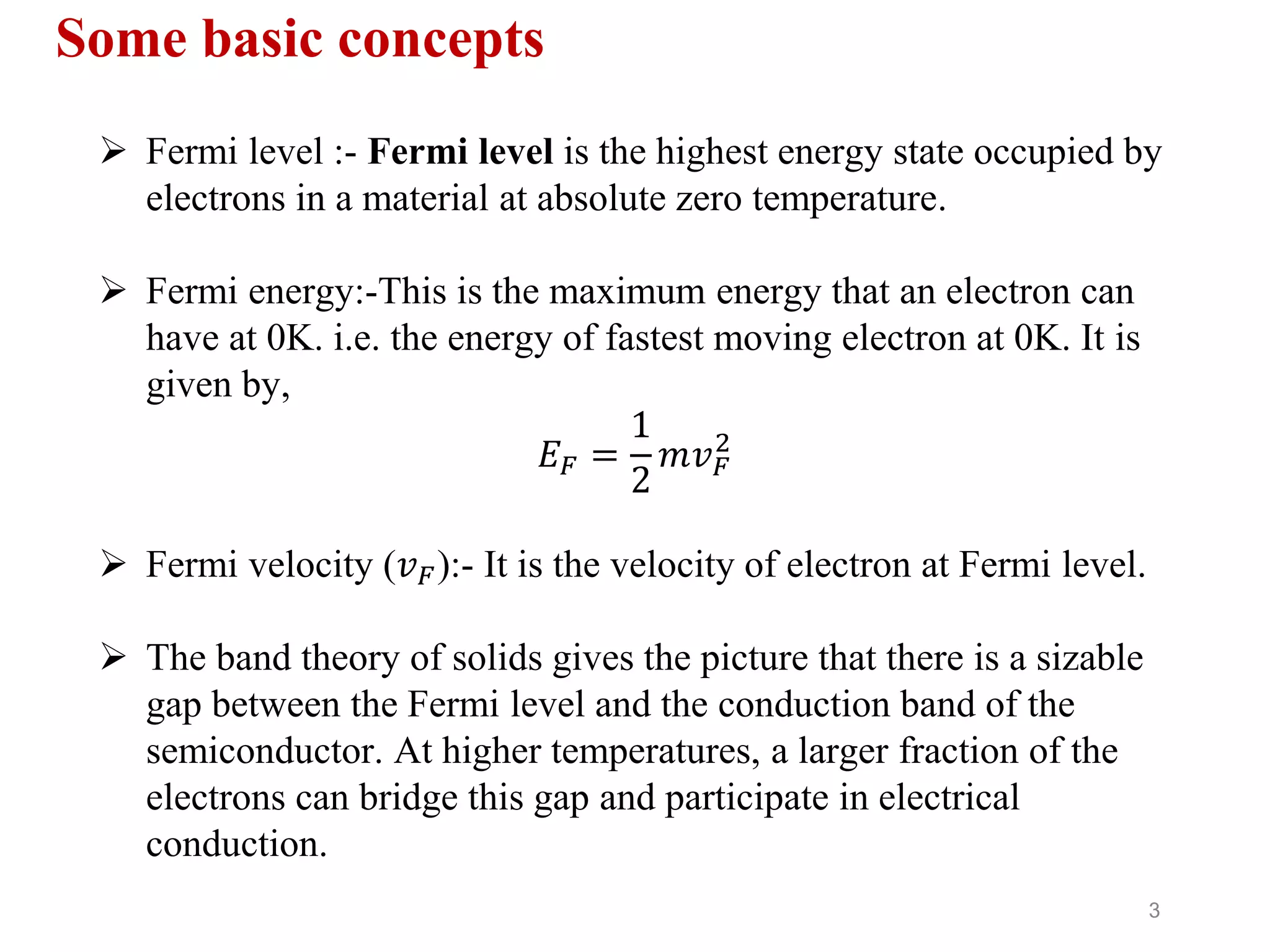
 Fermi energy:-This is the maximum energy that an electron can
have at 0K. i.e. the energy of fastest moving electron at 0K. It is
given by,
𝐸 𝐹 =
1
2
𝑚𝑣 𝐹
2
 Fermi velocity (𝑣 𝐹):- It is the velocity of electron at Fermi level.
 The band theory of solids gives the picture that there is a sizable
gap between the Fermi level and the conduction band of the
semiconductor. At higher temperatures, a larger fraction of the
electrons can bridge this gap and participate in electrical
conduction.
3
Fermi-statistics and Bose Statistics
 The wave function of a system of identical particles must be either
symmetrical (Bose) or antisymmetrical (Fermi) in permutation of a
particle of the particle coordinates (including spin). It means that there
can be only the following two cases:
1. Fermi-Dirac Distribution
2. Bose-Einstein Distribution
 The differences between the two cases are determined by the nature of
particle. Particles which follow Fermi-statistics are called Fermi-
particles (Fermions) and those which follow Bose-statistics are called
Bose- particles (Bosones).
 Electrons, positrons, protons and neutrons are Fermi-particles, whereas
photons are Bosons. Fermion has a spin 1/2 and boson has integral spin.
Let us consider this two types of statistics consequently.
4
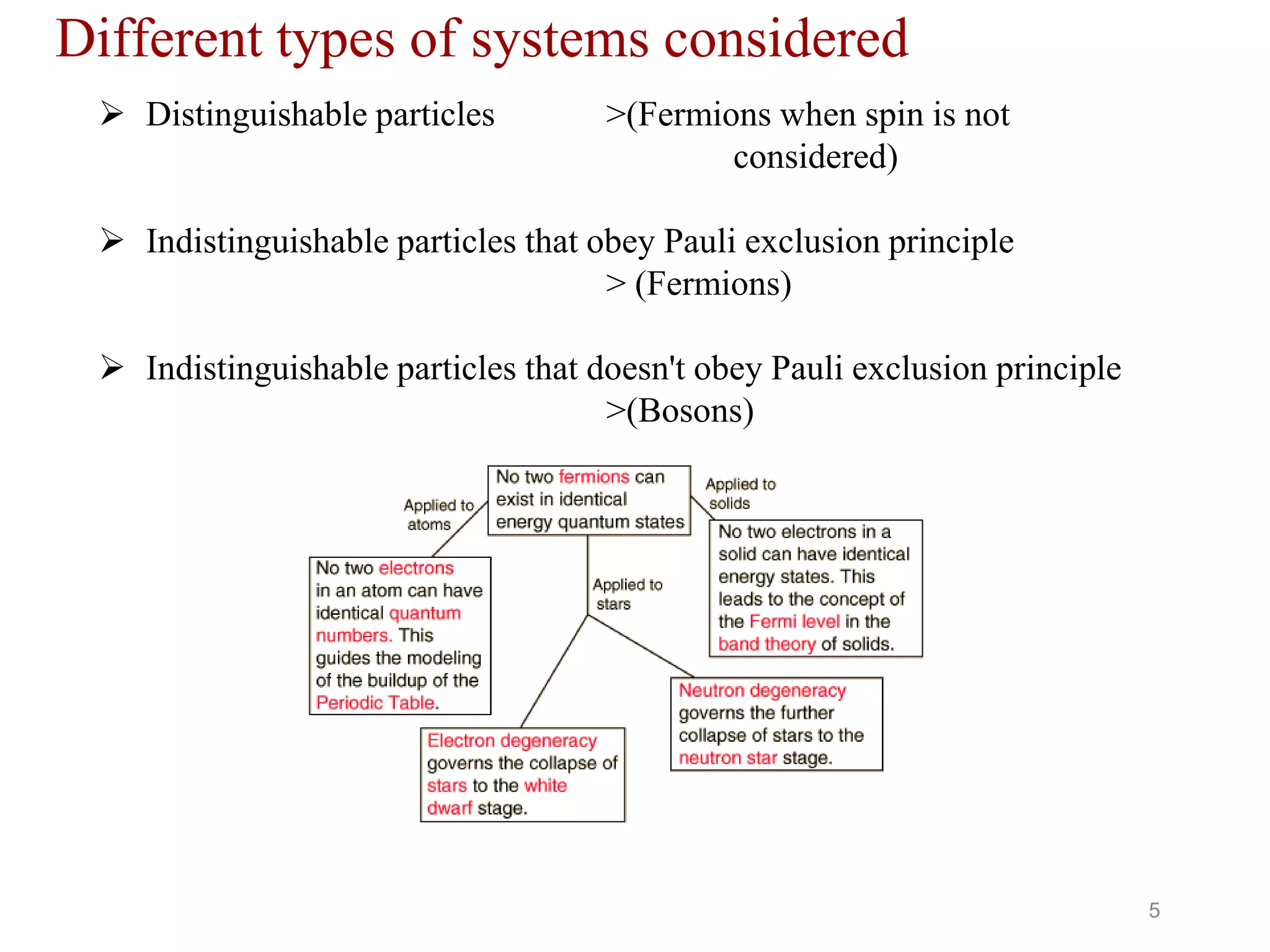
Different types of systems considered
 Distinguishable particles >(Fermions when spin is not
considered)
 Indistinguishable particles that obey Pauli exclusion principle
> (Fermions)
 Indistinguishable particles that doesn't obey Pauli exclusion principle
>(Bosons)
5
Postulates of Fermi Particle
 Particles are indistinguishable.
 Particles obey Pauli principle.
 Each quantum state can have only one particle.
 Each particle has one half spin.
 𝒈𝒊 be the quantum states associated with 𝒊 𝒕𝒉
energy
level.
 𝑵𝒊 is the no. of particles associated with 𝒊 𝒕𝒉 energy level.
 For a particular value of N, there is only one
distribution
6
N2 NnN1 ……………….
Fermi -Dirac distribution function
(Derivation)
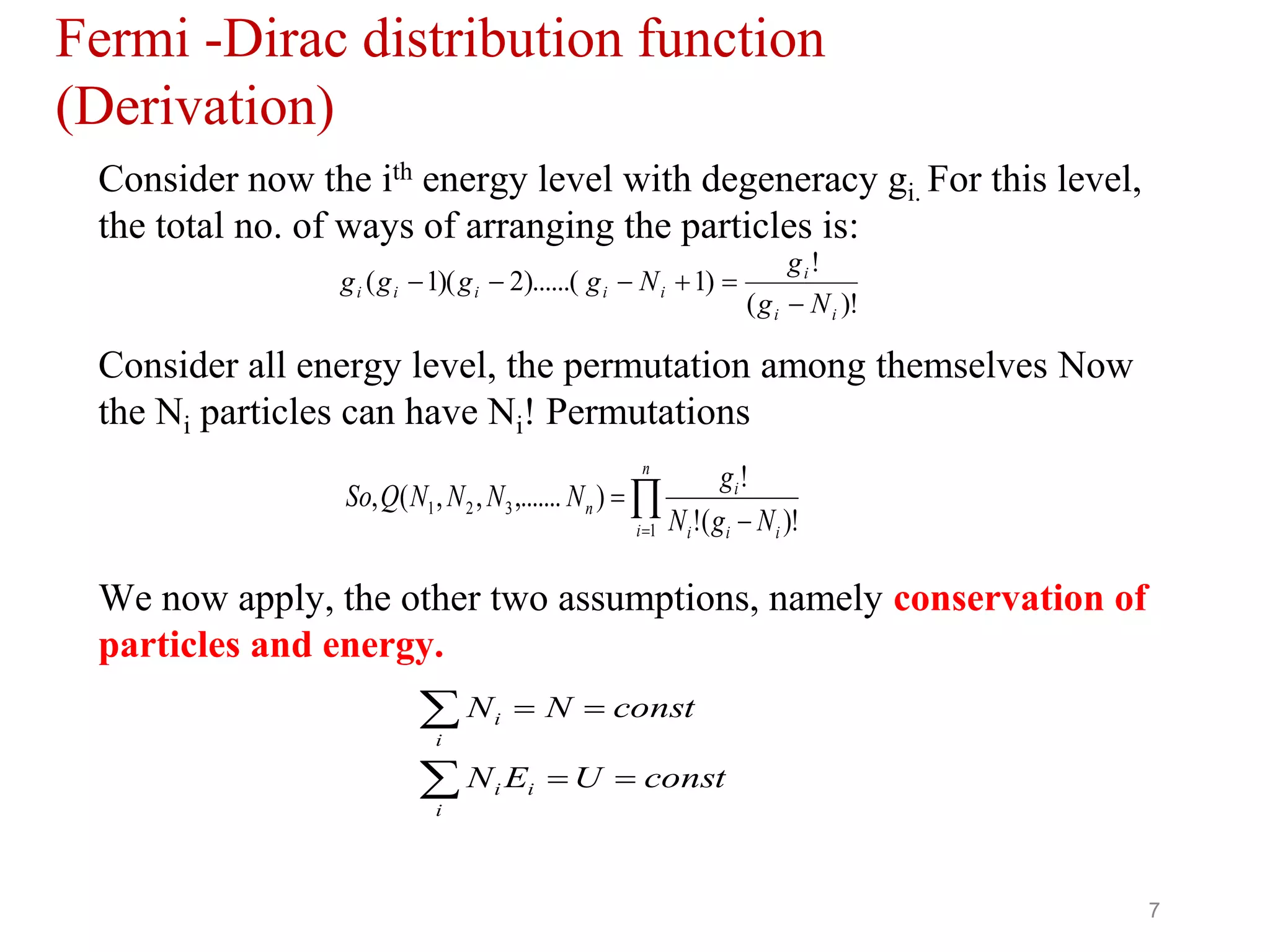
Consider now the ith energy level with degeneracy gi. For this level,
the total no. of ways of arranging the particles is:
Consider all energy level, the permutation among themselves Now
the Ni particles can have Ni! Permutations
We now apply, the other two assumptions, namely conservation of
particles and energy.
7
)!(
!
)1)......(2)(1(
ii
i
iiiii
Ng
g
Ngggg


 

n
i iii
i
n
NgN
g
NNNNQSo
1
321
)!(!
!
),.......,,(,
constUEN
constNN
i
i
i
i
i




Contd…
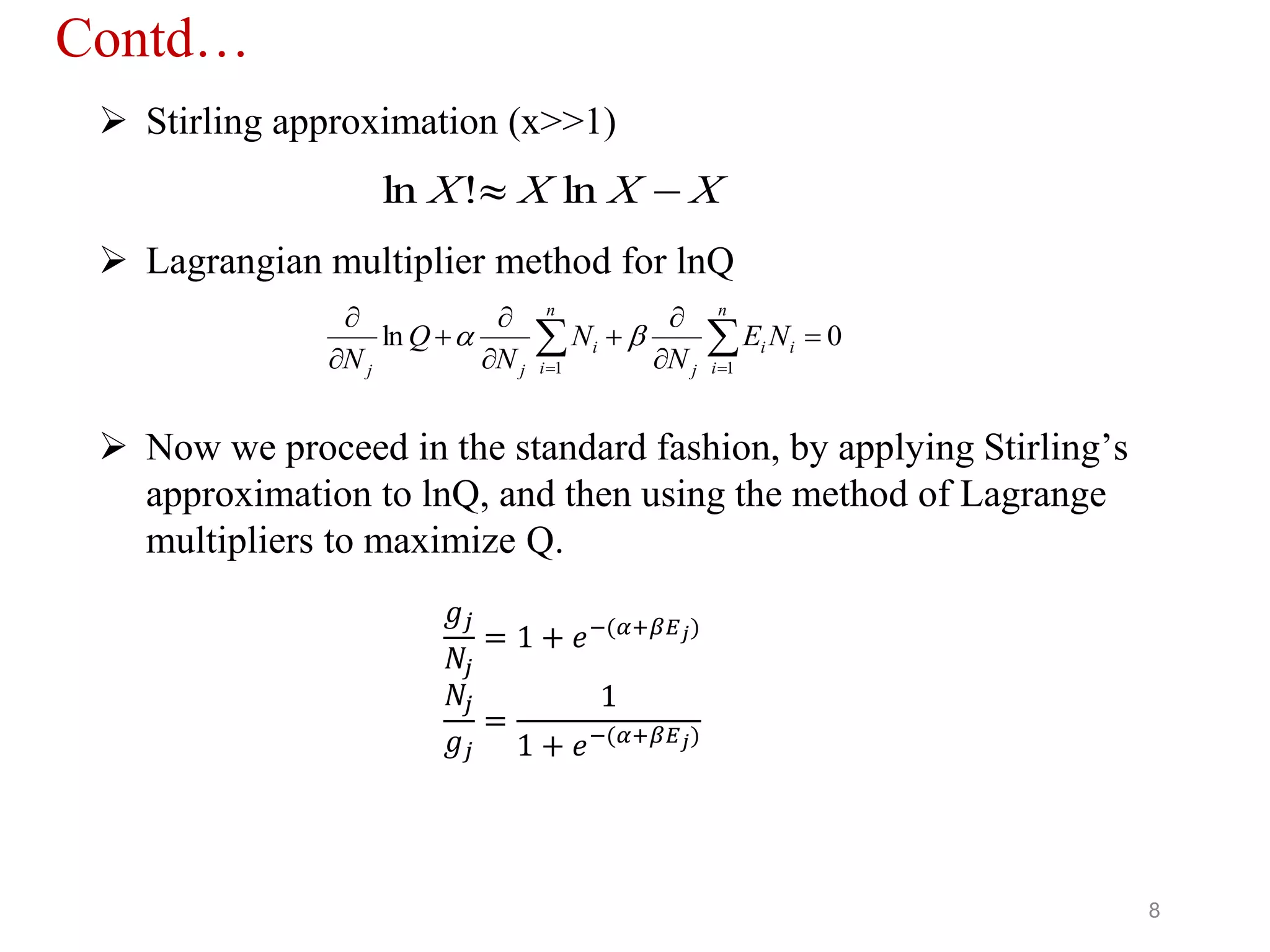
 Stirling approximation (x>>1)
 Lagrangian multiplier method for lnQ
 Now we proceed in the standard fashion, by applying Stirling’s
approximation to lnQ, and then using the method of Lagrange
multipliers to maximize Q.
8
0ln
11









 
n
i
ii
j
n
i
i
jj
NE
N
N
N
Q
N

XXXX  ln!ln
𝑔𝑗
𝑁𝑗
= 1 + 𝑒−(𝛼+𝛽𝐸 𝑗)
𝑁𝑗
𝑔𝑗
=
1
1 + 𝑒−(𝛼+𝛽𝐸 𝑗)
Contd…
For i=j,
𝑁𝑖
𝑔𝑖
=
1
1 + 𝑒−(𝛼+𝛽𝐸 𝑖)
=
1
1 + 𝑒(𝐸 𝑖−𝐸 𝐹)/𝑘𝑇
;
𝛼 =
𝐸 𝐹
𝑘𝑇
, 𝛽 = −
1
𝑘𝑇
And because energy level is continuous,
𝑁 𝐸 𝑑𝐸 =
𝑔 𝐸 𝑑𝐸
1 + 𝑒(𝐸−𝐸 𝐹)/𝑘𝑇
 g(E)dEis the number of available states in the energy range E and E+dE
 Number of particles between E and E+dE is given by
N(E)dE=f(E)*g(E)dE
 f(E) is the probability that a state at energy E is occupied by a particle
𝑓 𝐸 =
𝑁 𝐸
𝑔(𝐸)
=
1
1 + 𝑒(𝐸−𝐸 𝐹) 𝑘𝑇
9
Contd…
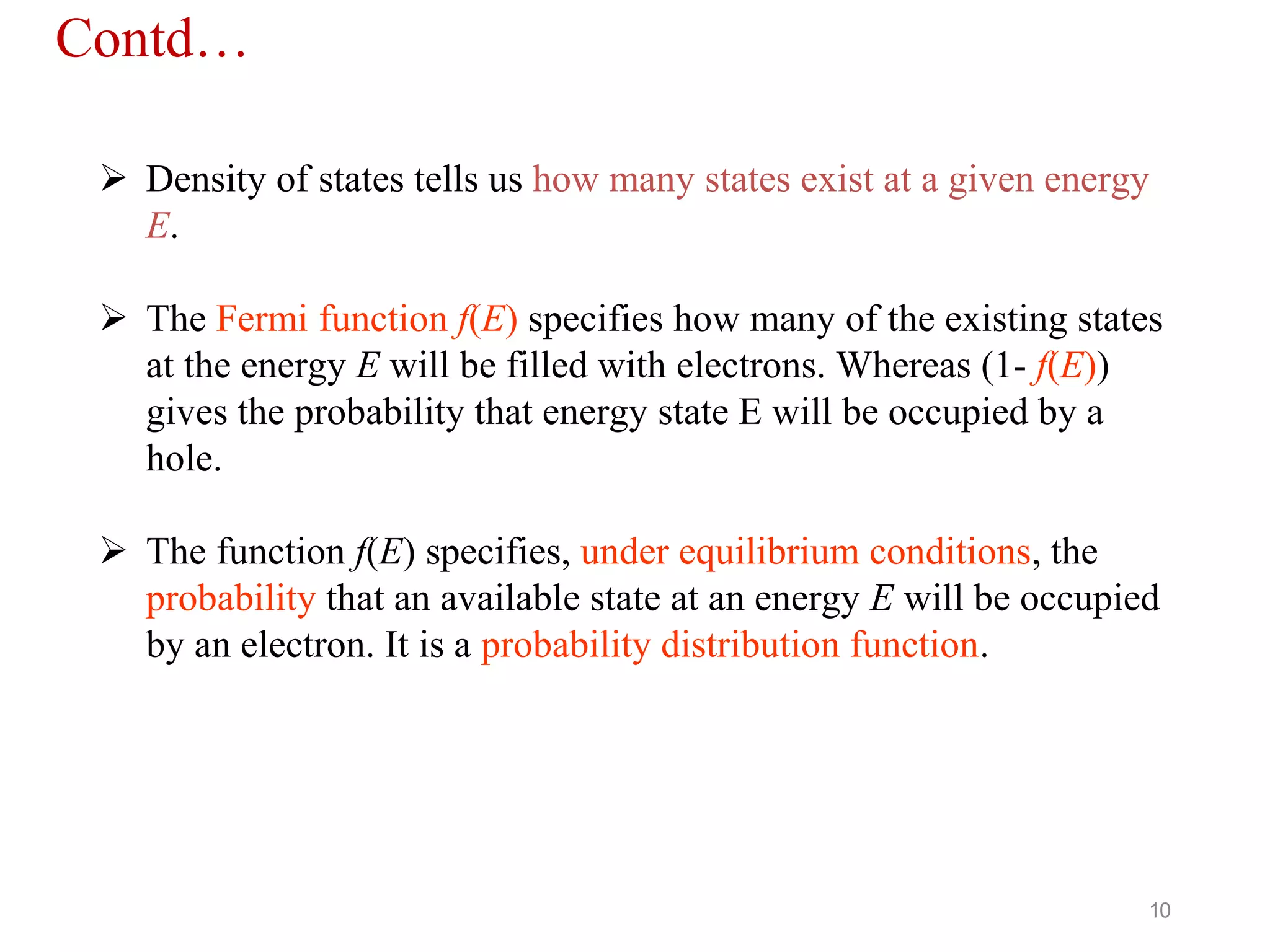
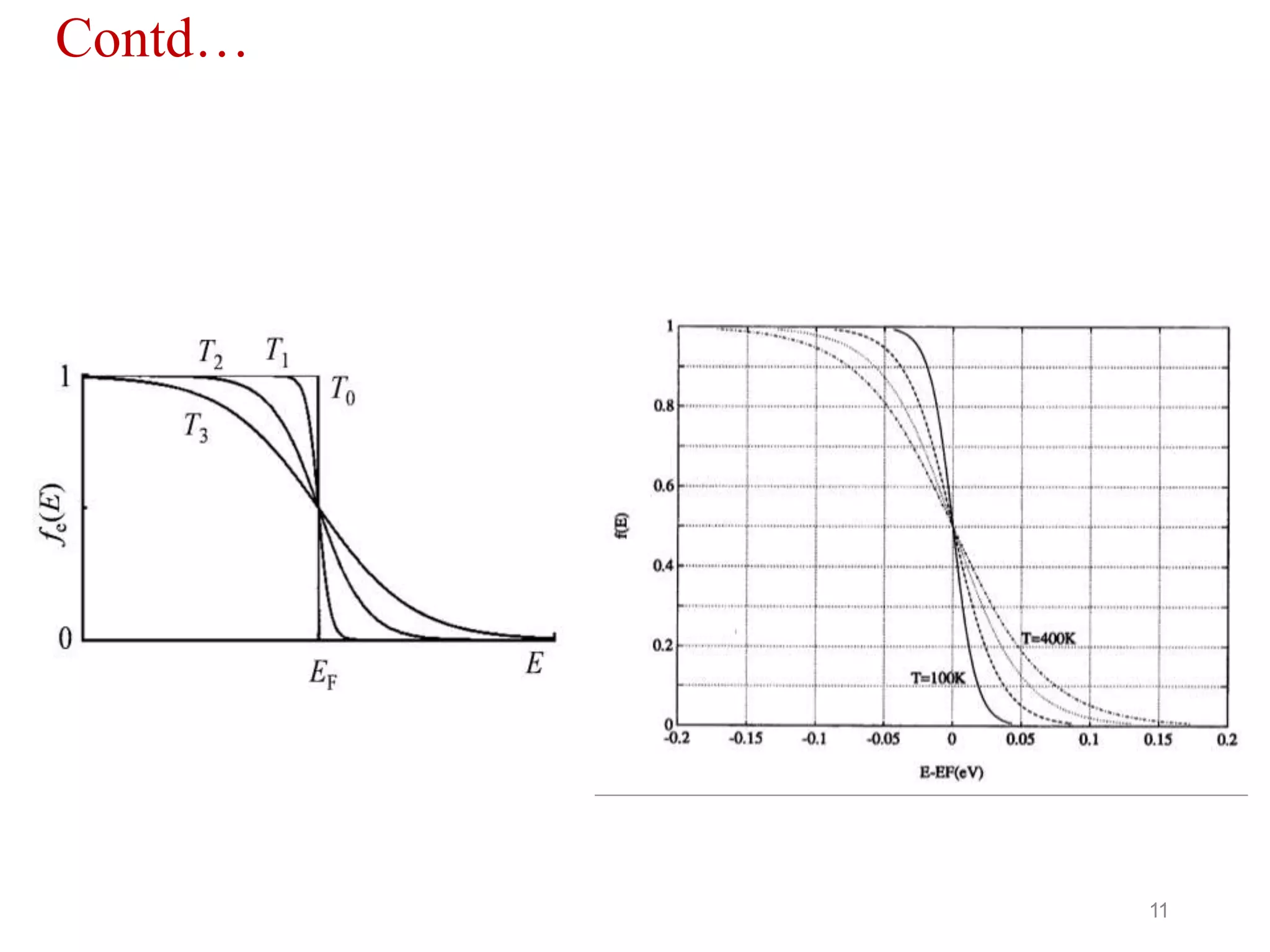
 Density of states tells us how many states exist at a given energy
E.
 The Fermi function f(E) specifies how many of the existing states
at the energy E will be filled with electrons. Whereas (1- f(E))
gives the probability that energy state E will be occupied by a
hole.
 The function f(E) specifies, under equilibrium conditions, the
probability that an available state at an energy E will be occupied
by an electron. It is a probability distribution function.
10
Contd…
11
12
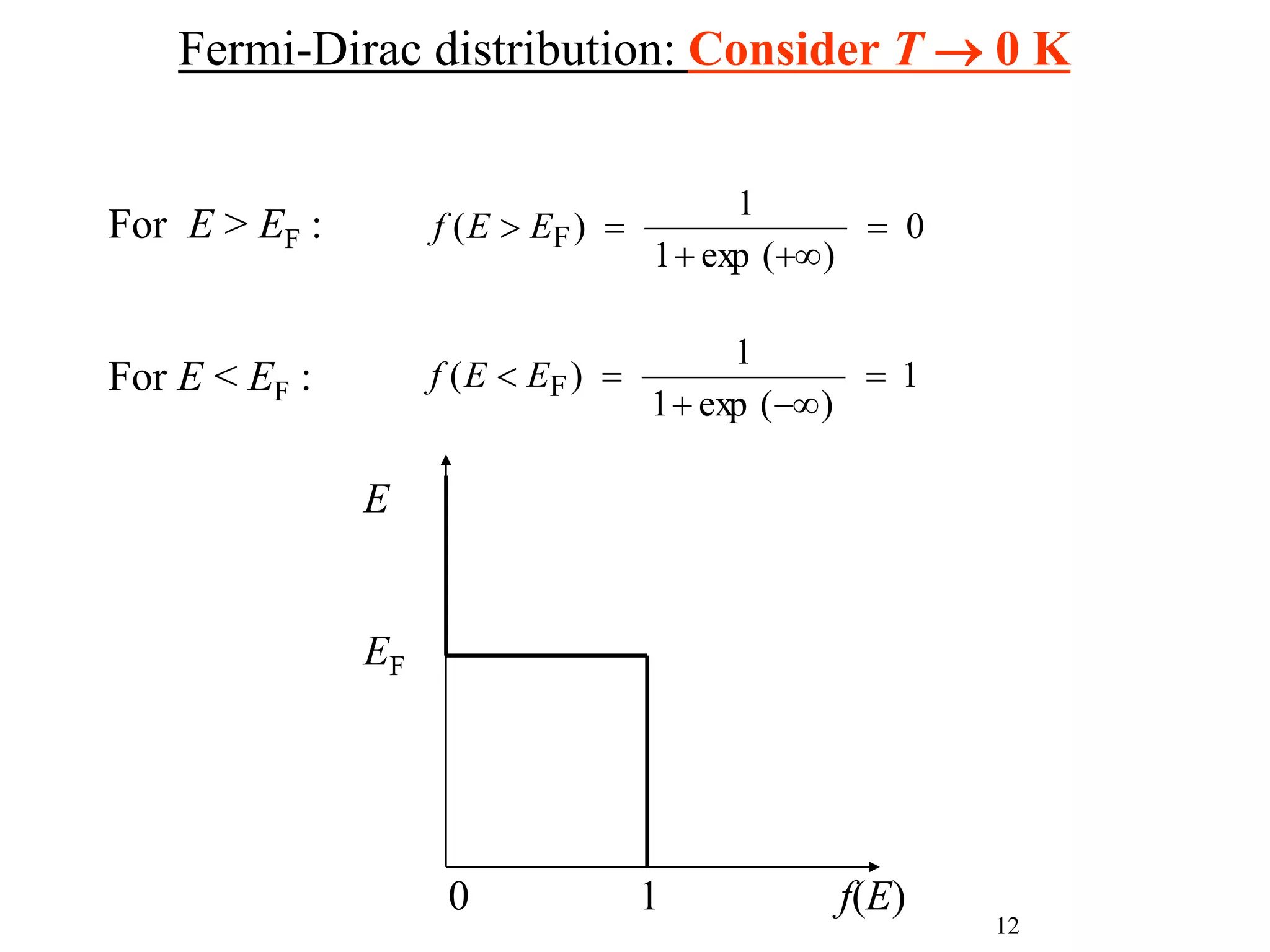
Fermi-Dirac distribution: Consider T  0 K
For E > EF :
For E < EF :
0
)(exp1
1
)( F 

 EEf
1
)(exp1
1
)( F 

 EEf
E
EF
0 1 f(E)
13
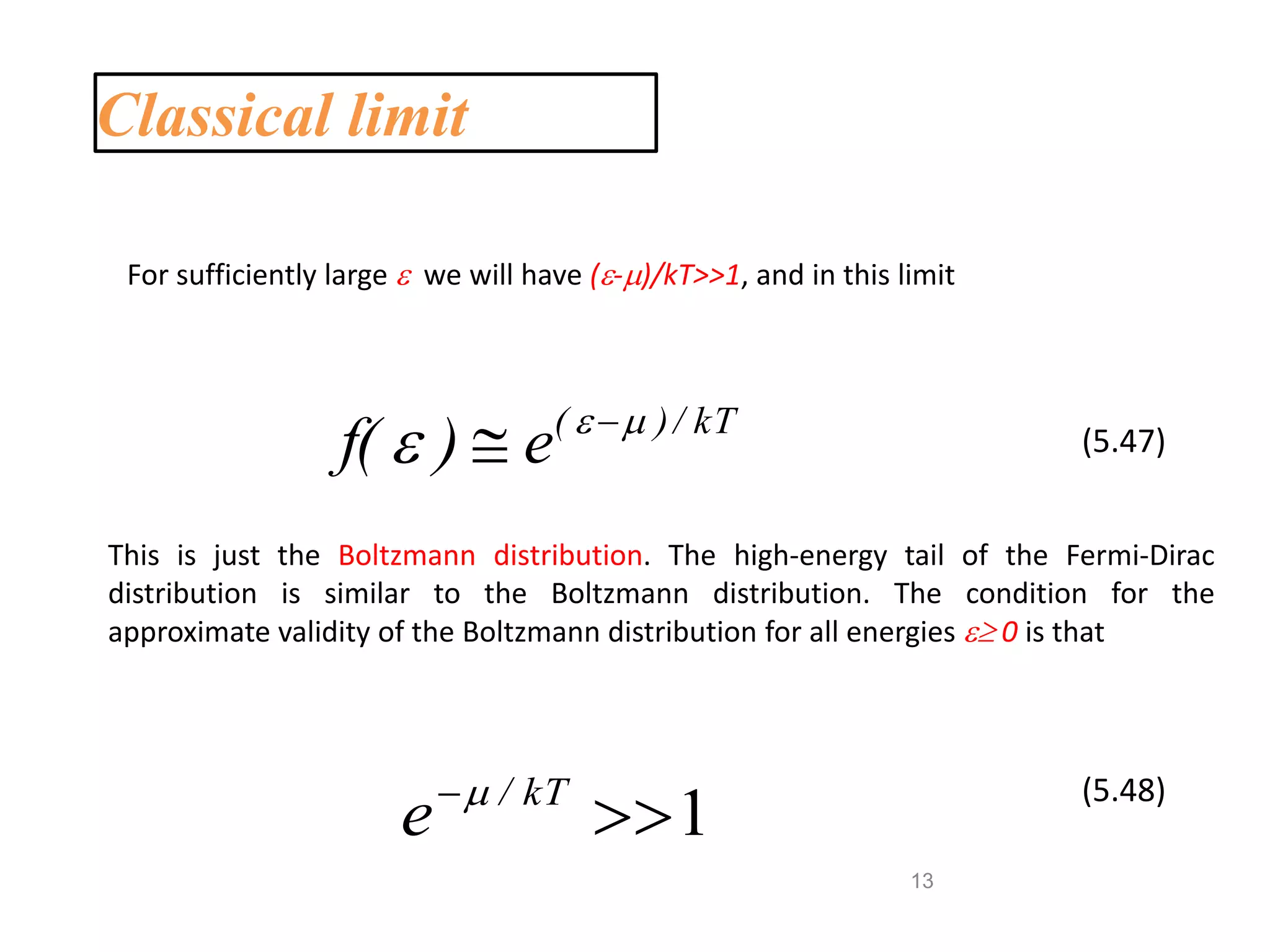
Classical limit
For sufficiently large  we will have (-)/kT>>1, and in this limit
kT/)(
e)f( 
 
 (5.47)
This is just the Boltzmann distribution. The high-energy tail of the Fermi-Dirac
distribution is similar to the Boltzmann distribution. The condition for the
approximate validity of the Boltzmann distribution for all energies  0 is that
1 kT/
e  (5.48)
Fermi -Dirac distribution function:-
14
0 0.05 0.1 0.15 0.2 0.25 0.3 0.35 0.4 0.45 0.5
0
0.2
0.4
0.6
0.8
1
1.2
1.4
1.6
1.8
2
Fermi Dirac Distribution function
Energy (eV)
FermiDiracDistributionfunction
T1=50 K
T2=100 K
T3=300 K
0 0.05 0.1 0.15 0.2 0.25 0.3 0.35 0.4 0.45 0.5
0
0.05
0.1
0.15
0.2
0.25
0.3
0.35
Fermi Dirac Distribution function of particle density with Energy
Energy (eV)
FermiDiracDistributionfunction
T1=50 K
T2=100 K
T3=300 K
References
1. Statistical Physics (2nd Edition), F. Mandl, Manchester
Physics, John Wiley & Sons, 2008,
ISBN 9780471915331.
2. H.J.W. Muller-Kirsten, Basics of Statistical Physics,
2nd ed., World Scientific, ISBN: 978-981-4449-53-3.
15
Thank You
16

Fermi dirac distribution

  • 1.
    Presented by- Md AhsanHalimi Scholar No: 19-3-04-105 Dept. of ECE, NIT Silchar “Introduction of Fermi Dirac Distribution Function” 1
  • 2.
    Contents Some Basic Concept Fermi-statisticsand Bose Statistics Postulates of Fermi particles Fermi Dirac Distribution Function Conclusion References 2
  • 3.
    Some basic concepts Fermi level :- Fermi level is the highest energy state occupied by electrons in a material at absolute zero temperature.  Fermi energy:-This is the maximum energy that an electron can have at 0K. i.e. the energy of fastest moving electron at 0K. It is given by, 𝐸 𝐹 = 1 2 𝑚𝑣 𝐹 2  Fermi velocity (𝑣 𝐹):- It is the velocity of electron at Fermi level.  The band theory of solids gives the picture that there is a sizable gap between the Fermi level and the conduction band of the semiconductor. At higher temperatures, a larger fraction of the electrons can bridge this gap and participate in electrical conduction. 3
  • 4.
    Fermi-statistics and BoseStatistics  The wave function of a system of identical particles must be either symmetrical (Bose) or antisymmetrical (Fermi) in permutation of a particle of the particle coordinates (including spin). It means that there can be only the following two cases: 1. Fermi-Dirac Distribution 2. Bose-Einstein Distribution  The differences between the two cases are determined by the nature of particle. Particles which follow Fermi-statistics are called Fermi- particles (Fermions) and those which follow Bose-statistics are called Bose- particles (Bosones).  Electrons, positrons, protons and neutrons are Fermi-particles, whereas photons are Bosons. Fermion has a spin 1/2 and boson has integral spin. Let us consider this two types of statistics consequently. 4
  • 5.
    Different types ofsystems considered  Distinguishable particles >(Fermions when spin is not considered)  Indistinguishable particles that obey Pauli exclusion principle > (Fermions)  Indistinguishable particles that doesn't obey Pauli exclusion principle >(Bosons) 5
  • 6.
    Postulates of FermiParticle  Particles are indistinguishable.  Particles obey Pauli principle.  Each quantum state can have only one particle.  Each particle has one half spin.  𝒈𝒊 be the quantum states associated with 𝒊 𝒕𝒉 energy level.  𝑵𝒊 is the no. of particles associated with 𝒊 𝒕𝒉 energy level.  For a particular value of N, there is only one distribution 6 N2 NnN1 ……………….
  • 7.
    Fermi -Dirac distributionfunction (Derivation) Consider now the ith energy level with degeneracy gi. For this level, the total no. of ways of arranging the particles is: Consider all energy level, the permutation among themselves Now the Ni particles can have Ni! Permutations We now apply, the other two assumptions, namely conservation of particles and energy. 7 )!( ! )1)......(2)(1( ii i iiiii Ng g Ngggg      n i iii i n NgN g NNNNQSo 1 321 )!(! ! ),.......,,(, constUEN constNN i i i i i    
  • 8.
    Contd…  Stirling approximation(x>>1)  Lagrangian multiplier method for lnQ  Now we proceed in the standard fashion, by applying Stirling’s approximation to lnQ, and then using the method of Lagrange multipliers to maximize Q. 8 0ln 11            n i ii j n i i jj NE N N N Q N  XXXX  ln!ln 𝑔𝑗 𝑁𝑗 = 1 + 𝑒−(𝛼+𝛽𝐸 𝑗) 𝑁𝑗 𝑔𝑗 = 1 1 + 𝑒−(𝛼+𝛽𝐸 𝑗)
  • 9.
    Contd… For i=j, 𝑁𝑖 𝑔𝑖 = 1 1 +𝑒−(𝛼+𝛽𝐸 𝑖) = 1 1 + 𝑒(𝐸 𝑖−𝐸 𝐹)/𝑘𝑇 ; 𝛼 = 𝐸 𝐹 𝑘𝑇 , 𝛽 = − 1 𝑘𝑇 And because energy level is continuous, 𝑁 𝐸 𝑑𝐸 = 𝑔 𝐸 𝑑𝐸 1 + 𝑒(𝐸−𝐸 𝐹)/𝑘𝑇  g(E)dEis the number of available states in the energy range E and E+dE  Number of particles between E and E+dE is given by N(E)dE=f(E)*g(E)dE  f(E) is the probability that a state at energy E is occupied by a particle 𝑓 𝐸 = 𝑁 𝐸 𝑔(𝐸) = 1 1 + 𝑒(𝐸−𝐸 𝐹) 𝑘𝑇 9
  • 10.
    Contd…  Density ofstates tells us how many states exist at a given energy E.  The Fermi function f(E) specifies how many of the existing states at the energy E will be filled with electrons. Whereas (1- f(E)) gives the probability that energy state E will be occupied by a hole.  The function f(E) specifies, under equilibrium conditions, the probability that an available state at an energy E will be occupied by an electron. It is a probability distribution function. 10
  • 11.
  • 12.
    12 Fermi-Dirac distribution: ConsiderT  0 K For E > EF : For E < EF : 0 )(exp1 1 )( F    EEf 1 )(exp1 1 )( F    EEf E EF 0 1 f(E)
  • 13.
    13 Classical limit For sufficientlylarge  we will have (-)/kT>>1, and in this limit kT/)( e)f(     (5.47) This is just the Boltzmann distribution. The high-energy tail of the Fermi-Dirac distribution is similar to the Boltzmann distribution. The condition for the approximate validity of the Boltzmann distribution for all energies  0 is that 1 kT/ e  (5.48)
  • 14.
    Fermi -Dirac distributionfunction:- 14 0 0.05 0.1 0.15 0.2 0.25 0.3 0.35 0.4 0.45 0.5 0 0.2 0.4 0.6 0.8 1 1.2 1.4 1.6 1.8 2 Fermi Dirac Distribution function Energy (eV) FermiDiracDistributionfunction T1=50 K T2=100 K T3=300 K 0 0.05 0.1 0.15 0.2 0.25 0.3 0.35 0.4 0.45 0.5 0 0.05 0.1 0.15 0.2 0.25 0.3 0.35 Fermi Dirac Distribution function of particle density with Energy Energy (eV) FermiDiracDistributionfunction T1=50 K T2=100 K T3=300 K
  • 15.
    References 1. Statistical Physics(2nd Edition), F. Mandl, Manchester Physics, John Wiley & Sons, 2008, ISBN 9780471915331. 2. H.J.W. Muller-Kirsten, Basics of Statistical Physics, 2nd ed., World Scientific, ISBN: 978-981-4449-53-3. 15
  • 16.