1
Advanced xc-functionals: DFT+U
Burak Himmetoglu
●
Well known failures of LDA/GGA: transition metal oxides
●
Importance of electronic correlations: Mott transition
●
Introduction to Hubbard Model
●
DFT+U: Formulation and implementation
●
Calculation of U
●
Some examples and applications
2
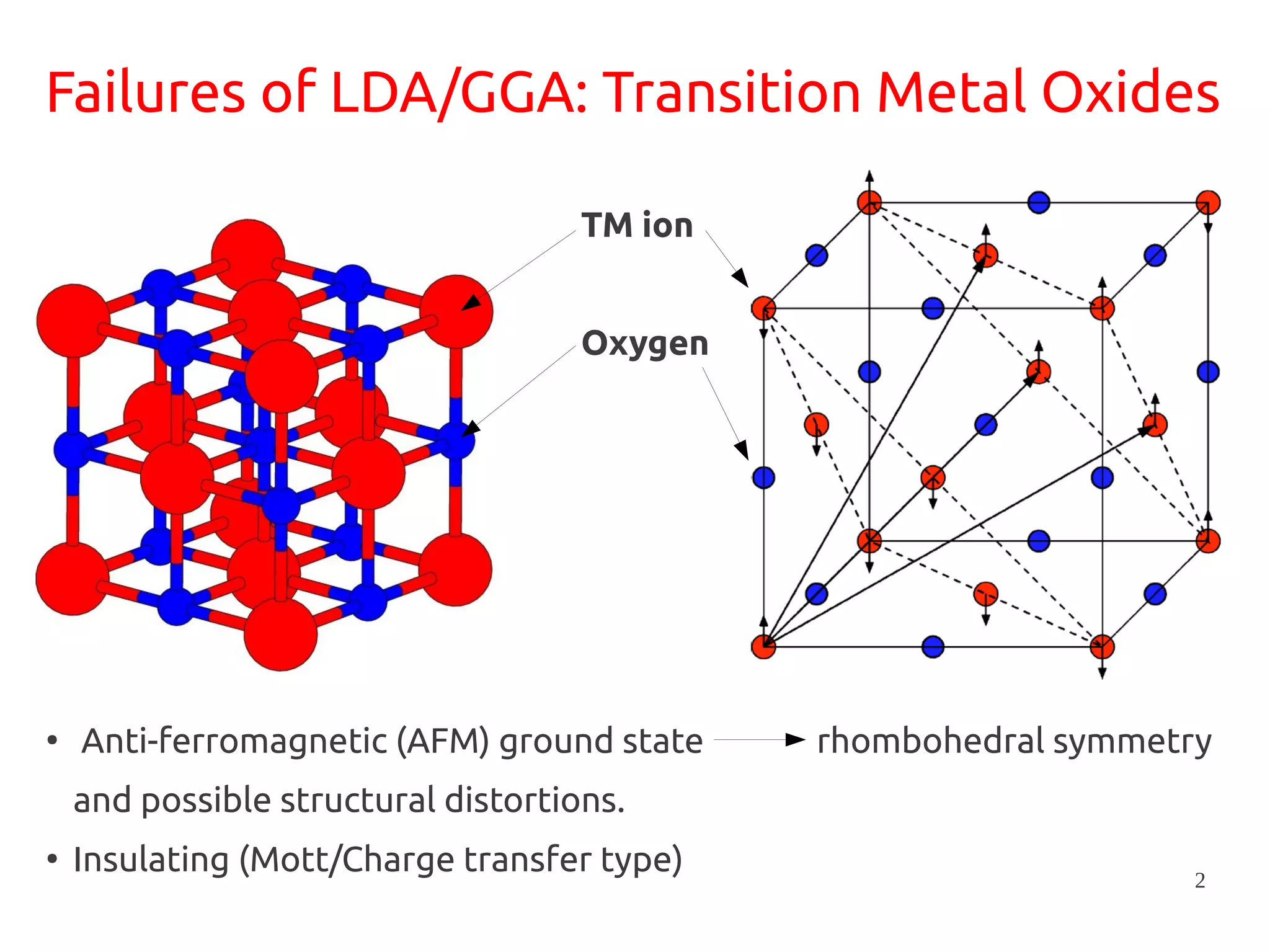
Failures of LDA/GGA: Transition Metal Oxides
TM ion
Oxygen
●
Anti-ferromagnetic (AFM) ground state rhombohedral symmetry
and possible structural distortions.
●
Insulating (Mott/Charge transfer type)
3
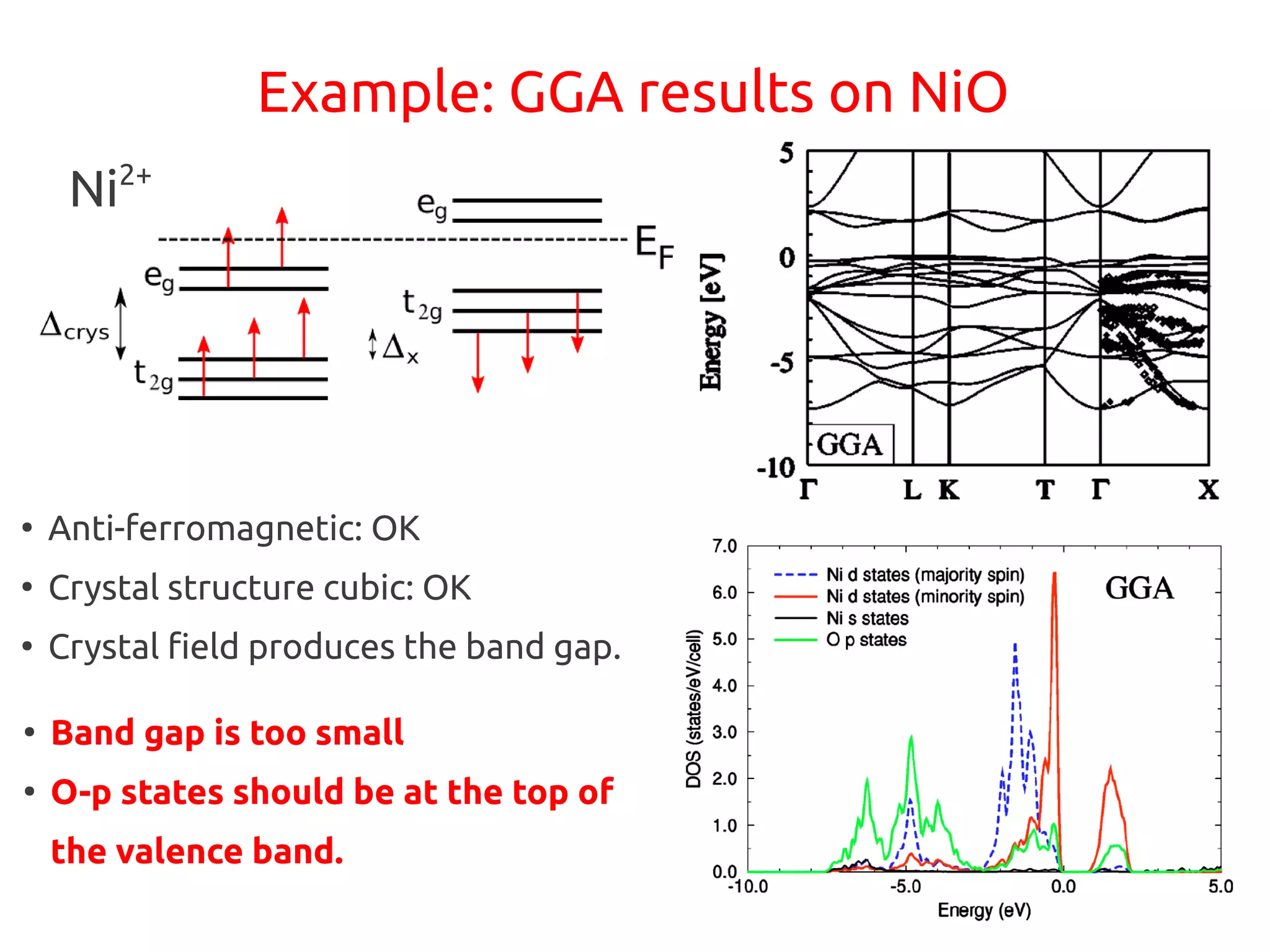
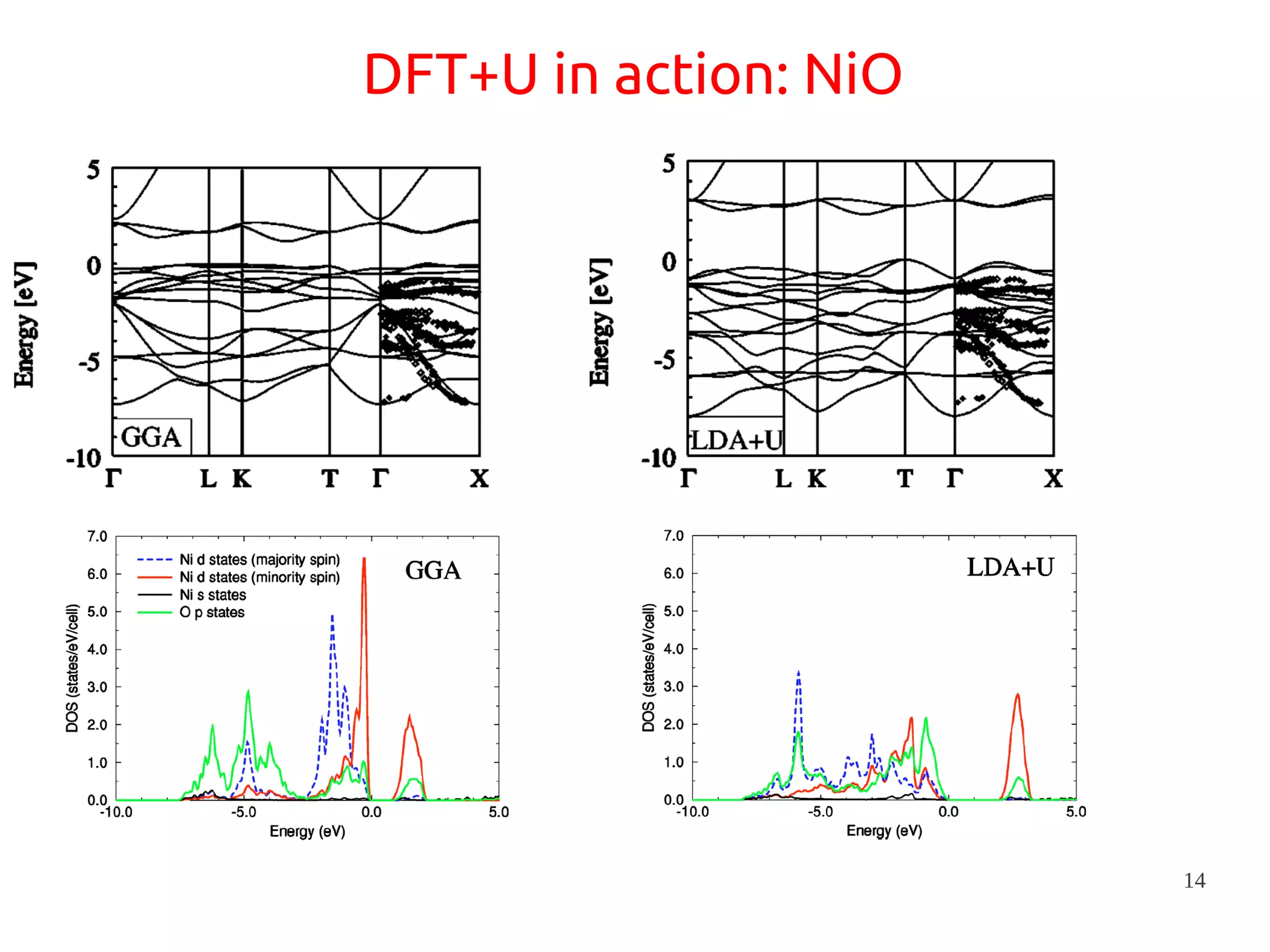
Example: GGA results on NiO
●
Anti-ferromagnetic: OK
●
Crystal structure cubic: OK
●
Crystal field produces the band gap.
●
Band gap is too small
●
O-p states should be at the top of
the valence band.
Ni2+
4
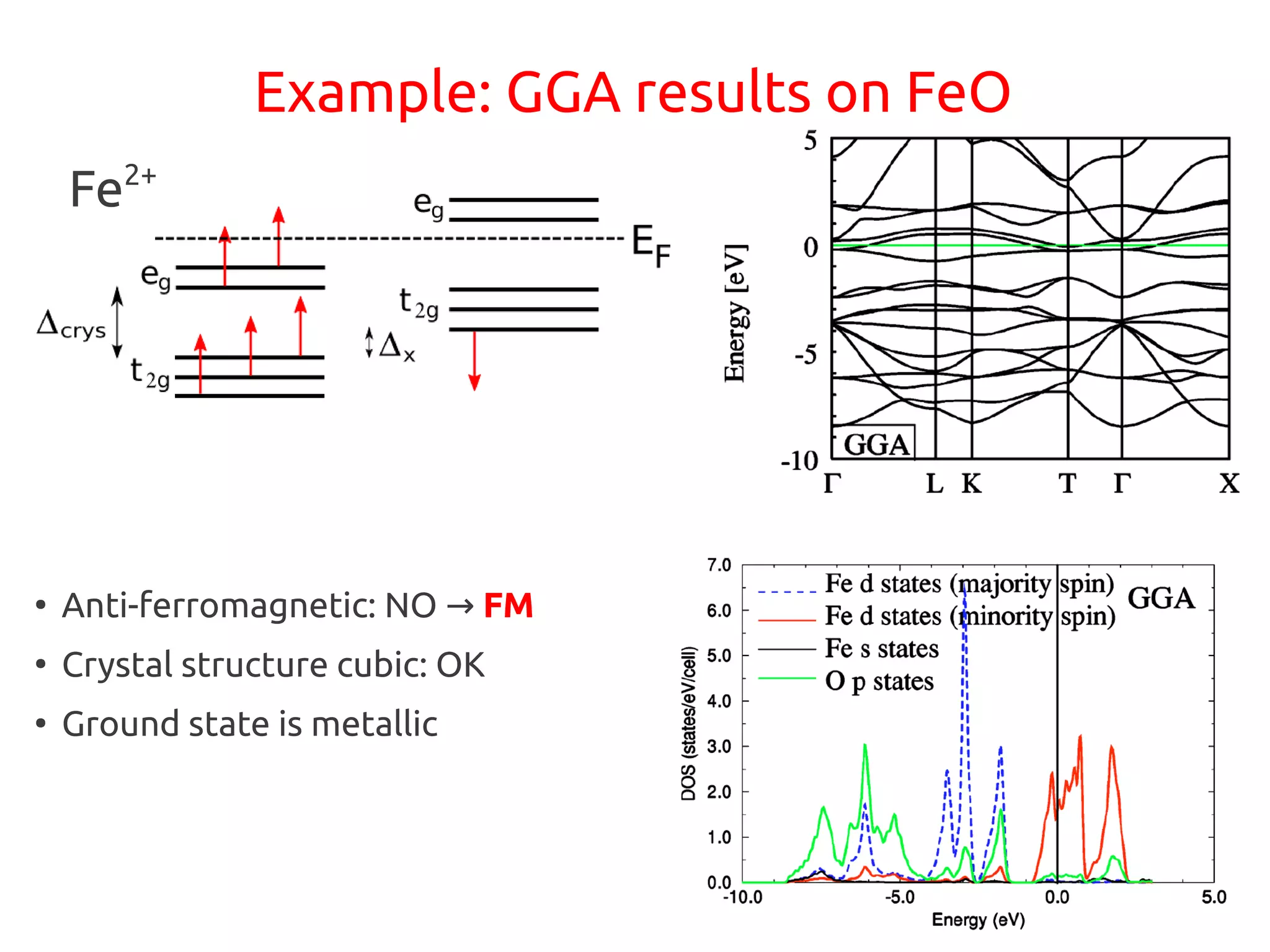
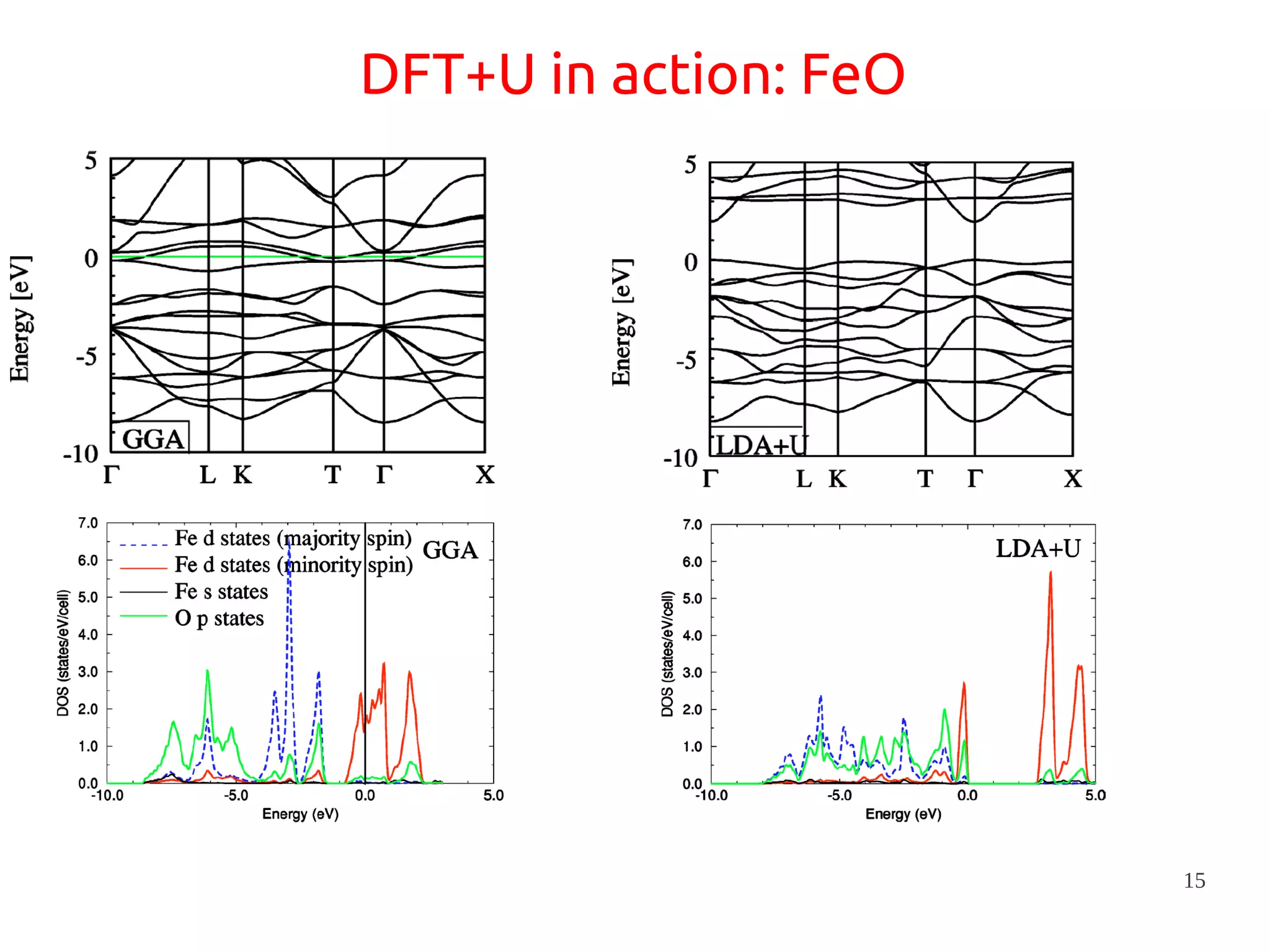
Example: GGA results on FeO
Fe2+
●
Anti-ferromagnetic: NO → FM
●
Crystal structure cubic: OK
●
Ground state is metallic
5
Importance of electronic correlations
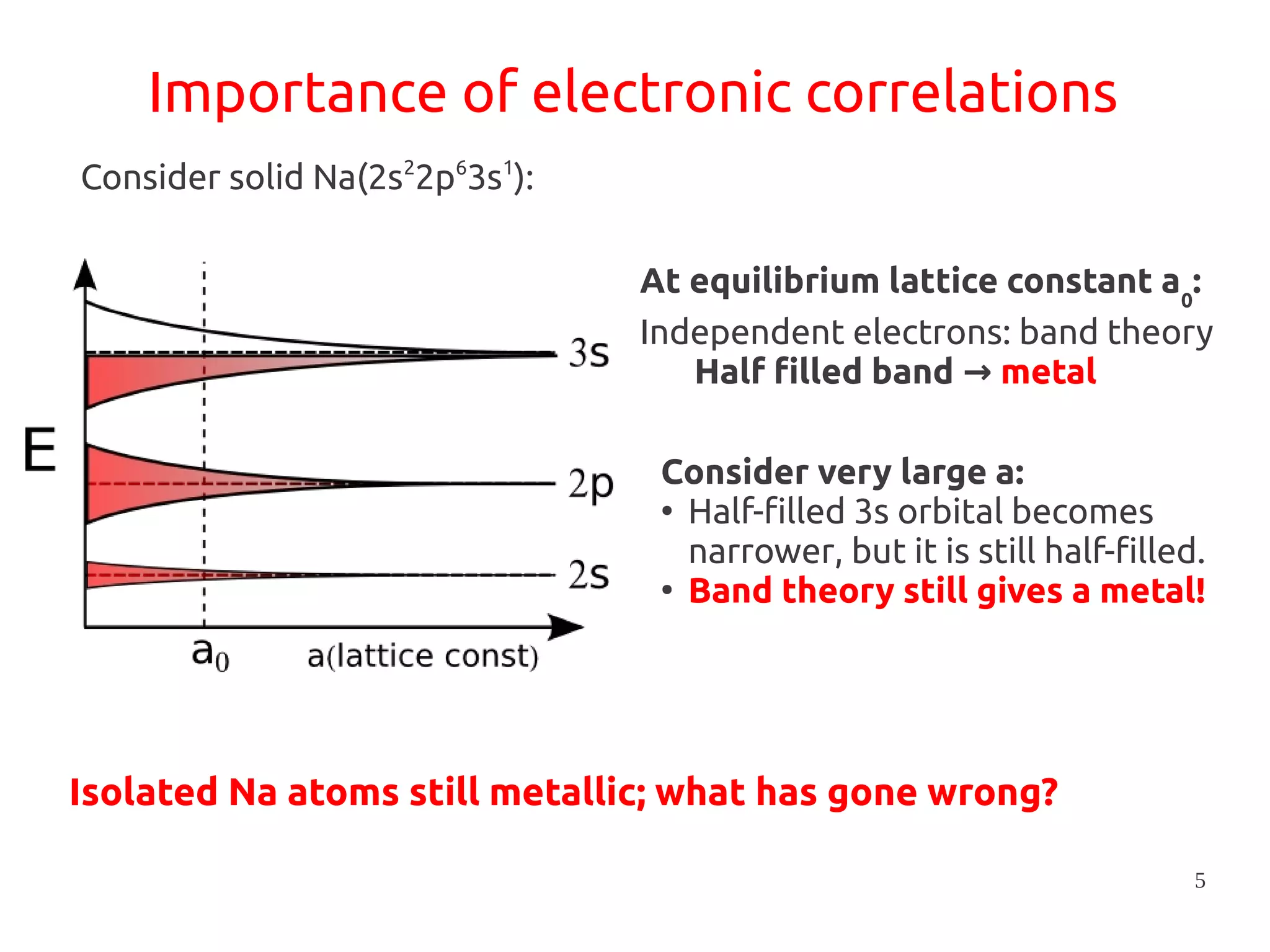
Consider solid Na(2s2
2p6
3s1
):
At equilibrium lattice constant a0
:
Independent electrons: band theory
Half filled band → metal
Consider very large a:
●
Half-filled 3s orbital becomes
narrower, but it is still half-filled.
●
Band theory still gives a metal!
Isolated Na atoms still metallic; what has gone wrong?
6
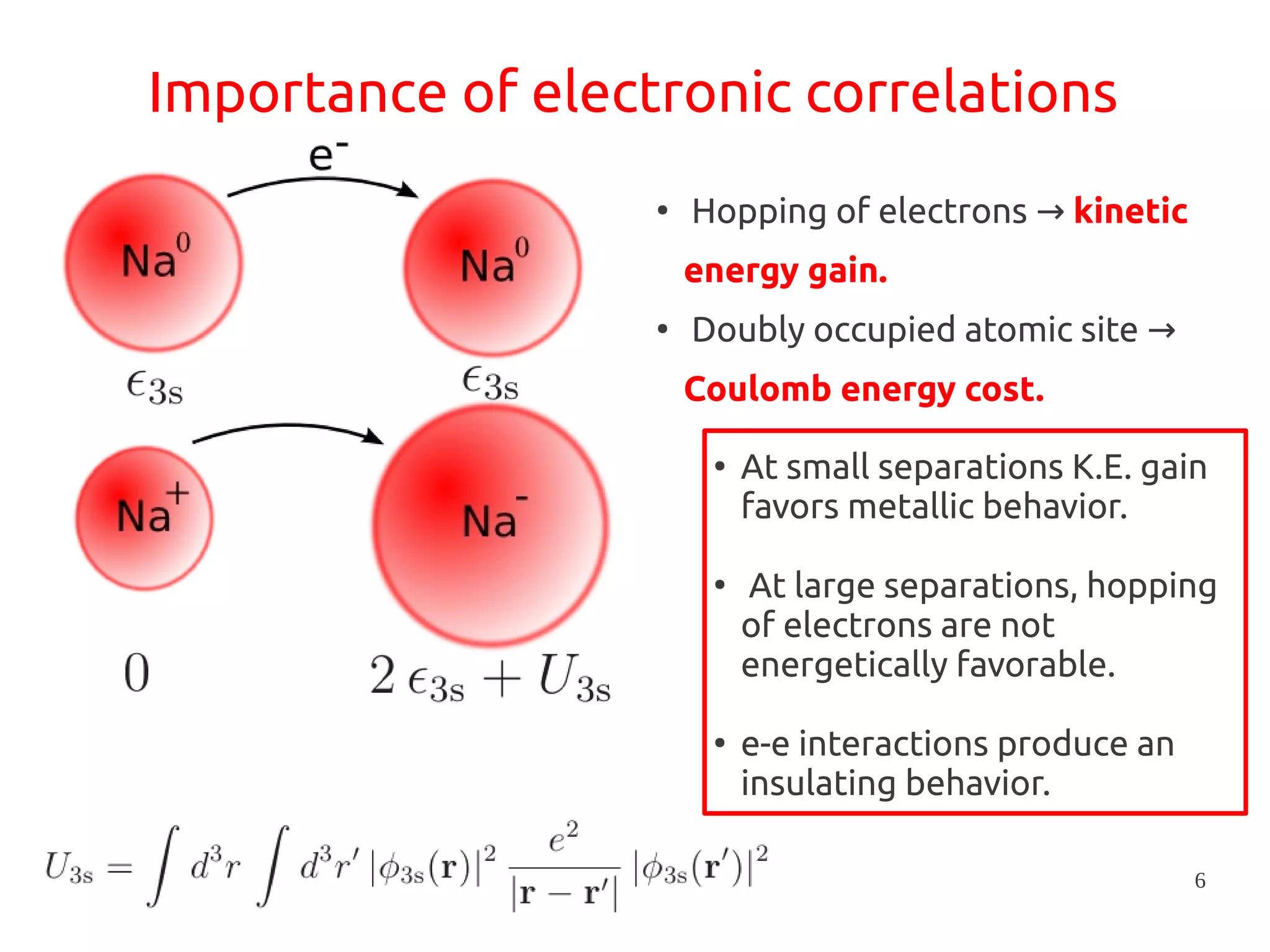
Importance of electronic correlations
●
Hopping of electrons → kinetic
energy gain.
●
Doubly occupied atomic site →
Coulomb energy cost.
●
At small separations K.E. gain
favors metallic behavior.
●
At large separations, hopping
of electrons are not
energetically favorable.
●
e-e interactions produce an
insulating behavior.
7
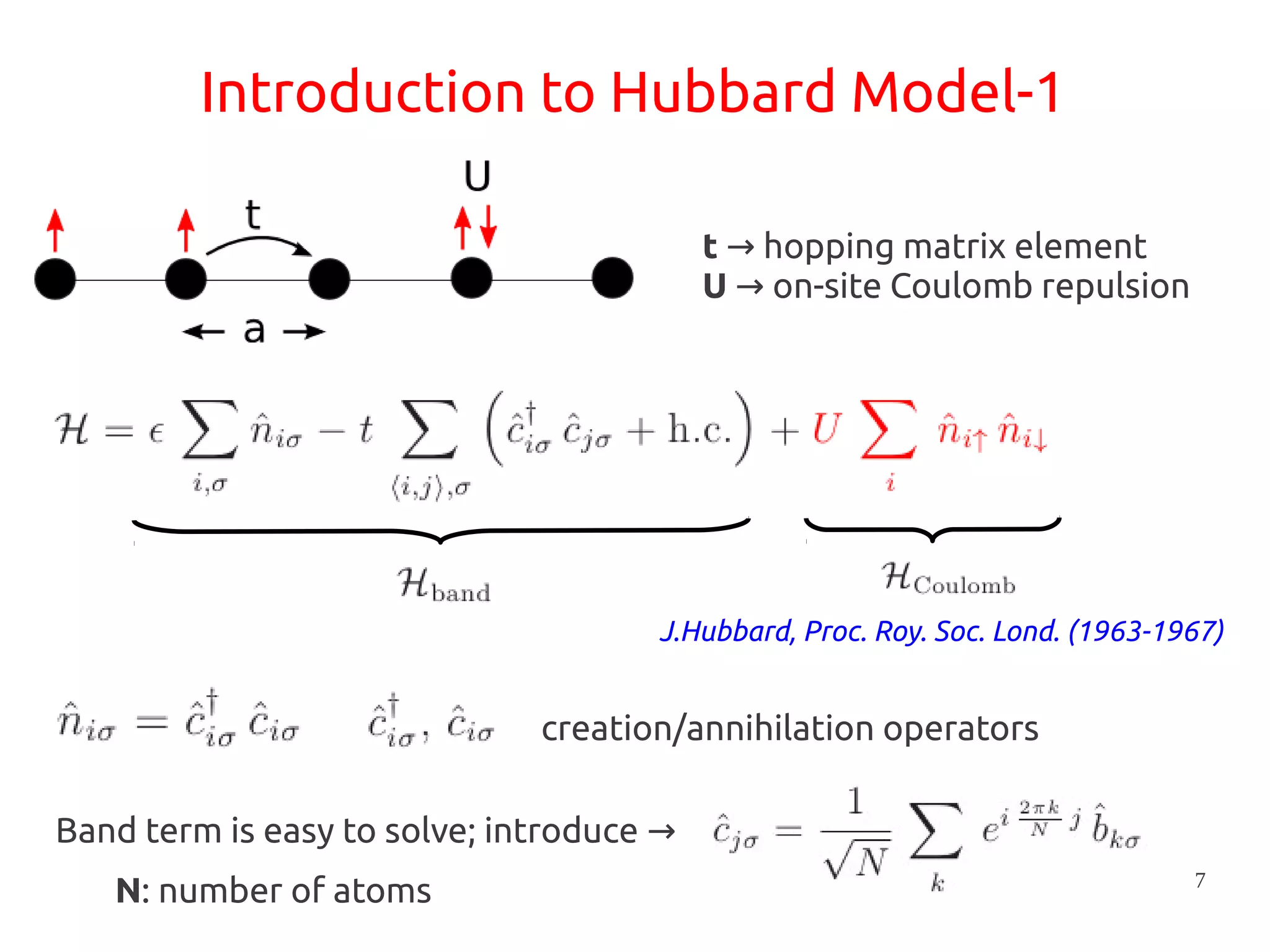
Introduction to Hubbard Model-1
t hopping matrix element→
U on-site Coulomb repulsion→
Band term is easy to solve; introduce →
creation/annihilation operators
N: number of atoms
J.Hubbard, Proc. Roy. Soc. Lond. (1963-1967)
8
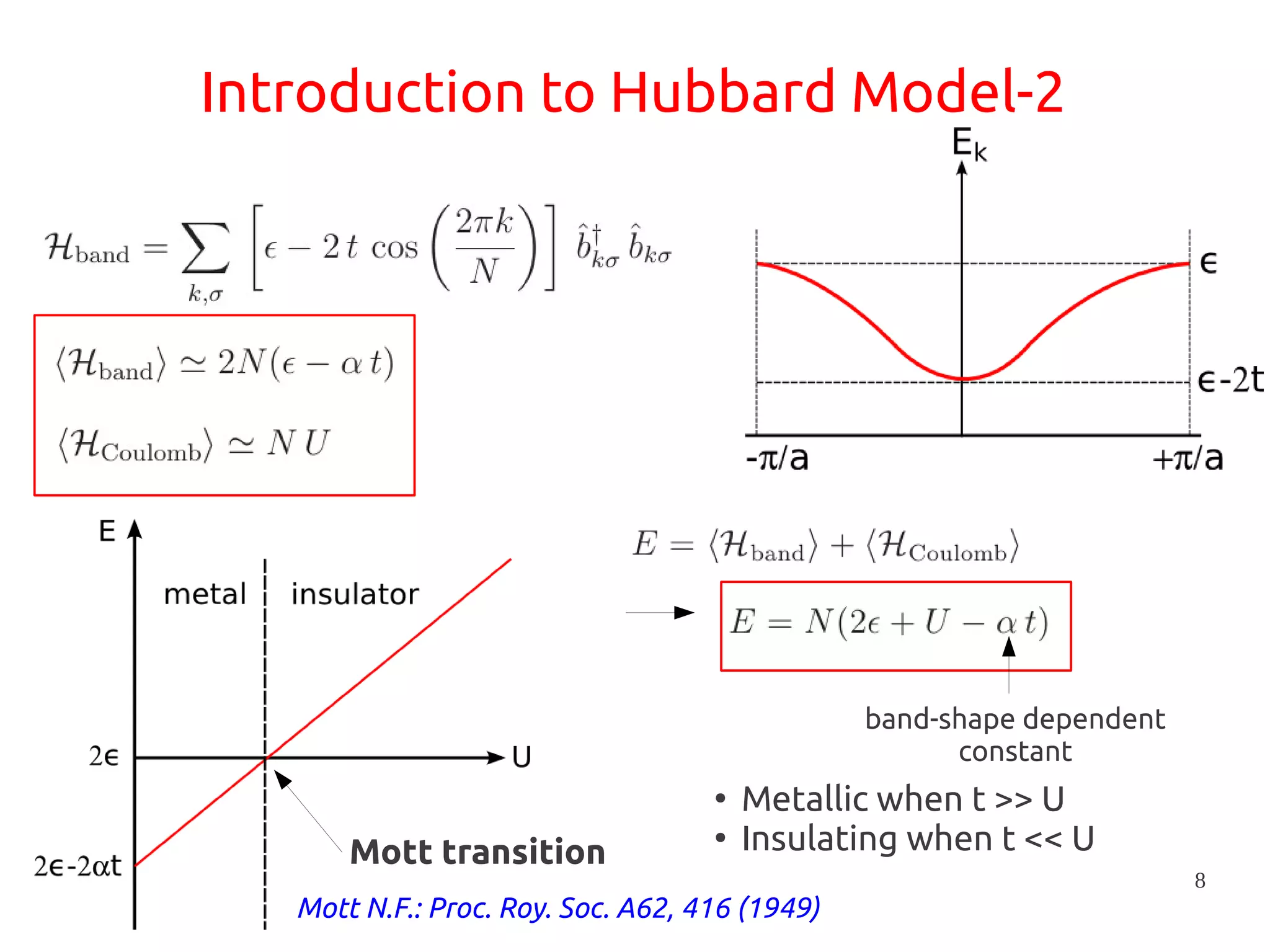
Introduction to Hubbard Model-2
●
Metallic when t >> U
●
Insulating when t << UMott transition
band-shape dependent
constant
Mott N.F.: Proc. Roy. Soc. A62, 416 (1949)
9
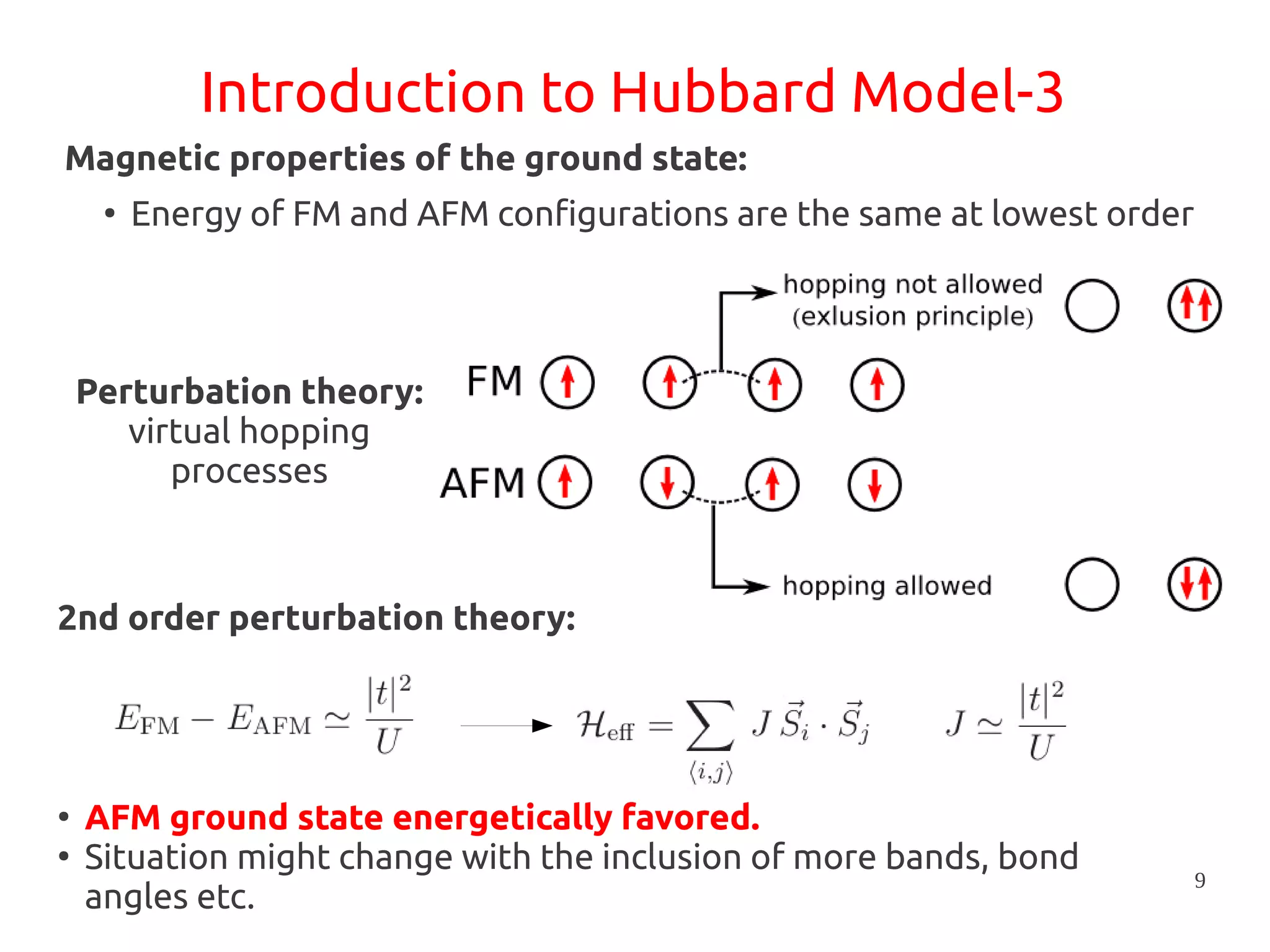
Introduction to Hubbard Model-3
Magnetic properties of the ground state:
2nd order perturbation theory:
Perturbation theory:
virtual hopping
processes
●
AFM ground state energetically favored.
●
Situation might change with the inclusion of more bands, bond
angles etc.
●
Energy of FM and AFM configurations are the same at lowest order
10
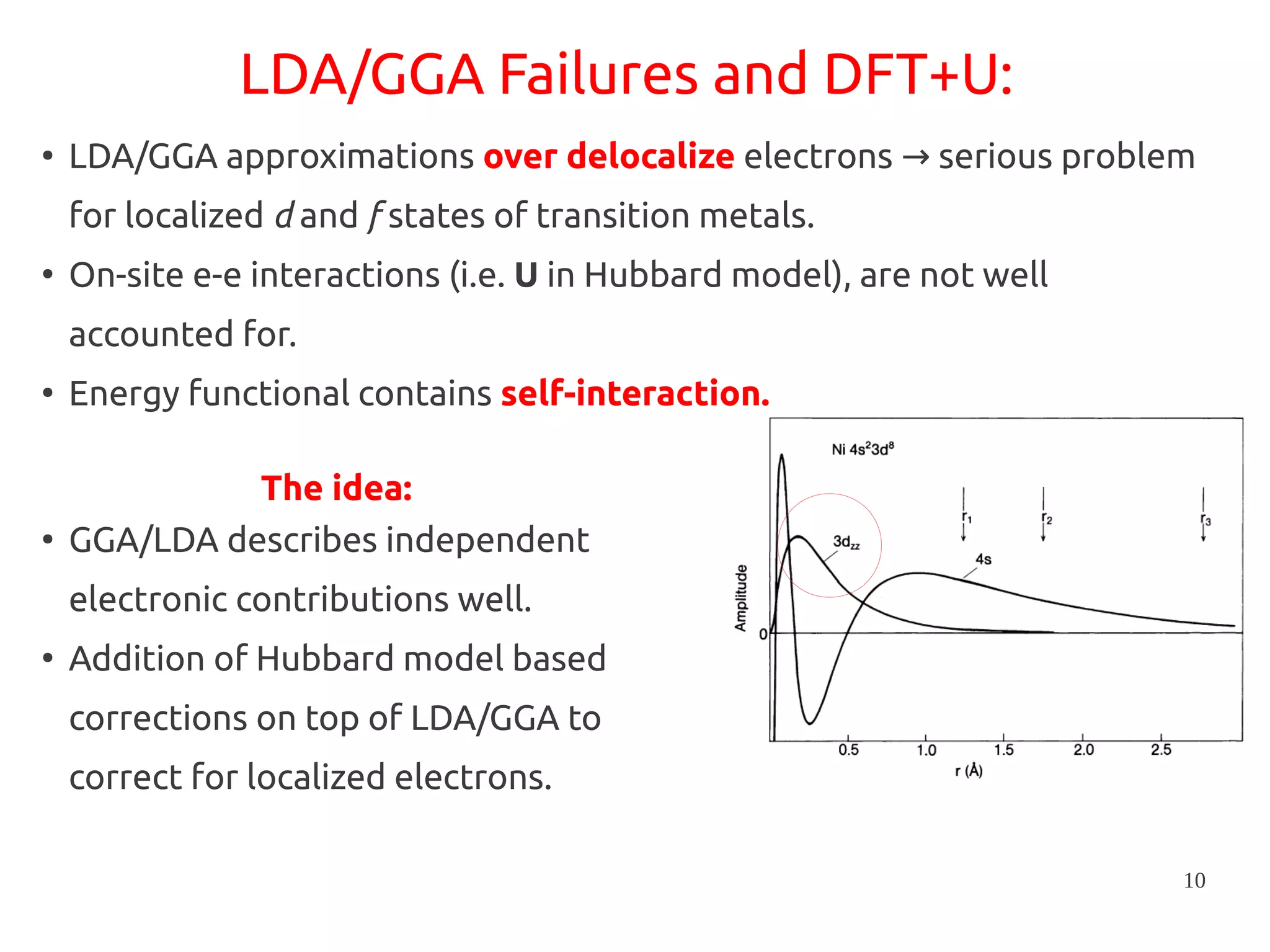
LDA/GGA Failures and DFT+U:
●
LDA/GGA approximations over delocalize electrons serious problem→
for localized d and f states of transition metals.
●
On-site e-e interactions (i.e. U in Hubbard model), are not well
accounted for.
●
Energy functional contains self-interaction.
●
GGA/LDA describes independent
electronic contributions well.
●
Addition of Hubbard model based
corrections on top of LDA/GGA to
correct for localized electrons.
The idea:
11
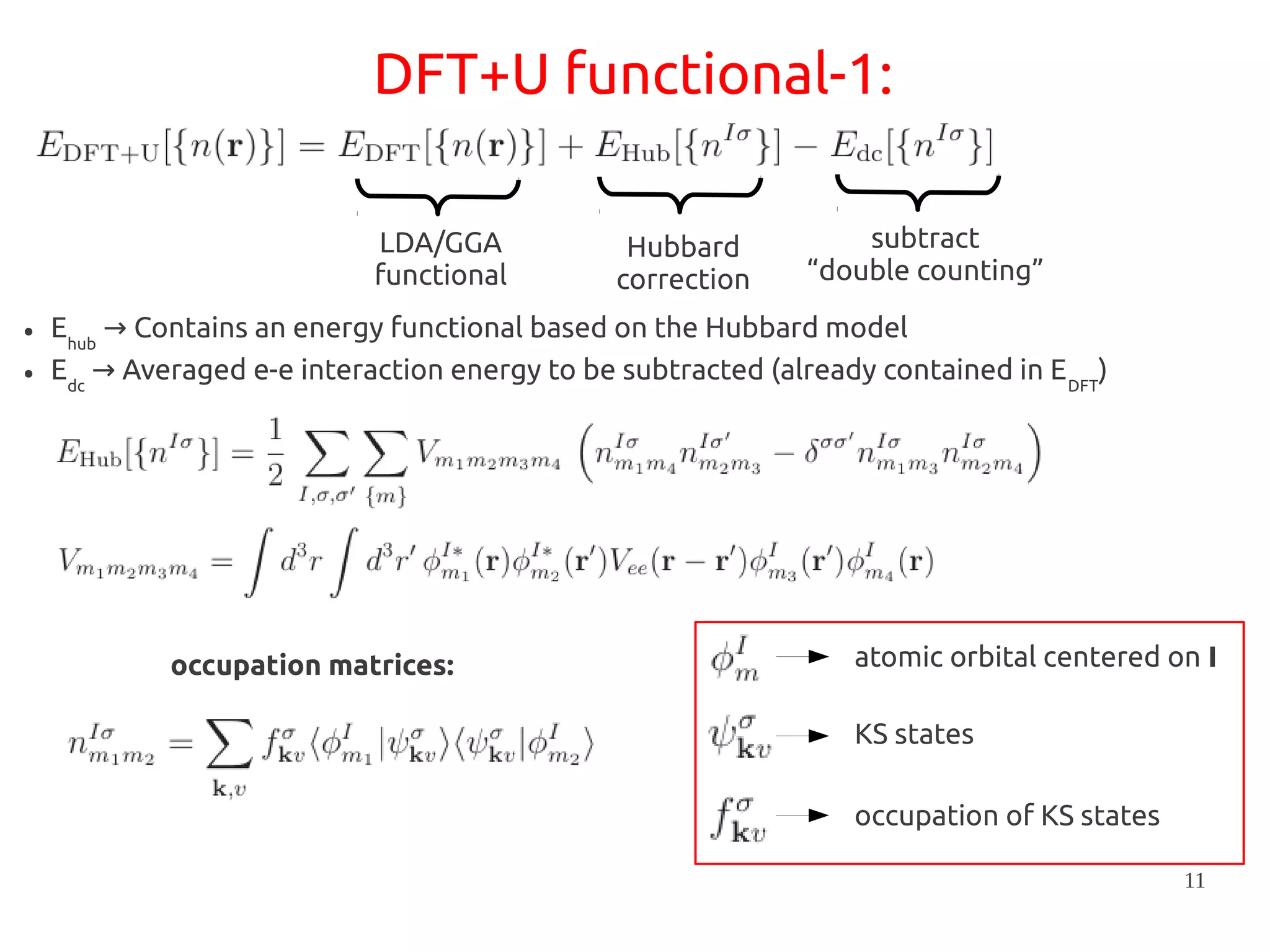
DFT+U functional-1:
LDA/GGA
functional
Hubbard
correction
subtract
“double counting”
● Ehub
Contains an energy functional based on the Hubbard model→
● Edc
Averaged e-e interaction energy to be subtracted (already contained in E→ DFT
)
atomic orbital centered on I
KS states
occupation of KS states
occupation matrices:
12
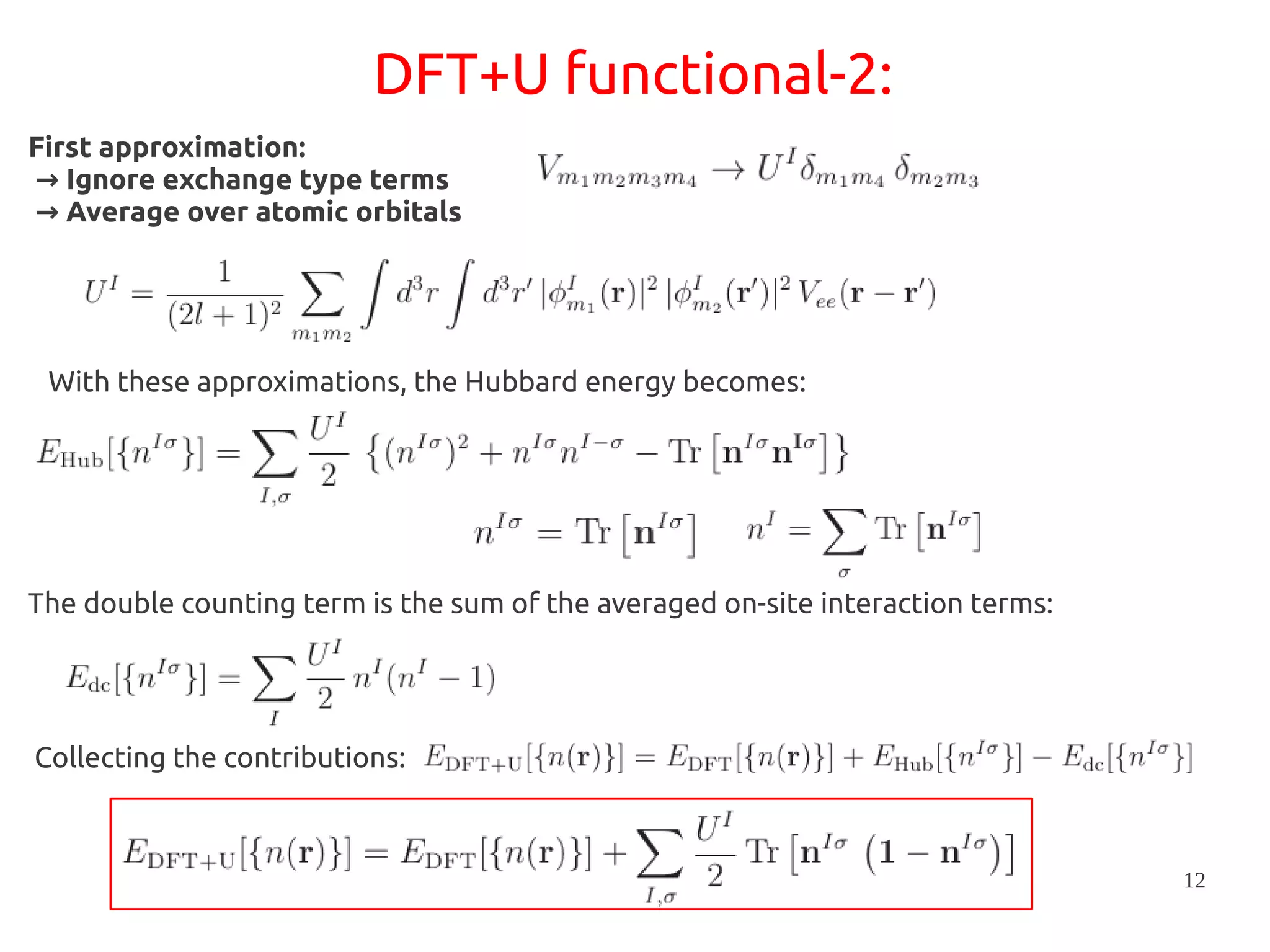
DFT+U functional-2:
First approximation:
→ Ignore exchange type terms
→ Average over atomic orbitals
The double counting term is the sum of the averaged on-site interaction terms:
Collecting the contributions:
With these approximations, the Hubbard energy becomes:
13
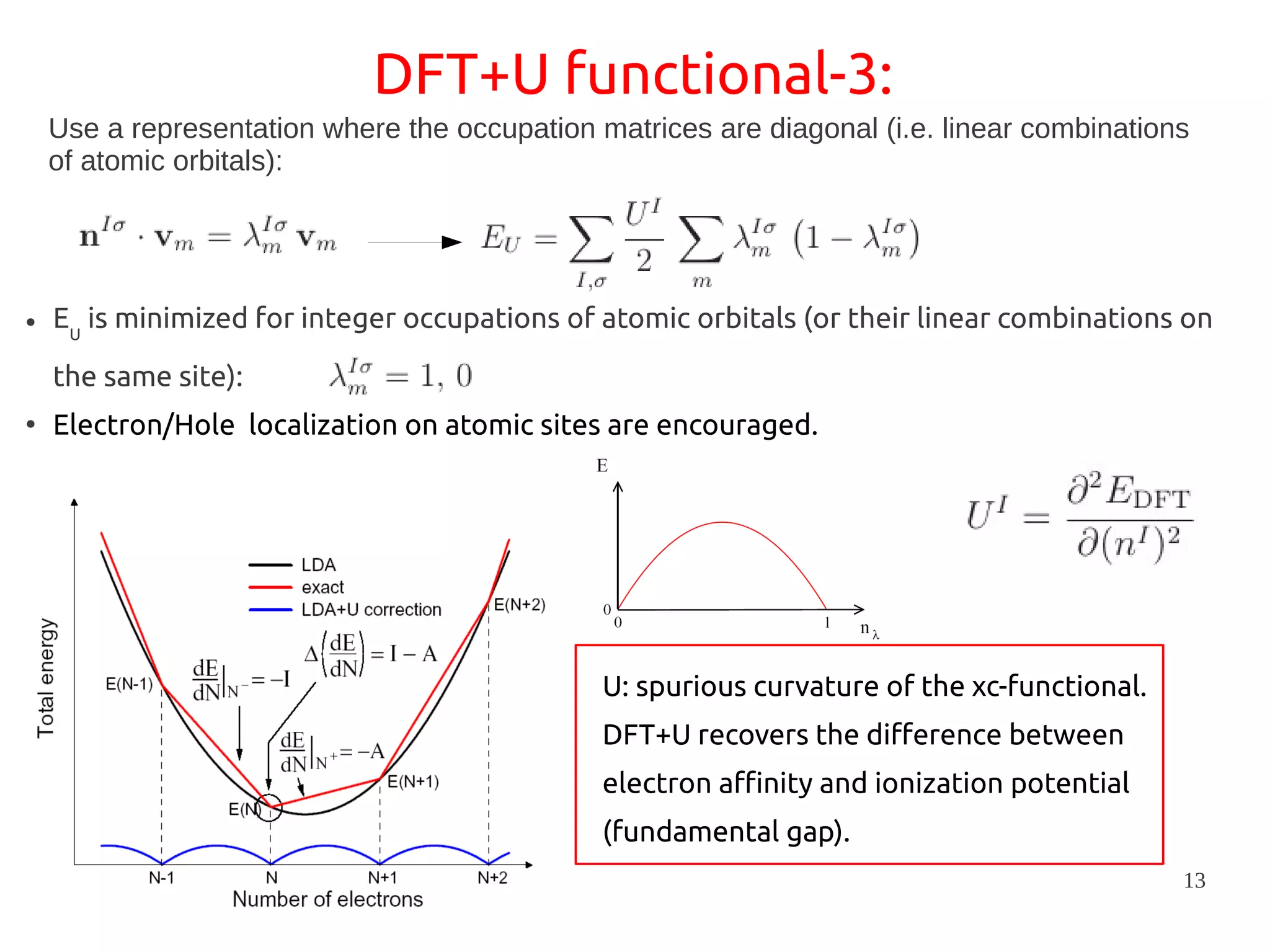
DFT+U functional-3:
Use a representation where the occupation matrices are diagonal (i.e. linear combinations
of atomic orbitals):
● EU
is minimized for integer occupations of atomic orbitals (or their linear combinations on
the same site):
●
Electron/Hole localization on atomic sites are encouraged.
U: spurious curvature of the xc-functional.
DFT+U recovers the difference between
electron affinity and ionization potential
(fundamental gap).
14
DFT+U in action: NiO
15
DFT+U in action: FeO
16
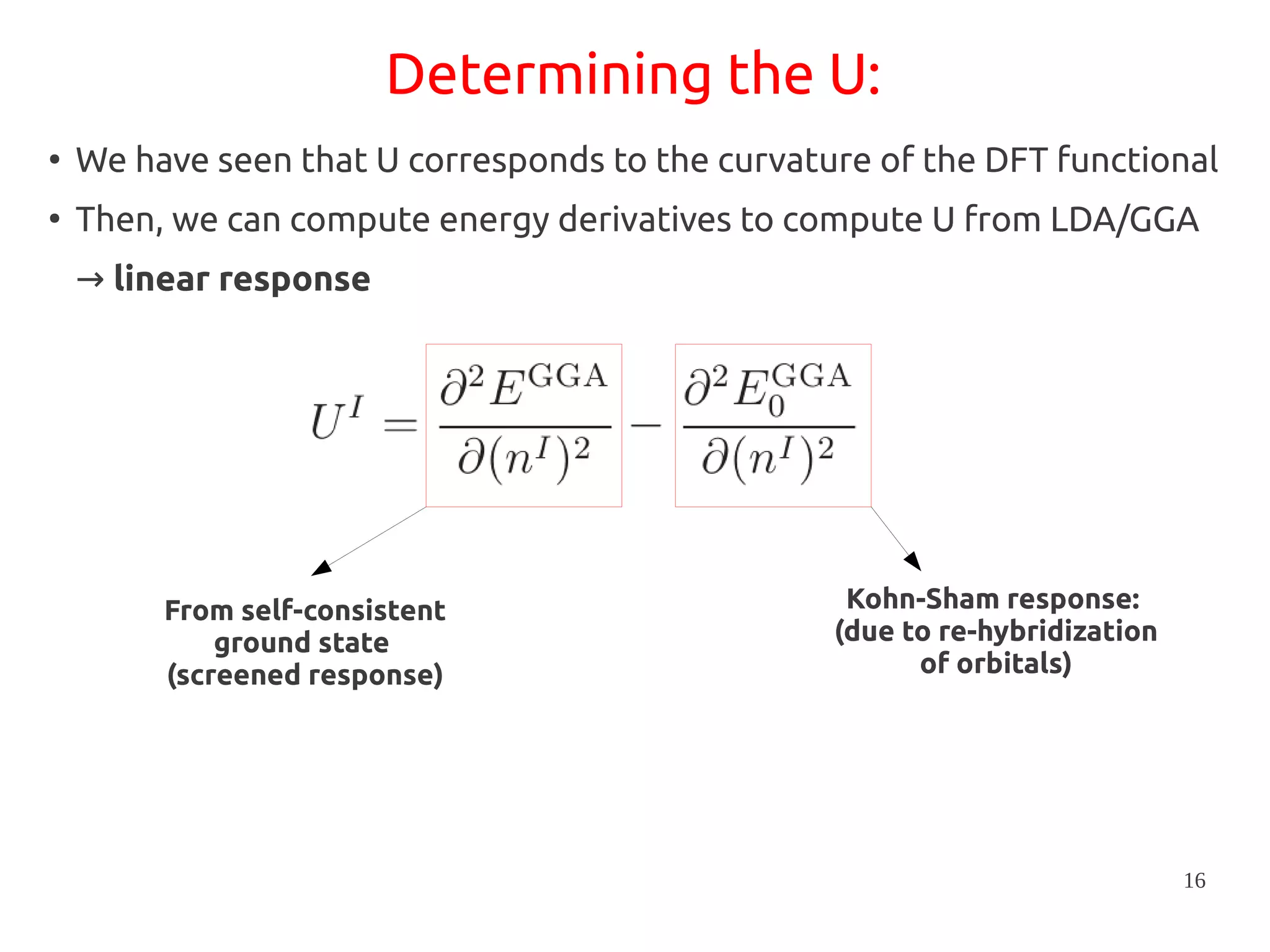
Determining the U:
●
We have seen that U corresponds to the curvature of the DFT functional
●
Then, we can compute energy derivatives to compute U from LDA/GGA
→ linear response
From self-consistent
ground state
(screened response)
Kohn-Sham response:
(due to re-hybridization
of orbitals)
17
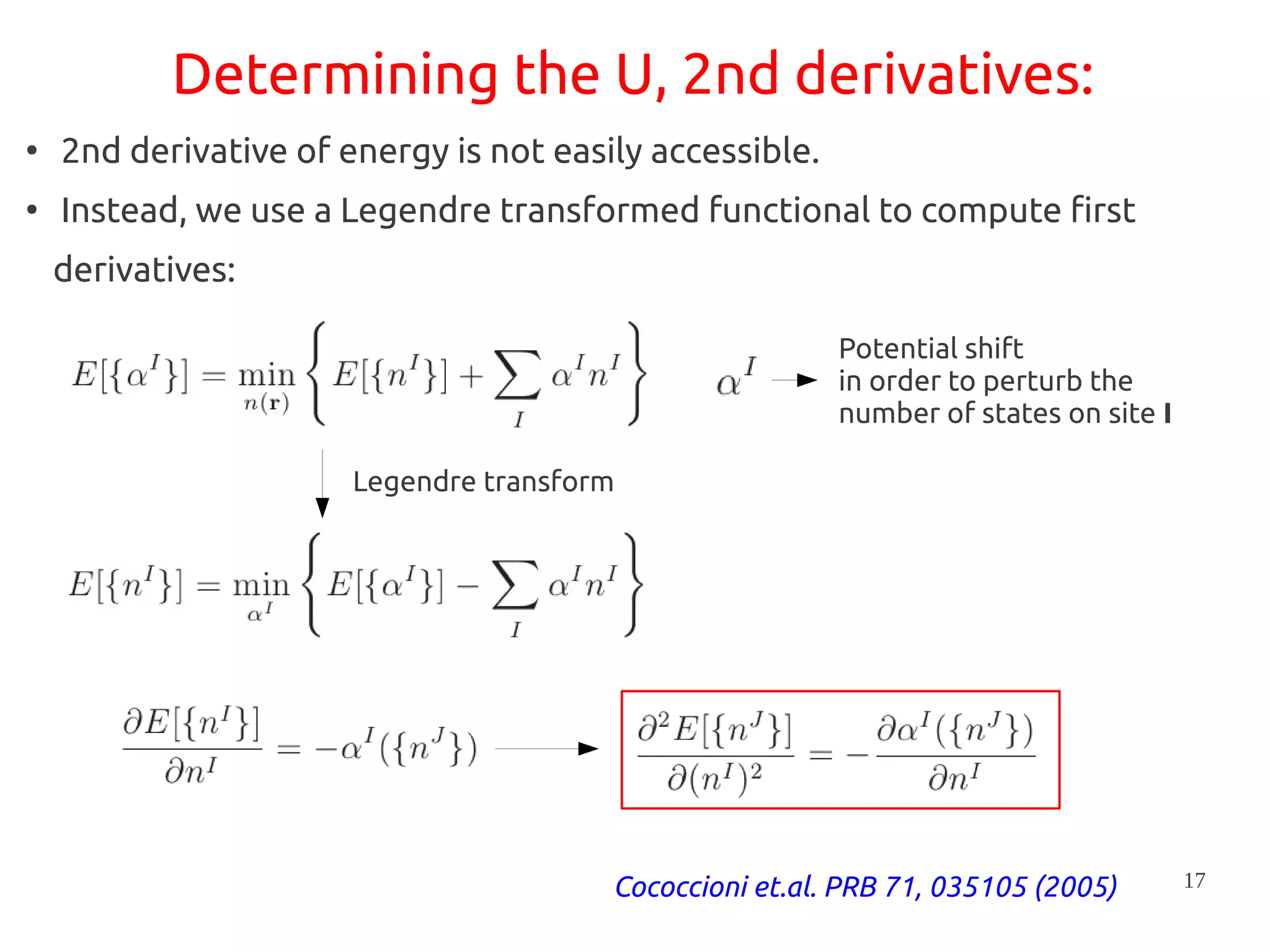
Determining the U, 2nd derivatives:
●
2nd derivative of energy is not easily accessible.
●
Instead, we use a Legendre transformed functional to compute first
derivatives:
Legendre transform
Potential shift
in order to perturb the
number of states on site I
Cococcioni et.al. PRB 71, 035105 (2005)
18
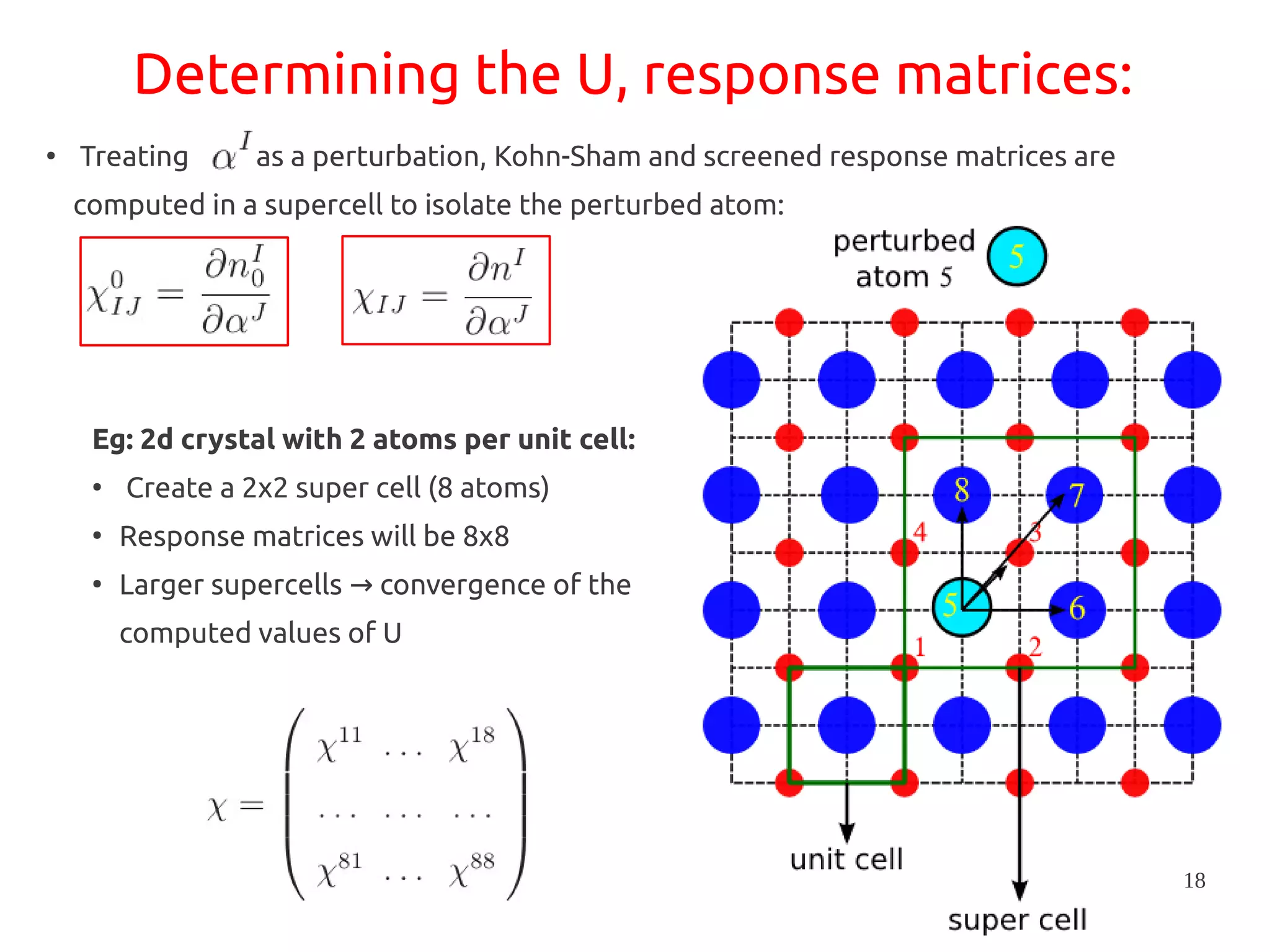
Determining the U, response matrices:
●
Treating as a perturbation, Kohn-Sham and screened response matrices are
computed in a supercell to isolate the perturbed atom:
Eg: 2d crystal with 2 atoms per unit cell:
●
Create a 2x2 super cell (8 atoms)
●
Response matrices will be 8x8
●
Larger supercells convergence of the→
computed values of U
19
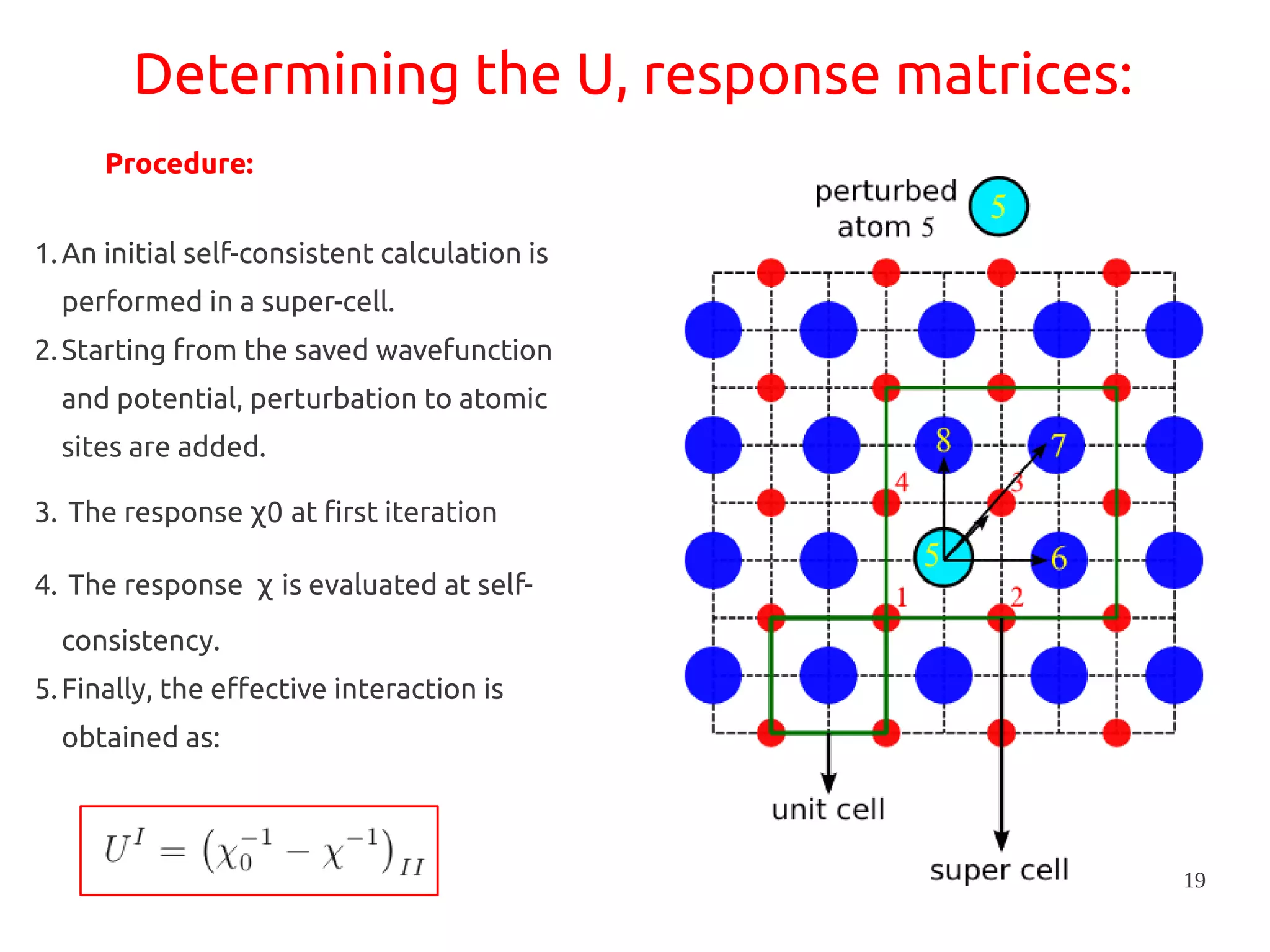
1.An initial self-consistent calculation is
performed in a super-cell.
2.Starting from the saved wavefunction
and potential, perturbation to atomic
sites are added.
3. The response 0χ at first iteration
4. The response χ is evaluated at self-
consistency.
5.Finally, the effective interaction is
obtained as:
Procedure:
Determining the U, response matrices:
20
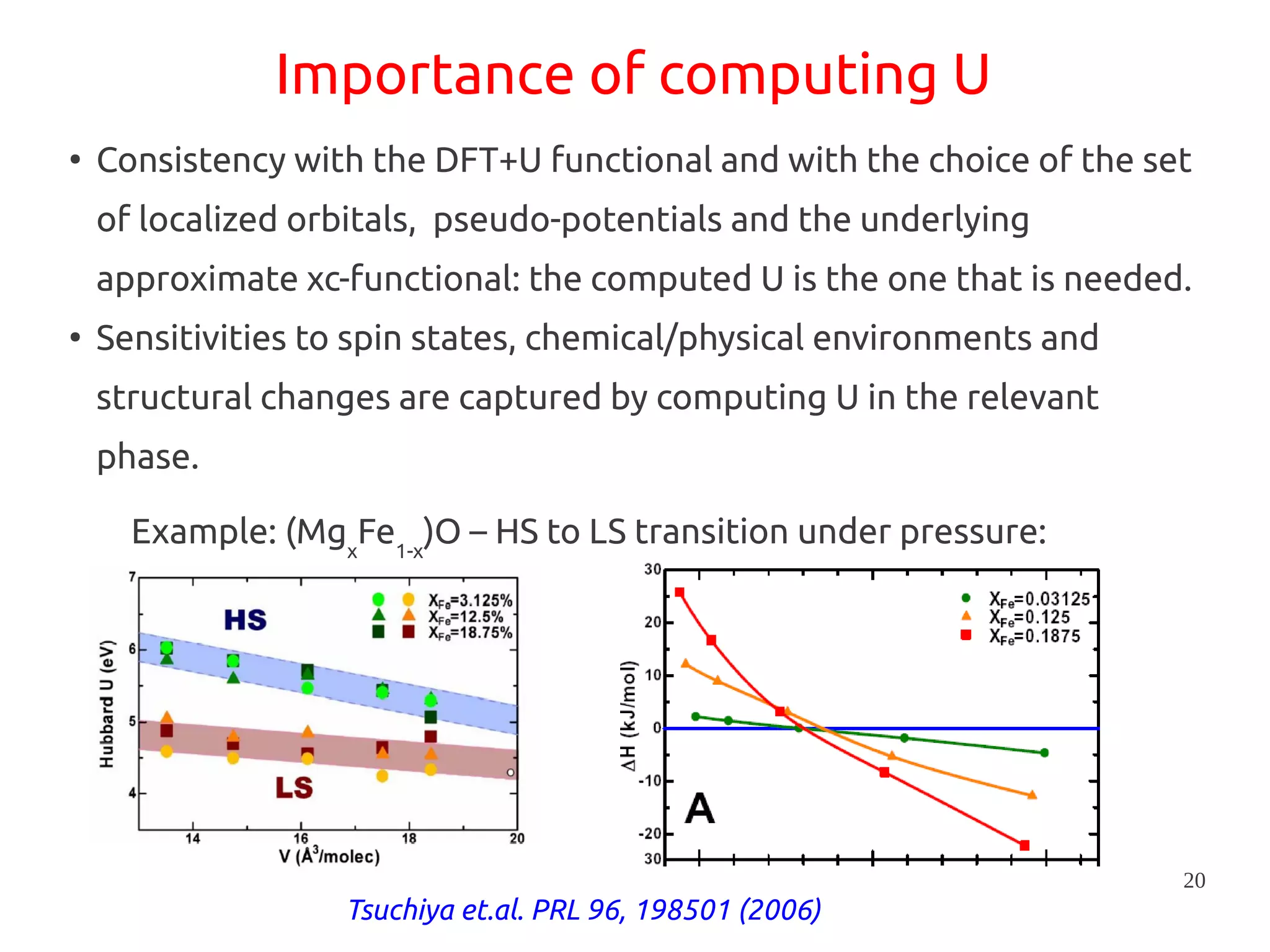
Importance of computing U
●
Consistency with the DFT+U functional and with the choice of the set
of localized orbitals, pseudo-potentials and the underlying
approximate xc-functional: the computed U is the one that is needed.
●
Sensitivities to spin states, chemical/physical environments and
structural changes are captured by computing U in the relevant
phase.
Example: (Mgx
Fe1-x
)O – HS to LS transition under pressure:
Tsuchiya et.al. PRL 96, 198501 (2006)
21
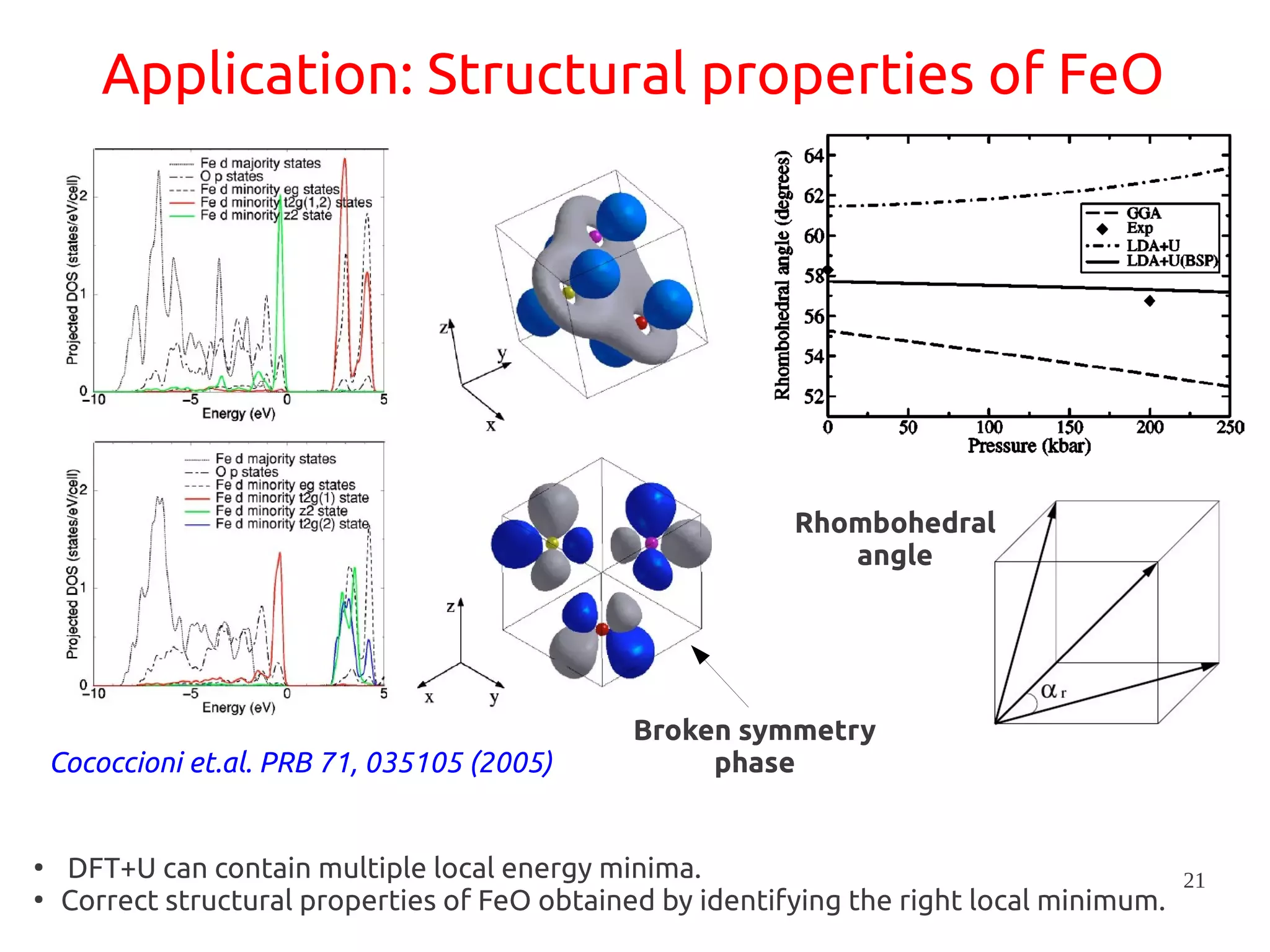
Application: Structural properties of FeO
Broken symmetry
phase
●
DFT+U can contain multiple local energy minima.
●
Correct structural properties of FeO obtained by identifying the right local minimum.
Rhombohedral
angle
Cococcioni et.al. PRB 71, 035105 (2005)
22
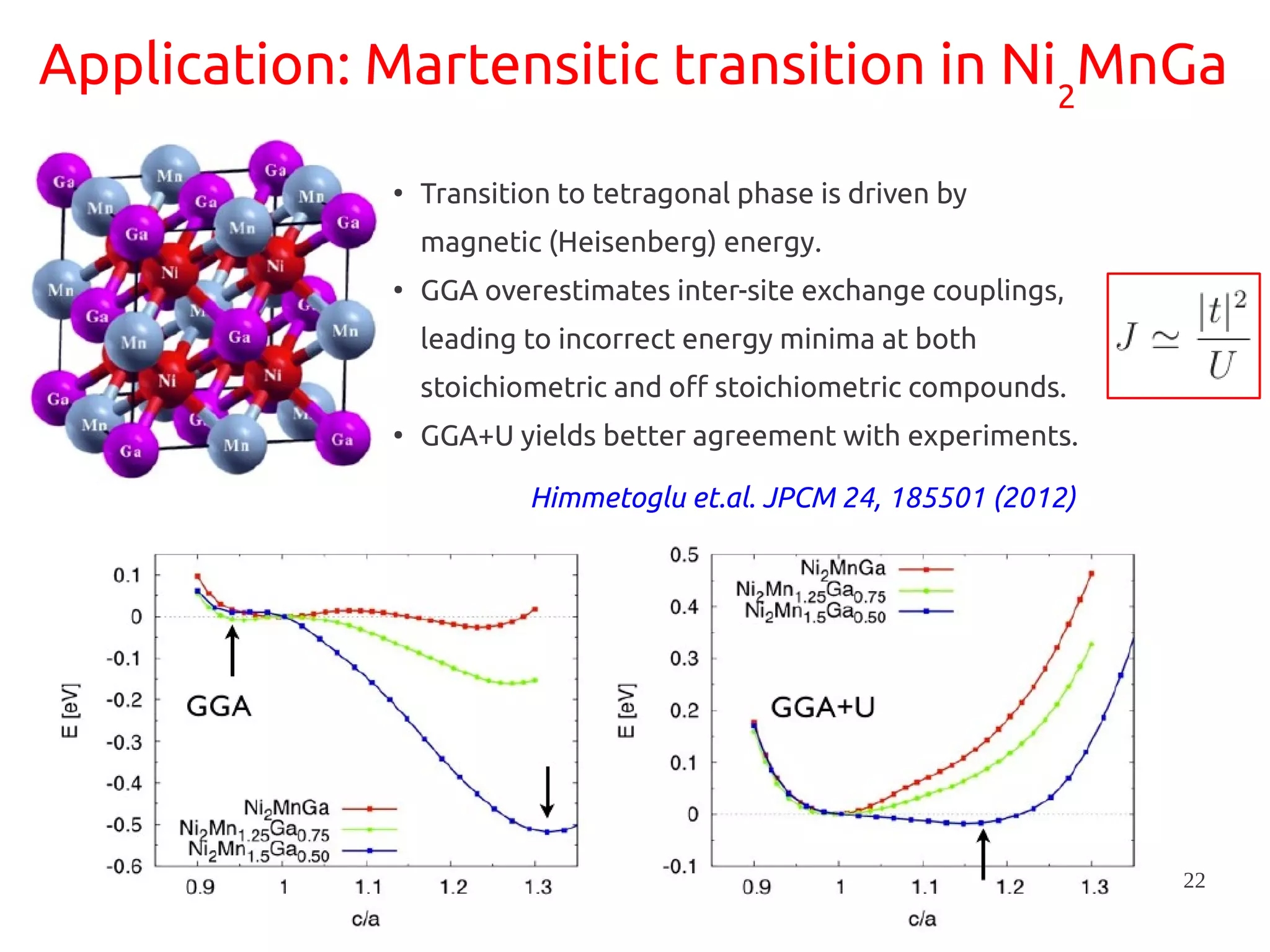
Application: Martensitic transition in Ni2
MnGa
●
Transition to tetragonal phase is driven by
magnetic (Heisenberg) energy.
●
GGA overestimates inter-site exchange couplings,
leading to incorrect energy minima at both
stoichiometric and off stoichiometric compounds.
●
GGA+U yields better agreement with experiments.
Himmetoglu et.al. JPCM 24, 185501 (2012)
23
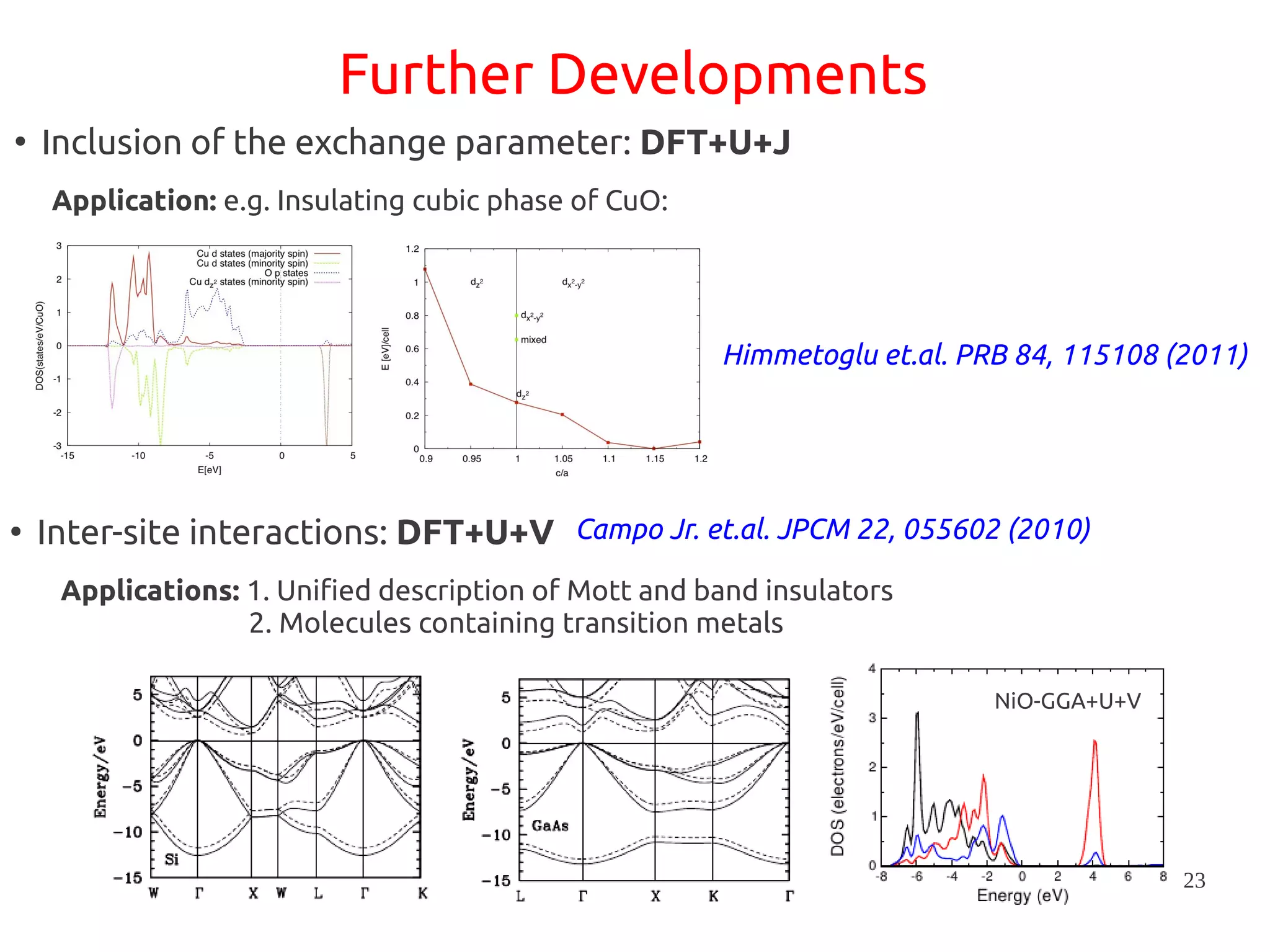
Further Developments
●
Inclusion of the exchange parameter: DFT+U+J
●
Inter-site interactions: DFT+U+V
Himmetoglu et.al. PRB 84, 115108 (2011)
Application: e.g. Insulating cubic phase of CuO:
Campo Jr. et.al. JPCM 22, 055602 (2010)
Applications: 1. Unified description of Mott and band insulators
2. Molecules containing transition metals
NiO-GGA+U+V

Basics of DFT+U

  • 1.
    1 Advanced xc-functionals: DFT+U BurakHimmetoglu ● Well known failures of LDA/GGA: transition metal oxides ● Importance of electronic correlations: Mott transition ● Introduction to Hubbard Model ● DFT+U: Formulation and implementation ● Calculation of U ● Some examples and applications
  • 2.
    2 Failures of LDA/GGA:Transition Metal Oxides TM ion Oxygen ● Anti-ferromagnetic (AFM) ground state rhombohedral symmetry and possible structural distortions. ● Insulating (Mott/Charge transfer type)
  • 3.
    3 Example: GGA resultson NiO ● Anti-ferromagnetic: OK ● Crystal structure cubic: OK ● Crystal field produces the band gap. ● Band gap is too small ● O-p states should be at the top of the valence band. Ni2+
  • 4.
    4 Example: GGA resultson FeO Fe2+ ● Anti-ferromagnetic: NO → FM ● Crystal structure cubic: OK ● Ground state is metallic
  • 5.
    5 Importance of electroniccorrelations Consider solid Na(2s2 2p6 3s1 ): At equilibrium lattice constant a0 : Independent electrons: band theory Half filled band → metal Consider very large a: ● Half-filled 3s orbital becomes narrower, but it is still half-filled. ● Band theory still gives a metal! Isolated Na atoms still metallic; what has gone wrong?
  • 6.
    6 Importance of electroniccorrelations ● Hopping of electrons → kinetic energy gain. ● Doubly occupied atomic site → Coulomb energy cost. ● At small separations K.E. gain favors metallic behavior. ● At large separations, hopping of electrons are not energetically favorable. ● e-e interactions produce an insulating behavior.
  • 7.
    7 Introduction to HubbardModel-1 t hopping matrix element→ U on-site Coulomb repulsion→ Band term is easy to solve; introduce → creation/annihilation operators N: number of atoms J.Hubbard, Proc. Roy. Soc. Lond. (1963-1967)
  • 8.
    8 Introduction to HubbardModel-2 ● Metallic when t >> U ● Insulating when t << UMott transition band-shape dependent constant Mott N.F.: Proc. Roy. Soc. A62, 416 (1949)
  • 9.
    9 Introduction to HubbardModel-3 Magnetic properties of the ground state: 2nd order perturbation theory: Perturbation theory: virtual hopping processes ● AFM ground state energetically favored. ● Situation might change with the inclusion of more bands, bond angles etc. ● Energy of FM and AFM configurations are the same at lowest order
  • 10.
    10 LDA/GGA Failures andDFT+U: ● LDA/GGA approximations over delocalize electrons serious problem→ for localized d and f states of transition metals. ● On-site e-e interactions (i.e. U in Hubbard model), are not well accounted for. ● Energy functional contains self-interaction. ● GGA/LDA describes independent electronic contributions well. ● Addition of Hubbard model based corrections on top of LDA/GGA to correct for localized electrons. The idea:
  • 11.
    11 DFT+U functional-1: LDA/GGA functional Hubbard correction subtract “double counting” ●Ehub Contains an energy functional based on the Hubbard model→ ● Edc Averaged e-e interaction energy to be subtracted (already contained in E→ DFT ) atomic orbital centered on I KS states occupation of KS states occupation matrices:
  • 12.
    12 DFT+U functional-2: First approximation: →Ignore exchange type terms → Average over atomic orbitals The double counting term is the sum of the averaged on-site interaction terms: Collecting the contributions: With these approximations, the Hubbard energy becomes:
  • 13.
    13 DFT+U functional-3: Use arepresentation where the occupation matrices are diagonal (i.e. linear combinations of atomic orbitals): ● EU is minimized for integer occupations of atomic orbitals (or their linear combinations on the same site): ● Electron/Hole localization on atomic sites are encouraged. U: spurious curvature of the xc-functional. DFT+U recovers the difference between electron affinity and ionization potential (fundamental gap).
  • 14.
  • 15.
  • 16.
    16 Determining the U: ● Wehave seen that U corresponds to the curvature of the DFT functional ● Then, we can compute energy derivatives to compute U from LDA/GGA → linear response From self-consistent ground state (screened response) Kohn-Sham response: (due to re-hybridization of orbitals)
  • 17.
    17 Determining the U,2nd derivatives: ● 2nd derivative of energy is not easily accessible. ● Instead, we use a Legendre transformed functional to compute first derivatives: Legendre transform Potential shift in order to perturb the number of states on site I Cococcioni et.al. PRB 71, 035105 (2005)
  • 18.
    18 Determining the U,response matrices: ● Treating as a perturbation, Kohn-Sham and screened response matrices are computed in a supercell to isolate the perturbed atom: Eg: 2d crystal with 2 atoms per unit cell: ● Create a 2x2 super cell (8 atoms) ● Response matrices will be 8x8 ● Larger supercells convergence of the→ computed values of U
  • 19.
    19 1.An initial self-consistentcalculation is performed in a super-cell. 2.Starting from the saved wavefunction and potential, perturbation to atomic sites are added. 3. The response 0χ at first iteration 4. The response χ is evaluated at self- consistency. 5.Finally, the effective interaction is obtained as: Procedure: Determining the U, response matrices:
  • 20.
    20 Importance of computingU ● Consistency with the DFT+U functional and with the choice of the set of localized orbitals, pseudo-potentials and the underlying approximate xc-functional: the computed U is the one that is needed. ● Sensitivities to spin states, chemical/physical environments and structural changes are captured by computing U in the relevant phase. Example: (Mgx Fe1-x )O – HS to LS transition under pressure: Tsuchiya et.al. PRL 96, 198501 (2006)
  • 21.
    21 Application: Structural propertiesof FeO Broken symmetry phase ● DFT+U can contain multiple local energy minima. ● Correct structural properties of FeO obtained by identifying the right local minimum. Rhombohedral angle Cococcioni et.al. PRB 71, 035105 (2005)
  • 22.
    22 Application: Martensitic transitionin Ni2 MnGa ● Transition to tetragonal phase is driven by magnetic (Heisenberg) energy. ● GGA overestimates inter-site exchange couplings, leading to incorrect energy minima at both stoichiometric and off stoichiometric compounds. ● GGA+U yields better agreement with experiments. Himmetoglu et.al. JPCM 24, 185501 (2012)
  • 23.
    23 Further Developments ● Inclusion ofthe exchange parameter: DFT+U+J ● Inter-site interactions: DFT+U+V Himmetoglu et.al. PRB 84, 115108 (2011) Application: e.g. Insulating cubic phase of CuO: Campo Jr. et.al. JPCM 22, 055602 (2010) Applications: 1. Unified description of Mott and band insulators 2. Molecules containing transition metals NiO-GGA+U+V