Near Infrared to Visible Electroluminescent
Diodes Based on Organometallic Halide
Perovskites: Structural and Optical
Investigation
• Submitted by: Preeti Choudhary
• Roll No.= 17/MAP/016
• MSC(applied physics)
content
• overview of perovskites
• classification of Perovskites
• Production of Perovskites
• Perovskites bandgap
•Characterization: XRD, UV-VIS
spectroscopy
• material properties
Electroluminescence(EL)
Electroluminescent(El) panel is a flat light bulb sandwich
consisting of layers of conductive and non-conductive plastic
and a layer of phosphor.
The phosphor is laminated between two conductive layers. As
a voltage is applied between the two conductive layers, or
electrodes, the electrical current passes through the panel
allows the phosphor crytals rapidly charged and emitted light
energy which illuminates the printed overlay.
Origin And History of Perovskite
compounds
• Perovskite is calcium titanium oxide or calcium
titanate, with the chemical formula CaTiO3.
• Very stable structure, large number of compounds,
variety of properties, many practical applications.
• Key role of the BO6 octahedra in ferromagnetism and
ferroelectricity.
• Extensive formation of solid solutions
• material optimization by composition control and
phase transition engineering.
Perovskite
Orthorhombic perovskite ABO3
Classification of Perovskite System
Production of Perovskite cell
The Perovskite Bandgap can be tuned
by Chemical Substitution
• The band gap can be tuned from 1.57 eV to 2.23 eV
by substituting bromine for iodine in CH3NH3Pb(Brx
I1-x )3
Perovskite
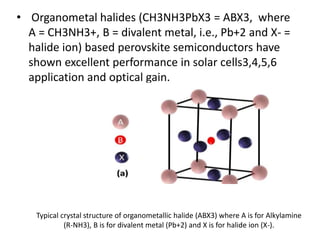
Typical crystal structure of organometallic halide (ABX3) where A is for Alkylamine
(R-NH3), B is for divalent metal (Pb+2) and X is for halide ion (X-).
• Organometal halides (CH3NH3PbX3 = ABX3, where
A = CH3NH3+, B = divalent metal, i.e., Pb+2 and X- =
halide ion) based perovskite semiconductors have
shown excellent performance in solar cells3,4,5,6
application and optical gain.
XRD
• Solid materials are formed by atoms or atomic group
arranged in certain way. When an x-ray beam is injected
into the material . it would be scattered by atoms.
• If two or more x-ray beams scattered by the atoms that
have some phase differences are superimposed onto
each other, diffraction is occurred. The x-ray diffraction
instrument is used to collect the intensities of the
scattered signals to get the diffraction pattern of the
measured sample.
• This pattern is normally as the signal intensity versus
the phase angle. An advantage for using X- ray
diffraction measurement is that it can analyse the
material without causing damage on the material.
XRD
• The crystallite size of Titanium dioxide nanoparticles
evaluated using the Debye-Scherer formula.
• D=kλ/βcosθ
• Where k is the constant (0.9), λ is the x-ray wave length of
X-ray , β is the full width half maximum (FWHM) of the
peak and Ѳ is the reflection angle.
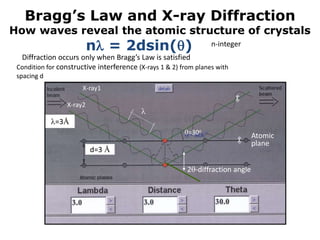
Bragg’s Law and X-ray Diffraction
How waves reveal the atomic structure of crystals
nl = 2dsin()
Atomic
plane
d=3 Å
l=3Å
=30o
n-integer
X-ray1
X-ray2
l
2-diffraction angle
Diffraction occurs only when Bragg’s Law is satisfied
Condition for constructive interference (X-rays 1 & 2) from planes with
spacing d
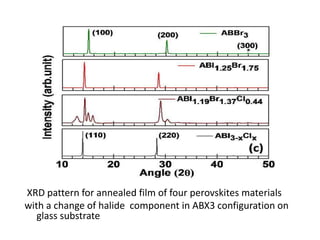
XRD pattern for annealed film of four perovskites materials
with a change of halide component in ABX3 configuration on
glass substrate.
Electronic Spectroscopy
• This is the earliest method of molecular
spectroscopy.
• A phenomenon of interaction of molecules with
ultraviolet and visible lights.
• Absorption of photon results in electronic
transition of a molecule, and electrons are
promoted from ground state to higher electronic
states.
Lambert-Beer’s Law
A=ebc
e: the molar absorptivity (L mol-1 cm-1)
b: the path length of the sample
c :the concentration of the compound in
solution, expressed in mol L-1
The Lambert -Beer law states that when a
monochromatic beam of light passes through a
dilute solution, then the light absorbed is directly
proportional to the concentration of the substance
and the path length of the light through the
solution
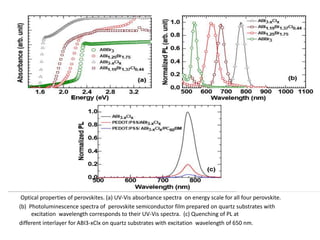
Optical properties of perovskites. (a) UV-Vis absorbance spectra on energy scale for all four perovskite.
(b) Photoluminescence spectra of perovskite semiconductor film prepared on quartz substrates with
excitation wavelength corresponds to their UV-Vis spectra. (c) Quenching of PL at
different interlayer for ABI3-xClx on quartz substrates with excitation wavelength of 650 nm.
Material Properties
Good for photovoltaics but with caution.
• cheap manufacturing:
lower manufacturing costs expected: directly deposited from solution.
Caution: Encapsulation needed,which may increase.
• Material Properties for high efficiency photovoltaics:
1. High optical absorption coefficient
2. Excellent charge carrier transport(crystallinity,diffusion,length,carrier mobility)
3. Promising device parameter: high Voc of >1.1v is reported
• Stability:
study shows it can maintain more than 80% of initial efficiency
after 500 hours.
cation:
toxicity from pd
scaling problem
Importance of Perovskite Material
• Advantage
direct optical band gap of around 1.5ev.
long diffusion length
long minority carrier lifetimes
Broad absorption range from visible to near-
infrared spectrum(800nm)
• Disadvantage
Degradation of methyl ammonium lead iodide
perovskite
Thank you

Perovskite

  • 1.
    Near Infrared toVisible Electroluminescent Diodes Based on Organometallic Halide Perovskites: Structural and Optical Investigation • Submitted by: Preeti Choudhary • Roll No.= 17/MAP/016 • MSC(applied physics)
  • 2.
    content • overview ofperovskites • classification of Perovskites • Production of Perovskites • Perovskites bandgap •Characterization: XRD, UV-VIS spectroscopy • material properties
  • 3.
    Electroluminescence(EL) Electroluminescent(El) panel isa flat light bulb sandwich consisting of layers of conductive and non-conductive plastic and a layer of phosphor. The phosphor is laminated between two conductive layers. As a voltage is applied between the two conductive layers, or electrodes, the electrical current passes through the panel allows the phosphor crytals rapidly charged and emitted light energy which illuminates the printed overlay.
  • 4.
    Origin And Historyof Perovskite compounds • Perovskite is calcium titanium oxide or calcium titanate, with the chemical formula CaTiO3. • Very stable structure, large number of compounds, variety of properties, many practical applications. • Key role of the BO6 octahedra in ferromagnetism and ferroelectricity. • Extensive formation of solid solutions • material optimization by composition control and phase transition engineering.
  • 5.
  • 6.
  • 7.
  • 8.
    The Perovskite Bandgapcan be tuned by Chemical Substitution • The band gap can be tuned from 1.57 eV to 2.23 eV by substituting bromine for iodine in CH3NH3Pb(Brx I1-x )3
  • 9.
  • 10.
    Typical crystal structureof organometallic halide (ABX3) where A is for Alkylamine (R-NH3), B is for divalent metal (Pb+2) and X is for halide ion (X-). • Organometal halides (CH3NH3PbX3 = ABX3, where A = CH3NH3+, B = divalent metal, i.e., Pb+2 and X- = halide ion) based perovskite semiconductors have shown excellent performance in solar cells3,4,5,6 application and optical gain.
  • 11.
    XRD • Solid materialsare formed by atoms or atomic group arranged in certain way. When an x-ray beam is injected into the material . it would be scattered by atoms. • If two or more x-ray beams scattered by the atoms that have some phase differences are superimposed onto each other, diffraction is occurred. The x-ray diffraction instrument is used to collect the intensities of the scattered signals to get the diffraction pattern of the measured sample. • This pattern is normally as the signal intensity versus the phase angle. An advantage for using X- ray diffraction measurement is that it can analyse the material without causing damage on the material.
  • 12.
    XRD • The crystallitesize of Titanium dioxide nanoparticles evaluated using the Debye-Scherer formula. • D=kλ/βcosθ • Where k is the constant (0.9), λ is the x-ray wave length of X-ray , β is the full width half maximum (FWHM) of the peak and Ѳ is the reflection angle.
  • 13.
    Bragg’s Law andX-ray Diffraction How waves reveal the atomic structure of crystals nl = 2dsin() Atomic plane d=3 Å l=3Å =30o n-integer X-ray1 X-ray2 l 2-diffraction angle Diffraction occurs only when Bragg’s Law is satisfied Condition for constructive interference (X-rays 1 & 2) from planes with spacing d
  • 14.
    XRD pattern forannealed film of four perovskites materials with a change of halide component in ABX3 configuration on glass substrate.
  • 15.
    Electronic Spectroscopy • Thisis the earliest method of molecular spectroscopy. • A phenomenon of interaction of molecules with ultraviolet and visible lights. • Absorption of photon results in electronic transition of a molecule, and electrons are promoted from ground state to higher electronic states.
  • 16.
    Lambert-Beer’s Law A=ebc e: themolar absorptivity (L mol-1 cm-1) b: the path length of the sample c :the concentration of the compound in solution, expressed in mol L-1 The Lambert -Beer law states that when a monochromatic beam of light passes through a dilute solution, then the light absorbed is directly proportional to the concentration of the substance and the path length of the light through the solution
  • 17.
    Optical properties ofperovskites. (a) UV-Vis absorbance spectra on energy scale for all four perovskite. (b) Photoluminescence spectra of perovskite semiconductor film prepared on quartz substrates with excitation wavelength corresponds to their UV-Vis spectra. (c) Quenching of PL at different interlayer for ABI3-xClx on quartz substrates with excitation wavelength of 650 nm.
  • 18.
    Material Properties Good forphotovoltaics but with caution. • cheap manufacturing: lower manufacturing costs expected: directly deposited from solution. Caution: Encapsulation needed,which may increase. • Material Properties for high efficiency photovoltaics: 1. High optical absorption coefficient 2. Excellent charge carrier transport(crystallinity,diffusion,length,carrier mobility) 3. Promising device parameter: high Voc of >1.1v is reported • Stability: study shows it can maintain more than 80% of initial efficiency after 500 hours. cation: toxicity from pd scaling problem
  • 19.
    Importance of PerovskiteMaterial • Advantage direct optical band gap of around 1.5ev. long diffusion length long minority carrier lifetimes Broad absorption range from visible to near- infrared spectrum(800nm) • Disadvantage Degradation of methyl ammonium lead iodide perovskite
  • 20.