All lectures online at: http://qc.chem.nagoya-u.ac.jp/presentations.html
2
Density-Functional Tight-Binding (DFTB) as fast
approximate DFT method
Helmut Eschrig Gotthard Seifert Thomas Frauenheim Marcus Elstner
Lecture II:
Introduction to the Density-Functional Tight-Binding (DFTB) Method
3
Density-Functional Tight-Binding
1. Tight-Binding
2. Density-Functional Tight-Binding (DFTB)
3. Bond Breaking in DFTB
4. Extensions
5. Performance and Applications
4
Density-Functional Tight-Binding
1. Tight-Binding
55
Lecture II 1. Tight-Binding
Resources
1. http://www.dftb.org
2. DFTB Porezag, D., T. Frauenheim, T. Köhler, G. Seifert, and R. Kaschner, Construction
of tight-binding-like potentials on the basis of density-functional theory: application to
carbon. Phys. Rev. B, 1995. 51: p. 12947-12957.
3. DFTB Seifert, G., D. Porezag, and T. Frauenheim, Calculations of
molecules, clusters, and solids with a simplified LCAO-DFT-LDA scheme. Int. J.
Quantum Chem., 1996. 58: p. 185-192.
4. SCC-DFTB Elstner, M., D. Porezag, G. Jungnickel, J. Elsner, M. Haugk, T.
Frauenheim, S. Suhai, and G. Seifert, Self-consistent-charge density-functional tight-
binding method for simulations of complex materials properties. Phys. Rev. B, 1998.
58: p. 7260-7268.
5. SCC-DFTB-D Elstner, M., P. Hobza, T. Frauenheim, S. Suhai, and E.
Kaxiras, Hydrogen bonding and stacking interactions of nucleic acid base pairs: A
density-functional-theory based treatment. J. Chem. Phys,, 2001. 114: p. 5149-5155.
6. SDFTB Kohler, C., G. Seifert, U. Gerstmann, M. Elstner, H. Overhof, and T.
Frauenheim, Approximate density-functional calculations of spin densities in large
molecular systems and complex solids. Phys. Chem. Chem. Phys., 2001. 3: p. 5109-
5114.
7. DFTB3 Gaus, M.; Cui, C.; Elstner, M. DFTB3: Extension of the Self-Consistent-Charge
Density-Functional Tight-Binding Method (SCC-DFTB). J. Chem. Theory
Comput., 2011. 7: p. 931-948.
6
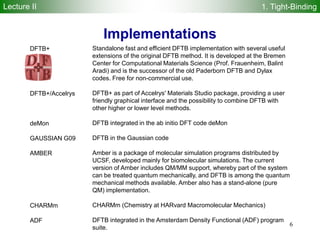
Standalone fast and efficient DFTB implementation with several useful
extensions of the original DFTB method. It is developed at the Bremen
Center for Computational Materials Science (Prof. Frauenheim, Balint
Aradi) and is the successor of the old Paderborn DFTB and Dylax
codes. Free for non-commercial use.
DFTB+ as part of Accelrys' Materials Studio package, providing a user
friendly graphical interface and the possibility to combine DFTB with
other higher or lower level methods.
DFTB integrated in the ab initio DFT code deMon
DFTB in the Gaussian code
Amber is a package of molecular simulation programs distributed by
UCSF, developed mainly for biomolecular simulations. The current
version of Amber includes QM/MM support, whereby part of the system
can be treated quantum mechanically, and DFTB is among the quantum
mechanical methods available. Amber also has a stand-alone (pure
QM) implementation.
CHARMm (Chemistry at HARvard Macromolecular Mechanics)
DFTB integrated in the Amsterdam Density Functional (ADF) program
suite.
DFTB+
DFTB+/Accelrys
deMon
GAUSSIAN G09
AMBER
CHARMm
ADF
Implementations
Lecture II 1. Tight-Binding
7
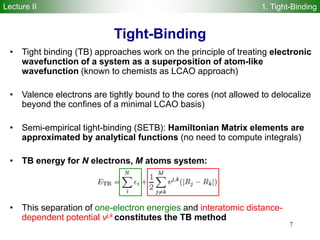
• Tight binding (TB) approaches work on the principle of treating electronic
wavefunction of a system as a superposition of atom-like
wavefunction (known to chemists as LCAO approach)
• Valence electrons are tightly bound to the cores (not allowed to delocalize
beyond the confines of a minimal LCAO basis)
• Semi-empirical tight-binding (SETB): Hamiltonian Matrix elements are
approximated by analytical functions (no need to compute integrals)
• TB energy for N electrons, M atoms system:
• This separation of one-electron energies and interatomic distance-
dependent potential vj,k constitutes the TB method
Tight-Binding
Lecture II 1. Tight-Binding
8
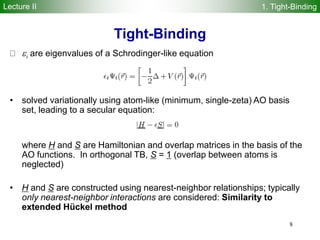
are eigenvalues of a Schrodinger-like equation
• solved variationally using atom-like (minimum, single-zeta) AO basis
set, leading to a secular equation:
where H and S are Hamiltonian and overlap matrices in the basis of the
AO functions. In orthogonal TB, S = 1 (overlap between atoms is
neglected)
• H and S are constructed using nearest-neighbor relationships; typically
only nearest-neighbor interactions are considered: Similarity to
extended Hückel method
Tight-Binding
Lecture II 1. Tight-Binding
9
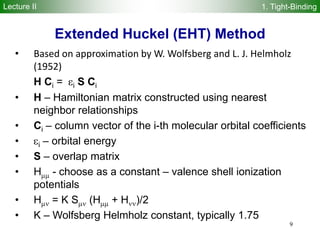
• Based on approximation by W. Wolfsberg and L. J. Helmholz
(1952)
H Ci = i S Ci
• H – Hamiltonian matrix constructed using nearest
neighbor relationships
• Ci – column vector of the i-th molecular orbital coefficients
• i – orbital energy
• S – overlap matrix
• H - choose as a constant – valence shell ionization
potentials
• H = K S (H + H )/2
• K – Wolfsberg Helmholz constant, typically 1.75
Extended Huckel (EHT) Method
Lecture II 1. Tight-Binding
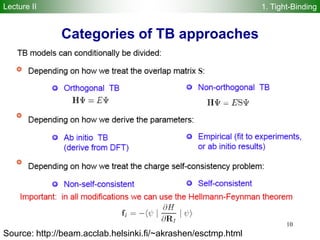
Categories of TB approaches
10
Source: http://beam.acclab.helsinki.fi/~akrashen/esctmp.html
Lecture II 1. Tight-Binding
Slater-Koster (SK) Approximation (I)
11
Source: http://beam.acclab.helsinki.fi/~akrashen/esctmp.html
Lecture II 1. Tight-Binding
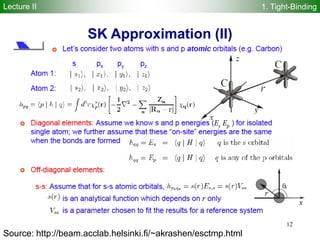
SK Approximation (II)
12
Source: http://beam.acclab.helsinki.fi/~akrashen/esctmp.html
Lecture II 1. Tight-Binding
SK Approximation (III)
13
Source: http://beam.acclab.helsinki.fi/~akrashen/esctmp.html
Lecture II 1. Tight-Binding
SK Approximation (IV)
14
Source: http://beam.acclab.helsinki.fi/~akrashen/esctmp.html
Lecture II 1. Tight-Binding
15
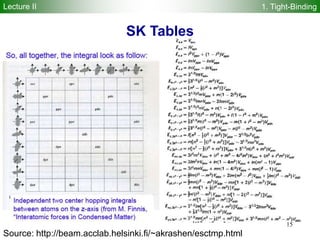
SK Tables
Source: http://beam.acclab.helsinki.fi/~akrashen/esctmp.html
Lecture II 1. Tight-Binding
16
Density-Functional Tight-Binding
2. Density-Functional Tight-Binding (DFTB)
17
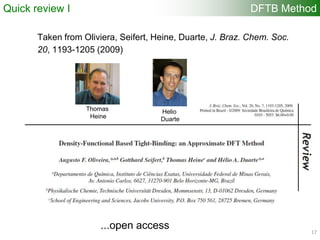
DFTB MethodQuick review I
Taken from Oliviera, Seifert, Heine, Duarte, J. Braz. Chem. Soc.
20, 1193-1205 (2009)
...open access
Thomas
Heine
Helio
Duarte
18
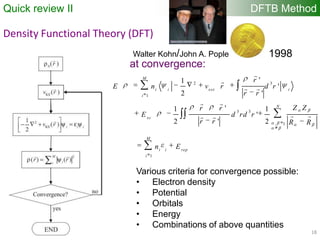
DFTB MethodQuick review II
Density Functional Theory (DFT)
2 3
1
3 3
, 1
1
'1
'
2 '
'1 1
'
2 ' 2
M
i i ext i
i
N
xc
M
i i rep
i
r
E n v r d r
r r
Z Zr r
E d rd r
r r R R
n E


 
 
  
at convergence:
Various criteria for convergence possible:
• Electron density
• Potential
• Orbitals
• Energy
• Combinations of above quantities
Walter Kohn/John A. Pople 1998
19
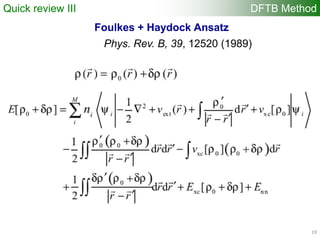
DFTB MethodQuick review III
Phys. Rev. B, 39, 12520 (1989)
Foulkes + Haydock Ansatz
20
Self-consistent-charge density-functional
tight-binding (SCC-DFTB)
M. Elstner et al., Phys. Rev. B 58 7260 (1998)
E r[ ] = ni fi
ˆH r0[ ] fi
i
valence
orbitals
å
1
  
+ ni fi
ˆH r0[ ] fi
i
core
orbitals
å
2
  
+ Exc r0[ ]
3

-
1
2
r0VH r0[ ]
R3
ò
4
  
-
- r0Vxc r0[ ]
R3
ò
5
  
+ Enucl
6
+
1
2
r1VH r1[ ]
R3
ò
7
  
+
1
2
d2
Exc
dr1
2
r0
r1
2
R3
òò
8
  
+ o 2( )
Approximate density functional theory (DFT) method!
Second order-expansion of DFT energy in terms of reference density 0 and
charge fluctuation 1 ( 0 + 1) yields:
Density-functional tight-binding (DFTB) method is derived from terms 1-6
Self-consistent-charge density-functional tight-binding (SCC-DFTB)
method is derived from terms 1-8
o(3)
Lecture II DFTB
21
DFTB and SCC-DFTB methods
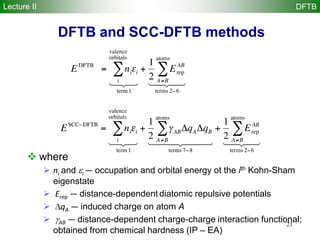
 where
 ni and i — occupation and orbital energy ot the ith Kohn-Sham
eigenstate
 Erep — distance-dependent diatomic repulsive potentials
 qA — induced charge on atom A
 AB — distance-dependent charge-charge interaction functional;
obtained from chemical hardness (IP – EA)
Lecture II DFTB
22
DFTB method
 Repulsive diatomic potentials replace usual nuclear repulsion
energy
 Reference density 0 is constructed from atomic densities
 Kohn-Sham eigenstates i are expanded in Slater basis of valence
pseudoatomic orbitals i
 The DFTB energy is obtained by solving a generalized DFTB
eigenvalue problem with H0 computed by atomic and diatomic DFT
r0 = r0
A
A
atoms
å
fi = cmicm
m
AO
å
H0
C = SCe with Smn = cm cn
Hmn
0
= cm
ˆH r0
M
,r0
N
[ ] cn
Lecture II DFTB
23
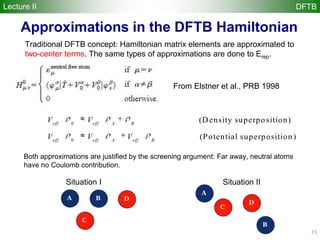
Traditional DFTB concept: Hamiltonian matrix elements are approximated to
two-center terms. The same types of approximations are done to Erep.
From Elstner et al., PRB 1998
0
0
(Density superposition)
(Potential superposition)
eff eff A B
eff eff A eff B
V V
V V V
A B D
C
A
B
D
C
Situation I Situation II
Both approximations are justified by the screening argument: Far away, neutral atoms
have no Coulomb contribution.
Approximations in the DFTB Hamiltonian
Lecture II DFTB
SCC-DFTB matrix elements
24
LCAO ansatz of wave function
Rr
i
i
c
secular equations
0SHc i
i
variational
principle
pseudoatomic orbital
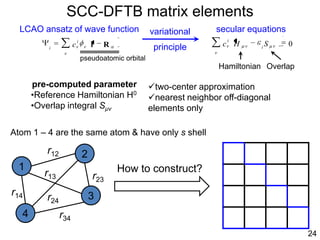
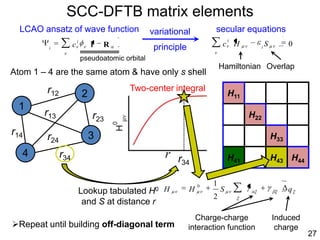
Atom 1 – 4 are the same atom & have only s shell
1
4
2
3
r12
r23
r14
r34
r13
r24
How to construct?
two-center approximation
nearest neighbor off-diagonal
elements only
Hamiltonian Overlap
pre-computed parameter
•Reference Hamiltonian H0
•Overlap integral Sμν
SCC-DFTB matrix elements
25
LCAO ansatz of wave function
Rr
i
i
c
secular equations
0SHc i
i
variational
principle
pseudoatomic orbital
H11
H22
H33
H44
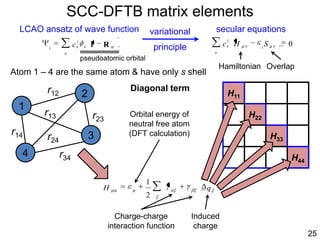
Atom 1 – 4 are the same atom & have only s shell
Diagonal term
Orbital energy of
neutral free atom
(DFT calculation)
1
4
2
3
r12
r23
r14
r34
r13
r24
Hamiltonian Overlap
qH
2
1
Charge-charge
interaction function
Induced
charge
SCC-DFTB matrix elements
26
LCAO ansatz of wave function
Rr
i
i
c
secular equations
0SHc i
i
variational
principle
pseudoatomic orbital
H11
H22
H33
H41 H44
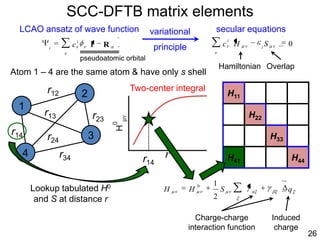
Atom 1 – 4 are the same atom & have only s shell
1
4
2
3
r12
r23
r14
r34
r13
r24
r14
Two-center integral
qSHH
2
10
Charge-charge
interaction function
Induced
charge
Hamiltonian Overlap
Lookup tabulated H0
and S at distance r
r14
SCC-DFTB matrix elements
27
LCAO ansatz of wave function
Rr
i
i
c
secular equations
0SHc i
i
variational
principle
pseudoatomic orbital
H11
H22
H33
H41 H43 H44
Atom 1 – 4 are the same atom & have only s shell
1
4
2
3
r12
r23
r34
r13
r24
r34
Two-center integral
qSHH
2
10
Charge-charge
interaction function
Induced
charge
Hamiltonian Overlap
Repeat until building off-diagonal term
Lookup tabulated H0
and S at distance r
28
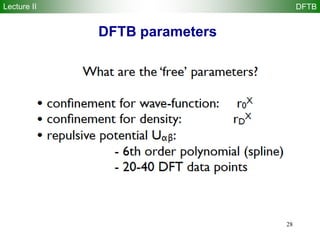
DFTB parameters
Lecture II DFTB
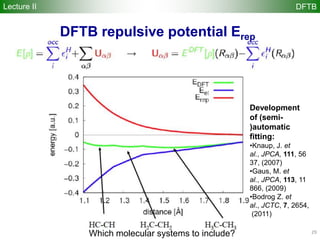
DFTB repulsive potential Erep
Which molecular systems to include?
Development
of (semi-
)automatic
fitting:
•Knaup, J. et
al., JPCA, 111, 56
37, (2007)
•Gaus, M. et
al., JPCA, 113, 11
866, (2009)
•Bodrog Z. et
al., JCTC, 7, 2654,
(2011)
29
Lecture II DFTB
30
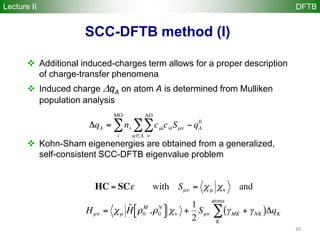
 Additional induced-charges term allows for a proper description
of charge-transfer phenomena
 Induced charge qA on atom A is determined from Mulliken
population analysis
 Kohn-Sham eigenenergies are obtained from a generalized,
self-consistent SCC-DFTB eigenvalue problem
SCC-DFTB method (I)
Lecture II DFTB
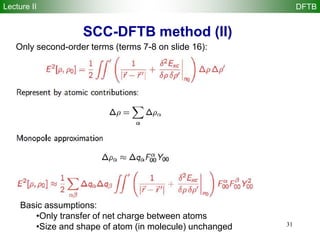
31
SCC-DFTB method (II)
Basic assumptions:
•Only transfer of net charge between atoms
•Size and shape of atom (in molecule) unchanged
Only second-order terms (terms 7-8 on slide 16):
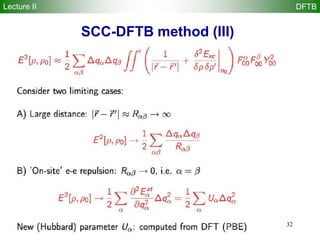
Lecture II DFTB
32
SCC-DFTB method (III)
Lecture II DFTB
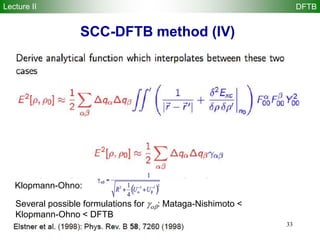
33
SCC-DFTB method (IV)
Several possible formulations for : Mataga-Nishimoto <
Klopmann-Ohno < DFTB
Klopmann-Ohno:
Lecture II DFTB
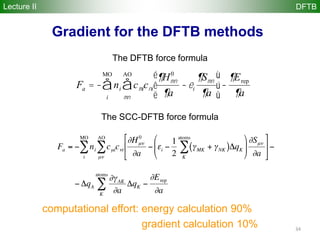
34
Gradient for the DFTB methods
The DFTB force formula
The SCC-DFTB force formula
computational effort: energy calculation 90%
gradient calculation 10%
Fa = - ni cmicni
¶Hmn
0
¶a
-ei
¶Smn
¶a
é
ë
ê
ù
û
ú
mn
AO
å
i
MO
å -
¶Erep
¶a
Lecture II DFTB
35
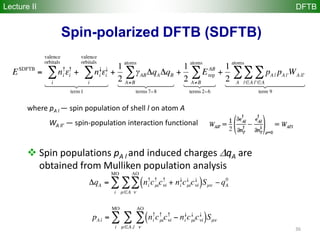
Spin-polarized DFTB (SDFTB)
Lecture II DFTB
 for systems with different and spin densities, we have
 total density = +
 magnetization density S = -
 2nd-order expansion of DFT energy at ( 0,0) yields
E r,rS
[ ]= ni fi
ˆH r0[ ] fi
i
valence
orbitals
å
1
  
+ ni fi
ˆH r0[ ] fi
i
core
orbitals
å
2
  
+ Exc r0[ ]
3

-
1
2
r0VH r0[ ]
R3
ò
4
  
-
- r0Vxc r0[ ]
R3
ò
5
  
+ Enucl
6
+
1
2
r1VH r1[ ]
R3
ò
7
  
+
1
2
d2
Exc
dr1
2
r0 ,0( )
r1
2
R3
òò
8
  
+
1
2
d2
Exc
drS
( )
2
r0 ,0( )
rS
( )
2
R3
òò
9
  
+ o 2( )
The Spin-Polarized SCC-DFTB (SDFTB) method is derived from terms 1-9
o(3)
where pA l — spin population of shell l on atom A
WA ll’ — spin-population interaction functional
 Spin populations pA l and induced charges qA are
obtained from Mulliken population analysis
36
Spin-polarized DFTB (SDFTB)
Lecture II DFTB
37
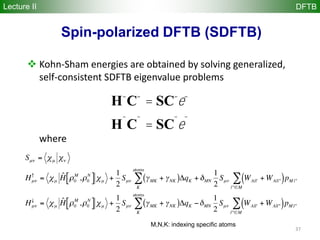
Spin-polarized DFTB (SDFTB)
Lecture II DFTB
 Kohn-Sham energies are obtained by solving generalized,
self-consistent SDFTB eigenvalue problems
where
H-
C-
= SC-
e-
H¯
C¯
= SC¯
e¯
M,N,K: indexing specific atoms
38
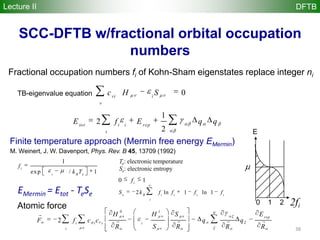
SCC-DFTB w/fractional orbital occupation
numbers
1
2
2
tot i i rep
i
E f E q q
0vi i
v
c H S
Fractional occupation numbers fi of Kohn-Sham eigenstates replace integer ni
TB-eigenvalue equation
Lecture II DFTB
E
2fi
0 1 2
Finite temperature approach (Mermin free energy EMermin)
1
exp / 1
i
i B e
f
k T
2 ln 1 ln 1e B i i i i
i
S k f f f f
Te: electronic temperature
Se: electronic entropy
0 1
2
N
rep
i i i i
i
EH H S
F f c c q q
SR R R R

   
0 1i
f
Atomic force
M. Weinert, J. W. Davenport, Phys. Rev. B 45, 13709 (1992)
EMermin = Etot - TeSe
39
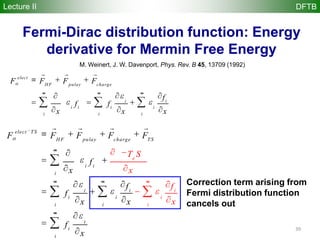
Fermi-Dirac distribution function: Energy
derivative for Mermin Free Energy
M. Weinert, J. W. Davenport, Phys. Rev. B 45, 13709 (1992)
elect TS
HF pulay charge TS
i i
i
i i
i i
i i
i
i
e
i
i
i
i
F F F F F
f
x
f
T
f
x x
f
S
f
x
x
x
   
elect
HF pulay charge
i i
i i i i
i i i
F F F F
f
f f
x x x
  
Correction term arising from
Fermi distribution function
cancels out
Lecture II DFTB
0 1 2 3 4 5
0
20
40
60
80
40
0 1 2 3 4 5
0
20
40
60
80
0 1 2 3 4 5
0
20
40
60
80
0 1 2 3 4 5
0
20
40
60
80
0 1 2 3 4 5
0
20
40
60
80
Time[ps] Time[ps]Time[ps]
Te= 0K
Te= 1500K
Te= 10kK
Te=0 K always yields SCC convergence problemSCC iterations(time)
Maximum iteration number is 70
0 1 2 3 4 5
0
20
40
60
80
0 1 2 3 4 5
0
20
40
60
80
0 2 4
0
20
40
60
80
0 1 2 3 4 5
0
20
40
60
80
(A) H10C60 Fe38 (B) Fe13C10 (C) Fe6C2
kbTe(10kK) ~0.87 eV
~half-width of 3d band in Fe38
DFTBLecture II
41
Density-Functional Tight-Binding
3. Bond Breaking in DFTB
Bond breakingLecture II
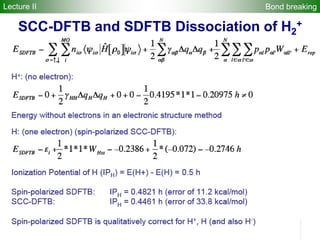
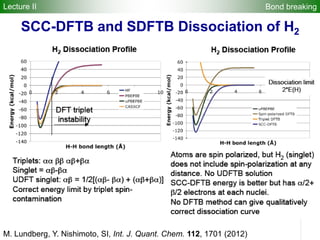
SCC-DFTB and SDFTB Dissociation of H2
+
Bond breakingLecture II
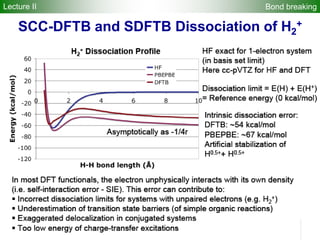
SCC-DFTB and SDFTB Dissociation of H2
+
Bond breakingLecture II
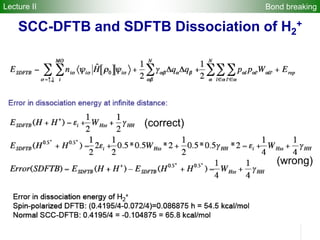
SCC-DFTB and SDFTB Dissociation of H2
+
(correct)
(wrong)
Bond breakingLecture II
SCC-DFTB and SDFTB Dissociation of H2
M. Lundberg, Y. Nishimoto, SI, Int. J. Quant. Chem. 112, 1701 (2012)
46
Density-Functional Tight-Binding
4. Extensions
47
Extensions
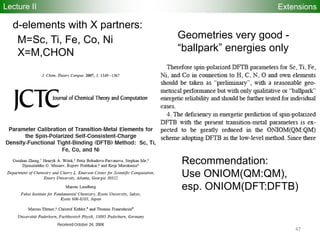
M=Sc, Ti, Fe, Co, Ni
X=M,CHON
d-elements with X partners:
Geometries very good -
“ballpark” energies only
Recommendation:
Use ONIOM(QM:QM),
esp. ONIOM(DFT:DFTB)
Lecture II
48/25
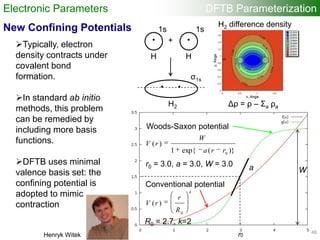
New Confining Potentials
Wa
Conventional potential
r0
Woods-Saxon potential
k
R
r
rV
0
)(
R0 = 2.7, k=2
)}(exp{1
)(
0
rra
W
rV
r0 = 3.0, a = 3.0, W = 3.0
Typically, electron
density contracts under
covalent bond
formation.
In standard ab initio
methods, this problem
can be remedied by
including more basis
functions.
DFTB uses minimal
valence basis set: the
confining potential is
adopted to mimic
contraction
• •+
• •
1s
σ1s
H H
H2 Δρ = ρ – Σa ρa
H2 difference density
1s
Henryk Witek
Electronic Parameters DFTB Parameterization
48
2). DFTB band structure fitting
•Optimization of parameter sets for Woods-Saxon confining potential (orbital
and density) and unoccupied orbital energies
•Fixed orbital energies for electron occupied orbitals
•Valence orbitals : [1s] for 1st row
[2s, 2p] for 2nd row
[ns, np, md] for 3rd – 6th row
(n ≥ 3, m = n-1 for group 1-12, m = n for group 13-18)
•Fitting points : valence bands + conduction bands (depending on the system,
at least including up to ~+5 eV with respect to Fermi level)
Electronic Parameters DFTB Parameterization
1). DFT band structure calculations
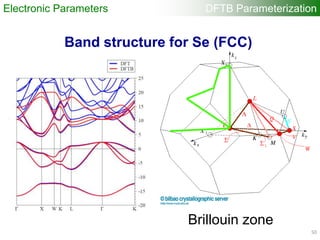
•VASP 4.6
•One atom per unit cell
•PAW (projector augmented wave) method
•32 x 32 x 32 Monkhorst-Pack k-point sampling
•cutoff = 400 eV
•Fermi level is shifted to 0 eV
49
Band structure for Se (FCC)
Brillouin zone
50
Electronic Parameters DFTB Parameterization
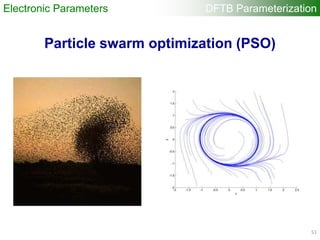
Particle swarm optimization (PSO)
Electronic Parameters DFTB Parameterization
51
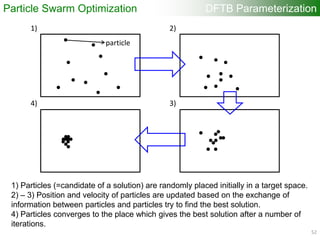
1) Particles (=candidate of a solution) are randomly placed initially in a target space.
2) – 3) Position and velocity of particles are updated based on the exchange of
information between particles and particles try to find the best solution.
4) Particles converges to the place which gives the best solution after a number of
iterations.
•
•
•
•
•
•
• •
••
•
•
••
••
• •
••
• ••
•••
•
•
•
•
••
••••••••
particle
1)
4)
2)
3)
Particle Swarm Optimization DFTB Parameterization
52
Each particle has
randomly generated
parameter sets (r0, a, W)
within some region
Generating one-center
quantities (atomic orbitals,
densities, etc.)
“onecent”
Computing two-center
overlap and Hamiltonian
integrals for wide range
of interatomic distances
“twocent”
“DFTB+”
Calculating DFTB band
structure
Update the parameter
sets of each particle
Memorizing the best fitness
value and parameter sets
Evaluating “fitness value”
(Difference DFTB – DFT band
structure using specified fitness
points) “VASP”
DFTB Parameterization
orbital
a [2.5, 3.5]
W [0.1, 0.5]
r0 [3.5, 6.5]
density
a [2.5, 3.5]
W [0.5, 2.0]
r0 [6.0, 10.0]
Particle Swarm Optimization
53
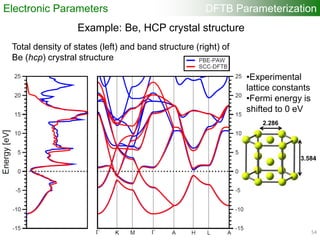
Example: Be, HCP crystal structure
DFTB Parameterization
Total density of states (left) and band structure (right) of
Be (hcp) crystral structure
2.286
3.584
•Experimental
lattice constants
•Fermi energy is
shifted to 0 eV
54
Electronic Parameters
55
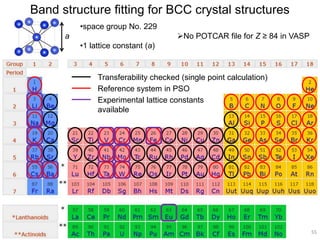
Band structure fitting for BCC crystal structures
•space group No. 229
•1 lattice constant (a)
Transferability checked (single point calculation)
Reference system in PSO
Experimental lattice constants
available
No POTCAR file for Z ≥ 84 in VASPa
55
56
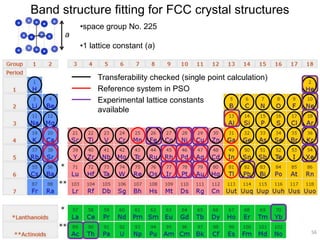
Band structure fitting for FCC crystal structures
Reference system in PSO
Experimental lattice constants
available
•space group No. 225
•1 lattice constant (a)
a
Transferability checked (single point calculation)
56
57
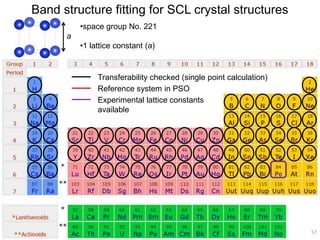
Band structure fitting for SCL crystal structures
Reference system in PSO
Experimental lattice constants
available
•space group No. 221
•1 lattice constant (a)
a
Transferability checked (single point calculation)
57
58
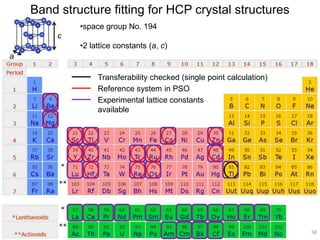
Band structure fitting for HCP crystal structures
Reference system in PSO
Experimental lattice constants
available
•space group No. 194
•2 lattice constants (a, c)
c
a
Transferability checked (single point calculation)
58
59
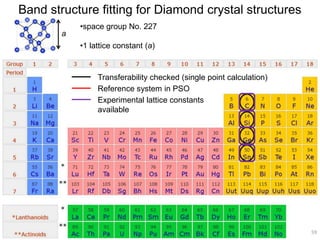
Band structure fitting for Diamond crystal structures
Reference system in PSO
Experimental lattice constants
available
•space group No. 227
•1 lattice constant (a)
a
Transferability checked (single point calculation)
59
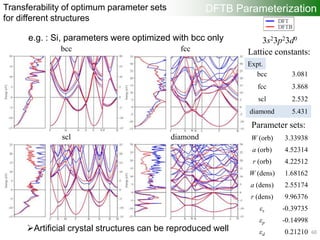
DFTB ParameterizationTransferability of optimum parameter sets
for different structures
Artificial crystal structures can be reproduced well
e.g. : Si, parameters were optimized with bcc only
W (orb) 3.33938
a (orb) 4.52314
r (orb) 4.22512
W (dens) 1.68162
a (dens) 2.55174
r (dens) 9.96376
εs -0.39735
εp -0.14998
εd 0.21210
3s23p23d0
bcc 3.081
fcc 3.868
scl 2.532
diamond 5.431
Parameter sets:
Lattice constants:bcc fcc
scl diamond
Expt.
60
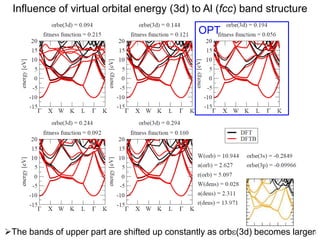
Influence of virtual orbital energy (3d) to Al (fcc) band structure
OPT
The bands of upper part are shifted up constantly as orb (3d) becomes larger61
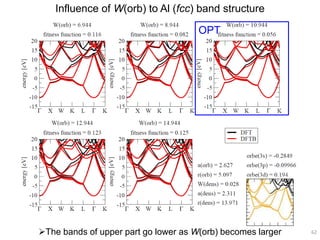
Influence of W(orb) to Al (fcc) band structure
OPT
The bands of upper part go lower as W(orb) becomes larger 62
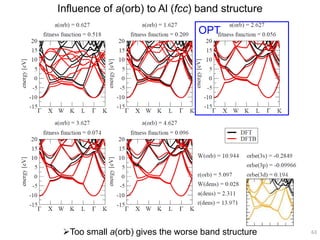
Influence of a(orb) to Al (fcc) band structure
OPT
Too small a(orb) gives the worse band structure 63
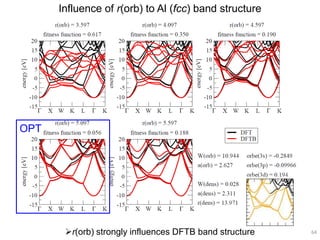
Influence of r(orb) to Al (fcc) band structure
OPT
r(orb) strongly influences DFTB band structure 64
Correlation of r(orb) vs. atomic diameter
Atomic Number Z
Atomicdiameter[a.u.]
Empirically measured radii
(Slater, J. C., J. Chem. Phys.,
41, 3199-3204, (1964).)
Calculated radii with minimal-
basis set SCF functions
(Clementi, E. et al., J. Chem.
Phys., 47, 1300-1307, (1967).)
Expected value using relativistic
Dirac-Fock calculations
(Desclaux, J. P., Atomic Data
and Nuclear Data Tables, 12,
311-406, (1973).)
This work r(orb)
In particular for main group elements, there seems to be a
correlation between r(orb) and atomic diameter.
65
DFTB ParameterizationElectronic Parameters
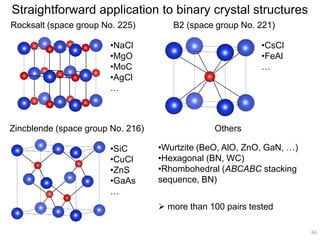
Straightforward application to binary crystal structures
Rocksalt (space group No. 225)
•NaCl
•MgO
•MoC
•AgCl
…
•CsCl
•FeAl
…
B2 (space group No. 221)
Zincblende (space group No. 216)
•SiC
•CuCl
•ZnS
•GaAs
…
Others
•Wurtzite (BeO, AlO, ZnO, GaN, …)
•Hexagonal (BN, WC)
•Rhombohedral (ABCABC stacking
sequence, BN)
 more than 100 pairs tested
66
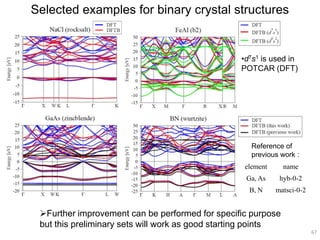
Selected examples for binary crystal structures
element name
Ga, As hyb-0-2
B, N matsci-0-2
Reference of
previous work :
•d7s1 is used in
POTCAR (DFT)
Further improvement can be performed for specific purpose
but this preliminary sets will work as good starting points
67
68
Extensions
Gab
DFTB
=
¶2
Erep
¶a¶b
+ 2 ni Umi
b
cmmcni
¶Hmn
0
¶a
-ei
¶Smn
¶a
é
ë
ê
ù
û
ú
mn
AO
å
im
MO
å +
+ ni cmicni
¶2
Hmn
0
¶a¶b
-ei
¶2
Smn
¶a¶b
-
¶ei
¶b
¶Smn
¶a
é
ë
ê
ù
û
ú
mn
AO
å
i
MO
å
( )
( )
( )
ååå
å å å å
å å å
å å å
D
D+D
D
+DD+
+ú
û
ù
ê
ë
é D
+-D÷
ø
ö
ç
è
æ
+--
-
ú
ú
û
ù
ê
ê
ë
é
÷
ø
ö
ç
è
æ
-D+++
+
ú
ú
û
ù
ê
ê
ë
é
÷
ø
ö
ç
è
æ
-D+++=
atomsatomsatoms 2
MO AO atoms atoms
MO AO 2atoms02
MO AO atoms0
rep
2
DFTB-SCC
2
1
2
1
2
1
2
1
2
K
K
A
AK
K
K
AAK
K
KA
AK
i K K
K
NKMKK
NKMKi
iii
i
i
K
KNKMKiii
im
i
K
KNKMKim
b
miiab
b
q
q
a
q
b
q
a
qq
ba
a
S
b
q
q
bbb
ccn
ba
S
q
ba
H
ccn
a
S
q
a
H
ccUn
ba
E
G


¶g


¶g
¶¶
g


gg

¶g

¶g

¶e
¶¶

egg
¶¶


egg


¶¶

mn
mn
nm
mn
mnmn
nm
mn
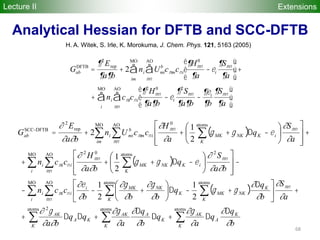
mnmn
nm
Analytical Hessian for DFTB and SCC-DFTB
H. A. Witek, S. Irle, K. Morokuma, J. Chem. Phys. 121, 5163 (2005)
Lecture II
69
Extensions
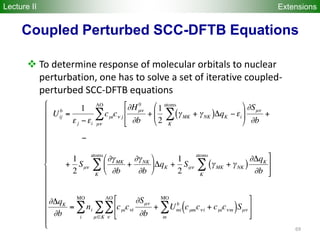
 To determine response of molecular orbitals to nuclear
perturbation, one has to solve a set of iterative coupled-
perturbed SCC-DFTB equations
Coupled Perturbed SCC-DFTB Equations
Lecture II
70
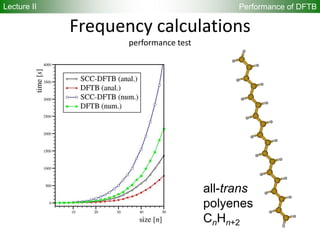
Frequency calculations
performance test
all-trans
polyenes
CnHn+2
Performance of DFTBLecture II
71
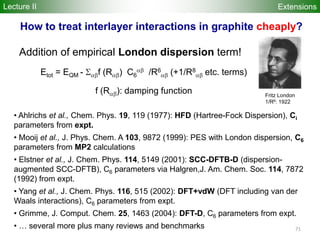
How to treat interlayer interactions in graphite cheaply?
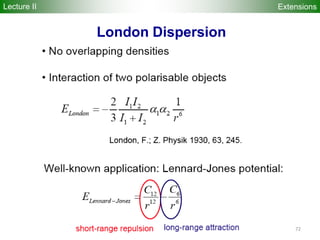
Addition of empirical London dispersion term!
• Ahlrichs et al., Chem. Phys. 19, 119 (1977): HFD (Hartree-Fock Dispersion), Ci
parameters from expt.
• Mooij et al., J. Phys. Chem. A 103, 9872 (1999): PES with London dispersion, C6
parameters from MP2 calculations
• Elstner et al., J. Chem. Phys. 114, 5149 (2001): SCC-DFTB-D (dispersion-
augmented SCC-DFTB), C6 parameters via Halgren,J. Am. Chem. Soc. 114, 7872
(1992) from expt.
• Yang et al., J. Chem. Phys. 116, 515 (2002): DFT+vdW (DFT including van der
Waals interactions), C6 parameters from expt.
• Grimme, J. Comput. Chem. 25, 1463 (2004): DFT-D, C6 parameters from expt.
• … several more plus many reviews and benchmarks
Etot = EQM - f (R ) C6 /R6 (+1/R8 etc. terms)
f (R ): damping function Fritz London
1/R6: 1922
ExtensionsLecture II
72
Extensions
London Dispersion
Lecture II
73
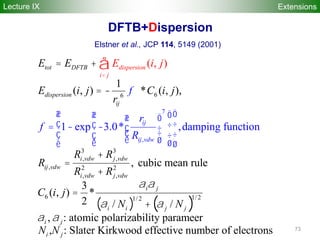
DFTB+Dispersion
4
7
,
66
3 3
, ,
, 2 2
, ,
6
1
( , ) * ( , ),
, cubic mean rule
3
( ,
1 exp 3.0* ,damping funct
)
(
ion
)
*
2
,
ij
ij vd
dispersio
w
tot DFTB
dispersion
ij
i vdw j vdw
ij vdw
i vdw
n
i j
j vdw
i j
E E
E i j C i j
r
R R
R
E i j
f
r
R
R
C
f
R
i j
a a
a
<
æ öæ öæ ö
ç ÷ç ÷= - - ç ÷ç ÷ç ÷ç ÷è
= +
= -
+
=
èè
=
ø øø
+
å
( ) ( )
1/ 21/ 2
/ /
, : atomic polarizability parameer
, : Slater Kirkwood effective number of electrons
i i j j
i j
i j
N N
N N
a
a a
+
Elstner et al., JCP 114, 5149 (2001)
Lecture IX Extensions
74
E ~
1/R6
damping f(R ) = [1-exp(-3(rij/Rij,vdW
)7)]3
Rij,vdW = 3.8 Å (for 1st row), 4.8 A (for 2nd row)
DFTB+Dispersion
Elstner et al., JCP 114, 5149 (2001)
DFTB-D choice of C6
parameters:
- generally hybridization
dependent (i.e. not
simply atomic values)
- use “empirical” values
for parameters to match
BSSE-corrected MP2
interaction energies
R [Å]
E [ha]
ExtensionsLecture II
75
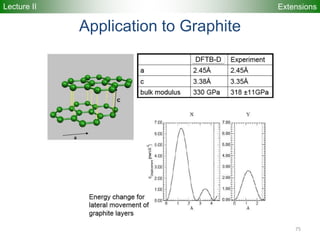
Application to Graphite
Extensions
DFTB-D
Lecture II
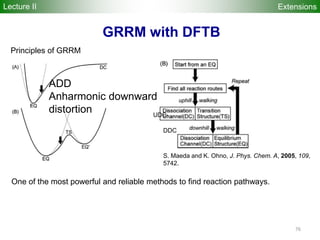
Principles of GRRM
ADD
Anharmonic downward
distortion
S. Maeda and K. Ohno, J. Phys. Chem. A, 2005, 109,
5742.
76
UDC
DDC
One of the most powerful and reliable methods to find reaction pathways.
Extensions
GRRM with DFTB
Lecture II
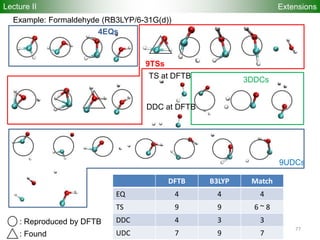
Example: Formaldehyde (RB3LYP/6-31G(d))
4EQs
9TSs
3DDCs
9UDCs
DDC at DFTB
DFTB B3LYP Match
EQ 4 4 4
TS 9 9 6 ~ 8
DDC 4 3 3
UDC 7 9 7
: Reproduced by DFTB
: Found
TS at DFTB
77
ExtensionsLecture II
78
Density-Functional Tight-Binding
5. Performance and Applications
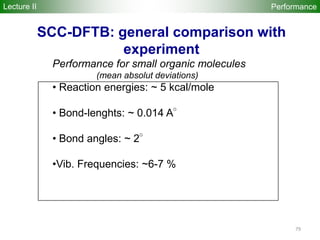
Performance for small organic molecules
(mean absolut deviations)
• Reaction energies: ~ 5 kcal/mole
• Bond-lenghts: ~ 0.014 A°
• Bond angles: ~ 2°
•Vib. Frequencies: ~6-7 %
79
Performance
SCC-DFTB: general comparison with
experiment
Lecture II
80
Performance
Accuracy of DFTB Geometries and
Energies for Fullerene Isomers
Fullerene Isomers Geometries and Energies vs B3LYP/6-31G(d)
G. Zheng, SI, M.
Elstner, K.
Morokuma, Chem.
Phys. Lett. 412, 210
(2005)
RMS [Å] NCC-DFTB SCC-DFTB AM1 PM3
C20-C36 0.025 0.019 0.035 0.030
C60-C86 0.014 0.014 0.016 0.015
R2
(lin. reg.) NCC-DFTB SCC-DFTB AM1 PM3
C20-C36 0.88 0.93 0.77 0.73
C60-C86 0.97 0.98 0.86 0.84
Geometries
Energetics
•102 Fullerene Isomers
• small cage non-IPR C20-C36 (35), large cage IPR C70-C86 (67)
R2: Energy linear regression between E(Method) and E(B3LYP)
Lecture II
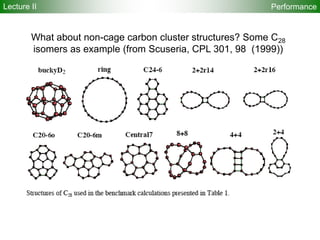
What about non-cage carbon cluster structures? Some C28
isomers as example (from Scuseria, CPL 301, 98 (1999))
PerformanceLecture II
Performance
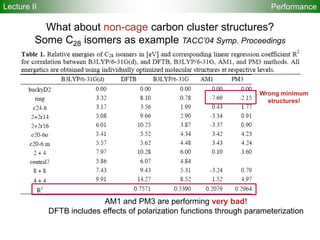
What about non-cage carbon cluster structures?
Some C28 isomers as example TACC’04 Symp. Proceedings
AM1 and PM3 are performing very bad!
DFTB includes effects of polarization functions through parameterization
Wrong minimum
structures!
Lecture II
83
Performance
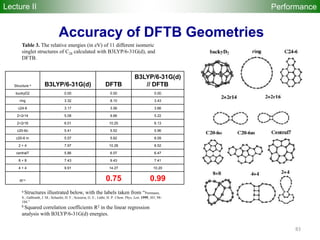
Accuracy of DFTB Geometries
Table 3. The relative energies (in eV) of 11 different isomeric
singlet structures of C28 calculated with B3LYP/6-31G(d), and
DFTB.
Structure a B3LYP/6-31G(d) DFTB
B3LYP/6-31G(d)
// DFTB
buckyD2 0.00 0.00 0.00
ring 3.32 8.10 3.43
c24-6 3.17 3.56 3.66
2+2r14 5.08 9.66 5.22
2+2r16 6.01 10.25 6.13
c20-6o 5.41 5.52 5.96
c20-6 m 5.57 5.62 6.09
2 + 4 7.97 10.28 8.52
central7 5.86 6.07 6.47
8 + 8 7.43 9.43 7.41
4 + 4 9.91 14.27 10.20
R2 b 0.75 0.99
a Structures illustrated below, with the labels taken from “Portmann,
S.; Galbraith, J. M.; Schaefer, H. F.; Scuseria, G. E.; Lüthi, H. P. Chem. Phys. Lett. 1999, 301, 98-
104.”
b Squared correlation coefficients R2 in the linear regression
analysis with B3LYP/6-31G(d) energies.
Lecture II
84
Performance
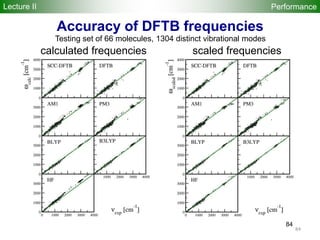
Accuracy of DFTB frequencies
84
calculated frequencies scaled frequencies
Testing set of 66 molecules, 1304 distinct vibrational modes
Lecture II
85
Performance
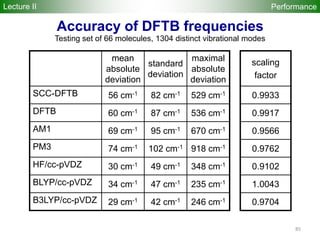
Accuracy of DFTB frequencies
Testing set of 66 molecules, 1304 distinct vibrational modes
mean
absolute
deviation
standard
deviation
maximal
absolute
deviation
scaling
factor
SCC-DFTB 56 cm-1 82 cm-1 529 cm-1 0.9933
DFTB 60 cm-1 87 cm-1 536 cm-1 0.9917
AM1 69 cm-1 95 cm-1 670 cm-1 0.9566
PM3 74 cm-1 102 cm-1 918 cm-1 0.9762
HF/cc-pVDZ 30 cm-1 49 cm-1 348 cm-1 0.9102
BLYP/cc-pVDZ 34 cm-1 47 cm-1 235 cm-1 1.0043
B3LYP/cc-pVDZ 29 cm-1 42 cm-1 246 cm-1 0.9704
Lecture II
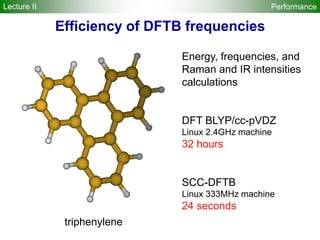
triphenylene
Energy, frequencies, and
Raman and IR intensities
calculations
DFT BLYP/cc-pVDZ
Linux 2.4GHz machine
32 hours
SCC-DFTB
Linux 333MHz machine
24 seconds
Performance
Efficiency of DFTB frequencies
Lecture II
Performance
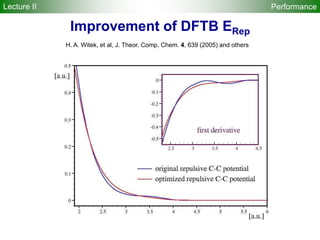
Improvement of DFTB ERep
H. A. Witek, et al, J. Theor. Comp. Chem. 4, 639 (2005) and others
Lecture II
88
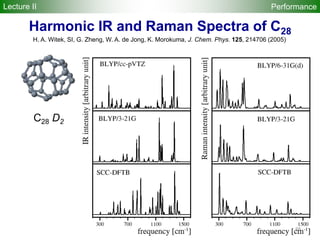
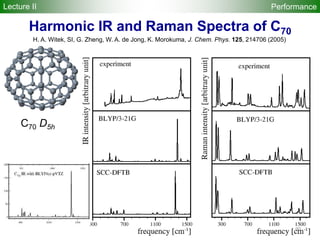
H. A. Witek, SI, G. Zheng, W. A. de Jong, K. Morokuma, J. Chem. Phys. 125, 214706 (2005)
Performance
C28 D2
Harmonic IR and Raman Spectra of C28
Lecture II
89
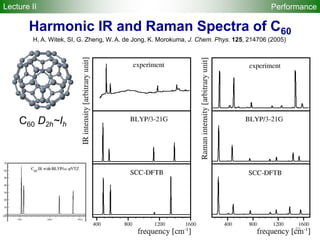
H. A. Witek, SI, G. Zheng, W. A. de Jong, K. Morokuma, J. Chem. Phys. 125, 214706 (2005)
Performance
Harmonic IR and Raman Spectra of C60
C60 D2h~Ih
Lecture II
90
H. A. Witek, SI, G. Zheng, W. A. de Jong, K. Morokuma, J. Chem. Phys. 125, 214706 (2005)
Performance
Harmonic IR and Raman Spectra of C70
C70 D5h
Lecture II
91
Performance
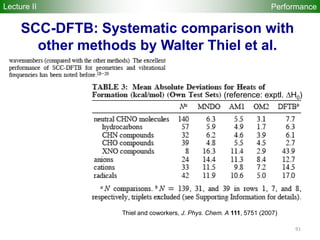
SCC-DFTB: Systematic comparison with
other methods by Walter Thiel et al.
Thiel and coworkers, J. Phys. Chem. A 111, 5751 (2007)
(reference: exptl. H0)
Lecture II
92
Performance
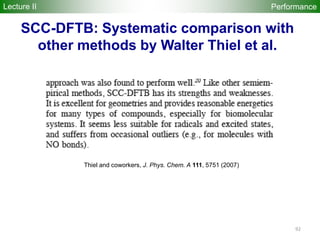
Thiel and coworkers, J. Phys. Chem. A 111, 5751 (2007)
SCC-DFTB: Systematic comparison with
other methods by Walter Thiel et al.
Lecture II
93
Performance
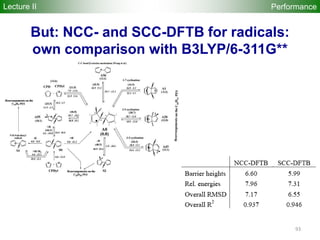
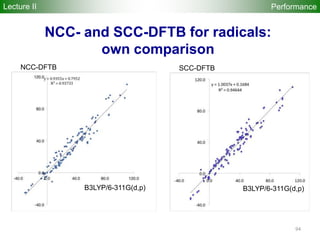
But: NCC- and SCC-DFTB for radicals:
own comparison with B3LYP/6-311G**
Lecture II
94
Performance
NCC- and SCC-DFTB for radicals:
own comparison
NCC-DFTB
B3LYP/6-311G(d,p)
SCC-DFTB
B3LYP/6-311G(d,p)
Lecture II
95
A B C
DFT:PW91[1] -6.24 -5.63 -1.82
SCC-DFTB[2] -5.17 -4.68 -1.86
Adhesion energies (eV/atom)
A B C
PW91: An ultrasoft pseudopotential with a plane-wave cutoff of 290 eV for the single metal and the
projector augmented wave method with a plane-wave cutoff of 400 eV for the metal cluster
Fe-Fe and Fe-C DFTB parameters from: G. Zheng et al., J. Chem. Theor. Comput. 3, 1349 (2007)
[1] Phys. Rev. B 75, 115419 (2007) [2] Fermi broadening=0.13 eV
H10C60Fe H10C60Fe
H10C60Fe55
Fe55
icosahedron
H-terminated (5,5) armchair SWNT + Fe atom/cluster
PerformanceLecture II
96
Acknowledgements
• Marcus Elstner
• Jan Knaup
• Alexey Krashenninikov
• Yasuhito Ohta
• Thomas Heine
• Keiji Morokuma
• Marcus Lundberg
• Yoshio Nishimoto
• Some others
Acknowledgements
Lecture II

Density-Functional Tight-Binding (DFTB) as fast approximate DFT method - An introduction

  • 1.
    All lectures onlineat: http://qc.chem.nagoya-u.ac.jp/presentations.html
  • 2.
    2 Density-Functional Tight-Binding (DFTB)as fast approximate DFT method Helmut Eschrig Gotthard Seifert Thomas Frauenheim Marcus Elstner Lecture II: Introduction to the Density-Functional Tight-Binding (DFTB) Method
  • 3.
    3 Density-Functional Tight-Binding 1. Tight-Binding 2.Density-Functional Tight-Binding (DFTB) 3. Bond Breaking in DFTB 4. Extensions 5. Performance and Applications
  • 4.
  • 5.
    55 Lecture II 1.Tight-Binding Resources 1. http://www.dftb.org 2. DFTB Porezag, D., T. Frauenheim, T. Köhler, G. Seifert, and R. Kaschner, Construction of tight-binding-like potentials on the basis of density-functional theory: application to carbon. Phys. Rev. B, 1995. 51: p. 12947-12957. 3. DFTB Seifert, G., D. Porezag, and T. Frauenheim, Calculations of molecules, clusters, and solids with a simplified LCAO-DFT-LDA scheme. Int. J. Quantum Chem., 1996. 58: p. 185-192. 4. SCC-DFTB Elstner, M., D. Porezag, G. Jungnickel, J. Elsner, M. Haugk, T. Frauenheim, S. Suhai, and G. Seifert, Self-consistent-charge density-functional tight- binding method for simulations of complex materials properties. Phys. Rev. B, 1998. 58: p. 7260-7268. 5. SCC-DFTB-D Elstner, M., P. Hobza, T. Frauenheim, S. Suhai, and E. Kaxiras, Hydrogen bonding and stacking interactions of nucleic acid base pairs: A density-functional-theory based treatment. J. Chem. Phys,, 2001. 114: p. 5149-5155. 6. SDFTB Kohler, C., G. Seifert, U. Gerstmann, M. Elstner, H. Overhof, and T. Frauenheim, Approximate density-functional calculations of spin densities in large molecular systems and complex solids. Phys. Chem. Chem. Phys., 2001. 3: p. 5109- 5114. 7. DFTB3 Gaus, M.; Cui, C.; Elstner, M. DFTB3: Extension of the Self-Consistent-Charge Density-Functional Tight-Binding Method (SCC-DFTB). J. Chem. Theory Comput., 2011. 7: p. 931-948.
  • 6.
    6 Standalone fast andefficient DFTB implementation with several useful extensions of the original DFTB method. It is developed at the Bremen Center for Computational Materials Science (Prof. Frauenheim, Balint Aradi) and is the successor of the old Paderborn DFTB and Dylax codes. Free for non-commercial use. DFTB+ as part of Accelrys' Materials Studio package, providing a user friendly graphical interface and the possibility to combine DFTB with other higher or lower level methods. DFTB integrated in the ab initio DFT code deMon DFTB in the Gaussian code Amber is a package of molecular simulation programs distributed by UCSF, developed mainly for biomolecular simulations. The current version of Amber includes QM/MM support, whereby part of the system can be treated quantum mechanically, and DFTB is among the quantum mechanical methods available. Amber also has a stand-alone (pure QM) implementation. CHARMm (Chemistry at HARvard Macromolecular Mechanics) DFTB integrated in the Amsterdam Density Functional (ADF) program suite. DFTB+ DFTB+/Accelrys deMon GAUSSIAN G09 AMBER CHARMm ADF Implementations Lecture II 1. Tight-Binding
  • 7.
    7 • Tight binding(TB) approaches work on the principle of treating electronic wavefunction of a system as a superposition of atom-like wavefunction (known to chemists as LCAO approach) • Valence electrons are tightly bound to the cores (not allowed to delocalize beyond the confines of a minimal LCAO basis) • Semi-empirical tight-binding (SETB): Hamiltonian Matrix elements are approximated by analytical functions (no need to compute integrals) • TB energy for N electrons, M atoms system: • This separation of one-electron energies and interatomic distance- dependent potential vj,k constitutes the TB method Tight-Binding Lecture II 1. Tight-Binding
  • 8.
    8 are eigenvalues ofa Schrodinger-like equation • solved variationally using atom-like (minimum, single-zeta) AO basis set, leading to a secular equation: where H and S are Hamiltonian and overlap matrices in the basis of the AO functions. In orthogonal TB, S = 1 (overlap between atoms is neglected) • H and S are constructed using nearest-neighbor relationships; typically only nearest-neighbor interactions are considered: Similarity to extended Hückel method Tight-Binding Lecture II 1. Tight-Binding
  • 9.
    9 • Based onapproximation by W. Wolfsberg and L. J. Helmholz (1952) H Ci = i S Ci • H – Hamiltonian matrix constructed using nearest neighbor relationships • Ci – column vector of the i-th molecular orbital coefficients • i – orbital energy • S – overlap matrix • H - choose as a constant – valence shell ionization potentials • H = K S (H + H )/2 • K – Wolfsberg Helmholz constant, typically 1.75 Extended Huckel (EHT) Method Lecture II 1. Tight-Binding
  • 10.
    Categories of TBapproaches 10 Source: http://beam.acclab.helsinki.fi/~akrashen/esctmp.html Lecture II 1. Tight-Binding
  • 11.
    Slater-Koster (SK) Approximation(I) 11 Source: http://beam.acclab.helsinki.fi/~akrashen/esctmp.html Lecture II 1. Tight-Binding
  • 12.
    SK Approximation (II) 12 Source:http://beam.acclab.helsinki.fi/~akrashen/esctmp.html Lecture II 1. Tight-Binding
  • 13.
    SK Approximation (III) 13 Source:http://beam.acclab.helsinki.fi/~akrashen/esctmp.html Lecture II 1. Tight-Binding
  • 14.
    SK Approximation (IV) 14 Source:http://beam.acclab.helsinki.fi/~akrashen/esctmp.html Lecture II 1. Tight-Binding
  • 15.
  • 16.
  • 17.
    17 DFTB MethodQuick reviewI Taken from Oliviera, Seifert, Heine, Duarte, J. Braz. Chem. Soc. 20, 1193-1205 (2009) ...open access Thomas Heine Helio Duarte
  • 18.
    18 DFTB MethodQuick reviewII Density Functional Theory (DFT) 2 3 1 3 3 , 1 1 '1 ' 2 ' '1 1 ' 2 ' 2 M i i ext i i N xc M i i rep i r E n v r d r r r Z Zr r E d rd r r r R R n E          at convergence: Various criteria for convergence possible: • Electron density • Potential • Orbitals • Energy • Combinations of above quantities Walter Kohn/John A. Pople 1998
  • 19.
    19 DFTB MethodQuick reviewIII Phys. Rev. B, 39, 12520 (1989) Foulkes + Haydock Ansatz
  • 20.
    20 Self-consistent-charge density-functional tight-binding (SCC-DFTB) M.Elstner et al., Phys. Rev. B 58 7260 (1998) E r[ ] = ni fi ˆH r0[ ] fi i valence orbitals å 1    + ni fi ˆH r0[ ] fi i core orbitals å 2    + Exc r0[ ] 3  - 1 2 r0VH r0[ ] R3 ò 4    - - r0Vxc r0[ ] R3 ò 5    + Enucl 6 + 1 2 r1VH r1[ ] R3 ò 7    + 1 2 d2 Exc dr1 2 r0 r1 2 R3 òò 8    + o 2( ) Approximate density functional theory (DFT) method! Second order-expansion of DFT energy in terms of reference density 0 and charge fluctuation 1 ( 0 + 1) yields: Density-functional tight-binding (DFTB) method is derived from terms 1-6 Self-consistent-charge density-functional tight-binding (SCC-DFTB) method is derived from terms 1-8 o(3) Lecture II DFTB
  • 21.
    21 DFTB and SCC-DFTBmethods  where  ni and i — occupation and orbital energy ot the ith Kohn-Sham eigenstate  Erep — distance-dependent diatomic repulsive potentials  qA — induced charge on atom A  AB — distance-dependent charge-charge interaction functional; obtained from chemical hardness (IP – EA) Lecture II DFTB
  • 22.
    22 DFTB method  Repulsivediatomic potentials replace usual nuclear repulsion energy  Reference density 0 is constructed from atomic densities  Kohn-Sham eigenstates i are expanded in Slater basis of valence pseudoatomic orbitals i  The DFTB energy is obtained by solving a generalized DFTB eigenvalue problem with H0 computed by atomic and diatomic DFT r0 = r0 A A atoms å fi = cmicm m AO å H0 C = SCe with Smn = cm cn Hmn 0 = cm ˆH r0 M ,r0 N [ ] cn Lecture II DFTB
  • 23.
    23 Traditional DFTB concept:Hamiltonian matrix elements are approximated to two-center terms. The same types of approximations are done to Erep. From Elstner et al., PRB 1998 0 0 (Density superposition) (Potential superposition) eff eff A B eff eff A eff B V V V V V A B D C A B D C Situation I Situation II Both approximations are justified by the screening argument: Far away, neutral atoms have no Coulomb contribution. Approximations in the DFTB Hamiltonian Lecture II DFTB
  • 24.
    SCC-DFTB matrix elements 24 LCAOansatz of wave function Rr i i c secular equations 0SHc i i variational principle pseudoatomic orbital Atom 1 – 4 are the same atom & have only s shell 1 4 2 3 r12 r23 r14 r34 r13 r24 How to construct? two-center approximation nearest neighbor off-diagonal elements only Hamiltonian Overlap pre-computed parameter •Reference Hamiltonian H0 •Overlap integral Sμν
  • 25.
    SCC-DFTB matrix elements 25 LCAOansatz of wave function Rr i i c secular equations 0SHc i i variational principle pseudoatomic orbital H11 H22 H33 H44 Atom 1 – 4 are the same atom & have only s shell Diagonal term Orbital energy of neutral free atom (DFT calculation) 1 4 2 3 r12 r23 r14 r34 r13 r24 Hamiltonian Overlap qH 2 1 Charge-charge interaction function Induced charge
  • 26.
    SCC-DFTB matrix elements 26 LCAOansatz of wave function Rr i i c secular equations 0SHc i i variational principle pseudoatomic orbital H11 H22 H33 H41 H44 Atom 1 – 4 are the same atom & have only s shell 1 4 2 3 r12 r23 r14 r34 r13 r24 r14 Two-center integral qSHH 2 10 Charge-charge interaction function Induced charge Hamiltonian Overlap Lookup tabulated H0 and S at distance r
  • 27.
    r14 SCC-DFTB matrix elements 27 LCAOansatz of wave function Rr i i c secular equations 0SHc i i variational principle pseudoatomic orbital H11 H22 H33 H41 H43 H44 Atom 1 – 4 are the same atom & have only s shell 1 4 2 3 r12 r23 r34 r13 r24 r34 Two-center integral qSHH 2 10 Charge-charge interaction function Induced charge Hamiltonian Overlap Repeat until building off-diagonal term Lookup tabulated H0 and S at distance r
  • 28.
  • 29.
    DFTB repulsive potentialErep Which molecular systems to include? Development of (semi- )automatic fitting: •Knaup, J. et al., JPCA, 111, 56 37, (2007) •Gaus, M. et al., JPCA, 113, 11 866, (2009) •Bodrog Z. et al., JCTC, 7, 2654, (2011) 29 Lecture II DFTB
  • 30.
    30  Additional induced-chargesterm allows for a proper description of charge-transfer phenomena  Induced charge qA on atom A is determined from Mulliken population analysis  Kohn-Sham eigenenergies are obtained from a generalized, self-consistent SCC-DFTB eigenvalue problem SCC-DFTB method (I) Lecture II DFTB
  • 31.
    31 SCC-DFTB method (II) Basicassumptions: •Only transfer of net charge between atoms •Size and shape of atom (in molecule) unchanged Only second-order terms (terms 7-8 on slide 16): Lecture II DFTB
  • 32.
  • 33.
    33 SCC-DFTB method (IV) Severalpossible formulations for : Mataga-Nishimoto < Klopmann-Ohno < DFTB Klopmann-Ohno: Lecture II DFTB
  • 34.
    34 Gradient for theDFTB methods The DFTB force formula The SCC-DFTB force formula computational effort: energy calculation 90% gradient calculation 10% Fa = - ni cmicni ¶Hmn 0 ¶a -ei ¶Smn ¶a é ë ê ù û ú mn AO å i MO å - ¶Erep ¶a Lecture II DFTB
  • 35.
    35 Spin-polarized DFTB (SDFTB) LectureII DFTB  for systems with different and spin densities, we have  total density = +  magnetization density S = -  2nd-order expansion of DFT energy at ( 0,0) yields E r,rS [ ]= ni fi ˆH r0[ ] fi i valence orbitals å 1    + ni fi ˆH r0[ ] fi i core orbitals å 2    + Exc r0[ ] 3  - 1 2 r0VH r0[ ] R3 ò 4    - - r0Vxc r0[ ] R3 ò 5    + Enucl 6 + 1 2 r1VH r1[ ] R3 ò 7    + 1 2 d2 Exc dr1 2 r0 ,0( ) r1 2 R3 òò 8    + 1 2 d2 Exc drS ( ) 2 r0 ,0( ) rS ( ) 2 R3 òò 9    + o 2( ) The Spin-Polarized SCC-DFTB (SDFTB) method is derived from terms 1-9 o(3)
  • 36.
    where pA l— spin population of shell l on atom A WA ll’ — spin-population interaction functional  Spin populations pA l and induced charges qA are obtained from Mulliken population analysis 36 Spin-polarized DFTB (SDFTB) Lecture II DFTB
  • 37.
    37 Spin-polarized DFTB (SDFTB) LectureII DFTB  Kohn-Sham energies are obtained by solving generalized, self-consistent SDFTB eigenvalue problems where H- C- = SC- e- H¯ C¯ = SC¯ e¯ M,N,K: indexing specific atoms
  • 38.
    38 SCC-DFTB w/fractional orbitaloccupation numbers 1 2 2 tot i i rep i E f E q q 0vi i v c H S Fractional occupation numbers fi of Kohn-Sham eigenstates replace integer ni TB-eigenvalue equation Lecture II DFTB E 2fi 0 1 2 Finite temperature approach (Mermin free energy EMermin) 1 exp / 1 i i B e f k T 2 ln 1 ln 1e B i i i i i S k f f f f Te: electronic temperature Se: electronic entropy 0 1 2 N rep i i i i i EH H S F f c c q q SR R R R      0 1i f Atomic force M. Weinert, J. W. Davenport, Phys. Rev. B 45, 13709 (1992) EMermin = Etot - TeSe
  • 39.
    39 Fermi-Dirac distribution function:Energy derivative for Mermin Free Energy M. Weinert, J. W. Davenport, Phys. Rev. B 45, 13709 (1992) elect TS HF pulay charge TS i i i i i i i i i i i e i i i i F F F F F f x f T f x x f S f x x x     elect HF pulay charge i i i i i i i i i F F F F f f f x x x    Correction term arising from Fermi distribution function cancels out Lecture II DFTB
  • 40.
    0 1 23 4 5 0 20 40 60 80 40 0 1 2 3 4 5 0 20 40 60 80 0 1 2 3 4 5 0 20 40 60 80 0 1 2 3 4 5 0 20 40 60 80 0 1 2 3 4 5 0 20 40 60 80 Time[ps] Time[ps]Time[ps] Te= 0K Te= 1500K Te= 10kK Te=0 K always yields SCC convergence problemSCC iterations(time) Maximum iteration number is 70 0 1 2 3 4 5 0 20 40 60 80 0 1 2 3 4 5 0 20 40 60 80 0 2 4 0 20 40 60 80 0 1 2 3 4 5 0 20 40 60 80 (A) H10C60 Fe38 (B) Fe13C10 (C) Fe6C2 kbTe(10kK) ~0.87 eV ~half-width of 3d band in Fe38 DFTBLecture II
  • 41.
  • 42.
    Bond breakingLecture II SCC-DFTBand SDFTB Dissociation of H2 +
  • 43.
    Bond breakingLecture II SCC-DFTBand SDFTB Dissociation of H2 +
  • 44.
    Bond breakingLecture II SCC-DFTBand SDFTB Dissociation of H2 + (correct) (wrong)
  • 45.
    Bond breakingLecture II SCC-DFTBand SDFTB Dissociation of H2 M. Lundberg, Y. Nishimoto, SI, Int. J. Quant. Chem. 112, 1701 (2012)
  • 46.
  • 47.
    47 Extensions M=Sc, Ti, Fe,Co, Ni X=M,CHON d-elements with X partners: Geometries very good - “ballpark” energies only Recommendation: Use ONIOM(QM:QM), esp. ONIOM(DFT:DFTB) Lecture II
  • 48.
    48/25 New Confining Potentials Wa Conventionalpotential r0 Woods-Saxon potential k R r rV 0 )( R0 = 2.7, k=2 )}(exp{1 )( 0 rra W rV r0 = 3.0, a = 3.0, W = 3.0 Typically, electron density contracts under covalent bond formation. In standard ab initio methods, this problem can be remedied by including more basis functions. DFTB uses minimal valence basis set: the confining potential is adopted to mimic contraction • •+ • • 1s σ1s H H H2 Δρ = ρ – Σa ρa H2 difference density 1s Henryk Witek Electronic Parameters DFTB Parameterization 48
  • 49.
    2). DFTB bandstructure fitting •Optimization of parameter sets for Woods-Saxon confining potential (orbital and density) and unoccupied orbital energies •Fixed orbital energies for electron occupied orbitals •Valence orbitals : [1s] for 1st row [2s, 2p] for 2nd row [ns, np, md] for 3rd – 6th row (n ≥ 3, m = n-1 for group 1-12, m = n for group 13-18) •Fitting points : valence bands + conduction bands (depending on the system, at least including up to ~+5 eV with respect to Fermi level) Electronic Parameters DFTB Parameterization 1). DFT band structure calculations •VASP 4.6 •One atom per unit cell •PAW (projector augmented wave) method •32 x 32 x 32 Monkhorst-Pack k-point sampling •cutoff = 400 eV •Fermi level is shifted to 0 eV 49
  • 50.
    Band structure forSe (FCC) Brillouin zone 50 Electronic Parameters DFTB Parameterization
  • 51.
    Particle swarm optimization(PSO) Electronic Parameters DFTB Parameterization 51
  • 52.
    1) Particles (=candidateof a solution) are randomly placed initially in a target space. 2) – 3) Position and velocity of particles are updated based on the exchange of information between particles and particles try to find the best solution. 4) Particles converges to the place which gives the best solution after a number of iterations. • • • • • • • • •• • • •• •• • • •• • •• ••• • • • • •• •••••••• particle 1) 4) 2) 3) Particle Swarm Optimization DFTB Parameterization 52
  • 53.
    Each particle has randomlygenerated parameter sets (r0, a, W) within some region Generating one-center quantities (atomic orbitals, densities, etc.) “onecent” Computing two-center overlap and Hamiltonian integrals for wide range of interatomic distances “twocent” “DFTB+” Calculating DFTB band structure Update the parameter sets of each particle Memorizing the best fitness value and parameter sets Evaluating “fitness value” (Difference DFTB – DFT band structure using specified fitness points) “VASP” DFTB Parameterization orbital a [2.5, 3.5] W [0.1, 0.5] r0 [3.5, 6.5] density a [2.5, 3.5] W [0.5, 2.0] r0 [6.0, 10.0] Particle Swarm Optimization 53
  • 54.
    Example: Be, HCPcrystal structure DFTB Parameterization Total density of states (left) and band structure (right) of Be (hcp) crystral structure 2.286 3.584 •Experimental lattice constants •Fermi energy is shifted to 0 eV 54 Electronic Parameters
  • 55.
    55 Band structure fittingfor BCC crystal structures •space group No. 229 •1 lattice constant (a) Transferability checked (single point calculation) Reference system in PSO Experimental lattice constants available No POTCAR file for Z ≥ 84 in VASPa 55
  • 56.
    56 Band structure fittingfor FCC crystal structures Reference system in PSO Experimental lattice constants available •space group No. 225 •1 lattice constant (a) a Transferability checked (single point calculation) 56
  • 57.
    57 Band structure fittingfor SCL crystal structures Reference system in PSO Experimental lattice constants available •space group No. 221 •1 lattice constant (a) a Transferability checked (single point calculation) 57
  • 58.
    58 Band structure fittingfor HCP crystal structures Reference system in PSO Experimental lattice constants available •space group No. 194 •2 lattice constants (a, c) c a Transferability checked (single point calculation) 58
  • 59.
    59 Band structure fittingfor Diamond crystal structures Reference system in PSO Experimental lattice constants available •space group No. 227 •1 lattice constant (a) a Transferability checked (single point calculation) 59
  • 60.
    DFTB ParameterizationTransferability ofoptimum parameter sets for different structures Artificial crystal structures can be reproduced well e.g. : Si, parameters were optimized with bcc only W (orb) 3.33938 a (orb) 4.52314 r (orb) 4.22512 W (dens) 1.68162 a (dens) 2.55174 r (dens) 9.96376 εs -0.39735 εp -0.14998 εd 0.21210 3s23p23d0 bcc 3.081 fcc 3.868 scl 2.532 diamond 5.431 Parameter sets: Lattice constants:bcc fcc scl diamond Expt. 60
  • 61.
    Influence of virtualorbital energy (3d) to Al (fcc) band structure OPT The bands of upper part are shifted up constantly as orb (3d) becomes larger61
  • 62.
    Influence of W(orb)to Al (fcc) band structure OPT The bands of upper part go lower as W(orb) becomes larger 62
  • 63.
    Influence of a(orb)to Al (fcc) band structure OPT Too small a(orb) gives the worse band structure 63
  • 64.
    Influence of r(orb)to Al (fcc) band structure OPT r(orb) strongly influences DFTB band structure 64
  • 65.
    Correlation of r(orb)vs. atomic diameter Atomic Number Z Atomicdiameter[a.u.] Empirically measured radii (Slater, J. C., J. Chem. Phys., 41, 3199-3204, (1964).) Calculated radii with minimal- basis set SCF functions (Clementi, E. et al., J. Chem. Phys., 47, 1300-1307, (1967).) Expected value using relativistic Dirac-Fock calculations (Desclaux, J. P., Atomic Data and Nuclear Data Tables, 12, 311-406, (1973).) This work r(orb) In particular for main group elements, there seems to be a correlation between r(orb) and atomic diameter. 65 DFTB ParameterizationElectronic Parameters
  • 66.
    Straightforward application tobinary crystal structures Rocksalt (space group No. 225) •NaCl •MgO •MoC •AgCl … •CsCl •FeAl … B2 (space group No. 221) Zincblende (space group No. 216) •SiC •CuCl •ZnS •GaAs … Others •Wurtzite (BeO, AlO, ZnO, GaN, …) •Hexagonal (BN, WC) •Rhombohedral (ABCABC stacking sequence, BN)  more than 100 pairs tested 66
  • 67.
    Selected examples forbinary crystal structures element name Ga, As hyb-0-2 B, N matsci-0-2 Reference of previous work : •d7s1 is used in POTCAR (DFT) Further improvement can be performed for specific purpose but this preliminary sets will work as good starting points 67
  • 68.
    68 Extensions Gab DFTB = ¶2 Erep ¶a¶b + 2 niUmi b cmmcni ¶Hmn 0 ¶a -ei ¶Smn ¶a é ë ê ù û ú mn AO å im MO å + + ni cmicni ¶2 Hmn 0 ¶a¶b -ei ¶2 Smn ¶a¶b - ¶ei ¶b ¶Smn ¶a é ë ê ù û ú mn AO å i MO å ( ) ( ) ( ) ååå å å å å å å å å å å D D+D D +DD+ +ú û ù ê ë é D +-D÷ ø ö ç è æ +-- - ú ú û ù ê ê ë é ÷ ø ö ç è æ -D+++ + ú ú û ù ê ê ë é ÷ ø ö ç è æ -D+++= atomsatomsatoms 2 MO AO atoms atoms MO AO 2atoms02 MO AO atoms0 rep 2 DFTB-SCC 2 1 2 1 2 1 2 1 2 K K A AK K K AAK K KA AK i K K K NKMKK NKMKi iii i i K KNKMKiii im i K KNKMKim b miiab b q q a q b q a qq ba a S b q q bbb ccn ba S q ba H ccn a S q a H ccUn ba E G ¶ ¶ ¶ ¶g ¶ ¶ ¶ ¶g ¶¶ g¶ ¶ ¶ ¶ ¶ gg ¶ ¶g ¶ ¶g ¶ ¶e ¶¶ ¶ egg ¶¶ ¶ ¶ ¶ egg ¶ ¶ ¶¶ ¶ mn mn nm mn mnmn nm mn mnmn nm Analytical Hessian for DFTB and SCC-DFTB H. A. Witek, S. Irle, K. Morokuma, J. Chem. Phys. 121, 5163 (2005) Lecture II
  • 69.
    69 Extensions  To determineresponse of molecular orbitals to nuclear perturbation, one has to solve a set of iterative coupled- perturbed SCC-DFTB equations Coupled Perturbed SCC-DFTB Equations Lecture II
  • 70.
  • 71.
    71 How to treatinterlayer interactions in graphite cheaply? Addition of empirical London dispersion term! • Ahlrichs et al., Chem. Phys. 19, 119 (1977): HFD (Hartree-Fock Dispersion), Ci parameters from expt. • Mooij et al., J. Phys. Chem. A 103, 9872 (1999): PES with London dispersion, C6 parameters from MP2 calculations • Elstner et al., J. Chem. Phys. 114, 5149 (2001): SCC-DFTB-D (dispersion- augmented SCC-DFTB), C6 parameters via Halgren,J. Am. Chem. Soc. 114, 7872 (1992) from expt. • Yang et al., J. Chem. Phys. 116, 515 (2002): DFT+vdW (DFT including van der Waals interactions), C6 parameters from expt. • Grimme, J. Comput. Chem. 25, 1463 (2004): DFT-D, C6 parameters from expt. • … several more plus many reviews and benchmarks Etot = EQM - f (R ) C6 /R6 (+1/R8 etc. terms) f (R ): damping function Fritz London 1/R6: 1922 ExtensionsLecture II
  • 72.
  • 73.
    73 DFTB+Dispersion 4 7 , 66 3 3 , , ,2 2 , , 6 1 ( , ) * ( , ), , cubic mean rule 3 ( , 1 exp 3.0* ,damping funct ) ( ion ) * 2 , ij ij vd dispersio w tot DFTB dispersion ij i vdw j vdw ij vdw i vdw n i j j vdw i j E E E i j C i j r R R R E i j f r R R C f R i j a a a < æ öæ öæ ö ç ÷ç ÷= - - ç ÷ç ÷ç ÷ç ÷è = + = - + = èè = ø øø + å ( ) ( ) 1/ 21/ 2 / / , : atomic polarizability parameer , : Slater Kirkwood effective number of electrons i i j j i j i j N N N N a a a + Elstner et al., JCP 114, 5149 (2001) Lecture IX Extensions
  • 74.
    74 E ~ 1/R6 damping f(R) = [1-exp(-3(rij/Rij,vdW )7)]3 Rij,vdW = 3.8 Å (for 1st row), 4.8 A (for 2nd row) DFTB+Dispersion Elstner et al., JCP 114, 5149 (2001) DFTB-D choice of C6 parameters: - generally hybridization dependent (i.e. not simply atomic values) - use “empirical” values for parameters to match BSSE-corrected MP2 interaction energies R [Å] E [ha] ExtensionsLecture II
  • 75.
  • 76.
    Principles of GRRM ADD Anharmonicdownward distortion S. Maeda and K. Ohno, J. Phys. Chem. A, 2005, 109, 5742. 76 UDC DDC One of the most powerful and reliable methods to find reaction pathways. Extensions GRRM with DFTB Lecture II
  • 77.
    Example: Formaldehyde (RB3LYP/6-31G(d)) 4EQs 9TSs 3DDCs 9UDCs DDCat DFTB DFTB B3LYP Match EQ 4 4 4 TS 9 9 6 ~ 8 DDC 4 3 3 UDC 7 9 7 : Reproduced by DFTB : Found TS at DFTB 77 ExtensionsLecture II
  • 78.
  • 79.
    Performance for smallorganic molecules (mean absolut deviations) • Reaction energies: ~ 5 kcal/mole • Bond-lenghts: ~ 0.014 A° • Bond angles: ~ 2° •Vib. Frequencies: ~6-7 % 79 Performance SCC-DFTB: general comparison with experiment Lecture II
  • 80.
    80 Performance Accuracy of DFTBGeometries and Energies for Fullerene Isomers Fullerene Isomers Geometries and Energies vs B3LYP/6-31G(d) G. Zheng, SI, M. Elstner, K. Morokuma, Chem. Phys. Lett. 412, 210 (2005) RMS [Å] NCC-DFTB SCC-DFTB AM1 PM3 C20-C36 0.025 0.019 0.035 0.030 C60-C86 0.014 0.014 0.016 0.015 R2 (lin. reg.) NCC-DFTB SCC-DFTB AM1 PM3 C20-C36 0.88 0.93 0.77 0.73 C60-C86 0.97 0.98 0.86 0.84 Geometries Energetics •102 Fullerene Isomers • small cage non-IPR C20-C36 (35), large cage IPR C70-C86 (67) R2: Energy linear regression between E(Method) and E(B3LYP) Lecture II
  • 81.
    What about non-cagecarbon cluster structures? Some C28 isomers as example (from Scuseria, CPL 301, 98 (1999)) PerformanceLecture II
  • 82.
    Performance What about non-cagecarbon cluster structures? Some C28 isomers as example TACC’04 Symp. Proceedings AM1 and PM3 are performing very bad! DFTB includes effects of polarization functions through parameterization Wrong minimum structures! Lecture II
  • 83.
    83 Performance Accuracy of DFTBGeometries Table 3. The relative energies (in eV) of 11 different isomeric singlet structures of C28 calculated with B3LYP/6-31G(d), and DFTB. Structure a B3LYP/6-31G(d) DFTB B3LYP/6-31G(d) // DFTB buckyD2 0.00 0.00 0.00 ring 3.32 8.10 3.43 c24-6 3.17 3.56 3.66 2+2r14 5.08 9.66 5.22 2+2r16 6.01 10.25 6.13 c20-6o 5.41 5.52 5.96 c20-6 m 5.57 5.62 6.09 2 + 4 7.97 10.28 8.52 central7 5.86 6.07 6.47 8 + 8 7.43 9.43 7.41 4 + 4 9.91 14.27 10.20 R2 b 0.75 0.99 a Structures illustrated below, with the labels taken from “Portmann, S.; Galbraith, J. M.; Schaefer, H. F.; Scuseria, G. E.; Lüthi, H. P. Chem. Phys. Lett. 1999, 301, 98- 104.” b Squared correlation coefficients R2 in the linear regression analysis with B3LYP/6-31G(d) energies. Lecture II
  • 84.
    84 Performance Accuracy of DFTBfrequencies 84 calculated frequencies scaled frequencies Testing set of 66 molecules, 1304 distinct vibrational modes Lecture II
  • 85.
    85 Performance Accuracy of DFTBfrequencies Testing set of 66 molecules, 1304 distinct vibrational modes mean absolute deviation standard deviation maximal absolute deviation scaling factor SCC-DFTB 56 cm-1 82 cm-1 529 cm-1 0.9933 DFTB 60 cm-1 87 cm-1 536 cm-1 0.9917 AM1 69 cm-1 95 cm-1 670 cm-1 0.9566 PM3 74 cm-1 102 cm-1 918 cm-1 0.9762 HF/cc-pVDZ 30 cm-1 49 cm-1 348 cm-1 0.9102 BLYP/cc-pVDZ 34 cm-1 47 cm-1 235 cm-1 1.0043 B3LYP/cc-pVDZ 29 cm-1 42 cm-1 246 cm-1 0.9704 Lecture II
  • 86.
    triphenylene Energy, frequencies, and Ramanand IR intensities calculations DFT BLYP/cc-pVDZ Linux 2.4GHz machine 32 hours SCC-DFTB Linux 333MHz machine 24 seconds Performance Efficiency of DFTB frequencies Lecture II
  • 87.
    Performance Improvement of DFTBERep H. A. Witek, et al, J. Theor. Comp. Chem. 4, 639 (2005) and others Lecture II
  • 88.
    88 H. A. Witek,SI, G. Zheng, W. A. de Jong, K. Morokuma, J. Chem. Phys. 125, 214706 (2005) Performance C28 D2 Harmonic IR and Raman Spectra of C28 Lecture II
  • 89.
    89 H. A. Witek,SI, G. Zheng, W. A. de Jong, K. Morokuma, J. Chem. Phys. 125, 214706 (2005) Performance Harmonic IR and Raman Spectra of C60 C60 D2h~Ih Lecture II
  • 90.
    90 H. A. Witek,SI, G. Zheng, W. A. de Jong, K. Morokuma, J. Chem. Phys. 125, 214706 (2005) Performance Harmonic IR and Raman Spectra of C70 C70 D5h Lecture II
  • 91.
    91 Performance SCC-DFTB: Systematic comparisonwith other methods by Walter Thiel et al. Thiel and coworkers, J. Phys. Chem. A 111, 5751 (2007) (reference: exptl. H0) Lecture II
  • 92.
    92 Performance Thiel and coworkers,J. Phys. Chem. A 111, 5751 (2007) SCC-DFTB: Systematic comparison with other methods by Walter Thiel et al. Lecture II
  • 93.
    93 Performance But: NCC- andSCC-DFTB for radicals: own comparison with B3LYP/6-311G** Lecture II
  • 94.
    94 Performance NCC- and SCC-DFTBfor radicals: own comparison NCC-DFTB B3LYP/6-311G(d,p) SCC-DFTB B3LYP/6-311G(d,p) Lecture II
  • 95.
    95 A B C DFT:PW91[1]-6.24 -5.63 -1.82 SCC-DFTB[2] -5.17 -4.68 -1.86 Adhesion energies (eV/atom) A B C PW91: An ultrasoft pseudopotential with a plane-wave cutoff of 290 eV for the single metal and the projector augmented wave method with a plane-wave cutoff of 400 eV for the metal cluster Fe-Fe and Fe-C DFTB parameters from: G. Zheng et al., J. Chem. Theor. Comput. 3, 1349 (2007) [1] Phys. Rev. B 75, 115419 (2007) [2] Fermi broadening=0.13 eV H10C60Fe H10C60Fe H10C60Fe55 Fe55 icosahedron H-terminated (5,5) armchair SWNT + Fe atom/cluster PerformanceLecture II
  • 96.
    96 Acknowledgements • Marcus Elstner •Jan Knaup • Alexey Krashenninikov • Yasuhito Ohta • Thomas Heine • Keiji Morokuma • Marcus Lundberg • Yoshio Nishimoto • Some others Acknowledgements Lecture II