The Variational Method James Salveo L. Olarve PHYDSPHY, DLSU-M January 29, 2010
This presentation shows a technique of how to solve for the approximate ground state energy using Schrodinger Equation in which the solution for wave function is not on hand.  The intended reader of this presentation were physics students. The author already assumed that the reader knows Dirac Braket notation. This presentation was made to facilitate learning in quantum mechanics.  INTRODUCTION
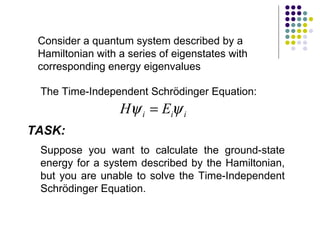
Consider a quantum system described by a Hamiltonian with a series of eigenstates with corresponding energy eigenvalues The Time-Independent Schrödinger Equation: Suppose you want to calculate the ground-state energy for a system described by the Hamiltonian, but you are unable to solve the Time-Independent Schrödinger Equation. TASK:
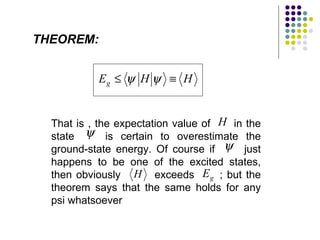
THEOREM: That is , the expectation value of  in the state  is certain to overestimate the ground-state energy. Of course if  just happens to be one of the excited states, then obviously  exceeds  ; but the theorem says that the same holds for any psi whatsoever
PROOF: Since the (unknown) eigenfunctions of  form a complete set, we can express  as linear combination of them: Assuming the eigenfunctions have been orthonormalized
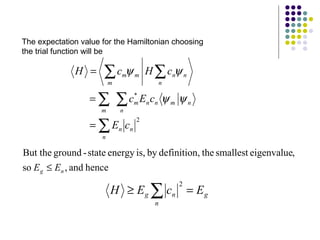
The expectation value for the Hamiltonian choosing the trial function will be
Reference Introduction to Quantum Mechanics, David J. Griffiths, 1994.

The Variational Method

  • 1.
    The Variational MethodJames Salveo L. Olarve PHYDSPHY, DLSU-M January 29, 2010
  • 2.
    This presentation showsa technique of how to solve for the approximate ground state energy using Schrodinger Equation in which the solution for wave function is not on hand. The intended reader of this presentation were physics students. The author already assumed that the reader knows Dirac Braket notation. This presentation was made to facilitate learning in quantum mechanics. INTRODUCTION
  • 3.
    Consider a quantumsystem described by a Hamiltonian with a series of eigenstates with corresponding energy eigenvalues The Time-Independent Schrödinger Equation: Suppose you want to calculate the ground-state energy for a system described by the Hamiltonian, but you are unable to solve the Time-Independent Schrödinger Equation. TASK:
  • 4.
    THEOREM: That is, the expectation value of in the state is certain to overestimate the ground-state energy. Of course if just happens to be one of the excited states, then obviously exceeds ; but the theorem says that the same holds for any psi whatsoever
  • 5.
    PROOF: Since the(unknown) eigenfunctions of form a complete set, we can express as linear combination of them: Assuming the eigenfunctions have been orthonormalized
  • 6.
    The expectation valuefor the Hamiltonian choosing the trial function will be
  • 7.
    Reference Introduction toQuantum Mechanics, David J. Griffiths, 1994.