UEEP2024 Solid State Physics
Topic 5 Magnetism
Magnetic properties of solids
• The magnetic moment of a free atom has
three principal sources :
1. The spin with which electrons are endowed
2. The electron orbital angular momentum about
the nucleus
3. The change in the orbital moment induced by an
applied magnetic field
Magnetic properties of solids
Materials may have intrinsic magnetic dipole moments, or they
may have magnetic dipole moments induced in them by an
applied external magnetic field of induction. In the presence of a
magnetic field of induction, the elementary magnetic dipoles,
whether permanent or induced, will act to set up a field of
induction of their own that will modify the original field. The
magnetic dipole moments are the source of magnetic induction B
MHB oo  
Magnetic field strengthMagnetic
constant
Magnetization
Magnetic properties of solids
Alternative names for B and H
B
name used by
magnetic flux density electrical engineers
magnetic induction applied mathematicians
electrical engineers
magnetic field physicists
H
name used by
magnetic field intensity electrical engineers
magnetic field strength electrical engineers
auxiliary magnetic field physicists
magnetizing field physicists
Magnetic properties of solids
Magnetization is defined as magnetic moment per unit volume.
For certain magnetic materials, it is found empirically that the
magnetization M is proportional to magnetic field strength H
HM 
Magnetic susceptibility
 > 0 -- paramagnetism
 < 0 -- diamagnetiism
Atomic Magnets
• In classical picture of an atom, the electrons
describe a circular orbit around the nucleus.
• Each orbit can therefore be thought of as a loop
of electric current.
• From electromagnetic theory, a loop of current
produces a magnetic field, so electrons in an
atom also generate a magnetic field.
• Quantum theory predicts that electrons in an
atom produce a magnetic field.
• The quantum number n, l, ml and ms label the
electrons in an atom.
Atomic Magnets
• The orbital magnetic number ml takes values
between –l and +l.
• Spin magnetic number ms takes values of
1/2.
• A single electron the component of the spin
magnetic moment, µs, in the direction parallel
to the magnetic field is given by
• The quantity is known as the Bohr
magneton.
ee
s
s
m
e
m
em
2




e
B
m
e
2


Atomic Magnets
• The component of orbital magnetic moment is
given by
• When an atom has more than one electron, for a
particular subshell,
Total spin angular momentum
Total orbital angular momentum
• If a subshell is filled, the values of S and L are
both zero.
• If a subshell is partially filled, electrons are
distributed between different ml and ms states.
Bl
l
l m
m
em
 
2

 smS
 lmL
Hund’s rules
• Two simple rules known as Hund’s rules to
determine how theses states are occupied in a
partially filled sub band.
1. The states are occupied so that as many
electrons as possible have their spin aligned
parallel to one another, i.e. so that the values of
S as large as possible.
2. When it is determined how the spins are
assigned, the electrons occupy states such that
the value of L is a maximum.
Total angular momentum J
• The total angular momemtum J is obtained by
combining L and S as follows:
 If the subshell is less than half filled then J = L-S;
If the subshell is more than half filled then J = L +
S;
If the subshell is exactly half filled then L = 0 and
so J = S.
• By applying these rules, the values of S, L and J
can be determined.
Landé splitting factor g
• The maximum component of the magnetic
moment of the atom in the direction parallel
to the magnetic field is
where g is the Landé splitting factor
• Most atom exhibit a magnetic moment.
Jgm Bj 
)1(2
)1()1()1(3



JJ
LLSSJJ
g
Example
Determine the values of S, L and J for Cr3+
which has three electrons in the 3d subshell.
(All lower energy subshells are filled)
Solution
• The 3d subshell corresponds to l = 2, and therefore ml takes
integer values between -2 and +2. i.e. there are five
allowed values of ml. so that the subband has a capacity to
hold 10 electrons.
• In Cr3+, the three 3d electrons can therefore all occupy ms =
+1/2 and therefore S = 3/2.
• The maximum value of L is obtained if two electrons occupy
the state with ml = +2 and one occupies the ml = +1 state.
However, the exclusion principle forbids two electrons with
the same value of ms from occupying the same ml state.
• Consequently the largest allowed value of L corresponds to
having one electron in each of the states m = +2, +1 and 0,
and therefore L = 3.
• Since the subband is less than half filled, the value of J is
J = L – S = 3 – 3/2 = 3/2.
Which materials have magnetic
moment?
• Filled electron subshell in an atom do not
affect the magnetic moment because S = L = 0
so J = 0.
• Inert atoms have a magnetic moment of zero.
• Ionic materials have a magnetic moment of
zero because the electrons are transferred
from one atom to another so that the
resulting ions have only filled subshells.
Which materials have magnetic
moment?
• In covalent material the outer subshell is only partially
filled, so these materials have finite magnetic moment.
• However, each covalent bond is formed by a pair of
electrons with opposite spin and with a net orbital
angular momentum of zero. Covalent solids have a net
magnetic moment zero.
• Actually, this is not quite true. The present of a
magnetic field also affect the orbital motion of the
electrons in an atom in such a way that the atom
generate a magnetic field which opposes the external
field. This is referred to as diamagnetism.
Which materials have magnetic
moment?
• Filled electron subshells in an atom do not affect
the magnetic momentum of the atom because
they have a net angular momentum of zero.
(S=L=0, so J = 0).
• This means that inert atoms have a magnetic
moment of zero because they have only filled
electron subshells.
• Ionic materials have a magnetic moment of zero
because the electrons are transferred from one
atom type to another so the resulting ions have
only filled subshells.
Which materials have magnetic
moment?
• In covalent materials the outer subshell is only
partially filled, and so these materials have a
finite magnetic moment.
• However, each covalent bond is formed by a pair
of electrons with opposite spin and with net
orbital angular momentum of zero, covalent
solids have a net magnetic moment of zero.
• Although most atoms have a non-zero magnetic
moment, it appears that in majority of solids the
effects cancel and the resultant magnetization is
zero.
Which materials have magnetic
moment?
• The presence of a magnetic field affects the
orbital motion of the electrons in an atom in
such a way that the atom generates a
magnetic field which opposes the external
field. This is referred to as diamagnetism and
occurs in all type of atom.
• It produces a finite magnetic susceptibility in
all solids, but the effect is weak.
Which materials have magnetic
moment?
• It appears that most non-metals display only a small
magnetic susceptibility.
• In simple metal, such as sodium and aluminium, the
valence electrons are assumed to be localized, in other
words they are no longer attached to any particular
atom. As a result the metal ions contains only filled
electron subshells, and so each has a total angular
momentum of zero.
• Although the ions do not contribute to the magnetic
moment, the delocalised electrons do produce a non-
zero magnetic moment. This is known as Pauli
paramagnetism.
Which materials have magnetic
moment?
• Free electron paramagnetism is a weak effect.
• Paramagnetism is caused by the magnetic
dipole moments becoming aligned with the
magnetic field, whereas diamagnetism results
from an induced magnetic field which opposes
the applied field.
• Paramagnetism gives rise to a positive
susceptibility, whilst diamagnetism produces a
negative susceptibility.
Which materials have magnetic
moment?
• A group of metallic elements known as the
transition metal, and the so called rare earth and
actinide elements have more promising
characteristics.
• These materials have an electronic structure
which is very different to that of the simple
metals.
• These elements give rise to Curie paramagnetism.
• Under certain circumstances they can form
permanent magnets.
Diamagnetism
• The value of B is smaller in the region of the
diamagnetic material than it would be if the
material were absent
• The origin of diamagnetism is Lenz’s law
When the flux through an electrical circuit is changed,
an induced current is set up in such a direction as to
oppose the flux change.
Diamagnetism
(Classical theory)
2
omRF 
Consider an electron in a
circular orbit of radius R and
angular frequency o
If a magnetic field dB is turned
on, and assume it affects
angular frequency only
BqvmRF o d  2
Diamagnetism
(Classical theory)
   
    BqRmRmR
BqRmRmR
BqvmRmR
oooo
ooo
o
dddd
ddd
d



222
22
22
2
The new angular frequency 
Taking only first order form (assume o>>d)
m
Bq
BqRmR oo
2
2
d
ddd 
Classically, the B field will make the electrons revolve slower
Diamagnetism
(Classical theory)

d
d


22
qIqI 
Current formed by the loop = charge x revolution/second
For an electron in an atom
m
Be
I
m
Bqq
I

d
d
d

d
422
2

The magnetic moment  = (curent) x (area of the loop)
m
Be
m
Be
44
22
2
2
d


d
 
Diamagnetism
(Classical theory)
2
2
1 4

d

m
BZeZ
i
i 
For an atom with Z electrons
If r = radius of the 3-D electron shell
2222
zyxr 
For a spherically symmetrical distribution of charge
22222
2
3
 rzyx
 is the radius of the electron loops
222
yx 
Diamagnetism
(Classical theory)
2
2
6
r
m
BZe
atom
d
 
The magnetic moment of an atom with Z electrons
Diamagnetic susceptibility per unit volume
B
N atomo
d

 
Classical Langevin equation for diamagnetism
2
2
6
r
m
NZeo
 
Number of atoms per
unit volume
Paramagnetism
• When atoms possess their own magnetic
moment, paramagnetism will occur
In a paramagnetic material the atoms contain permanent
magnetic dipole moments. An externally applied B field will
tend to align these dipole moments parallel to the field. The
result is an induced field that adds to the applied field so
that the susceptibility is positive.
1. Electron spin
2. Orbital motion of the electrons
Paramagnetism
• In atoms with filled subshells, the spin
magnetic dipole moments, and separately the
orbital magnetic dipole moments, cancel in
pairs.
• The inert gas, have closed subshell
configurations, so that they do not exhibit
paramagnetism and are excellent for
diamagnetic studies.
Paramagnetism
• Only unfilled subshells can have unpaired electrons,
so that we expect paramagnetism only in material
containing atoms whose electronic subshells are
partly filled.
• The basic requirement for paramagnetism in solids is
that the individual magnetic dipole moments have
some degree of isolation
If wave functions of atoms overlap significantly, they will tend to pair up
the magnetic dipole moments
Paramagnetism
• Unfilled inner subshells
• Isolation of the individual moments results
from the shielding of these inner subshells by
the filled outer subshells
Transition elements Rare earth elements
Paramagnetic solids
Paramagnetism
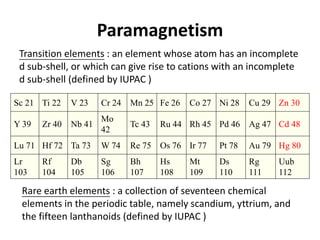
Transition elements : an element whose atom has an incomplete
d sub-shell, or which can give rise to cations with an incomplete
d sub-shell (defined by IUPAC )
Sc 21 Ti 22 V 23 Cr 24 Mn 25 Fe 26 Co 27 Ni 28 Cu 29 Zn 30
Y 39 Zr 40 Nb 41
Mo
42
Tc 43 Ru 44 Rh 45 Pd 46 Ag 47 Cd 48
Lu 71 Hf 72 Ta 73 W 74 Re 75 Os 76 Ir 77 Pt 78 Au 79 Hg 80
Lr
103
Rf
104
Db
105
Sg
106
Bh
107
Hs
108
Mt
109
Ds
110
Rg
111
Uub
112
Rare earth elements : a collection of seventeen chemical
elements in the periodic table, namely scandium, yttrium, and
the fifteen lanthanoids (defined by IUPAC )
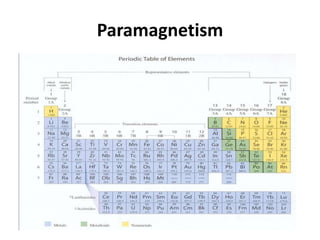
Paramagnetism
Paramagnetism
1s<2s<2p<3s<3p<4s<3d<4p<5s<4d<5p<6s<4f5d<6p<7s<5f<6d<7p
Paramagnetism
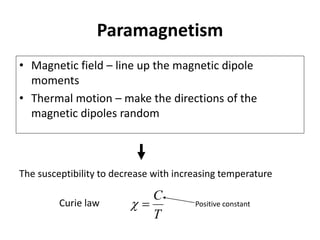
• Magnetic field – line up the magnetic dipole
moments
• Thermal motion – make the directions of the
magnetic dipoles random
The susceptibility to decrease with increasing temperature
T
C
Curie law Positive constant
Paramagnetism
JgJ B  
The magnetic moment of an atom in free space is
Total angular momentum = sum of the orbital and spin
angular momentum
, gyromagnetic ratio – the ratio of the magnetic moment to
the angular momentum
B, Bohr magneton – is define as eh/4m
g – g factor or spectroscopic splitting factor
Paramagnetism
     
 12
111
1



JJ
LLSSJJ
g
The g factor comes about during the calculation of the first-
order perturbation in the energy of an atom when a weak
uniform magnetic field is applied to the system
J : the total electronic angular momentum
L : the orbital angular momentum
S : the spin angular momentum
The energy levels of the system in an applied magnetic field B
are
BE

 
Paramagnetism
When there is no field (B=0)

 NN
Paramagnetism
When an external field is applied
Paramagnetism






F
F
E
B
E
B
dEBEDN
dEBEDN




)(
2
1
)(
2
1
The total magnetic moment
B
E
N
NNM
F2
3
)(
2

  
Pauli paramagnetism
Ordered magnetic materials
• Interaction between the 3d electrons in these materials
have two effect on the magnetic moments of the ions
1. Interaction affects the orbital angular momentum
in such a way that the average orbital angular
momentum on neighbouring ions cancels. Magnetic
moment due to orbital angular momentum become
zero.
2. The spins of the 3d electrons interact in such a way
that there is a correlation between the spins of 3d
electrons on neighbouring ions. This is called the
exchange interaction.
Ordered magnetic materials
• If the interaction between the electrons is
sufficiently strong, it is energetically
favourable for the electrons in the two ions to
have the same spin.
• Each ion affects the dipole moment of each of
its neighbouring ions, then all of the atomic
dipoles in the crystal will be aligned in a
common direction.
• Such a material is called a ferromagnet.
Ordered magnetic materials
• The exchange interaction provides a
mechanism for aligning the atomic dipoles
without the need for an external field.
• Ferromagnet can have a large magnetization
even when no external field is present.
Ordered magnetic materials
• Some materials retain their magnetization even in
the absence of a magnetic field.
• These materials are referred to as permanent
magnet.
• To explain this type of behaviour, require some
mechanism for causing the magnetic diople on
neighbouring ions to become mutually aligned
without the aid of an external magnetic field.
• The 3d electrons in the iron group of transistion
metals interact strongly with similar electrons on
neighbouring ions.
Three simplest type of ordering of
atomic magnetic moments .
(a) Ferromagnetic.
(adjacent magnetic
moment are
aligned)
(b) Antiferromagnetic
(adjacent
magnetic
moment are
antiparallel)
(c) Ferrimagnetic
(adjacent magnetic
moment are
antiparalle and
unequal magnitude)
Long range magnetic ordering
• Long range magnetic ordering is duo to exchange field from
neighbors
• Magnetic ordered states occurs only ay low temperatures (T <
Tc). When T > Tc there will be no ordering and the material
has to be paramagnetic
• Three common types of magnetic ordering :
Spontaneous magnetisation
Ordered magnetic materials
• Another possible way of
ordering the dipoles is if the
magnetic dipoles in
adjacent planes are
misaligned in such a way
that the dipole form a helix.
• Example, in magnesium
dioxide the angle between
the dipoles is about 129o.
• These materials are called
helimagnets.
In a helimagnet the
magnetic dipoles are rotated
by a fixed angle
Example
Show that the magnetic susceptibility due to
the delocalized electrons in a metal is given by
.)(
2
omFm mEg  
Solution
• The number of electrons in the shaded region
on the left hand side is
• Factor of ½ is because only using one-half of
the electron distribution.
• If the total number of valence electrons per
unit volume is N, then the number aligned
parallel to the field is
• number aligned antiparallel to the field is
omF BmEg )(
2
1
.)(
2
1
2
omF BmEg
N
N 
.)(
2
1
2
omF BmEg
N
N 
Solution
• The difference is therefore
• Since each electron contributes a magnetic
moment mm.
• The magnetism is
• Susceptibility
.)( onF BmEgNN  
omFm BmEgmNNM
2
)()(  
2
)( mFo
o
o
m mEg
B
M


 
Example
the probability that an atomic dipole moment
mj is given by where A is a contant as
a function of temperature.
Show that the temperature dependence of the
magnetic susceptibility can be written as
where C is a constant.(called Curie constant)
,kT
Bm oj
Ae
T
C
m 
Solution
• If there are N magnetic ions per unit volume,
then the total number of dipole in this state is
and the magnetic moment of
these atom is
Magnetization M of the crystal
kT
Bm oj
NAe
kT
Bm
j
oj
NAem


j
j
kT
Bm
j
oj
NAemM
Solution
• Since at room temperature mjBo is very much
smaller than the thermal energy kT,
• Magnetization becomes
where C’ is a constant
kT
Bm
e ojkT
Bm oj
1
T
BC
m
kT
NAB
kT
Bm
NA
kT
Bm
mNA
kT
Bm
NAmM
o
j
j
j
o
j
j
oj
j
j
oj
j
j
j
oj
j




































2
2
2
1
Solution
• Susceptibility
T
C
T
C
B
M o
o
o
B 




Example
Calculate the magnetization of magnetite,
Fe3O4, assuming that the magnetization is due
only to the Fe2+ ions (which have six 3d
electrons) and that only the spin angular
momentum of the electrons contributes to
the magnetic moment of the ions. (The molar
volume of Fe3O4 is 4.40×10⁻⁵ m-3.)
Solution
• According to the Hund’s rule, the six 3d electrons
in each Fe2+ ion are arranged so that the spins of
five of the electrons are parallel to one another
and the sixth electron is antiparallel.
• This can be represented as ↑↑↑↑↑↓.
• Since each electron has a spin magnetic moment
of µB, the net magnetic dipole moment per ions is
4 µB, and so the dipole moment per mole is 4
µBNA where NA is avogadro’s number.
Solution
• The magnetization
.mJT1007.5
molm1040.4
)mol1002.6)(TJ1027.9)(4(
memolar volu
4
315
135
123124







 AB N
M

Temperature dependence of
permanent magnets
• When a permanent magnet is heated it is found
that there is a temperature above which the
magnetization of the material disappears.
• The transition point is known as the curie
temperature.
• Above the curie temperature the material
behaves like a paramagnet- the dipoles are
randomly aligned unless they are exposed to an
external magnetic field.
Temperature dependence of
permanent magnets
• The magnetic susceptibility of this magnetic
material is given by a modified form of the Curie
law, known as Curie-Weiss law,
where c is the Curie temperature.
• As the temperature of a ferromagnet is lowered
towards the Curie point, all the atomic dipoles
move to the lowest energy state and therefore
become aligned along a common direction.
c
m
T
C




Values of the saturation magnetization at 300 K shown as
Ms (JT-1 m-3), µoMs(T) and Curie temperature c(K).
Ms (×105 J T-1 m-3) µoMs (T) c (K)
Iron 17.1 2.15 1043
Cobalt 14.0 1.76 1388
Nickel 4.85 0.61 627
Gadolinium 20.6 2.60 292
CrO2 5.18 0.65 386
Fe3O4 4.80 0.60 858
MnFe2O4 4.10 0.52 573
NiFe2O4 2.70 0.34 858
Temperature dependence of
permanent magnets
• In iron, cobalt and nickel the curie temperature is
well above room temperature.
• Some material, their Curie points are below room
temperature, such materials are not normally
used as permanent magnet.
• The existence of the Curie temperature can be
explained as follow.
• As the temperature is increased, the thermal
vibrations of the ions become so large that the
alignment of the magnetic dipoles is destroyed.
Temperature dependence of
permanent magnets
• This happens when the thermal energy kT is
comparable with the interaction energy between
the neighbouring dipoles.
• Since thermal effects are random in nature, we
might expect the transition to occur gradually
over a temperature range of several degrees, but
the Curie temperature is remarkably well defined.
• To understand why this is so, let us consider what
happens if we have a ferromagnetic material in
the absence of any external magnetic field.
Temperature dependence of
permanent magnets
• Suppose that initially the temperature is higher than the Curie
temperature.
• In this case the magnetic dipoles are orientated in random directions.
• If the temperature is now lowered, then as we reach the Curie
temperature we find that the thermal vibrations are weak enough to allow
a few neighbouring magnetic dipoles to become aligned.
• As the result these aligned dipoles create a local magnetic field within the
sample, so other neighbouring dipoles tend to become aligned in the
same direction, which in turn further increases the strength of the internal
magnetic field.
• So we have a runaway process which does not stop until all of the
magnetic dipoles in the crystal are aligned in the same direction.
• Such process is known as a cooperative transition.
• Consequently, the change from a disordered paramagnet to an ordered
magnetic material takes place over a very narrow temperature range.
Application of magnetic materials for
information storage
• This includes audio and video tapes, floppy disks and hard
disks for computers.
• The basic principle of magnetic storage of information is
broadly similar regardless of whether the data stored is
digital or analogue.
• The magnetic medium is covered by many small magnetic
particles, each of which behaves as a single domian.
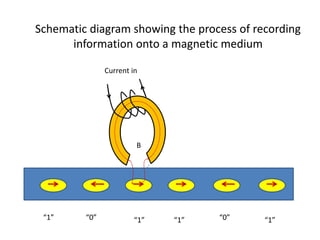
• A magnet- known as the write head- is used to record
information onto this medium by orientating the magnetic
particles along particular direction.
• Reading the information from the tape or disk is simply the
reverse of this process- the magnetic field produced by the
magnetic particles induces a magnetization in the read
head.
Schematic diagram showing the process of recording
information onto a magnetic medium
Current in
“1” “1” “1” “1”“0” “0”
B
Application of magnetic materials for
information storage
• The choice of material for magnetic recording
medium depends on several factors.
• The coercivity must be low enough so that the
orientation of the particles can be altered by the
write head, but high enough so that the
orientation is not accidentally affected by other
external magnetic fields.
• The curie temperature should also be well above
the temperature to which the material will
normally be exposed.
Application of magnetic materials for
information storage
• Magnetic hard disks are used in computer
because they are considerably cheaper than
semiconductor memory.
• They are not volatile.
• Magnetic system does not require a constant
electric power supply in order to remain in the
same memory state.
Application of magnetic materials for
information storage
• In order to keep pace with the advances in
semiconductor technology it has been necessary
to increase continually the storage density of
these magnetic hard disks, from about 2 MB cm-2
in 1980 to 75 MB cm-2 in 1996.
• Firstly the size of magnetic particle is reduced.
• The read head are made using magnetoresistive
materials. ( resistance change in the present of
magnetic field)
• Align the particle so that they are perpendicular
to the surface of the disk.
Orientation of particle perpendicular
to the surface to increase its density.
Orientated parallel to
the surface
Orientated perpendicular to
the surface
Application of magnetic materials for
information storage
• The write process is achieved by using a laser
beam to heat a magnetic particle above the Curie
temperature as a magnetic field is applied.
• As it cool down the particle retains the
magnetization of the applied field.
• To read the information another (weaker)
polarized laser beam is directed onto the surface.
• The polarization of the reflected beam is
determined by the direction of magnetization of
each particle.

Magnetism

  • 1.
    UEEP2024 Solid StatePhysics Topic 5 Magnetism
  • 2.
    Magnetic properties ofsolids • The magnetic moment of a free atom has three principal sources : 1. The spin with which electrons are endowed 2. The electron orbital angular momentum about the nucleus 3. The change in the orbital moment induced by an applied magnetic field
  • 3.
    Magnetic properties ofsolids Materials may have intrinsic magnetic dipole moments, or they may have magnetic dipole moments induced in them by an applied external magnetic field of induction. In the presence of a magnetic field of induction, the elementary magnetic dipoles, whether permanent or induced, will act to set up a field of induction of their own that will modify the original field. The magnetic dipole moments are the source of magnetic induction B MHB oo   Magnetic field strengthMagnetic constant Magnetization
  • 4.
    Magnetic properties ofsolids Alternative names for B and H B name used by magnetic flux density electrical engineers magnetic induction applied mathematicians electrical engineers magnetic field physicists H name used by magnetic field intensity electrical engineers magnetic field strength electrical engineers auxiliary magnetic field physicists magnetizing field physicists
  • 5.
    Magnetic properties ofsolids Magnetization is defined as magnetic moment per unit volume. For certain magnetic materials, it is found empirically that the magnetization M is proportional to magnetic field strength H HM  Magnetic susceptibility  > 0 -- paramagnetism  < 0 -- diamagnetiism
  • 6.
    Atomic Magnets • Inclassical picture of an atom, the electrons describe a circular orbit around the nucleus. • Each orbit can therefore be thought of as a loop of electric current. • From electromagnetic theory, a loop of current produces a magnetic field, so electrons in an atom also generate a magnetic field. • Quantum theory predicts that electrons in an atom produce a magnetic field. • The quantum number n, l, ml and ms label the electrons in an atom.
  • 7.
    Atomic Magnets • Theorbital magnetic number ml takes values between –l and +l. • Spin magnetic number ms takes values of 1/2. • A single electron the component of the spin magnetic moment, µs, in the direction parallel to the magnetic field is given by • The quantity is known as the Bohr magneton. ee s s m e m em 2     e B m e 2  
  • 8.
    Atomic Magnets • Thecomponent of orbital magnetic moment is given by • When an atom has more than one electron, for a particular subshell, Total spin angular momentum Total orbital angular momentum • If a subshell is filled, the values of S and L are both zero. • If a subshell is partially filled, electrons are distributed between different ml and ms states. Bl l l m m em   2   smS  lmL
  • 9.
    Hund’s rules • Twosimple rules known as Hund’s rules to determine how theses states are occupied in a partially filled sub band. 1. The states are occupied so that as many electrons as possible have their spin aligned parallel to one another, i.e. so that the values of S as large as possible. 2. When it is determined how the spins are assigned, the electrons occupy states such that the value of L is a maximum.
  • 10.
    Total angular momentumJ • The total angular momemtum J is obtained by combining L and S as follows:  If the subshell is less than half filled then J = L-S; If the subshell is more than half filled then J = L + S; If the subshell is exactly half filled then L = 0 and so J = S. • By applying these rules, the values of S, L and J can be determined.
  • 11.
    Landé splitting factorg • The maximum component of the magnetic moment of the atom in the direction parallel to the magnetic field is where g is the Landé splitting factor • Most atom exhibit a magnetic moment. Jgm Bj  )1(2 )1()1()1(3    JJ LLSSJJ g
  • 12.
    Example Determine the valuesof S, L and J for Cr3+ which has three electrons in the 3d subshell. (All lower energy subshells are filled)
  • 13.
    Solution • The 3dsubshell corresponds to l = 2, and therefore ml takes integer values between -2 and +2. i.e. there are five allowed values of ml. so that the subband has a capacity to hold 10 electrons. • In Cr3+, the three 3d electrons can therefore all occupy ms = +1/2 and therefore S = 3/2. • The maximum value of L is obtained if two electrons occupy the state with ml = +2 and one occupies the ml = +1 state. However, the exclusion principle forbids two electrons with the same value of ms from occupying the same ml state. • Consequently the largest allowed value of L corresponds to having one electron in each of the states m = +2, +1 and 0, and therefore L = 3. • Since the subband is less than half filled, the value of J is J = L – S = 3 – 3/2 = 3/2.
  • 14.
    Which materials havemagnetic moment? • Filled electron subshell in an atom do not affect the magnetic moment because S = L = 0 so J = 0. • Inert atoms have a magnetic moment of zero. • Ionic materials have a magnetic moment of zero because the electrons are transferred from one atom to another so that the resulting ions have only filled subshells.
  • 15.
    Which materials havemagnetic moment? • In covalent material the outer subshell is only partially filled, so these materials have finite magnetic moment. • However, each covalent bond is formed by a pair of electrons with opposite spin and with a net orbital angular momentum of zero. Covalent solids have a net magnetic moment zero. • Actually, this is not quite true. The present of a magnetic field also affect the orbital motion of the electrons in an atom in such a way that the atom generate a magnetic field which opposes the external field. This is referred to as diamagnetism.
  • 16.
    Which materials havemagnetic moment? • Filled electron subshells in an atom do not affect the magnetic momentum of the atom because they have a net angular momentum of zero. (S=L=0, so J = 0). • This means that inert atoms have a magnetic moment of zero because they have only filled electron subshells. • Ionic materials have a magnetic moment of zero because the electrons are transferred from one atom type to another so the resulting ions have only filled subshells.
  • 17.
    Which materials havemagnetic moment? • In covalent materials the outer subshell is only partially filled, and so these materials have a finite magnetic moment. • However, each covalent bond is formed by a pair of electrons with opposite spin and with net orbital angular momentum of zero, covalent solids have a net magnetic moment of zero. • Although most atoms have a non-zero magnetic moment, it appears that in majority of solids the effects cancel and the resultant magnetization is zero.
  • 18.
    Which materials havemagnetic moment? • The presence of a magnetic field affects the orbital motion of the electrons in an atom in such a way that the atom generates a magnetic field which opposes the external field. This is referred to as diamagnetism and occurs in all type of atom. • It produces a finite magnetic susceptibility in all solids, but the effect is weak.
  • 19.
    Which materials havemagnetic moment? • It appears that most non-metals display only a small magnetic susceptibility. • In simple metal, such as sodium and aluminium, the valence electrons are assumed to be localized, in other words they are no longer attached to any particular atom. As a result the metal ions contains only filled electron subshells, and so each has a total angular momentum of zero. • Although the ions do not contribute to the magnetic moment, the delocalised electrons do produce a non- zero magnetic moment. This is known as Pauli paramagnetism.
  • 20.
    Which materials havemagnetic moment? • Free electron paramagnetism is a weak effect. • Paramagnetism is caused by the magnetic dipole moments becoming aligned with the magnetic field, whereas diamagnetism results from an induced magnetic field which opposes the applied field. • Paramagnetism gives rise to a positive susceptibility, whilst diamagnetism produces a negative susceptibility.
  • 21.
    Which materials havemagnetic moment? • A group of metallic elements known as the transition metal, and the so called rare earth and actinide elements have more promising characteristics. • These materials have an electronic structure which is very different to that of the simple metals. • These elements give rise to Curie paramagnetism. • Under certain circumstances they can form permanent magnets.
  • 22.
    Diamagnetism • The valueof B is smaller in the region of the diamagnetic material than it would be if the material were absent • The origin of diamagnetism is Lenz’s law When the flux through an electrical circuit is changed, an induced current is set up in such a direction as to oppose the flux change.
  • 23.
    Diamagnetism (Classical theory) 2 omRF  Consideran electron in a circular orbit of radius R and angular frequency o If a magnetic field dB is turned on, and assume it affects angular frequency only BqvmRF o d  2
  • 24.
    Diamagnetism (Classical theory)        BqRmRmR BqRmRmR BqvmRmR oooo ooo o dddd ddd d    222 22 22 2 The new angular frequency  Taking only first order form (assume o>>d) m Bq BqRmR oo 2 2 d ddd  Classically, the B field will make the electrons revolve slower
  • 25.
    Diamagnetism (Classical theory)  d d   22 qIqI  Currentformed by the loop = charge x revolution/second For an electron in an atom m Be I m Bqq I  d d d  d 422 2  The magnetic moment  = (curent) x (area of the loop) m Be m Be 44 22 2 2 d   d  
  • 26.
    Diamagnetism (Classical theory) 2 2 1 4  d  m BZeZ i i For an atom with Z electrons If r = radius of the 3-D electron shell 2222 zyxr  For a spherically symmetrical distribution of charge 22222 2 3  rzyx  is the radius of the electron loops 222 yx 
  • 27.
    Diamagnetism (Classical theory) 2 2 6 r m BZe atom d   Themagnetic moment of an atom with Z electrons Diamagnetic susceptibility per unit volume B N atomo d    Classical Langevin equation for diamagnetism 2 2 6 r m NZeo   Number of atoms per unit volume
  • 28.
    Paramagnetism • When atomspossess their own magnetic moment, paramagnetism will occur In a paramagnetic material the atoms contain permanent magnetic dipole moments. An externally applied B field will tend to align these dipole moments parallel to the field. The result is an induced field that adds to the applied field so that the susceptibility is positive. 1. Electron spin 2. Orbital motion of the electrons
  • 29.
    Paramagnetism • In atomswith filled subshells, the spin magnetic dipole moments, and separately the orbital magnetic dipole moments, cancel in pairs. • The inert gas, have closed subshell configurations, so that they do not exhibit paramagnetism and are excellent for diamagnetic studies.
  • 30.
    Paramagnetism • Only unfilledsubshells can have unpaired electrons, so that we expect paramagnetism only in material containing atoms whose electronic subshells are partly filled. • The basic requirement for paramagnetism in solids is that the individual magnetic dipole moments have some degree of isolation If wave functions of atoms overlap significantly, they will tend to pair up the magnetic dipole moments
  • 31.
    Paramagnetism • Unfilled innersubshells • Isolation of the individual moments results from the shielding of these inner subshells by the filled outer subshells Transition elements Rare earth elements Paramagnetic solids
  • 32.
    Paramagnetism Transition elements :an element whose atom has an incomplete d sub-shell, or which can give rise to cations with an incomplete d sub-shell (defined by IUPAC ) Sc 21 Ti 22 V 23 Cr 24 Mn 25 Fe 26 Co 27 Ni 28 Cu 29 Zn 30 Y 39 Zr 40 Nb 41 Mo 42 Tc 43 Ru 44 Rh 45 Pd 46 Ag 47 Cd 48 Lu 71 Hf 72 Ta 73 W 74 Re 75 Os 76 Ir 77 Pt 78 Au 79 Hg 80 Lr 103 Rf 104 Db 105 Sg 106 Bh 107 Hs 108 Mt 109 Ds 110 Rg 111 Uub 112 Rare earth elements : a collection of seventeen chemical elements in the periodic table, namely scandium, yttrium, and the fifteen lanthanoids (defined by IUPAC )
  • 33.
  • 34.
  • 35.
    Paramagnetism • Magnetic field– line up the magnetic dipole moments • Thermal motion – make the directions of the magnetic dipoles random The susceptibility to decrease with increasing temperature T C Curie law Positive constant
  • 36.
    Paramagnetism JgJ B  The magnetic moment of an atom in free space is Total angular momentum = sum of the orbital and spin angular momentum , gyromagnetic ratio – the ratio of the magnetic moment to the angular momentum B, Bohr magneton – is define as eh/4m g – g factor or spectroscopic splitting factor
  • 37.
    Paramagnetism       12 111 1    JJ LLSSJJ g The g factor comes about during the calculation of the first- order perturbation in the energy of an atom when a weak uniform magnetic field is applied to the system J : the total electronic angular momentum L : the orbital angular momentum S : the spin angular momentum The energy levels of the system in an applied magnetic field B are BE   
  • 38.
    Paramagnetism When there isno field (B=0)   NN
  • 39.
  • 40.
  • 41.
    Ordered magnetic materials •Interaction between the 3d electrons in these materials have two effect on the magnetic moments of the ions 1. Interaction affects the orbital angular momentum in such a way that the average orbital angular momentum on neighbouring ions cancels. Magnetic moment due to orbital angular momentum become zero. 2. The spins of the 3d electrons interact in such a way that there is a correlation between the spins of 3d electrons on neighbouring ions. This is called the exchange interaction.
  • 42.
    Ordered magnetic materials •If the interaction between the electrons is sufficiently strong, it is energetically favourable for the electrons in the two ions to have the same spin. • Each ion affects the dipole moment of each of its neighbouring ions, then all of the atomic dipoles in the crystal will be aligned in a common direction. • Such a material is called a ferromagnet.
  • 43.
    Ordered magnetic materials •The exchange interaction provides a mechanism for aligning the atomic dipoles without the need for an external field. • Ferromagnet can have a large magnetization even when no external field is present.
  • 44.
    Ordered magnetic materials •Some materials retain their magnetization even in the absence of a magnetic field. • These materials are referred to as permanent magnet. • To explain this type of behaviour, require some mechanism for causing the magnetic diople on neighbouring ions to become mutually aligned without the aid of an external magnetic field. • The 3d electrons in the iron group of transistion metals interact strongly with similar electrons on neighbouring ions.
  • 45.
    Three simplest typeof ordering of atomic magnetic moments . (a) Ferromagnetic. (adjacent magnetic moment are aligned) (b) Antiferromagnetic (adjacent magnetic moment are antiparallel) (c) Ferrimagnetic (adjacent magnetic moment are antiparalle and unequal magnitude)
  • 46.
    Long range magneticordering • Long range magnetic ordering is duo to exchange field from neighbors • Magnetic ordered states occurs only ay low temperatures (T < Tc). When T > Tc there will be no ordering and the material has to be paramagnetic • Three common types of magnetic ordering : Spontaneous magnetisation
  • 47.
    Ordered magnetic materials •Another possible way of ordering the dipoles is if the magnetic dipoles in adjacent planes are misaligned in such a way that the dipole form a helix. • Example, in magnesium dioxide the angle between the dipoles is about 129o. • These materials are called helimagnets. In a helimagnet the magnetic dipoles are rotated by a fixed angle
  • 48.
    Example Show that themagnetic susceptibility due to the delocalized electrons in a metal is given by .)( 2 omFm mEg  
  • 49.
    Solution • The numberof electrons in the shaded region on the left hand side is • Factor of ½ is because only using one-half of the electron distribution. • If the total number of valence electrons per unit volume is N, then the number aligned parallel to the field is • number aligned antiparallel to the field is omF BmEg )( 2 1 .)( 2 1 2 omF BmEg N N  .)( 2 1 2 omF BmEg N N 
  • 50.
    Solution • The differenceis therefore • Since each electron contributes a magnetic moment mm. • The magnetism is • Susceptibility .)( onF BmEgNN   omFm BmEgmNNM 2 )()(   2 )( mFo o o m mEg B M    
  • 51.
    Example the probability thatan atomic dipole moment mj is given by where A is a contant as a function of temperature. Show that the temperature dependence of the magnetic susceptibility can be written as where C is a constant.(called Curie constant) ,kT Bm oj Ae T C m 
  • 52.
    Solution • If thereare N magnetic ions per unit volume, then the total number of dipole in this state is and the magnetic moment of these atom is Magnetization M of the crystal kT Bm oj NAe kT Bm j oj NAem   j j kT Bm j oj NAemM
  • 53.
    Solution • Since atroom temperature mjBo is very much smaller than the thermal energy kT, • Magnetization becomes where C’ is a constant kT Bm e ojkT Bm oj 1 T BC m kT NAB kT Bm NA kT Bm mNA kT Bm NAmM o j j j o j j oj j j oj j j j oj j                                     2 2 2 1
  • 54.
  • 55.
    Example Calculate the magnetizationof magnetite, Fe3O4, assuming that the magnetization is due only to the Fe2+ ions (which have six 3d electrons) and that only the spin angular momentum of the electrons contributes to the magnetic moment of the ions. (The molar volume of Fe3O4 is 4.40×10⁻⁵ m-3.)
  • 56.
    Solution • According tothe Hund’s rule, the six 3d electrons in each Fe2+ ion are arranged so that the spins of five of the electrons are parallel to one another and the sixth electron is antiparallel. • This can be represented as ↑↑↑↑↑↓. • Since each electron has a spin magnetic moment of µB, the net magnetic dipole moment per ions is 4 µB, and so the dipole moment per mole is 4 µBNA where NA is avogadro’s number.
  • 57.
    Solution • The magnetization .mJT1007.5 molm1040.4 )mol1002.6)(TJ1027.9)(4( memolarvolu 4 315 135 123124         AB N M 
  • 58.
    Temperature dependence of permanentmagnets • When a permanent magnet is heated it is found that there is a temperature above which the magnetization of the material disappears. • The transition point is known as the curie temperature. • Above the curie temperature the material behaves like a paramagnet- the dipoles are randomly aligned unless they are exposed to an external magnetic field.
  • 59.
    Temperature dependence of permanentmagnets • The magnetic susceptibility of this magnetic material is given by a modified form of the Curie law, known as Curie-Weiss law, where c is the Curie temperature. • As the temperature of a ferromagnet is lowered towards the Curie point, all the atomic dipoles move to the lowest energy state and therefore become aligned along a common direction. c m T C    
  • 60.
    Values of thesaturation magnetization at 300 K shown as Ms (JT-1 m-3), µoMs(T) and Curie temperature c(K). Ms (×105 J T-1 m-3) µoMs (T) c (K) Iron 17.1 2.15 1043 Cobalt 14.0 1.76 1388 Nickel 4.85 0.61 627 Gadolinium 20.6 2.60 292 CrO2 5.18 0.65 386 Fe3O4 4.80 0.60 858 MnFe2O4 4.10 0.52 573 NiFe2O4 2.70 0.34 858
  • 61.
    Temperature dependence of permanentmagnets • In iron, cobalt and nickel the curie temperature is well above room temperature. • Some material, their Curie points are below room temperature, such materials are not normally used as permanent magnet. • The existence of the Curie temperature can be explained as follow. • As the temperature is increased, the thermal vibrations of the ions become so large that the alignment of the magnetic dipoles is destroyed.
  • 62.
    Temperature dependence of permanentmagnets • This happens when the thermal energy kT is comparable with the interaction energy between the neighbouring dipoles. • Since thermal effects are random in nature, we might expect the transition to occur gradually over a temperature range of several degrees, but the Curie temperature is remarkably well defined. • To understand why this is so, let us consider what happens if we have a ferromagnetic material in the absence of any external magnetic field.
  • 63.
    Temperature dependence of permanentmagnets • Suppose that initially the temperature is higher than the Curie temperature. • In this case the magnetic dipoles are orientated in random directions. • If the temperature is now lowered, then as we reach the Curie temperature we find that the thermal vibrations are weak enough to allow a few neighbouring magnetic dipoles to become aligned. • As the result these aligned dipoles create a local magnetic field within the sample, so other neighbouring dipoles tend to become aligned in the same direction, which in turn further increases the strength of the internal magnetic field. • So we have a runaway process which does not stop until all of the magnetic dipoles in the crystal are aligned in the same direction. • Such process is known as a cooperative transition. • Consequently, the change from a disordered paramagnet to an ordered magnetic material takes place over a very narrow temperature range.
  • 64.
    Application of magneticmaterials for information storage • This includes audio and video tapes, floppy disks and hard disks for computers. • The basic principle of magnetic storage of information is broadly similar regardless of whether the data stored is digital or analogue. • The magnetic medium is covered by many small magnetic particles, each of which behaves as a single domian. • A magnet- known as the write head- is used to record information onto this medium by orientating the magnetic particles along particular direction. • Reading the information from the tape or disk is simply the reverse of this process- the magnetic field produced by the magnetic particles induces a magnetization in the read head.
  • 65.
    Schematic diagram showingthe process of recording information onto a magnetic medium Current in “1” “1” “1” “1”“0” “0” B
  • 66.
    Application of magneticmaterials for information storage • The choice of material for magnetic recording medium depends on several factors. • The coercivity must be low enough so that the orientation of the particles can be altered by the write head, but high enough so that the orientation is not accidentally affected by other external magnetic fields. • The curie temperature should also be well above the temperature to which the material will normally be exposed.
  • 67.
    Application of magneticmaterials for information storage • Magnetic hard disks are used in computer because they are considerably cheaper than semiconductor memory. • They are not volatile. • Magnetic system does not require a constant electric power supply in order to remain in the same memory state.
  • 68.
    Application of magneticmaterials for information storage • In order to keep pace with the advances in semiconductor technology it has been necessary to increase continually the storage density of these magnetic hard disks, from about 2 MB cm-2 in 1980 to 75 MB cm-2 in 1996. • Firstly the size of magnetic particle is reduced. • The read head are made using magnetoresistive materials. ( resistance change in the present of magnetic field) • Align the particle so that they are perpendicular to the surface of the disk.
  • 69.
    Orientation of particleperpendicular to the surface to increase its density. Orientated parallel to the surface Orientated perpendicular to the surface
  • 70.
    Application of magneticmaterials for information storage • The write process is achieved by using a laser beam to heat a magnetic particle above the Curie temperature as a magnetic field is applied. • As it cool down the particle retains the magnetization of the applied field. • To read the information another (weaker) polarized laser beam is directed onto the surface. • The polarization of the reflected beam is determined by the direction of magnetization of each particle.