.
DENSITY
FUNCTIONAL
THEORY
Project mentor :- Dr. Divya Srivastava
Sandhya Singh
2016MSPH007
M.Sc. Physics,
Department of Physics,
Central University of Rajasthan
CONTENTS
• History .
• Background.
• Fundamentals of DFT.
• Working of DFT.
• Example .
• Hohenberg- kohn theorems.
• Energy functional .
• Kohn – sham scheme.
• Doing DFT calculation (practical aspect).
HISTORY
1920: INTRODUCTION OF THE THOMAS FERMI MODEL
1964: HOHENBERG-KOHN PAPER PROVING EXISTENCE OF
EXACT DFT
1965: KOHN-SHAM SCHEME INTRODUCED
1970S AND EARLY 80S: DFT BECOMES USEFUL.
1998: NOBEL PRIZE AWARDED TO WALTER KOHN IN
CHEMISTRY FOR DEVELOPMENT OF DFT.
BACKGROUND
 To solve many body problems by Schrödinger's equation.
 Only upto one electron problem we can solve
Schrödinger's equation exactly.
 it is very hectic to solve the Schrödinger's equation for a
N- body system.
 We must involve some approximation to solve the problem
a method to obtain an approximate solution to the
Schrödinger's equation of a many body system is DFT.
We discuss two parts :
• Part 1 : fundamentals of density functional theory .
o solving many body Schrödinger equation .
o Applications of DFT.
• Part 2: doing DFT calculations - practical aspect .
DENSITY FUNCTIONAL THEORY
• DFT is a computational quantum mechanical modelling
method used in physics ,chemistry, & material science to
investigate the electronic structure ( ground state) of many
body systems .
• Using this theory the properties of many- electron system
can be determined by using FUNCTIONALS.
• in DFT instead of considering wave function we
considered density functional .
DFT : work in terms of density
E=E[n(r)]
𝜑2=n(r)
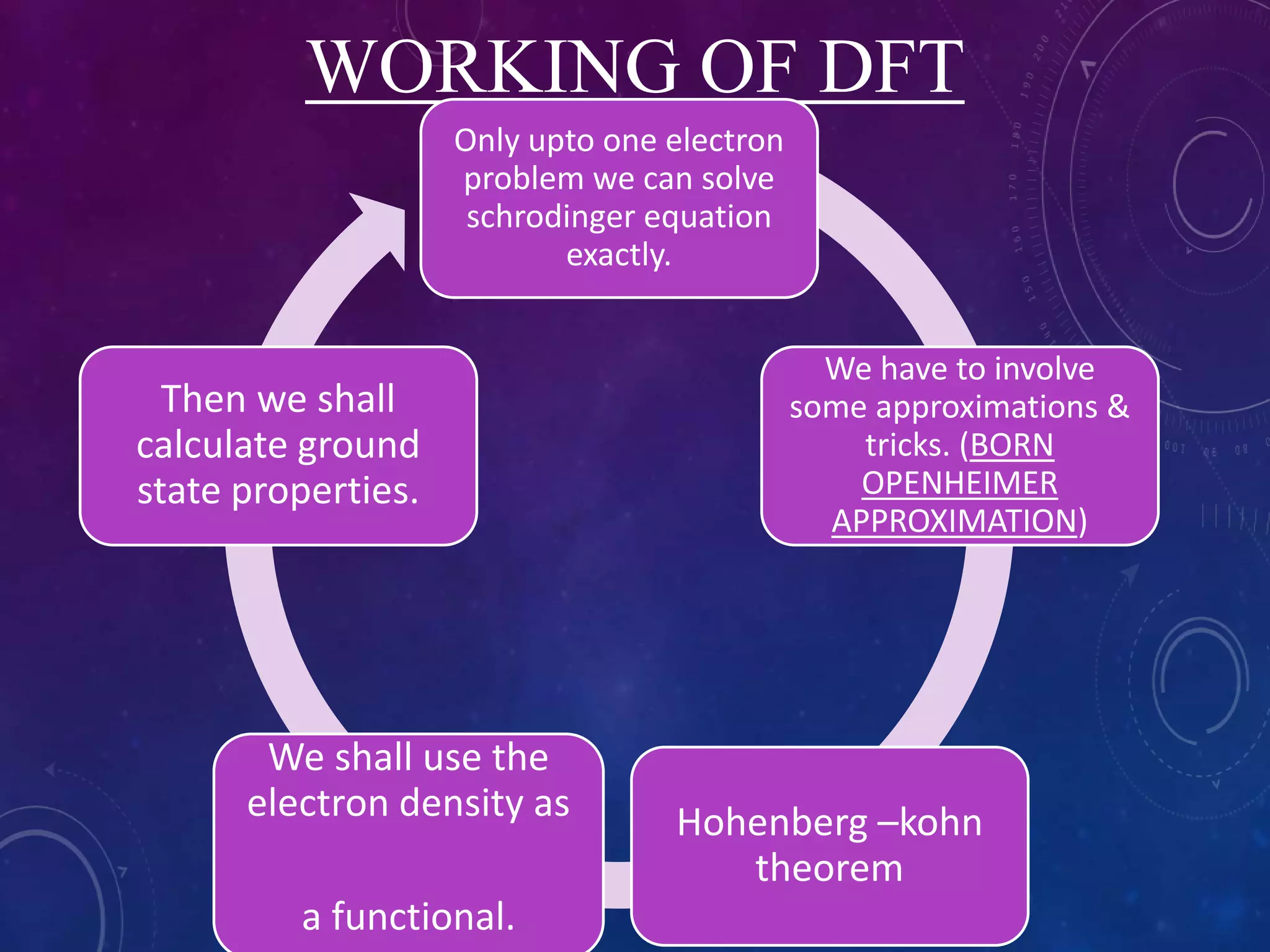
WORKING OF DFT
Only upto one electron
problem we can solve
schrodinger equation
exactly.
We have to involve
some approximations &
tricks. (BORN
OPENHEIMER
APPROXIMATION)
Hohenberg –kohn
theorem
We shall use the
electron density as
a functional.
Then we shall
calculate ground
state properties.
MANY PARTICLE PROBLEMS
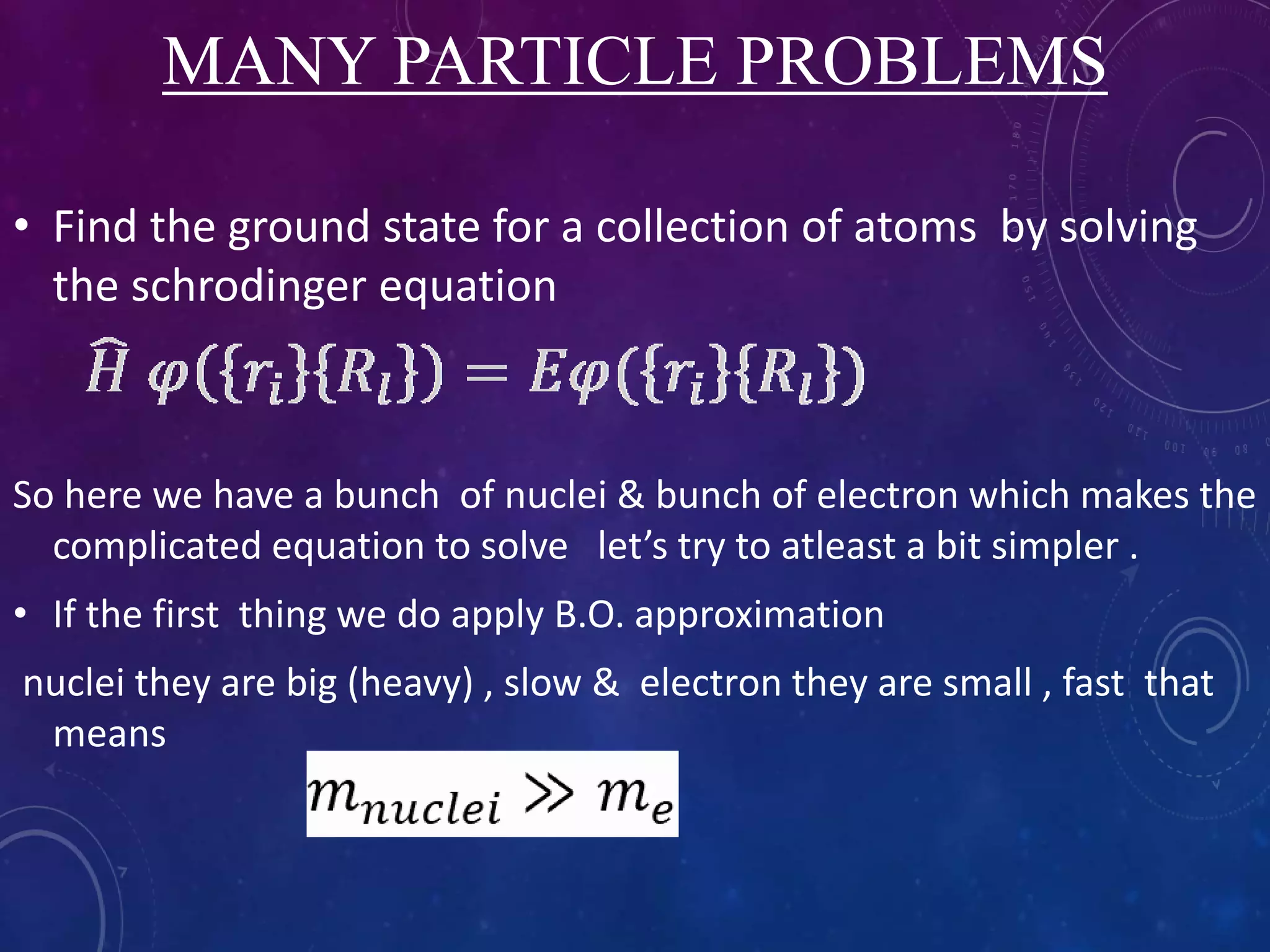
• Find the ground state for a collection of atoms by solving
the schrodinger equation
So here we have a bunch of nuclei & bunch of electron which makes the
complicated equation to solve let’s try to atleast a bit simpler .
• If the first thing we do apply B.O. approximation
nuclei they are big (heavy) , slow & electron they are small , fast that
means
.
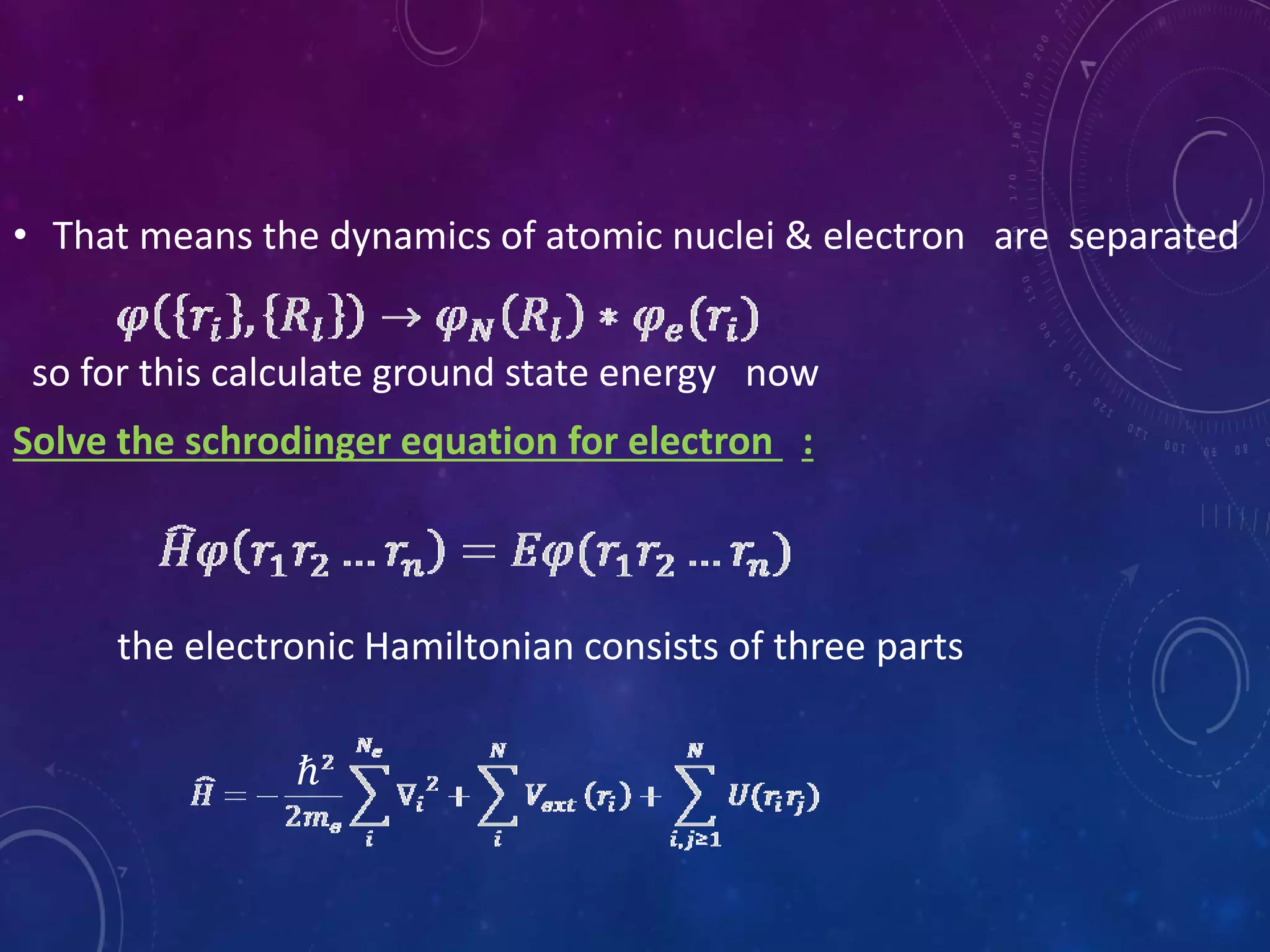
• That means the dynamics of atomic nuclei & electron are separated
so for this calculate ground state energy now
Solve the schrodinger equation for electron :
the electronic Hamiltonian consists of three parts
ℏ
.
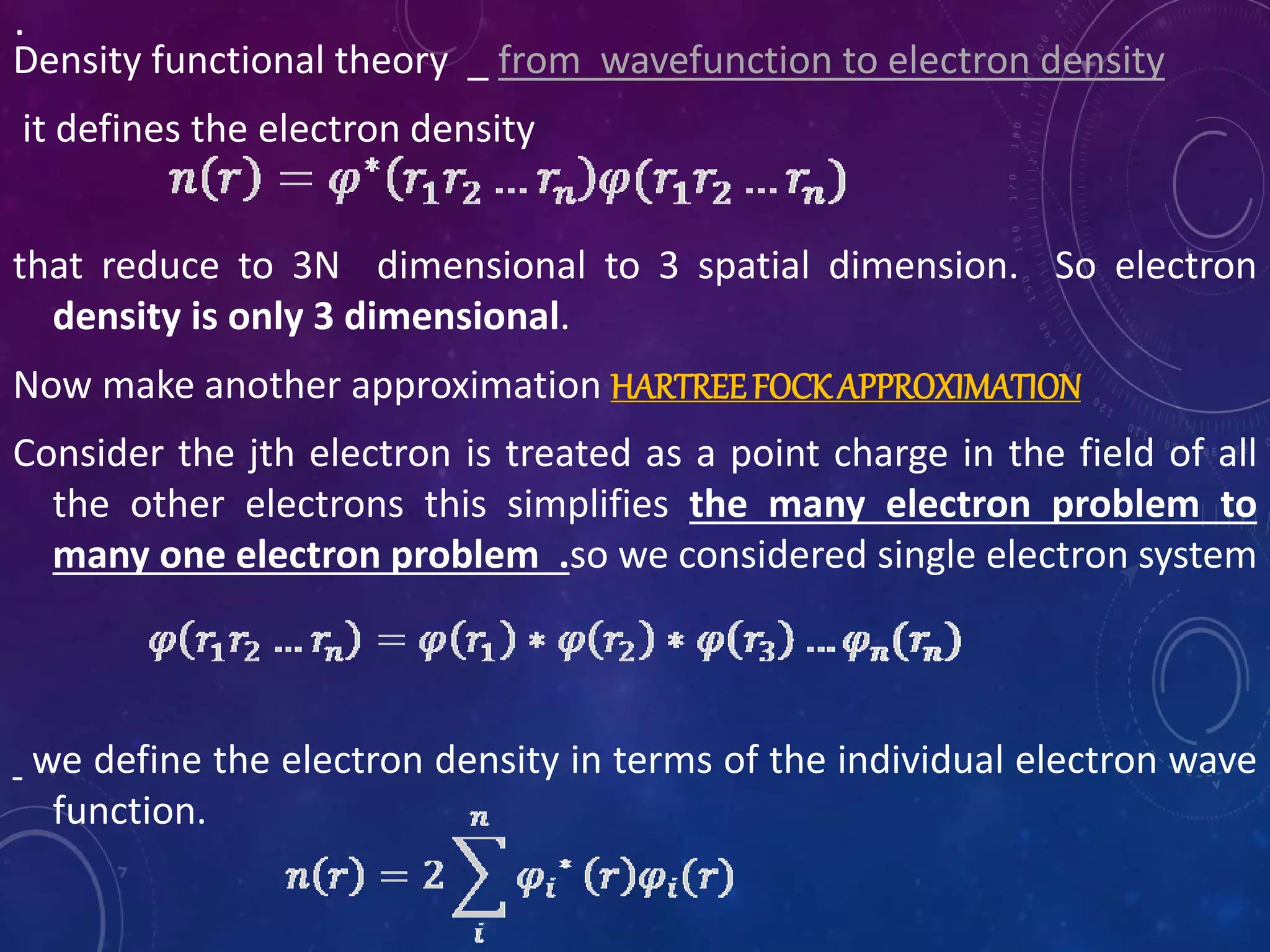
Density functional theory _ from wavefunction to electron density
it defines the electron density
that reduce to 3N dimensional to 3 spatial dimension. So electron
density is only 3 dimensional.
Now make another approximation HARTREEFOCKAPPROXIMATION
Consider the jth electron is treated as a point charge in the field of all
the other electrons this simplifies the many electron problem to
many one electron problem .so we considered single electron system
we define the electron density in terms of the individual electron wave
function.
HOHENBERG – KOHN THEOREMS
Based on two fundamental theorems :
 Theorem 1 : The external potential or the ground state energy
E is a unique functional of electron density .
functional is a function of a function.
 Theorem 2 : The electron density that minimizes the energy
of the overall functional is the true ground state electron density
.
E=E[n(r)]
ENERGY FUNCTIONAL
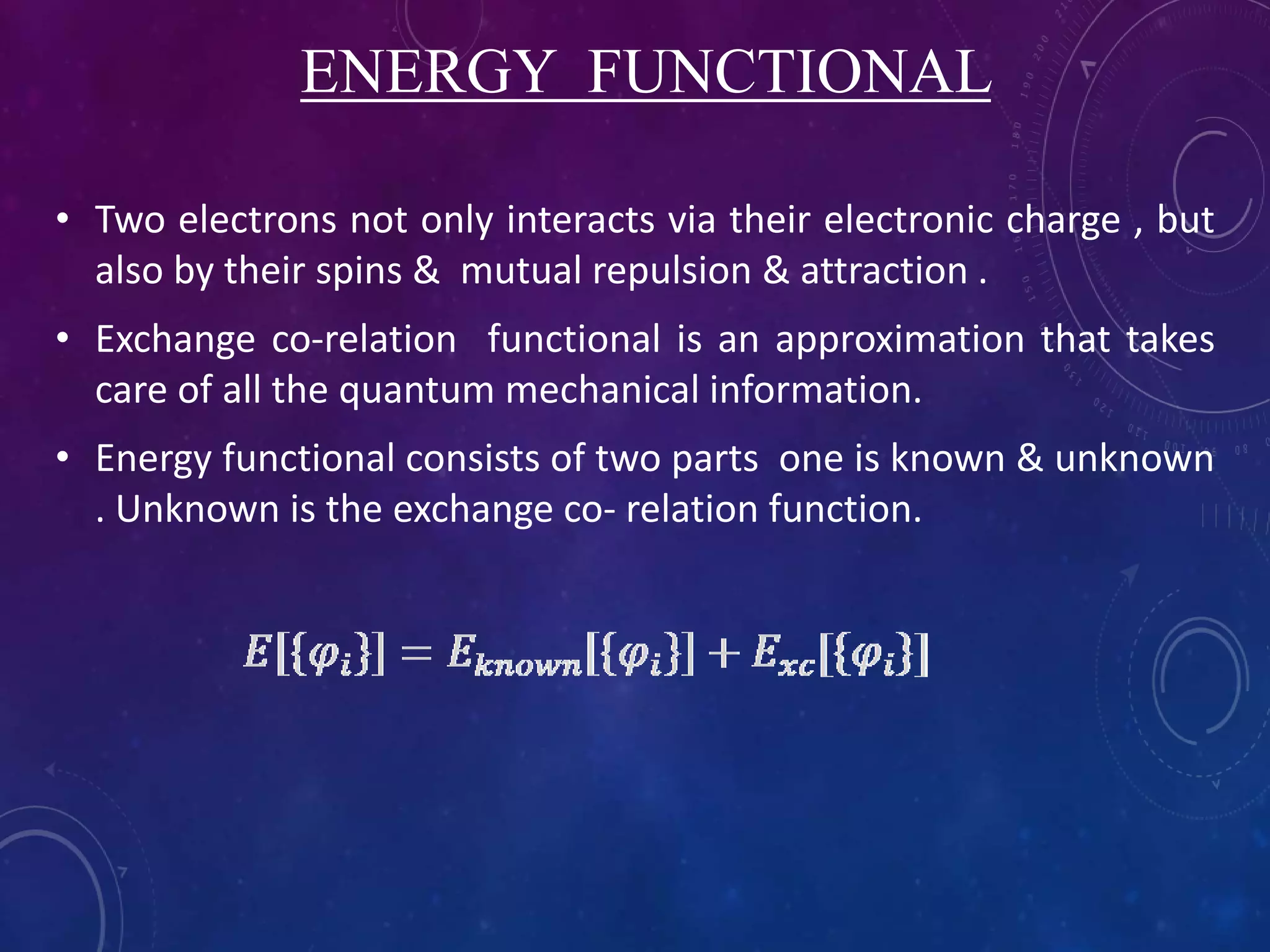
• Two electrons not only interacts via their electronic charge , but
also by their spins & mutual repulsion & attraction .
• Exchange co-relation functional is an approximation that takes
care of all the quantum mechanical information.
• Energy functional consists of two parts one is known & unknown
. Unknown is the exchange co- relation function.
KOHN- SHAM SCHEME
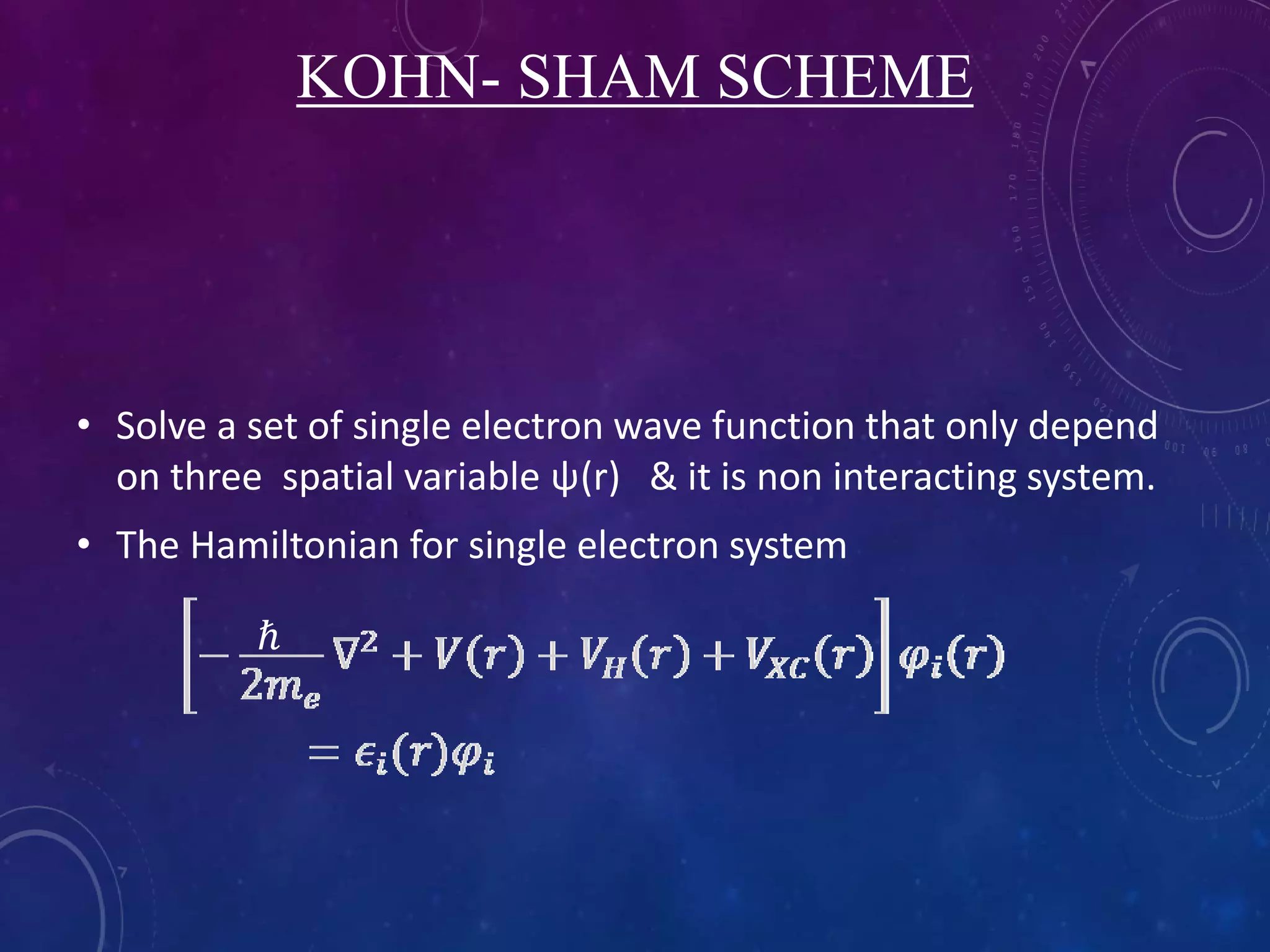
• Solve a set of single electron wave function that only depend
on three spatial variable ψ(r) & it is non interacting system.
• The Hamiltonian for single electron system
ℏ
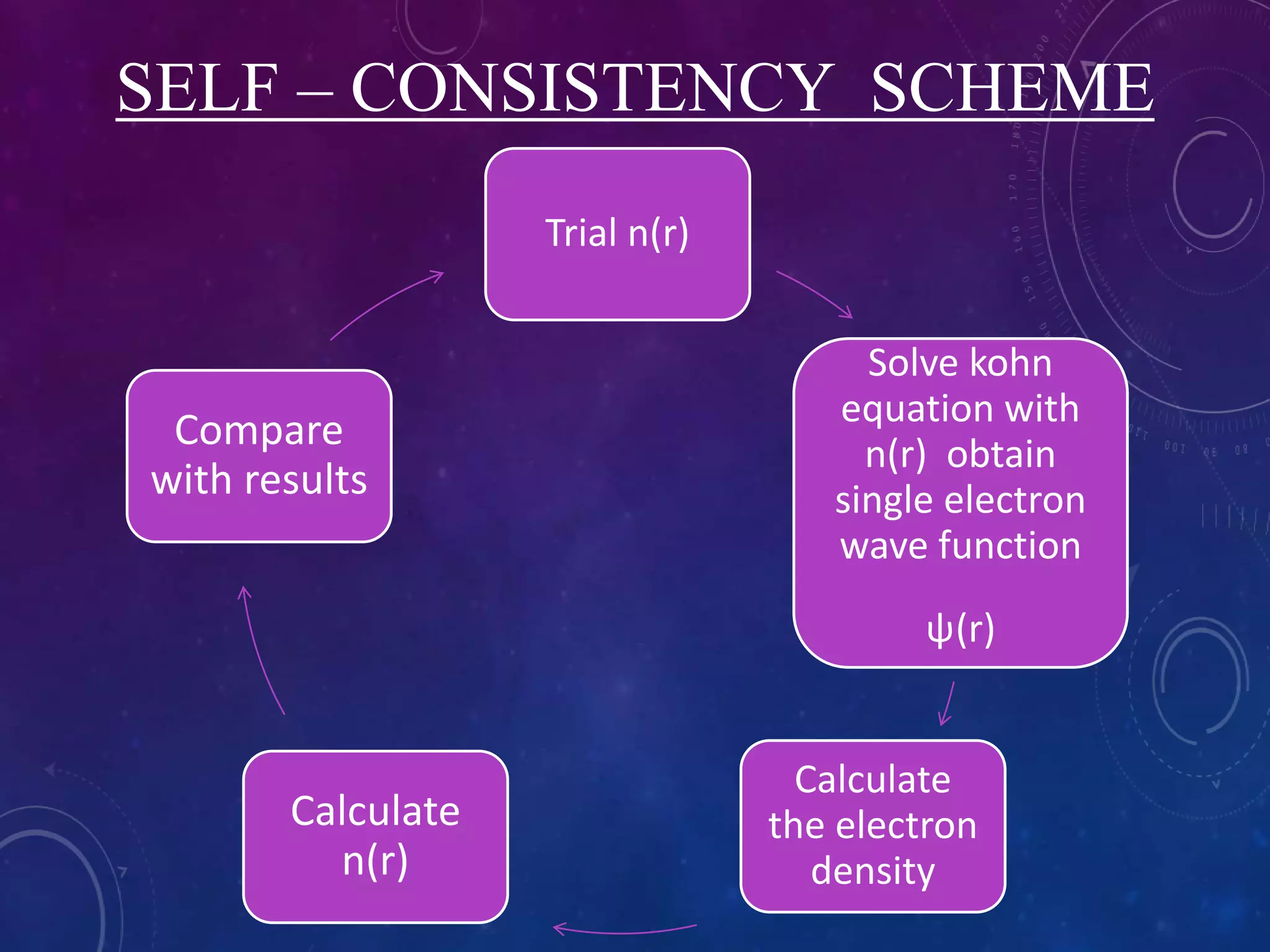
SELF – CONSISTENCY SCHEME
Trial n(r)
Solve kohn
equation with
n(r) obtain
single electron
wave function
ψ(r)
Calculate
the electron
density
Calculate
n(r)
Compare
with results
.
Step 4 : compare
 If different , then process begins from starting
with new n(r).
 If identical then true ground state density is
obtained .
DOING DFT CALCULATION
• There are so many DFT packages (public licence)
• VASP
• QUANTUM EXPRESSO
• ABINIT
• SIESTA
http://cms.mpi.univie.ac.at/vasp/vasp
/vasp.html
www.quantumexpresso.org
www.abinit.org
http://icmab.cat/reem/siesta
REFERENCES
The VASP manual
http://cms.mpi.univie.ac.at/vasp/vasp/vasp.html
Electrons.wikidot.com/density -functional –theory
 Book - ABC of DFT
Lecture -by fundamental & application of DFT
THANK YOU
• .

Density functional theory

  • 1.
    . DENSITY FUNCTIONAL THEORY Project mentor :-Dr. Divya Srivastava Sandhya Singh 2016MSPH007 M.Sc. Physics, Department of Physics, Central University of Rajasthan
  • 2.
    CONTENTS • History . •Background. • Fundamentals of DFT. • Working of DFT. • Example . • Hohenberg- kohn theorems. • Energy functional . • Kohn – sham scheme. • Doing DFT calculation (practical aspect).
  • 3.
    HISTORY 1920: INTRODUCTION OFTHE THOMAS FERMI MODEL 1964: HOHENBERG-KOHN PAPER PROVING EXISTENCE OF EXACT DFT 1965: KOHN-SHAM SCHEME INTRODUCED 1970S AND EARLY 80S: DFT BECOMES USEFUL. 1998: NOBEL PRIZE AWARDED TO WALTER KOHN IN CHEMISTRY FOR DEVELOPMENT OF DFT.
  • 4.
    BACKGROUND  To solvemany body problems by Schrödinger's equation.  Only upto one electron problem we can solve Schrödinger's equation exactly.  it is very hectic to solve the Schrödinger's equation for a N- body system.  We must involve some approximation to solve the problem a method to obtain an approximate solution to the Schrödinger's equation of a many body system is DFT.
  • 5.
    We discuss twoparts : • Part 1 : fundamentals of density functional theory . o solving many body Schrödinger equation . o Applications of DFT. • Part 2: doing DFT calculations - practical aspect .
  • 6.
    DENSITY FUNCTIONAL THEORY •DFT is a computational quantum mechanical modelling method used in physics ,chemistry, & material science to investigate the electronic structure ( ground state) of many body systems . • Using this theory the properties of many- electron system can be determined by using FUNCTIONALS. • in DFT instead of considering wave function we considered density functional . DFT : work in terms of density E=E[n(r)] 𝜑2=n(r)
  • 7.
    WORKING OF DFT Onlyupto one electron problem we can solve schrodinger equation exactly. We have to involve some approximations & tricks. (BORN OPENHEIMER APPROXIMATION) Hohenberg –kohn theorem We shall use the electron density as a functional. Then we shall calculate ground state properties.
  • 8.
    MANY PARTICLE PROBLEMS •Find the ground state for a collection of atoms by solving the schrodinger equation So here we have a bunch of nuclei & bunch of electron which makes the complicated equation to solve let’s try to atleast a bit simpler . • If the first thing we do apply B.O. approximation nuclei they are big (heavy) , slow & electron they are small , fast that means
  • 9.
    . • That meansthe dynamics of atomic nuclei & electron are separated so for this calculate ground state energy now Solve the schrodinger equation for electron : the electronic Hamiltonian consists of three parts ℏ
  • 10.
    . Density functional theory_ from wavefunction to electron density it defines the electron density that reduce to 3N dimensional to 3 spatial dimension. So electron density is only 3 dimensional. Now make another approximation HARTREEFOCKAPPROXIMATION Consider the jth electron is treated as a point charge in the field of all the other electrons this simplifies the many electron problem to many one electron problem .so we considered single electron system we define the electron density in terms of the individual electron wave function.
  • 11.
    HOHENBERG – KOHNTHEOREMS Based on two fundamental theorems :  Theorem 1 : The external potential or the ground state energy E is a unique functional of electron density . functional is a function of a function.  Theorem 2 : The electron density that minimizes the energy of the overall functional is the true ground state electron density . E=E[n(r)]
  • 12.
    ENERGY FUNCTIONAL • Twoelectrons not only interacts via their electronic charge , but also by their spins & mutual repulsion & attraction . • Exchange co-relation functional is an approximation that takes care of all the quantum mechanical information. • Energy functional consists of two parts one is known & unknown . Unknown is the exchange co- relation function.
  • 13.
    KOHN- SHAM SCHEME •Solve a set of single electron wave function that only depend on three spatial variable ψ(r) & it is non interacting system. • The Hamiltonian for single electron system ℏ
  • 14.
    SELF – CONSISTENCYSCHEME Trial n(r) Solve kohn equation with n(r) obtain single electron wave function ψ(r) Calculate the electron density Calculate n(r) Compare with results
  • 15.
    . Step 4 :compare  If different , then process begins from starting with new n(r).  If identical then true ground state density is obtained .
  • 16.
    DOING DFT CALCULATION •There are so many DFT packages (public licence) • VASP • QUANTUM EXPRESSO • ABINIT • SIESTA http://cms.mpi.univie.ac.at/vasp/vasp /vasp.html www.quantumexpresso.org www.abinit.org http://icmab.cat/reem/siesta
  • 17.
    REFERENCES The VASP manual http://cms.mpi.univie.ac.at/vasp/vasp/vasp.html Electrons.wikidot.com/density-functional –theory  Book - ABC of DFT Lecture -by fundamental & application of DFT
  • 18.