
Ab initio molecular
dynamics
Shyue Ping Ong
What is molecular dynamics (MD)?
Moving atomic nuclei by solving Newton’s
equation of motion
For N nuclei, we have 3N positions and 3N
velocities, i.e., a 6N dimensional phase space.
NANO266
2
M!!RI = −
∂E
∂RI
= FI [{RJ}]
Where do forces come from?
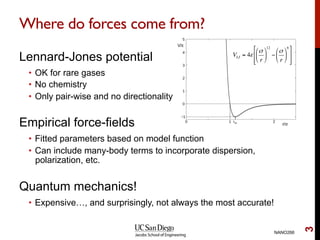
Lennard-Jones potential
•  OK for rare gases
•  No chemistry
•  Only pair-wise and no directionality
Empirical force-fields
•  Fitted parameters based on model function
•  Can include many-body terms to incorporate dispersion,
polarization, etc.
Quantum mechanics!
•  Expensive…, and surprisingly, not always the most accurate!
NANO266
3
VLJ = 4ε
σ
r
!
"
#
$
%
&
12
−
σ
r
!
"
#
$
%
&
6(
)
*
*
+
,
-
-
2013 Nobel Prize in Chemistry
NANO266
4
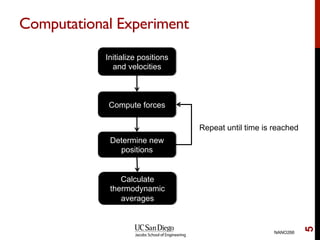
Computational Experiment
NANO266
5
Initialize positions
and velocities
Compute forces
Determine new
positions
Calculate
thermodynamic
averages
Repeat until time is reached
Initialization
2nd order PDF -> Initial positions and velocities
Positions
•  Reasonable guess based on structure
•  No overlap / short atomic distances
Velocities
•  Small initial velocity
•  Steadily increase temperature (velocity scaling)
NANO266
6
M!!RI = −
∂E
∂RI
= FI [{RI}]
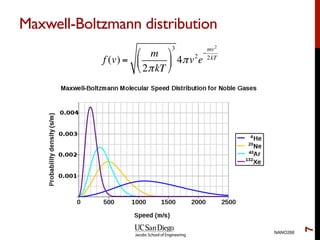
Maxwell-Boltzmann distribution
NANO266
7
f (v) =
m
2πkT
!
"
#
$
%
&
3
4πv2
e
−
mv2
2kT
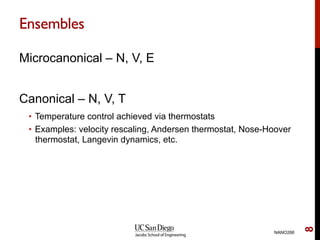
Ensembles
Microcanonical – N, V, E
Canonical – N, V, T
•  Temperature control achieved via thermostats
•  Examples: velocity rescaling, Andersen thermostat, Nose-Hoover
thermostat, Langevin dynamics, etc.
NANO266
8
Integrating equations of motion –Verlet algorithm
Key properties of Verlet algorithm
•  Errors do not accumulate
•  Energy is conserved
•  Simulations are stable
NANO266
9
M!!RI = FI [{RJ}]
!!RI =
1
MI
FI [{RJ}]
[RI (t + Δt)− RI (t)]−[RI (t)− RI (t − Δt)]
(Δt)2
=
1
MI
FI [{RJ}]
RI (t + Δt) = 2RI (t)+ RI (t − Δt)+
(Δt)2
MI
FI [{RJ (t)}]
Flavors of quantum MD
Born-Oppenheimer
•  Electrons stay in instantaneous ground state as nuclei move
•  Perform electronic SCF at each time step
•  Compute forces (Hellman-Feynman theorem)
•  Move nuclei
Car-Parrinello
•  Treat ions and electrons as one unified system
•  Accomplished with fictitious kinetic energy for electrons
NANO266
10
Car, R.; Parrinello, M. Unified approach for molecular dynamics and density-functional theory, Phys. Rev. Lett., 1985, 55, 2471–2474, doi:
10.1103/PhysRevLett.55.2471.
Coupled equations of motion
The CP Lagrangian
Equations of motion
NANO266
11
L =
1
2
(2µ)
i=1
N
∑ dr !ψi (r)
2
∫ + MI
I=1
NI
∑ !!RI − E[ψi,r]+ Λij drψi
*
(r)ψj (r)−δij∫%
&
'
(
ij
∑
Imposes orthonormality of
electronic states
µ !!ψi (r,t) = −Hψj (r)+ Λikψk (r,t)
k
∑
MI
!!RI = −
∂E
∂RI
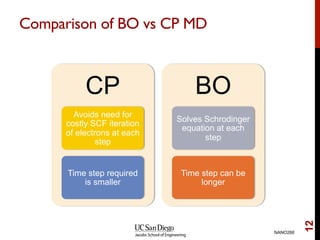
Comparison of BO vs CP MD
NANO266
12
CP
Avoids need for
costly SCF iteration
of electrons at each
step
Time step required
is smaller
BO
Solves Schrodinger
equation at each
step
Time step can be
longer
General procedure for MD simulation
NANO266
13
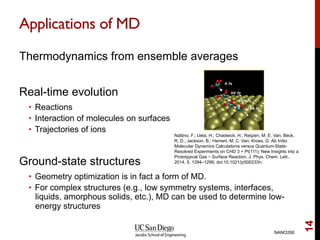
Applications of MD
Thermodynamics from ensemble averages
Real-time evolution
•  Reactions
•  Interaction of molecules on surfaces
•  Trajectories of ions
Ground-state structures
•  Geometry optimization is in fact a form of MD.
•  For complex structures (e.g., low symmetry systems, interfaces,
liquids, amorphous solids, etc.), MD can be used to determine low-
energy structures
NANO266
14
Nattino, F.; Ueta, H.; Chadwick, H.; Reijzen, M. E. Van; Beck,
R. D.; Jackson, B.; Hemert, M. C. Van; Kroes, G. Ab Initio
Molecular Dynamics Calculations versus Quantum-State-
Resolved Experiments on CHD 3 + Pt(111): New Insights into a
Prototypical Gas − Surface Reaction, J. Phys. Chem. Lett.,
2014, 5, 1294–1299, doi:10.1021/jz500233n.
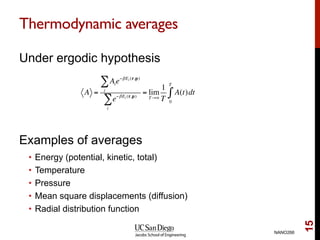
Thermodynamic averages
Under ergodic hypothesis
Examples of averages
•  Energy (potential, kinetic, total)
•  Temperature
•  Pressure
•  Mean square displacements (diffusion)
•  Radial distribution function
NANO266
15
A =
Aie−βEi (r,p)
i
∑
e−βEi (r,p)
i
∑
= lim
T→∞
1
T
A(t)dt
0
T
∫
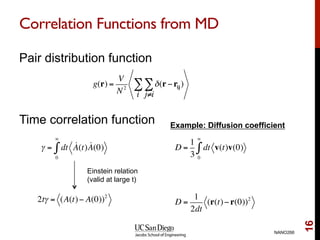
Correlation Functions from MD
Pair distribution function
Time correlation function
NANO266
16
g(r) =
V
N2
δ(r − rij)
j≠i
∑
i
∑
Einstein relation
(valid at large t)
D =
1
3
dt v(t)v(0)
0
∞
∫
Example: Diffusion coefficient
D =
1
2dt
(r(t)− r(0))22tγ = (A(t)− A(0))2
γ = dt !A(t) !A(0)
0
∞
∫
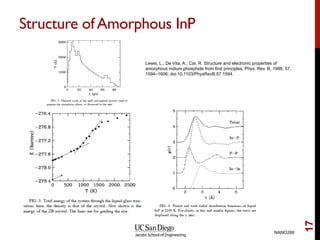
Structure ofAmorphous InP
NANO266
17
Lewis, L.; De Vita, A.; Car, R. Structure and electronic properties of
amorphous indium phosphide from first principles, Phys. Rev. B, 1998, 57,
1594–1606, doi:10.1103/PhysRevB.57.1594.
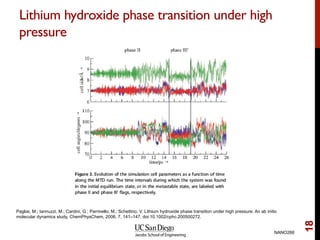
Lithium hydroxide phase transition under high
pressure
NANO266
18
Pagliai, M.; Iannuzzi, M.; Cardini, G.; Parrinello, M.; Schettino, V. Lithium hydroxide phase transition under high pressure: An ab initio
molecular dynamics study, ChemPhysChem, 2006, 7, 141–147, doi:10.1002/cphc.200500272.
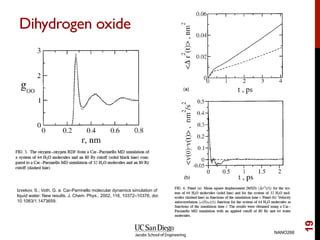
Dihydrogen oxide
NANO266
19
Izvekov, S.; Voth, G. a. Car-Parrinello molecular dynamics simulation of
liquid water: New results, J. Chem. Phys., 2002, 116, 10372–10376, doi:
10.1063/1.1473659.
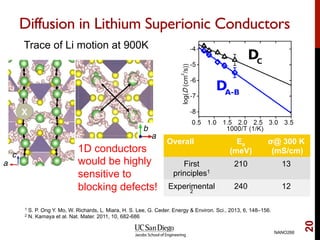
Diffusion in Lithium Superionic Conductors
NANO266
20
a
c
a
b
1D conductors
would be highly
sensitive to
blocking defects!
X
Trace of Li motion at 900K
Overall Ea
(meV)
σ@ 300 K
(mS/cm)
First
principles1
210 13
Experimental
2
240 12
1 S. P. Ong Y. Mo, W. Richards, L. Miara, H. S. Lee, G. Ceder. Energy  Environ. Sci., 2013, 6, 148–156.
2 N. Kamaya et al. Nat. Mater. 2011, 10, 682-686
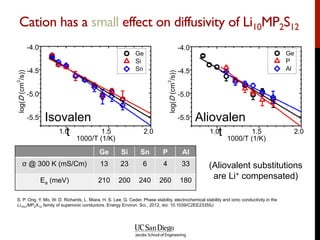
Cation has a small effect on diffusivity of Li10MP2S12
Isovalen
t
Aliovalen
t
Ge Si Sn P Al
σ @ 300 K (mS/Cm) 13 23 6 4 33
Ea (meV) 210 200 240 260 180
(Aliovalent substitutions
are Li+ compensated)
S. P. Ong, Y. Mo, W. D. Richards, L. Miara, H. S. Lee, G. Ceder, Phase stability, electrochemical stability and ionic conductivity in the
Li10±1MP2X12 family of superionic conductors. Energy Environ. Sci., 2012, doi: 10.1039/C2EE23355J
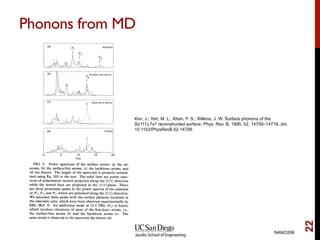
Phonons from MD
NANO266
22
Kim, J.; Yeh, M. L.; Khan, F. S.; Wilkins, J. W. Surface phonons of the
Si(111)-7x7 reconstructed surface, Phys. Rev. B, 1995, 52, 14709–14718, doi:
10.1103/PhysRevB.52.14709.
Surface reactions with MD
NANO266
23
Arifin, R.; Shibuta, Y.; Shimamura, K.; Shimojo, F.; Yamaguchi, S. Ab Initio Molecular Dynamics Simulation of Ethylene Reaction on Nickel
(111) Surface, J. Phys. Chem. C, 2015, 119, 3210–3216, doi:10.1021/jp512148b.

NANO266 - Lecture 13 - Ab initio molecular dyanmics

  • 1.
  • 2.
    What is moleculardynamics (MD)? Moving atomic nuclei by solving Newton’s equation of motion For N nuclei, we have 3N positions and 3N velocities, i.e., a 6N dimensional phase space. NANO266 2 M!!RI = − ∂E ∂RI = FI [{RJ}]
  • 3.
    Where do forcescome from? Lennard-Jones potential •  OK for rare gases •  No chemistry •  Only pair-wise and no directionality Empirical force-fields •  Fitted parameters based on model function •  Can include many-body terms to incorporate dispersion, polarization, etc. Quantum mechanics! •  Expensive…, and surprisingly, not always the most accurate! NANO266 3 VLJ = 4ε σ r ! " # $ % & 12 − σ r ! " # $ % & 6( ) * * + , - -
  • 4.
    2013 Nobel Prizein Chemistry NANO266 4
  • 5.
    Computational Experiment NANO266 5 Initialize positions andvelocities Compute forces Determine new positions Calculate thermodynamic averages Repeat until time is reached
  • 6.
    Initialization 2nd order PDF-> Initial positions and velocities Positions •  Reasonable guess based on structure •  No overlap / short atomic distances Velocities •  Small initial velocity •  Steadily increase temperature (velocity scaling) NANO266 6 M!!RI = − ∂E ∂RI = FI [{RI}]
  • 7.
    Maxwell-Boltzmann distribution NANO266 7 f (v)= m 2πkT ! " # $ % & 3 4πv2 e − mv2 2kT
  • 8.
    Ensembles Microcanonical – N,V, E Canonical – N, V, T •  Temperature control achieved via thermostats •  Examples: velocity rescaling, Andersen thermostat, Nose-Hoover thermostat, Langevin dynamics, etc. NANO266 8
  • 9.
    Integrating equations ofmotion –Verlet algorithm Key properties of Verlet algorithm •  Errors do not accumulate •  Energy is conserved •  Simulations are stable NANO266 9 M!!RI = FI [{RJ}] !!RI = 1 MI FI [{RJ}] [RI (t + Δt)− RI (t)]−[RI (t)− RI (t − Δt)] (Δt)2 = 1 MI FI [{RJ}] RI (t + Δt) = 2RI (t)+ RI (t − Δt)+ (Δt)2 MI FI [{RJ (t)}]
  • 10.
    Flavors of quantumMD Born-Oppenheimer •  Electrons stay in instantaneous ground state as nuclei move •  Perform electronic SCF at each time step •  Compute forces (Hellman-Feynman theorem) •  Move nuclei Car-Parrinello •  Treat ions and electrons as one unified system •  Accomplished with fictitious kinetic energy for electrons NANO266 10 Car, R.; Parrinello, M. Unified approach for molecular dynamics and density-functional theory, Phys. Rev. Lett., 1985, 55, 2471–2474, doi: 10.1103/PhysRevLett.55.2471.
  • 11.
    Coupled equations ofmotion The CP Lagrangian Equations of motion NANO266 11 L = 1 2 (2µ) i=1 N ∑ dr !ψi (r) 2 ∫ + MI I=1 NI ∑ !!RI − E[ψi,r]+ Λij drψi * (r)ψj (r)−δij∫% & ' ( ij ∑ Imposes orthonormality of electronic states µ !!ψi (r,t) = −Hψj (r)+ Λikψk (r,t) k ∑ MI !!RI = − ∂E ∂RI
  • 12.
    Comparison of BOvs CP MD NANO266 12 CP Avoids need for costly SCF iteration of electrons at each step Time step required is smaller BO Solves Schrodinger equation at each step Time step can be longer
  • 13.
    General procedure forMD simulation NANO266 13
  • 14.
    Applications of MD Thermodynamicsfrom ensemble averages Real-time evolution •  Reactions •  Interaction of molecules on surfaces •  Trajectories of ions Ground-state structures •  Geometry optimization is in fact a form of MD. •  For complex structures (e.g., low symmetry systems, interfaces, liquids, amorphous solids, etc.), MD can be used to determine low- energy structures NANO266 14 Nattino, F.; Ueta, H.; Chadwick, H.; Reijzen, M. E. Van; Beck, R. D.; Jackson, B.; Hemert, M. C. Van; Kroes, G. Ab Initio Molecular Dynamics Calculations versus Quantum-State- Resolved Experiments on CHD 3 + Pt(111): New Insights into a Prototypical Gas − Surface Reaction, J. Phys. Chem. Lett., 2014, 5, 1294–1299, doi:10.1021/jz500233n.
  • 15.
    Thermodynamic averages Under ergodichypothesis Examples of averages •  Energy (potential, kinetic, total) •  Temperature •  Pressure •  Mean square displacements (diffusion) •  Radial distribution function NANO266 15 A = Aie−βEi (r,p) i ∑ e−βEi (r,p) i ∑ = lim T→∞ 1 T A(t)dt 0 T ∫
  • 16.
    Correlation Functions fromMD Pair distribution function Time correlation function NANO266 16 g(r) = V N2 δ(r − rij) j≠i ∑ i ∑ Einstein relation (valid at large t) D = 1 3 dt v(t)v(0) 0 ∞ ∫ Example: Diffusion coefficient D = 1 2dt (r(t)− r(0))22tγ = (A(t)− A(0))2 γ = dt !A(t) !A(0) 0 ∞ ∫
  • 17.
    Structure ofAmorphous InP NANO266 17 Lewis,L.; De Vita, A.; Car, R. Structure and electronic properties of amorphous indium phosphide from first principles, Phys. Rev. B, 1998, 57, 1594–1606, doi:10.1103/PhysRevB.57.1594.
  • 18.
    Lithium hydroxide phasetransition under high pressure NANO266 18 Pagliai, M.; Iannuzzi, M.; Cardini, G.; Parrinello, M.; Schettino, V. Lithium hydroxide phase transition under high pressure: An ab initio molecular dynamics study, ChemPhysChem, 2006, 7, 141–147, doi:10.1002/cphc.200500272.
  • 19.
    Dihydrogen oxide NANO266 19 Izvekov, S.;Voth, G. a. Car-Parrinello molecular dynamics simulation of liquid water: New results, J. Chem. Phys., 2002, 116, 10372–10376, doi: 10.1063/1.1473659.
  • 20.
    Diffusion in LithiumSuperionic Conductors NANO266 20 a c a b 1D conductors would be highly sensitive to blocking defects! X Trace of Li motion at 900K Overall Ea (meV) σ@ 300 K (mS/cm) First principles1 210 13 Experimental 2 240 12 1 S. P. Ong Y. Mo, W. Richards, L. Miara, H. S. Lee, G. Ceder. Energy Environ. Sci., 2013, 6, 148–156. 2 N. Kamaya et al. Nat. Mater. 2011, 10, 682-686
  • 21.
    Cation has asmall effect on diffusivity of Li10MP2S12 Isovalen t Aliovalen t Ge Si Sn P Al σ @ 300 K (mS/Cm) 13 23 6 4 33 Ea (meV) 210 200 240 260 180 (Aliovalent substitutions are Li+ compensated) S. P. Ong, Y. Mo, W. D. Richards, L. Miara, H. S. Lee, G. Ceder, Phase stability, electrochemical stability and ionic conductivity in the Li10±1MP2X12 family of superionic conductors. Energy Environ. Sci., 2012, doi: 10.1039/C2EE23355J
  • 22.
    Phonons from MD NANO266 22 Kim,J.; Yeh, M. L.; Khan, F. S.; Wilkins, J. W. Surface phonons of the Si(111)-7x7 reconstructed surface, Phys. Rev. B, 1995, 52, 14709–14718, doi: 10.1103/PhysRevB.52.14709.
  • 23.
    Surface reactions withMD NANO266 23 Arifin, R.; Shibuta, Y.; Shimamura, K.; Shimojo, F.; Yamaguchi, S. Ab Initio Molecular Dynamics Simulation of Ethylene Reaction on Nickel (111) Surface, J. Phys. Chem. C, 2015, 119, 3210–3216, doi:10.1021/jp512148b.