Beyond the HF
Approximation
Shyue Ping Ong
Overview
In this lecture, we will only touch on conceptual
underpinnings of how correlation is included,
without going too much into the details of the
methods. Most of the advanced methods are far
too computationally expensive and limited to
small system sizes, which makes them less
useful for the materials scientist at this time. It
suffices that you understand them at a conceptual
level, and if you are interested (or they become
more accessible in future), there are many
excellent works on the subject.
NANO266
2
Limitations of HF
All correlation, other than exchange, is ignored in
HF
NANO266
3
Ecorr = Eexact − EHF
So how might one improve on HF?
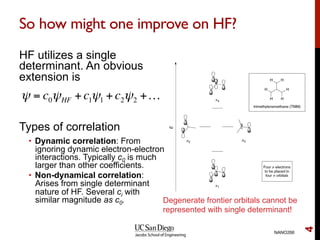
HF utilizes a single
determinant. An obvious
extension is
Types of correlation
•  Dynamic correlation: From
ignoring dynamic electron-electron
interactions. Typically c0 is much
larger than other coefficients.
•  Non-dynamical correlation:
Arises from single determinant
nature of HF. Several ci with
similar magnitude as c0.
NANO266
4
ψ = c0ψHF +c1ψ1 +c2ψ2 +…
Degenerate frontier orbitals cannot be
represented with single determinant!
Multiconfiguration SCF
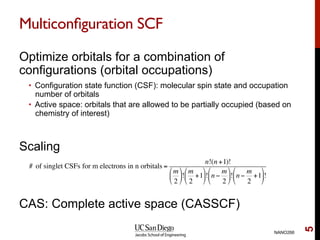
Optimize orbitals for a combination of
configurations (orbital occupations)
•  Configuration state function (CSF): molecular spin state and occupation
number of orbitals
•  Active space: orbitals that are allowed to be partially occupied (based on
chemistry of interest)
Scaling
CAS: Complete active space (CASSCF)
NANO266
5
# of singlet CSFs for m electrons in n orbitals =
n!(n +1)!
m
2
!
"
#
$
%
&!
m
2
+1
!
"
#
$
%
&! n −
m
2
!
"
#
$
%
&! n −
m
2
+1
!
"
#
$
%
&!
Full Configuration Interaction (CI)
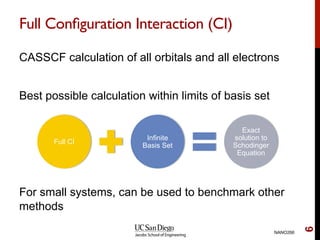
CASSCF calculation of all orbitals and all electrons
Best possible calculation within limits of basis set
For small systems, can be used to benchmark other
methods
NANO266
6
Full CI
Infinite
Basis Set
Exact
solution to
Schodinger
Equation
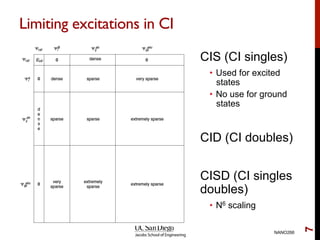
Limiting excitations in CI
CIS (CI singles)
•  Used for excited
states
•  No use for ground
states
CID (CI doubles)
CISD (CI singles
doubles)
•  N6 scaling
NANO266
7
Møller–Plesset perturbation theory
Treats exact Hamiltonian as a perturbation on sum of one-
electron Fock operators
NANO266
8
H = H(0)
+ λV = fi
i
∑ + λV
Expanding the ground-state eigenfunctions and eigenvalues as Taylor series in λ,
ψ =ψ(0)
+ λψ(1)
+ λ2
ψ(2)
+…
a = a(0)
+ λa(1)
+ λ2
a(2)
+…
where ψ(k)
=
1
k!
∂k
ψ
∂λk
and a(k)
=
1
k!
∂k
a
∂λk
H ψ = a ψ
∴(H(0)
+ λV) λk
ψ(k)
∑ = λk
a(k)
λk
ψ(k)
∑∑
By equating powers of λ and imposing normalization, we can derive
a(k)
, which are the kth
order corrections to a(0)
.
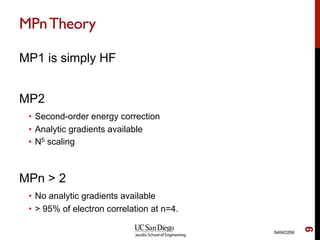
MPnTheory
MP1 is simply HF
MP2
•  Second-order energy correction
•  Analytic gradients available
•  N5 scaling
MPn > 2
•  No analytic gradients available
•  > 95% of electron correlation at n=4.
NANO266
9
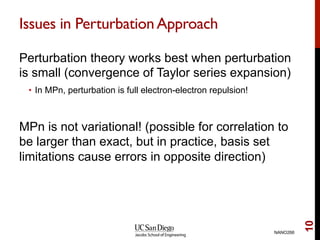
Issues in PerturbationApproach
Perturbation theory works best when perturbation
is small (convergence of Taylor series expansion)
•  In MPn, perturbation is full electron-electron repulsion!
MPn is not variational! (possible for correlation to
be larger than exact, but in practice, basis set
limitations cause errors in opposite direction)
NANO266
10
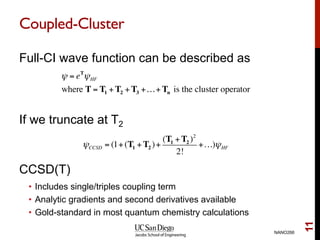
Coupled-Cluster
Full-CI wave function can be described as
If we truncate at T2
CCSD(T)
•  Includes single/triples coupling term
•  Analytic gradients and second derivatives available
•  Gold-standard in most quantum chemistry calculations
NANO266
11
ψ = eT
ψHF
where T = T1 + T2 + T3 +…+ Tn is the cluster operator
ψCCSD = (1+(T1 + T2 )+
(T1 + T2 )2
2!
+…)ψHF
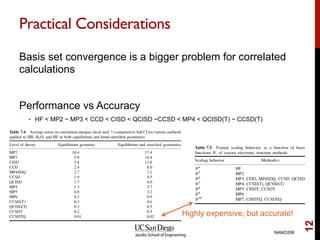
Practical Considerations
Basis set convergence is a bigger problem for correlated
calculations
Performance vs Accuracy
•  HF < MP2 ~ MP3 < CCD < CISD < QCISD ~CCSD < MP4 < QCISD(T) ~ CCSD(T)
NANO266
12
Highly expensive, but accurate!
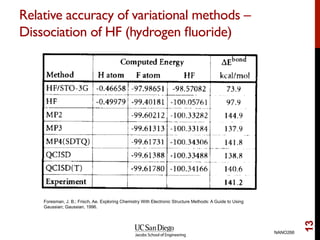
Relative accuracy of variational methods –
Dissociation of HF (hydrogen fluoride)
NANO266
13
Foresman, J. B.; Frisch, Ae. Exploring Chemistry With Electronic Structure Methods: A Guide to Using
Gaussian; Gaussian, 1996.
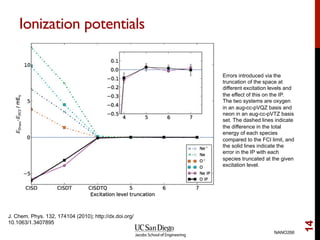
Ionization potentials
NANO266
14
Errors introduced via the
truncation of the space at
different excitation levels and
the effect of this on the IP.
The two systems are oxygen
in an aug-cc-pVQZ basis and
neon in an aug-cc-pVTZ basis
set. The dashed lines indicate
the difference in the total
energy of each species
compared to the FCI limit, and
the solid lines indicate the
error in the IP with each
species truncated at the given
excitation level.
J. Chem. Phys. 132, 174104 (2010); http://dx.doi.org/
10.1063/1.3407895
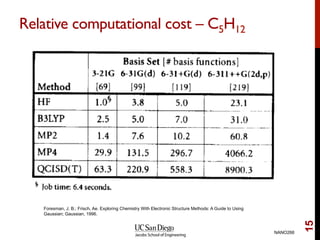
Relative computational cost – C5H12
NANO266
15
Foresman, J. B.; Frisch, Ae. Exploring Chemistry With Electronic Structure Methods: A Guide to Using
Gaussian; Gaussian, 1996.
Bond lengths
NANO266
16
Cramer, C. J. Essentials of Computational Chemistry:
Theories and Models; 2004.
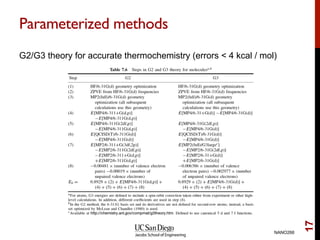
Parameterized methods
G2/G3 theory for accurate thermochemistry (errors < 4 kcal / mol)
NANO266
17
References
Essentials of Computational Chemistry: Theories
and Models by Christopher J. Cramer
NANO266
18

NANO266 - Lecture 3 - Beyond the Hartree-Fock Approximation

  • 1.
  • 2.
    Overview In this lecture,we will only touch on conceptual underpinnings of how correlation is included, without going too much into the details of the methods. Most of the advanced methods are far too computationally expensive and limited to small system sizes, which makes them less useful for the materials scientist at this time. It suffices that you understand them at a conceptual level, and if you are interested (or they become more accessible in future), there are many excellent works on the subject. NANO266 2
  • 3.
    Limitations of HF Allcorrelation, other than exchange, is ignored in HF NANO266 3 Ecorr = Eexact − EHF
  • 4.
    So how mightone improve on HF? HF utilizes a single determinant. An obvious extension is Types of correlation •  Dynamic correlation: From ignoring dynamic electron-electron interactions. Typically c0 is much larger than other coefficients. •  Non-dynamical correlation: Arises from single determinant nature of HF. Several ci with similar magnitude as c0. NANO266 4 ψ = c0ψHF +c1ψ1 +c2ψ2 +… Degenerate frontier orbitals cannot be represented with single determinant!
  • 5.
    Multiconfiguration SCF Optimize orbitalsfor a combination of configurations (orbital occupations) •  Configuration state function (CSF): molecular spin state and occupation number of orbitals •  Active space: orbitals that are allowed to be partially occupied (based on chemistry of interest) Scaling CAS: Complete active space (CASSCF) NANO266 5 # of singlet CSFs for m electrons in n orbitals = n!(n +1)! m 2 ! " # $ % &! m 2 +1 ! " # $ % &! n − m 2 ! " # $ % &! n − m 2 +1 ! " # $ % &!
  • 6.
    Full Configuration Interaction(CI) CASSCF calculation of all orbitals and all electrons Best possible calculation within limits of basis set For small systems, can be used to benchmark other methods NANO266 6 Full CI Infinite Basis Set Exact solution to Schodinger Equation
  • 7.
    Limiting excitations inCI CIS (CI singles) •  Used for excited states •  No use for ground states CID (CI doubles) CISD (CI singles doubles) •  N6 scaling NANO266 7
  • 8.
    Møller–Plesset perturbation theory Treatsexact Hamiltonian as a perturbation on sum of one- electron Fock operators NANO266 8 H = H(0) + λV = fi i ∑ + λV Expanding the ground-state eigenfunctions and eigenvalues as Taylor series in λ, ψ =ψ(0) + λψ(1) + λ2 ψ(2) +… a = a(0) + λa(1) + λ2 a(2) +… where ψ(k) = 1 k! ∂k ψ ∂λk and a(k) = 1 k! ∂k a ∂λk H ψ = a ψ ∴(H(0) + λV) λk ψ(k) ∑ = λk a(k) λk ψ(k) ∑∑ By equating powers of λ and imposing normalization, we can derive a(k) , which are the kth order corrections to a(0) .
  • 9.
    MPnTheory MP1 is simplyHF MP2 •  Second-order energy correction •  Analytic gradients available •  N5 scaling MPn > 2 •  No analytic gradients available •  > 95% of electron correlation at n=4. NANO266 9
  • 10.
    Issues in PerturbationApproach Perturbationtheory works best when perturbation is small (convergence of Taylor series expansion) •  In MPn, perturbation is full electron-electron repulsion! MPn is not variational! (possible for correlation to be larger than exact, but in practice, basis set limitations cause errors in opposite direction) NANO266 10
  • 11.
    Coupled-Cluster Full-CI wave functioncan be described as If we truncate at T2 CCSD(T) •  Includes single/triples coupling term •  Analytic gradients and second derivatives available •  Gold-standard in most quantum chemistry calculations NANO266 11 ψ = eT ψHF where T = T1 + T2 + T3 +…+ Tn is the cluster operator ψCCSD = (1+(T1 + T2 )+ (T1 + T2 )2 2! +…)ψHF
  • 12.
    Practical Considerations Basis setconvergence is a bigger problem for correlated calculations Performance vs Accuracy •  HF < MP2 ~ MP3 < CCD < CISD < QCISD ~CCSD < MP4 < QCISD(T) ~ CCSD(T) NANO266 12 Highly expensive, but accurate!
  • 13.
    Relative accuracy ofvariational methods – Dissociation of HF (hydrogen fluoride) NANO266 13 Foresman, J. B.; Frisch, Ae. Exploring Chemistry With Electronic Structure Methods: A Guide to Using Gaussian; Gaussian, 1996.
  • 14.
    Ionization potentials NANO266 14 Errors introducedvia the truncation of the space at different excitation levels and the effect of this on the IP. The two systems are oxygen in an aug-cc-pVQZ basis and neon in an aug-cc-pVTZ basis set. The dashed lines indicate the difference in the total energy of each species compared to the FCI limit, and the solid lines indicate the error in the IP with each species truncated at the given excitation level. J. Chem. Phys. 132, 174104 (2010); http://dx.doi.org/ 10.1063/1.3407895
  • 15.
    Relative computational cost– C5H12 NANO266 15 Foresman, J. B.; Frisch, Ae. Exploring Chemistry With Electronic Structure Methods: A Guide to Using Gaussian; Gaussian, 1996.
  • 16.
    Bond lengths NANO266 16 Cramer, C.J. Essentials of Computational Chemistry: Theories and Models; 2004.
  • 17.
    Parameterized methods G2/G3 theoryfor accurate thermochemistry (errors < 4 kcal / mol) NANO266 17
  • 18.
    References Essentials of ComputationalChemistry: Theories and Models by Christopher J. Cramer NANO266 18