E P R O S Y
[ETIOLOGY+ CLINICAL
SYMPTOMS+DIAGNOSIS+TREATMENT]
What is Leprosy ?
Leprosy is a long term infectious , ancient,progressive disease caused by bacteria known as
Mycobacterium Laprae or Mycobacterium Lepromatosis.
Leprosy is also known as HANSEN’S DISEASE after the name of the discoverer Dr. Hansen.
SITE OF INFECTION- Mainly affects the skin, peripheral nerves, mucosal surfaces of upper
respiratory tract.
Initially the infection is asympotamatic for 5-20 years.
It occurs at all ages from infants to elder individuals.
DIFFERENCE B/W M.LAPRAE and
M.LEPROMATOSIS
• Mycobacterium Laprae was the only organism responsile for the infection
until 2008 but new organism known as M.Lepromatosis was identified in
fatal case of diffused lepromatous leprosy in 2008.
• Both are similar in structure surrounded by a typical waxy cell membrane
and they have same genus but their species are different.
TYPES OF LEPROSY
Leprosy can be classified on the basis of different criteria--
ONTHE BASIS OF SKIN SMEAR RESULTS—
• Paucibacillary Bacteria- In this type, patients show five or fewer lesions with no bacteria
detected in the skin sample.
• Multibacillary Bacteria- In this type, patients show more than five lesions in which bacteria
is detected in the skin sample.
ONTHE BASIS OF
MAJOR
CLASSIFICATION
LEPROMATOUS
LEPROSY
TUBERCULOID
LEPROSY
ETIOLOGY
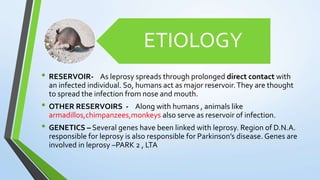
• RESERVOIR- As leprosy spreads through prolonged direct contact with
an infected individual. So, humans act as major reservoir.They are thought
to spread the infection from nose and mouth.
• OTHER RESERVOIRS - Along with humans , animals like
armadillos,chimpanzees,monkeys also serve as reservoir of infection.
• GENETICS – Several genes have been linked with leprosy. Region of D.N.A.
responsible for leprosy is also responsible for Parkinson’s disease. Genes are
involved in leprosy –PARK 2 , LTA
CLINICAL SYMPTOMS
INCUBATION PERIOD of leprosy is 5 years as the bacteria causing the disease grows very
slowly.
The most common clinical symptom is Spots on the skin(arms,legs & back). Other symptoms
include-
 Faded or discoloured skin lesions.
 Thick, Stiff or dry skin.
 Muscle weakness.
 Severe pain and Enlargened nerves.
 Eye problems.
DIAGNOSIS
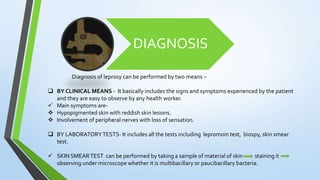
Diagnosis of leprosy can be performed by two means –
 BY CLINICAL MEANS - It basically includes the signs and symptoms experienced by the patient
and they are easy to observe by any health worker.
 Main symptoms are-
 Hypopigmented skin with reddish skin lesions.
 Involvement of peripheral nerves with loss of sensation.
 BY LABORATORYTESTS- It includes all the tests including lepromoin test, biospy, skin smear
test.
 SKIN SMEARTEST can be performed by taking a sample of material of skin staining it
observing under microscope whether it is multibacillary or paucibacillary bacteria.
LEPROMOIN TEST
This test help to determine what type of leprosy a person has.
In this test, about 0.1 ml of attentuated leprosy causing bacteria is injected under
the skin the injection site is labelled and examined 3 days . Skin reaction
observered after 3 days is called as FERNANDEZ REACTION.
Observations --- People who don’t have leprsoy have little or no skin reaction . A
positive result may be seen with specific form of leprosy includingTuberculoid,
Borderline.
IMPORTANT NOTE-There will be no skin reaction in case of lepromatous leprosy.
TREATMENT
oLeprosy is treated by MDT-Multiple DrugTherapy.These drugs should
never be used alone.Typically 2-3 antibiotics are given at the same time.
oDapsone, Rifampicin and Clofazimine are used in M.D.T.
oThis therapy helps to prevent the development of antibiotic resistance by
the bacteria.
Basics Of Leprosy ( PATHOGENESIS)

Basics Of Leprosy ( PATHOGENESIS)

  • 1.
    E P RO S Y [ETIOLOGY+ CLINICAL SYMPTOMS+DIAGNOSIS+TREATMENT]
  • 2.
    What is Leprosy? Leprosy is a long term infectious , ancient,progressive disease caused by bacteria known as Mycobacterium Laprae or Mycobacterium Lepromatosis. Leprosy is also known as HANSEN’S DISEASE after the name of the discoverer Dr. Hansen. SITE OF INFECTION- Mainly affects the skin, peripheral nerves, mucosal surfaces of upper respiratory tract. Initially the infection is asympotamatic for 5-20 years. It occurs at all ages from infants to elder individuals.
  • 3.
    DIFFERENCE B/W M.LAPRAEand M.LEPROMATOSIS • Mycobacterium Laprae was the only organism responsile for the infection until 2008 but new organism known as M.Lepromatosis was identified in fatal case of diffused lepromatous leprosy in 2008. • Both are similar in structure surrounded by a typical waxy cell membrane and they have same genus but their species are different.
  • 4.
    TYPES OF LEPROSY Leprosycan be classified on the basis of different criteria-- ONTHE BASIS OF SKIN SMEAR RESULTS— • Paucibacillary Bacteria- In this type, patients show five or fewer lesions with no bacteria detected in the skin sample. • Multibacillary Bacteria- In this type, patients show more than five lesions in which bacteria is detected in the skin sample.
  • 5.
  • 6.
    ETIOLOGY • RESERVOIR- Asleprosy spreads through prolonged direct contact with an infected individual. So, humans act as major reservoir.They are thought to spread the infection from nose and mouth. • OTHER RESERVOIRS - Along with humans , animals like armadillos,chimpanzees,monkeys also serve as reservoir of infection. • GENETICS – Several genes have been linked with leprosy. Region of D.N.A. responsible for leprosy is also responsible for Parkinson’s disease. Genes are involved in leprosy –PARK 2 , LTA
  • 7.
    CLINICAL SYMPTOMS INCUBATION PERIODof leprosy is 5 years as the bacteria causing the disease grows very slowly. The most common clinical symptom is Spots on the skin(arms,legs & back). Other symptoms include-  Faded or discoloured skin lesions.  Thick, Stiff or dry skin.  Muscle weakness.  Severe pain and Enlargened nerves.  Eye problems.
  • 8.
    DIAGNOSIS Diagnosis of leprosycan be performed by two means –  BY CLINICAL MEANS - It basically includes the signs and symptoms experienced by the patient and they are easy to observe by any health worker.  Main symptoms are-  Hypopigmented skin with reddish skin lesions.  Involvement of peripheral nerves with loss of sensation.  BY LABORATORYTESTS- It includes all the tests including lepromoin test, biospy, skin smear test.  SKIN SMEARTEST can be performed by taking a sample of material of skin staining it observing under microscope whether it is multibacillary or paucibacillary bacteria.
  • 9.
    LEPROMOIN TEST This testhelp to determine what type of leprosy a person has. In this test, about 0.1 ml of attentuated leprosy causing bacteria is injected under the skin the injection site is labelled and examined 3 days . Skin reaction observered after 3 days is called as FERNANDEZ REACTION. Observations --- People who don’t have leprsoy have little or no skin reaction . A positive result may be seen with specific form of leprosy includingTuberculoid, Borderline. IMPORTANT NOTE-There will be no skin reaction in case of lepromatous leprosy.
  • 10.
    TREATMENT oLeprosy is treatedby MDT-Multiple DrugTherapy.These drugs should never be used alone.Typically 2-3 antibiotics are given at the same time. oDapsone, Rifampicin and Clofazimine are used in M.D.T. oThis therapy helps to prevent the development of antibiotic resistance by the bacteria.