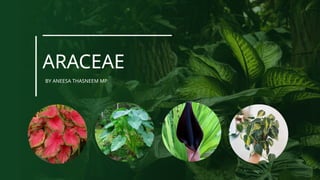
ARACEAE
BY ANEESA THASNEEM MP
1
MAJOR GENERA AND COMMON PLANTS
2
DISTRIBUTION AND DESCRIPTION
3
ECONOMIC IMPORTANCE
4
REFERENCE
5
contents
Systematic position
Systematic position
•Bentham and hooker:
class: Monocotyledons
series : Nudiflorae
•APG IV :
Division : Angiosperms
Clade: Monocots
Order : Alismatales
•anthurium,philodendron,Arisaema,amorphophallus,po
thos, dieffenbachia,syngonium
Major genera
•Probably originated in
tropical Asia, Now nearly
worldwide, primarily
tropical regions.
•It is commonly called
Arum family, contain 115
genera and 2000 species.
• About 25 genera and
over 140 species have
been reported from
India. The members
tend to be aquatic but
some are epiphytic.
Distribution:
Key Identifying Characters
of the Family
01
02
03
04
Stem modified into corm
The inflorescence is spadix, covered
by bract known as spathe
Fruit is berry
Flowers are small or minute
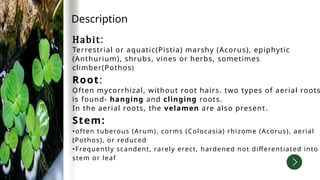
Habit:
Terrestrial or aquatic(Pistia) marshy (Acorus), epiphytic
(Anthurium), shrubs, vines or herbs, sometimes
climber(Pothos)
Root:
Often mycorrhizal, without root hairs. two types of aerial roots
is found- hanging and clinging roots.
In the aerial roots, the velamen are also present.
Stem:
•often tuberous (Arum), corms (Colocasia) rhizome (Acorus), aerial
(Pothos), or reduced
•Frequently scandent, rarely erect, hardened not differentiated into
stem or leaf
Description
Leaf:
Generally large, measuring 3 meters (Amorphophallus
companulatus), simple, alternate, bifacial, spiral, or distichous,
petiolate or sessile (Pistia), usually parallel(Acorus), penni-
parallel, but rarely reticulate (Arisaema) entire or lobed.
B. Floral characters:
Inflorescence:
• Many-flowered spadix (with a sterile apical portion in some),
usually subtended by a prominent, often colored spathe , it may
be more than 1 m long (Amorphophallus riviera), or reduced
• The flowers of both sexes are in distinct zones separated by
zone of sterile hair
Flower:
Small, sessile, actinomorphic, di- or trimerous,
unisexual rarely bisexual (Acorus, Pothos, Monstera),
female flowers often proximal, and the male distal on
a spadix, hypogynous or epigynous, ebracteate,
often bad-smelling.
Perianth:
Absent (Calla, Colocasia) in unisexual flowers and
present in bisexual flowers, 1 (Acorus) or 4
(Anthurium) to 6 (Acorus), perianth lobes small, scale-
like, free or rarely connate. hypanthium absent
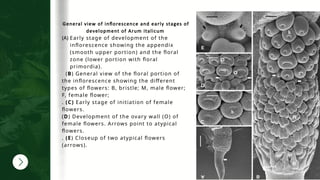
General view of inflorescence and early stages of
development of Arum italicum
(A) Early stage of development of the
inflorescence showing the appendix
(smooth upper portion) and the floral
zone (lower portion with floral
primordia).
(B) General view of the floral portion of
the inflorescence showing the different
types of flowers: B, bristle; M, male flower;
F, female flower;
. (C) Early stage of initiation of female
flowers.
(D) Development of the ovary wall (O) of
female flowers. Arrows point to atypical
flowers.
. (E) Closeup of two atypical flowers
(arrows).
Androecium:
Stamens many or reduced to 4-10, even 1 (Arisaema) in two or
one whorls; situated opposite to perianth lobes; free or united
into a synandrium (Colocasia, Alocasia) dithecous, introrse,
female flowers bear staminodes.
anthers are poricidal, longitudinal, or transverse in dehiscence
Gynoecium:
- Syncarpous, with a superior ovary, 3 carpels, usually as many
locules as carpels, ovules one or more in each cell; placentation
may be axile (Pothos) or parietal (Arum) or basal (Typhonium);
style short, stigma one or more; ovules are usually anatropous
and bitegmic
.
Fruit:
A berry, the cluster densely grouped on the fruiting
spadix, looking like a multiple-fruit, less often dry.
Seed:
Oily (sometimes also starchy) endospermous (rarely
endosperm absent) with a sometimes fleshy seed
coat.
Some have cyanogenic compounds or alkaloids.
Raphides are present and laticifers are common.
Pollination:
Entomophilous due to coloured–spathe, rarely self-
pollinated (species of Arisaema).
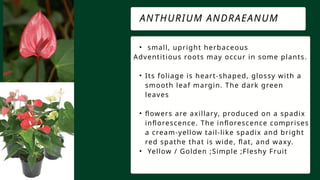
• small, upright herbaceous
Adventitious roots may occur in some plants.
• Its foliage is heart-shaped, glossy with a
smooth leaf margin. The dark green
leaves
• flowers are axillary, produced on a spadix
inflorescence. The inflorescence comprises
a cream-yellow tail-like spadix and bright
red spathe that is wide, flat, and waxy.
• Yellow / Golden ;Simple ;Fleshy Fruit
ANTHURIUM ANDRAEANUM
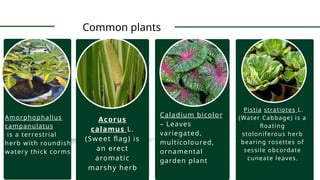
Common plants
Caladium bicolor
– Leaves
variegated,
multicoloured,
ornamental
garden plant
Pistia stratiotes L.
(Water Cabbage) is a
floating
stoloniferous herb
bearing rosettes of
sessile obcordate
cuneate leaves.
Amorphophallus
campanulatus
is a terrestrial
herb with roundish,
watery thick corms.
Acorus
calamus L.
(Sweet flag) is
an erect
aromatic
marshy herb
Pothos aureus L
(Money plant)
a climbing herb
without latex. The
leaves may be
variegated, or
cultivated.
Arisaema tortuosum
(Snake plant)
seen in Darjeeling and
Shillong, is characterized
by a greenish-purple
spathe which expands over
the spadix like the hood of
a snake
Monstera deliciosa
an ornamental
herb or shrub with
leaves perforated
The Araceae is divided into eight sub-families:
Sub-family I.
Arodeae:
Latex sacs straight, flowers with or without
perianth. Stamens free or in synandria.
Examples:
Arum, Typhonium, etc.
Sub-family II.
Calloideae:
Leaves fever sagittate, Latex sacs present, Flowers
bisexual, naked.
Example: Calla.
Division of the family
and chief genera:
Typhonium
•Sub-family III.
Colocasioideae:
Leaves always net-veined. Latex sacs branched
Flowers unisexual, naked, Stamens in synandria.
Examples: Alocasia, Colocasia etc.
•Sub-family IV.
Lasioideae:
•Leaves sagittate, Latex sacs present. Flowers
bisexual or unisexual.
•Examples: Amorphophallus, Lasia, etc.
•Sub-family V.
Monsteroideae:
•Latex sacs absent, but spicular cells present.
Flowers bisexual, naked.
•Examples: Monestera, Scindapsus etc. Lasia
•Sub-family VI.
Philodendroideae:
Leaves always parallel-veined. Flowers bisexual or
unisexual.
•Examples: Philodendron, Richardia etc.
•Sub-family VII.
Pistioideae:
•Aquatic herbs. Leaves parallel-veined. Flowers
extremely reduced.
•Example: Pistia.
•Sub-family VIII.
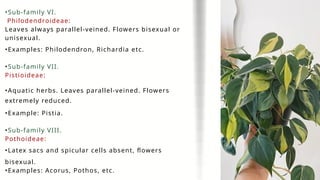
Pothoideae:
•Latex sacs and spicular cells absent, flowers
bisexual.
•Examples: Acorus, Pothos, etc.
Economic importance
• Food:
• The plants cultivated for vegetables are Colocasia esculenta;
Alocasia indica, Amorphophallus campanulatus (elephant foot).
• Leaves of Lasia spinosa are eaten as food.
• The large fruits of Monstera are eaten in many tropical regions.
• From the tubers of Colocasia esculenta, starchy baby foods, and
alcohol are also prepared.
2. Medicinal:
• The rhizomes of the Acorus calamus are used in diarrhea and dyspepsia.
• The stem juice of Alocasia macrorrhiza is used to relieve pain in scorpion
bites.
• The corms of Amorphophallus campanulatus are used in treating piles and
dysentery.
3. Poison:
Arisaema spp. are poisonous.
4. Ornamentals:
• The plants of this family are commonly grown in gardens
and green houses for their variegated and handsome
leaves.
• The plants are Pothos aureus (Money plant), Monstera
deliciosa, Alocasia indica var. metallica, Caladium
picturatum, C. bicolor, Colocasia esculenta, Scindapsus
officinalis, Anthurium and Pistia spp. in aquaria.
• The family is considered to be monophyletic
• Hutchinson believed it had been derived from the tribe Aspidistreae of
Liliaceae.
• Bisexual flowers are considered more primitive and unisexual flowers
highly evolved.
• Most recent classification places this family under the order Arales
along with Lemnaceae, Acoraceae having been removed to a separate
order Acorales.
• APG IV and APweb place Acoraceae under separate order,but include
Araceae along with several others under order Alismatales, Lemnaceae
being merged with Araceae
• The family is considered to be a early divergent lineage within
monocots and sister to the remaining families of Alismatales
phylogeny
1. Epiphytic : a plant that grows on another plant but does not feed from it
2. Velamen : an outer layer of dead cells in the aerial roots of . ,.
epiphytic orchids and aroids.
3. Corms :underground stem that acts as a food-storage structure
4. Scandent : having a climbing habit.
5. Bifacial : having upper and lower surfaces that differ from each other
6. Distichous : arranged in two vertical rows on opposite sides of an axis, such as
leaves
7. Petiolate :the stalk that attaches a leaf blade to a stem
8. Sessile : no stalk.
9. Penni-parallel :has a central midvein with secondary veins that are essentially
parallel to one another
10.Reticulate :veins form a network
11.Actinomorphic : A flower that can be divided into two equal halves from any plane
passing through the center
12.di- or trimerous: three or it's multiple in all floral appendages
13.Hypogynous : gynoecium located above the other parts of the flower
14.Epigynous : gynoecium is located below the other parts of the flower.
15.Ebracteate : without bracts.
GLOSSARY:
• Connate :fused
• Hypanthium : a cup-like structure connecting the petals, sepals, and stamens
• Synandrium : stamens are united
• Dithecous : Having two thecae.A theca refers to the case of a sporangium
• Introrse : Facing inward
• Staminodes : Sterile stamens
• Poricidal : pollen is released through pores.
• Syncarpous : carpels united
• Placentation :arrangement of a placenta
• Bitegmic : Having two integuments
• Raphides :crystals of calcium oxalate or calcium carbonate
• Synandria : stamens are united by their anthers
• Sagittate :shaped like an arrowhead
• Variegated : appearance of differently colored zones in the leaves
• Stoloniferous : producing stolons (horizontal stems that grow along the ground and produce new plants
at their tips or nodes
• Rosettes : clusters of leaves growing in a circular pattern
• Obcordate : heart-shaped but attached at the pointed end
• Cuneate : wedge-shaped
• Leaves perforated :leaves that have holes or openings in them
• Spicular cells :Cells that are elongated and pointed, resembling a spike.
references:
• https://wwhttps/www.biologydiscussion.com/botany/monocotyledons/araceae-characters-
distribution-and-types/48340
• https://balconygardenweb.com/
• https://indiabiodiversity.org/
• Plant systematics by Michael G.Simpson
THANK YOU