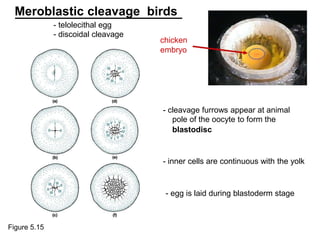
Cell division after fertilization is called cleavage. It results in the fertilized egg converting from a single cell to multiple cells. During cleavage, the number of nuclei doubles with each division through DNA synthesis, while RNA and protein synthesis are more limited. Cleavage patterns vary between species but include radial, spiral, bilateral, rotational, meroblastic and holoblastic types. Experiments transplanting nuclei between cells provide evidence against the theory that determinants on chromosomes alone control development, and show that nuclei retain developmental potential even in differentiated cells.