Biology 199
SS 2011-2012
Research Methodology
Research Design
 represents the “plan of attack” of the
researcher
 in answering the research objectives
 in obtaining all the relevant data in relation to
objectives and hypothesis
The specific areas of concern in the
choice of a research design are the
following
 selection and number of subjects
 control and manipulation of relevant variables
 establishment of criteria to evaluate outcomes
 instrumentation
 maximization of internal and external validity
Factors to consider
 research objectives
 feasibility
 ethical considerations
 economy and efficiency
 internal and external validity.
Internal Validity
 refers to extent to which investigator is able to
control the different biases affecting the study and in
the end, measures what he really intends to
measure.
 Did the experimental treatment really bring about a
change in the dependent variable?
 Did the independent variable make a significant
difference?
External Validity
 refers to the extent to which the investigator is able
to generalize the results of his study.
Are the results applicable to groups and
environment outside of experimental setting?
DESIGN THE TOOLS FOR DATA
COLLECTION
 Experimentation
 Questionnaire
 Interview schedule and forms
DESIGN THE PLAN FOR DATA ANALYSIS
 A number of researchers think about data
analysis only after all data has been collected.
 Consequences:
 Some very important variables in study are either
not measured at all or collected using a
measurement scale which is inconsistent with
desired mode of data analysis.
 Objectives are too ambitious or non-measurable,
given the nature of the data that were collected.
Dummy Table
 skeleton tables drawn to help the investigator
conceptualize how the data is going to be
organized and presented after it has been
collected.
COLLECTION OF DATA
 Essential phase of the research process.
 Researcher employs specialized tools,
instruments and procedures depending upon the
method designed for such activity.
DATA PROCESSING
 Process the information gathered to prepare for
and facilitate analysis and interpretation of data.
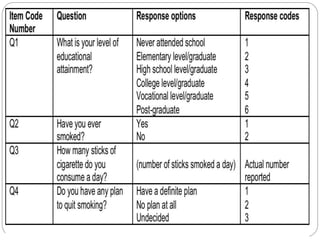
 Editing of data collection forms and coding of
responses are procedures usually done in this
stage
DATA ANALYSIS AND INTERPRETATION
 Involves quantification, description, and
classification of data
 Statistics play a major role.
 Researcher must be familiar with basic statistical
concepts and procedures and must know their
limitations as well as the areas where they may
be appropriately applied.
Selection of a research design
depends mainly on the
objectives of the study
1. To describe, compare –
descriptive design
2. To test hypothesis –
experimental designs
EXAMPLE
General Objective: To explain why
university students engage in
vandalistic acts in schools?
Specific objectives
1. To determine the prevalence of students who
admitted that they have committed some
vandalistic acts at least once in their college
life; PROPORTION/PERCENT
2. To describe the socio-demographic and
psychographic profile of this group of students;
DESCRIPTIVE STATS (frequencies, percent,
mean (SD), median (range)
3. To identify the types of vandalistic acts
committed by these students; FREQ, PERCENT
Specific objectives
4. To know the reasons why they committed such acts.
FREQ, PERCENT
5. To analyze significant differences in motivations to
commit vandalistic acts among students classified by
sex and socio-economic status; INFERENTIAL
STATISTICS (CHI-SQUARE since expected data is
nominal level)
6. To determine significant associations among selected
psychological traits and motivations to commit
vandalistic acts.CORRELATION/REGRESSION
Criteria for selecting the most appropriate
statistical test
1. if variable of interest (dependent variable, outcome
factor) is continuous or discrete;
2. If level of measurement of the dependent variable is
nominal, ordinal, ratio or interval;
3. if probability or non-probability sampling is used. This will
indicate if your samples are independent or related;
4. if the underlying distribution of the dependent variable is
normal or non-normal (skewed)
5. If variances of the samples are homoscedastic or equal.
6. depends also on number of groups being tested.
Parametric vs Non-parametric tests
Based on the criteria, you have 2 choices of statistical
methods:
1. Parametric tests - assume that data come from a
normally distributed or approximately normally
distributed population. It is more powerful but has
more stringent requirements for use.
2. Non-parametric (or distribution-free) test make
no assumptions about the probability distributions of
the variables being assessed.
Use a parametric statistical tests
if:
 Variables are continuous ( i.e., interval or ratio level
of measurement)
 Samples have underlying normal distribution (is not
a problem if you have large sample size)
Compute for sample size to get minimum number
of samples to be included in the study
 Variances of the samples are equal (homoscedastic
or homogenous) - (is not a problem if you have large
sample size)
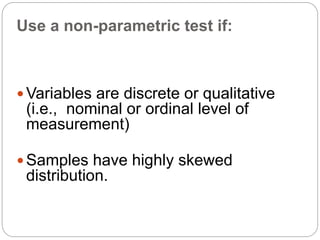
Use a non-parametric test if:
 Variables are discrete or qualitative
(i.e., nominal or ordinal level of
measurement)
 Samples have highly skewed
distribution.
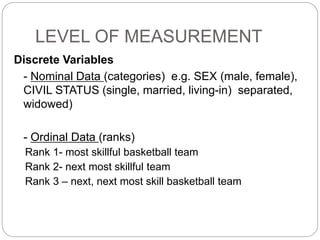
LEVEL OF MEASUREMENT
Discrete Variables
- Nominal Data (categories) e.g. SEX (male, female),
CIVIL STATUS (single, married, living-in) separated,
widowed)
- Ordinal Data (ranks)
Rank 1- most skillful basketball team
Rank 2- next most skillful team
Rank 3 – next, next most skill basketball team
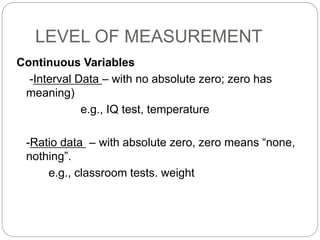
LEVEL OF MEASUREMENT
Continuous Variables
-Interval Data – with no absolute zero; zero has
meaning)
e.g., IQ test, temperature
-Ratio data – with absolute zero, zero means “none,
nothing”.
e.g., classroom tests. weight
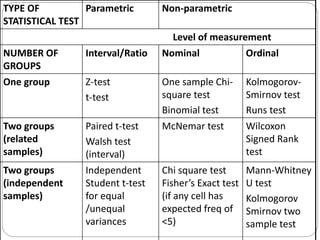
TYPE OF
STATISTICAL TEST
Parametric Non-parametric
Level of measurement
NUMBER OF
GROUPS
Interval/Ratio Nominal Ordinal
One group Z-test
t-test
One sample Chi-
square test
Binomial test
Kolmogorov-
Smirnov test
Runs test
Two groups
(related
samples)
Paired t-test
Walsh test
(interval)
McNemar test Wilcoxon
Signed Rank
test
Two groups
(independent
samples)
Independent
Student t-test
for equal
/unequal
variances
Chi square test
Fisher’s Exact test
(if any cell has
expected freq of
<5)
Mann-Whitney
U test
Kolmogorov
Smirnov two
sample test
TYPE OF
STATISTICAL
TEST
Parametric Non-parametric
Level of measurement
NUMBER OF
GROUPS
Interval/Ratio Nominal Ordinal
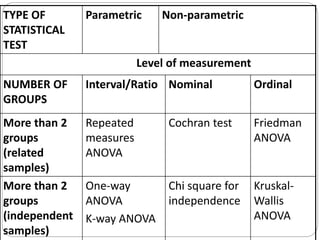
More than 2
groups
(related
samples)
Repeated
measures
ANOVA
Cochran test Friedman
ANOVA
More than 2
groups
(independent
samples)
One-way
ANOVA
K-way ANOVA
Chi square for
independence
Kruskal-
Wallis
ANOVA
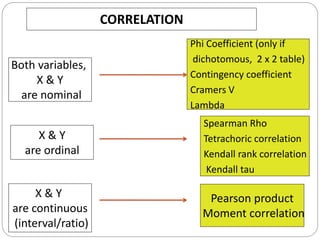
CORRELATION
Pearson product
Moment correlation
X & Y
are ordinal
Spearman Rho
Tetrachoric correlation
Kendall rank correlation
Kendall tau
Both variables,
X & Y
are nominal
X & Y
are continuous
(interval/ratio)
Phi Coefficient (only if
dichotomous, 2 x 2 table)
Contingency coefficient
Cramers V
Lambda
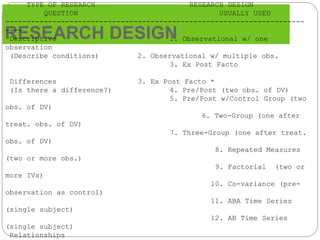
RESEARCH DESIGN
TYPE OF RESEARCH RESEARCH DESIGN
QUESTION USUALLY USED
----------------------------------------------------------------------
----
Descriptive 1. Observational w/ one
observation
(Describe conditions) 2. Observational w/ multiple obs.
3. Ex Post Facto
Differences 3. Ex Post Facto *
(Is there a difference?) 4. Pre/Post (two obs. of DV)
5. Pre/Post w/Control Group (two
obs. of DV)
6. Two-Group (one after
treat. obs. of DV)
7. Three-Group (one after treat.
obs. of DV)
8. Repeated Measures
(two or more obs.)
9. Factorial (two or
more IVs)
10. Co-variance (pre-
observation as control)
11. ABA Time Series
(single subject)
12. AB Time Series
(single subject)
Relationships
DATA ANALYSIS
-----------
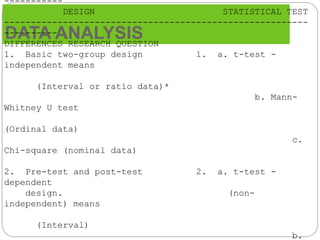
DESIGN STATISTICAL TEST
---------------------------------------------------------
----------
DIFFERENCES RESEARCH QUESTION
1. Basic two-group design 1. a. t-test -
independent means
(Interval or ratio data)*
b. Mann-
Whitney U test
(Ordinal data)
c.
Chi-square (nominal data)
2. Pre-test and post-test 2. a. t-test -
dependent
design. (non-
independent) means
(Interval)
b.
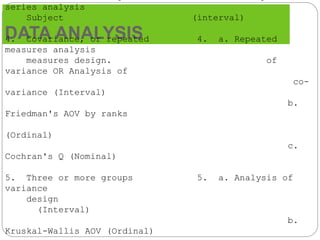
DATA ANALYSIS
series analysis
Subject (interval)
4. Covariance, or repeated 4. a. Repeated
measures analysis
measures design. of
variance OR Analysis of
co-
variance (Interval)
b.
Friedman's AOV by ranks
(Ordinal)
c.
Cochran's Q (Nominal)
5. Three or more groups 5. a. Analysis of
variance
design
(Interval)
b.
Kruskal-Wallis AOV (Ordinal)
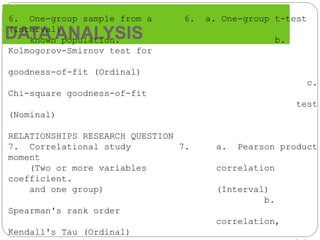
DATA ANALYSIS
6. One-group sample from a 6. a. One-group t-test
(Interval)
known population. b.
Kolmogorov-Smirnov test for
goodness-of-fit (Ordinal)
c.
Chi-square goodness-of-fit
test
(Nominal)
RELATIONSHIPS RESEARCH QUESTION
7. Correlational study 7. a. Pearson product
moment
(Two or more variables correlation
coefficient.
and one group) (Interval)
b.
Spearman's rank order
correlation,
Kendall's Tau (Ordinal)

Lect4 research methodology

  • 1.
  • 2.
    Research Design  representsthe “plan of attack” of the researcher  in answering the research objectives  in obtaining all the relevant data in relation to objectives and hypothesis
  • 3.
    The specific areasof concern in the choice of a research design are the following  selection and number of subjects  control and manipulation of relevant variables  establishment of criteria to evaluate outcomes  instrumentation  maximization of internal and external validity
  • 4.
    Factors to consider research objectives  feasibility  ethical considerations  economy and efficiency  internal and external validity.
  • 5.
    Internal Validity  refersto extent to which investigator is able to control the different biases affecting the study and in the end, measures what he really intends to measure.  Did the experimental treatment really bring about a change in the dependent variable?  Did the independent variable make a significant difference?
  • 6.
    External Validity  refersto the extent to which the investigator is able to generalize the results of his study. Are the results applicable to groups and environment outside of experimental setting?
  • 7.
    DESIGN THE TOOLSFOR DATA COLLECTION  Experimentation  Questionnaire  Interview schedule and forms
  • 8.
    DESIGN THE PLANFOR DATA ANALYSIS  A number of researchers think about data analysis only after all data has been collected.  Consequences:  Some very important variables in study are either not measured at all or collected using a measurement scale which is inconsistent with desired mode of data analysis.  Objectives are too ambitious or non-measurable, given the nature of the data that were collected.
  • 9.
    Dummy Table  skeletontables drawn to help the investigator conceptualize how the data is going to be organized and presented after it has been collected.
  • 10.
    COLLECTION OF DATA Essential phase of the research process.  Researcher employs specialized tools, instruments and procedures depending upon the method designed for such activity.
  • 11.
    DATA PROCESSING  Processthe information gathered to prepare for and facilitate analysis and interpretation of data.  Editing of data collection forms and coding of responses are procedures usually done in this stage
  • 13.
    DATA ANALYSIS ANDINTERPRETATION  Involves quantification, description, and classification of data  Statistics play a major role.  Researcher must be familiar with basic statistical concepts and procedures and must know their limitations as well as the areas where they may be appropriately applied.
  • 14.
    Selection of aresearch design depends mainly on the objectives of the study 1. To describe, compare – descriptive design 2. To test hypothesis – experimental designs
  • 15.
    EXAMPLE General Objective: Toexplain why university students engage in vandalistic acts in schools?
  • 16.
    Specific objectives 1. Todetermine the prevalence of students who admitted that they have committed some vandalistic acts at least once in their college life; PROPORTION/PERCENT 2. To describe the socio-demographic and psychographic profile of this group of students; DESCRIPTIVE STATS (frequencies, percent, mean (SD), median (range) 3. To identify the types of vandalistic acts committed by these students; FREQ, PERCENT
  • 17.
    Specific objectives 4. Toknow the reasons why they committed such acts. FREQ, PERCENT 5. To analyze significant differences in motivations to commit vandalistic acts among students classified by sex and socio-economic status; INFERENTIAL STATISTICS (CHI-SQUARE since expected data is nominal level) 6. To determine significant associations among selected psychological traits and motivations to commit vandalistic acts.CORRELATION/REGRESSION
  • 18.
    Criteria for selectingthe most appropriate statistical test 1. if variable of interest (dependent variable, outcome factor) is continuous or discrete; 2. If level of measurement of the dependent variable is nominal, ordinal, ratio or interval; 3. if probability or non-probability sampling is used. This will indicate if your samples are independent or related; 4. if the underlying distribution of the dependent variable is normal or non-normal (skewed) 5. If variances of the samples are homoscedastic or equal. 6. depends also on number of groups being tested.
  • 19.
    Parametric vs Non-parametrictests Based on the criteria, you have 2 choices of statistical methods: 1. Parametric tests - assume that data come from a normally distributed or approximately normally distributed population. It is more powerful but has more stringent requirements for use. 2. Non-parametric (or distribution-free) test make no assumptions about the probability distributions of the variables being assessed.
  • 20.
    Use a parametricstatistical tests if:  Variables are continuous ( i.e., interval or ratio level of measurement)  Samples have underlying normal distribution (is not a problem if you have large sample size) Compute for sample size to get minimum number of samples to be included in the study  Variances of the samples are equal (homoscedastic or homogenous) - (is not a problem if you have large sample size)
  • 21.
    Use a non-parametrictest if:  Variables are discrete or qualitative (i.e., nominal or ordinal level of measurement)  Samples have highly skewed distribution.
  • 22.
    LEVEL OF MEASUREMENT DiscreteVariables - Nominal Data (categories) e.g. SEX (male, female), CIVIL STATUS (single, married, living-in) separated, widowed) - Ordinal Data (ranks) Rank 1- most skillful basketball team Rank 2- next most skillful team Rank 3 – next, next most skill basketball team
  • 23.
    LEVEL OF MEASUREMENT ContinuousVariables -Interval Data – with no absolute zero; zero has meaning) e.g., IQ test, temperature -Ratio data – with absolute zero, zero means “none, nothing”. e.g., classroom tests. weight
  • 24.
    TYPE OF STATISTICAL TEST ParametricNon-parametric Level of measurement NUMBER OF GROUPS Interval/Ratio Nominal Ordinal One group Z-test t-test One sample Chi- square test Binomial test Kolmogorov- Smirnov test Runs test Two groups (related samples) Paired t-test Walsh test (interval) McNemar test Wilcoxon Signed Rank test Two groups (independent samples) Independent Student t-test for equal /unequal variances Chi square test Fisher’s Exact test (if any cell has expected freq of <5) Mann-Whitney U test Kolmogorov Smirnov two sample test
  • 25.
    TYPE OF STATISTICAL TEST Parametric Non-parametric Levelof measurement NUMBER OF GROUPS Interval/Ratio Nominal Ordinal More than 2 groups (related samples) Repeated measures ANOVA Cochran test Friedman ANOVA More than 2 groups (independent samples) One-way ANOVA K-way ANOVA Chi square for independence Kruskal- Wallis ANOVA
  • 26.
    CORRELATION Pearson product Moment correlation X& Y are ordinal Spearman Rho Tetrachoric correlation Kendall rank correlation Kendall tau Both variables, X & Y are nominal X & Y are continuous (interval/ratio) Phi Coefficient (only if dichotomous, 2 x 2 table) Contingency coefficient Cramers V Lambda
  • 27.
    RESEARCH DESIGN TYPE OFRESEARCH RESEARCH DESIGN QUESTION USUALLY USED ---------------------------------------------------------------------- ---- Descriptive 1. Observational w/ one observation (Describe conditions) 2. Observational w/ multiple obs. 3. Ex Post Facto Differences 3. Ex Post Facto * (Is there a difference?) 4. Pre/Post (two obs. of DV) 5. Pre/Post w/Control Group (two obs. of DV) 6. Two-Group (one after treat. obs. of DV) 7. Three-Group (one after treat. obs. of DV) 8. Repeated Measures (two or more obs.) 9. Factorial (two or more IVs) 10. Co-variance (pre- observation as control) 11. ABA Time Series (single subject) 12. AB Time Series (single subject) Relationships
  • 28.
    DATA ANALYSIS ----------- DESIGN STATISTICALTEST --------------------------------------------------------- ---------- DIFFERENCES RESEARCH QUESTION 1. Basic two-group design 1. a. t-test - independent means (Interval or ratio data)* b. Mann- Whitney U test (Ordinal data) c. Chi-square (nominal data) 2. Pre-test and post-test 2. a. t-test - dependent design. (non- independent) means (Interval) b.
  • 29.
    DATA ANALYSIS series analysis Subject(interval) 4. Covariance, or repeated 4. a. Repeated measures analysis measures design. of variance OR Analysis of co- variance (Interval) b. Friedman's AOV by ranks (Ordinal) c. Cochran's Q (Nominal) 5. Three or more groups 5. a. Analysis of variance design (Interval) b. Kruskal-Wallis AOV (Ordinal)
  • 30.
    DATA ANALYSIS 6. One-groupsample from a 6. a. One-group t-test (Interval) known population. b. Kolmogorov-Smirnov test for goodness-of-fit (Ordinal) c. Chi-square goodness-of-fit test (Nominal) RELATIONSHIPS RESEARCH QUESTION 7. Correlational study 7. a. Pearson product moment (Two or more variables correlation coefficient. and one group) (Interval) b. Spearman's rank order correlation, Kendall's Tau (Ordinal)