“ANGIOSPERMS SYSTEMATIC, ANATOMY AND EMBRYOLOGY”
Unit – III
‘Angiosperms Systematic’
Family- Liliaceae
DR. SWATI V. PUNDKAR
Assistant Professor
Department of Botany
Shri Shivaji Science College, Amravati
NAAC Accredited ‘A’ Grade
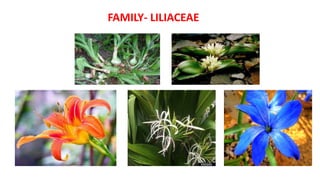
FAMILY- LILIACEAE
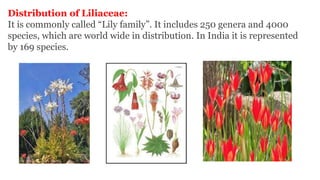
Distribution of Liliaceae:
It is commonly called “Lily family”. It includes 250 genera and 4000
species, which are world wide in distribution. In India it is represented
by 169 species.
Comonm plants of the family:
1. Allium:
Cultivated in winter for bulbs.
2. Aloe:
Shrubby xerophytic plant, wild on rocks with dull red flowers.
3. Asphodelus:
Common winter weed in wheat fields.
4. Asparagus:
A thorny climbing under-shrub with cladodes and fasiculated roots.
5. Dracaena:
Tree with anomalous secondary growth in the stem.
as ornamental.
6.Gloriosa (Glory lily):
Climber with tips of leaves turned into tendrils.
7. Ruscus:
Flowers arise on the upper surface of phylloclades.
10. Smilax:
A climber with stipular tendrils and reticulate venation.
11. Tulipa:
Grown in garden as ornamentals.
Primitive characters:
1. Perennial and arboreal habit in
some genera (Aloe, Yucca).
2. Leaves simple and spirally arranged
in most genera.
3. Solitary flowers in some genera.
4. Flowers hermaphrodite and
actinomorphic.
5. Flowers are large and hypogynous.
6. Perianth polyphyllous in some
genera (Asphodelus, Veratrum).
7. Seeds endospermic.
Advanced characters:
1. Many plants are herbaceous.
2. Leaves exstipulate, opposite or
whorled in some genera.
3. Flowers are zygomorphic in some
genera (Lilium, Hemerocallis).
4. Flowers unisexual (Ruscus, Smilax).
5. Perianth gamophyllous in many
genera.
6. Stamens epiphyllous.
7. Reduction in the number of stamens
to 3 (Ruscus).
8. Carpels 3 or 2 and syncarpous.
9. Axile placentation.
Characters of Liliaceae:
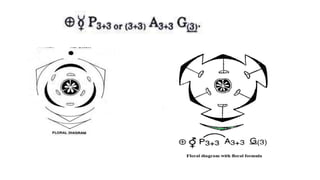
Herbs rarely shrubs, stem underground rhizome, corm
or bulb; leaves alternate, flowers actinomorphic,
trimerous, hypogynous, perianth 6 in two whorls of 3
each, free or fused; stamen 3+3, epiphyllous,
antiphyllous; gynoecium tricarpellary, syncarpous,
ovary superior, axile placentation, two to many ovules
per loculus; fruit capsule or berry; seed endospermic.
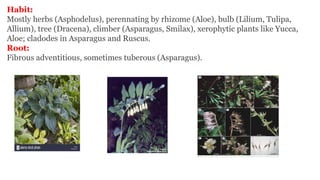
Habit:
Mostly herbs (Asphodelus), perennating by rhizome (Aloe), bulb (Lilium, Tulipa,
Allium), tree (Dracena), climber (Asparagus, Smilax), xerophytic plants like Yucca,
Aloe; cladodes in Asparagus and Ruscus.
Root:
Fibrous adventitious, sometimes tuberous (Asparagus).
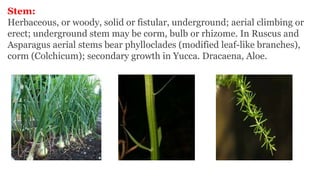
Stem:
Herbaceous, or woody, solid or fistular, underground; aerial climbing or
erect; underground stem may be corm, bulb or rhizome. In Ruscus and
Asparagus aerial stems bear phylloclades (modified leaf-like branches),
corm (Colchicum); secondary growth in Yucca. Dracaena, Aloe.
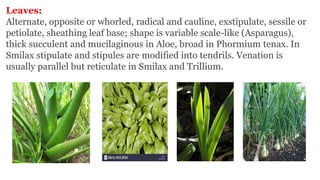
Leaves:
Alternate, opposite or whorled, radical and cauline, exstipulate, sessile or
petiolate, sheathing leaf base; shape is variable scale-like (Asparagus),
thick succulent and mucilaginous in Aloe, broad in Phormium tenax. In
Smilax stipulate and stipules are modified into tendrils. Venation is
usually parallel but reticulate in Smilax and Trillium.
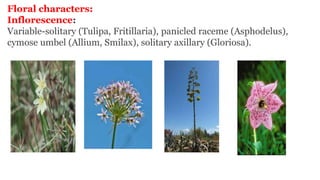
Floral characters:
Inflorescence:
Variable-solitary (Tulipa, Fritillaria), panicled raceme (Asphodelus),
cymose umbel (Allium, Smilax), solitary axillary (Gloriosa).
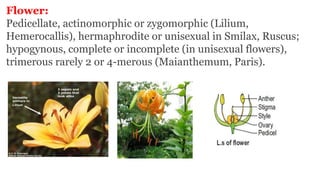
Flower:
Pedicellate, actinomorphic or zygomorphic (Lilium,
Hemerocallis), hermaphrodite or unisexual in Smilax, Ruscus;
hypogynous, complete or incomplete (in unisexual flowers),
trimerous rarely 2 or 4-merous (Maianthemum, Paris).
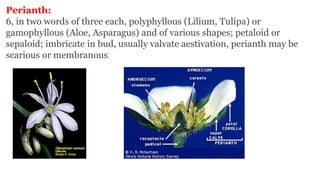
Perianth:
6, in two words of three each, polyphyllous (Lilium, Tulipa) or
gamophyllous (Aloe, Asparagus) and of various shapes; petaloid or
sepaloid; imbricate in bud, usually valvate aestivation, perianth may be
scarious or membranous.
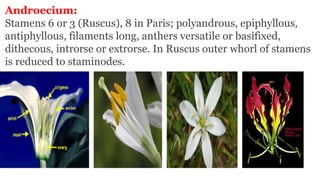
Androecium:
Stamens 6 or 3 (Ruscus), 8 in Paris; polyandrous, epiphyllous,
antiphyllous, filaments long, anthers versatile or basifixed,
dithecous, introrse or extrorse. In Ruscus outer whorl of stamens
is reduced to staminodes.
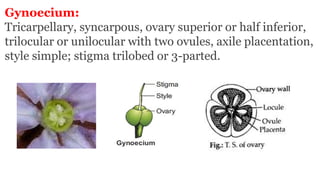
Gynoecium:
Tricarpellary, syncarpous, ovary superior or half inferior,
trilocular or unilocular with two ovules, axile placentation,
style simple; stigma trilobed or 3-parted.
Fruit:
A berry (Asparagus, Smilax), capsule (Asphodelus).
Seed:
Endospermic; endosperm horny or cartilagenous.
Pollination:
Entomophilous rarely self-pollination.
Economic Importance of Liliaceae:
1. Food:
Allium cepa (Onion), Allium sativum (Garlic) and Asparagus are edible and used as
food.
2. Medicinal:
Smilax, Aloe, Gloriosa, Veratrum, Colchicum, Scilla and Urginea yield useful drugs.
Rat poison is obtained from Urginea and the bulbs of Scilla. Aloe vera yields “Aloin”.
The roots of Asparagus (H. Satavaer) yields a tonic. From Colchicum, colchicine is
obtained.
3. Fibres:
Yucca, Phormium tenax yield fibres of commerce.
4. Resin:
Dracaena and Xanthorrhoea yield resin. From the acrid resin of Xanthorrhoea sealing
wax is prepared.
5. Ornamentals:
The common cultivated garden plants are Tulipa, Lilium, Gloriosa, Aloe, Ruscus,
Dracaena, Asparagus, Yucca, Hemerocallis etc.

Liliaceae

  • 1.
    “ANGIOSPERMS SYSTEMATIC, ANATOMYAND EMBRYOLOGY” Unit – III ‘Angiosperms Systematic’ Family- Liliaceae DR. SWATI V. PUNDKAR Assistant Professor Department of Botany Shri Shivaji Science College, Amravati NAAC Accredited ‘A’ Grade
  • 2.
  • 3.
    Distribution of Liliaceae: Itis commonly called “Lily family”. It includes 250 genera and 4000 species, which are world wide in distribution. In India it is represented by 169 species.
  • 5.
    Comonm plants ofthe family: 1. Allium: Cultivated in winter for bulbs. 2. Aloe: Shrubby xerophytic plant, wild on rocks with dull red flowers. 3. Asphodelus: Common winter weed in wheat fields. 4. Asparagus: A thorny climbing under-shrub with cladodes and fasiculated roots. 5. Dracaena: Tree with anomalous secondary growth in the stem. as ornamental. 6.Gloriosa (Glory lily): Climber with tips of leaves turned into tendrils. 7. Ruscus: Flowers arise on the upper surface of phylloclades. 10. Smilax: A climber with stipular tendrils and reticulate venation. 11. Tulipa: Grown in garden as ornamentals.
  • 6.
    Primitive characters: 1. Perennialand arboreal habit in some genera (Aloe, Yucca). 2. Leaves simple and spirally arranged in most genera. 3. Solitary flowers in some genera. 4. Flowers hermaphrodite and actinomorphic. 5. Flowers are large and hypogynous. 6. Perianth polyphyllous in some genera (Asphodelus, Veratrum). 7. Seeds endospermic. Advanced characters: 1. Many plants are herbaceous. 2. Leaves exstipulate, opposite or whorled in some genera. 3. Flowers are zygomorphic in some genera (Lilium, Hemerocallis). 4. Flowers unisexual (Ruscus, Smilax). 5. Perianth gamophyllous in many genera. 6. Stamens epiphyllous. 7. Reduction in the number of stamens to 3 (Ruscus). 8. Carpels 3 or 2 and syncarpous. 9. Axile placentation.
  • 7.
    Characters of Liliaceae: Herbsrarely shrubs, stem underground rhizome, corm or bulb; leaves alternate, flowers actinomorphic, trimerous, hypogynous, perianth 6 in two whorls of 3 each, free or fused; stamen 3+3, epiphyllous, antiphyllous; gynoecium tricarpellary, syncarpous, ovary superior, axile placentation, two to many ovules per loculus; fruit capsule or berry; seed endospermic.
  • 8.
    Habit: Mostly herbs (Asphodelus),perennating by rhizome (Aloe), bulb (Lilium, Tulipa, Allium), tree (Dracena), climber (Asparagus, Smilax), xerophytic plants like Yucca, Aloe; cladodes in Asparagus and Ruscus. Root: Fibrous adventitious, sometimes tuberous (Asparagus).
  • 9.
    Stem: Herbaceous, or woody,solid or fistular, underground; aerial climbing or erect; underground stem may be corm, bulb or rhizome. In Ruscus and Asparagus aerial stems bear phylloclades (modified leaf-like branches), corm (Colchicum); secondary growth in Yucca. Dracaena, Aloe.
  • 10.
    Leaves: Alternate, opposite orwhorled, radical and cauline, exstipulate, sessile or petiolate, sheathing leaf base; shape is variable scale-like (Asparagus), thick succulent and mucilaginous in Aloe, broad in Phormium tenax. In Smilax stipulate and stipules are modified into tendrils. Venation is usually parallel but reticulate in Smilax and Trillium.
  • 11.
    Floral characters: Inflorescence: Variable-solitary (Tulipa,Fritillaria), panicled raceme (Asphodelus), cymose umbel (Allium, Smilax), solitary axillary (Gloriosa).
  • 12.
    Flower: Pedicellate, actinomorphic orzygomorphic (Lilium, Hemerocallis), hermaphrodite or unisexual in Smilax, Ruscus; hypogynous, complete or incomplete (in unisexual flowers), trimerous rarely 2 or 4-merous (Maianthemum, Paris).
  • 13.
    Perianth: 6, in twowords of three each, polyphyllous (Lilium, Tulipa) or gamophyllous (Aloe, Asparagus) and of various shapes; petaloid or sepaloid; imbricate in bud, usually valvate aestivation, perianth may be scarious or membranous.
  • 14.
    Androecium: Stamens 6 or3 (Ruscus), 8 in Paris; polyandrous, epiphyllous, antiphyllous, filaments long, anthers versatile or basifixed, dithecous, introrse or extrorse. In Ruscus outer whorl of stamens is reduced to staminodes.
  • 15.
    Gynoecium: Tricarpellary, syncarpous, ovarysuperior or half inferior, trilocular or unilocular with two ovules, axile placentation, style simple; stigma trilobed or 3-parted.
  • 16.
    Fruit: A berry (Asparagus,Smilax), capsule (Asphodelus). Seed: Endospermic; endosperm horny or cartilagenous. Pollination: Entomophilous rarely self-pollination.
  • 18.
    Economic Importance ofLiliaceae: 1. Food: Allium cepa (Onion), Allium sativum (Garlic) and Asparagus are edible and used as food. 2. Medicinal: Smilax, Aloe, Gloriosa, Veratrum, Colchicum, Scilla and Urginea yield useful drugs. Rat poison is obtained from Urginea and the bulbs of Scilla. Aloe vera yields “Aloin”. The roots of Asparagus (H. Satavaer) yields a tonic. From Colchicum, colchicine is obtained. 3. Fibres: Yucca, Phormium tenax yield fibres of commerce. 4. Resin: Dracaena and Xanthorrhoea yield resin. From the acrid resin of Xanthorrhoea sealing wax is prepared. 5. Ornamentals: The common cultivated garden plants are Tulipa, Lilium, Gloriosa, Aloe, Ruscus, Dracaena, Asparagus, Yucca, Hemerocallis etc.