By
Hem Chander
Assistant Professor (Botany)
Career Point University Hamirpur (HP) 176041
hemchander78@gmail.com
•Albugo (means white in Latin), the only genus
of family Albuginaceae is represented by more
than 25 species.
•They are all plant parasite.
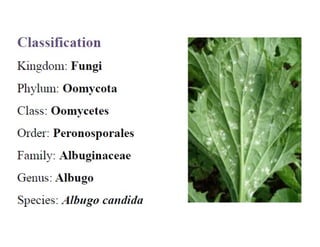
•Albugo candida (=Cystopus candidus) is the
most important pathogen of Brassicaceae/
Crucifereae members, causing white rust.
•Other families that are prone to attack of this
fungi are Asteraceae, Convolvulaceae and
Chenopodiaceae.
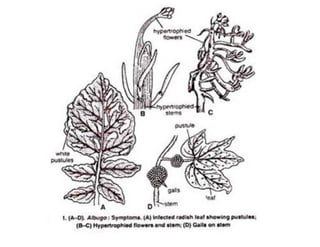
• This pathogen attack all the above ground parts. The
infection occurs through stomata.
• The disease results in the formation of shiny white
irregular patches on leaves or stems.
• In the later stages, these patches turn powdery.
• The flowers and fruits get deformed. Hypertrophy
(increase in size of the cells and organs) is also a
symptom of the disease.
Asexual Reproduction
• The fungus reproduces both by asexual and sexual
methods.
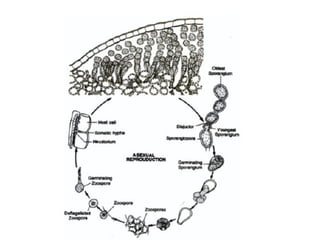
• The asexual reproduction takes place by conidia,
condiosporangia or zoosporangia.
• These are produced on the sporangiophores.
• Under suitable conditions the mycelium grows and
branches rapidly. After attaining a certain age of
maturity, it produces a dense mat like growth.
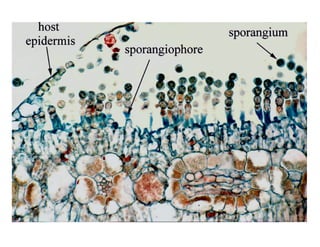
• In the mat like growth, just beneath the epidermis of the host
and some of the hyphae start behaving as sporangiophores or
conidiophores.
• These sporangiophores contain dense cytoplasm and about a
dozen nuclei. Later, the apical portion of sporangiophore gets
swollen and a constriction appears below the swollen end and
results in the formation of first sporangium.
• A second sporangium is similarly formed from the tip just
beneath the previous one.
• Similarly, a chain of sporangia or conidia in basipetal succession
(youngest at the base and oldest at the tip) is formed above
each sporangiophore.
• After maturity, the sporangia are set free due to
dissolution of separation disc.
• Under suitable environmental conditions when they
are blown away by wind or by rain water and falling on
a suitable host, sporangia germinates within 2 or 3
hours.
hours.
• The sporangia germinate to give rise to zoospores and
these zoospores on coming in contact with host
germinates and enters inside through stomata.
Sexual Reproduction
• It takes place when the growing season comes to an
end. The mycelium penetrates into the deeper tissues
of the host.
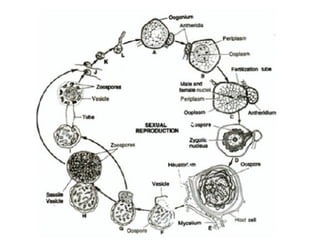
• The sexual reproduction is oogamous type. The male
sex organ is called antheridium and oogonium
represent the female sex organ
• Antheridium is elongated and club shaped structure.
• It is multinucleate, in some cases, only one nuclei
remain functional but in some many can remain
functional.
• Oogonium is spherical and multinucleate containing as
many as 65 to 115 nuclei.
• All nuclei are evenly distributed throughout the
cytoplasm.
• As the oogonium reaches towards the maturity the
contents of the oogonium get organised into an outer
peripheral region of periplasm and the inner dense
central region of ooplasm or oosphereor the egg.
• However, at the time of maturity, all nuclei disintegrate,
except single functional nucleus.
• Before fertilization a deeply staining mass of cytoplasm appears
in the center of the ooplasm. This is called coenocentrum. The
functional female nucleus attracted towards it and becomes
attached to a point near it.
• The oogonium develops a papilla like out grow that the point of
contact with the antheridium. This is called as receptive papilla,
soon it disappears, and the antheridium develops a fertilization
Fertilization
soon it disappears, and the antheridium develops a fertilization
tube.
• It penetrates through receptive papilla, oogonial wall and
periplasm and finally reaches upto the ooplasm. It carries a
single male nucleus. The tip ruptures to discharge the male
nucleus near the female nucleus. Ultimately the male nucleus
fuses with the female nucleus (karyogamy).
Oospore:
• The oosphere along with the fusion nucleus is called
oospore
• The oospore on maturity secretes a two to three layered
wall.
wall.
• The outer layer is thick, warty or tuberculated and
represents the exospore.
• The inner layer is thin and called the endospore.
Germination of oospore:
• With the secretion of the wall, the zygotic nucleus
divides repeatedly to form about 32 nuclei.
• The first division is meiotic.
• At this stage the oospore undergoes a long period of
rest until unfavorable conditions are over.
• Mean while its host tissues disintegrate leaving the
oospore free.
• After a long period of rest the oospore germinates. Its nuclei
divide mitotically and large number of nuclei are produced.
• A small amount of cytoplasm gathers around each nucleus.
• Protoplasm undergoes segmentation and each segment later on
rounds up and metamorphoses into a zoomeiospore or
zoospore.
• The exospore is ruptured and the endospore comes out as a
thin vesicle.
• The zoospores move out into the thin vesicle which soon
perishes to liberate the zoospores.
• The zoospores after swimming for sometime encyst and
germinate by a germ tube which again infects the host plant.
25. Albugo.pdf
25. Albugo.pdf

25. Albugo.pdf

  • 1.
    By Hem Chander Assistant Professor(Botany) Career Point University Hamirpur (HP) 176041 hemchander78@gmail.com
  • 2.
    •Albugo (means whitein Latin), the only genus of family Albuginaceae is represented by more than 25 species. •They are all plant parasite. •Albugo candida (=Cystopus candidus) is the •Albugo candida (=Cystopus candidus) is the most important pathogen of Brassicaceae/ Crucifereae members, causing white rust. •Other families that are prone to attack of this fungi are Asteraceae, Convolvulaceae and Chenopodiaceae.
  • 4.
    • This pathogenattack all the above ground parts. The infection occurs through stomata. • The disease results in the formation of shiny white irregular patches on leaves or stems. • In the later stages, these patches turn powdery. • In the later stages, these patches turn powdery. • The flowers and fruits get deformed. Hypertrophy (increase in size of the cells and organs) is also a symptom of the disease.
  • 6.
    Asexual Reproduction • Thefungus reproduces both by asexual and sexual methods. • The asexual reproduction takes place by conidia, condiosporangia or zoosporangia. condiosporangia or zoosporangia. • These are produced on the sporangiophores. • Under suitable conditions the mycelium grows and branches rapidly. After attaining a certain age of maturity, it produces a dense mat like growth.
  • 8.
    • In themat like growth, just beneath the epidermis of the host and some of the hyphae start behaving as sporangiophores or conidiophores. • These sporangiophores contain dense cytoplasm and about a dozen nuclei. Later, the apical portion of sporangiophore gets swollen and a constriction appears below the swollen end and results in the formation of first sporangium. results in the formation of first sporangium. • A second sporangium is similarly formed from the tip just beneath the previous one. • Similarly, a chain of sporangia or conidia in basipetal succession (youngest at the base and oldest at the tip) is formed above each sporangiophore.
  • 9.
    • After maturity,the sporangia are set free due to dissolution of separation disc. • Under suitable environmental conditions when they are blown away by wind or by rain water and falling on a suitable host, sporangia germinates within 2 or 3 hours. hours. • The sporangia germinate to give rise to zoospores and these zoospores on coming in contact with host germinates and enters inside through stomata.
  • 11.
    Sexual Reproduction • Ittakes place when the growing season comes to an end. The mycelium penetrates into the deeper tissues of the host. • The sexual reproduction is oogamous type. The male sex organ is called antheridium and oogonium represent the female sex organ represent the female sex organ • Antheridium is elongated and club shaped structure. • It is multinucleate, in some cases, only one nuclei remain functional but in some many can remain functional.
  • 12.
    • Oogonium isspherical and multinucleate containing as many as 65 to 115 nuclei. • All nuclei are evenly distributed throughout the cytoplasm. • As the oogonium reaches towards the maturity the • As the oogonium reaches towards the maturity the contents of the oogonium get organised into an outer peripheral region of periplasm and the inner dense central region of ooplasm or oosphereor the egg. • However, at the time of maturity, all nuclei disintegrate, except single functional nucleus.
  • 13.
    • Before fertilizationa deeply staining mass of cytoplasm appears in the center of the ooplasm. This is called coenocentrum. The functional female nucleus attracted towards it and becomes attached to a point near it. • The oogonium develops a papilla like out grow that the point of contact with the antheridium. This is called as receptive papilla, soon it disappears, and the antheridium develops a fertilization Fertilization soon it disappears, and the antheridium develops a fertilization tube. • It penetrates through receptive papilla, oogonial wall and periplasm and finally reaches upto the ooplasm. It carries a single male nucleus. The tip ruptures to discharge the male nucleus near the female nucleus. Ultimately the male nucleus fuses with the female nucleus (karyogamy).
  • 14.
    Oospore: • The oospherealong with the fusion nucleus is called oospore • The oospore on maturity secretes a two to three layered wall. wall. • The outer layer is thick, warty or tuberculated and represents the exospore. • The inner layer is thin and called the endospore.
  • 15.
    Germination of oospore: •With the secretion of the wall, the zygotic nucleus divides repeatedly to form about 32 nuclei. • The first division is meiotic. • The first division is meiotic. • At this stage the oospore undergoes a long period of rest until unfavorable conditions are over. • Mean while its host tissues disintegrate leaving the oospore free.
  • 16.
    • After along period of rest the oospore germinates. Its nuclei divide mitotically and large number of nuclei are produced. • A small amount of cytoplasm gathers around each nucleus. • Protoplasm undergoes segmentation and each segment later on rounds up and metamorphoses into a zoomeiospore or zoospore. • The exospore is ruptured and the endospore comes out as a thin vesicle. • The zoospores move out into the thin vesicle which soon perishes to liberate the zoospores. • The zoospores after swimming for sometime encyst and germinate by a germ tube which again infects the host plant.