






“THESIS WRITING”
MAKE OR BREAK YOUR FINAL
GRADES
INTRODUCTION TO THESIS
Thesis (plural: theses, pronounced THEES-eez)
 By definition, a “thesis” is the point your paper is
trying to prove.
 In the US, a thesis is the final project for the
masters degree, written by a candidate.
 A thesis is not the same as the thesis statement,
which is a sentence or two in your introduction
that tells the reader what the thesis is.
1
COMPONENTS OF A THESIS
Preliminaries:
All theses have a number of
preliminary requirements, that
are:
1) Cover page/Title Page
2) Approval sheet
3) Summary/abstract
4) Acknowledgements
5) Nomenclature/Notation
6) Table of Contents
7) Publications
8) List of tables, figures or
illustrations
2
TITLE PAGE
1. Thesis Title
2. Candidate's Name
3. Qualifications
4. Thesis Details
5. Faculty & Department
6. University & Date
3
APPROVAL SHEET
o Proves that the authors have passed the requirements
needed for the thesis.
o Is signed by the thesis/FS adviser, panel and the Dean.
o States the grade obtained by the author/s.
4
SUMMARY/ABSTRACT
o Summarizes the research undertaken
o Provide an overview of the project & its scholarly
significance
o Never contains new information
o Extends no longer than 2 pages of A4
5
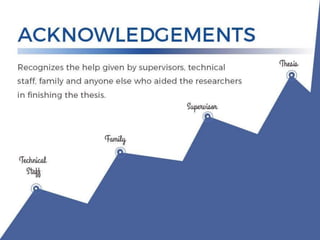
ACKNOWLEDGEMENTS
Recognizes the help given by supervisors, technical
staff, family and anyone else who aided the
researchers in finishing the thesis.
6
NOMENCLATURE / NOTATION
o Defines all notation and symbols used in the text
of the dissertation.
o May be replaced by a list of abbreviations in other
disciplines.
7
TABLE OF CONTENTS
o A topic outline of the thesis
o A list of all major divisions and chapter
titles.
8
PUBLICATIONS
o A list of the author's publications which directly
relate to the research work for the dissertation.
o often included in an appendix.
9
LIST OF TABLES, FIGURES OR
ILLUSTRATIONS
o Include a list of figures (illustrations) and a list of
tables
o Use a separate page for each list.
o List the number, caption, and page number of every
figure and table in the body of the thesis.
10
TEXT OF THE THESIS:
o Introduction
o Literature Review
o Sequential chapters
o Conclusions and Recommendations
o References/Bibliography
o Appendices
11
INTRODUCTION
 Provides a clear statement of the topic under
investigation
 Provides the general context for the research
 Outlines applications of the research.
 Justifies the need for this research, and states the
aims
 Concludes with a chapter by chapter outline of the
content of the dissertation.
12
LITERATURE REVIEW
o Presents a critical review of relevant previous
studies in the research field
o Shows how knowledge has been built up in the
research field
o Demonstrate the achievements and the limitations
of the previous research
o Presents a well argued justification for the research
to be undertaken. 13
SEQUENTIAL CHAPTERS
o Present a detailed description of the experimental or
theoretical work undertaken, the results and a
discussion of the significance of these results.
o Each chapter usually has a brief introduction which
states the aim of the chapter and an outline of its
structure, as well as a short summary to highlight the
significant findings of the chapter. 14
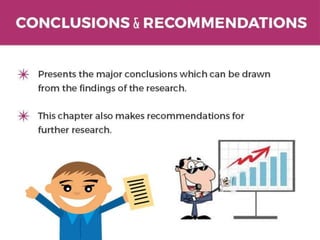
CONCLUSIONS & RECOMMENDATIONS
o Presents the major conclusions which can be
drawn from the findings of the research.
o This chapter also makes recommendations for
further research.
15
REFERENCES / BIBLIOGRAPHY
Records all works that have been referred to
in the text of the dissertation.
16
APPENDICES
o Contain any information which is too detailed to include in
the body of the dissertation, such as:
1) Additional graphs
2) Tables of detailed data
3) Interview transcripts,
4) Coding procedures etc.
o Copies of published papers based on the research reported in
the dissertation are often included in an appendix. 17
BROUGHT TO YOU BY
About Thesis Writing
18
For Any Queries:
Or Visit Our Website : www.aboutthesiswriting.com

How To Master The Thesis Writing?

  • 1.
    “THESIS WRITING” MAKE ORBREAK YOUR FINAL GRADES
  • 2.
    INTRODUCTION TO THESIS Thesis(plural: theses, pronounced THEES-eez)  By definition, a “thesis” is the point your paper is trying to prove.  In the US, a thesis is the final project for the masters degree, written by a candidate.  A thesis is not the same as the thesis statement, which is a sentence or two in your introduction that tells the reader what the thesis is. 1
  • 3.
    COMPONENTS OF ATHESIS Preliminaries: All theses have a number of preliminary requirements, that are: 1) Cover page/Title Page 2) Approval sheet 3) Summary/abstract 4) Acknowledgements 5) Nomenclature/Notation 6) Table of Contents 7) Publications 8) List of tables, figures or illustrations 2
  • 4.
    TITLE PAGE 1. ThesisTitle 2. Candidate's Name 3. Qualifications 4. Thesis Details 5. Faculty & Department 6. University & Date 3
  • 5.
    APPROVAL SHEET o Provesthat the authors have passed the requirements needed for the thesis. o Is signed by the thesis/FS adviser, panel and the Dean. o States the grade obtained by the author/s. 4
  • 6.
    SUMMARY/ABSTRACT o Summarizes theresearch undertaken o Provide an overview of the project & its scholarly significance o Never contains new information o Extends no longer than 2 pages of A4 5
  • 7.
    ACKNOWLEDGEMENTS Recognizes the helpgiven by supervisors, technical staff, family and anyone else who aided the researchers in finishing the thesis. 6
  • 8.
    NOMENCLATURE / NOTATION oDefines all notation and symbols used in the text of the dissertation. o May be replaced by a list of abbreviations in other disciplines. 7
  • 9.
    TABLE OF CONTENTS oA topic outline of the thesis o A list of all major divisions and chapter titles. 8
  • 10.
    PUBLICATIONS o A listof the author's publications which directly relate to the research work for the dissertation. o often included in an appendix. 9
  • 11.
    LIST OF TABLES,FIGURES OR ILLUSTRATIONS o Include a list of figures (illustrations) and a list of tables o Use a separate page for each list. o List the number, caption, and page number of every figure and table in the body of the thesis. 10
  • 12.
    TEXT OF THETHESIS: o Introduction o Literature Review o Sequential chapters o Conclusions and Recommendations o References/Bibliography o Appendices 11
  • 13.
    INTRODUCTION  Provides aclear statement of the topic under investigation  Provides the general context for the research  Outlines applications of the research.  Justifies the need for this research, and states the aims  Concludes with a chapter by chapter outline of the content of the dissertation. 12
  • 14.
    LITERATURE REVIEW o Presentsa critical review of relevant previous studies in the research field o Shows how knowledge has been built up in the research field o Demonstrate the achievements and the limitations of the previous research o Presents a well argued justification for the research to be undertaken. 13
  • 15.
    SEQUENTIAL CHAPTERS o Presenta detailed description of the experimental or theoretical work undertaken, the results and a discussion of the significance of these results. o Each chapter usually has a brief introduction which states the aim of the chapter and an outline of its structure, as well as a short summary to highlight the significant findings of the chapter. 14
  • 16.
    CONCLUSIONS & RECOMMENDATIONS oPresents the major conclusions which can be drawn from the findings of the research. o This chapter also makes recommendations for further research. 15
  • 17.
    REFERENCES / BIBLIOGRAPHY Recordsall works that have been referred to in the text of the dissertation. 16
  • 18.
    APPENDICES o Contain anyinformation which is too detailed to include in the body of the dissertation, such as: 1) Additional graphs 2) Tables of detailed data 3) Interview transcripts, 4) Coding procedures etc. o Copies of published papers based on the research reported in the dissertation are often included in an appendix. 17
  • 19.
    BROUGHT TO YOUBY About Thesis Writing 18 For Any Queries: Or Visit Our Website : www.aboutthesiswriting.com