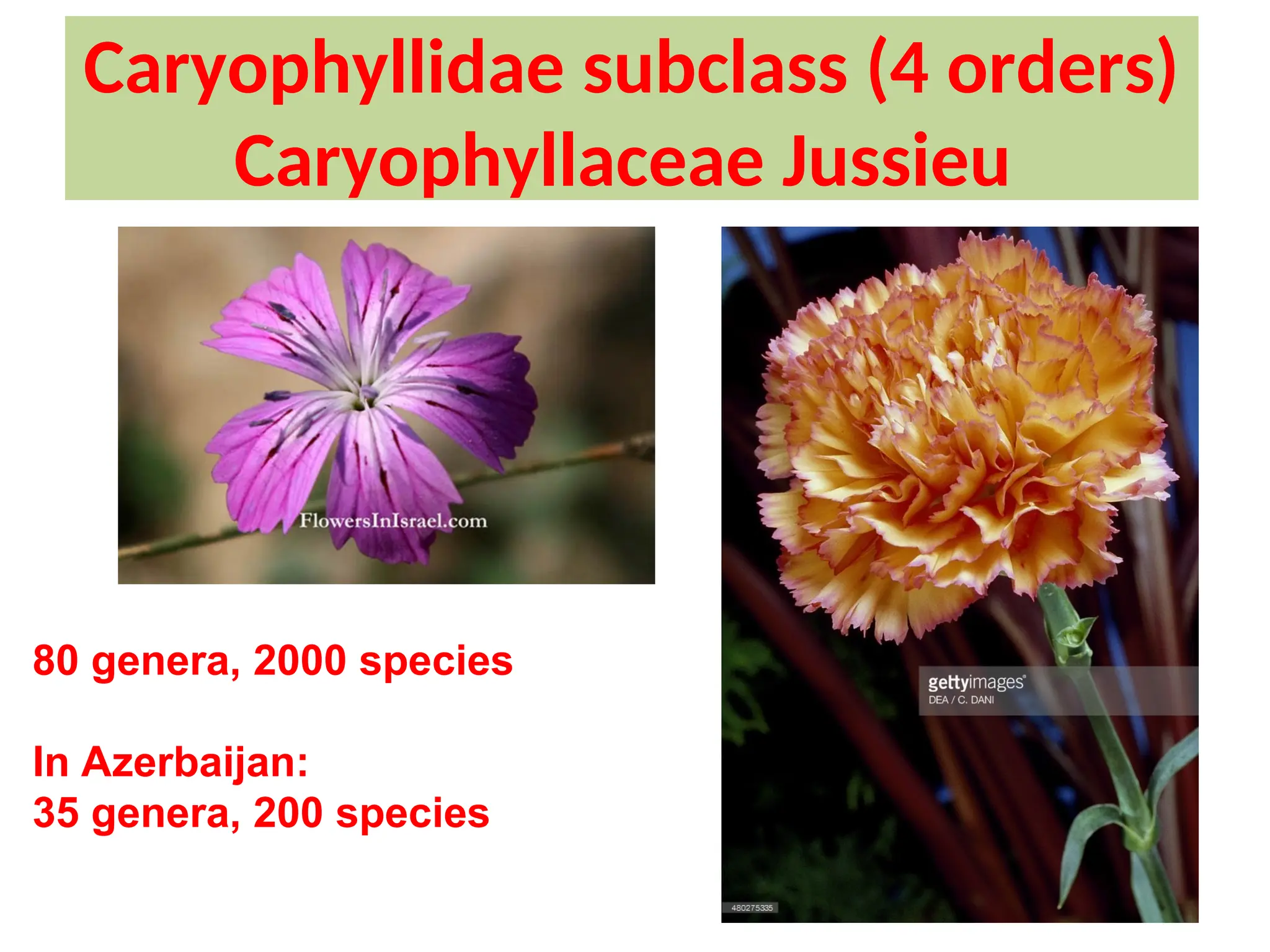
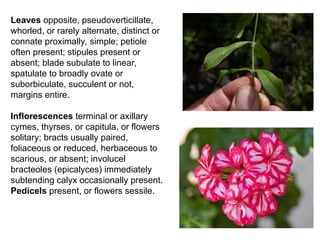
Caryophyllidae subclass (4 orders)
Caryophyllaceae Jussieu
80 genera, 2000 species
In Azerbaijan:
35 genera, 200 species
• Herbs [small trees, shrubs,
or vines], winter annual,
annual, biennial, or
perennial, glabrous or
pubescence of simple hairs
or stalked glands; taprooted
and/or rhizomatous with
fibrous roots, sometimes
from woody caudex,
rhizomes rarely with
tuberous thickenings.
• Stems erect to prostrate,
often with swollen nodes,
herbaceous.
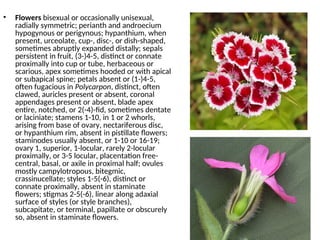
Leaves opposite, pseudoverticillate,
whorled, or rarely alternate, distinct or
connate proximally, simple; petiole
often present; stipules present or
absent; blade subulate to linear,
spatulate to broadly ovate or
suborbiculate, succulent or not,
margins entire.
Inflorescences terminal or axillary
cymes, thyrses, or capitula, or flowers
solitary; bracts usually paired,
foliaceous or reduced, herbaceous to
scarious, or absent; involucel
bracteoles (epicalyces) immediately
subtending calyx occasionally present.
Pedicels present, or flowers sessile.
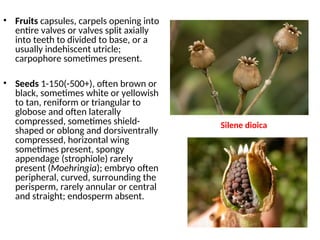
• Flowers bisexual or occasionally unisexual,
radially symmetric; perianth and androecium
hypogynous or perigynous; hypanthium, when
present, urceolate, cup-, disc-, or dish-shaped,
sometimes abruptly expanded distally; sepals
persistent in fruit, (3-)4-5, distinct or connate
proximally into cup or tube, herbaceous or
scarious, apex sometimes hooded or with apical
or subapical spine; petals absent or (1-)4-5,
often fugacious in Polycarpon, distinct, often
clawed, auricles present or absent, coronal
appendages present or absent, blade apex
entire, notched, or 2(-4)-fid, sometimes dentate
or laciniate; stamens 1-10, in 1 or 2 whorls,
arising from base of ovary, nectariferous disc,
or hypanthium rim, absent in pistillate flowers;
staminodes usually absent, or 1-10 or 16-19;
ovary 1, superior, 1-locular, rarely 2-locular
proximally, or 3-5 locular, placentation free-
central, basal, or axile in proximal half; ovules
mostly campylotropous, bitegmic,
crassinucellate; styles 1-5(-6), distinct or
connate proximally, absent in staminate
flowers; stigmas 2-5(-6), linear along adaxial
surface of styles (or style branches),
subcapitate, or terminal, papillate or obscurely
so, absent in staminate flowers.
• Fruits capsules, carpels opening into
entire valves or valves split axially
into teeth to divided to base, or a
usually indehiscent utricle;
carpophore sometimes present.
• Seeds 1-150(-500+), often brown or
black, sometimes white or yellowish
to tan, reniform or triangular to
globose and often laterally
compressed, sometimes shield-
shaped or oblong and dorsiventrally
compressed, horizontal wing
sometimes present, spongy
appendage (strophiole) rarely
present (Moehringia); embryo often
peripheral, curved, surrounding the
perisperm, rarely annular or central
and straight; endosperm absent.
Silene dioica
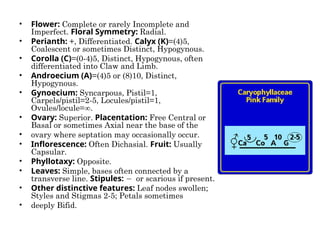
• Flower: Complete or rarely Incomplete and
Imperfect. Floral Symmetry: Radial.
• Perianth: +, Differentiated. Calyx (K)=(4)5,
Coalescent or sometimes Distinct, Hypogynous.
• Corolla (C)=(0-4)5, Distinct, Hypogynous, often
differentiated into Claw and Limb.
• Androecium (A)=(4)5 or (8)10, Distinct,
Hypogynous.
• Gynoecium: Syncarpous, Pistil=1,
Carpels/pistil=2-5, Locules/pistil=1,
Ovules/locule=∞.
• Ovary: Superior. Placentation: Free Central or
Basal or sometimes Axial near the base of the
• ovary where septation may occasionally occur.
• Inflorescence: Often Dichasial. Fruit: Usually
Capsular.
• Phyllotaxy: Opposite.
• Leaves: Simple, bases often connected by a
transverse line. Stipules: −or scarious if present.
• Other distinctive features: Leaf nodes swollen;
Styles and Stigmas 2-5; Petals sometimes
• deeply Bifid.
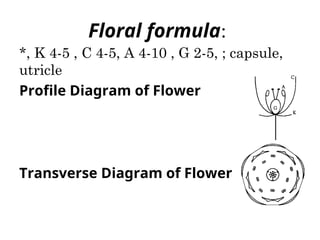
Floral formula:
*, K 4-5 , C 4-5, A 4-10 , G 2-5, ; capsule,
utricle
Profile Diagram of Flower
Transverse Diagram of Flower
Caryophyllaceae has 3 subfamilies:
1.Silenoideae
2.Alsinoideae
3.Scleranthoideae
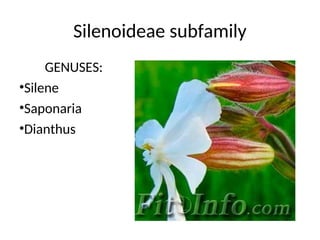
Silenoideae subfamily
GENUSES:
•Silene
•Saponaria
•Dianthus
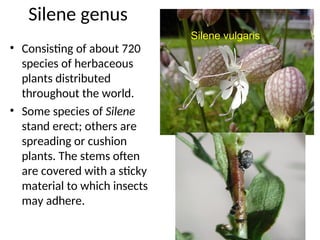
Silene genus
• Consisting of about 720
species of herbaceous
plants distributed
throughout the world.
• Some species of Silene
stand erect; others are
spreading or cushion
plants. The stems often
are covered with a sticky
material to which insects
may adhere.
Silene vulgaris
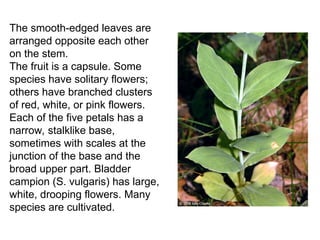
The smooth-edged leaves are
arranged opposite each other
on the stem.
The fruit is a capsule. Some
species have solitary flowers;
others have branched clusters
of red, white, or pink flowers.
Each of the five petals has a
narrow, stalklike base,
sometimes with scales at the
junction of the base and the
broad upper part. Bladder
campion (S. vulgaris) has large,
white, drooping flowers. Many
species are cultivated.
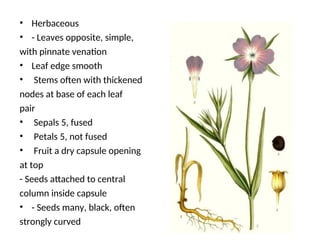
• Herbaceous
• - Leaves opposite, simple,
with pinnate venation
• Leaf edge smooth
• Stems often with thickened
nodes at base of each leaf
pair
• Sepals 5, fused
• Petals 5, not fused
• Fruit a dry capsule opening
at top
- Seeds attached to central
column inside capsule
• - Seeds many, black, often
strongly curved
Saponaria genus
Soapwort- Saponaria officinalis
Growing form: Perennial herb. Rhizomatous. Forms
stands.
Height: 30–90 cm (12–35 in.). Stem sturdy, usually
glabrous, sometimes finely haired.
Flower: Corolla regular (actinomorphic), pink–lilac–
white, broad; petals 5 or many, entire, with notched
or ragged tips. Corona small. Calyx narrowly round, 5-
lobed, violet, without epicalyx. Stamens usually 10.
Pistil of 2 fused carpels, styles 2. Inflorescence a
dense, 2-sided cyme. Flowers with pleasant fragrance.
Leaves: Opposite, lower short-stalked, upper
stalkless. Blade elliptic–elliptically ovate, with entire
margins, 3-veined.
Fruit: 4-valved capsule.
Habitat: Sites of old houses, gardens, banks,
wasteland, rubbish tips. An ornamental, escape from
cultivation.
Flowering time: July–September.
Soapwort’s roots contain a lot of saponins which
makes it good for washing woollen clothes, shorn
sheep and also hair.
Soapwort was used as a medicine to treat e.g.
liver disease and coughs and even used to give
beer a better head. Internal use was however
abandoned because the saponins are toxic: they
have a detrimental effect on red blood cells by
destroying haemoglobin (haemolysis).
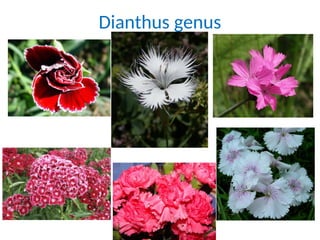
Dianthus genus
Chenopodiaceae -Goosefoot or Beet Family
(more than 100 genera and 1500 species )
in Azerbaijan: 33 genera, 110 species
• A few are semixerophytic and
many are halophytic, i.e.,
especially adapted to growth in
salty or alkali soil.
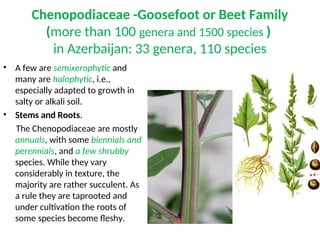
• Stems and Roots.
The Chenopodiaceae are mostly
annuals, with some biennials and
perennials, and a few shrubby
species. While they vary
considerably in texture, the
majority are rather succulent. As
a rule they are taprooted and
under cultivation the roots of
some species become fleshy.
Leaves
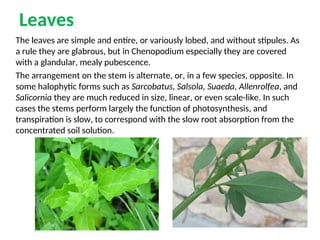
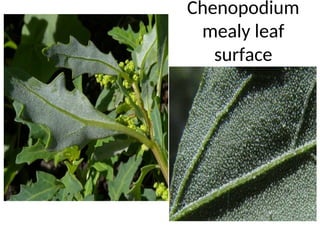
The leaves are simple and entire, or variously lobed, and without stipules. As
a rule they are glabrous, but in Chenopodium especially they are covered
with a glandular, mealy pubescence.
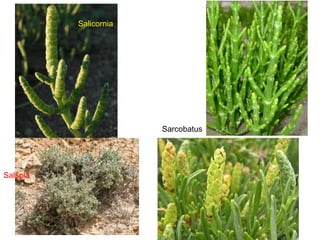
The arrangement on the stem is alternate, or, in a few species, opposite. In
some halophytic forms such as Sarcobatus, Salsola, Suaeda, Allenrolfea, and
Salicornia they are much reduced in size, linear, or even scale-like. In such
cases the stems perform largely the function of photosynthesis, and
transpiration is slow, to correspond with the slow root absorption from the
concentrated soil solution.
Chenopodium
mealy leaf
surface
Salicornia
Sarcobatus
Salsola
Inflorescences and Flowers
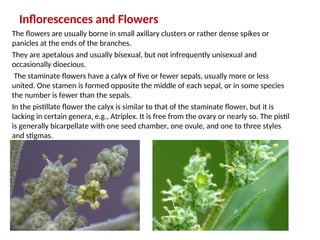
The flowers are usually borne in small axillary clusters or rather dense spikes or
panicles at the ends of the branches.
They are apetalous and usually bisexual, but not infrequently unisexual and
occasionally dioecious.
The staminate flowers have a calyx of five or fewer sepals, usually more or less
united. One stamen is formed opposite the middle of each sepal, or in some species
the number is fewer than the sepals.
In the pistillate flower the calyx is similar to that of the staminate flower, but it is
lacking in certain genera, e.g., Atriplex. It is free from the ovary or nearly so. The pistil
is generally bicarpellate with one seed chamber, one ovule, and one to three styles
and stigmas.
Fruits and Seeds
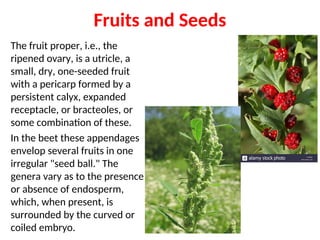
The fruit proper, i.e., the
ripened ovary, is a utricle, a
small, dry, one-seeded fruit
with a pericarp formed by a
persistent calyx, expanded
receptacle, or bracteoles, or
some combination of these.
In the beet these appendages
envelop several fruits in one
irregular "seed ball." The
genera vary as to the presence
or absence of endosperm,
which, when present, is
surrounded by the curved or
coiled embryo.
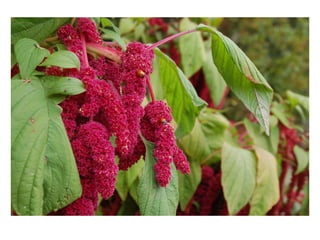
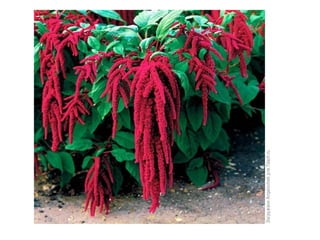
Amaranthaceae family
(more than 65 genera and 500 species )
in Azerbaijan: 3 genera, 9 species
Characters of Amaranthaceae:
Plants mostly herbs, a few shrubs, leaves exstipulate and simple;
opposite or alternate, hairy; flowers small, incospicuous and
usually with bracts and bracteoles, actinomorphic, arranged in
spikes or racemes;
perianth 2 to 5, green or coloured, free or united; stamens 3 to 5
free,
gynoecium bi or tri-carpellary, unilocular with a single basal ovule;
fruit one seeded nutlet.
Habit:
Mostly herbs, rarely shrubs or undershrubs (Deeringia), annual or perennial
(Bosia, Ptilotus).
Root:
A branched tap root.
Stem:
Aerial, herbaceous or woody, erect or straggling, cylindrical, or angular,
branched, solid, hairy, green or striped green.
Leaves:
Simple, alternate or opposite, petiolate, exstipulate, reddish in colour,
unicostate reticulate venation.
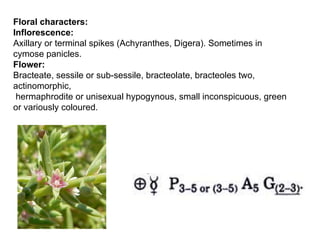
Floral characters:
Inflorescence:
Axillary or terminal spikes (Achyranthes, Digera). Sometimes in
cymose panicles.
Flower:
Bracteate, sessile or sub-sessile, bracteolate, bracteoles two,
actinomorphic,
hermaphrodite or unisexual hypogynous, small inconspicuous, green
or variously coloured.
• Perianth:
Usually five tepals, free or united, sometimes two or three (Amaranthus), dry
membranous, valvate or twisted, sometime, hairy, green or coloured, persistent,
inferior.
• Androecium:
Stamens 5 or 3 (Amaranthus), free or united, staminodes sometimes present, introrse,
dithecous or monothecous (Alternanthera). In Achyranthes 5 fimbriated scales
alternate with 5 fertile stamens.
• Gynoecium:
Bicarpellary, or tricarpellary; syncarpous, ovary superior, unilocular, usually one
campylotropous ovule; basal placentation; style short or filiform; stigma 2 or 3.
• Pollination:
Mostly anemophilous and in some plants entomophilous.
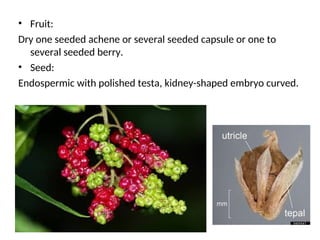
• Fruit:
Dry one seeded achene or several seeded capsule or one to
several seeded berry.
• Seed:
Endospermic with polished testa, kidney-shaped embryo curved.

Caryophyllaceae Jussieu.ppts#@#1###2"@*@#*@#*

  • 1.
    Caryophyllidae subclass (4orders) Caryophyllaceae Jussieu 80 genera, 2000 species In Azerbaijan: 35 genera, 200 species
  • 2.
    • Herbs [smalltrees, shrubs, or vines], winter annual, annual, biennial, or perennial, glabrous or pubescence of simple hairs or stalked glands; taprooted and/or rhizomatous with fibrous roots, sometimes from woody caudex, rhizomes rarely with tuberous thickenings. • Stems erect to prostrate, often with swollen nodes, herbaceous.
  • 3.
    Leaves opposite, pseudoverticillate, whorled,or rarely alternate, distinct or connate proximally, simple; petiole often present; stipules present or absent; blade subulate to linear, spatulate to broadly ovate or suborbiculate, succulent or not, margins entire. Inflorescences terminal or axillary cymes, thyrses, or capitula, or flowers solitary; bracts usually paired, foliaceous or reduced, herbaceous to scarious, or absent; involucel bracteoles (epicalyces) immediately subtending calyx occasionally present. Pedicels present, or flowers sessile.
  • 4.
    • Flowers bisexualor occasionally unisexual, radially symmetric; perianth and androecium hypogynous or perigynous; hypanthium, when present, urceolate, cup-, disc-, or dish-shaped, sometimes abruptly expanded distally; sepals persistent in fruit, (3-)4-5, distinct or connate proximally into cup or tube, herbaceous or scarious, apex sometimes hooded or with apical or subapical spine; petals absent or (1-)4-5, often fugacious in Polycarpon, distinct, often clawed, auricles present or absent, coronal appendages present or absent, blade apex entire, notched, or 2(-4)-fid, sometimes dentate or laciniate; stamens 1-10, in 1 or 2 whorls, arising from base of ovary, nectariferous disc, or hypanthium rim, absent in pistillate flowers; staminodes usually absent, or 1-10 or 16-19; ovary 1, superior, 1-locular, rarely 2-locular proximally, or 3-5 locular, placentation free- central, basal, or axile in proximal half; ovules mostly campylotropous, bitegmic, crassinucellate; styles 1-5(-6), distinct or connate proximally, absent in staminate flowers; stigmas 2-5(-6), linear along adaxial surface of styles (or style branches), subcapitate, or terminal, papillate or obscurely so, absent in staminate flowers.
  • 5.
    • Fruits capsules,carpels opening into entire valves or valves split axially into teeth to divided to base, or a usually indehiscent utricle; carpophore sometimes present. • Seeds 1-150(-500+), often brown or black, sometimes white or yellowish to tan, reniform or triangular to globose and often laterally compressed, sometimes shield- shaped or oblong and dorsiventrally compressed, horizontal wing sometimes present, spongy appendage (strophiole) rarely present (Moehringia); embryo often peripheral, curved, surrounding the perisperm, rarely annular or central and straight; endosperm absent. Silene dioica
  • 6.
    • Flower: Completeor rarely Incomplete and Imperfect. Floral Symmetry: Radial. • Perianth: +, Differentiated. Calyx (K)=(4)5, Coalescent or sometimes Distinct, Hypogynous. • Corolla (C)=(0-4)5, Distinct, Hypogynous, often differentiated into Claw and Limb. • Androecium (A)=(4)5 or (8)10, Distinct, Hypogynous. • Gynoecium: Syncarpous, Pistil=1, Carpels/pistil=2-5, Locules/pistil=1, Ovules/locule=∞. • Ovary: Superior. Placentation: Free Central or Basal or sometimes Axial near the base of the • ovary where septation may occasionally occur. • Inflorescence: Often Dichasial. Fruit: Usually Capsular. • Phyllotaxy: Opposite. • Leaves: Simple, bases often connected by a transverse line. Stipules: −or scarious if present. • Other distinctive features: Leaf nodes swollen; Styles and Stigmas 2-5; Petals sometimes • deeply Bifid.
  • 7.
    Floral formula: *, K4-5 , C 4-5, A 4-10 , G 2-5, ; capsule, utricle Profile Diagram of Flower Transverse Diagram of Flower
  • 8.
    Caryophyllaceae has 3subfamilies: 1.Silenoideae 2.Alsinoideae 3.Scleranthoideae
  • 9.
  • 10.
    Silene genus • Consistingof about 720 species of herbaceous plants distributed throughout the world. • Some species of Silene stand erect; others are spreading or cushion plants. The stems often are covered with a sticky material to which insects may adhere. Silene vulgaris
  • 11.
    The smooth-edged leavesare arranged opposite each other on the stem. The fruit is a capsule. Some species have solitary flowers; others have branched clusters of red, white, or pink flowers. Each of the five petals has a narrow, stalklike base, sometimes with scales at the junction of the base and the broad upper part. Bladder campion (S. vulgaris) has large, white, drooping flowers. Many species are cultivated.
  • 12.
    • Herbaceous • -Leaves opposite, simple, with pinnate venation • Leaf edge smooth • Stems often with thickened nodes at base of each leaf pair • Sepals 5, fused • Petals 5, not fused • Fruit a dry capsule opening at top - Seeds attached to central column inside capsule • - Seeds many, black, often strongly curved
  • 13.
    Saponaria genus Soapwort- Saponariaofficinalis Growing form: Perennial herb. Rhizomatous. Forms stands. Height: 30–90 cm (12–35 in.). Stem sturdy, usually glabrous, sometimes finely haired. Flower: Corolla regular (actinomorphic), pink–lilac– white, broad; petals 5 or many, entire, with notched or ragged tips. Corona small. Calyx narrowly round, 5- lobed, violet, without epicalyx. Stamens usually 10. Pistil of 2 fused carpels, styles 2. Inflorescence a dense, 2-sided cyme. Flowers with pleasant fragrance. Leaves: Opposite, lower short-stalked, upper stalkless. Blade elliptic–elliptically ovate, with entire margins, 3-veined. Fruit: 4-valved capsule. Habitat: Sites of old houses, gardens, banks, wasteland, rubbish tips. An ornamental, escape from cultivation. Flowering time: July–September.
  • 14.
    Soapwort’s roots containa lot of saponins which makes it good for washing woollen clothes, shorn sheep and also hair. Soapwort was used as a medicine to treat e.g. liver disease and coughs and even used to give beer a better head. Internal use was however abandoned because the saponins are toxic: they have a detrimental effect on red blood cells by destroying haemoglobin (haemolysis).
  • 15.
  • 16.
    Chenopodiaceae -Goosefoot orBeet Family (more than 100 genera and 1500 species ) in Azerbaijan: 33 genera, 110 species • A few are semixerophytic and many are halophytic, i.e., especially adapted to growth in salty or alkali soil. • Stems and Roots. The Chenopodiaceae are mostly annuals, with some biennials and perennials, and a few shrubby species. While they vary considerably in texture, the majority are rather succulent. As a rule they are taprooted and under cultivation the roots of some species become fleshy.
  • 17.
    Leaves The leaves aresimple and entire, or variously lobed, and without stipules. As a rule they are glabrous, but in Chenopodium especially they are covered with a glandular, mealy pubescence. The arrangement on the stem is alternate, or, in a few species, opposite. In some halophytic forms such as Sarcobatus, Salsola, Suaeda, Allenrolfea, and Salicornia they are much reduced in size, linear, or even scale-like. In such cases the stems perform largely the function of photosynthesis, and transpiration is slow, to correspond with the slow root absorption from the concentrated soil solution.
  • 18.
  • 19.
  • 20.
    Inflorescences and Flowers Theflowers are usually borne in small axillary clusters or rather dense spikes or panicles at the ends of the branches. They are apetalous and usually bisexual, but not infrequently unisexual and occasionally dioecious. The staminate flowers have a calyx of five or fewer sepals, usually more or less united. One stamen is formed opposite the middle of each sepal, or in some species the number is fewer than the sepals. In the pistillate flower the calyx is similar to that of the staminate flower, but it is lacking in certain genera, e.g., Atriplex. It is free from the ovary or nearly so. The pistil is generally bicarpellate with one seed chamber, one ovule, and one to three styles and stigmas.
  • 21.
    Fruits and Seeds Thefruit proper, i.e., the ripened ovary, is a utricle, a small, dry, one-seeded fruit with a pericarp formed by a persistent calyx, expanded receptacle, or bracteoles, or some combination of these. In the beet these appendages envelop several fruits in one irregular "seed ball." The genera vary as to the presence or absence of endosperm, which, when present, is surrounded by the curved or coiled embryo.
  • 22.
    Amaranthaceae family (more than65 genera and 500 species ) in Azerbaijan: 3 genera, 9 species Characters of Amaranthaceae: Plants mostly herbs, a few shrubs, leaves exstipulate and simple; opposite or alternate, hairy; flowers small, incospicuous and usually with bracts and bracteoles, actinomorphic, arranged in spikes or racemes; perianth 2 to 5, green or coloured, free or united; stamens 3 to 5 free, gynoecium bi or tri-carpellary, unilocular with a single basal ovule; fruit one seeded nutlet.
  • 26.
    Habit: Mostly herbs, rarelyshrubs or undershrubs (Deeringia), annual or perennial (Bosia, Ptilotus). Root: A branched tap root. Stem: Aerial, herbaceous or woody, erect or straggling, cylindrical, or angular, branched, solid, hairy, green or striped green. Leaves: Simple, alternate or opposite, petiolate, exstipulate, reddish in colour, unicostate reticulate venation.
  • 27.
    Floral characters: Inflorescence: Axillary orterminal spikes (Achyranthes, Digera). Sometimes in cymose panicles. Flower: Bracteate, sessile or sub-sessile, bracteolate, bracteoles two, actinomorphic, hermaphrodite or unisexual hypogynous, small inconspicuous, green or variously coloured.
  • 28.
    • Perianth: Usually fivetepals, free or united, sometimes two or three (Amaranthus), dry membranous, valvate or twisted, sometime, hairy, green or coloured, persistent, inferior. • Androecium: Stamens 5 or 3 (Amaranthus), free or united, staminodes sometimes present, introrse, dithecous or monothecous (Alternanthera). In Achyranthes 5 fimbriated scales alternate with 5 fertile stamens. • Gynoecium: Bicarpellary, or tricarpellary; syncarpous, ovary superior, unilocular, usually one campylotropous ovule; basal placentation; style short or filiform; stigma 2 or 3. • Pollination: Mostly anemophilous and in some plants entomophilous.
  • 29.
    • Fruit: Dry oneseeded achene or several seeded capsule or one to several seeded berry. • Seed: Endospermic with polished testa, kidney-shaped embryo curved.