Diversity And Classification of
Flowering Plants:
Eudicots: Asterids
Michael G. Simpson
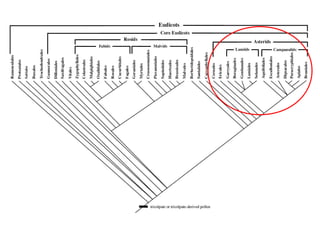
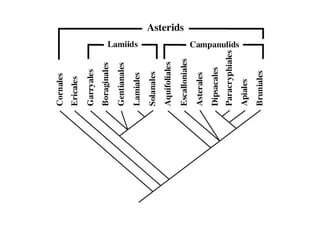
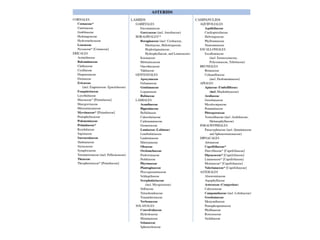
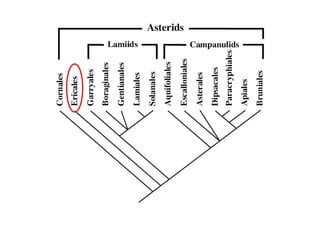
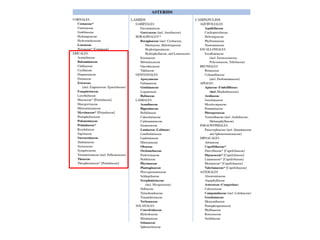
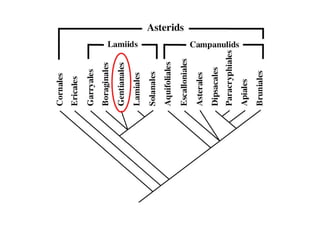
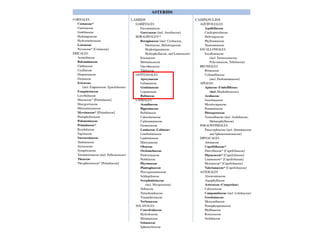
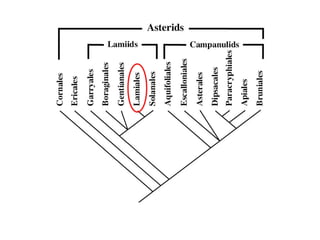
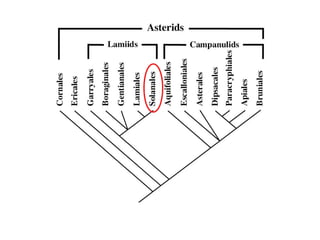
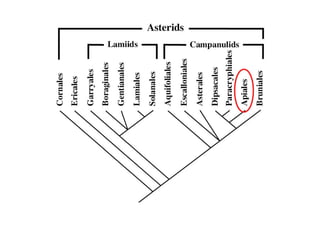
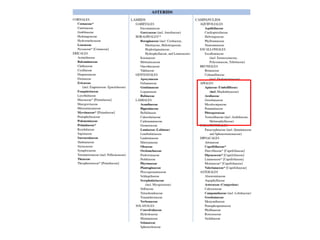
Asterids
• Very large, diverse group
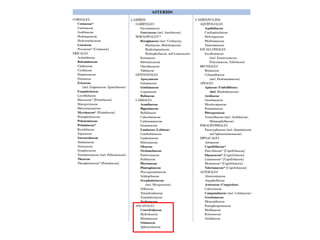
• 10 orders, many families
• Putative apomorphies:
– iridoid compounds
– sympetalous corolla
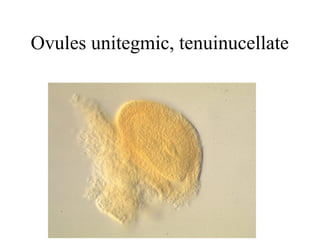
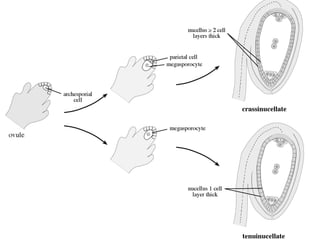
– ovules: unitegmic (one integument),
tenuinucellate (megasporangium 1-cell thick)
Ovules unitegmic, tenuinucellate
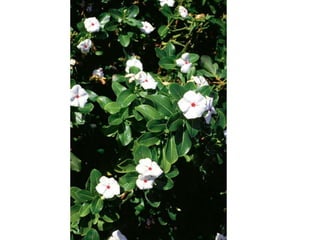
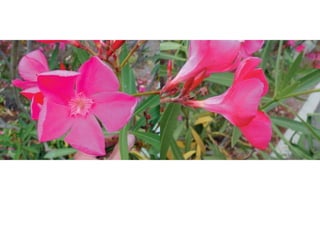
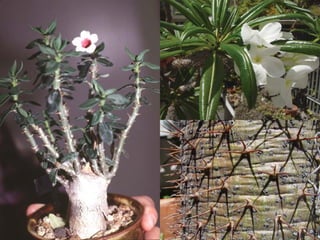
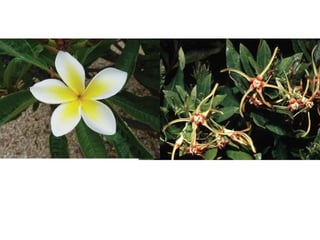
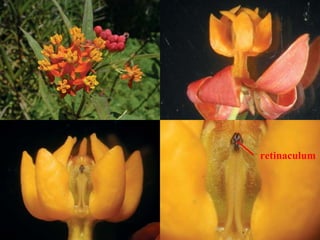
Apocynaceae, s.l. - Dogbane/Milkweed
family (Greek for "away from dog," in reference to past use
of some taxa as a dog poison). 411 genera / 4,650 species.
The Apocynaceae, s.l. are distinctive in being lianas, trees,
shrubs, or herbs with a 5-merous perianth/androecium, the
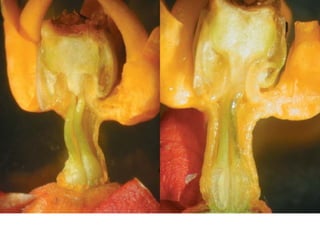
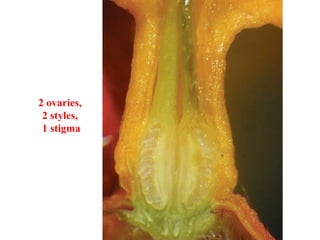
gynoecium usually with 2 carpels, the ovaries distinct in
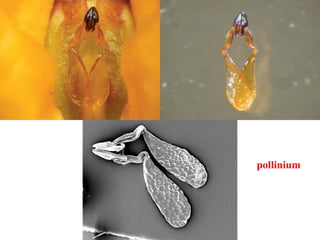
some taxa with styles connate (in Asclepiadoids
androecium adnate to single stigma forming a
gynostegium and pollen fused to form pollinia, each half
derived from an adjacent anther), the fruits variable, but a
schizocarp of follicles in the Asclepiadoids.
K (5) C (5) A 5 or (5) G (2) [(-8)], superior, rarely
half-inferior.
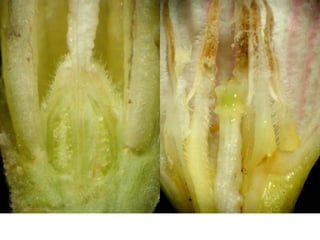
retinaculum
pollinium
2 ovaries,
2 styles,
1 stigma
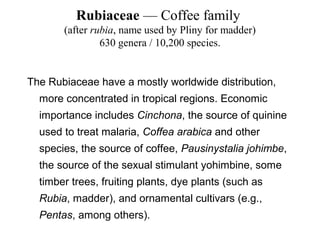
Rubiaceae — Coffee family
(after rubia, name used by Pliny for madder)
630 genera / 10,200 species.
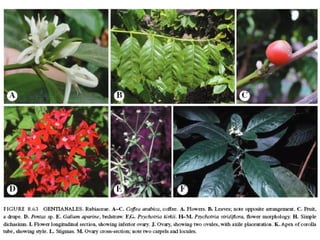
The Rubiaceae are distinctive in being trees, shrubs,
lianas, or herbs with simple, entire, usually
decussate leaves and connate stipules, the
stipules often with mucilage-secreting colleters, the
inflorescence usually a cyme, flowers usually
bisexual, the perianth dichlamydeous, perianth and
androecium often 4 –5-merous (calyx absent in
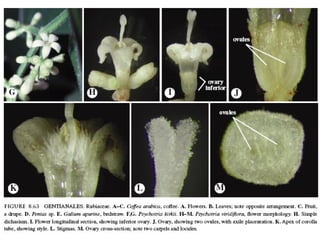
some), the ovary usually inferior (rarely superior),
often with an apical nectariferous disk, ovules with
a funicular obturator, the fruit a berry, capsule,
drupe, or schizocarp.
K (4-5) [0] C (4-5) [(3,8-10)] A 4-5 [3,8-10] G (2) [(3-
5+)], usually inferior, rarely superior.
Rubiaceae — Coffee family
(after rubia, name used by Pliny for madder)
630 genera / 10,200 species.
The Rubiaceae have a mostly worldwide distribution,
more concentrated in tropical regions. Economic
importance includes Cinchona, the source of quinine
used to treat malaria, Coffea arabica and other
species, the source of coffee, Pausinystalia johimbe,
the source of the sexual stimulant yohimbine, some
timber trees, fruiting plants, dye plants (such as
Rubia, madder), and ornamental cultivars (e.g.,
Pentas, among others).
Acanthaceae — Acanthus family
(from Acanthus, prickly-one).
229 genera / 3450 species.
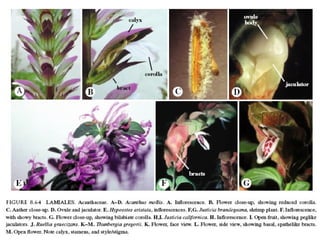
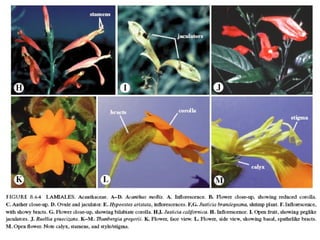
The Acanthaceae are distinctive in having simple,
opposite leaves with zygomorphic, bracteate,
usually bilabiate flowers, the fruit an explosively
dehiscent, loculicidal capsule with distinctive
funicular retinacula ( jaculators) that function in
seed dispersal, the funicular retinacula a presumed
apomorphy of the family.
K (5) [(4,6)] C (4-5) A 2,4,or 5 G (2), superior.
Acanthaceae — Acanthus family
(from Acanthus, prickly-one).
229 genera / 3450 species.
Members of the Acanthaceae are distributed from the
tropics to temperate regions. Economic importance
includes several cultivated ornamentals, such as
Acanthus mollis, Aphelandra, and Justicia [including
Beloperone]
Lamiaceae (=Labiatae) - Mint family
(Lamium, gullet, after the shape of the corolla tube or old Latin name
used by Pliny). 251 genera / 6,700 species.
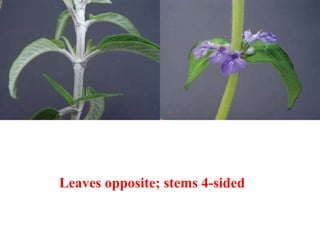
The Lamiaceae are distinctive in being herbs or shrubs,
often aromatic with ethereal oils, with usually 4-sided stems,
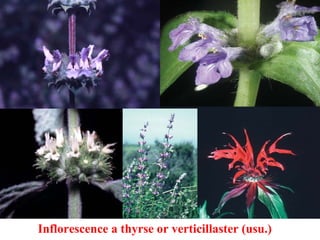
opposite [or whorled] leaves, a verticillaster or thyrse
inflorescence [flowers solitary and axillary in some], and
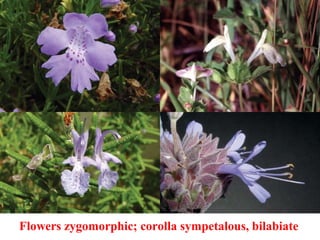
zygomorphic [rarely actinomorphic], usually bilabiate flowers
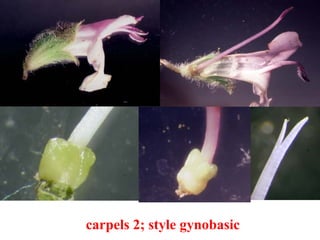
having a superior, deeply 4-lobed ovary (by formation of "false
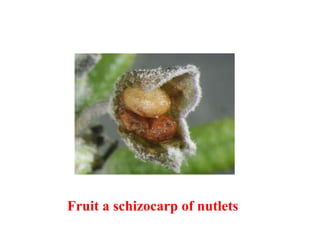
septa") and gynobasic style, the fruit a schizocarp of usually 4
nutlets.
K (5) C (5) [(4)] A 4 or 2 [+2 staminodes] G (2), superior,
hypanthium absent.
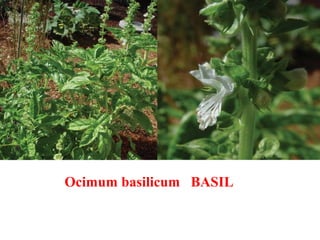
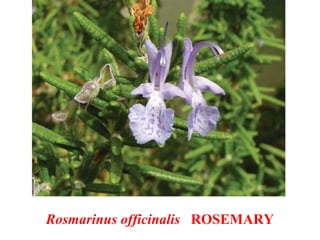
Economic importance includes medicinals, herbs (e.g., Mentha,
mint; Ocimum, basal; Rosmarinus, rosemary; Salvia, sage;
Thymus, thyme), fragrance plants (e.g., Lavandula, lavender;
Pogostemon, patchouli), and a number or cultivated
ornamentals.
Leaves opposite; stems 4-sided
Inflorescence a thyrse or verticillaster (usu.)
Flowers zygomorphic; corolla sympetalous, bilabiate
carpels 2; style gynobasic
Fruit a schizocarp of nutlets
Ocimum basilicum BASIL
Rosmarinus officinalis ROSEMARY
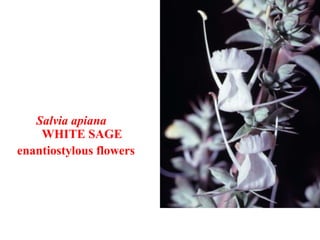
Salvia apiana
WHITE SAGE
enantiostylous flowers
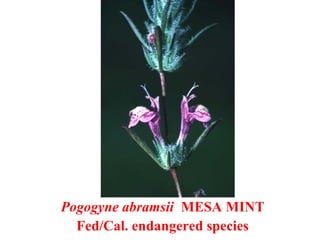
Pogogyne abramsii MESA MINT
Fed/Cal. endangered species
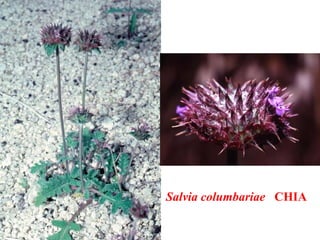
Salvia columbariae CHIA
Solanaceae - Nightshade family
(Latin for sleeping or comforter, after narcotic properties of
some). 94 genera / 2,950 species.
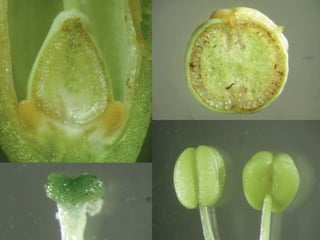
The Solanaceae are distinctive in being herbs,
shrubs, trees, or lianas with internal phloem, spiral
leaves, a usually actinomorphic, 5-merous perianth
and androecium (corolla plicate in bud), a usually
bicarpellate, syncarpous gynoecium, and usually
numerous ovules per carpel, the fruit a berry, drupe,
or capsule.
K (5) C (5) [(4),(6)] A 5 [4 or 2+2 staminodes]
G (2) [(3-5)], superior, hypanthium absent.
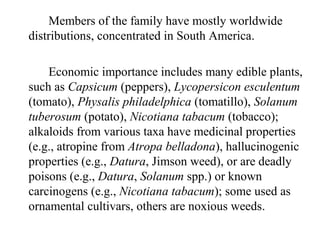
Members of the family have mostly worldwide
distributions, concentrated in South America.
Economic importance includes many edible plants,
such as Capsicum (peppers), Lycopersicon esculentum
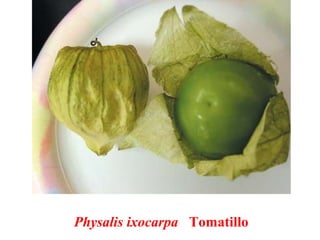
(tomato), Physalis philadelphica (tomatillo), Solanum
tuberosum (potato), Nicotiana tabacum (tobacco);
alkaloids from various taxa have medicinal properties
(e.g., atropine from Atropa belladona), hallucinogenic
properties (e.g., Datura, Jimson weed), or are deadly
poisons (e.g., Datura, Solanum spp.) or known
carcinogens (e.g., Nicotiana tabacum); some used as
ornamental cultivars, others are noxious weeds.
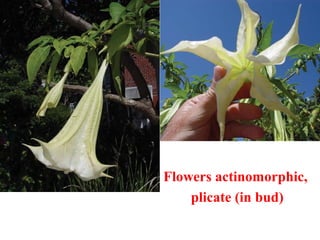
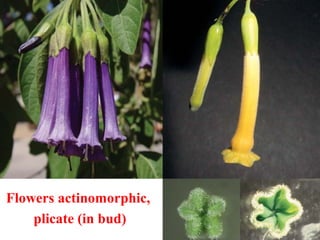
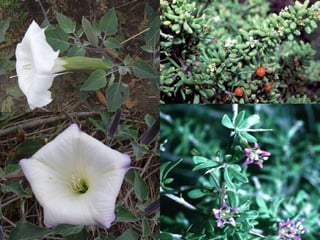
Flowers actinomorphic,
plicate (in bud)
Flowers actinomorphic,
plicate (in bud)
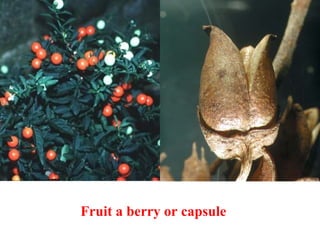
Fruit a berry or capsule
Physalis ixocarpa Tomatillo
Asteraceae (Compositae)
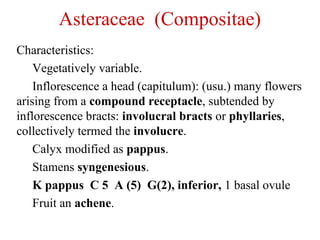
Characteristics:
Vegetatively variable.
Inflorescence a head (capitulum): (usu.) many flowers
arising from a compound receptacle, subtended by
inflorescence bracts: involucral bracts or phyllaries,
collectively termed the involucre.
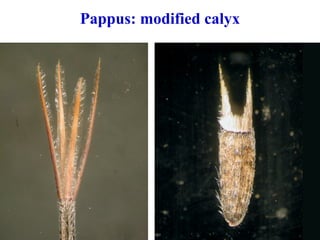
Calyx modified as pappus.
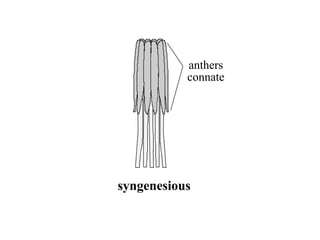
Stamens syngenesious.
K pappus C 5 A (5) G(2), inferior, 1 basal ovule
Fruit an achene.
Asteraceae (=Compositae) -
Sunflower family
(after Aster, meaning star). 1,528 genera / 22,750 species.
The Asteraceae are distinctive in being herbs, shrubs, vines, or
trees, the inflorescence a head (capitulum) subtended by an
involucre of phyllaries, flowers either bilabiate, disk, or
ray/ligulate, (heads of many taxa a mixture of central disk
flowers and peripheral ray flowers), with the calyx, termed a
pappus, modified as scales, awns, or capillary bristles (or
absent), the androecium syngenesious, and with an inferior
ovary with a single, basal ovule, the fruit a multiple of achenes.
Asteraceae (=Compositae) -
Sunflower family
(after Aster, meaning star). 1,528 genera / 22,750 species.
Economic importance includes some food plants
(e.g., Cynara scolymus, artichoke, and
Helianthus annuus, sunflower), a number of
ornamental cultivars, and various species used
locally or industrially; the prickly fruits of
Arctium lappa (burdock) are purported to have
been the model for invention of velcro.
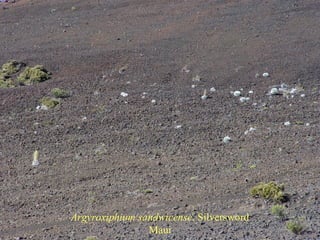
Argyroxiphium sandwicense, Silversword
Maui
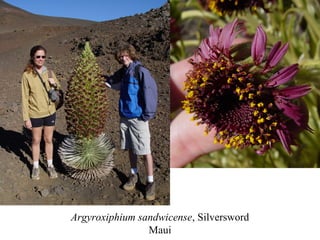
Argyroxiphium sandwicense, Silversword
Maui
Asteraceae (=Compositae) -
Sunflower family
(after Aster, meaning star). 1,528 genera / 22,750 species.
K 0-∞ (pappus)
C (5) [(4)] or (3) in some ray flowers
A (5) [(4)]
G (2), inferior, hypanthium absent.
Asteraceae: floral variation
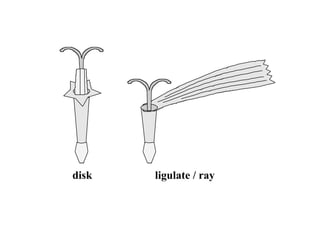
Three types of flowers:
1) Bilabiate: zygomorphic (bilateral) with 2 lips
2) Ray (ligulate): zygomorphic (bilateral) with 1
lobe
3) Disk: actinomorphic (radial), usu. 5-lobed
Five types of heads:
1) discoid, with only disk flowers;
2) disciform, with central disk flowers and
marginal, eligulate female flowers;
3) radiate, with central (bisexual or male) disk
flowers and peripheral (female or sterile) ray
flowers;
4) ligulate, with all ray flowers (typically with
5-toothed corolla apices);
5) bilabiate, with all bilabiate flowers.
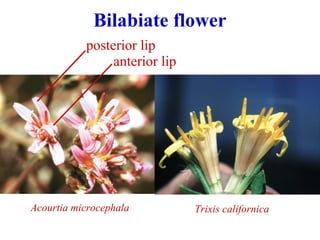
Bilabiate flower
Acourtia microcephala Trixis californica
posterior lip
anterior lip
ligulate / raydisk
syngenesious
anthers
connate
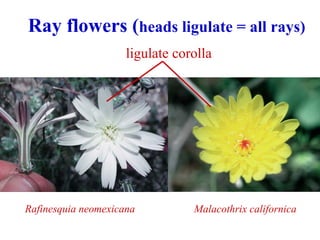
Ray flowers (heads ligulate = all rays)
Rafinesquia neomexicana Malacothrix californica
ligulate corolla
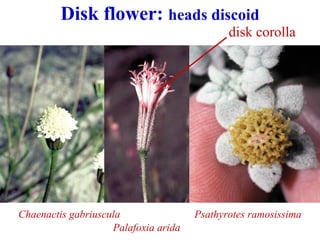
Disk flower: heads discoid
Palafoxia arida
Psathyrotes ramosissima
disk corolla
Chaenactis gabriuscula
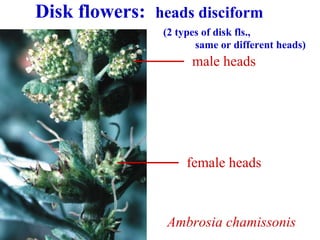
Disk flowers: heads disciform
(2 types of disk fls.,
same or different heads)
male heads
Ambrosia chamissonis
female heads
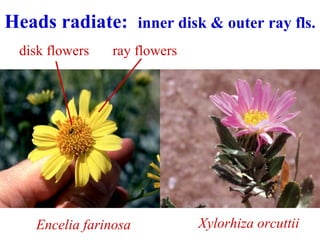
Xylorhiza orcuttiiEncelia farinosa
Heads radiate: inner disk & outer ray fls.
ray flowersdisk flowers
Encelia californica
ovary
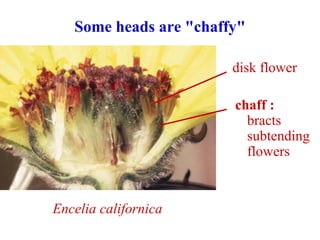
Some heads are "chaffy"
chaff :
bracts
subtending
flowers
disk flower
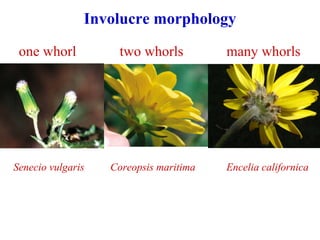
Involucre morphology
one whorl two whorls many whorls
Senecio vulgaris Coreopsis maritima Encelia californica
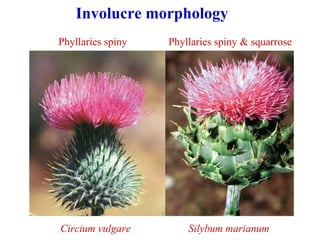
Circium vulgare Silybum marianum
Phyllaries spiny
Involucre morphology
Phyllaries spiny & squarrose
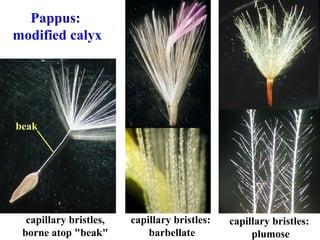
Pappus:
modified calyx
capillary bristles:
barbellate
capillary bristles:
plumose
beak
capillary bristles,
borne atop "beak"
Pappus: modified calyx

Botany Lecture Ch8cmodified

  • 1.
    Diversity And Classificationof Flowering Plants: Eudicots: Asterids Michael G. Simpson
  • 4.
    Asterids • Very large,diverse group • 10 orders, many families • Putative apomorphies: – iridoid compounds – sympetalous corolla – ovules: unitegmic (one integument), tenuinucellate (megasporangium 1-cell thick)
  • 5.
  • 12.
    Apocynaceae, s.l. -Dogbane/Milkweed family (Greek for "away from dog," in reference to past use of some taxa as a dog poison). 411 genera / 4,650 species. The Apocynaceae, s.l. are distinctive in being lianas, trees, shrubs, or herbs with a 5-merous perianth/androecium, the gynoecium usually with 2 carpels, the ovaries distinct in some taxa with styles connate (in Asclepiadoids androecium adnate to single stigma forming a gynostegium and pollen fused to form pollinia, each half derived from an adjacent anther), the fruits variable, but a schizocarp of follicles in the Asclepiadoids. K (5) C (5) A 5 or (5) G (2) [(-8)], superior, rarely half-inferior.
  • 18.
  • 19.
  • 21.
  • 22.
    Rubiaceae — Coffeefamily (after rubia, name used by Pliny for madder) 630 genera / 10,200 species. The Rubiaceae are distinctive in being trees, shrubs, lianas, or herbs with simple, entire, usually decussate leaves and connate stipules, the stipules often with mucilage-secreting colleters, the inflorescence usually a cyme, flowers usually bisexual, the perianth dichlamydeous, perianth and androecium often 4 –5-merous (calyx absent in some), the ovary usually inferior (rarely superior), often with an apical nectariferous disk, ovules with a funicular obturator, the fruit a berry, capsule, drupe, or schizocarp. K (4-5) [0] C (4-5) [(3,8-10)] A 4-5 [3,8-10] G (2) [(3- 5+)], usually inferior, rarely superior.
  • 23.
    Rubiaceae — Coffeefamily (after rubia, name used by Pliny for madder) 630 genera / 10,200 species. The Rubiaceae have a mostly worldwide distribution, more concentrated in tropical regions. Economic importance includes Cinchona, the source of quinine used to treat malaria, Coffea arabica and other species, the source of coffee, Pausinystalia johimbe, the source of the sexual stimulant yohimbine, some timber trees, fruiting plants, dye plants (such as Rubia, madder), and ornamental cultivars (e.g., Pentas, among others).
  • 28.
    Acanthaceae — Acanthusfamily (from Acanthus, prickly-one). 229 genera / 3450 species. The Acanthaceae are distinctive in having simple, opposite leaves with zygomorphic, bracteate, usually bilabiate flowers, the fruit an explosively dehiscent, loculicidal capsule with distinctive funicular retinacula ( jaculators) that function in seed dispersal, the funicular retinacula a presumed apomorphy of the family. K (5) [(4,6)] C (4-5) A 2,4,or 5 G (2), superior.
  • 29.
    Acanthaceae — Acanthusfamily (from Acanthus, prickly-one). 229 genera / 3450 species. Members of the Acanthaceae are distributed from the tropics to temperate regions. Economic importance includes several cultivated ornamentals, such as Acanthus mollis, Aphelandra, and Justicia [including Beloperone]
  • 32.
    Lamiaceae (=Labiatae) -Mint family (Lamium, gullet, after the shape of the corolla tube or old Latin name used by Pliny). 251 genera / 6,700 species. The Lamiaceae are distinctive in being herbs or shrubs, often aromatic with ethereal oils, with usually 4-sided stems, opposite [or whorled] leaves, a verticillaster or thyrse inflorescence [flowers solitary and axillary in some], and zygomorphic [rarely actinomorphic], usually bilabiate flowers having a superior, deeply 4-lobed ovary (by formation of "false septa") and gynobasic style, the fruit a schizocarp of usually 4 nutlets. K (5) C (5) [(4)] A 4 or 2 [+2 staminodes] G (2), superior, hypanthium absent.
  • 33.
    Economic importance includesmedicinals, herbs (e.g., Mentha, mint; Ocimum, basal; Rosmarinus, rosemary; Salvia, sage; Thymus, thyme), fragrance plants (e.g., Lavandula, lavender; Pogostemon, patchouli), and a number or cultivated ornamentals.
  • 34.
  • 35.
    Inflorescence a thyrseor verticillaster (usu.)
  • 36.
    Flowers zygomorphic; corollasympetalous, bilabiate
  • 37.
  • 38.
  • 39.
  • 40.
  • 41.
  • 42.
    Pogogyne abramsii MESAMINT Fed/Cal. endangered species
  • 43.
  • 46.
    Solanaceae - Nightshadefamily (Latin for sleeping or comforter, after narcotic properties of some). 94 genera / 2,950 species. The Solanaceae are distinctive in being herbs, shrubs, trees, or lianas with internal phloem, spiral leaves, a usually actinomorphic, 5-merous perianth and androecium (corolla plicate in bud), a usually bicarpellate, syncarpous gynoecium, and usually numerous ovules per carpel, the fruit a berry, drupe, or capsule. K (5) C (5) [(4),(6)] A 5 [4 or 2+2 staminodes] G (2) [(3-5)], superior, hypanthium absent.
  • 47.
    Members of thefamily have mostly worldwide distributions, concentrated in South America. Economic importance includes many edible plants, such as Capsicum (peppers), Lycopersicon esculentum (tomato), Physalis philadelphica (tomatillo), Solanum tuberosum (potato), Nicotiana tabacum (tobacco); alkaloids from various taxa have medicinal properties (e.g., atropine from Atropa belladona), hallucinogenic properties (e.g., Datura, Jimson weed), or are deadly poisons (e.g., Datura, Solanum spp.) or known carcinogens (e.g., Nicotiana tabacum); some used as ornamental cultivars, others are noxious weeds.
  • 48.
  • 49.
  • 52.
    Fruit a berryor capsule
  • 53.
  • 57.
    Asteraceae (Compositae) Characteristics: Vegetatively variable. Inflorescencea head (capitulum): (usu.) many flowers arising from a compound receptacle, subtended by inflorescence bracts: involucral bracts or phyllaries, collectively termed the involucre. Calyx modified as pappus. Stamens syngenesious. K pappus C 5 A (5) G(2), inferior, 1 basal ovule Fruit an achene.
  • 58.
    Asteraceae (=Compositae) - Sunflowerfamily (after Aster, meaning star). 1,528 genera / 22,750 species. The Asteraceae are distinctive in being herbs, shrubs, vines, or trees, the inflorescence a head (capitulum) subtended by an involucre of phyllaries, flowers either bilabiate, disk, or ray/ligulate, (heads of many taxa a mixture of central disk flowers and peripheral ray flowers), with the calyx, termed a pappus, modified as scales, awns, or capillary bristles (or absent), the androecium syngenesious, and with an inferior ovary with a single, basal ovule, the fruit a multiple of achenes.
  • 59.
    Asteraceae (=Compositae) - Sunflowerfamily (after Aster, meaning star). 1,528 genera / 22,750 species. Economic importance includes some food plants (e.g., Cynara scolymus, artichoke, and Helianthus annuus, sunflower), a number of ornamental cultivars, and various species used locally or industrially; the prickly fruits of Arctium lappa (burdock) are purported to have been the model for invention of velcro.
  • 60.
  • 61.
  • 62.
    Asteraceae (=Compositae) - Sunflowerfamily (after Aster, meaning star). 1,528 genera / 22,750 species. K 0-∞ (pappus) C (5) [(4)] or (3) in some ray flowers A (5) [(4)] G (2), inferior, hypanthium absent.
  • 63.
    Asteraceae: floral variation Threetypes of flowers: 1) Bilabiate: zygomorphic (bilateral) with 2 lips 2) Ray (ligulate): zygomorphic (bilateral) with 1 lobe 3) Disk: actinomorphic (radial), usu. 5-lobed
  • 64.
    Five types ofheads: 1) discoid, with only disk flowers; 2) disciform, with central disk flowers and marginal, eligulate female flowers; 3) radiate, with central (bisexual or male) disk flowers and peripheral (female or sterile) ray flowers; 4) ligulate, with all ray flowers (typically with 5-toothed corolla apices); 5) bilabiate, with all bilabiate flowers.
  • 65.
    Bilabiate flower Acourtia microcephalaTrixis californica posterior lip anterior lip
  • 66.
  • 67.
  • 68.
    Ray flowers (headsligulate = all rays) Rafinesquia neomexicana Malacothrix californica ligulate corolla
  • 69.
    Disk flower: headsdiscoid Palafoxia arida Psathyrotes ramosissima disk corolla Chaenactis gabriuscula
  • 70.
    Disk flowers: headsdisciform (2 types of disk fls., same or different heads) male heads Ambrosia chamissonis female heads
  • 71.
    Xylorhiza orcuttiiEncelia farinosa Headsradiate: inner disk & outer ray fls. ray flowersdisk flowers
  • 72.
    Encelia californica ovary Some headsare "chaffy" chaff : bracts subtending flowers disk flower
  • 73.
    Involucre morphology one whorltwo whorls many whorls Senecio vulgaris Coreopsis maritima Encelia californica
  • 74.
    Circium vulgare Silybummarianum Phyllaries spiny Involucre morphology Phyllaries spiny & squarrose
  • 75.
    Pappus: modified calyx capillary bristles: barbellate capillarybristles: plumose beak capillary bristles, borne atop "beak"
  • 76.