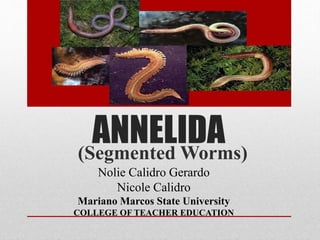
ANNELIDA 
(Segmented Worms) 
Nolie Calidro Gerardo 
Nicole Calidro 
Mariano Marcos State University 
COLLEGE OF TEACHER EDUCATION
• Annelida came from the Latin word “annelus” means little 
ring 
• Over 12,00 known species are grouped into 3 classes: 
Polychaetes, Oligochates and Hirudinea 
• The most highly advanced and most successful of the 
various “worms phyla 
• Symmetry bilateral; three germ layers 
• Soft bodied animals in which the large fluid filled coelom 
serves as a hydrostatic skeleton
3 MAJOR CLASSES 
CLASS POLYCHAETA 
• From the Greek word poly (many) and chate (spine or 
bristle) 
• Largest class of annelids with over 8,00 species 
• Live in ocean 
Features 
• Long, slender, greenish body is rounded and flattened 
vertically and composed of 200 or more similar somites 
• Distinct head is formed by prostomium and peristomium
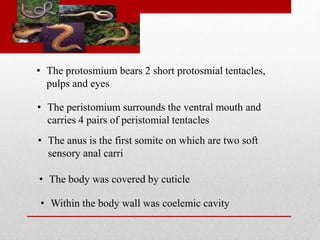
• The protosmium bears 2 short protosmial tentacles, 
pulps and eyes 
• The peristomium surrounds the ventral mouth and 
carries 4 pairs of peristomial tentacles 
• The anus is the first somite on which are two soft 
sensory anal carri 
• The body was covered by cuticle 
• Within the body wall was coelemic cavity
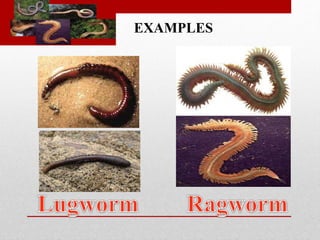
EXAMPLES
Digestive System 
• Includes mouth, pharynx, esophagus, stomach, intestine and 
anus. 
Circulatory System 
• Comprised a dorsal and ventral vessel 
• The plasma is red containing dissolved hemoglobin and 
amoebocytes 
• Circulation results from peristaltic contraction of dorsal 
vessel
Respiration 
• Effected by capillaries in the parapodia and body wall 
Excretion 
• Performed by paired nephridia 
Nervous System 
• Includes brain, nerves to the bead and tentacles, connectives 
to the mid ventral nerve cord and a pair of ganglia and 
lateral nerves 
Reproduction 
• Sexes are separate and gonands are present only on 
breeding season 
• Fertilization occurs in the sea 
• Allows epitoke
SUB CLASS 
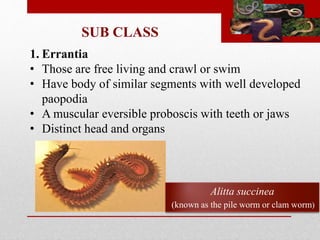
1. Errantia 
• Those are free living and crawl or swim 
• Have body of similar segments with well developed 
paopodia 
• A muscular eversible proboscis with teeth or jaws 
• Distinct head and organs 
Alitta succinea 
(known as the pile worm or clam worm)
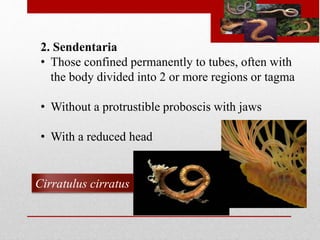
2. Sendentaria 
• Those confined permanently to tubes, often with 
the body divided into 2 or more regions or tagma 
• Without a protrustible proboscis with jaws 
• With a reduced head 
Cirratulus cirratus
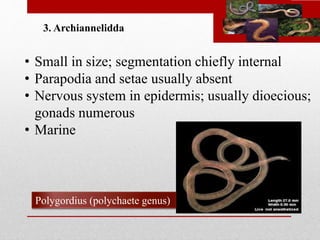
3. Archiannelidda 
• Small in size; segmentation chiefly internal 
• Parapodia and setae usually absent 
• Nervous system in epidermis; usually dioecious; 
gonads numerous 
• Marine 
Polygordius (polychaete genus)
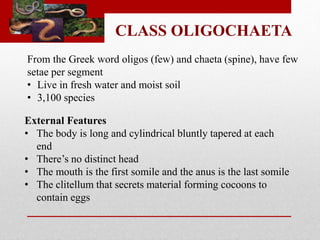
CLASS OLIGOCHAETA 
From the Greek word oligos (few) and chaeta (spine), have few 
setae per segment 
• Live in fresh water and moist soil 
• 3,100 species 
External Features 
• The body is long and cylindrical bluntly tapered at each 
end 
• There’s no distinct head 
• The mouth is the first somile and the anus is the last somile 
• The clitellum that secrets material forming cocoons to 
contain eggs
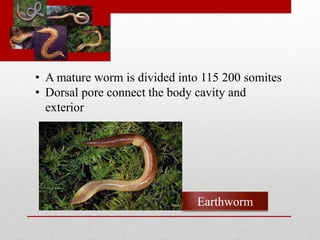
• A mature worm is divided into 115 200 somites 
• Dorsal pore connect the body cavity and 
exterior 
Earthworm
Internal Structure 
• The space between of the two concentric tubes, the outer 
body wall and the digestive tract is the body cavity or coelom 
• The coelom and all organisms within it are covered by 
peritoneum
Digestive System 
• Consist of the mouth, pharynx, esophagus, crop, intestine 
and anus 
• The intestine is thin walled and bulges laterally in each 
somile and its dorsal wall carries an infolded thyposole 
for absorption of food
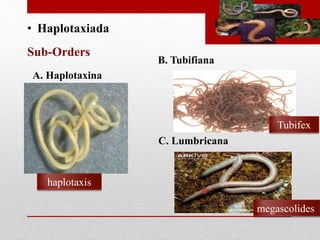
Circulatory System 
• Blood consist of fluid plasma that contains 
amoebocytes 
• Plasma is colored red by hemoglobin 
• Blood circulate in a system of closed blood 
vessels
Respiration 
• No organized respiratory system 
• Through epidermis 
Excretory System 
• Every somile except the first three and last has a pair 
of nephridia 
• Nephridia act much like tubules in human kidney
Nervous System 
• A pair of supra pharyngeal cerebral ganglia, the 
brain 
Reproduction 
• Monoecious; both male and female sex organs are 
ventral and anterior 
• Males sex organs: 2 pairs of minute testes, 2 sperm 
funnel, ductus efferens, ductus deferens, malepore and 
seminal vesicles 
• Female sex organs includes ovaries, oviduct funnels, 
oviduct and seminal receptacles
ORDER 
• Lumbriculida 
Lumbriculus variegatus
• Monilogastrida 
Moniligaster
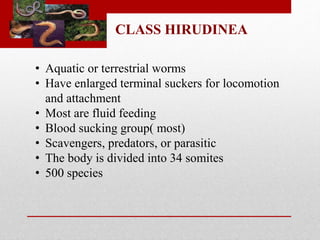
• Haplotaxiada 
Sub-Orders 
A. Haplotaxina 
B. Tubifiana 
C. Lumbricana 
haplotaxis 
Tubifex 
megascolides
CLASS HIRUDINEA 
• Aquatic or terrestrial worms 
• Have enlarged terminal suckers for locomotion 
and attachment 
• Most are fluid feeding 
• Blood sucking group( most) 
• Scavengers, predators, or parasitic 
• The body is divided into 34 somites 
• 500 species
Features 
• The body of a leech at rest is long or oval in outline 
• Usually flat dorsoventrally and very flexible maybe 
stretched 
• Posterior end is a rounded sucker 
• Another sucker surrounds the mouth at the anterior 
end in many species
Digestive system 
• Includes the mouth, pharynx, short esophagus, 20 pairs of 
lateral caeca, a slender intestine, short rectum 
Circulatory System 
• Longitudinal sinuses , dorsal, ventral and lateral, with many 
cross sections 
• Pulsations in some of three cause the blood to circulate
Respirations 
• A network of capillaries beneath he epidermis 
Excretion 
• It pairs of peculiar nephridia 
• Sometimes branched and sometimes have closed 
nephrostomes 
Nervous Sysem 
• Pair of dorsal ganglia and paired connectives to the 
ventral nevre cord 
• Four of the anterior ganglia 
• Seven at he posterior end are fused
Reproductive Sytem 
• Male reproductive system includes 4 to 12 pairs of testes 
beneath the crop, ductus deferens running anteriorly 
• 2 ducts enter a median penis to which accessory glands 
connect 
• The penis is within the general pore 
• Female reproductive system includes 2 ovaries and oviducts 
joining a single albumen gland and a median vagina that 
opens just behind the male pore 
• Sexes are united
Image Source: Google Images

ANNELIDA (segmented worms)

  • 1.
    ANNELIDA (Segmented Worms) Nolie Calidro Gerardo Nicole Calidro Mariano Marcos State University COLLEGE OF TEACHER EDUCATION
  • 2.
    • Annelida camefrom the Latin word “annelus” means little ring • Over 12,00 known species are grouped into 3 classes: Polychaetes, Oligochates and Hirudinea • The most highly advanced and most successful of the various “worms phyla • Symmetry bilateral; three germ layers • Soft bodied animals in which the large fluid filled coelom serves as a hydrostatic skeleton
  • 3.
    3 MAJOR CLASSES CLASS POLYCHAETA • From the Greek word poly (many) and chate (spine or bristle) • Largest class of annelids with over 8,00 species • Live in ocean Features • Long, slender, greenish body is rounded and flattened vertically and composed of 200 or more similar somites • Distinct head is formed by prostomium and peristomium
  • 4.
    • The protosmiumbears 2 short protosmial tentacles, pulps and eyes • The peristomium surrounds the ventral mouth and carries 4 pairs of peristomial tentacles • The anus is the first somite on which are two soft sensory anal carri • The body was covered by cuticle • Within the body wall was coelemic cavity
  • 5.
  • 6.
    Digestive System •Includes mouth, pharynx, esophagus, stomach, intestine and anus. Circulatory System • Comprised a dorsal and ventral vessel • The plasma is red containing dissolved hemoglobin and amoebocytes • Circulation results from peristaltic contraction of dorsal vessel
  • 7.
    Respiration • Effectedby capillaries in the parapodia and body wall Excretion • Performed by paired nephridia Nervous System • Includes brain, nerves to the bead and tentacles, connectives to the mid ventral nerve cord and a pair of ganglia and lateral nerves Reproduction • Sexes are separate and gonands are present only on breeding season • Fertilization occurs in the sea • Allows epitoke
  • 8.
    SUB CLASS 1.Errantia • Those are free living and crawl or swim • Have body of similar segments with well developed paopodia • A muscular eversible proboscis with teeth or jaws • Distinct head and organs Alitta succinea (known as the pile worm or clam worm)
  • 9.
    2. Sendentaria •Those confined permanently to tubes, often with the body divided into 2 or more regions or tagma • Without a protrustible proboscis with jaws • With a reduced head Cirratulus cirratus
  • 10.
    3. Archiannelidda •Small in size; segmentation chiefly internal • Parapodia and setae usually absent • Nervous system in epidermis; usually dioecious; gonads numerous • Marine Polygordius (polychaete genus)
  • 11.
    CLASS OLIGOCHAETA Fromthe Greek word oligos (few) and chaeta (spine), have few setae per segment • Live in fresh water and moist soil • 3,100 species External Features • The body is long and cylindrical bluntly tapered at each end • There’s no distinct head • The mouth is the first somile and the anus is the last somile • The clitellum that secrets material forming cocoons to contain eggs
  • 12.
    • A matureworm is divided into 115 200 somites • Dorsal pore connect the body cavity and exterior Earthworm
  • 13.
    Internal Structure •The space between of the two concentric tubes, the outer body wall and the digestive tract is the body cavity or coelom • The coelom and all organisms within it are covered by peritoneum
  • 14.
    Digestive System •Consist of the mouth, pharynx, esophagus, crop, intestine and anus • The intestine is thin walled and bulges laterally in each somile and its dorsal wall carries an infolded thyposole for absorption of food
  • 15.
    Circulatory System •Blood consist of fluid plasma that contains amoebocytes • Plasma is colored red by hemoglobin • Blood circulate in a system of closed blood vessels
  • 16.
    Respiration • Noorganized respiratory system • Through epidermis Excretory System • Every somile except the first three and last has a pair of nephridia • Nephridia act much like tubules in human kidney
  • 17.
    Nervous System •A pair of supra pharyngeal cerebral ganglia, the brain Reproduction • Monoecious; both male and female sex organs are ventral and anterior • Males sex organs: 2 pairs of minute testes, 2 sperm funnel, ductus efferens, ductus deferens, malepore and seminal vesicles • Female sex organs includes ovaries, oviduct funnels, oviduct and seminal receptacles
  • 18.
    ORDER • Lumbriculida Lumbriculus variegatus
  • 19.
  • 20.
    • Haplotaxiada Sub-Orders A. Haplotaxina B. Tubifiana C. Lumbricana haplotaxis Tubifex megascolides
  • 21.
    CLASS HIRUDINEA •Aquatic or terrestrial worms • Have enlarged terminal suckers for locomotion and attachment • Most are fluid feeding • Blood sucking group( most) • Scavengers, predators, or parasitic • The body is divided into 34 somites • 500 species
  • 22.
    Features • Thebody of a leech at rest is long or oval in outline • Usually flat dorsoventrally and very flexible maybe stretched • Posterior end is a rounded sucker • Another sucker surrounds the mouth at the anterior end in many species
  • 23.
    Digestive system •Includes the mouth, pharynx, short esophagus, 20 pairs of lateral caeca, a slender intestine, short rectum Circulatory System • Longitudinal sinuses , dorsal, ventral and lateral, with many cross sections • Pulsations in some of three cause the blood to circulate
  • 24.
    Respirations • Anetwork of capillaries beneath he epidermis Excretion • It pairs of peculiar nephridia • Sometimes branched and sometimes have closed nephrostomes Nervous Sysem • Pair of dorsal ganglia and paired connectives to the ventral nevre cord • Four of the anterior ganglia • Seven at he posterior end are fused
  • 25.
    Reproductive Sytem •Male reproductive system includes 4 to 12 pairs of testes beneath the crop, ductus deferens running anteriorly • 2 ducts enter a median penis to which accessory glands connect • The penis is within the general pore • Female reproductive system includes 2 ovaries and oviducts joining a single albumen gland and a median vagina that opens just behind the male pore • Sexes are united
  • 26.