CHAPTER 3
Microsoft PowerPoint 2010
Introduction to PowerPoint
 PowerPoint is a program used to create professional
presentations.
 Presentations can include:
• Text
• graphics
• tables
• charts
• audio
• video
• flash animation files
• animated clip art
• movie clips
• links to Web sites
PowerPoint
 With PowerPoint you can
 Enter and edit text easily
 Change the appearance of information
 Organize and arrange information
 Incorporate information from other sources
 Present information in a variety of ways
 Collaborate on a presentation with others
Planning an Effective Presentation
 Using PowerPoint themes, you can use a design and enter your text immediately
 You can go back and tailor your presentation based on the needs of the audience
 Planning is a critical part of creating a presentation
 Planning includes:
 Determining and outlining your message
 Identifying the audience and the delivery location
 Determining the type of output
 Determining the design
 Deciding on additional materials needed
Presentations
 A presentation is a collection of data and information that is to be
delivered to a specific audience.
 A PowerPoint presentation is a collection of electronic slides that can
have text, pictures, graphics, tables, sound and video. This collection can
run automatically or can be controlled by a presenter.
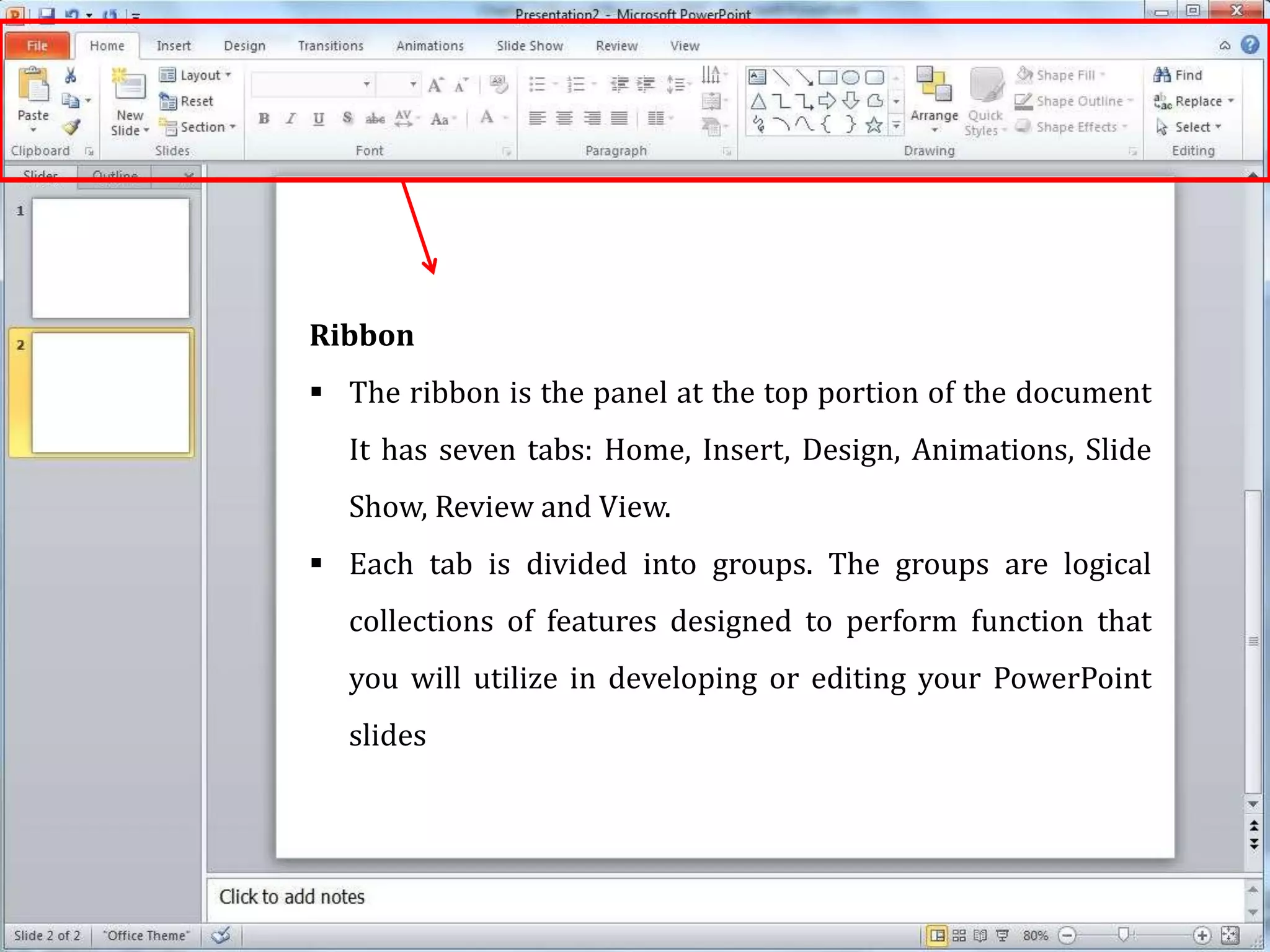
Ribbon
 The ribbon is the panel at the top portion of the document
It has seven tabs: Home, Insert, Design, Animations, Slide
Show, Review and View.
 Each tab is divided into groups. The groups are logical
collections of features designed to perform function that
you will utilize in developing or editing your PowerPoint
slides
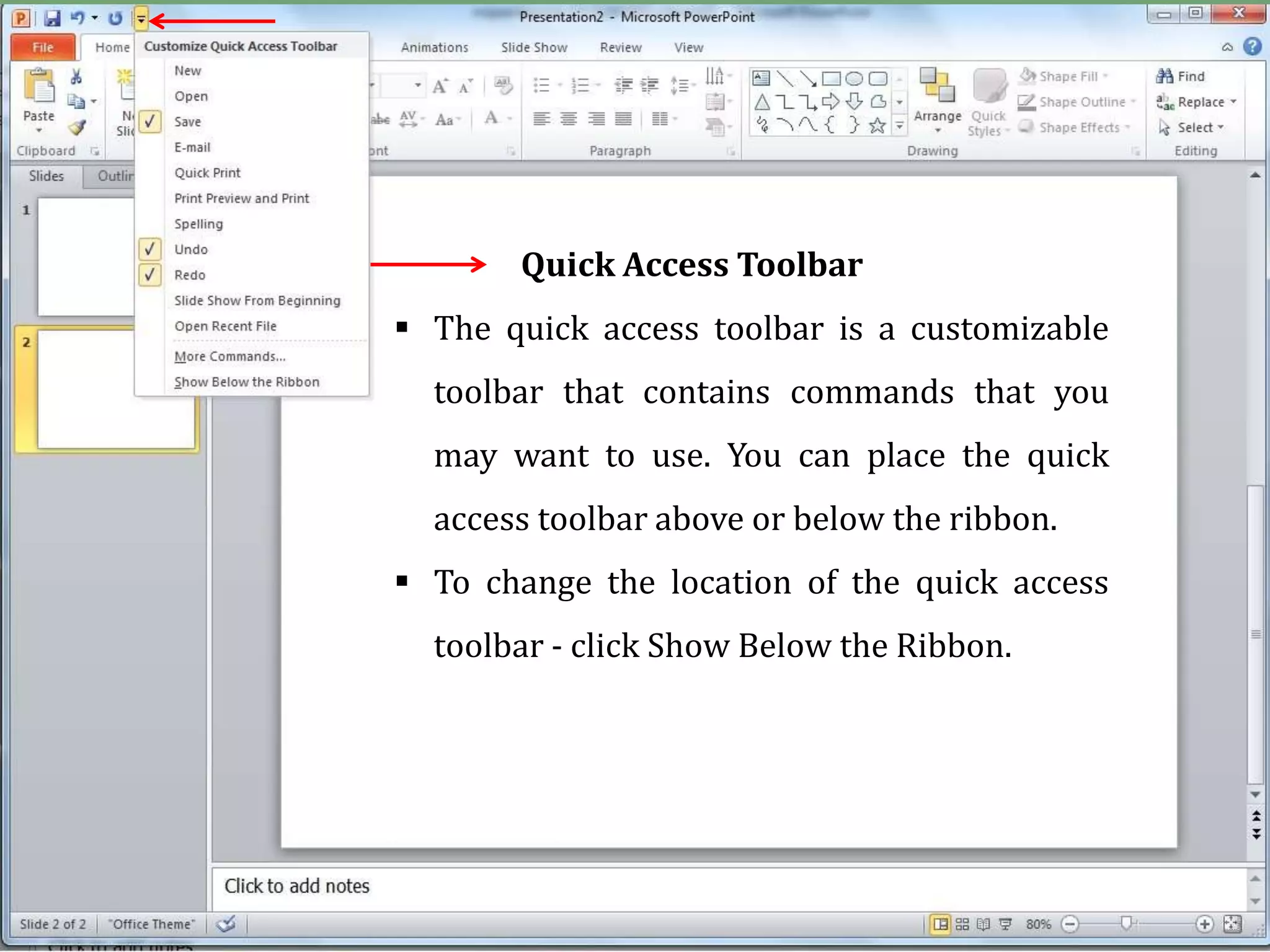
Quick Access Toolbar
 The quick access toolbar is a customizable
toolbar that contains commands that you
may want to use. You can place the quick
access toolbar above or below the ribbon.
 To change the location of the quick access
toolbar - click Show Below the Ribbon.
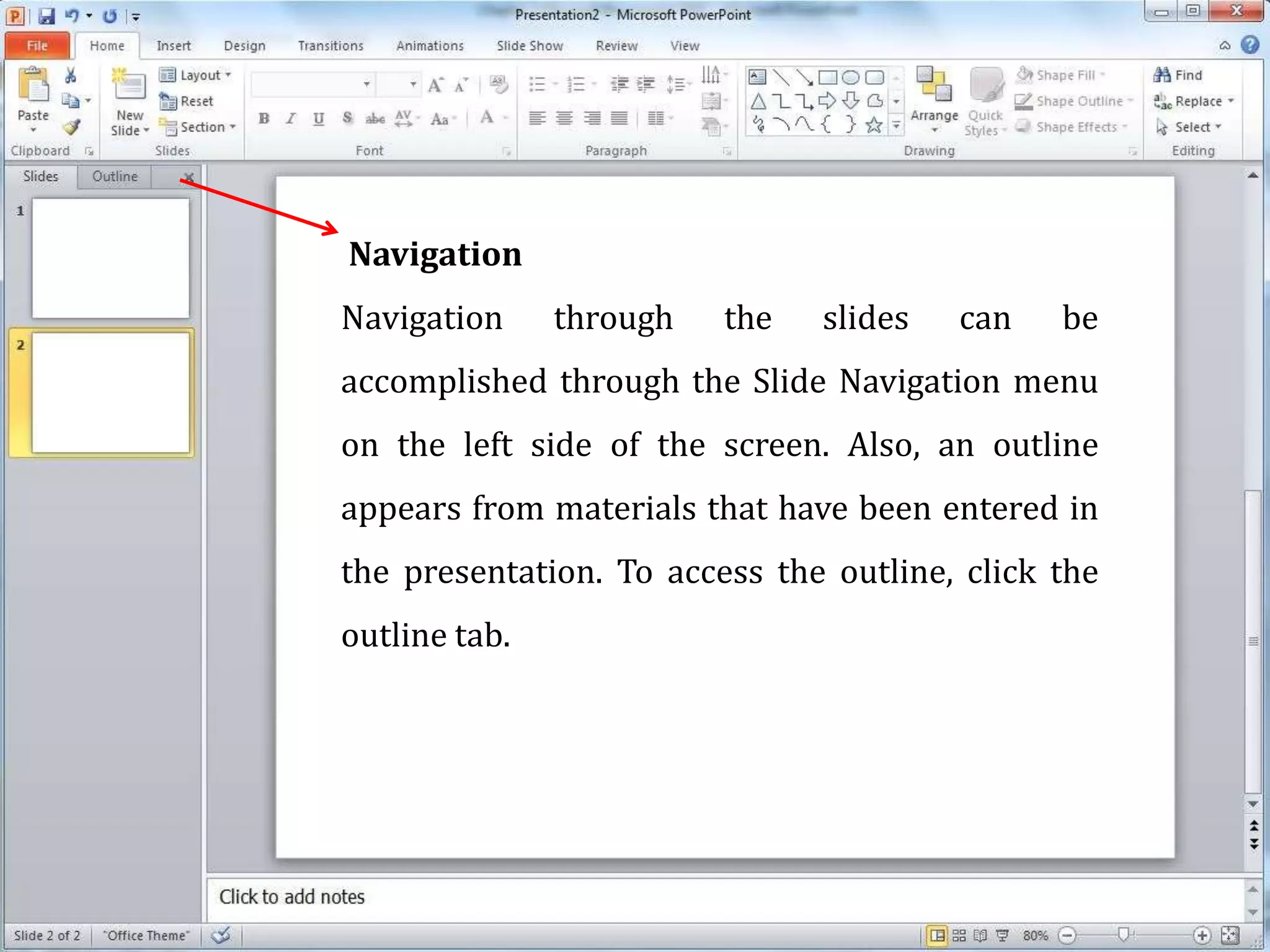
Navigation
Navigation through the slides can be
accomplished through the Slide Navigation menu
on the left side of the screen. Also, an outline
appears from materials that have been entered in
the presentation. To access the outline, click the
outline tab.
Slides Tab and Outline Tab
 While working with slides, power point displays all the slides in a pane
on the left side of your screen.
 It has two tabs – slides tab and the outline tab.
 Slides tab displays all slides as small pictures or thumbnails
 Outline Tab displays all test on the slides in outline form. This tab
does not show any graphics. It gives a quick over view of the slides.
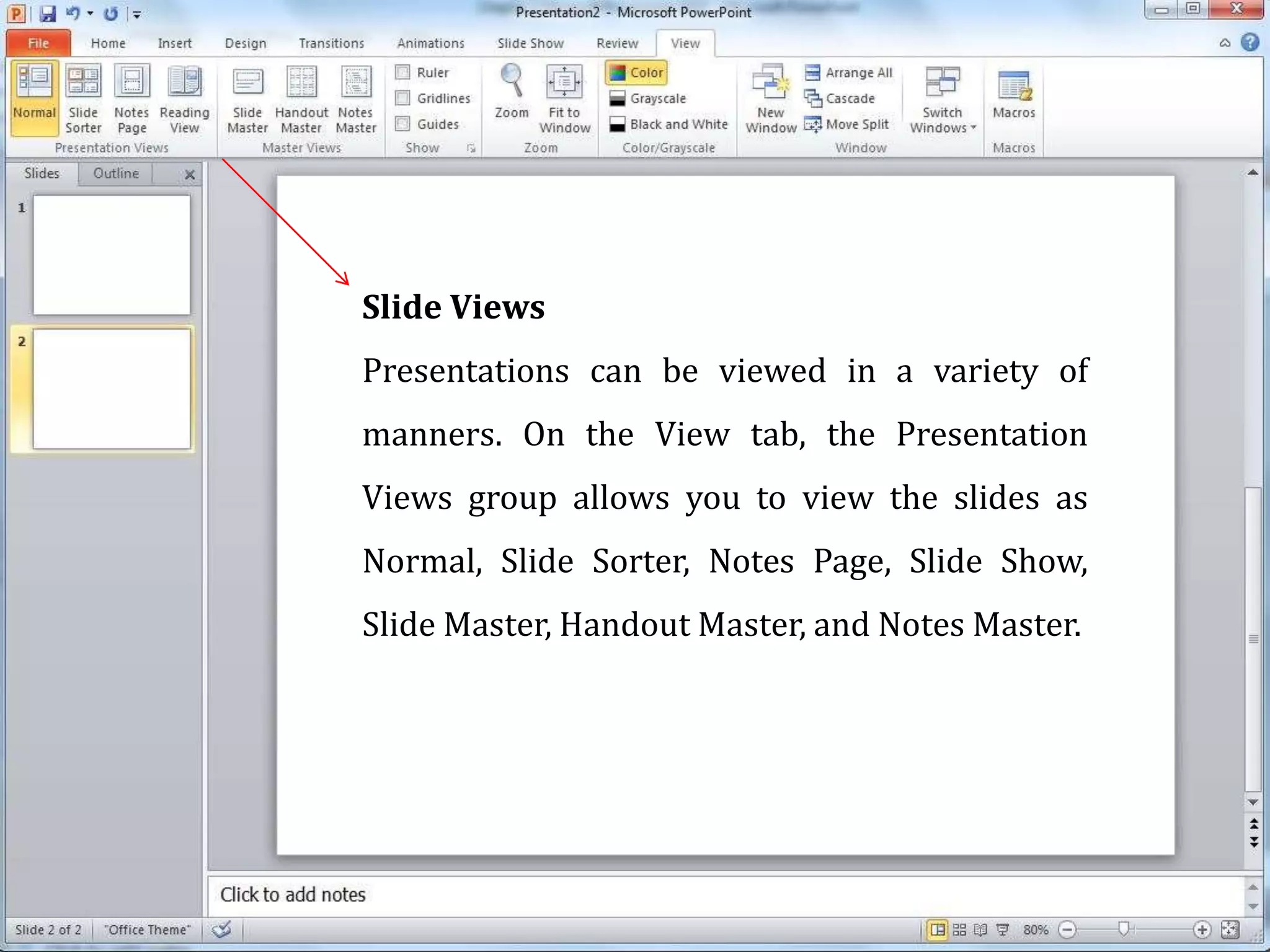
Slide Views
Presentations can be viewed in a variety of
manners. On the View tab, the Presentation
Views group allows you to view the slides as
Normal, Slide Sorter, Notes Page, Slide Show,
Slide Master, Handout Master, and Notes Master.
Managing Slides and Presentation
PowerPoint has five primary views -
Normal view
Slide Sorter view
Notes Page view
Slide Show view
Reading view
Managing Slides and Presentation
• Normal View: This is the default view where you create and edit your
slides. You can also move slides in the Slides tab in the pane on the left.
• Slide Sorter View: In this view, miniature slides are arranged on the
screen. You can drag and drop slides to easily reorder them, and see
more slides at one time. This is a good view to use to confirm that you
have all the needed slides and that none have been deleted.
Managing Slides and Presentation
 Reading View: This view fills most of the computer screen with a
preview of your presentation. Unlike Slide Show View, it includes easily
accessible buttons for navigation, located at the bottom right.
 Slide Show View: This view completely fills the computer screen, and is
what the audience will see when they view the presentation. Slide Show
View has an additional menu that appears when you hover over it,
allowing you to navigate through the slides, and access other features
you can use during a presentation
More New Features
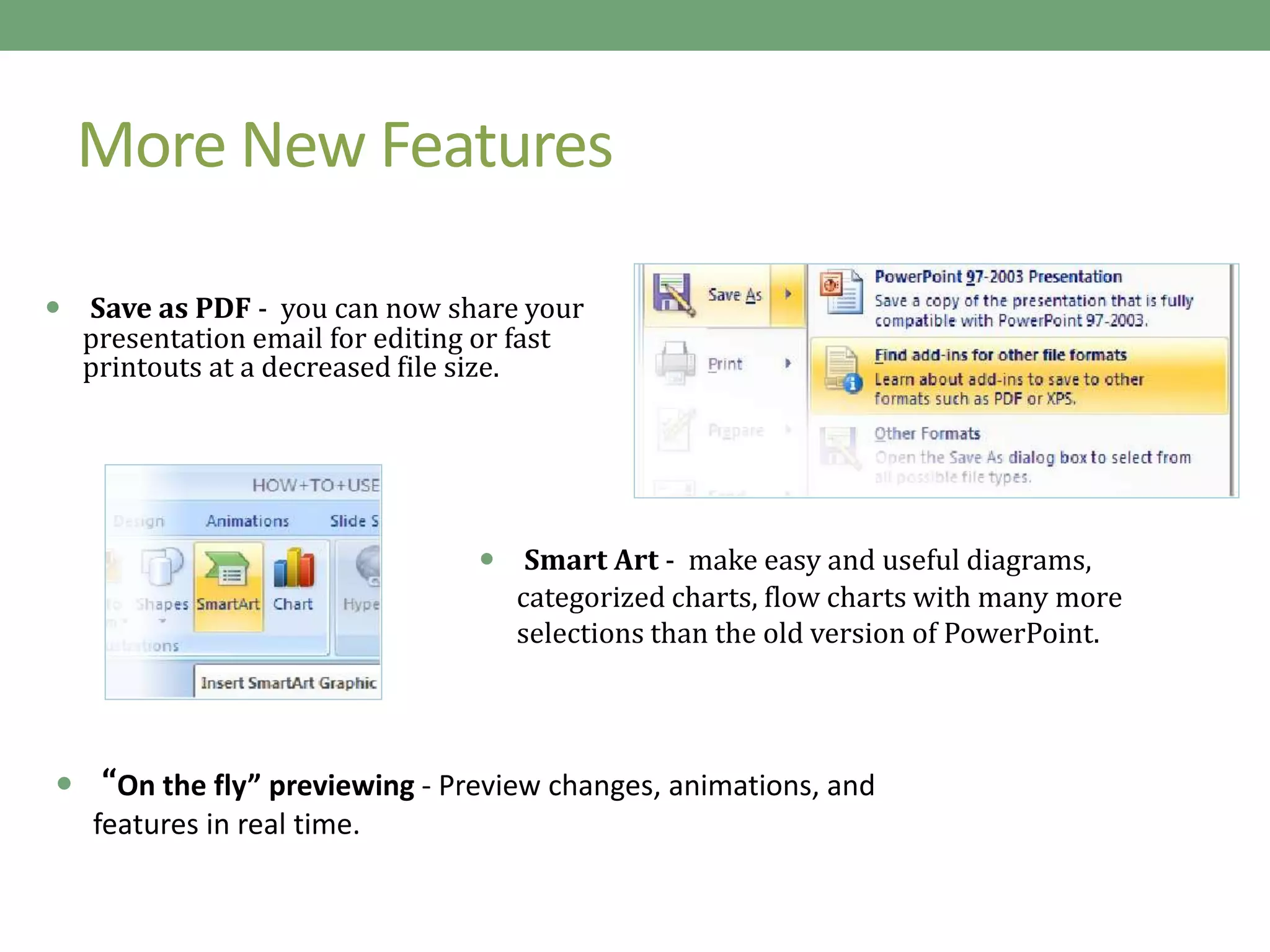
 Save as PDF - you can now share your
presentation email for editing or fast
printouts at a decreased file size.
 Smart Art - make easy and useful diagrams,
categorized charts, flow charts with many more
selections than the old version of PowerPoint.
 “On the fly” previewing - Preview changes, animations, and
features in real time.
Tab Functions
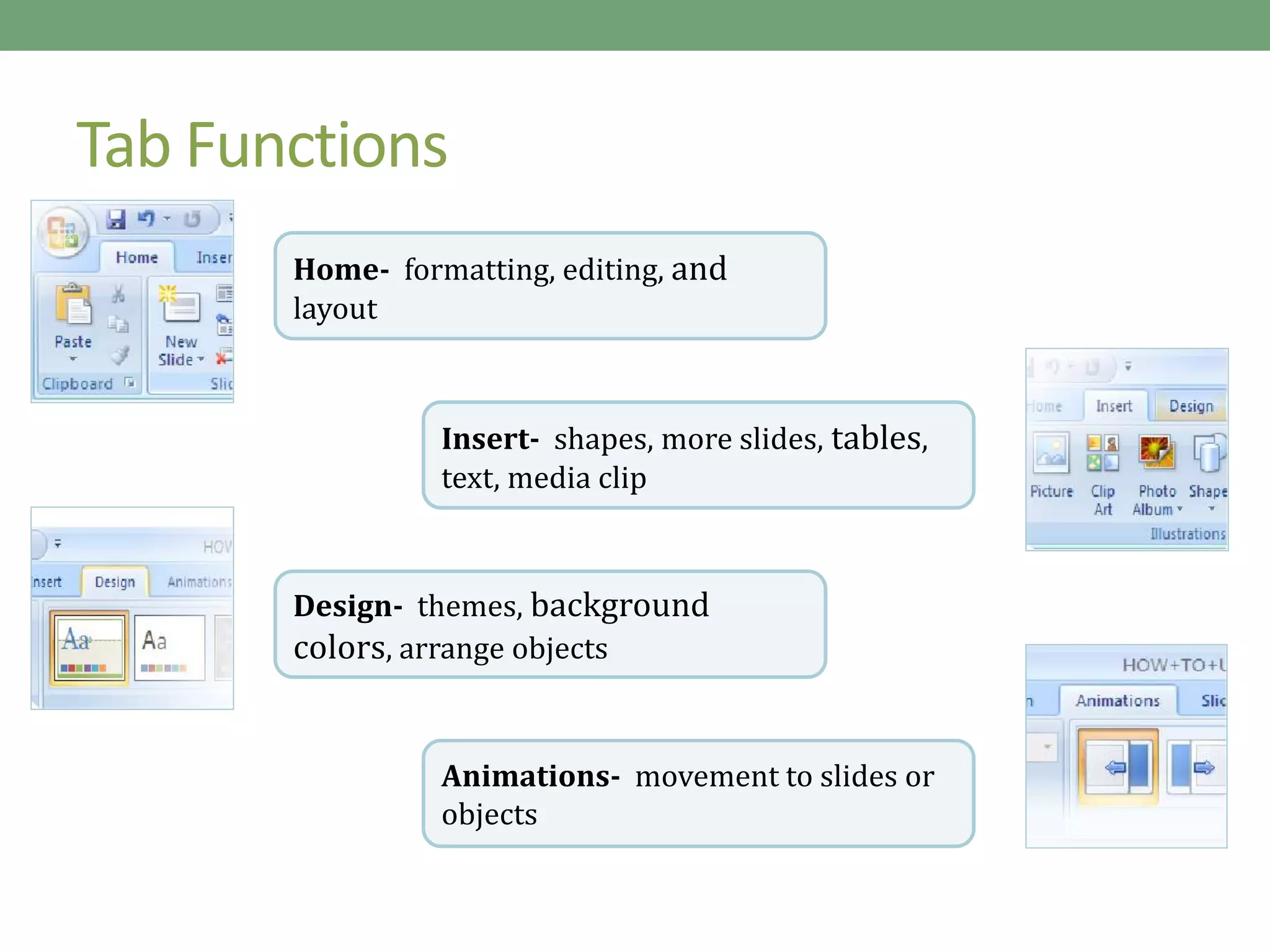
Home- formatting, editing, and
layout
Insert- shapes, more slides, tables,
text, media clip
Design- themes, background
colors, arrange objects
Animations- movement to slides or
objects
Tab Functions Continued
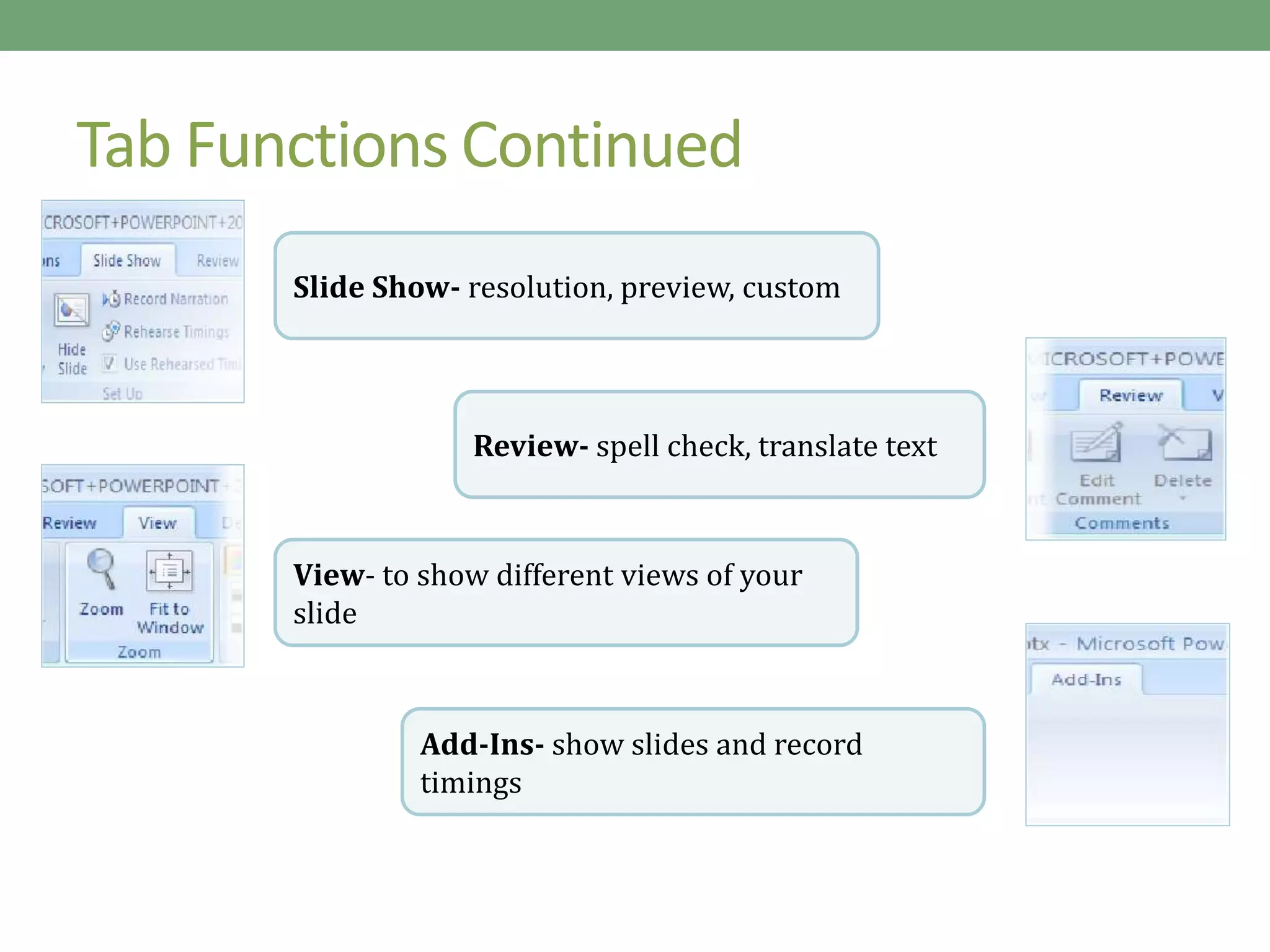
Slide Show- resolution, preview, custom
Review- spell check, translate text
View- to show different views of your
slide
Add-Ins- show slides and record
timings
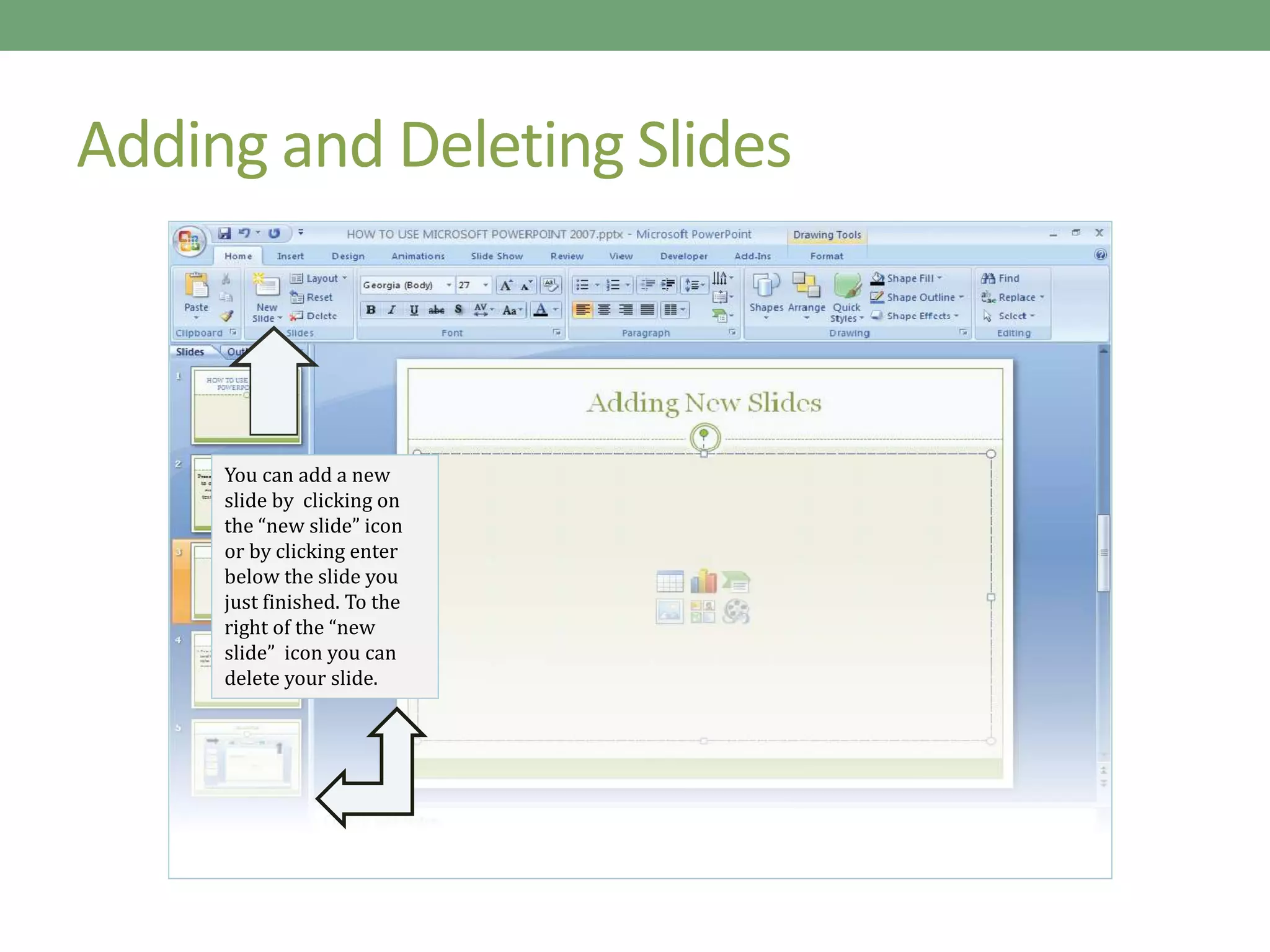
Adding and Deleting Slides
You can add a new
slide by clicking on
the “new slide” icon
or by clicking enter
below the slide you
just finished. To the
right of the “new
slide” icon you can
delete your slide.
You can add a new
slide by clicking on
the “new slide” icon
or by clicking enter
below the slide you
just finished. To the
right of the “new
slide” icon you can
delete your slide.
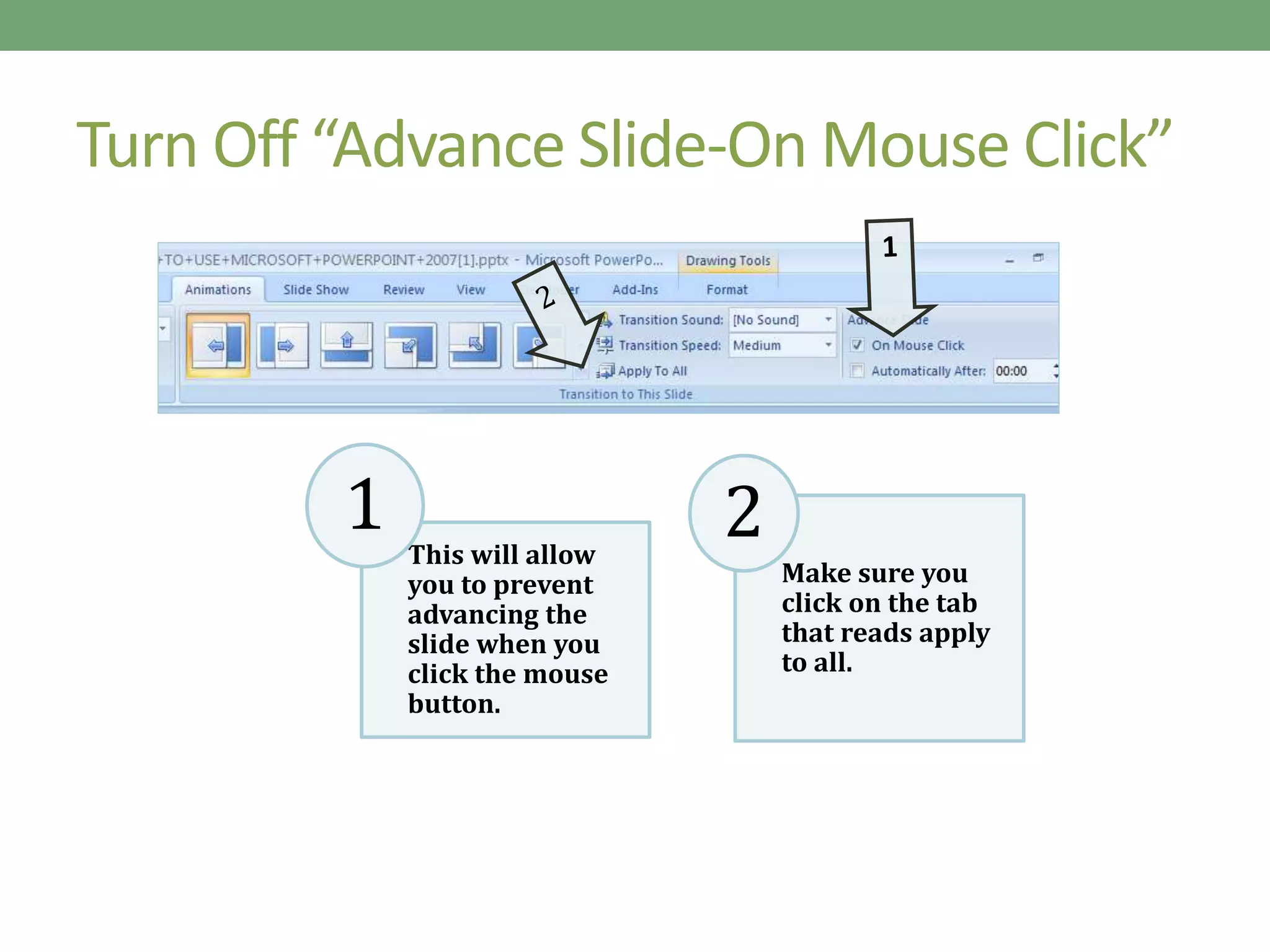
Turn Off “Advance Slide-On Mouse Click”
This will allow
you to prevent
advancing the
slide when you
click the mouse
button.
1
Make sure you
click on the tab
that reads apply
to all.
2
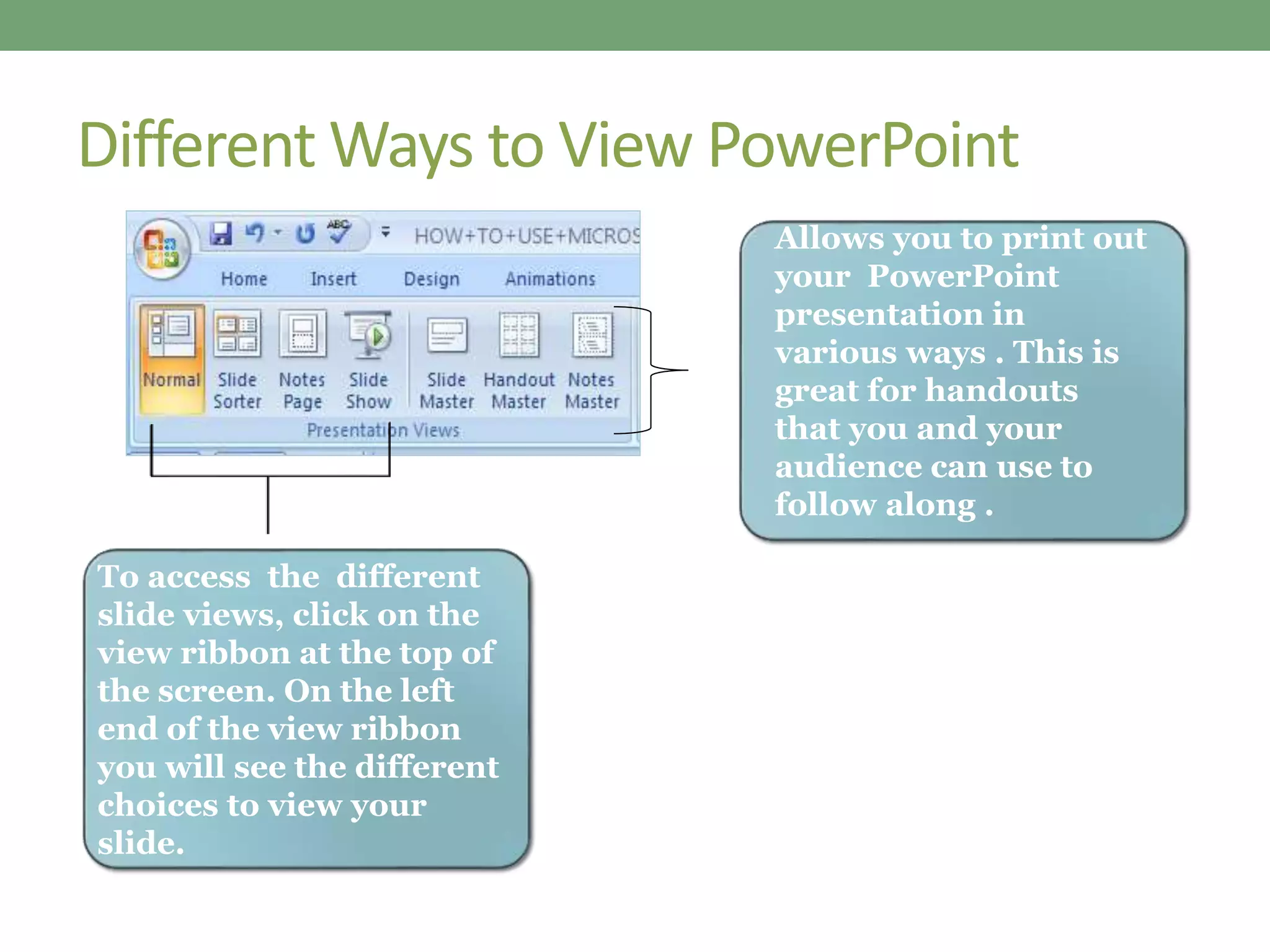
Different Ways to View PowerPoint
To access the different
slide views, click on the
view ribbon at the top of
the screen. On the left
end of the view ribbon
you will see the different
choices to view your
slide.
Allows you to print out
your PowerPoint
presentation in
various ways . This is
great for handouts
that you and your
audience can use to
follow along .
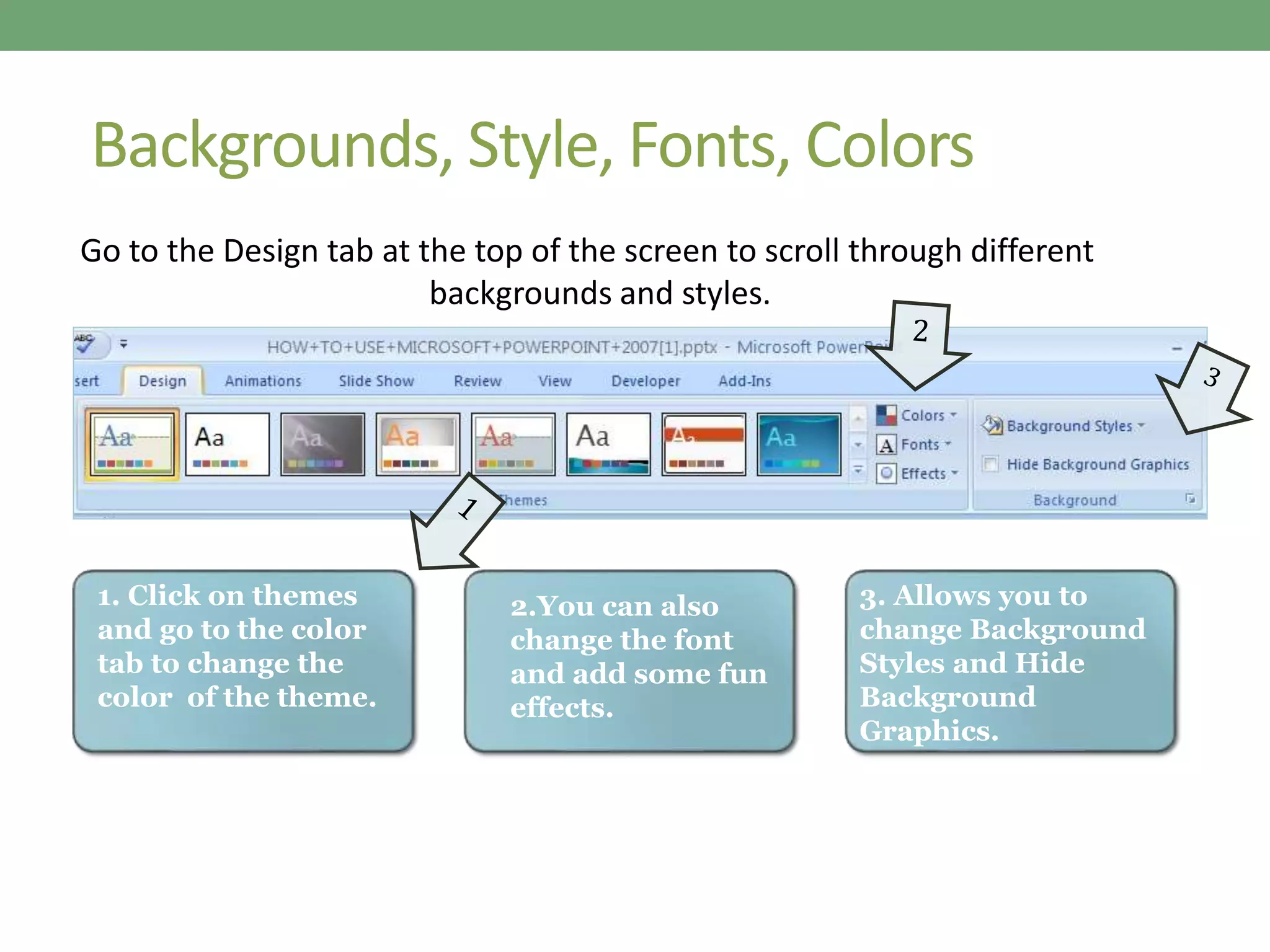
Backgrounds, Style, Fonts, Colors
Go to the Design tab at the top of the screen to scroll through different
backgrounds and styles.
1. Click on themes
and go to the color
tab to change the
color of the theme.
2.You can also
change the font
and add some fun
effects.
3. Allows you to
change Background
Styles and Hide
Background
Graphics.
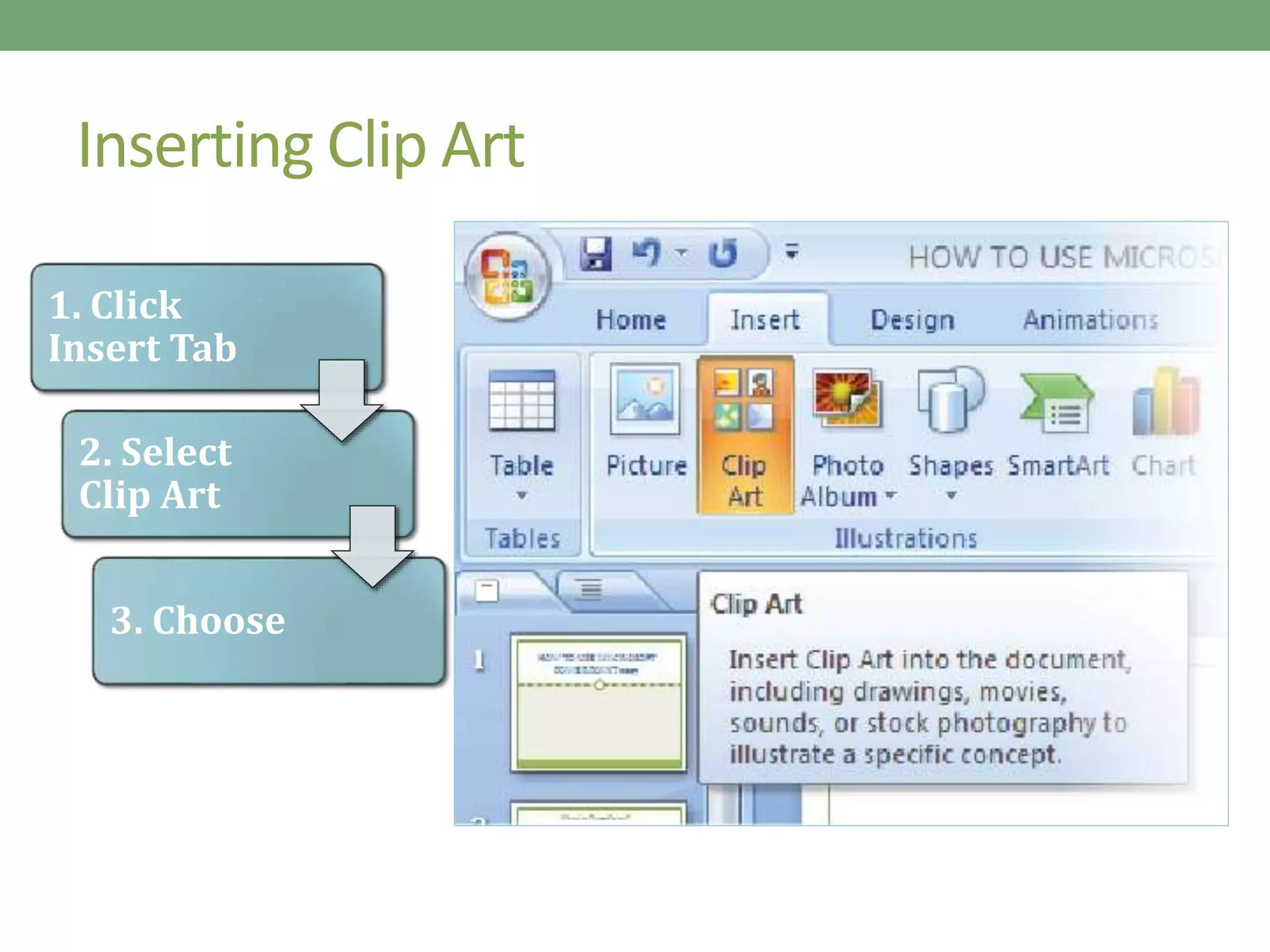
Inserting Clip Art
1. Click
Insert Tab
2. Select
Clip Art
3. Choose
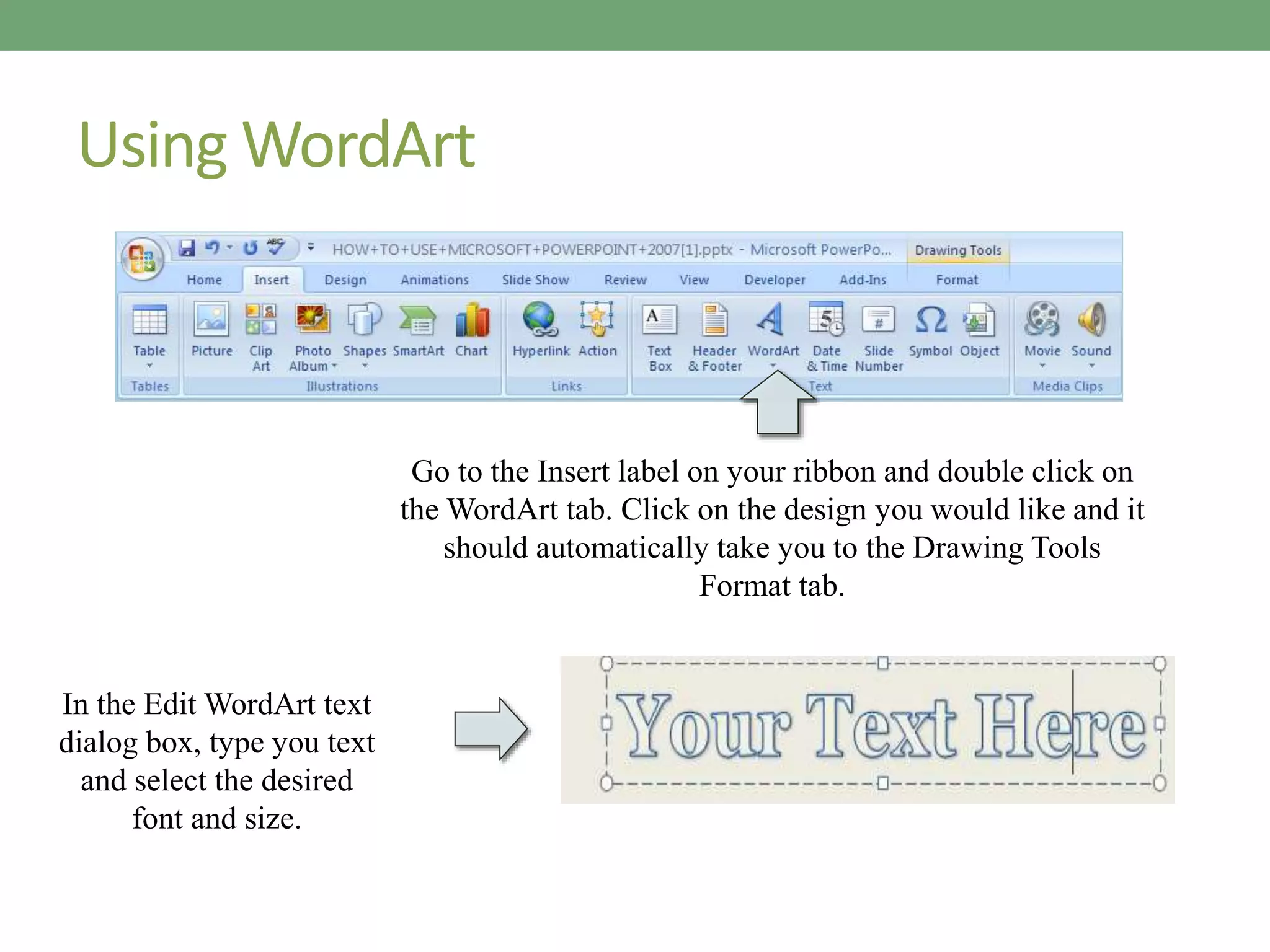
Using WordArt
Go to the Insert label on your ribbon and double click on
the WordArt tab. Click on the design you would like and it
should automatically take you to the Drawing Tools
Format tab.
In the Edit WordArt text
dialog box, type you text
and select the desired
font and size.
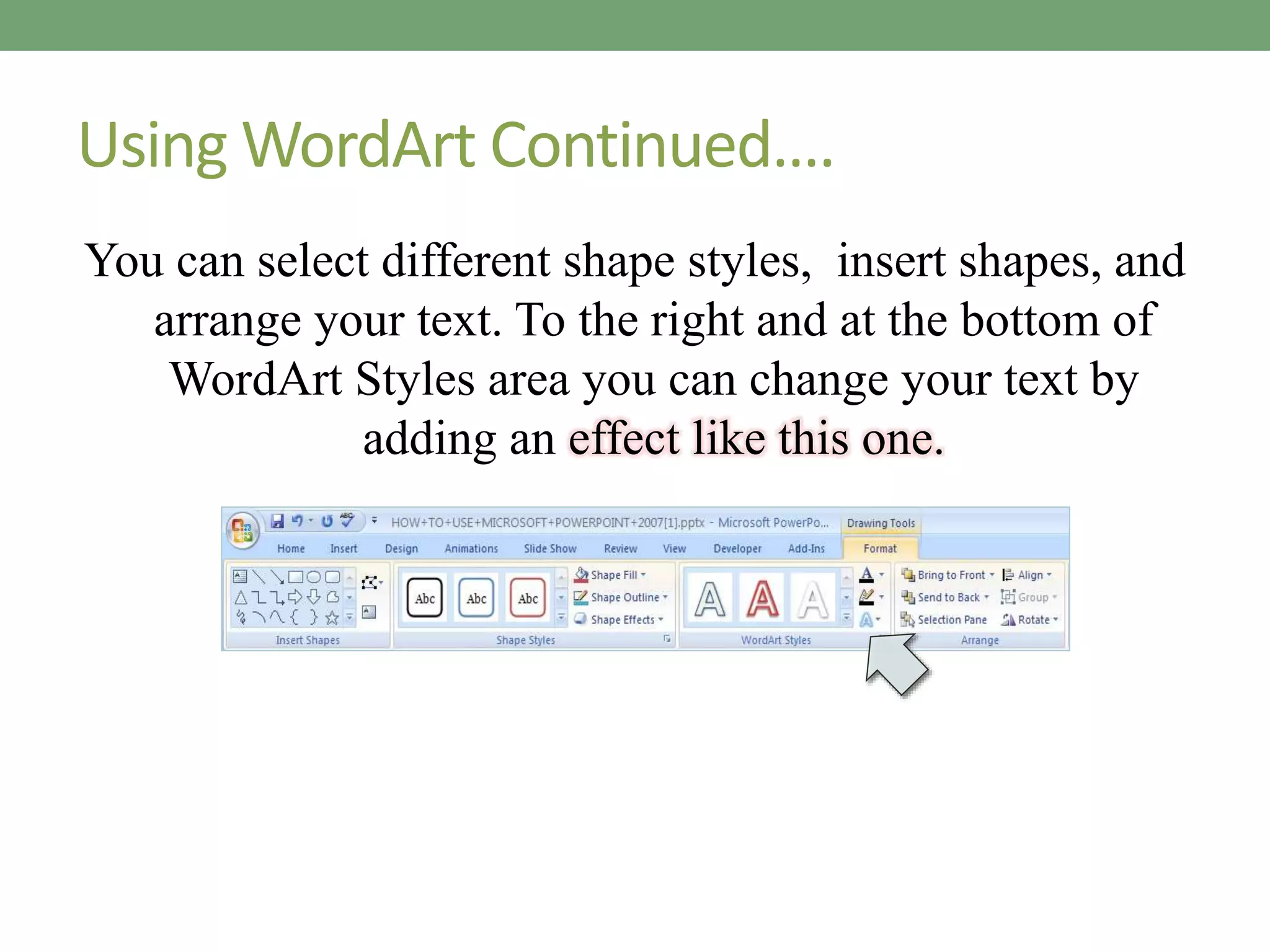
Using WordArt Continued….
You can select different shape styles, insert shapes, and
arrange your text. To the right and at the bottom of
WordArt Styles area you can change your text by
adding an effect like this one.
Inserting Sound Files
• Two Types: Embedded vs. Linked sound files
• Embedded sound file is directly inserted into PowerPoint
• Linked sound file is when a connection is created between the destination
file and a source file. Destination being Word or PowerPoint document.
• When your presentation contains linked files, you must copy both
the linked files and the presentation if you plan to give the
presentation on another computer or send it to someone in an e-
mail message.
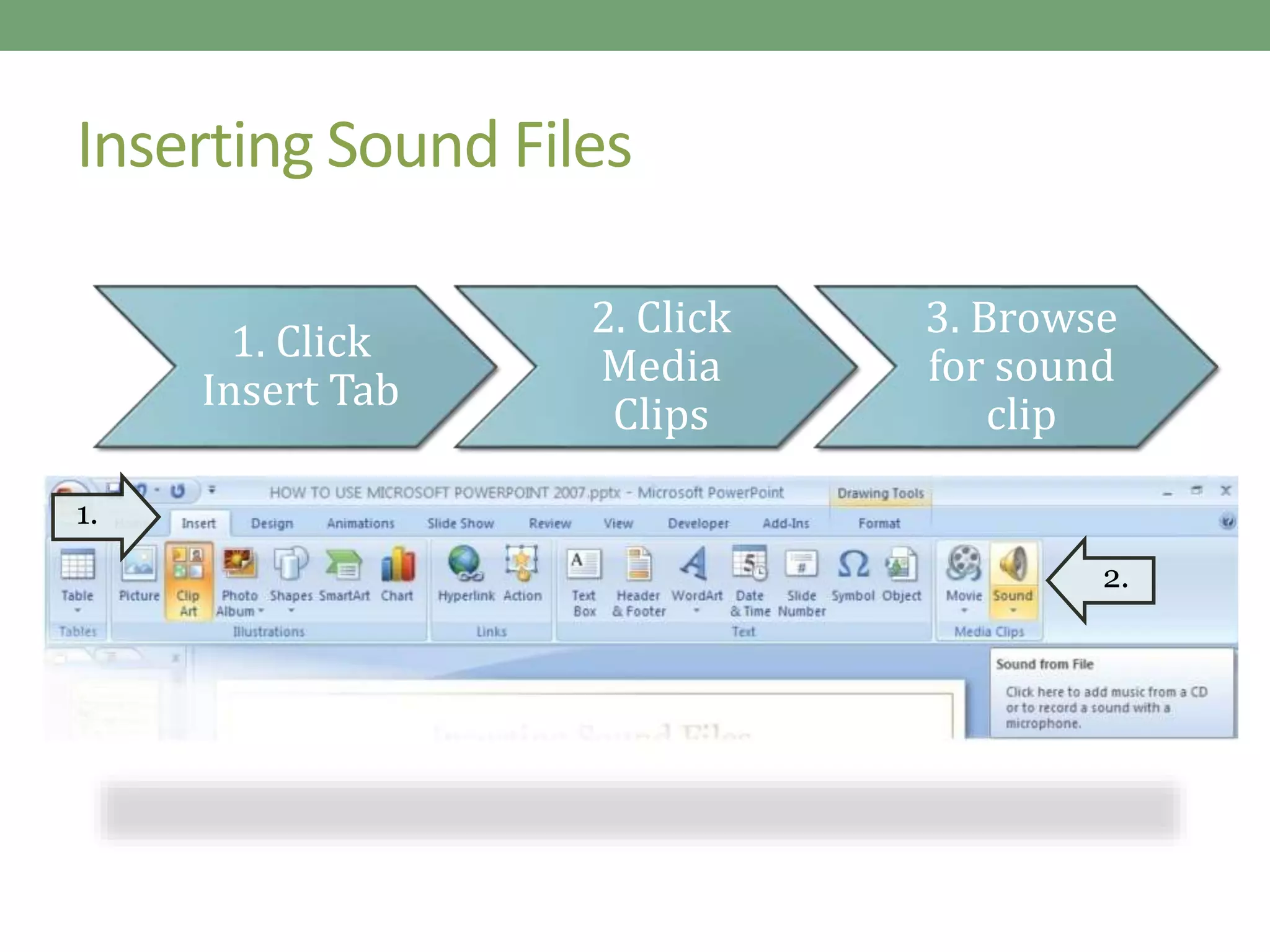
Inserting Sound Files
1. Click
Insert Tab
2. Click
Media
Clips
3. Browse
for sound
clip
1.
2.
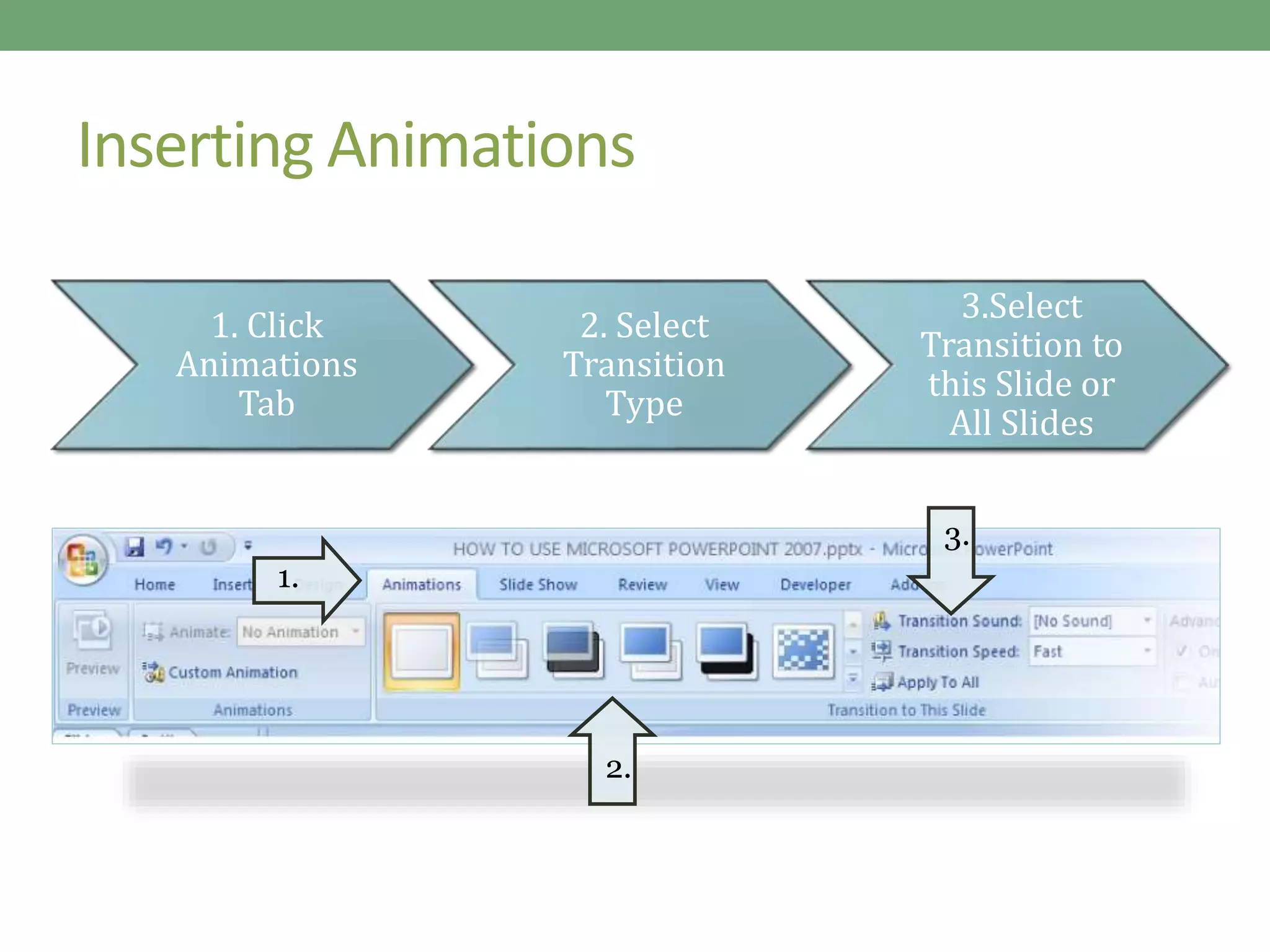
Inserting Animations
1. Click
Animations
Tab
2. Select
Transition
Type
3.Select
Transition to
this Slide or
All Slides
1.
2.
3.
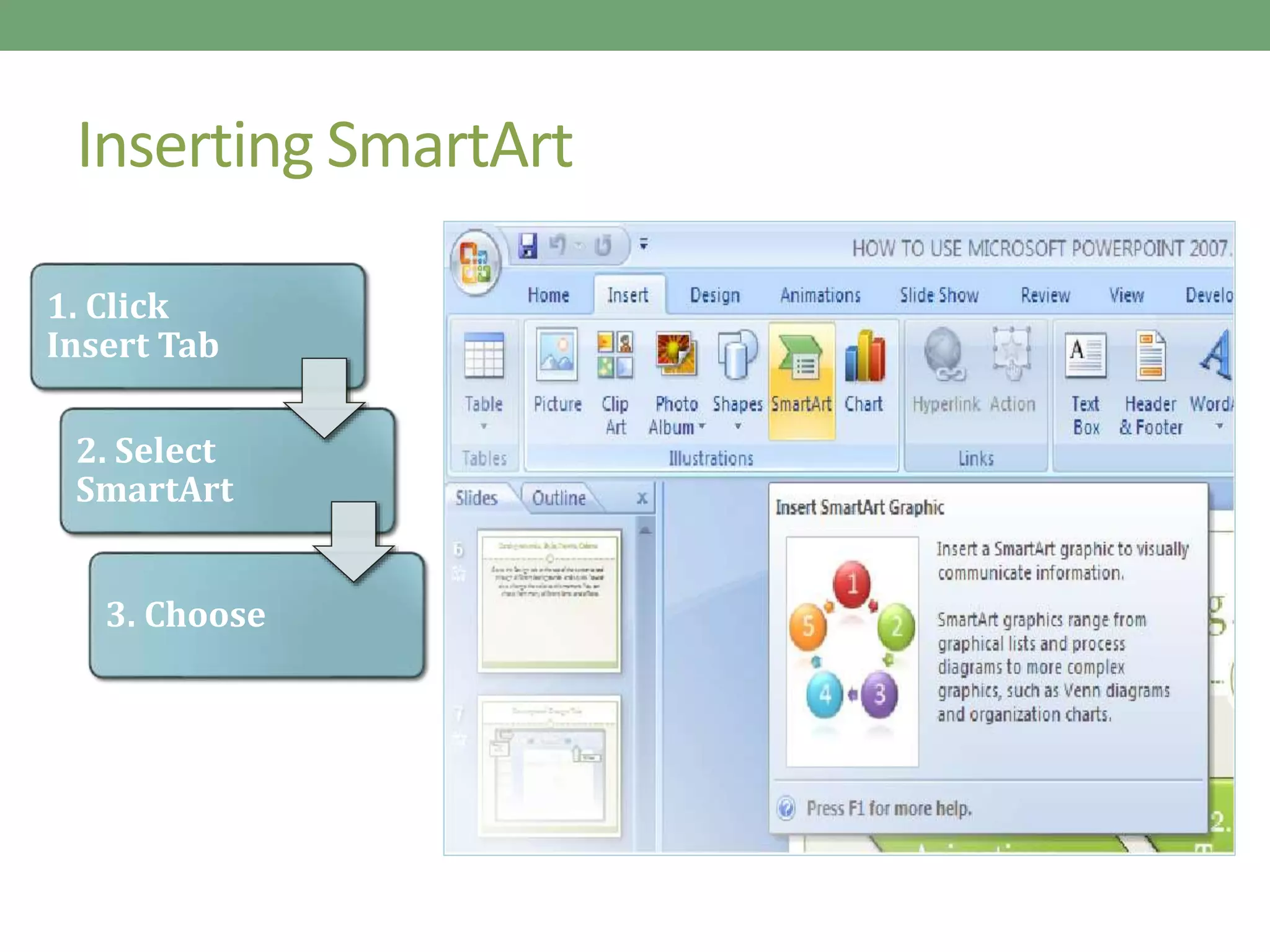
Inserting SmartArt
1. Click
Insert Tab
2. Select
SmartArt
3. Choose
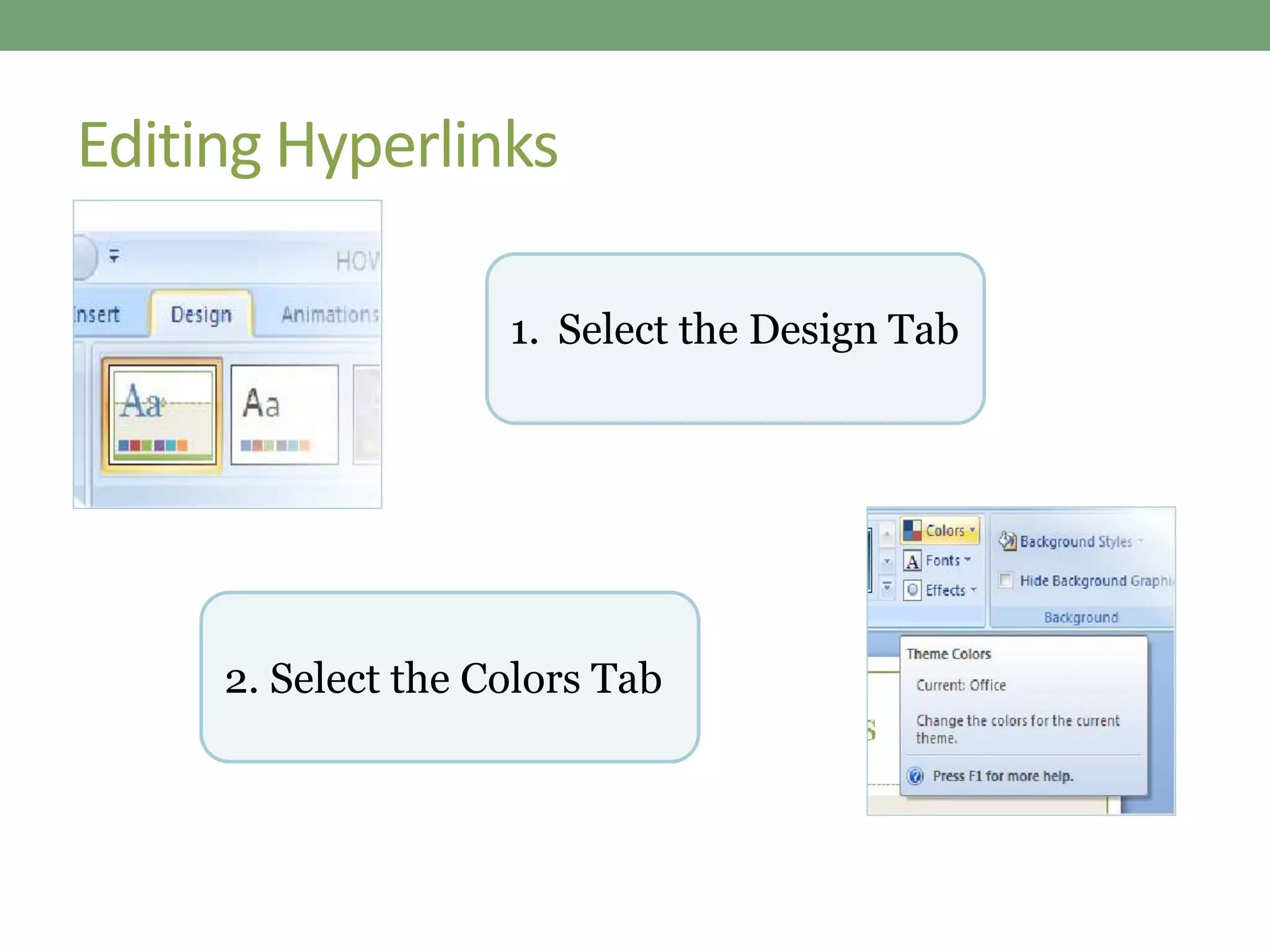
Editing Hyperlinks
1. Select the Design Tab
2. Select the Colors Tab
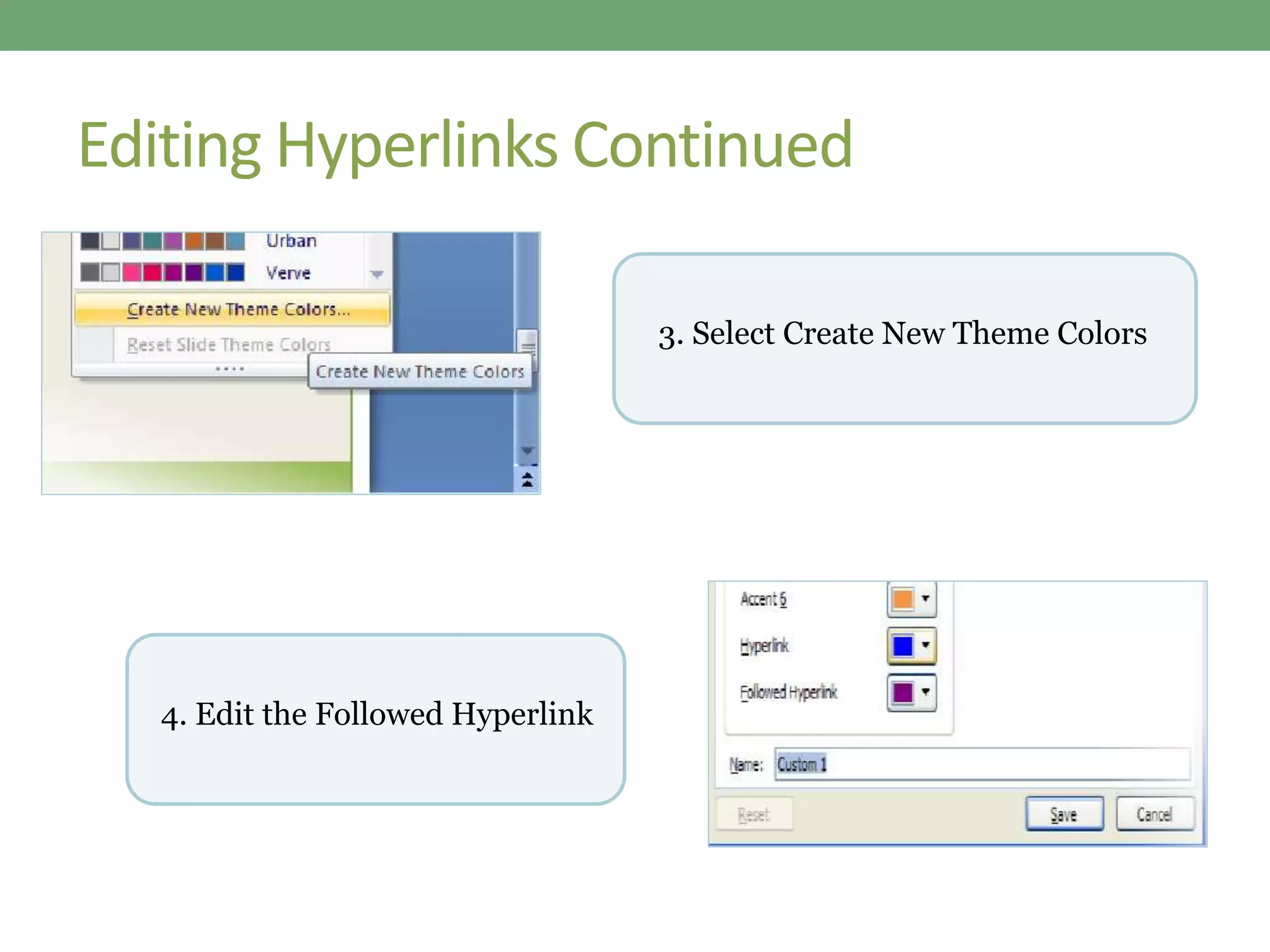
Editing Hyperlinks Continued
3. Select Create New Theme Colors
4. Edit the Followed Hyperlink

Microsoft Power Point 2010

  • 1.
  • 2.
    Introduction to PowerPoint PowerPoint is a program used to create professional presentations.  Presentations can include: • Text • graphics • tables • charts • audio • video • flash animation files • animated clip art • movie clips • links to Web sites
  • 3.
    PowerPoint  With PowerPointyou can  Enter and edit text easily  Change the appearance of information  Organize and arrange information  Incorporate information from other sources  Present information in a variety of ways  Collaborate on a presentation with others
  • 4.
    Planning an EffectivePresentation  Using PowerPoint themes, you can use a design and enter your text immediately  You can go back and tailor your presentation based on the needs of the audience  Planning is a critical part of creating a presentation  Planning includes:  Determining and outlining your message  Identifying the audience and the delivery location  Determining the type of output  Determining the design  Deciding on additional materials needed
  • 5.
    Presentations  A presentationis a collection of data and information that is to be delivered to a specific audience.  A PowerPoint presentation is a collection of electronic slides that can have text, pictures, graphics, tables, sound and video. This collection can run automatically or can be controlled by a presenter.
  • 6.
    Ribbon  The ribbonis the panel at the top portion of the document It has seven tabs: Home, Insert, Design, Animations, Slide Show, Review and View.  Each tab is divided into groups. The groups are logical collections of features designed to perform function that you will utilize in developing or editing your PowerPoint slides
  • 7.
    Quick Access Toolbar The quick access toolbar is a customizable toolbar that contains commands that you may want to use. You can place the quick access toolbar above or below the ribbon.  To change the location of the quick access toolbar - click Show Below the Ribbon.
  • 8.
    Navigation Navigation through theslides can be accomplished through the Slide Navigation menu on the left side of the screen. Also, an outline appears from materials that have been entered in the presentation. To access the outline, click the outline tab.
  • 9.
    Slides Tab andOutline Tab  While working with slides, power point displays all the slides in a pane on the left side of your screen.  It has two tabs – slides tab and the outline tab.  Slides tab displays all slides as small pictures or thumbnails  Outline Tab displays all test on the slides in outline form. This tab does not show any graphics. It gives a quick over view of the slides.
  • 10.
    Slide Views Presentations canbe viewed in a variety of manners. On the View tab, the Presentation Views group allows you to view the slides as Normal, Slide Sorter, Notes Page, Slide Show, Slide Master, Handout Master, and Notes Master.
  • 11.
    Managing Slides andPresentation PowerPoint has five primary views - Normal view Slide Sorter view Notes Page view Slide Show view Reading view
  • 12.
    Managing Slides andPresentation • Normal View: This is the default view where you create and edit your slides. You can also move slides in the Slides tab in the pane on the left. • Slide Sorter View: In this view, miniature slides are arranged on the screen. You can drag and drop slides to easily reorder them, and see more slides at one time. This is a good view to use to confirm that you have all the needed slides and that none have been deleted.
  • 13.
    Managing Slides andPresentation  Reading View: This view fills most of the computer screen with a preview of your presentation. Unlike Slide Show View, it includes easily accessible buttons for navigation, located at the bottom right.  Slide Show View: This view completely fills the computer screen, and is what the audience will see when they view the presentation. Slide Show View has an additional menu that appears when you hover over it, allowing you to navigate through the slides, and access other features you can use during a presentation
  • 14.
    More New Features Save as PDF - you can now share your presentation email for editing or fast printouts at a decreased file size.  Smart Art - make easy and useful diagrams, categorized charts, flow charts with many more selections than the old version of PowerPoint.  “On the fly” previewing - Preview changes, animations, and features in real time.
  • 15.
    Tab Functions Home- formatting,editing, and layout Insert- shapes, more slides, tables, text, media clip Design- themes, background colors, arrange objects Animations- movement to slides or objects
  • 16.
    Tab Functions Continued SlideShow- resolution, preview, custom Review- spell check, translate text View- to show different views of your slide Add-Ins- show slides and record timings
  • 17.
    Adding and DeletingSlides You can add a new slide by clicking on the “new slide” icon or by clicking enter below the slide you just finished. To the right of the “new slide” icon you can delete your slide. You can add a new slide by clicking on the “new slide” icon or by clicking enter below the slide you just finished. To the right of the “new slide” icon you can delete your slide.
  • 18.
    Turn Off “AdvanceSlide-On Mouse Click” This will allow you to prevent advancing the slide when you click the mouse button. 1 Make sure you click on the tab that reads apply to all. 2
  • 19.
    Different Ways toView PowerPoint To access the different slide views, click on the view ribbon at the top of the screen. On the left end of the view ribbon you will see the different choices to view your slide. Allows you to print out your PowerPoint presentation in various ways . This is great for handouts that you and your audience can use to follow along .
  • 20.
    Backgrounds, Style, Fonts,Colors Go to the Design tab at the top of the screen to scroll through different backgrounds and styles. 1. Click on themes and go to the color tab to change the color of the theme. 2.You can also change the font and add some fun effects. 3. Allows you to change Background Styles and Hide Background Graphics.
  • 21.
    Inserting Clip Art 1.Click Insert Tab 2. Select Clip Art 3. Choose
  • 22.
    Using WordArt Go tothe Insert label on your ribbon and double click on the WordArt tab. Click on the design you would like and it should automatically take you to the Drawing Tools Format tab. In the Edit WordArt text dialog box, type you text and select the desired font and size.
  • 23.
    Using WordArt Continued…. Youcan select different shape styles, insert shapes, and arrange your text. To the right and at the bottom of WordArt Styles area you can change your text by adding an effect like this one.
  • 24.
    Inserting Sound Files •Two Types: Embedded vs. Linked sound files • Embedded sound file is directly inserted into PowerPoint • Linked sound file is when a connection is created between the destination file and a source file. Destination being Word or PowerPoint document. • When your presentation contains linked files, you must copy both the linked files and the presentation if you plan to give the presentation on another computer or send it to someone in an e- mail message.
  • 25.
    Inserting Sound Files 1.Click Insert Tab 2. Click Media Clips 3. Browse for sound clip 1. 2.
  • 26.
    Inserting Animations 1. Click Animations Tab 2.Select Transition Type 3.Select Transition to this Slide or All Slides 1. 2. 3.
  • 27.
    Inserting SmartArt 1. Click InsertTab 2. Select SmartArt 3. Choose
  • 28.
    Editing Hyperlinks 1. Selectthe Design Tab 2. Select the Colors Tab
  • 29.
    Editing Hyperlinks Continued 3.Select Create New Theme Colors 4. Edit the Followed Hyperlink