INTRODUCTION TO
Microsoft PowerPoint
Sometimes abbreviated as PP,
PowerPoint is a Microsoft software
presentation program that allows a
user to create a slide show of
important notes that can be shown
and moved through during a
presentation.
PowerPoint presentations consist of a number
of individual pages or "slides". The presentation
can be printed, displayed live on a computer, or
navigated through at the command of the
presenter. For larger audiences the computer
display is often projected using a VIDEO
PROJECTOR. Slides can also form the basis of
WEBCASTS.
POWERPOINT PROVIDES THREE
TYPES OF MOVEMENTS:
 Entrance, emphasis, and exit of elements on a
slide itself are controlled by what PowerPoint calls
Custom Animations.
 Transitions, on the other hand, are movements
between slides. These can be animated in a
variety of ways.
 Custom animation can be used to create small
story boards by animating pictures to enter, exit
or move.
VERSIONS
Versions for MICROSOFT WINDOWS include:
1990 PowerPoint 2.0 for Windows 3.0
1992 PowerPoint 3.0 for Windows 3.1
1993 PowerPoint 4.0 (Office 4.x)
1995 PowerPoint for Windows 95 (version 7.0; Office 95)
1997 PowerPoint 97 (version 8.0; Office 97)
1999 PowerPoint 2000 (version 9.0; Office 2000)
2001 PowerPoint 2002 (version 10; Office XP)
2003 Office PowerPoint 2003 (version 11; Office 2003)
2007 Office PowerPoint 2007 (version 12; Office 2007)
2010 PowerPoint 2010 (version 14; Office 2010)
2013 PowerPoint 2013 (version 15; Office 2013)
Versions for the Mac OS include:
1987 PowerPoint 1.0 for Mac OS classic
1988 PowerPoint 2.0 for Mac OS classic
1992 PowerPoint 3.0 for Mac OS classic
1994 PowerPoint 4.0 for Mac OS classic
1998 PowerPoint 98 (8.0) for Mac OS classic (Office 1998 for Mac)
2000 PowerPoint 2001 (9.0) for Mac OS classic (Office 2001 for Mac)
2002 PowerPoint v. X (10.0) for Mac OS X (Office:Mac v. X)
2004 PowerPoint 2004 (11.0) for Mac OS X Office: Mac 2004
2008 PowerPoint 2008 (12.0) for Mac OS X Microsoft Office 2008 for Mac
2010 PowerPoint 2011 (14.0) for Mac OS X Microsoft Office 2011 for Mac
VERSIONS
EXPLORING POWERPOINT 2007
 Starting Up PowerPoint 2007
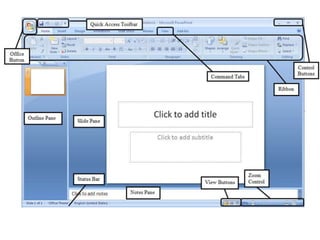
 The New PowerPoint Environment
 Creating a New Presentation
 Opening an Existing Presentation
 Creating a New Slide
 Choosing a Layout for a New Slide
 Adding Text to a Slide
 Deleting a Slide
 Selecting a Theme for your
Presentation
INSERTING OBJECTS INTO YOUR
PRESENTATIONS AND FORMAT OBJECTS
 Inserting Pictures into Your Presentation and
Format
 Inserting Clip Art into Your Presentation and
Format
 Inserting Shapes into your Presentation and Format
 Add text to a shape and Format
 Inserting Charts into your Presentation and Format
 Inserting music into your Presentation
 Inserting movies into your Presentation
 Add hyperlinks
APPLYING SIMPLE
ANIMATION TO YOUR
PRESENTATION
 Animate text
 Animate graphics
 Create slide transitions
 Advance slides
automatically

Introduction to powerpoint

  • 1.
  • 2.
    Sometimes abbreviated asPP, PowerPoint is a Microsoft software presentation program that allows a user to create a slide show of important notes that can be shown and moved through during a presentation.
  • 4.
    PowerPoint presentations consistof a number of individual pages or "slides". The presentation can be printed, displayed live on a computer, or navigated through at the command of the presenter. For larger audiences the computer display is often projected using a VIDEO PROJECTOR. Slides can also form the basis of WEBCASTS.
  • 5.
    POWERPOINT PROVIDES THREE TYPESOF MOVEMENTS:  Entrance, emphasis, and exit of elements on a slide itself are controlled by what PowerPoint calls Custom Animations.  Transitions, on the other hand, are movements between slides. These can be animated in a variety of ways.  Custom animation can be used to create small story boards by animating pictures to enter, exit or move.
  • 6.
    VERSIONS Versions for MICROSOFTWINDOWS include: 1990 PowerPoint 2.0 for Windows 3.0 1992 PowerPoint 3.0 for Windows 3.1 1993 PowerPoint 4.0 (Office 4.x) 1995 PowerPoint for Windows 95 (version 7.0; Office 95) 1997 PowerPoint 97 (version 8.0; Office 97) 1999 PowerPoint 2000 (version 9.0; Office 2000) 2001 PowerPoint 2002 (version 10; Office XP) 2003 Office PowerPoint 2003 (version 11; Office 2003) 2007 Office PowerPoint 2007 (version 12; Office 2007) 2010 PowerPoint 2010 (version 14; Office 2010) 2013 PowerPoint 2013 (version 15; Office 2013)
  • 7.
    Versions for theMac OS include: 1987 PowerPoint 1.0 for Mac OS classic 1988 PowerPoint 2.0 for Mac OS classic 1992 PowerPoint 3.0 for Mac OS classic 1994 PowerPoint 4.0 for Mac OS classic 1998 PowerPoint 98 (8.0) for Mac OS classic (Office 1998 for Mac) 2000 PowerPoint 2001 (9.0) for Mac OS classic (Office 2001 for Mac) 2002 PowerPoint v. X (10.0) for Mac OS X (Office:Mac v. X) 2004 PowerPoint 2004 (11.0) for Mac OS X Office: Mac 2004 2008 PowerPoint 2008 (12.0) for Mac OS X Microsoft Office 2008 for Mac 2010 PowerPoint 2011 (14.0) for Mac OS X Microsoft Office 2011 for Mac VERSIONS
  • 8.
    EXPLORING POWERPOINT 2007 Starting Up PowerPoint 2007  The New PowerPoint Environment  Creating a New Presentation  Opening an Existing Presentation  Creating a New Slide  Choosing a Layout for a New Slide  Adding Text to a Slide  Deleting a Slide  Selecting a Theme for your Presentation
  • 9.
    INSERTING OBJECTS INTOYOUR PRESENTATIONS AND FORMAT OBJECTS  Inserting Pictures into Your Presentation and Format  Inserting Clip Art into Your Presentation and Format  Inserting Shapes into your Presentation and Format  Add text to a shape and Format  Inserting Charts into your Presentation and Format  Inserting music into your Presentation  Inserting movies into your Presentation  Add hyperlinks
  • 10.
    APPLYING SIMPLE ANIMATION TOYOUR PRESENTATION  Animate text  Animate graphics  Create slide transitions  Advance slides automatically