Downloaded 23 times




![MOBILE PHASE
• The particle size of the stationary phase is
generally finer in flash column
chromatography than in gravity column
chromatography.
• For example, one of the most widely used
silica gel grades in the former technique is
mesh 230 – 400 (40 – 63 µm), while the latter
technique typically requires mesh 70 – 230
(63 – 200 µm) silica gel.[4]](https://image.slidesharecdn.com/snachromatographycolumnchromatography-160923131846/85/Sna-chromatography-column-chromatography-14-320.jpg)
![MOBILE PHASE
• A spreadsheet that assists in the successful
development of flash columns has been
developed.
• The spreadsheet estimates the retention volume
and band volume of analytes, the fraction
numbers expected to contain each analyte, and
the resolution between adjacent peaks.
• This information allows users to select optimal
parameters for preparative-scale separations
before the flash column itself is attempted.[5]](https://image.slidesharecdn.com/snachromatographycolumnchromatography-160923131846/85/Sna-chromatography-column-chromatography-15-320.jpg)
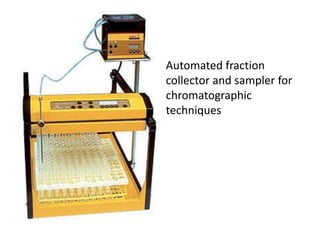
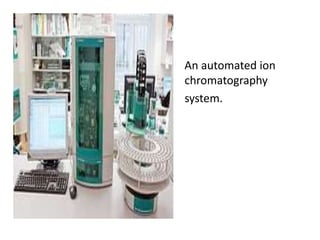
![Automated system
• The software controlling an automated system will coordinate the
components, allow a user to only collect the fractions that contain
their target compound (assuming they are detectable on the
system's detector) and help the user to find the resulting purified
material within the fraction collector. The software will also save
the resulting chromatograph from the process for archival and/or
later recall purposes.
• A representative example of column chromatography as part of an
undergraduate laboratory exercise is the separation of three
components (out of 28) in the oil
of spearmint: carvone, limonene and dehydrocarveol.[6] Amicroscal
e setup consisting of a Pasteur pipette as column with silica gel
stationary phase can suffice. The starting eluent is hexane and
solvent polarity is increased during the process by adding ethyl
acetate.](https://image.slidesharecdn.com/snachromatographycolumnchromatography-160923131846/85/Sna-chromatography-column-chromatography-21-320.jpg)
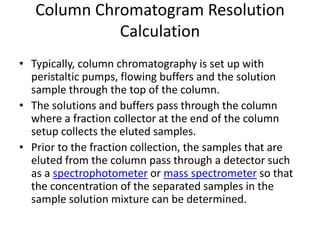
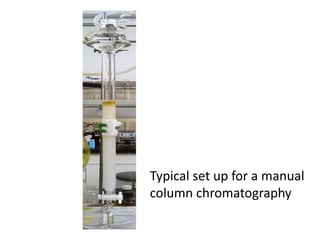
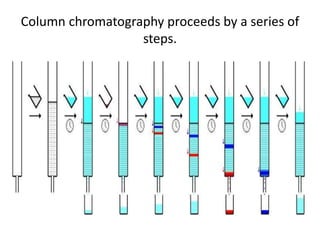
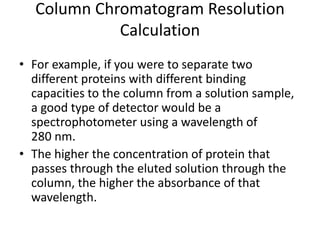
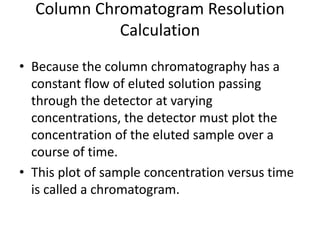
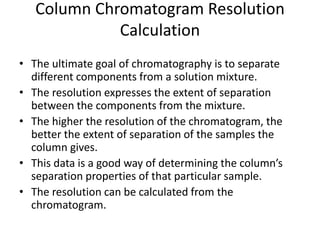
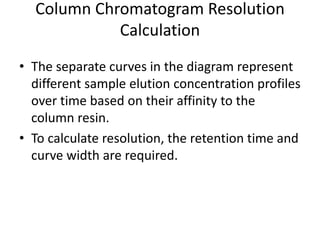
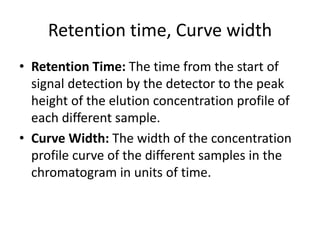
![Retention time, Curve width
• A simplified method of calculating chromatogram
resolution is to use the plate model.[7]
• The plate model assumes that the column can be
divided into a certain number of sections, or plates and
the mass balance can be calculated for each individual
plate.
• This approach approximates a typical chromatogram
curve as a Gaussian distribution curve.
• By doing this, the curve width is estimated as 4 times
the standard deviation of the curve, 4σ.
• The retention time is the time from the start of signal
detection to the time of the peak height of the
Gaussian curve.](https://image.slidesharecdn.com/snachromatographycolumnchromatography-160923131846/85/Sna-chromatography-column-chromatography-31-320.jpg)
![Resolution (Rs)
• Rs = 2(tRB – tRA)/(wB + wA)
where:
• tRB = retention time of solute B
tRA = retention time of solute A
wB = Gaussian curve width of solute B
wA = Gaussian curve width of solute A
Plate Number (N):
N = (tR)2/(w/4)2
Plate Height (H):
H = L/N
Where L is the length of the column.[7]](https://image.slidesharecdn.com/snachromatographycolumnchromatography-160923131846/85/Sna-chromatography-column-chromatography-33-320.jpg)
![Column Adsorption Equilibrium
• For an adsorption column, the column resin (the stationary phase)
is composed of microbeads. Even smaller particles such as proteins,
carbohydrates, metal ions, or other chemical compounds are
conjugated onto the microbeads. Each binding particle that is
attached to the microbead can be assumed to bind in a 1:1 ratio
with the solute sample sent through the column that needs to be
purified or separated.
• Binding between the target molecule to be separated and the
binding molecule on the column beads can be modeled using a
simple equilibrium reaction Keq = [CS]/([C][S]) where Keq is
the equilibrium constant, [C] and [S] are the concentrations of the
target molecule and the binding molecule on the column resin,
respectively. [CS] is the concentration of the complex of the target
molecule bound to the column resin.[7]](https://image.slidesharecdn.com/snachromatographycolumnchromatography-160923131846/85/Sna-chromatography-column-chromatography-34-320.jpg)
![Column Adsorption Equilibrium
• Using this as a basis, three different isotherms
can be used to describe the binding dynamics
of a column chromatography: linear, Langmuir,
and Freundlich.
• The linear isotherm occurs when the solute
concentration needed to be purified is very
small relative to the binding molecule. Thus,
the equilibrium can be defined as:
• [CS] = Keq[C].](https://image.slidesharecdn.com/snachromatographycolumnchromatography-160923131846/85/Sna-chromatography-column-chromatography-35-320.jpg)
![Column Adsorption Equilibrium
• For industrial scale uses, the total binding
molecules on the column resin beads must be
factored in because unoccupied sites must be
taken into account.
• The Langmuir isotherm and Freundlich isotherm
are useful in describing this equilibrium.
• Langmuir Isotherm:
[CS] = (KeqStot[C])/(1 + Keq[C]), where Stot is the
total binding molecules on the beads.](https://image.slidesharecdn.com/snachromatographycolumnchromatography-160923131846/85/Sna-chromatography-column-chromatography-36-320.jpg)


Column chromatography is a method used to separate chemical mixtures by using a column filled with a stationary phase and pumping a mobile phase through it. Key steps include preparing the column with a dry or wet method, loading the sample, and collecting fractions as compounds elute from the column at different rates depending on their interactions with the stationary phase. Resolution, a measure of separation, can be calculated from chromatograms by measuring retention times and curve widths. Automated systems now streamline column chromatography but typically have lower resolution than HPLC.


![Polymer [ बहुलक ] Chemistry Notes PDF - Irfanullah Mehar - JJ Sir Chemistry.pdf](https://cdn.slidesharecdn.com/ss_thumbnails/polymerchemistrynotespdf-irfanullahmehar-jjsirchemistry-260210172118-3f9b37f7-thumbnail.jpg?width=640&height=640&fit=bounds)


