1
What Is HPLC?
Basic Principles
What is HPLC?
•Fundamentally, chromatography is a technique used to
separate the components contained in a sample.
•Above all, high performance liquid chromatography (HPLC) is
a type of chromatography that, because of its wide
application range and quantitative accuracy, is regarded as an
indispensable analytical technique, particularly in the field of
organic chemistry. It is also widely used as a preparation
technique for the isolation and purification of target
components contained in mixtures.
2
3
Invention of Chromatography by M.
Tswett
Ether
CaCO3
Chlorophyll
Chromatography
Colors
Invention of Chromatography by M.
Tswett
4
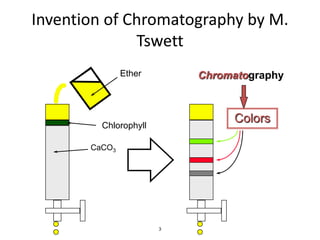
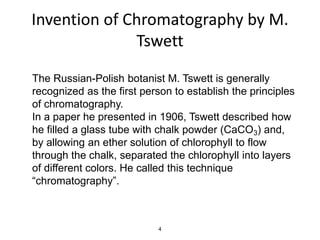
The Russian-Polish botanist M. Tswett is generally
recognized as the first person to establish the principles
of chromatography.
In a paper he presented in 1906, Tswett described how
he filled a glass tube with chalk powder (CaCO3) and,
by allowing an ether solution of chlorophyll to flow
through the chalk, separated the chlorophyll into layers
of different colors. He called this technique
“chromatography”.
5
Comparing Chromatography to the
Flow of a River...
Base
Water flow
Light leaf
Heavy stone
Comparing Chromatography to the
Flow of a River...
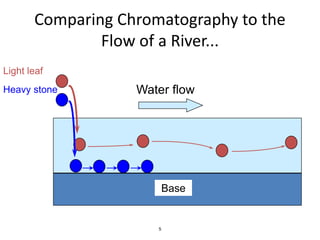
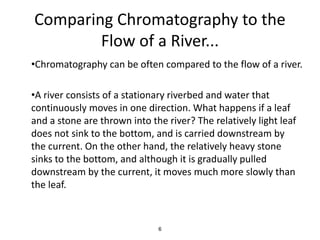
•Chromatography can be often compared to the flow of a river.
•A river consists of a stationary riverbed and water that
continuously moves in one direction. What happens if a leaf
and a stone are thrown into the river? The relatively light leaf
does not sink to the bottom, and is carried downstream by
the current. On the other hand, the relatively heavy stone
sinks to the bottom, and although it is gradually pulled
downstream by the current, it moves much more slowly than
the leaf.
6
Comparing Chromatography to the
Flow of a River...
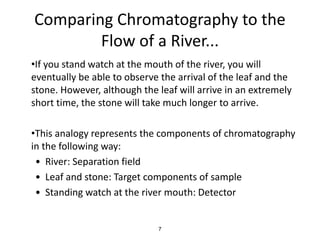
•If you stand watch at the mouth of the river, you will
eventually be able to observe the arrival of the leaf and the
stone. However, although the leaf will arrive in an extremely
short time, the stone will take much longer to arrive.
•This analogy represents the components of chromatography
in the following way:
• River: Separation field
• Leaf and stone: Target components of sample
• Standing watch at the river mouth: Detector
7
8
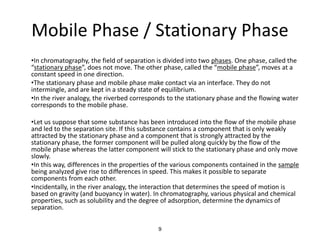
Mobile Phase / Stationary Phase
• A site in which a moving
phase (mobile phase) and a
non-moving phase (stationary
phase) make contact via an
interface that is set up.
• The affinity with the mobile
phase and stationary phase
varies with the solute. 
Separation occurs due to
differences in the speed of
motion.
Strong Weak
Mobile
phase
Stationary
phase
Mobile Phase / Stationary Phase
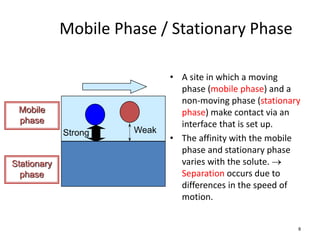
•In chromatography, the field of separation is divided into two phases. One phase, called the
“stationary phase”, does not move. The other phase, called the “mobile phase”, moves at a
constant speed in one direction.
•The stationary phase and mobile phase make contact via an interface. They do not
intermingle, and are kept in a steady state of equilibrium.
•In the river analogy, the riverbed corresponds to the stationary phase and the flowing water
corresponds to the mobile phase.
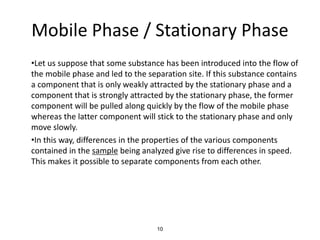
•Let us suppose that some substance has been introduced into the flow of the mobile phase
and led to the separation site. If this substance contains a component that is only weakly
attracted by the stationary phase and a component that is strongly attracted by the
stationary phase, the former component will be pulled along quickly by the flow of the
mobile phase whereas the latter component will stick to the stationary phase and only move
slowly.
•In this way, differences in the properties of the various components contained in the sample
being analyzed give rise to differences in speed. This makes it possible to separate
components from each other.
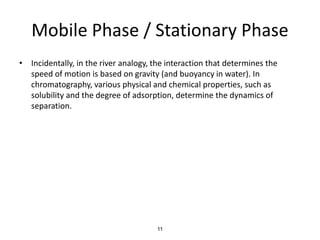
•Incidentally, in the river analogy, the interaction that determines the speed of motion is
based on gravity (and buoyancy in water). In chromatography, various physical and chemical
properties, such as solubility and the degree of adsorption, determine the dynamics of
separation.
9
Mobile Phase / Stationary Phase
•Let us suppose that some substance has been introduced into the flow of
the mobile phase and led to the separation site. If this substance contains
a component that is only weakly attracted by the stationary phase and a
component that is strongly attracted by the stationary phase, the former
component will be pulled along quickly by the flow of the mobile phase
whereas the latter component will stick to the stationary phase and only
move slowly.
•In this way, differences in the properties of the various components
contained in the sample being analyzed give rise to differences in speed.
This makes it possible to separate components from each other.
10
Mobile Phase / Stationary Phase
• Incidentally, in the river analogy, the interaction that determines the
speed of motion is based on gravity (and buoyancy in water). In
chromatography, various physical and chemical properties, such as
solubility and the degree of adsorption, determine the dynamics of
separation.
11
12
Chromato-graphy / -graph / -gram / -
grapher
• Chromatography: Analytical technique
• Chromatograph: Instrument
• Chromatogram: Obtained “picture”
• Chromatographer: Person
Chromato-graphy / -graph / -gram / -
grapher
•There are many similar terms in this field and so let us clarify some of
them.
•“Chromatography” is the name of the analytical technique itself.
•A “chromatograph” is an analytical instrument that is used to perform
chromatography. The product names of the chromatographs given in the
catalogs of analytical instrument manufacturers should all include this
word.
•A “chromatogram” is produced by recording the results obtained with
chromatography on recording paper (or some other medium).
•A “chromatographer” is a person who carries out a chromatography
experiment.
13
14
Three States of Matter and
Chromatography Types
Mobile phase
Gas Liquid Solid
Stationary
phase
Gas
Liquid
Solid
Gas
chromatography
Liquid
chromatography
Three States of Matter and
Chromatography Types
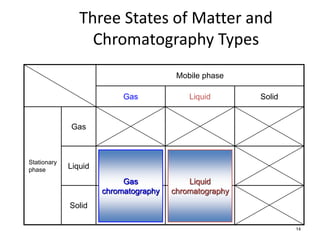
•There are various ways of categorizing chromatography. Here, let us
categorize it in terms of the three states of matter.
•There are generally three states of matter: gas, liquid, and solid. If we
could use stationary phases and mobile phases of any state, this would
give a total of nine different types of chromatography. Using a gas as the
stationary phase or a solid as the mobile phase, however, is not practical
(even if it is possible) and this restricts the combinations that can be used.
•Chromatography performed using a gas as the mobile phase and a liquid
or a solid as the stationary phase is called “gas chromatography” (GC).
Chromatography performed using a liquid as the mobile phase and a liquid
or a solid as the stationary phase is called “liquid chromatography” (LC).
Both of these techniques are indispensable, particularly in the field of
organic chemistry.
15
Three States of Matter and
Chromatography Types
• In addition to these, there is a technique called “supercritical fluid
chromatography” (SFC), in which a supercritical fluid kept at a high
temperature and high pressure is used as the mobile phase.
16
17
Liquid Chromatography
• Chromatography in which the mobile phase is a
liquid.
– The liquid used as the mobile phase is called the
“eluent”.
• The stationary phase is usually a solid or a liquid.
• In general, it is possible to analyze any substance
that can be stably dissolved in the mobile phase.
Liquid Chromatography
• “Liquid chromatography” (LC) is chromatography in which the mobile
phase is a liquid.
• Stationary Phase
– Usually a solid or a liquid is used as the mobile phase. (This includes
the case where a substance regarded as a liquid is chemically bonded,
or applied, to the surface of a solid.)
– The most common form of stationary phase consists of fine particles
of, for example, silica gel or resin packed into a cylindrical tube. These
packed particles are called “packing material” or “packing” and the
separation tube into which they are packed is called the “separation
column” or simply the “column”. In day-to-day analysis work, “column”
is sometimes used to refer to the stationary phase and “stationary
phase” is sometimes used to refer to the column.
18
Liquid Chromatography
• Mobile Phase
• Various solvents are used as mobile phases. The mobile phase conveys the
components of the dissolved sample through the separation field, and
facilitates the repeated three-way interactions that take place between
the phases and the sample, thereby leading to separation.
• The solvent used for the mobile phase is called the “eluent” or “eluant”.
(In LC, the term “mobile phase” is also used to refer to this solvent. In this
text, however, we shall use the term “eluent”.)
19
Liquid Chromatography
• Sample
• In general, it is possible to analyze any substance that can be stably
dissolved in the eluent. This is one advantage that LC has over GC, which
cannot be used to analyze substances that do not vaporize or that are
thermally decomposed easily.
• The sample is generally converted to liquid form before being introduced
to the system. It contains various solutes. The target substances (the
analytes) are separated and detected.
20
21
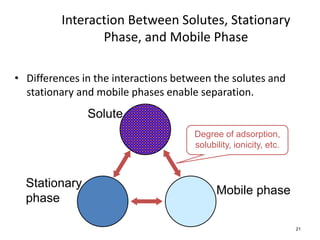
Interaction Between Solutes, Stationary
Phase, and Mobile Phase
• Differences in the interactions between the solutes and
stationary and mobile phases enable separation.
Solute
Stationary
phase
Mobile phase
Degree of adsorption,
solubility, ionicity, etc.
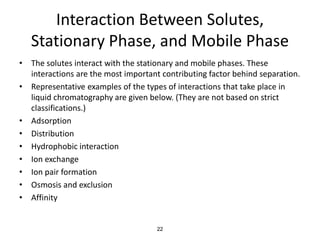
Interaction Between Solutes,
Stationary Phase, and Mobile Phase
• The solutes interact with the stationary and mobile phases. These
interactions are the most important contributing factor behind separation.
• Representative examples of the types of interactions that take place in
liquid chromatography are given below. (They are not based on strict
classifications.)
• Adsorption
• Distribution
• Hydrophobic interaction
• Ion exchange
• Ion pair formation
• Osmosis and exclusion
• Affinity
22
23
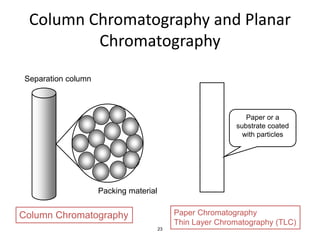
Column Chromatography and Planar
Chromatography
Separation column
Packing material
Column Chromatography
Paper or a
substrate coated
with particles
Paper Chromatography
Thin Layer Chromatography (TLC)
Column Chromatography and Planar
Chromatography
• Liquid chromatography can be categorized by shape of separation field
into column-shaped and planar types.
• A representative type of chromatography that uses a column-shaped field
is “column chromatography”, which is performed using a separation
column consisting of a cylindrical tube filled with packing material.
Another type is “capillary chromatography”, which is performed using a
narrow hollow tube. Unlike column chromatography, however, capillary
chromatography has yet to attain general acceptance. (In the field of GC,
however, capillary chromatography is a commonly used technique.)
• Types of chromatography that use a planar (or plate layer) field include
“thin layer chromatography”, in which the stationary phase consists of a
substrate of glass or some other material to which minute particles are
applied, and “paper chromatography”, in which the stationary phase
consists of cellulose filter paper.
24
25
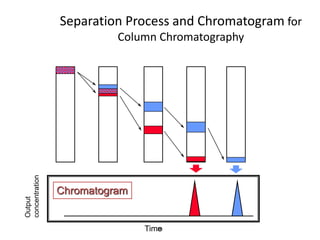
Separation Process and Chromatogram for
Column Chromatography
Output
concentration
Time
Chromatogram
Separation Process and Chromatogram
for Column Chromatography
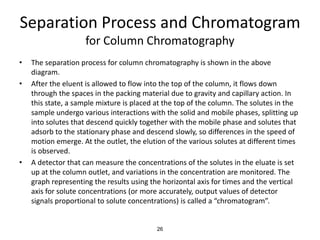
• The separation process for column chromatography is shown in the above
diagram.
• After the eluent is allowed to flow into the top of the column, it flows down
through the spaces in the packing material due to gravity and capillary action. In
this state, a sample mixture is placed at the top of the column. The solutes in the
sample undergo various interactions with the solid and mobile phases, splitting up
into solutes that descend quickly together with the mobile phase and solutes that
adsorb to the stationary phase and descend slowly, so differences in the speed of
motion emerge. At the outlet, the elution of the various solutes at different times
is observed.
• A detector that can measure the concentrations of the solutes in the eluate is set
up at the column outlet, and variations in the concentration are monitored. The
graph representing the results using the horizontal axis for times and the vertical
axis for solute concentrations (or more accurately, output values of detector
signals proportional to solute concentrations) is called a “chromatogram”.
26
27
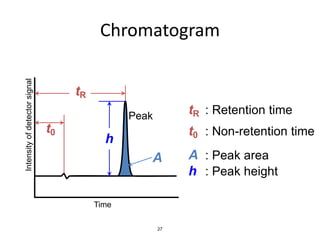
Chromatogram
tR
t0
Intensityofdetectorsignal
Time
Peak
tR : Retention time
h
A
t0 : Non-retention time
A : Peak area
h : Peak height
Chromatogram
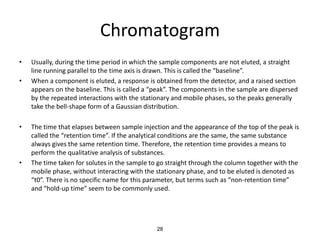
• Usually, during the time period in which the sample components are not eluted, a straight
line running parallel to the time axis is drawn. This is called the “baseline”.
• When a component is eluted, a response is obtained from the detector, and a raised section
appears on the baseline. This is called a “peak”. The components in the sample are dispersed
by the repeated interactions with the stationary and mobile phases, so the peaks generally
take the bell-shape form of a Gaussian distribution.
• The time that elapses between sample injection and the appearance of the top of the peak is
called the “retention time”. If the analytical conditions are the same, the same substance
always gives the same retention time. Therefore, the retention time provides a means to
perform the qualitative analysis of substances.
• The time taken for solutes in the sample to go straight through the column together with the
mobile phase, without interacting with the stationary phase, and to be eluted is denoted as
“t0”. There is no specific name for this parameter, but terms such as “non-retention time”
and “hold-up time” seem to be commonly used.
28
Chromatogram
• Because the eluent usually passes through the column at a constant flow rate, tR
and t0 are sometimes multiplied by the eluent flow rate and handled as volumes.
The volume corresponding to the retention time is called the “retention volume”
and is notated as VR.
• The length of a straight line drawn from the top of a peak down to the baseline is
called the “peak height”, and the area of the raised section above the baseline is
called the “peak area”.
• If the intensities of the detector signals are proportional to the concentrations or
absolute quantities of the peak components, then the peak areas and heights are
proportional to the concentrations of the peak components. Therefore, the peak
areas and heights provide a means to perform the quantitative analysis of sample
components. It is generally said that using the peak areas gives greater accuracy.
29
30
From Liquid Chromatography to High Performance
Liquid Chromatography
• Higher degree of separation!
 Refinement of packing material (3 to 10 µm)
• Reduction of analysis time!
 Delivery of eluent by pump
 Demand for special equipment that can
withstand high pressures
The arrival of high performance liquid chromatography!
From Liquid Chromatography to High
Performance Liquid Chromatography
• In order to increase the separation capability of column chromatography,
in addition to increasing the surface area of the stationary phase so that
the interaction efficiency is increased, it is also necessary to homogenize
the separation field as much as possible so that dispersion in the mobile
and stationary phases is minimized. The most effective way of achieving
this is to refine the packing material.
• Refining the packing material, however, causes resistance to the delivery
of the eluent to increase. This is similar to the way that water drains easily
through sand, which has relatively large particles, whereas it does not
drain easily through clay-rich soil, which has relatively fine particles.
• Depending on gravity and capillary action would cause analysis to take a
very long time to be completed, and the idea of delivering the eluent
forcibly using a high-pressure pump was proposed. This was the start of
high performance liquid chromatography.
31
From Liquid Chromatography to High
Performance Liquid Chromatography
• Depending on gravity and capillary action would cause analysis to take a
very long time to be completed, and the idea of delivering the eluent
forcibly using a high-pressure pump was proposed. This was the start of
high performance liquid chromatography.
32
33
Pump
Sample injection unit
(injector)
Column
Column oven
(thermostatic
column chamber)
Detector
Eluent
(mobile phase)
Drain
Data processor
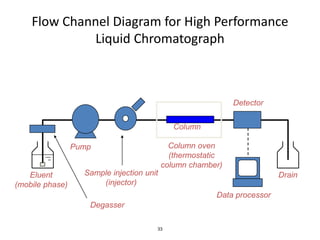
Degasser
Flow Channel Diagram for High Performance
Liquid Chromatograph
Flow Channel Diagram for High
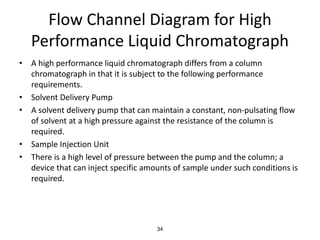
Performance Liquid Chromatograph
• A high performance liquid chromatograph differs from a column
chromatograph in that it is subject to the following performance
requirements.
• Solvent Delivery Pump
• A solvent delivery pump that can maintain a constant, non-pulsating flow
of solvent at a high pressure against the resistance of the column is
required.
• Sample Injection Unit
• There is a high level of pressure between the pump and the column; a
device that can inject specific amounts of sample under such conditions is
required.
34
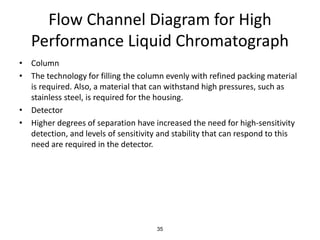
Flow Channel Diagram for High
Performance Liquid Chromatograph
• Column
• The technology for filling the column evenly with refined packing material
is required. Also, a material that can withstand high pressures, such as
stainless steel, is required for the housing.
• Detector
• Higher degrees of separation have increased the need for high-sensitivity
detection, and levels of sensitivity and stability that can respond to this
need are required in the detector.
35
36
Advantages of High Performance
Liquid Chromatography
• High separation capacity, enabling the batch analysis
of multiple components
• Superior quantitative capability and reproducibility
• Moderate analytical conditions
– Unlike GC, the sample does not need to be vaporized.
• Generally high sensitivity
• Low sample consumption
• Easy preparative separation and purification of
samples
Advantages of High Performance
Liquid Chromatography
• HPLC is a type of separation analysis, and this is the most important aspect
of this analytical technique. Even if the sample consists of a mixture, it
allows the target components to be separated, detected, and quantified. It
also allows simultaneous analysis of multiple components.
• It could be said that HPLC is more suited to quantitative analysis than it is
to qualitative analysis. Under the appropriate conditions, it is possible to
attain a high level of reproducibility with a coefficient of variation not
exceeding 1%.
37
Advantages of High Performance
Liquid Chromatography
• One advantage that HPLC has over GC is that, in general, analysis is
possible for any sample that can be stably dissolved in the eluent. With
GC, gas is used as the mobile phase, so substances that are difficult to
vaporize or that decompose easily when heated cannot be analyzed. For
this reason, particularly in the fields of pharmaceutical science and
biochemistry, HPLC is used much more frequently than GC.
• The level of sensitivity that can be attained varies with the detector, but
detection down to the µg and pg levels is usually possible and, in some
cases, even smaller quantities can be detected.
38
Advantages of High Performance
Liquid Chromatography
• The level of sensitivity that can be attained varies with the detector, but
detection down to the µg and pg levels is usually possible and, in some
cases, even smaller quantities can be detected.
• The amount of sample used is very small, and is usually in the range of 1
to 100 µL.
• The components contained in the sample are eluted from the column
separately. So, if a non-destructive detector is used, the preparative
separation and purification of specific components is possible. In fact,
liquid chromatographs specially designed for preparative separation are
commercially available.
39
40
Fields in Which High Performance
Liquid Chromatography Is Used
• Biogenic substances
– Sugars, lipids, nucleic acids,
amino acids, proteins,
peptides, steroids, amines, etc.
• Medical products
– Drugs, antibiotics, etc.
• Food products
– Vitamins, food additives,
sugars, organic acids, amino
acids, etc.
• Environmental samples
– Inorganic ions
– Hazardous organic substances,
etc.
• Organic industrial
products
– Synthetic polymers, additives,
surfactants, etc.
Fields in Which High Performance
Liquid Chromatography Is Used
• HPLC is currently being used in a broad range of fields. In particular, in the
field of biochemistry, it is widely used as an indispensable analytical
technique.
• From the perspective of an analytical instrument manufacturer, we
observe that the industry that purchases the highest number of high
performance liquid chromatographs is the pharmaceutical industry. It is
said that the number of deliveries for this industry accounts for about 40%
of the total. Although the number of deliveries to quality control
departments is particularly high, it is also quite high for drug discovery and
R&D departments.
41

Sna hplc

  • 1.
  • 2.
    What is HPLC? •Fundamentally,chromatography is a technique used to separate the components contained in a sample. •Above all, high performance liquid chromatography (HPLC) is a type of chromatography that, because of its wide application range and quantitative accuracy, is regarded as an indispensable analytical technique, particularly in the field of organic chemistry. It is also widely used as a preparation technique for the isolation and purification of target components contained in mixtures. 2
  • 3.
    3 Invention of Chromatographyby M. Tswett Ether CaCO3 Chlorophyll Chromatography Colors
  • 4.
    Invention of Chromatographyby M. Tswett 4 The Russian-Polish botanist M. Tswett is generally recognized as the first person to establish the principles of chromatography. In a paper he presented in 1906, Tswett described how he filled a glass tube with chalk powder (CaCO3) and, by allowing an ether solution of chlorophyll to flow through the chalk, separated the chlorophyll into layers of different colors. He called this technique “chromatography”.
  • 5.
    5 Comparing Chromatography tothe Flow of a River... Base Water flow Light leaf Heavy stone
  • 6.
    Comparing Chromatography tothe Flow of a River... •Chromatography can be often compared to the flow of a river. •A river consists of a stationary riverbed and water that continuously moves in one direction. What happens if a leaf and a stone are thrown into the river? The relatively light leaf does not sink to the bottom, and is carried downstream by the current. On the other hand, the relatively heavy stone sinks to the bottom, and although it is gradually pulled downstream by the current, it moves much more slowly than the leaf. 6
  • 7.
    Comparing Chromatography tothe Flow of a River... •If you stand watch at the mouth of the river, you will eventually be able to observe the arrival of the leaf and the stone. However, although the leaf will arrive in an extremely short time, the stone will take much longer to arrive. •This analogy represents the components of chromatography in the following way: • River: Separation field • Leaf and stone: Target components of sample • Standing watch at the river mouth: Detector 7
  • 8.
    8 Mobile Phase /Stationary Phase • A site in which a moving phase (mobile phase) and a non-moving phase (stationary phase) make contact via an interface that is set up. • The affinity with the mobile phase and stationary phase varies with the solute.  Separation occurs due to differences in the speed of motion. Strong Weak Mobile phase Stationary phase
  • 9.
    Mobile Phase /Stationary Phase •In chromatography, the field of separation is divided into two phases. One phase, called the “stationary phase”, does not move. The other phase, called the “mobile phase”, moves at a constant speed in one direction. •The stationary phase and mobile phase make contact via an interface. They do not intermingle, and are kept in a steady state of equilibrium. •In the river analogy, the riverbed corresponds to the stationary phase and the flowing water corresponds to the mobile phase. •Let us suppose that some substance has been introduced into the flow of the mobile phase and led to the separation site. If this substance contains a component that is only weakly attracted by the stationary phase and a component that is strongly attracted by the stationary phase, the former component will be pulled along quickly by the flow of the mobile phase whereas the latter component will stick to the stationary phase and only move slowly. •In this way, differences in the properties of the various components contained in the sample being analyzed give rise to differences in speed. This makes it possible to separate components from each other. •Incidentally, in the river analogy, the interaction that determines the speed of motion is based on gravity (and buoyancy in water). In chromatography, various physical and chemical properties, such as solubility and the degree of adsorption, determine the dynamics of separation. 9
  • 10.
    Mobile Phase /Stationary Phase •Let us suppose that some substance has been introduced into the flow of the mobile phase and led to the separation site. If this substance contains a component that is only weakly attracted by the stationary phase and a component that is strongly attracted by the stationary phase, the former component will be pulled along quickly by the flow of the mobile phase whereas the latter component will stick to the stationary phase and only move slowly. •In this way, differences in the properties of the various components contained in the sample being analyzed give rise to differences in speed. This makes it possible to separate components from each other. 10
  • 11.
    Mobile Phase /Stationary Phase • Incidentally, in the river analogy, the interaction that determines the speed of motion is based on gravity (and buoyancy in water). In chromatography, various physical and chemical properties, such as solubility and the degree of adsorption, determine the dynamics of separation. 11
  • 12.
    12 Chromato-graphy / -graph/ -gram / - grapher • Chromatography: Analytical technique • Chromatograph: Instrument • Chromatogram: Obtained “picture” • Chromatographer: Person
  • 13.
    Chromato-graphy / -graph/ -gram / - grapher •There are many similar terms in this field and so let us clarify some of them. •“Chromatography” is the name of the analytical technique itself. •A “chromatograph” is an analytical instrument that is used to perform chromatography. The product names of the chromatographs given in the catalogs of analytical instrument manufacturers should all include this word. •A “chromatogram” is produced by recording the results obtained with chromatography on recording paper (or some other medium). •A “chromatographer” is a person who carries out a chromatography experiment. 13
  • 14.
    14 Three States ofMatter and Chromatography Types Mobile phase Gas Liquid Solid Stationary phase Gas Liquid Solid Gas chromatography Liquid chromatography
  • 15.
    Three States ofMatter and Chromatography Types •There are various ways of categorizing chromatography. Here, let us categorize it in terms of the three states of matter. •There are generally three states of matter: gas, liquid, and solid. If we could use stationary phases and mobile phases of any state, this would give a total of nine different types of chromatography. Using a gas as the stationary phase or a solid as the mobile phase, however, is not practical (even if it is possible) and this restricts the combinations that can be used. •Chromatography performed using a gas as the mobile phase and a liquid or a solid as the stationary phase is called “gas chromatography” (GC). Chromatography performed using a liquid as the mobile phase and a liquid or a solid as the stationary phase is called “liquid chromatography” (LC). Both of these techniques are indispensable, particularly in the field of organic chemistry. 15
  • 16.
    Three States ofMatter and Chromatography Types • In addition to these, there is a technique called “supercritical fluid chromatography” (SFC), in which a supercritical fluid kept at a high temperature and high pressure is used as the mobile phase. 16
  • 17.
    17 Liquid Chromatography • Chromatographyin which the mobile phase is a liquid. – The liquid used as the mobile phase is called the “eluent”. • The stationary phase is usually a solid or a liquid. • In general, it is possible to analyze any substance that can be stably dissolved in the mobile phase.
  • 18.
    Liquid Chromatography • “Liquidchromatography” (LC) is chromatography in which the mobile phase is a liquid. • Stationary Phase – Usually a solid or a liquid is used as the mobile phase. (This includes the case where a substance regarded as a liquid is chemically bonded, or applied, to the surface of a solid.) – The most common form of stationary phase consists of fine particles of, for example, silica gel or resin packed into a cylindrical tube. These packed particles are called “packing material” or “packing” and the separation tube into which they are packed is called the “separation column” or simply the “column”. In day-to-day analysis work, “column” is sometimes used to refer to the stationary phase and “stationary phase” is sometimes used to refer to the column. 18
  • 19.
    Liquid Chromatography • MobilePhase • Various solvents are used as mobile phases. The mobile phase conveys the components of the dissolved sample through the separation field, and facilitates the repeated three-way interactions that take place between the phases and the sample, thereby leading to separation. • The solvent used for the mobile phase is called the “eluent” or “eluant”. (In LC, the term “mobile phase” is also used to refer to this solvent. In this text, however, we shall use the term “eluent”.) 19
  • 20.
    Liquid Chromatography • Sample •In general, it is possible to analyze any substance that can be stably dissolved in the eluent. This is one advantage that LC has over GC, which cannot be used to analyze substances that do not vaporize or that are thermally decomposed easily. • The sample is generally converted to liquid form before being introduced to the system. It contains various solutes. The target substances (the analytes) are separated and detected. 20
  • 21.
    21 Interaction Between Solutes,Stationary Phase, and Mobile Phase • Differences in the interactions between the solutes and stationary and mobile phases enable separation. Solute Stationary phase Mobile phase Degree of adsorption, solubility, ionicity, etc.
  • 22.
    Interaction Between Solutes, StationaryPhase, and Mobile Phase • The solutes interact with the stationary and mobile phases. These interactions are the most important contributing factor behind separation. • Representative examples of the types of interactions that take place in liquid chromatography are given below. (They are not based on strict classifications.) • Adsorption • Distribution • Hydrophobic interaction • Ion exchange • Ion pair formation • Osmosis and exclusion • Affinity 22
  • 23.
    23 Column Chromatography andPlanar Chromatography Separation column Packing material Column Chromatography Paper or a substrate coated with particles Paper Chromatography Thin Layer Chromatography (TLC)
  • 24.
    Column Chromatography andPlanar Chromatography • Liquid chromatography can be categorized by shape of separation field into column-shaped and planar types. • A representative type of chromatography that uses a column-shaped field is “column chromatography”, which is performed using a separation column consisting of a cylindrical tube filled with packing material. Another type is “capillary chromatography”, which is performed using a narrow hollow tube. Unlike column chromatography, however, capillary chromatography has yet to attain general acceptance. (In the field of GC, however, capillary chromatography is a commonly used technique.) • Types of chromatography that use a planar (or plate layer) field include “thin layer chromatography”, in which the stationary phase consists of a substrate of glass or some other material to which minute particles are applied, and “paper chromatography”, in which the stationary phase consists of cellulose filter paper. 24
  • 25.
    25 Separation Process andChromatogram for Column Chromatography Output concentration Time Chromatogram
  • 26.
    Separation Process andChromatogram for Column Chromatography • The separation process for column chromatography is shown in the above diagram. • After the eluent is allowed to flow into the top of the column, it flows down through the spaces in the packing material due to gravity and capillary action. In this state, a sample mixture is placed at the top of the column. The solutes in the sample undergo various interactions with the solid and mobile phases, splitting up into solutes that descend quickly together with the mobile phase and solutes that adsorb to the stationary phase and descend slowly, so differences in the speed of motion emerge. At the outlet, the elution of the various solutes at different times is observed. • A detector that can measure the concentrations of the solutes in the eluate is set up at the column outlet, and variations in the concentration are monitored. The graph representing the results using the horizontal axis for times and the vertical axis for solute concentrations (or more accurately, output values of detector signals proportional to solute concentrations) is called a “chromatogram”. 26
  • 27.
    27 Chromatogram tR t0 Intensityofdetectorsignal Time Peak tR : Retentiontime h A t0 : Non-retention time A : Peak area h : Peak height
  • 28.
    Chromatogram • Usually, duringthe time period in which the sample components are not eluted, a straight line running parallel to the time axis is drawn. This is called the “baseline”. • When a component is eluted, a response is obtained from the detector, and a raised section appears on the baseline. This is called a “peak”. The components in the sample are dispersed by the repeated interactions with the stationary and mobile phases, so the peaks generally take the bell-shape form of a Gaussian distribution. • The time that elapses between sample injection and the appearance of the top of the peak is called the “retention time”. If the analytical conditions are the same, the same substance always gives the same retention time. Therefore, the retention time provides a means to perform the qualitative analysis of substances. • The time taken for solutes in the sample to go straight through the column together with the mobile phase, without interacting with the stationary phase, and to be eluted is denoted as “t0”. There is no specific name for this parameter, but terms such as “non-retention time” and “hold-up time” seem to be commonly used. 28
  • 29.
    Chromatogram • Because theeluent usually passes through the column at a constant flow rate, tR and t0 are sometimes multiplied by the eluent flow rate and handled as volumes. The volume corresponding to the retention time is called the “retention volume” and is notated as VR. • The length of a straight line drawn from the top of a peak down to the baseline is called the “peak height”, and the area of the raised section above the baseline is called the “peak area”. • If the intensities of the detector signals are proportional to the concentrations or absolute quantities of the peak components, then the peak areas and heights are proportional to the concentrations of the peak components. Therefore, the peak areas and heights provide a means to perform the quantitative analysis of sample components. It is generally said that using the peak areas gives greater accuracy. 29
  • 30.
    30 From Liquid Chromatographyto High Performance Liquid Chromatography • Higher degree of separation!  Refinement of packing material (3 to 10 µm) • Reduction of analysis time!  Delivery of eluent by pump  Demand for special equipment that can withstand high pressures The arrival of high performance liquid chromatography!
  • 31.
    From Liquid Chromatographyto High Performance Liquid Chromatography • In order to increase the separation capability of column chromatography, in addition to increasing the surface area of the stationary phase so that the interaction efficiency is increased, it is also necessary to homogenize the separation field as much as possible so that dispersion in the mobile and stationary phases is minimized. The most effective way of achieving this is to refine the packing material. • Refining the packing material, however, causes resistance to the delivery of the eluent to increase. This is similar to the way that water drains easily through sand, which has relatively large particles, whereas it does not drain easily through clay-rich soil, which has relatively fine particles. • Depending on gravity and capillary action would cause analysis to take a very long time to be completed, and the idea of delivering the eluent forcibly using a high-pressure pump was proposed. This was the start of high performance liquid chromatography. 31
  • 32.
    From Liquid Chromatographyto High Performance Liquid Chromatography • Depending on gravity and capillary action would cause analysis to take a very long time to be completed, and the idea of delivering the eluent forcibly using a high-pressure pump was proposed. This was the start of high performance liquid chromatography. 32
  • 33.
    33 Pump Sample injection unit (injector) Column Columnoven (thermostatic column chamber) Detector Eluent (mobile phase) Drain Data processor Degasser Flow Channel Diagram for High Performance Liquid Chromatograph
  • 34.
    Flow Channel Diagramfor High Performance Liquid Chromatograph • A high performance liquid chromatograph differs from a column chromatograph in that it is subject to the following performance requirements. • Solvent Delivery Pump • A solvent delivery pump that can maintain a constant, non-pulsating flow of solvent at a high pressure against the resistance of the column is required. • Sample Injection Unit • There is a high level of pressure between the pump and the column; a device that can inject specific amounts of sample under such conditions is required. 34
  • 35.
    Flow Channel Diagramfor High Performance Liquid Chromatograph • Column • The technology for filling the column evenly with refined packing material is required. Also, a material that can withstand high pressures, such as stainless steel, is required for the housing. • Detector • Higher degrees of separation have increased the need for high-sensitivity detection, and levels of sensitivity and stability that can respond to this need are required in the detector. 35
  • 36.
    36 Advantages of HighPerformance Liquid Chromatography • High separation capacity, enabling the batch analysis of multiple components • Superior quantitative capability and reproducibility • Moderate analytical conditions – Unlike GC, the sample does not need to be vaporized. • Generally high sensitivity • Low sample consumption • Easy preparative separation and purification of samples
  • 37.
    Advantages of HighPerformance Liquid Chromatography • HPLC is a type of separation analysis, and this is the most important aspect of this analytical technique. Even if the sample consists of a mixture, it allows the target components to be separated, detected, and quantified. It also allows simultaneous analysis of multiple components. • It could be said that HPLC is more suited to quantitative analysis than it is to qualitative analysis. Under the appropriate conditions, it is possible to attain a high level of reproducibility with a coefficient of variation not exceeding 1%. 37
  • 38.
    Advantages of HighPerformance Liquid Chromatography • One advantage that HPLC has over GC is that, in general, analysis is possible for any sample that can be stably dissolved in the eluent. With GC, gas is used as the mobile phase, so substances that are difficult to vaporize or that decompose easily when heated cannot be analyzed. For this reason, particularly in the fields of pharmaceutical science and biochemistry, HPLC is used much more frequently than GC. • The level of sensitivity that can be attained varies with the detector, but detection down to the µg and pg levels is usually possible and, in some cases, even smaller quantities can be detected. 38
  • 39.
    Advantages of HighPerformance Liquid Chromatography • The level of sensitivity that can be attained varies with the detector, but detection down to the µg and pg levels is usually possible and, in some cases, even smaller quantities can be detected. • The amount of sample used is very small, and is usually in the range of 1 to 100 µL. • The components contained in the sample are eluted from the column separately. So, if a non-destructive detector is used, the preparative separation and purification of specific components is possible. In fact, liquid chromatographs specially designed for preparative separation are commercially available. 39
  • 40.
    40 Fields in WhichHigh Performance Liquid Chromatography Is Used • Biogenic substances – Sugars, lipids, nucleic acids, amino acids, proteins, peptides, steroids, amines, etc. • Medical products – Drugs, antibiotics, etc. • Food products – Vitamins, food additives, sugars, organic acids, amino acids, etc. • Environmental samples – Inorganic ions – Hazardous organic substances, etc. • Organic industrial products – Synthetic polymers, additives, surfactants, etc.
  • 41.
    Fields in WhichHigh Performance Liquid Chromatography Is Used • HPLC is currently being used in a broad range of fields. In particular, in the field of biochemistry, it is widely used as an indispensable analytical technique. • From the perspective of an analytical instrument manufacturer, we observe that the industry that purchases the highest number of high performance liquid chromatographs is the pharmaceutical industry. It is said that the number of deliveries for this industry accounts for about 40% of the total. Although the number of deliveries to quality control departments is particularly high, it is also quite high for drug discovery and R&D departments. 41