1 
Excel Lesson 1 
Microsoft Excel Basics 
Microsoft Office 2010 
Introductory 
Pasewark & Pasewark
Excel Lesson 1 
Objectives 
 Define the terms spreadsheet and 
worksheet. 
 Identify the parts of a worksheet. 
 Start Excel, open an existing workbook, and 
save a workbook. 
 Move the active cell in a worksheet. 
2 Pasewark & Pasewark Microsoft Office 2010 Introductory
Excel Lesson 1 
Objectives (continued) 
 Select cells and enter data in a worksheet. 
 Edit and replace data in cells. 
 Zoom, preview, and print a worksheet. 
 Close a workbook and exit Excel. 
3 Pasewark & Pasewark Microsoft Office 2010 Introductory
Excel Lesson 1 
Vocabulary 
 active cell 
 active worksheet 
 adjacent range 
 cell 
 cell reference 
 column 
 formula 
 Formula Bar 
 landscape orientation 
 Microsoft Excel 2010 
(Excel) 
 Name Box 
 nonadjacent range 
 portrait orientation 
4 Pasewark & Pasewark Microsoft Office 2010 Introductory
Excel Lesson 1 
Vocabulary (continued) 
 range 
 range reference 
 row 
 sheet tab 
 spreadsheet 
 workbook 
 worksheet 
5 Pasewark & Pasewark Microsoft Office 2010 Introductory
Excel Lesson 1 
Introduction to Spreadsheets 
 Microsoft Excel 2010 is the spreadsheet 
program in Microsoft Office 2010. 
 A spreadsheet is a grid of rows and columns 
in which you enter text, numbers, and the 
results of calculations. 
 In Excel, a computerized spreadsheet is 
called a worksheet. The file used to store 
worksheets is called a workbook. 
Pasewark & Pasewark Microsoft Office 2010 Introductory 
6
Excel Lesson 1 
Starting Excel 
 You start Excel from the Start menu in 
Windows. Click the Start button, click All 
Programs, click Microsoft Office, and then 
click Microsoft Excel 2010. 
 The Excel program window has the same 
basic parts as all Office programs: the title 
bar, the Quick Access Toolbar, the Ribbon, 
Backstage view, and the status bar. 
7 Pasewark & Pasewark Microsoft Office 2010 Introductory
Excel Lesson 1 
Starting Excel (continued) 
 Excel program window 
Pasewark & Pasewark Microsoft Office 2010 Introductory 
8
Excel Lesson 1 
Exploring the Parts of the 
Workbook 
 Each workbook contains three worksheets by 
default. The worksheet displayed in the work 
area is the active worksheet. 
 Columns appear vertically and are identified 
by letters. Rows appear horizontally and are 
identified by numbers. 
 A cell is the intersection of a row and a 
column. Each cell is identified by a unique 
cell reference. 
9 
Pasewark & Pasewark Microsoft Office 2010 Introductory
Excel Lesson 1 
Exploring the Parts of the 
Workbook (continued) 
 The cell in the worksheet in which you can type 
data is called the active cell. 
 The Name Box, or cell reference area, displays 
the cell reference of the active cell. 
 The Formula Bar displays a formula when a 
worksheet cell contains a calculated value. 
 A formula is an equation that calculates a new 
value from values currently in a worksheet. 
10 
Pasewark & Pasewark Microsoft Office 2010 Introductory
Excel Lesson 1 
Opening an Existing Workbook 
 Opening a workbook means loading an 
existing workbook file from a drive into the 
program window. 
 To open an existing workbook, you click the 
File tab on the Ribbon to display Backstage 
view, and then click Open in the navigation 
bar. The Open dialog box appears. 
11 
Pasewark & Pasewark Microsoft Office 2010 Introductory
Excel Lesson 1 
Opening an Existing Workbook 
(continued) 
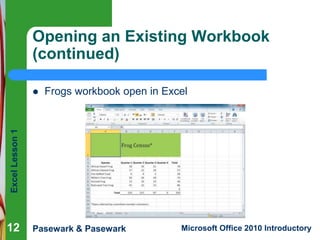
 Frogs workbook open in Excel 
Pasewark & Pasewark Microsoft Office 2010 Introductory 
12
Excel Lesson 1 
Saving a Workbook 
 The Save command saves an existing 
workbook, using its current name and save 
location. 
 The Save As command lets you save a 
workbook with a new name or to a new 
location. 
13 
Pasewark & Pasewark Microsoft Office 2010 Introductory
Excel Lesson 1 
Moving the Active Cell in a 
Worksheet 
 The easiest way to change the active cell in a 
worksheet is to move the pointer to the cell 
you want to make active and click. 
 You can display different parts of the 
worksheet by using the mouse to drag the 
scroll box in the scroll bar to another position. 
 You can also move the active cell to different 
parts of the worksheet using the keyboard or 
the Go To command. 
14 
Pasewark & Pasewark Microsoft Office 2010 Introductory
Excel Lesson 1 
Moving the Active Cell in a 
Worksheet (continued) 
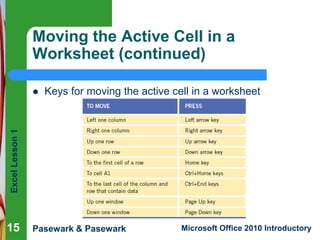
 Keys for moving the active cell in a worksheet 
Pasewark & Pasewark Microsoft Office 2010 Introductory 
15
Excel Lesson 1 
Selecting a Group of Cells 
 A group of selected cells is called a range. 
The range is identified by its range reference, 
for example, A3:C5. 
 In an adjacent range, all cells touch each 
other and form a rectangle. 
– To select an adjacent range, click the cell in a 
corner of the range, drag the pointer to the cell in 
the opposite corner of the range, and release the 
mouse button. 
Pasewark & Pasewark Microsoft Office 2010 Introductory 
16
Excel Lesson 1 
Selecting a Group of Cells 
(continued) 
 A nonadjacent range includes two or more 
adjacent ranges and selected cells. 
– To select a nonadjacent range, select the first 
adjacent range or cell, press the Ctrl key as you 
select the other cells or ranges you want to 
include, and then release the Ctrl key and the 
mouse button. 
Pasewark & Pasewark Microsoft Office 2010 Introductory 
17
Excel Lesson 1 
Entering Data in a Cell 
 Worksheet cells can contain text, numbers, 
or formulas. 
– Text is any combination of letters and numbers 
and symbols. 
– Numbers are values, dates, or times. 
– Formulas are equations that calculate a value. 
 You enter data in the active cell. 
Pasewark & Pasewark Microsoft Office 2010 Introductory 
18
Excel Lesson 1 
Changing Data in a Cell 
 You can edit, replace, or clear data. 
 You can edit cell data in the Formula Bar or 
in the cell. The contents of the active cell 
always appear in the Formula Bar. 
 To replace cell data, select the cell, type new 
data, and press the Enter button on the 
Formula Bar or the Enter key or the Tab key. 
 To clear the active cell, you can use the 
Ribbon, the keyboard, or the mouse. 
Pasewark & Pasewark Microsoft Office 2010 Introductory 
19
Excel Lesson 1 
Searching for Data 
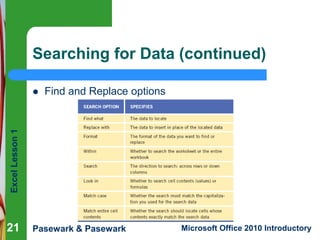
 The Find command locates data in a 
worksheet, which is particularly helpful when 
a worksheet contains a large amount of data. 
You can use the Find command to locate 
words or parts of words. 
 The Replace command is an extension of the 
Find command. Replacing data substitutes 
new data for the data that the Find command 
locates. 
20 
Pasewark & Pasewark Microsoft Office 2010 Introductory
Excel Lesson 1 
Searching for Data (continued) 
 Find and Replace options 
Pasewark & Pasewark Microsoft Office 2010 Introductory 
21
Excel Lesson 1 
Zooming a Worksheet 
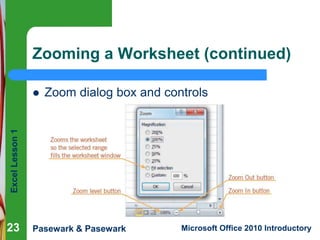
 You can change the magnification of a 
worksheet using the Zoom controls on the 
status bar. 
 The default magnification for a workbook is 
100%. 
 For a closer view of a worksheet, click the 
Zoom In button or drag the Zoom slider to 
the right to increase the zoom percentage. 
22 
Pasewark & Pasewark Microsoft Office 2010 Introductory
Excel Lesson 1 
Zooming a Worksheet (continued) 
 Zoom dialog box and controls 
Pasewark & Pasewark Microsoft Office 2010 Introductory 
23
Excel Lesson 1 
Previewing and Printing a 
Worksheet 
 You can print a worksheet by clicking the File 
tab on the Ribbon, and then clicking Print in 
the navigation bar to display the Print tab. 
 The Print tab enables you to choose print 
settings. 
 The Print tab also allows you to preview your 
pages before printing. 
24 
Pasewark & Pasewark Microsoft Office 2010 Introductory
Excel Lesson 1 
Closing a Workbook and Exiting 
Excel 
 You can close a workbook by clicking the File 
tab on the Ribbon, and then clicking Close in 
the navigation bar. Excel remains open. 
 To exit the workbook, click the Exit command 
in the navigation bar. 
25 
Pasewark & Pasewark Microsoft Office 2010 Introductory
Excel Lesson 1 
Summary 
In this lesson, you learned: 
 The primary purpose of a spreadsheet is to solve 
problems involving numbers. The advantage of using 
a computer spreadsheet is that you can complete 
complex and repetitious calculations quickly and 
accurately. 
 A worksheet consists of columns and rows that 
intersect to form cells. Each cell is identified by a cell 
reference, which combines the letter of the column 
and the number of the row. 
26 
Pasewark & Pasewark Microsoft Office 2010 Introductory
Excel Lesson 1 
Summary (continued) 
 The first time you save a workbook, the Save As dialog 
box opens so you can enter a descriptive name and 
select a save location. After that, you can use the Save 
command in Backstage view or the Save button on the 
Quick Access Toolbar to save the latest version of the 
workbook. 
 You can change the active cell in the worksheet by 
clicking the cell with the pointer, pressing keys, or using 
the scroll bars. The Go To dialog box lets you quickly 
move the active cell anywhere in the worksheet. 
27 
Pasewark & Pasewark Microsoft Office 2010 Introductory
Excel Lesson 1 
Summary (continued) 
 A group of selected cells is called a range. A range is 
identified by the cells in the upper-left and lower-right 
corners of the range, separated by a colon. To select 
an adjacent range, drag the pointer across the 
rectangle of cells you want to include. To select a 
nonadjacent range, select the first adjacent range, 
hold down the Ctrl key, select each additional cell or 
range, and then release the Ctrl key. 
28 
Pasewark & Pasewark Microsoft Office 2010 Introductory
Excel Lesson 1 
Summary (continued) 
 Worksheet cells can contain text, numbers, and 
formulas. After you enter data or a formula in a cell, 
you can change the cell contents by editing, 
replacing, or deleting it. 
 You can search for specific characters in a 
worksheet. You can also replace data you have 
searched for with specific characters. 
29 
Pasewark & Pasewark Microsoft Office 2010 Introductory
Excel Lesson 1 
Summary (continued) 
 The zoom controls on the status bar enable you to 
enlarge or reduce the magnification of the worksheet 
in the worksheet window. 
 Before you print a worksheet, you should check the 
page preview to see how the printed pages will look. 
 When you finish your work session, you should save 
your final changes and close the workbook. 
30 
Pasewark & Pasewark Microsoft Office 2010 Introductory

Excel lesson01

  • 1.
    1 Excel Lesson1 Microsoft Excel Basics Microsoft Office 2010 Introductory Pasewark & Pasewark
  • 2.
    Excel Lesson 1 Objectives  Define the terms spreadsheet and worksheet.  Identify the parts of a worksheet.  Start Excel, open an existing workbook, and save a workbook.  Move the active cell in a worksheet. 2 Pasewark & Pasewark Microsoft Office 2010 Introductory
  • 3.
    Excel Lesson 1 Objectives (continued)  Select cells and enter data in a worksheet.  Edit and replace data in cells.  Zoom, preview, and print a worksheet.  Close a workbook and exit Excel. 3 Pasewark & Pasewark Microsoft Office 2010 Introductory
  • 4.
    Excel Lesson 1 Vocabulary  active cell  active worksheet  adjacent range  cell  cell reference  column  formula  Formula Bar  landscape orientation  Microsoft Excel 2010 (Excel)  Name Box  nonadjacent range  portrait orientation 4 Pasewark & Pasewark Microsoft Office 2010 Introductory
  • 5.
    Excel Lesson 1 Vocabulary (continued)  range  range reference  row  sheet tab  spreadsheet  workbook  worksheet 5 Pasewark & Pasewark Microsoft Office 2010 Introductory
  • 6.
    Excel Lesson 1 Introduction to Spreadsheets  Microsoft Excel 2010 is the spreadsheet program in Microsoft Office 2010.  A spreadsheet is a grid of rows and columns in which you enter text, numbers, and the results of calculations.  In Excel, a computerized spreadsheet is called a worksheet. The file used to store worksheets is called a workbook. Pasewark & Pasewark Microsoft Office 2010 Introductory 6
  • 7.
    Excel Lesson 1 Starting Excel  You start Excel from the Start menu in Windows. Click the Start button, click All Programs, click Microsoft Office, and then click Microsoft Excel 2010.  The Excel program window has the same basic parts as all Office programs: the title bar, the Quick Access Toolbar, the Ribbon, Backstage view, and the status bar. 7 Pasewark & Pasewark Microsoft Office 2010 Introductory
  • 8.
    Excel Lesson 1 Starting Excel (continued)  Excel program window Pasewark & Pasewark Microsoft Office 2010 Introductory 8
  • 9.
    Excel Lesson 1 Exploring the Parts of the Workbook  Each workbook contains three worksheets by default. The worksheet displayed in the work area is the active worksheet.  Columns appear vertically and are identified by letters. Rows appear horizontally and are identified by numbers.  A cell is the intersection of a row and a column. Each cell is identified by a unique cell reference. 9 Pasewark & Pasewark Microsoft Office 2010 Introductory
  • 10.
    Excel Lesson 1 Exploring the Parts of the Workbook (continued)  The cell in the worksheet in which you can type data is called the active cell.  The Name Box, or cell reference area, displays the cell reference of the active cell.  The Formula Bar displays a formula when a worksheet cell contains a calculated value.  A formula is an equation that calculates a new value from values currently in a worksheet. 10 Pasewark & Pasewark Microsoft Office 2010 Introductory
  • 11.
    Excel Lesson 1 Opening an Existing Workbook  Opening a workbook means loading an existing workbook file from a drive into the program window.  To open an existing workbook, you click the File tab on the Ribbon to display Backstage view, and then click Open in the navigation bar. The Open dialog box appears. 11 Pasewark & Pasewark Microsoft Office 2010 Introductory
  • 12.
    Excel Lesson 1 Opening an Existing Workbook (continued)  Frogs workbook open in Excel Pasewark & Pasewark Microsoft Office 2010 Introductory 12
  • 13.
    Excel Lesson 1 Saving a Workbook  The Save command saves an existing workbook, using its current name and save location.  The Save As command lets you save a workbook with a new name or to a new location. 13 Pasewark & Pasewark Microsoft Office 2010 Introductory
  • 14.
    Excel Lesson 1 Moving the Active Cell in a Worksheet  The easiest way to change the active cell in a worksheet is to move the pointer to the cell you want to make active and click.  You can display different parts of the worksheet by using the mouse to drag the scroll box in the scroll bar to another position.  You can also move the active cell to different parts of the worksheet using the keyboard or the Go To command. 14 Pasewark & Pasewark Microsoft Office 2010 Introductory
  • 15.
    Excel Lesson 1 Moving the Active Cell in a Worksheet (continued)  Keys for moving the active cell in a worksheet Pasewark & Pasewark Microsoft Office 2010 Introductory 15
  • 16.
    Excel Lesson 1 Selecting a Group of Cells  A group of selected cells is called a range. The range is identified by its range reference, for example, A3:C5.  In an adjacent range, all cells touch each other and form a rectangle. – To select an adjacent range, click the cell in a corner of the range, drag the pointer to the cell in the opposite corner of the range, and release the mouse button. Pasewark & Pasewark Microsoft Office 2010 Introductory 16
  • 17.
    Excel Lesson 1 Selecting a Group of Cells (continued)  A nonadjacent range includes two or more adjacent ranges and selected cells. – To select a nonadjacent range, select the first adjacent range or cell, press the Ctrl key as you select the other cells or ranges you want to include, and then release the Ctrl key and the mouse button. Pasewark & Pasewark Microsoft Office 2010 Introductory 17
  • 18.
    Excel Lesson 1 Entering Data in a Cell  Worksheet cells can contain text, numbers, or formulas. – Text is any combination of letters and numbers and symbols. – Numbers are values, dates, or times. – Formulas are equations that calculate a value.  You enter data in the active cell. Pasewark & Pasewark Microsoft Office 2010 Introductory 18
  • 19.
    Excel Lesson 1 Changing Data in a Cell  You can edit, replace, or clear data.  You can edit cell data in the Formula Bar or in the cell. The contents of the active cell always appear in the Formula Bar.  To replace cell data, select the cell, type new data, and press the Enter button on the Formula Bar or the Enter key or the Tab key.  To clear the active cell, you can use the Ribbon, the keyboard, or the mouse. Pasewark & Pasewark Microsoft Office 2010 Introductory 19
  • 20.
    Excel Lesson 1 Searching for Data  The Find command locates data in a worksheet, which is particularly helpful when a worksheet contains a large amount of data. You can use the Find command to locate words or parts of words.  The Replace command is an extension of the Find command. Replacing data substitutes new data for the data that the Find command locates. 20 Pasewark & Pasewark Microsoft Office 2010 Introductory
  • 21.
    Excel Lesson 1 Searching for Data (continued)  Find and Replace options Pasewark & Pasewark Microsoft Office 2010 Introductory 21
  • 22.
    Excel Lesson 1 Zooming a Worksheet  You can change the magnification of a worksheet using the Zoom controls on the status bar.  The default magnification for a workbook is 100%.  For a closer view of a worksheet, click the Zoom In button or drag the Zoom slider to the right to increase the zoom percentage. 22 Pasewark & Pasewark Microsoft Office 2010 Introductory
  • 23.
    Excel Lesson 1 Zooming a Worksheet (continued)  Zoom dialog box and controls Pasewark & Pasewark Microsoft Office 2010 Introductory 23
  • 24.
    Excel Lesson 1 Previewing and Printing a Worksheet  You can print a worksheet by clicking the File tab on the Ribbon, and then clicking Print in the navigation bar to display the Print tab.  The Print tab enables you to choose print settings.  The Print tab also allows you to preview your pages before printing. 24 Pasewark & Pasewark Microsoft Office 2010 Introductory
  • 25.
    Excel Lesson 1 Closing a Workbook and Exiting Excel  You can close a workbook by clicking the File tab on the Ribbon, and then clicking Close in the navigation bar. Excel remains open.  To exit the workbook, click the Exit command in the navigation bar. 25 Pasewark & Pasewark Microsoft Office 2010 Introductory
  • 26.
    Excel Lesson 1 Summary In this lesson, you learned:  The primary purpose of a spreadsheet is to solve problems involving numbers. The advantage of using a computer spreadsheet is that you can complete complex and repetitious calculations quickly and accurately.  A worksheet consists of columns and rows that intersect to form cells. Each cell is identified by a cell reference, which combines the letter of the column and the number of the row. 26 Pasewark & Pasewark Microsoft Office 2010 Introductory
  • 27.
    Excel Lesson 1 Summary (continued)  The first time you save a workbook, the Save As dialog box opens so you can enter a descriptive name and select a save location. After that, you can use the Save command in Backstage view or the Save button on the Quick Access Toolbar to save the latest version of the workbook.  You can change the active cell in the worksheet by clicking the cell with the pointer, pressing keys, or using the scroll bars. The Go To dialog box lets you quickly move the active cell anywhere in the worksheet. 27 Pasewark & Pasewark Microsoft Office 2010 Introductory
  • 28.
    Excel Lesson 1 Summary (continued)  A group of selected cells is called a range. A range is identified by the cells in the upper-left and lower-right corners of the range, separated by a colon. To select an adjacent range, drag the pointer across the rectangle of cells you want to include. To select a nonadjacent range, select the first adjacent range, hold down the Ctrl key, select each additional cell or range, and then release the Ctrl key. 28 Pasewark & Pasewark Microsoft Office 2010 Introductory
  • 29.
    Excel Lesson 1 Summary (continued)  Worksheet cells can contain text, numbers, and formulas. After you enter data or a formula in a cell, you can change the cell contents by editing, replacing, or deleting it.  You can search for specific characters in a worksheet. You can also replace data you have searched for with specific characters. 29 Pasewark & Pasewark Microsoft Office 2010 Introductory
  • 30.
    Excel Lesson 1 Summary (continued)  The zoom controls on the status bar enable you to enlarge or reduce the magnification of the worksheet in the worksheet window.  Before you print a worksheet, you should check the page preview to see how the printed pages will look.  When you finish your work session, you should save your final changes and close the workbook. 30 Pasewark & Pasewark Microsoft Office 2010 Introductory