Faculty of dentistry
Atheer ahmed 1330129
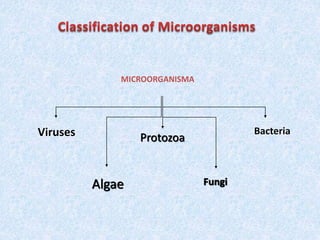
MICROORGANISMA
Viruses Protozoa
Bacteria
Algae Fungi
Types of Classification
• Carlolus Linnaeus proposed the Two Kingdom
Classification in 1758.
• The two kingdoms consisted of:
– Plantae
– Animalia
THREE KINGDOM SYSTEM
• ERNEST HAECKEL‐1866
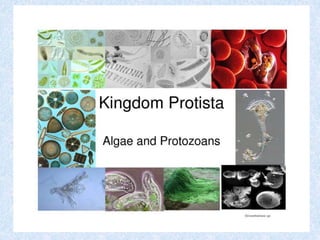
• KINGDOM PROTISTA:
– It includes unicellular & colonial eukaryotes such as
bacteria, algae, fungi & protozoans.
• KINGDOM PLANTAE:
– It includes multicellular photosynthetic plants.
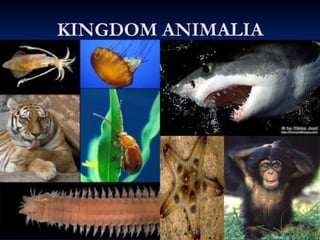
• KINGDOM ANIMALIA:
– It includes multicellular animals.
Types of Classification.
• The next classification system that came
about consisted of 5 kingdoms.
• It was proposed by Robert Whittaker in 1969.
• The 5 kingdoms consisted of:
– Plantae
– Animalia
– Fungi
– Protista
– Monera
Robert Whittaker’s Five Kingdom System
• Plantae
– Plants are immobile, multicellular eukaryotes that
produce their food by photosynthesis and have
cells encased in cellulose cell walls.
– Examples: Ferns, pine trees, roses
• Animailia
– Animals are multicellular, heterotrophic
eukaryotes that are capable of mobility at some
stage during their lives, and that have cells lacking
cell walls.
– Examples: Humans, worms, spiders
Robert Whittaker’s Five Kingdom System
• Fungi
– Fungi are a eukaryotic, heterotrophic, usually multicellular group
having multinucleated cells enclosed in cells with cell walls.
– They obtain their energy by decomposing dead and dying
organisms and absorbing their nutrients from those organisms.
– Examples: Mushrooms, moulds, yeast
1
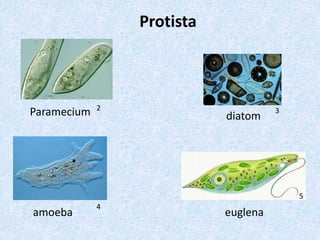
• Protista
• The most ancient eukaryotic kingdom, protista include a variety of
eukaryotic forms.
• Perhaps they are best defined as eukaryotes that are not fungi, animals,
or plants.
• Cell wall is usually absent, if present it is impregnated with silica
(diatoms).
• Photosynthetic or non photosynthetic.
• Locomotory structure may be cilia, flagella, pseudopodia or absent.
• Examples: , amoeba, diatom, euglena
Robert Whittaker’s Five Kingdom System
Protista
Paramecium diatom
amoeba euglena
2 3
4
5
Robert Whittaker’s Five Kingdom System
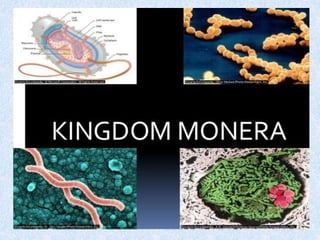
• Monera
–Monera are the only kingdom
composed of prokaryotic organisms,
they have a cell wall, and lack both
membrane-bound organelles and
multicellular forms.
–Examples: Bacteria, blue-green
bacteria
Characteristics of Monera:
• Unicellular or filamentous prokaryotes
• Omni present (air, soil, hot springs, deserts,
deep sea, snow & as parasites)
• Cell wall is composed of polysaccharides &
amino acids(peptido glycons ormurein)
• Autotrophic (photo & chemosynthetic) &
heterotrophic (saprophytic & parasitic)
• Reproduce by vegetative, asexual & sexual
methods
• MAJOR GROUPS OF MONERA:
1. Archaebacteria: Methanogens,
Halophyles, thermoacidophyles
2. Eubacteria: Vibrio, mycobacteria
3. Cyanobacteria: Nostoc, Anabena
1
9
HalobacteriumVibrioAnabenaNostoc
6 7 8 9
Types of Classification Systems cont..
• In the 1970’s, microbiologist Carl Woese, among other
researchers conducted studies and concluded that a group of
prokaryotic microorganisms called archaebacteria are
separate from other monerans.
• Therefore, they decided to split kingdom monera into two
separate kingdoms:
– Eubacteria
– Archaebacteria
• Archaebacteria
– Unicellular
– Prokaryotic
– Exist in extreme environments – they do not
need oxygen or light to live
– Examples: methanogens, extreme thermophiles,
extreme halophiles
• Eubacteria
– Unicellular
– Prokaryotic
– Heterotrophic, autotrophic, and chemotrophic
– Examples: Bacteria, cyanobacteria (blue-green
bacteria)
Three Domain System
• The Three Domain System, developed by Carl Woese,
is a system for classifying biological organisms.
• Over the years, scientists have developed several
systems for the classification of organisms.
• From the late 1960's, organisms had been classified
according to a Five Kingdom system.
• This classification system model was based on
principles developed by Swedish scientist Carolus
Linnaeus, whose hierarchical system groups organisms
based on common physical characteristics.
Comparison of Classification Systems
• Five Kingdom System
Kingdoms: Monera, Protista, Fungi, Plantae, and Animalia.
Three Domain System
• Archaea Domain
– Archaebacteria Kingdom
• Bacteria Domain
– Eubacteria Kingdom
• Eukarya Domain
– Protista Kingdom
– Fungi Kingdom
– Plantae Kingdom
– Animalia Kingdom
References
Books:
1. Biology of microorganisms By M. T. Madigan, J. M. Martinko, D. A.
Stahl and D. P. Clark
Images:
1. https://lh4.ggpht.com/BL8zyuw37iAzWft6GzMuHTWQ7LmX1pGCKxaXjY_wF8R
uMzVbHGnNAsu-XFO-r6w_ozc8hHM=s125
2. http://cfb.unh.edu/phycokey/Choices/Amoebae_Flagellates_Ciliates/Ciliates/P
ARAMECIUM/Paramecium_05_600x395_caudatum.jpg
3. http://www.bodc.ac.uk/projects/uk/mfmb/introduction/images/diatoms.jpg
4. http://www.microscopy-uk.org.uk/mag/imgsep01/amoebaproteus450.jpg
5. https://lh6.ggpht.com/mkGhpDrT154r8rgB0tTM4wfgOG0-
ULTlnUzmbRT7pvKbgVUoTrBC9XuJEqxTdQkEniP1jQ=s170
6. http://www.ohio.edu/plantbio/vislab/algaeimage/jpegs/nost1nitr.JPG
7. http://protist.i.hosei.ac.jp/PDB/images/Prokaryotes/Nostocaceae/Anabaena/A
nabaena9c.jpg
8. https://s3.amazonaws.com/healthtap-public/ht-
staging/user_answer/reference_image/8742/large/Cholera.jpeg?1344948822
9. http://plantphys.info/organismal/lechtml/images/halobacterium.jpg
Thank you

Microbiology

  • 1.
  • 2.
  • 3.
    Types of Classification •Carlolus Linnaeus proposed the Two Kingdom Classification in 1758. • The two kingdoms consisted of: – Plantae – Animalia
  • 4.
    THREE KINGDOM SYSTEM •ERNEST HAECKEL‐1866 • KINGDOM PROTISTA: – It includes unicellular & colonial eukaryotes such as bacteria, algae, fungi & protozoans. • KINGDOM PLANTAE: – It includes multicellular photosynthetic plants. • KINGDOM ANIMALIA: – It includes multicellular animals.
  • 6.
    Types of Classification. •The next classification system that came about consisted of 5 kingdoms. • It was proposed by Robert Whittaker in 1969. • The 5 kingdoms consisted of: – Plantae – Animalia – Fungi – Protista – Monera
  • 7.
    Robert Whittaker’s FiveKingdom System • Plantae – Plants are immobile, multicellular eukaryotes that produce their food by photosynthesis and have cells encased in cellulose cell walls. – Examples: Ferns, pine trees, roses
  • 9.
    • Animailia – Animalsare multicellular, heterotrophic eukaryotes that are capable of mobility at some stage during their lives, and that have cells lacking cell walls. – Examples: Humans, worms, spiders
  • 11.
    Robert Whittaker’s FiveKingdom System • Fungi – Fungi are a eukaryotic, heterotrophic, usually multicellular group having multinucleated cells enclosed in cells with cell walls. – They obtain their energy by decomposing dead and dying organisms and absorbing their nutrients from those organisms. – Examples: Mushrooms, moulds, yeast 1
  • 13.
    • Protista • Themost ancient eukaryotic kingdom, protista include a variety of eukaryotic forms. • Perhaps they are best defined as eukaryotes that are not fungi, animals, or plants. • Cell wall is usually absent, if present it is impregnated with silica (diatoms). • Photosynthetic or non photosynthetic. • Locomotory structure may be cilia, flagella, pseudopodia or absent. • Examples: , amoeba, diatom, euglena Robert Whittaker’s Five Kingdom System
  • 15.
  • 16.
    Robert Whittaker’s FiveKingdom System • Monera –Monera are the only kingdom composed of prokaryotic organisms, they have a cell wall, and lack both membrane-bound organelles and multicellular forms. –Examples: Bacteria, blue-green bacteria
  • 18.
    Characteristics of Monera: •Unicellular or filamentous prokaryotes • Omni present (air, soil, hot springs, deserts, deep sea, snow & as parasites) • Cell wall is composed of polysaccharides & amino acids(peptido glycons ormurein) • Autotrophic (photo & chemosynthetic) & heterotrophic (saprophytic & parasitic) • Reproduce by vegetative, asexual & sexual methods
  • 19.
    • MAJOR GROUPSOF MONERA: 1. Archaebacteria: Methanogens, Halophyles, thermoacidophyles 2. Eubacteria: Vibrio, mycobacteria 3. Cyanobacteria: Nostoc, Anabena 1 9 HalobacteriumVibrioAnabenaNostoc 6 7 8 9
  • 20.
    Types of ClassificationSystems cont.. • In the 1970’s, microbiologist Carl Woese, among other researchers conducted studies and concluded that a group of prokaryotic microorganisms called archaebacteria are separate from other monerans. • Therefore, they decided to split kingdom monera into two separate kingdoms: – Eubacteria – Archaebacteria
  • 21.
    • Archaebacteria – Unicellular –Prokaryotic – Exist in extreme environments – they do not need oxygen or light to live – Examples: methanogens, extreme thermophiles, extreme halophiles • Eubacteria – Unicellular – Prokaryotic – Heterotrophic, autotrophic, and chemotrophic – Examples: Bacteria, cyanobacteria (blue-green bacteria)
  • 22.
    Three Domain System •The Three Domain System, developed by Carl Woese, is a system for classifying biological organisms. • Over the years, scientists have developed several systems for the classification of organisms. • From the late 1960's, organisms had been classified according to a Five Kingdom system. • This classification system model was based on principles developed by Swedish scientist Carolus Linnaeus, whose hierarchical system groups organisms based on common physical characteristics.
  • 23.
    Comparison of ClassificationSystems • Five Kingdom System Kingdoms: Monera, Protista, Fungi, Plantae, and Animalia. Three Domain System • Archaea Domain – Archaebacteria Kingdom • Bacteria Domain – Eubacteria Kingdom • Eukarya Domain – Protista Kingdom – Fungi Kingdom – Plantae Kingdom – Animalia Kingdom
  • 24.
    References Books: 1. Biology ofmicroorganisms By M. T. Madigan, J. M. Martinko, D. A. Stahl and D. P. Clark Images: 1. https://lh4.ggpht.com/BL8zyuw37iAzWft6GzMuHTWQ7LmX1pGCKxaXjY_wF8R uMzVbHGnNAsu-XFO-r6w_ozc8hHM=s125 2. http://cfb.unh.edu/phycokey/Choices/Amoebae_Flagellates_Ciliates/Ciliates/P ARAMECIUM/Paramecium_05_600x395_caudatum.jpg 3. http://www.bodc.ac.uk/projects/uk/mfmb/introduction/images/diatoms.jpg 4. http://www.microscopy-uk.org.uk/mag/imgsep01/amoebaproteus450.jpg 5. https://lh6.ggpht.com/mkGhpDrT154r8rgB0tTM4wfgOG0- ULTlnUzmbRT7pvKbgVUoTrBC9XuJEqxTdQkEniP1jQ=s170 6. http://www.ohio.edu/plantbio/vislab/algaeimage/jpegs/nost1nitr.JPG 7. http://protist.i.hosei.ac.jp/PDB/images/Prokaryotes/Nostocaceae/Anabaena/A nabaena9c.jpg 8. https://s3.amazonaws.com/healthtap-public/ht- staging/user_answer/reference_image/8742/large/Cholera.jpeg?1344948822 9. http://plantphys.info/organismal/lechtml/images/halobacterium.jpg
  • 25.