B Y S R E E R E M Y A . S . M . p h i l
BIODEGRADATION OF
PETROLEUM
HYDROCARBONS
Introduction
 The Spilled petroleum constitutes (Hydrocarbons) are
one of the main environmental
pollutants.
 Their abundance and persistence in several polluted
environmental areas have beenReported. Oil spillage
may be caused by natural disasters likeearthquakes in
the sea surface or due to accidental leaks during
exploration, refining, storage andtransportation.
 The causes can be numerous but the consequences are
the same. In case of crude oil, the different types such as
heavy or light crude oil can affect the clean-up
procedures.
Summary on Hydrocarbons:
 Hydrocarbons are naturally occurring, flammable
organic compounds in the crude oil found in geologic
formations beneath the Earth's surface.
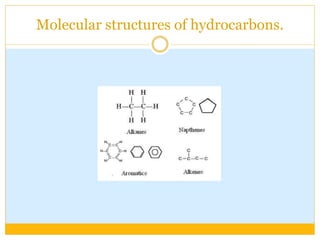
Hydrocarbons contained in crude are categorized on
the basis of molecular composition as alkanes,
naphthenes, aromatics, and alkenes
Molecular structures of hydrocarbons.
Hydrocarbons of Crude oil:
 Oils are further categorized into three broad groups,
according to their molecular weight.
 General statements can be made for each of the three
categories namely light weight, medium weight, and
heavy weight components
Light Weight Components:
 These are carbon atoms range from C1 to C10 which
are smaller molecules with few numbersof atoms.
 They are characterized by high volitility, readily
dissolve and evaporate and leave littleor no residue
because of there short residence time. Many of these
components (e.g., benzene,and toluene) are thought
to be more bioavailable to animals by primary
exposure route(respiratory system).
 Being highly flammable and readily inhaled, and
therefore are of concern for human health and safety.
Medium Weight Components:
 These are carbon atoms rangeing from C11 to C22
which have complex molecule. It has low rate of
evaporaton and dissolves very slowly that take
several days with some residue remaining.
 Not as bioavailable as lower weight components, it is
less likely to affect aquatic animals. Its primary
exposure route is respiratory system and gets readily
absorbed through skin.
Heavy Weight Components:
 These are components which carbone atoms more
than C23. It has the longest residence timewith very
little loss due to evoparation or dissolition. It can
cause chronic effect through smothering as residue
in the water column and sediments (tarballs, etc).
 Its primary exposoure route is direct topical contact.
Some heavy weight components contain carcinogens
that are absorbed through the skin. Its risk of
exposure is increased due to long residence time,
probability of contact, and adsorpiton property of the
oil components.
Oil Spills and Their Effects:
 Oil spills kill wildlife and damage the ecosystem that
can last for generations by forcing changes in
reproduction and compromising complex food webs.
Oil spill damage to the waterways of birds and
animals, destroys the animal immune systems,
interrupt breeding andfouling of breeding grounds.
 Besides, they thin bird and turtle egg shells and also
damage the fish larvae, causing deformities. They
cause damage to sea grass beds and other
shelter/feedingareas, tainting of algae, which
perform a vital role in waterway ecosystems
Oil Spill Cleaning Techniques:
 Oil is presently a nonrenewable energy source in
everyday life. This fossil fuel is used for a variety of
purposes including fuel for transportation and
factories.
 Unfortunately, oil spills sometimes occur within the
environment due to accidents and unavoidable
actions such asweather and earthquakes or through
intentional spills from war and dumping. Several
techniques can be used to clean up oil spills and to
prevent further destruction by this hazardous
constituent.
Booms:
 It’s an easier way of cleaning-up the oil spill with booms,
if it’s all in one place. Equipment named containment
booms act like a fence to keep the oil from spreading or
floating away overthe water surface.
 Booms float on the surface and have three parts: a
‘freeboard’ or part that rises above the water surface and
contains the oil and prevents it from splashing over the
top, a ‘skirt’ that rides below the surface and prevents the
oil from being pushed under the booms and escaping,
and some kind of cable or chain that connects,
strengthens, and stabilizes the boom.
 Connected sections of boom are placed around the oil
spill until it is totally surrounded and contained
Sorbents:
 These are materials that soak up oils by either absorption or adsorption. It
works on the principle in use of hydrophobic materials to wipe up oil from
the contaminated surface.
 This property helps in removing the oil from the water much easily.
Materials like why hay is used to clean oil spill on beaches and whey
materials like vermiculite are spread over spilled oil. Thesematerials are
often designed as large squares, much like paper towels, or shaped into
“mops.”
 The squares or mops are used to wipe the shoreline or oily rocks during
which time the absorbents are filled with as much oil as they can hold. One
problem with using this method is that once the material is coated with oil,
it may then be heavier than water.
 Then the oil-coated material sinks to the bottom where it could harm
animals living there. Absorbent materials, very much like paper towels, are
used to soak up oil from the water’s surface or even from rocks and animal
life on shore that becomes coated with oil. Wiping with absorbent materials
requires the use of a large quantity of material and several personnel
Chemical cleaning methods:
 Chemical methods, particularly dispersants, have
been routinely used in many countries as a response
option.
Dispersants:
 Dispersants are also be used to dissipate oil slicks. Dispersing agents, which contain
surfactants, are used to remove floating oil from the water surface to disperse it into the
watercolumn before the oil reaches and contaminates the shoreline.
 Some types of oil get rapidly dispersed from the sea surface by transferring it into the water
column. They will cause the oil slick to break up and form water-soluble micelles that are
rapidly diluted .The oil is then effectively spread throughout a larger volume of water than the
surface from where the oilwas dispersed.
 They can also delay the formation of persistent oil-in-water emulsions.
 Dispersants have two main components, a surfactant and a solvent. Surfactants molecules are
made up of two parts, an oleophilic part (with an attraction to oil) and a hydrophilic
part
(with an attraction to water).
• When dispersants are sprayed onto an oil slick, the solvent transport and distribute the
surfactants through the oil slick to the oil/water interface where they arrangethemselves so that
the oleophilic part of the molecule is in the oil and the hydrophilic part is inthe water.
• This creates a reduction in the surface tension at the oil/water interface and small oil droplets
will break away from the oil slick with the help of wave energy.
• These droplets will be of varying sizes. Although the larger ones may rise back to the surface
some will remain in suspension and will drift apart and become degraded by naturally
occurring bacteria.
• If dispersion is successful, a characteristic brown plume will spread slowly down from the water
surface a few minutes after treatment.
In-situ Bioremediation:
 The method of In-situ bioremediation requires that the
contaminated subsoil must be removed or scraped. Treatment
is carried out in subsoil either by biological means such as
hydrocarbon degradation by microorganisms, chemical
processes, or by physical processes such air sparging or soil
venting can be applied to extract contaminants from the soil
as well as groundwater.
 To conduct this treatment vertical and horizontal drilling
processes may be required. Also it is more effective on sandy
soils than in soils that contain clay. Bioremediation can be
applied with the help of spreading units in case the
contamination is at the surface. It also accelerated the growth
of aerobic bacteria in the contaminated area by oxygen
feeding
 Slurping is a process in which special well completion is
required to
extract the oil by means of vacuum. It is preferred if the
contamination is in the boundary area between groundwater
saturated soil and groundwater unsaturated soil. Soil air
suction is also a method where suction extraction of
contaminated soil air is done by means of vacuum to remove
volatile hydrocarbon from contaminated area.
• In-situ steam injection is another method where steam at
high temperature and compressed air are injected into the
contaminated soil. The temperature of the injected steam
should be greater than the boiling points of volatile
components so that the contaminants can be converted to
gaseous or volatile phase
Ex-situ Bioremediation:
 For these methods soil must be removed to an off site remediation facility.
The treatment is carried out by incinerating the soil, chemical extraction or
soil washing to remove the hydrocarbon components.
 The important methods of ex-situ treatment are steam stripping and
combustion, extraction methods and biological methods. The chemical
extraction method involves the usage of different solvents, where the
contaminants are dissociated from the soil,dissolved or suspended in the
solvents.
 It can be applied for different types of crude and soils but is more effective
for soil with low clay content. It can be performed in-situ or ex-situ, but in
exsitu the clean-up period is relatively short and the efficiency is better
controlled.
 Surfactant washing too can be applied in-situ or ex-situ. Ex-situ methods
can be applied only if the amount of contaminated soil is small or if the
contamination has occurred in a residential or industrial area where in-situ
treatment cannot be applied.
 Ex-situ treatment leads to a higher degree of remediation because of
controllability of many factors like pH, temperature, salinity, moisture
Microbial degradation of hydrocarbons:
 The biodegraded petroleum-derived aromatic hydrocarbons in
marine sediments by Arthrobacter, Burkholderia, Mycobacterium,
Pseudomonas, Sphingomonas, and Rhodococcus
were found to be very effective [Jones et al., 1983].
 The extensive biodegradation of alkyl aromatics occurred prior to
detectable biodegradation of n-alkane profile of the crude. Bacteria
strains are the most active agents in petroleum degradation, and
they work as primary degraders of spilled oil in environment.
 Many of the microorganisms have the genotypic ability to utilize the
hydrocarbons as a sole carbon source, but they express it only when
they aregrown in the hydrocarbon contaminated environment.
 Floodgate isolated 25 genera of hydrocarbon degrading bacteria and
25 genera of hydrocarbon degrading fungi which were isolated from
marine environment.
 A similar compilation by Bartha and Bossert included 22 genera of
bacteria and 31 genera of fungi.
CONCLUSION
 Microorganisms having the potential to degrade hydrocarbons exist
in the nature. May be they have this ability genetically, but when
they come in contact with the hydrocarbons they exhibit the
degradation characteristic. So collection of samples from the
hydrocarbon contaminated sites will help in the isolation of
microorganisms with hydrocarbon degradation ability.
Environmental conditions like temperature, pH and dissolved
oxygen content, plays a key role in the growth of microorganisms.
 Microorganisms require proper nutrients to perform the metabolic
activates and to grow. Adding nutrients (N, P, S and Mg) will help to
maintain proper metabolism and it aids to produce intracellular and
extracellular organic compounds (enzymes and biosurfactants)
which improves the hydrocarbon degradation rate by increasing
uptake of hydrocarbons and in their metabolism to yield biomass,
energy, water and CO2.
 Microbes produce biosurfactants to make hydrocarbons available to
them.
THANK YOU

Biodegradation of petroleum

  • 1.
    B Y SR E E R E M Y A . S . M . p h i l BIODEGRADATION OF PETROLEUM HYDROCARBONS
  • 2.
    Introduction  The Spilledpetroleum constitutes (Hydrocarbons) are one of the main environmental pollutants.  Their abundance and persistence in several polluted environmental areas have beenReported. Oil spillage may be caused by natural disasters likeearthquakes in the sea surface or due to accidental leaks during exploration, refining, storage andtransportation.  The causes can be numerous but the consequences are the same. In case of crude oil, the different types such as heavy or light crude oil can affect the clean-up procedures.
  • 3.
    Summary on Hydrocarbons: Hydrocarbons are naturally occurring, flammable organic compounds in the crude oil found in geologic formations beneath the Earth's surface. Hydrocarbons contained in crude are categorized on the basis of molecular composition as alkanes, naphthenes, aromatics, and alkenes
  • 4.
  • 5.
    Hydrocarbons of Crudeoil:  Oils are further categorized into three broad groups, according to their molecular weight.  General statements can be made for each of the three categories namely light weight, medium weight, and heavy weight components
  • 6.
    Light Weight Components: These are carbon atoms range from C1 to C10 which are smaller molecules with few numbersof atoms.  They are characterized by high volitility, readily dissolve and evaporate and leave littleor no residue because of there short residence time. Many of these components (e.g., benzene,and toluene) are thought to be more bioavailable to animals by primary exposure route(respiratory system).  Being highly flammable and readily inhaled, and therefore are of concern for human health and safety.
  • 7.
    Medium Weight Components: These are carbon atoms rangeing from C11 to C22 which have complex molecule. It has low rate of evaporaton and dissolves very slowly that take several days with some residue remaining.  Not as bioavailable as lower weight components, it is less likely to affect aquatic animals. Its primary exposure route is respiratory system and gets readily absorbed through skin.
  • 8.
    Heavy Weight Components: These are components which carbone atoms more than C23. It has the longest residence timewith very little loss due to evoparation or dissolition. It can cause chronic effect through smothering as residue in the water column and sediments (tarballs, etc).  Its primary exposoure route is direct topical contact. Some heavy weight components contain carcinogens that are absorbed through the skin. Its risk of exposure is increased due to long residence time, probability of contact, and adsorpiton property of the oil components.
  • 9.
    Oil Spills andTheir Effects:  Oil spills kill wildlife and damage the ecosystem that can last for generations by forcing changes in reproduction and compromising complex food webs. Oil spill damage to the waterways of birds and animals, destroys the animal immune systems, interrupt breeding andfouling of breeding grounds.  Besides, they thin bird and turtle egg shells and also damage the fish larvae, causing deformities. They cause damage to sea grass beds and other shelter/feedingareas, tainting of algae, which perform a vital role in waterway ecosystems
  • 10.
    Oil Spill CleaningTechniques:  Oil is presently a nonrenewable energy source in everyday life. This fossil fuel is used for a variety of purposes including fuel for transportation and factories.  Unfortunately, oil spills sometimes occur within the environment due to accidents and unavoidable actions such asweather and earthquakes or through intentional spills from war and dumping. Several techniques can be used to clean up oil spills and to prevent further destruction by this hazardous constituent.
  • 11.
    Booms:  It’s aneasier way of cleaning-up the oil spill with booms, if it’s all in one place. Equipment named containment booms act like a fence to keep the oil from spreading or floating away overthe water surface.  Booms float on the surface and have three parts: a ‘freeboard’ or part that rises above the water surface and contains the oil and prevents it from splashing over the top, a ‘skirt’ that rides below the surface and prevents the oil from being pushed under the booms and escaping, and some kind of cable or chain that connects, strengthens, and stabilizes the boom.  Connected sections of boom are placed around the oil spill until it is totally surrounded and contained
  • 12.
    Sorbents:  These arematerials that soak up oils by either absorption or adsorption. It works on the principle in use of hydrophobic materials to wipe up oil from the contaminated surface.  This property helps in removing the oil from the water much easily. Materials like why hay is used to clean oil spill on beaches and whey materials like vermiculite are spread over spilled oil. Thesematerials are often designed as large squares, much like paper towels, or shaped into “mops.”  The squares or mops are used to wipe the shoreline or oily rocks during which time the absorbents are filled with as much oil as they can hold. One problem with using this method is that once the material is coated with oil, it may then be heavier than water.  Then the oil-coated material sinks to the bottom where it could harm animals living there. Absorbent materials, very much like paper towels, are used to soak up oil from the water’s surface or even from rocks and animal life on shore that becomes coated with oil. Wiping with absorbent materials requires the use of a large quantity of material and several personnel
  • 13.
    Chemical cleaning methods: Chemical methods, particularly dispersants, have been routinely used in many countries as a response option.
  • 14.
    Dispersants:  Dispersants arealso be used to dissipate oil slicks. Dispersing agents, which contain surfactants, are used to remove floating oil from the water surface to disperse it into the watercolumn before the oil reaches and contaminates the shoreline.  Some types of oil get rapidly dispersed from the sea surface by transferring it into the water column. They will cause the oil slick to break up and form water-soluble micelles that are rapidly diluted .The oil is then effectively spread throughout a larger volume of water than the surface from where the oilwas dispersed.  They can also delay the formation of persistent oil-in-water emulsions.  Dispersants have two main components, a surfactant and a solvent. Surfactants molecules are made up of two parts, an oleophilic part (with an attraction to oil) and a hydrophilic part (with an attraction to water). • When dispersants are sprayed onto an oil slick, the solvent transport and distribute the surfactants through the oil slick to the oil/water interface where they arrangethemselves so that the oleophilic part of the molecule is in the oil and the hydrophilic part is inthe water. • This creates a reduction in the surface tension at the oil/water interface and small oil droplets will break away from the oil slick with the help of wave energy. • These droplets will be of varying sizes. Although the larger ones may rise back to the surface some will remain in suspension and will drift apart and become degraded by naturally occurring bacteria. • If dispersion is successful, a characteristic brown plume will spread slowly down from the water surface a few minutes after treatment.
  • 15.
    In-situ Bioremediation:  Themethod of In-situ bioremediation requires that the contaminated subsoil must be removed or scraped. Treatment is carried out in subsoil either by biological means such as hydrocarbon degradation by microorganisms, chemical processes, or by physical processes such air sparging or soil venting can be applied to extract contaminants from the soil as well as groundwater.  To conduct this treatment vertical and horizontal drilling processes may be required. Also it is more effective on sandy soils than in soils that contain clay. Bioremediation can be applied with the help of spreading units in case the contamination is at the surface. It also accelerated the growth of aerobic bacteria in the contaminated area by oxygen feeding
  • 16.
     Slurping isa process in which special well completion is required to extract the oil by means of vacuum. It is preferred if the contamination is in the boundary area between groundwater saturated soil and groundwater unsaturated soil. Soil air suction is also a method where suction extraction of contaminated soil air is done by means of vacuum to remove volatile hydrocarbon from contaminated area. • In-situ steam injection is another method where steam at high temperature and compressed air are injected into the contaminated soil. The temperature of the injected steam should be greater than the boiling points of volatile components so that the contaminants can be converted to gaseous or volatile phase
  • 17.
    Ex-situ Bioremediation:  Forthese methods soil must be removed to an off site remediation facility. The treatment is carried out by incinerating the soil, chemical extraction or soil washing to remove the hydrocarbon components.  The important methods of ex-situ treatment are steam stripping and combustion, extraction methods and biological methods. The chemical extraction method involves the usage of different solvents, where the contaminants are dissociated from the soil,dissolved or suspended in the solvents.  It can be applied for different types of crude and soils but is more effective for soil with low clay content. It can be performed in-situ or ex-situ, but in exsitu the clean-up period is relatively short and the efficiency is better controlled.  Surfactant washing too can be applied in-situ or ex-situ. Ex-situ methods can be applied only if the amount of contaminated soil is small or if the contamination has occurred in a residential or industrial area where in-situ treatment cannot be applied.  Ex-situ treatment leads to a higher degree of remediation because of controllability of many factors like pH, temperature, salinity, moisture
  • 18.
    Microbial degradation ofhydrocarbons:  The biodegraded petroleum-derived aromatic hydrocarbons in marine sediments by Arthrobacter, Burkholderia, Mycobacterium, Pseudomonas, Sphingomonas, and Rhodococcus were found to be very effective [Jones et al., 1983].  The extensive biodegradation of alkyl aromatics occurred prior to detectable biodegradation of n-alkane profile of the crude. Bacteria strains are the most active agents in petroleum degradation, and they work as primary degraders of spilled oil in environment.  Many of the microorganisms have the genotypic ability to utilize the hydrocarbons as a sole carbon source, but they express it only when they aregrown in the hydrocarbon contaminated environment.  Floodgate isolated 25 genera of hydrocarbon degrading bacteria and 25 genera of hydrocarbon degrading fungi which were isolated from marine environment.  A similar compilation by Bartha and Bossert included 22 genera of bacteria and 31 genera of fungi.
  • 19.
    CONCLUSION  Microorganisms havingthe potential to degrade hydrocarbons exist in the nature. May be they have this ability genetically, but when they come in contact with the hydrocarbons they exhibit the degradation characteristic. So collection of samples from the hydrocarbon contaminated sites will help in the isolation of microorganisms with hydrocarbon degradation ability. Environmental conditions like temperature, pH and dissolved oxygen content, plays a key role in the growth of microorganisms.  Microorganisms require proper nutrients to perform the metabolic activates and to grow. Adding nutrients (N, P, S and Mg) will help to maintain proper metabolism and it aids to produce intracellular and extracellular organic compounds (enzymes and biosurfactants) which improves the hydrocarbon degradation rate by increasing uptake of hydrocarbons and in their metabolism to yield biomass, energy, water and CO2.  Microbes produce biosurfactants to make hydrocarbons available to them.
  • 20.