© 2022, Aakash BYJU'S. All rights reserved.
Biological Classification
© 2022, Aakash BYJU'S. All rights reserved.
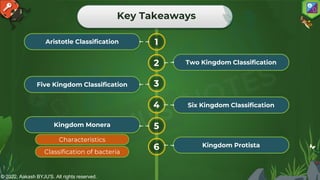
Key Takeaways
Aristotle Classification 1
Two Kingdom Classification
2
4
Five Kingdom Classification 3
Six Kingdom Classification
6
5
Kingdom Protista
Characteristics
Classification of bacteria
Kingdom Monera
© 2022, Aakash BYJU'S. All rights reserved.
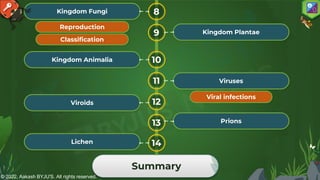
Summary
Kingdom Fungi 8
Kingdom Plantae
9
Kingdom Animalia 10
11
Viroids 12
Viruses
13
14
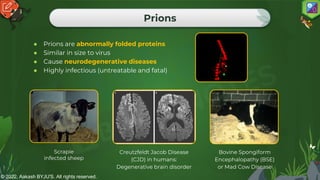
Prions
Reproduction
Classification
Lichen
Viral infections
© 2022, Aakash BYJU'S. All rights reserved.
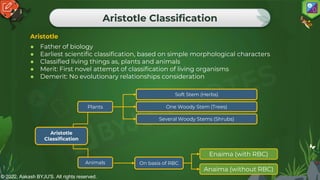
Aristotle Classification
Aristotle
● Father of biology
● Earliest scientific classification, based on simple morphological characters
● Classified living things as, plants and animals
● Merit: First novel attempt of classification of living organisms
● Demerit: No evolutionary relationships consideration
Several Woody Stems (Shrubs)
One Woody Stem (Trees)
Soft Stem (Herbs)
Enaima (with RBC)
Anaima (without RBC)
On basis of RBC
Animals
Plants
© 2022, Aakash BYJU'S. All rights reserved.
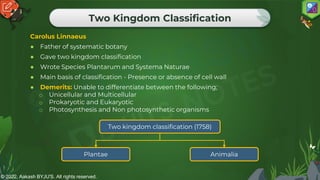
Two Kingdom Classification
Carolus Linnaeus
● Father of systematic botany
● Gave two kingdom classification
● Wrote Species Plantarum and Systema Naturae
● Main basis of classification - Presence or absence of cell wall
● Demerits: Unable to differentiate between the following;
o Unicellular and Multicellular
o Prokaryotic and Eukaryotic
o Photosynthesis and Non photosynthetic organisms
Plantae
Two kingdom classification (1758)
Animalia
© 2022, Aakash BYJU'S. All rights reserved.
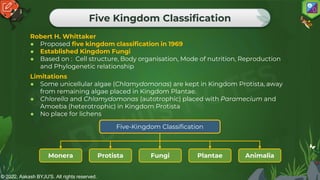
Five Kingdom Classification
Robert H. Whittaker
● Proposed five kingdom classification in 1969
● Established Kingdom Fungi
● Based on : Cell structure, Body organisation, Mode of nutrition, Reproduction
and Phylogenetic relationship
Limitations
● Some unicellular algae (Chlamydomonas) are kept in Kingdom Protista, away
from remaining algae placed in Kingdom Plantae.
● Chlorella and Chlamydomonas (autotrophic) placed with Paramecium and
Amoeba (heterotrophic) in Kingdom Protista
● No place for lichens
Monera
Five-Kingdom Classification
Animalia
Protista Fungi Plantae
© 2022, Aakash BYJU'S. All rights reserved.
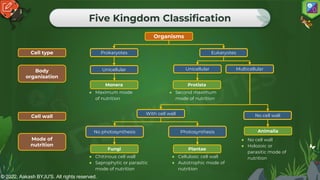
Five Kingdom Classification
Organisms
Eukaryotes
Prokaryotes
Unicellular Unicellular Multicellular
Monera Protista
With cell wall No cell wall
Animalia
No photosynthesis Photosynthesis
Plantae
Fungi
Cell type
Body
organisation
Cell wall
Mode of
nutrition
● Chitinous cell wall
● Saprophytic or parasitic
mode of nutrition
● Cellulosic cell wall
● Autotrophic mode of
nutrition
● No cell wall
● Holozoic or
parasitic mode of
nutrition
● Maximum mode
of nutrition
● Second maximum
mode of nutrition
© 2022, Aakash BYJU'S. All rights reserved.
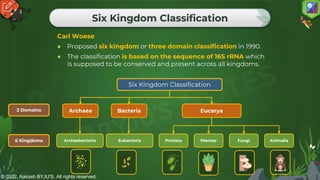
Six Kingdom Classification
Carl Woese
● Proposed six kingdom or three domain classification in 1990.
● The classification is based on the sequence of 16S rRNA which
is supposed to be conserved and present across all kingdoms.
Archaebacteria
Six Kingdom Classification
Eucarya
Archaea Bacteria
3 Domains
6 Kingdoms Eubacteria Protista Plantae Fungi Animalia
© 2022, Aakash BYJU'S. All rights reserved.
Kingdom Monera
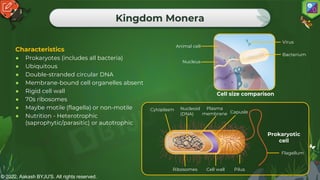
Characteristics
● Prokaryotes (includes all bacteria)
● Ubiquitous
● Double-stranded circular DNA
● Membrane-bound cell organelles absent
● Rigid cell wall
● 70s ribosomes
● Maybe motile (flagella) or non-motile
● Nutrition - Heterotrophic
(saprophytic/parasitic) or autotrophic
Cell size comparison
Animal cell
Nucleus
Virus
Bacterium
Pilus
Capusle
Flagellum
Cell wall
Plasma
membrane
Nucleoid
(DNA)
Ribosomes
Cytoplasm
Prokaryotic
cell
© 2022, Aakash BYJU'S. All rights reserved.
Kingdom Monera
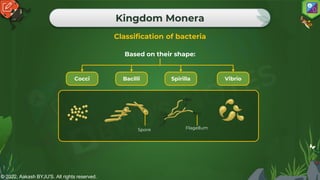
Classification of bacteria
Cocci Bacilli Spirilla Vibrio
Spore Flagellum
Based on their shape:
© 2022, Aakash BYJU'S. All rights reserved.
Kingdom Monera
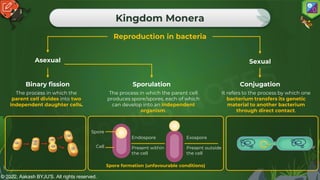
Reproduction in bacteria
Asexual Sexual
Binary fission Sporulation Conjugation
Endospore
Present within
the cell
Spore
Cell
Exospore
Present outside
the cell
Spore formation (unfavourable conditions)
The process in which the
parent cell divides into two
independent daughter cells.
The process in which the parent cell
produces spore/spores, each of which
can develop into an independent
organism.
It refers to the process by which one
bacterium transfers its genetic
material to another bacterium
through direct contact.
© 2022, Aakash BYJU'S. All rights reserved.
Kingdom Monera
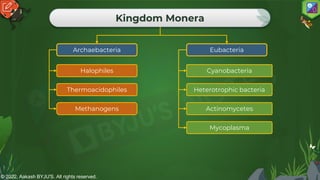
Archaebacteria Eubacteria
Halophiles
Thermoacidophiles
Methanogens
Cyanobacteria
Heterotrophic bacteria
Actinomycetes
Mycoplasma
© 2022, Aakash BYJU'S. All rights reserved.
Kingdom Monera
Archaebacteria
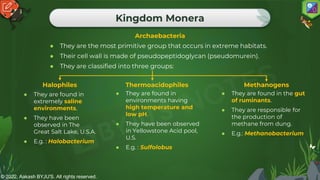
● They are the most primitive group that occurs in extreme habitats.
● Their cell wall is made of pseudopeptidoglycan (pseudomurein).
● They are classified into three groups:
Halophiles Thermoacidophiles Methanogens
● They are found in
extremely saline
environments.
● They have been
observed in The
Great Salt Lake, U.S.A.
● E.g. : Halobacterium
● They are found in
environments having
high temperature and
low pH.
● They have been observed
in Yellowstone Acid pool,
U.S.
● E.g. : Sulfolobus
● They are found in the gut
of ruminants.
● They are responsible for
the production of
methane from dung.
● E.g.: Methanobacterium
© 2022, Aakash BYJU'S. All rights reserved.
Kingdom Monera
Eubacteria
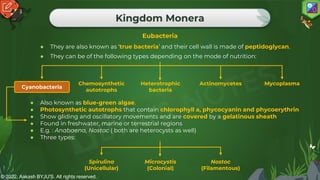
● They are also known as ‘true bacteria’ and their cell wall is made of peptidoglycan.
● They can be of the following types depending on the mode of nutrition:
Heterotrophic
bacteria
Mycoplasma
Actinomycetes
Chemosynthetic
autotrophs
● Also known as blue-green algae.
● Photosynthetic autotrophs that contain chlorophyll a, phycocyanin and phycoerythrin
● Show gliding and oscillatory movements and are covered by a gelatinous sheath
● Found in freshwater, marine or terrestrial regions
● E.g. : Anabaena, Nostoc ( both are heterocysts as well)
● Three types:
Microcystis
(Colonial)
Nostoc
(Filamentous)
Spirulina
(Unicellular)
Cyanobacteria
© 2022, Aakash BYJU'S. All rights reserved.
Kingdom Monera
Eubacteria
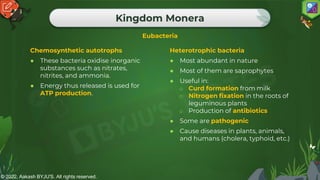
Chemosynthetic autotrophs
● These bacteria oxidise inorganic
substances such as nitrates,
nitrites, and ammonia.
● Energy thus released is used for
ATP production.
Heterotrophic bacteria
● Most abundant in nature
● Most of them are saprophytes
● Useful in:
o Curd formation from milk
o Nitrogen fixation in the roots of
leguminous plants
o Production of antibiotics
● Some are pathogenic
● Cause diseases in plants, animals,
and humans (cholera, typhoid, etc.)
© 2022, Aakash BYJU'S. All rights reserved.
Kingdom Monera
Eubacteria
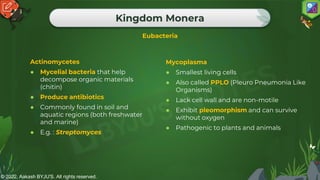
Actinomycetes
● Mycelial bacteria that help
decompose organic materials
(chitin)
● Produce antibiotics
● Commonly found in soil and
aquatic regions (both freshwater
and marine)
● E.g. : Streptomyces
Mycoplasma
● Smallest living cells
● Also called PPLO (Pleuro Pneumonia Like
Organisms)
● Lack cell wall and are non-motile
● Exhibit pleomorphism and can survive
without oxygen
● Pathogenic to plants and animals
© 2022, Aakash BYJU'S. All rights reserved.
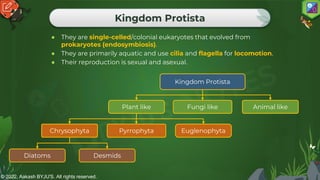
Kingdom Protista
● They are single-celled/colonial eukaryotes that evolved from
prokaryotes (endosymbiosis).
● They are primarily aquatic and use cilia and flagella for locomotion.
● Their reproduction is sexual and asexual.
Kingdom Protista
Plant like Fungi like Animal like
Chrysophyta Pyrrophyta Euglenophyta
Diatoms Desmids
© 2022, Aakash BYJU'S. All rights reserved.
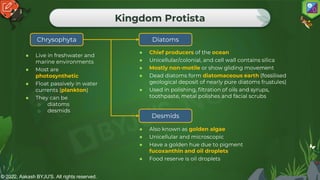
Kingdom Protista
● Live in freshwater and
marine environments
● Most are
photosynthetic
● Float passively in water
currents (plankton)
● They can be
o diatoms
o desmids
Chrysophyta Diatoms
Desmids
● Chief producers of the ocean
● Unicellular/colonial, and cell wall contains silica
● Mostly non-motile or show gliding movement
● Dead diatoms form diatomaceous earth (fossilised
geological deposit of nearly pure diatoms frustules)
● Used in polishing, filtration of oils and syrups,
toothpaste, metal polishes and facial scrubs
● Also known as golden algae
● Unicellular and microscopic
● Have a golden hue due to pigment
fucoxanthin and oil droplets
● Food reserve is oil droplets
© 2022, Aakash BYJU'S. All rights reserved.
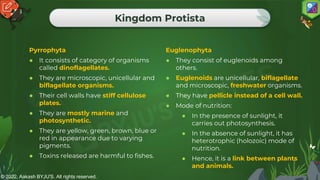
Kingdom Protista
Pyrrophyta
● It consists of category of organisms
called dinoflagellates.
● They are microscopic, unicellular and
biflagellate organisms.
● Their cell walls have stiff cellulose
plates.
● They are mostly marine and
photosynthetic.
● They are yellow, green, brown, blue or
red in appearance due to varying
pigments.
● Toxins released are harmful to fishes.
Euglenophyta
● They consist of euglenoids among
others.
● Euglenoids are unicellular, biflagellate
and microscopic, freshwater organisms.
● They have pellicle instead of a cell wall.
● Mode of nutrition:
● In the presence of sunlight, it
carries out photosynthesis.
● In the absence of sunlight, it has
heterotrophic (holozoic) mode of
nutrition.
● Hence, it is a link between plants
and animals.
© 2022, Aakash BYJU'S. All rights reserved.
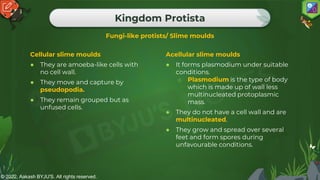
Kingdom Protista
Cellular slime moulds
● They are amoeba-like cells with
no cell wall.
● They move and capture by
pseudopodia.
● They remain grouped but as
unfused cells.
Acellular slime moulds
● It forms plasmodium under suitable
conditions.
o Plasmodium is the type of body
which is made up of wall less
multinucleated protoplasmic
mass.
● They do not have a cell wall and are
multinucleated.
● They grow and spread over several
feet and form spores during
unfavourable conditions.
Fungi-like protists/ Slime moulds
© 2022, Aakash BYJU'S. All rights reserved.
Kingdom Protista
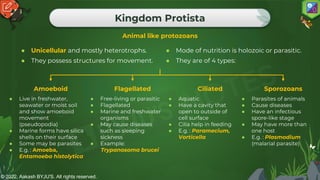
● Unicellular and mostly heterotrophs.
● They possess structures for movement.
Animal like protozoans
● Mode of nutrition is holozoic or parasitic.
● They are of 4 types:
● Live in freshwater,
seawater or moist soil
and show amoeboid
movement
(pseudopodia)
● Marine forms have silica
shells on their surface
● Some may be parasites
● E.g. : Amoeba,
Entamoeba histolytica
Amoeboid
● Free-living or parasitic
● Flagellated
● Marine and freshwater
organisms
● May cause diseases
such as sleeping
sickness
● Example:
Trypanosoma brucei
Flagellated
● Aquatic
● Have a cavity that
open to outside of
cell surface
● Cilia help in feeding
● E.g. : Paramecium,
Vorticella
Ciliated
● Parasites of animals
● Cause diseases
● Have an infectious
spore-like stage
● May have more than
one host
● E.g. : Plasmodium
(malarial parasite)
Sporozoans
© 2022, Aakash BYJU'S. All rights reserved.
Kingdom Fungi
Characteristics
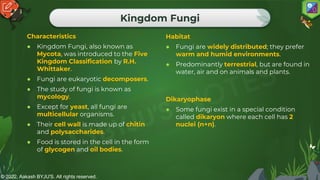
● Kingdom Fungi, also known as
Mycota, was introduced to the Five
Kingdom Classification by R.H.
Whittaker.
● Fungi are eukaryotic decomposers.
● The study of fungi is known as
mycology.
● Except for yeast, all fungi are
multicellular organisms.
● Their cell wall is made up of chitin
and polysaccharides.
● Food is stored in the cell in the form
of glycogen and oil bodies.
Habitat
● Fungi are widely distributed; they prefer
warm and humid environments.
● Predominantly terrestrial, but are found in
water, air and on animals and plants.
Dikaryophase
● Some fungi exist in a special condition
called dikaryon where each cell has 2
nuclei (n+n).
© 2022, Aakash BYJU'S. All rights reserved.
Kingdom Fungi
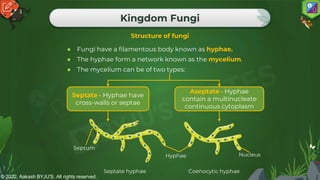
● Fungi have a filamentous body known as hyphae.
● The hyphae form a network known as the mycelium.
● The mycelium can be of two types:
Structure of fungi
Septate - Hyphae have
cross-walls or septae
Aseptate - Hyphae
contain a multinucleate
continuous cytoplasm
Septate hyphae Coenocytic hyphae
Septum
Nucleus
Hyphae
© 2022, Aakash BYJU'S. All rights reserved.
Kingdom Fungi
Mode of nutrition
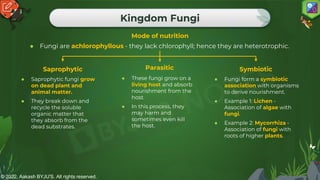
● Fungi are achlorophyllous - they lack chlorophyll; hence they are heterotrophic.
● Saprophytic fungi grow
on dead plant and
animal matter.
● They break down and
recycle the soluble
organic matter that
they absorb from the
dead substrates.
Saprophytic
● These fungi grow on a
living host and absorb
nourishment from the
host.
● In this process, they
may harm and
sometimes even kill
the host.
Parasitic
● Fungi form a symbiotic
association with organisms
to derive nourishment.
● Example 1: Lichen -
Association of algae with
fungi.
● Example 2: Mycorrhiza -
Association of fungi with
roots of higher plants.
Symbiotic
© 2022, Aakash BYJU'S. All rights reserved.
Kingdom Fungi
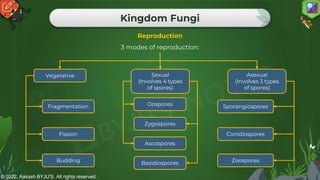
Reproduction
3 modes of reproduction:
Vegetative Sexual
(Involves 4 types
of spores)
Asexual
(Involves 3 types
of spores)
Fragmentation
Fission
Budding
Oospores
Zygospores
Ascospores
Basidiospores
Sporangiospores
Conidiospores
Zoospores
© 2022, Aakash BYJU'S. All rights reserved.
Kingdom Fungi
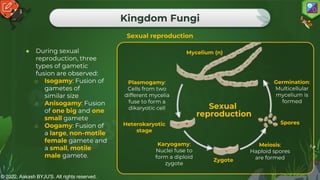
Sexual reproduction
● During sexual
reproduction, three
types of gametic
fusion are observed:
o Isogamy: Fusion of
gametes of
similar size
o Anisogamy: Fusion
of one big and one
small gamete
o Oogamy: Fusion of
a large, non-motile
female gamete and
a small, motile
male gamete.
Plasmogamy:
Cells from two
different mycelia
fuse to form a
dikaryotic cell
Karyogamy:
Nuclei fuse to
form a diploid
zygote
Meiosis:
Haploid spores
are formed
Germination:
Multicellular
mycelium is
formed
Mycelium (n)
Heterokaryotic
stage
Zygote
Spores
Sexual
reproduction
© 2022, Aakash BYJU'S. All rights reserved.
Kingdom Fungi
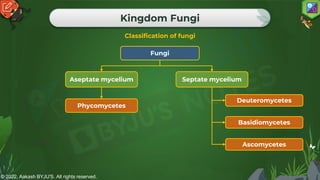
Classification of fungi
Fungi
Aseptate mycelium Septate mycelium
Ascomycetes
Basidiomycetes
Deuteromycetes
Phycomycetes
© 2022, Aakash BYJU'S. All rights reserved.
Classification of Fungi
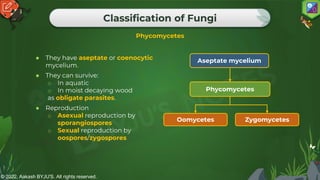
Phycomycetes
● They have aseptate or coenocytic
mycelium.
● They can survive:
o In aquatic
o In moist decaying wood
as obligate parasites.
● Reproduction
o Asexual reproduction by
sporangiospores
o Sexual reproduction by
oospores/zygospores
Aseptate mycelium
Phycomycetes
Oomycetes Zygomycetes
© 2022, Aakash BYJU'S. All rights reserved.
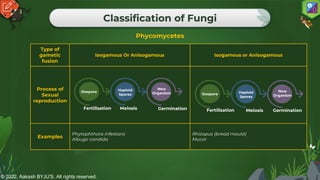
Classification of Fungi
Phycomycetes
Type of
gametic
fusion
Isogamous Or Anisogamous Isogamous or Anisogamous
Process of
Sexual
reproduction
Examples
Phytophthora infestans
Albugo candida
Rhizopus (bread mould)
Mucor
Fertilisation
Oospore
Meiosis
Haploid
Spores
Germination
New
Organism
Fertilisation
Oospore
Meiosis
Haploid
Spores
Germination
New
Organism
© 2022, Aakash BYJU'S. All rights reserved.
Classification of Fungi
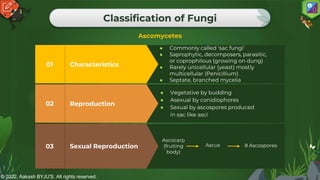
Ascomycetes
Sexual Reproduction
03
Reproduction
02
● Vegetative by budding
● Asexual by conidiophores
● Sexual by ascospores produced
in sac like asci
Characteristics
01
● Commonly called ‘sac fungi’
● Saprophytic, decomposers, parasitic,
or coprophilous (growing on dung)
● Rarely unicellular (yeast) mostly
multicellular (Penicillium)
● Septate, branched mycelia
Ascocarp
(fruiting
body)
Ascus 8 Ascospores
© 2022, Aakash BYJU'S. All rights reserved.
Classification of Fungi
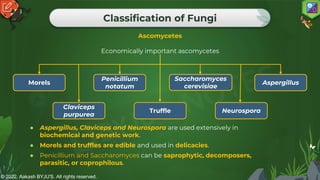
Ascomycetes
Economically important ascomycetes
Penicillium
notatum
Aspergillus
Saccharomyces
cerevisiae
Claviceps
purpurea
Neurospora
Morels
Truffle
● Aspergillus, Claviceps and Neurospora are used extensively in
biochemical and genetic work.
● Morels and truffles are edible and used in delicacies.
● Penicillium and Saccharomyces can be saprophytic, decomposers,
parasitic, or coprophilous.
© 2022, Aakash BYJU'S. All rights reserved.
Classification of Fungi
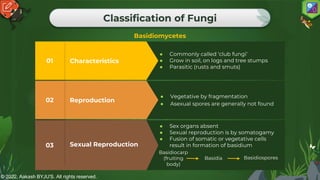
Basidiomycetes
Sexual Reproduction
03
Reproduction
02
● Vegetative by fragmentation
● Asexual spores are generally not found
Characteristics
01
● Commonly called ‘club fungi’
● Grow in soil, on logs and tree stumps
● Parasitic (rusts and smuts)
Basidiocarp
(fruiting
body)
Basidia Basidiospores
● Sex organs absent
● Sexual reproduction is by somatogamy
● Fusion of somatic or vegetative cells
result in formation of basidium
© 2022, Aakash BYJU'S. All rights reserved.
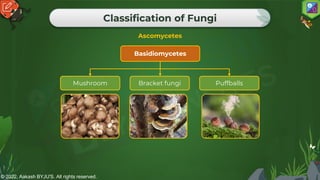
Classification of Fungi
Ascomycetes
Mushroom
Basidiomycetes
Puffballs
Bracket fungi
© 2022, Aakash BYJU'S. All rights reserved.
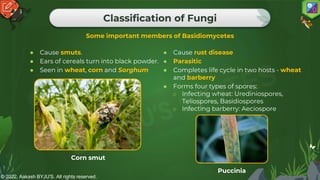
Classification of Fungi
Some important members of Basidiomycetes
● Cause smuts.
● Ears of cereals turn into black powder.
● Seen in wheat, corn and Sorghum
● Cause rust disease
● Parasitic
● Completes life cycle in two hosts - wheat
and barberry
● Forms four types of spores:
o Infecting wheat: Urediniospores,
Teliospores, Basidiospores
o Infecting barberry: Aeciospore
Corn smut
Puccinia
© 2022, Aakash BYJU'S. All rights reserved.
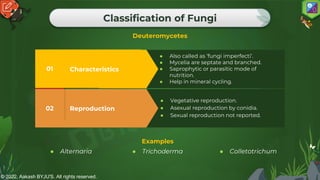
Classification of Fungi
Deuteromycetes
Reproduction
02
● Vegetative reproduction.
● Asexual reproduction by conidia.
● Sexual reproduction not reported.
Characteristics
01
● Also called as ‘fungi imperfecti’.
● Mycelia are septate and branched.
● Saprophytic or parasitic mode of
nutrition.
● Help in mineral cycling.
Examples
● Alternaria ● Trichoderma ● Colletotrichum
© 2022, Aakash BYJU'S. All rights reserved.
Kingdom Plantae
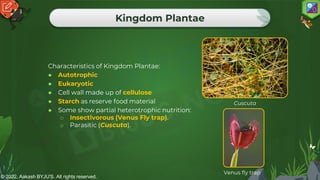
Characteristics of Kingdom Plantae:
● Autotrophic
● Eukaryotic
● Cell wall made up of cellulose
● Starch as reserve food material
● Some show partial heterotrophic nutrition:
o Insectivorous (Venus Fly trap).
o Parasitic (Cuscuta).
Venus fly trap
Cuscuta
© 2022, Aakash BYJU'S. All rights reserved.
Kingdom Plantae
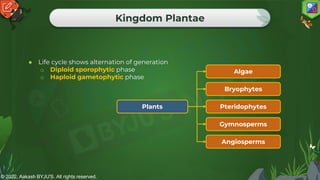
● Life cycle shows alternation of generation
o Diploid sporophytic phase
o Haploid gametophytic phase
Plants
Bryophytes
Pteridophytes
Gymnosperms
Angiosperms
Algae
© 2022, Aakash BYJU'S. All rights reserved.
Kingdom Animalia
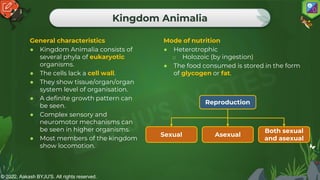
General characteristics
● Kingdom Animalia consists of
several phyla of eukaryotic
organisms.
● The cells lack a cell wall.
● They show tissue/organ/organ
system level of organisation.
● A definite growth pattern can
be seen.
● Complex sensory and
neuromotor mechanisms can
be seen in higher organisms.
● Most members of the kingdom
show locomotion.
Mode of nutrition
● Heterotrophic
o Holozoic (by ingestion)
● The food consumed is stored in the form
of glycogen or fat.
Reproduction
Sexual
Both sexual
and asexual
Asexual
© 2022, Aakash BYJU'S. All rights reserved.
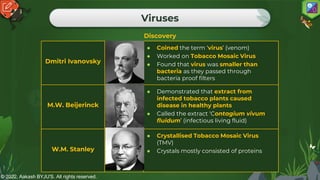
Viruses
Discovery
Dmitri Ivanovsky
● Coined the term ‘virus’ (venom)
● Worked on Tobacco Mosaic Virus
● Found that virus was smaller than
bacteria as they passed through
bacteria proof filters
M.W. Beijerinck
● Demonstrated that extract from
infected tobacco plants caused
disease in healthy plants
● Called the extract ‘Contagium vivum
fluidum’ (infectious living fluid)
W.M. Stanley
● Crystallised Tobacco Mosaic Virus
(TMV)
● Crystals mostly consisted of proteins
© 2022, Aakash BYJU'S. All rights reserved.
Viruses
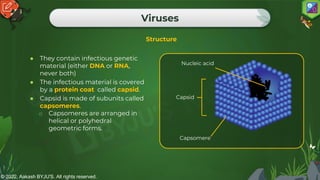
Structure
● They contain infectious genetic
material (either DNA or RNA,
never both)
● The infectious material is covered
by a protein coat called capsid.
● Capsid is made of subunits called
capsomeres.
o Capsomeres are arranged in
helical or polyhedral
geometric forms.
Nucleic acid
Capsid
Capsomere
© 2022, Aakash BYJU'S. All rights reserved.
Viruses
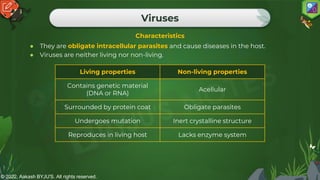
Characteristics
● They are obligate intracellular parasites and cause diseases in the host.
● Viruses are neither living nor non-living.
Living properties Non-living properties
Contains genetic material
(DNA or RNA)
Acellular
Surrounded by protein coat Obligate parasites
Undergoes mutation Inert crystalline structure
Reproduces in living host Lacks enzyme system
© 2022, Aakash BYJU'S. All rights reserved.
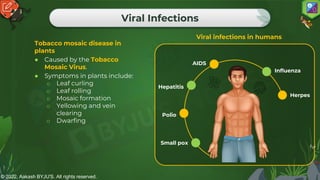
Viral Infections
Tobacco mosaic disease in
plants
● Caused by the Tobacco
Mosaic Virus.
● Symptoms in plants include:
o Leaf curling
o Leaf rolling
o Mosaic formation
o Yellowing and vein
clearing
o Dwarfing
Viral infections in humans
AIDS
Polio
Herpes
Small pox
Influenza
Hepatitis
© 2022, Aakash BYJU'S. All rights reserved.
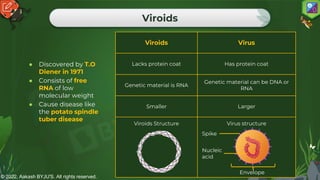
Viroids
● Discovered by T.O
Diener in 1971
● Consists of free
RNA of low
molecular weight
● Cause disease like
the potato spindle
tuber disease
Viroids Virus
Lacks protein coat Has protein coat
Genetic material is RNA
Genetic material can be DNA or
RNA
Smaller Larger
Viroids Structure Virus structure
Spike
Nucleic
acid
Envelope
© 2022, Aakash BYJU'S. All rights reserved.
Prions
● Prions are abnormally folded proteins
● Similar in size to virus
● Cause neurodegenerative diseases
● Highly infectious (untreatable and fatal)
Scrapie
infected sheep
Creutzfeldt Jacob Disease
(CJD) in humans:
Degenerative brain disorder
Bovine Spongiform
Encephalopathy (BSE)
or Mad Cow Disease
© 2022, Aakash BYJU'S. All rights reserved.
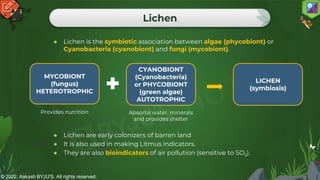
Lichen
● Lichen is the symbiotic association between algae (phycobiont) or
Cyanobacteria (cyanobiont) and fungi (mycobiont).
Provides nutrition Absorbs water, minerals
and provides shelter
● Lichen are early colonizers of barren land
● It is also used in making Litmus indicators.
● They are also bioindicators of air pollution (sensitive to SO2).
MYCOBIONT
(fungus)
HETEROTROPHIC
CYANOBIONT
(Cyanobacteria)
or PHYCOBIONT
(green algae)
AUTOTROPHIC
LICHEN
(symbiosis)
© 2022, Aakash BYJU'S. All rights reserved.
Summary
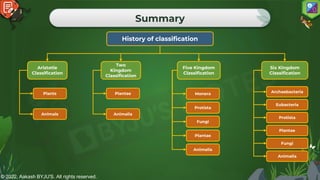
History of classification
Aristotle
Classification
Two
Kingdom
Classification
Six Kingdom
Classification
Plantae
Protista
Eubacteria
Archaebacteria
Animalia
Fungi
Animalia
Plantae
Animals
Plants
Five Kingdom
Classification
Plantae
Fungi
Protista
Monera
Animalia
© 2022, Aakash BYJU'S. All rights reserved.
Summary
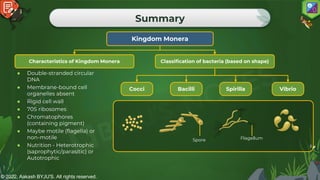
Kingdom Monera
Cocci Bacilli Spirilla Vibrio
Spore Flagellum
Classification of bacteria (based on shape)
Characteristics of Kingdom Monera
● Double-stranded circular
DNA
● Membrane-bound cell
organelles absent
● Rigid cell wall
● 70S ribosomes
● Chromatophores
(containing pigment)
● Maybe motile (flagella) or
non-motile
● Nutrition - Heterotrophic
(saprophytic/parasitic) or
Autotrophic
© 2022, Aakash BYJU'S. All rights reserved.
Summary
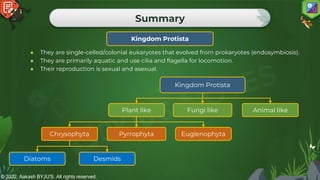
Kingdom Protista
● They are single-celled/colonial eukaryotes that evolved from prokaryotes (endosymbiosis).
● They are primarily aquatic and use cilia and flagella for locomotion.
● Their reproduction is sexual and asexual.
Kingdom Protista
Plant like Fungi like Animal like
Chrysophyta Pyrrophyta Euglenophyta
Diatoms Desmids
© 2022, Aakash BYJU'S. All rights reserved.
Summary
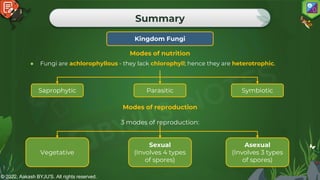
Kingdom Fungi
● Fungi are achlorophyllous - they lack chlorophyll; hence they are heterotrophic.
Modes of nutrition
Saprophytic Parasitic Symbiotic
Modes of reproduction
3 modes of reproduction:
Vegetative
Sexual
(Involves 4 types
of spores)
Asexual
(Involves 3 types
of spores)
© 2022, Aakash BYJU'S. All rights reserved.
Summary
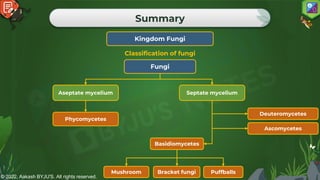
Kingdom Fungi
Classification of fungi
Fungi
Aseptate mycelium Septate mycelium
Ascomycetes
Basidiomycetes
Deuteromycetes
Phycomycetes
Puffballs
Bracket fungi
Mushroom
© 2022, Aakash BYJU'S. All rights reserved.
Summary
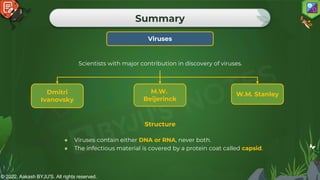
Viruses
Scientists with major contribution in discovery of viruses.
Dmitri
Ivanovsky
M.W.
Beijerinck
W.M. Stanley
● Viruses contain either DNA or RNA, never both.
● The infectious material is covered by a protein coat called capsid.​
Structure

Biological-Classification (1).pdf.......

  • 1.
    © 2022, AakashBYJU'S. All rights reserved. © 2022, Aakash BYJU'S. All rights reserved. Biological Classification
  • 2.
    © 2022, AakashBYJU'S. All rights reserved. Key Takeaways Aristotle Classification 1 Two Kingdom Classification 2 4 Five Kingdom Classification 3 Six Kingdom Classification 6 5 Kingdom Protista Characteristics Classification of bacteria Kingdom Monera
  • 3.
    © 2022, AakashBYJU'S. All rights reserved. Summary Kingdom Fungi 8 Kingdom Plantae 9 Kingdom Animalia 10 11 Viroids 12 Viruses 13 14 Prions Reproduction Classification Lichen Viral infections
  • 4.
    © 2022, AakashBYJU'S. All rights reserved. Aristotle Classification Aristotle ● Father of biology ● Earliest scientific classification, based on simple morphological characters ● Classified living things as, plants and animals ● Merit: First novel attempt of classification of living organisms ● Demerit: No evolutionary relationships consideration Several Woody Stems (Shrubs) One Woody Stem (Trees) Soft Stem (Herbs) Enaima (with RBC) Anaima (without RBC) On basis of RBC Animals Plants
  • 5.
    © 2022, AakashBYJU'S. All rights reserved. Two Kingdom Classification Carolus Linnaeus ● Father of systematic botany ● Gave two kingdom classification ● Wrote Species Plantarum and Systema Naturae ● Main basis of classification - Presence or absence of cell wall ● Demerits: Unable to differentiate between the following; o Unicellular and Multicellular o Prokaryotic and Eukaryotic o Photosynthesis and Non photosynthetic organisms Plantae Two kingdom classification (1758) Animalia
  • 6.
    © 2022, AakashBYJU'S. All rights reserved. Five Kingdom Classification Robert H. Whittaker ● Proposed five kingdom classification in 1969 ● Established Kingdom Fungi ● Based on : Cell structure, Body organisation, Mode of nutrition, Reproduction and Phylogenetic relationship Limitations ● Some unicellular algae (Chlamydomonas) are kept in Kingdom Protista, away from remaining algae placed in Kingdom Plantae. ● Chlorella and Chlamydomonas (autotrophic) placed with Paramecium and Amoeba (heterotrophic) in Kingdom Protista ● No place for lichens Monera Five-Kingdom Classification Animalia Protista Fungi Plantae
  • 7.
    © 2022, AakashBYJU'S. All rights reserved. Five Kingdom Classification Organisms Eukaryotes Prokaryotes Unicellular Unicellular Multicellular Monera Protista With cell wall No cell wall Animalia No photosynthesis Photosynthesis Plantae Fungi Cell type Body organisation Cell wall Mode of nutrition ● Chitinous cell wall ● Saprophytic or parasitic mode of nutrition ● Cellulosic cell wall ● Autotrophic mode of nutrition ● No cell wall ● Holozoic or parasitic mode of nutrition ● Maximum mode of nutrition ● Second maximum mode of nutrition
  • 8.
    © 2022, AakashBYJU'S. All rights reserved. Six Kingdom Classification Carl Woese ● Proposed six kingdom or three domain classification in 1990. ● The classification is based on the sequence of 16S rRNA which is supposed to be conserved and present across all kingdoms. Archaebacteria Six Kingdom Classification Eucarya Archaea Bacteria 3 Domains 6 Kingdoms Eubacteria Protista Plantae Fungi Animalia
  • 9.
    © 2022, AakashBYJU'S. All rights reserved. Kingdom Monera Characteristics ● Prokaryotes (includes all bacteria) ● Ubiquitous ● Double-stranded circular DNA ● Membrane-bound cell organelles absent ● Rigid cell wall ● 70s ribosomes ● Maybe motile (flagella) or non-motile ● Nutrition - Heterotrophic (saprophytic/parasitic) or autotrophic Cell size comparison Animal cell Nucleus Virus Bacterium Pilus Capusle Flagellum Cell wall Plasma membrane Nucleoid (DNA) Ribosomes Cytoplasm Prokaryotic cell
  • 10.
    © 2022, AakashBYJU'S. All rights reserved. Kingdom Monera Classification of bacteria Cocci Bacilli Spirilla Vibrio Spore Flagellum Based on their shape:
  • 11.
    © 2022, AakashBYJU'S. All rights reserved. Kingdom Monera Reproduction in bacteria Asexual Sexual Binary fission Sporulation Conjugation Endospore Present within the cell Spore Cell Exospore Present outside the cell Spore formation (unfavourable conditions) The process in which the parent cell divides into two independent daughter cells. The process in which the parent cell produces spore/spores, each of which can develop into an independent organism. It refers to the process by which one bacterium transfers its genetic material to another bacterium through direct contact.
  • 12.
    © 2022, AakashBYJU'S. All rights reserved. Kingdom Monera Archaebacteria Eubacteria Halophiles Thermoacidophiles Methanogens Cyanobacteria Heterotrophic bacteria Actinomycetes Mycoplasma
  • 13.
    © 2022, AakashBYJU'S. All rights reserved. Kingdom Monera Archaebacteria ● They are the most primitive group that occurs in extreme habitats. ● Their cell wall is made of pseudopeptidoglycan (pseudomurein). ● They are classified into three groups: Halophiles Thermoacidophiles Methanogens ● They are found in extremely saline environments. ● They have been observed in The Great Salt Lake, U.S.A. ● E.g. : Halobacterium ● They are found in environments having high temperature and low pH. ● They have been observed in Yellowstone Acid pool, U.S. ● E.g. : Sulfolobus ● They are found in the gut of ruminants. ● They are responsible for the production of methane from dung. ● E.g.: Methanobacterium
  • 14.
    © 2022, AakashBYJU'S. All rights reserved. Kingdom Monera Eubacteria ● They are also known as ‘true bacteria’ and their cell wall is made of peptidoglycan. ● They can be of the following types depending on the mode of nutrition: Heterotrophic bacteria Mycoplasma Actinomycetes Chemosynthetic autotrophs ● Also known as blue-green algae. ● Photosynthetic autotrophs that contain chlorophyll a, phycocyanin and phycoerythrin ● Show gliding and oscillatory movements and are covered by a gelatinous sheath ● Found in freshwater, marine or terrestrial regions ● E.g. : Anabaena, Nostoc ( both are heterocysts as well) ● Three types: Microcystis (Colonial) Nostoc (Filamentous) Spirulina (Unicellular) Cyanobacteria
  • 15.
    © 2022, AakashBYJU'S. All rights reserved. Kingdom Monera Eubacteria Chemosynthetic autotrophs ● These bacteria oxidise inorganic substances such as nitrates, nitrites, and ammonia. ● Energy thus released is used for ATP production. Heterotrophic bacteria ● Most abundant in nature ● Most of them are saprophytes ● Useful in: o Curd formation from milk o Nitrogen fixation in the roots of leguminous plants o Production of antibiotics ● Some are pathogenic ● Cause diseases in plants, animals, and humans (cholera, typhoid, etc.)
  • 16.
    © 2022, AakashBYJU'S. All rights reserved. Kingdom Monera Eubacteria Actinomycetes ● Mycelial bacteria that help decompose organic materials (chitin) ● Produce antibiotics ● Commonly found in soil and aquatic regions (both freshwater and marine) ● E.g. : Streptomyces Mycoplasma ● Smallest living cells ● Also called PPLO (Pleuro Pneumonia Like Organisms) ● Lack cell wall and are non-motile ● Exhibit pleomorphism and can survive without oxygen ● Pathogenic to plants and animals
  • 17.
    © 2022, AakashBYJU'S. All rights reserved. Kingdom Protista ● They are single-celled/colonial eukaryotes that evolved from prokaryotes (endosymbiosis). ● They are primarily aquatic and use cilia and flagella for locomotion. ● Their reproduction is sexual and asexual. Kingdom Protista Plant like Fungi like Animal like Chrysophyta Pyrrophyta Euglenophyta Diatoms Desmids
  • 18.
    © 2022, AakashBYJU'S. All rights reserved. Kingdom Protista ● Live in freshwater and marine environments ● Most are photosynthetic ● Float passively in water currents (plankton) ● They can be o diatoms o desmids Chrysophyta Diatoms Desmids ● Chief producers of the ocean ● Unicellular/colonial, and cell wall contains silica ● Mostly non-motile or show gliding movement ● Dead diatoms form diatomaceous earth (fossilised geological deposit of nearly pure diatoms frustules) ● Used in polishing, filtration of oils and syrups, toothpaste, metal polishes and facial scrubs ● Also known as golden algae ● Unicellular and microscopic ● Have a golden hue due to pigment fucoxanthin and oil droplets ● Food reserve is oil droplets
  • 19.
    © 2022, AakashBYJU'S. All rights reserved. Kingdom Protista Pyrrophyta ● It consists of category of organisms called dinoflagellates. ● They are microscopic, unicellular and biflagellate organisms. ● Their cell walls have stiff cellulose plates. ● They are mostly marine and photosynthetic. ● They are yellow, green, brown, blue or red in appearance due to varying pigments. ● Toxins released are harmful to fishes. Euglenophyta ● They consist of euglenoids among others. ● Euglenoids are unicellular, biflagellate and microscopic, freshwater organisms. ● They have pellicle instead of a cell wall. ● Mode of nutrition: ● In the presence of sunlight, it carries out photosynthesis. ● In the absence of sunlight, it has heterotrophic (holozoic) mode of nutrition. ● Hence, it is a link between plants and animals.
  • 20.
    © 2022, AakashBYJU'S. All rights reserved. Kingdom Protista Cellular slime moulds ● They are amoeba-like cells with no cell wall. ● They move and capture by pseudopodia. ● They remain grouped but as unfused cells. Acellular slime moulds ● It forms plasmodium under suitable conditions. o Plasmodium is the type of body which is made up of wall less multinucleated protoplasmic mass. ● They do not have a cell wall and are multinucleated. ● They grow and spread over several feet and form spores during unfavourable conditions. Fungi-like protists/ Slime moulds
  • 21.
    © 2022, AakashBYJU'S. All rights reserved. Kingdom Protista ● Unicellular and mostly heterotrophs. ● They possess structures for movement. Animal like protozoans ● Mode of nutrition is holozoic or parasitic. ● They are of 4 types: ● Live in freshwater, seawater or moist soil and show amoeboid movement (pseudopodia) ● Marine forms have silica shells on their surface ● Some may be parasites ● E.g. : Amoeba, Entamoeba histolytica Amoeboid ● Free-living or parasitic ● Flagellated ● Marine and freshwater organisms ● May cause diseases such as sleeping sickness ● Example: Trypanosoma brucei Flagellated ● Aquatic ● Have a cavity that open to outside of cell surface ● Cilia help in feeding ● E.g. : Paramecium, Vorticella Ciliated ● Parasites of animals ● Cause diseases ● Have an infectious spore-like stage ● May have more than one host ● E.g. : Plasmodium (malarial parasite) Sporozoans
  • 22.
    © 2022, AakashBYJU'S. All rights reserved. Kingdom Fungi Characteristics ● Kingdom Fungi, also known as Mycota, was introduced to the Five Kingdom Classification by R.H. Whittaker. ● Fungi are eukaryotic decomposers. ● The study of fungi is known as mycology. ● Except for yeast, all fungi are multicellular organisms. ● Their cell wall is made up of chitin and polysaccharides. ● Food is stored in the cell in the form of glycogen and oil bodies. Habitat ● Fungi are widely distributed; they prefer warm and humid environments. ● Predominantly terrestrial, but are found in water, air and on animals and plants. Dikaryophase ● Some fungi exist in a special condition called dikaryon where each cell has 2 nuclei (n+n).
  • 23.
    © 2022, AakashBYJU'S. All rights reserved. Kingdom Fungi ● Fungi have a filamentous body known as hyphae. ● The hyphae form a network known as the mycelium. ● The mycelium can be of two types: Structure of fungi Septate - Hyphae have cross-walls or septae Aseptate - Hyphae contain a multinucleate continuous cytoplasm Septate hyphae Coenocytic hyphae Septum Nucleus Hyphae
  • 24.
    © 2022, AakashBYJU'S. All rights reserved. Kingdom Fungi Mode of nutrition ● Fungi are achlorophyllous - they lack chlorophyll; hence they are heterotrophic. ● Saprophytic fungi grow on dead plant and animal matter. ● They break down and recycle the soluble organic matter that they absorb from the dead substrates. Saprophytic ● These fungi grow on a living host and absorb nourishment from the host. ● In this process, they may harm and sometimes even kill the host. Parasitic ● Fungi form a symbiotic association with organisms to derive nourishment. ● Example 1: Lichen - Association of algae with fungi. ● Example 2: Mycorrhiza - Association of fungi with roots of higher plants. Symbiotic
  • 25.
    © 2022, AakashBYJU'S. All rights reserved. Kingdom Fungi Reproduction 3 modes of reproduction: Vegetative Sexual (Involves 4 types of spores) Asexual (Involves 3 types of spores) Fragmentation Fission Budding Oospores Zygospores Ascospores Basidiospores Sporangiospores Conidiospores Zoospores
  • 26.
    © 2022, AakashBYJU'S. All rights reserved. Kingdom Fungi Sexual reproduction ● During sexual reproduction, three types of gametic fusion are observed: o Isogamy: Fusion of gametes of similar size o Anisogamy: Fusion of one big and one small gamete o Oogamy: Fusion of a large, non-motile female gamete and a small, motile male gamete. Plasmogamy: Cells from two different mycelia fuse to form a dikaryotic cell Karyogamy: Nuclei fuse to form a diploid zygote Meiosis: Haploid spores are formed Germination: Multicellular mycelium is formed Mycelium (n) Heterokaryotic stage Zygote Spores Sexual reproduction
  • 27.
    © 2022, AakashBYJU'S. All rights reserved. Kingdom Fungi Classification of fungi Fungi Aseptate mycelium Septate mycelium Ascomycetes Basidiomycetes Deuteromycetes Phycomycetes
  • 28.
    © 2022, AakashBYJU'S. All rights reserved. Classification of Fungi Phycomycetes ● They have aseptate or coenocytic mycelium. ● They can survive: o In aquatic o In moist decaying wood as obligate parasites. ● Reproduction o Asexual reproduction by sporangiospores o Sexual reproduction by oospores/zygospores Aseptate mycelium Phycomycetes Oomycetes Zygomycetes
  • 29.
    © 2022, AakashBYJU'S. All rights reserved. Classification of Fungi Phycomycetes Type of gametic fusion Isogamous Or Anisogamous Isogamous or Anisogamous Process of Sexual reproduction Examples Phytophthora infestans Albugo candida Rhizopus (bread mould) Mucor Fertilisation Oospore Meiosis Haploid Spores Germination New Organism Fertilisation Oospore Meiosis Haploid Spores Germination New Organism
  • 30.
    © 2022, AakashBYJU'S. All rights reserved. Classification of Fungi Ascomycetes Sexual Reproduction 03 Reproduction 02 ● Vegetative by budding ● Asexual by conidiophores ● Sexual by ascospores produced in sac like asci Characteristics 01 ● Commonly called ‘sac fungi’ ● Saprophytic, decomposers, parasitic, or coprophilous (growing on dung) ● Rarely unicellular (yeast) mostly multicellular (Penicillium) ● Septate, branched mycelia Ascocarp (fruiting body) Ascus 8 Ascospores
  • 31.
    © 2022, AakashBYJU'S. All rights reserved. Classification of Fungi Ascomycetes Economically important ascomycetes Penicillium notatum Aspergillus Saccharomyces cerevisiae Claviceps purpurea Neurospora Morels Truffle ● Aspergillus, Claviceps and Neurospora are used extensively in biochemical and genetic work. ● Morels and truffles are edible and used in delicacies. ● Penicillium and Saccharomyces can be saprophytic, decomposers, parasitic, or coprophilous.
  • 32.
    © 2022, AakashBYJU'S. All rights reserved. Classification of Fungi Basidiomycetes Sexual Reproduction 03 Reproduction 02 ● Vegetative by fragmentation ● Asexual spores are generally not found Characteristics 01 ● Commonly called ‘club fungi’ ● Grow in soil, on logs and tree stumps ● Parasitic (rusts and smuts) Basidiocarp (fruiting body) Basidia Basidiospores ● Sex organs absent ● Sexual reproduction is by somatogamy ● Fusion of somatic or vegetative cells result in formation of basidium
  • 33.
    © 2022, AakashBYJU'S. All rights reserved. Classification of Fungi Ascomycetes Mushroom Basidiomycetes Puffballs Bracket fungi
  • 34.
    © 2022, AakashBYJU'S. All rights reserved. Classification of Fungi Some important members of Basidiomycetes ● Cause smuts. ● Ears of cereals turn into black powder. ● Seen in wheat, corn and Sorghum ● Cause rust disease ● Parasitic ● Completes life cycle in two hosts - wheat and barberry ● Forms four types of spores: o Infecting wheat: Urediniospores, Teliospores, Basidiospores o Infecting barberry: Aeciospore Corn smut Puccinia
  • 35.
    © 2022, AakashBYJU'S. All rights reserved. Classification of Fungi Deuteromycetes Reproduction 02 ● Vegetative reproduction. ● Asexual reproduction by conidia. ● Sexual reproduction not reported. Characteristics 01 ● Also called as ‘fungi imperfecti’. ● Mycelia are septate and branched. ● Saprophytic or parasitic mode of nutrition. ● Help in mineral cycling. Examples ● Alternaria ● Trichoderma ● Colletotrichum
  • 36.
    © 2022, AakashBYJU'S. All rights reserved. Kingdom Plantae Characteristics of Kingdom Plantae: ● Autotrophic ● Eukaryotic ● Cell wall made up of cellulose ● Starch as reserve food material ● Some show partial heterotrophic nutrition: o Insectivorous (Venus Fly trap). o Parasitic (Cuscuta). Venus fly trap Cuscuta
  • 37.
    © 2022, AakashBYJU'S. All rights reserved. Kingdom Plantae ● Life cycle shows alternation of generation o Diploid sporophytic phase o Haploid gametophytic phase Plants Bryophytes Pteridophytes Gymnosperms Angiosperms Algae
  • 38.
    © 2022, AakashBYJU'S. All rights reserved. Kingdom Animalia General characteristics ● Kingdom Animalia consists of several phyla of eukaryotic organisms. ● The cells lack a cell wall. ● They show tissue/organ/organ system level of organisation. ● A definite growth pattern can be seen. ● Complex sensory and neuromotor mechanisms can be seen in higher organisms. ● Most members of the kingdom show locomotion. Mode of nutrition ● Heterotrophic o Holozoic (by ingestion) ● The food consumed is stored in the form of glycogen or fat. Reproduction Sexual Both sexual and asexual Asexual
  • 39.
    © 2022, AakashBYJU'S. All rights reserved. Viruses Discovery Dmitri Ivanovsky ● Coined the term ‘virus’ (venom) ● Worked on Tobacco Mosaic Virus ● Found that virus was smaller than bacteria as they passed through bacteria proof filters M.W. Beijerinck ● Demonstrated that extract from infected tobacco plants caused disease in healthy plants ● Called the extract ‘Contagium vivum fluidum’ (infectious living fluid) W.M. Stanley ● Crystallised Tobacco Mosaic Virus (TMV) ● Crystals mostly consisted of proteins
  • 40.
    © 2022, AakashBYJU'S. All rights reserved. Viruses Structure ● They contain infectious genetic material (either DNA or RNA, never both) ● The infectious material is covered by a protein coat called capsid. ● Capsid is made of subunits called capsomeres. o Capsomeres are arranged in helical or polyhedral geometric forms. Nucleic acid Capsid Capsomere
  • 41.
    © 2022, AakashBYJU'S. All rights reserved. Viruses Characteristics ● They are obligate intracellular parasites and cause diseases in the host. ● Viruses are neither living nor non-living. Living properties Non-living properties Contains genetic material (DNA or RNA) Acellular Surrounded by protein coat Obligate parasites Undergoes mutation Inert crystalline structure Reproduces in living host Lacks enzyme system
  • 42.
    © 2022, AakashBYJU'S. All rights reserved. Viral Infections Tobacco mosaic disease in plants ● Caused by the Tobacco Mosaic Virus. ● Symptoms in plants include: o Leaf curling o Leaf rolling o Mosaic formation o Yellowing and vein clearing o Dwarfing Viral infections in humans AIDS Polio Herpes Small pox Influenza Hepatitis
  • 43.
    © 2022, AakashBYJU'S. All rights reserved. Viroids ● Discovered by T.O Diener in 1971 ● Consists of free RNA of low molecular weight ● Cause disease like the potato spindle tuber disease Viroids Virus Lacks protein coat Has protein coat Genetic material is RNA Genetic material can be DNA or RNA Smaller Larger Viroids Structure Virus structure Spike Nucleic acid Envelope
  • 44.
    © 2022, AakashBYJU'S. All rights reserved. Prions ● Prions are abnormally folded proteins ● Similar in size to virus ● Cause neurodegenerative diseases ● Highly infectious (untreatable and fatal) Scrapie infected sheep Creutzfeldt Jacob Disease (CJD) in humans: Degenerative brain disorder Bovine Spongiform Encephalopathy (BSE) or Mad Cow Disease
  • 45.
    © 2022, AakashBYJU'S. All rights reserved. Lichen ● Lichen is the symbiotic association between algae (phycobiont) or Cyanobacteria (cyanobiont) and fungi (mycobiont). Provides nutrition Absorbs water, minerals and provides shelter ● Lichen are early colonizers of barren land ● It is also used in making Litmus indicators. ● They are also bioindicators of air pollution (sensitive to SO2). MYCOBIONT (fungus) HETEROTROPHIC CYANOBIONT (Cyanobacteria) or PHYCOBIONT (green algae) AUTOTROPHIC LICHEN (symbiosis)
  • 46.
    © 2022, AakashBYJU'S. All rights reserved. Summary History of classification Aristotle Classification Two Kingdom Classification Six Kingdom Classification Plantae Protista Eubacteria Archaebacteria Animalia Fungi Animalia Plantae Animals Plants Five Kingdom Classification Plantae Fungi Protista Monera Animalia
  • 47.
    © 2022, AakashBYJU'S. All rights reserved. Summary Kingdom Monera Cocci Bacilli Spirilla Vibrio Spore Flagellum Classification of bacteria (based on shape) Characteristics of Kingdom Monera ● Double-stranded circular DNA ● Membrane-bound cell organelles absent ● Rigid cell wall ● 70S ribosomes ● Chromatophores (containing pigment) ● Maybe motile (flagella) or non-motile ● Nutrition - Heterotrophic (saprophytic/parasitic) or Autotrophic
  • 48.
    © 2022, AakashBYJU'S. All rights reserved. Summary Kingdom Protista ● They are single-celled/colonial eukaryotes that evolved from prokaryotes (endosymbiosis). ● They are primarily aquatic and use cilia and flagella for locomotion. ● Their reproduction is sexual and asexual. Kingdom Protista Plant like Fungi like Animal like Chrysophyta Pyrrophyta Euglenophyta Diatoms Desmids
  • 49.
    © 2022, AakashBYJU'S. All rights reserved. Summary Kingdom Fungi ● Fungi are achlorophyllous - they lack chlorophyll; hence they are heterotrophic. Modes of nutrition Saprophytic Parasitic Symbiotic Modes of reproduction 3 modes of reproduction: Vegetative Sexual (Involves 4 types of spores) Asexual (Involves 3 types of spores)
  • 50.
    © 2022, AakashBYJU'S. All rights reserved. Summary Kingdom Fungi Classification of fungi Fungi Aseptate mycelium Septate mycelium Ascomycetes Basidiomycetes Deuteromycetes Phycomycetes Puffballs Bracket fungi Mushroom
  • 51.
    © 2022, AakashBYJU'S. All rights reserved. Summary Viruses Scientists with major contribution in discovery of viruses. Dmitri Ivanovsky M.W. Beijerinck W.M. Stanley ● Viruses contain either DNA or RNA, never both. ● The infectious material is covered by a protein coat called capsid.​ Structure