
The university of Georgia
Atheer ahmed 1330129
Hematology
THALASSEMIA
THALASSEMIA
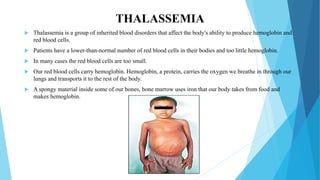
 Thalassemia is a group of inherited blood disorders that affect the body's ability to produce hemoglobin and
red blood cells.
 Patients have a lower-than-normal number of red blood cells in their bodies and too little hemoglobin.
 In many cases the red blood cells are too small.
 Our red blood cells carry hemoglobin. Hemoglobin, a protein, carries the oxygen we breathe in through our
lungs and transports it to the rest of the body.
 A spongy material inside some of our bones, bone marrow uses iron that our body takes from food and
makes hemoglobin.
Types of Thalassemia
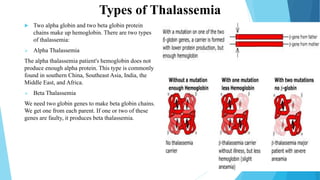
 Two alpha globin and two beta globin protein
chains make up hemoglobin. There are two types
of thalassemia:
 Alpha Thalassemia
The alpha thalassemia patient's hemoglobin does not
produce enough alpha protein. This type is commonly
found in southern China, Southeast Asia, India, the
Middle East, and Africa.
 Beta Thalassemia
We need two globin genes to make beta globin chains.
We get one from each parent. If one or two of these
genes are faulty, it produces beta thalassemia.
Signs and Symptoms Of Thalassemia
 Signs And Symptoms Of Thalassemia
a) The majority of infants with beta thalassemia will not have symptoms until they reach six months, because
they start off with a different type of hemoglobin called fetal hemoglobin. After the age of six months
"normal" hemoglobin starts replacing the fetal one.
b) People with thalassemia mainly have anemia-like symptoms.
i. Jaundice
ii. Fatigue
iii. Pale skin
iv. Cold hands and feet
v. Shortness of breath
Diagnosing Thalassemia
 Most children with moderate to severe thalassemia are diagnosed by the end of their second year.
 People with no symptoms may not realize until they have a child with thalassemia and are then diagnosed as
carriers.
 If the doctor suspects thalassemia, certain blood tests may be ordered:
a) A complete blood count (CBC)
b) Iron
c) Genetic testing
Treatment options for Thalassemia
 Blood transfusions
This is done to replenish hemoglobin and red blood cell levels. Patients with moderate to severe thalassemia will
have repeat transfusions every 4 months, while those with more severe disease may require transfusions every
two to four weeks. Patients with mild symptoms may require occasional transfusions when they are ill or have
an infection.
 Iron chelation
This involves removing excess iron from the bloodstream. Sometimes blood transfusions can cause iron
overload. Iron overload is bad for the heart and some other organs. Patients may be prescribed subcutaneous
(injected under the skin) deferoxamine or oral (taken by mouth) deferasirox.
Prevention of Thalassaemia
 Public education
ƒCarrier screening
Genetic counseling
Prenatal Diagnosis
References
http://www.medicalnewstoday.com/articles/263489.php
http://www.healthcentral.com/encyclopedia/408/477.html
http://www.continentalhospitals.com/encyclopedia/t/thalassemia
Case study on Tribals
http://ispub.com/IJBA/1/2/5492
Any question
Thankyou

thalassemia

  • 1.
    The university ofGeorgia Atheer ahmed 1330129 Hematology THALASSEMIA
  • 2.
    THALASSEMIA  Thalassemia isa group of inherited blood disorders that affect the body's ability to produce hemoglobin and red blood cells.  Patients have a lower-than-normal number of red blood cells in their bodies and too little hemoglobin.  In many cases the red blood cells are too small.  Our red blood cells carry hemoglobin. Hemoglobin, a protein, carries the oxygen we breathe in through our lungs and transports it to the rest of the body.  A spongy material inside some of our bones, bone marrow uses iron that our body takes from food and makes hemoglobin.
  • 3.
    Types of Thalassemia Two alpha globin and two beta globin protein chains make up hemoglobin. There are two types of thalassemia:  Alpha Thalassemia The alpha thalassemia patient's hemoglobin does not produce enough alpha protein. This type is commonly found in southern China, Southeast Asia, India, the Middle East, and Africa.  Beta Thalassemia We need two globin genes to make beta globin chains. We get one from each parent. If one or two of these genes are faulty, it produces beta thalassemia.
  • 4.
    Signs and SymptomsOf Thalassemia  Signs And Symptoms Of Thalassemia a) The majority of infants with beta thalassemia will not have symptoms until they reach six months, because they start off with a different type of hemoglobin called fetal hemoglobin. After the age of six months "normal" hemoglobin starts replacing the fetal one. b) People with thalassemia mainly have anemia-like symptoms. i. Jaundice ii. Fatigue iii. Pale skin iv. Cold hands and feet v. Shortness of breath
  • 5.
    Diagnosing Thalassemia  Mostchildren with moderate to severe thalassemia are diagnosed by the end of their second year.  People with no symptoms may not realize until they have a child with thalassemia and are then diagnosed as carriers.  If the doctor suspects thalassemia, certain blood tests may be ordered: a) A complete blood count (CBC) b) Iron c) Genetic testing
  • 6.
    Treatment options forThalassemia  Blood transfusions This is done to replenish hemoglobin and red blood cell levels. Patients with moderate to severe thalassemia will have repeat transfusions every 4 months, while those with more severe disease may require transfusions every two to four weeks. Patients with mild symptoms may require occasional transfusions when they are ill or have an infection.  Iron chelation This involves removing excess iron from the bloodstream. Sometimes blood transfusions can cause iron overload. Iron overload is bad for the heart and some other organs. Patients may be prescribed subcutaneous (injected under the skin) deferoxamine or oral (taken by mouth) deferasirox.
  • 7.
    Prevention of Thalassaemia Public education ƒCarrier screening Genetic counseling Prenatal Diagnosis
  • 8.
  • 9.
  • 10.