



The university of Georgia
Pediatric Dentistry IV (Endodontics)
Atheer Ahmed 1330129
Root canal filling materials in pediatric dentistry
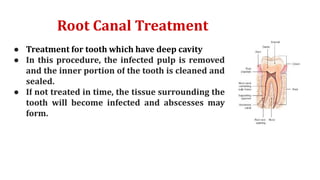
● Treatment for tooth which have deep cavity
● In this procedure, the infected pulp is removed
and the inner portion of the tooth is cleaned and
sealed.
● If not treated in time, the tissue surrounding the
tooth will become infected and abscesses may
form.
Root Canal Treatment
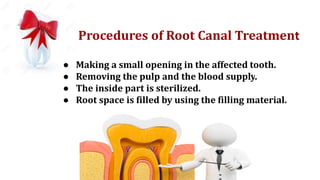
● Making a small opening in the affected tooth.
● Removing the pulp and the blood supply.
● The inside part is sterilized.
● Root space is filled by using the filling material.
Procedures of Root Canal Treatment
Step-by-Step Endodontic Procedure
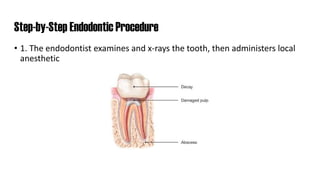
• 1. The endodontist examines and x-rays the tooth, then administers local
anesthetic
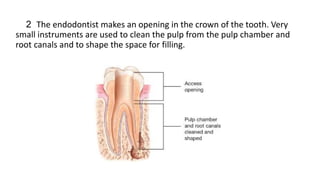
2 The endodontist makes an opening in the crown of the tooth. Very
small instruments are used to clean the pulp from the pulp chamber and
root canals and to shape the space for filling.
• 3. After the space is cleaned and shaped, the endodontist fills the root
canals with a biocompatible material, usually a rubber-like material called
gutta-percha. The gutta-percha is placed with an adhesive cement to
ensure complete sealing of the root canals. In most cases, a temporary
filling is placed to close the opening. The temporary filling will be removed
by your dentist before the tooth is restored.
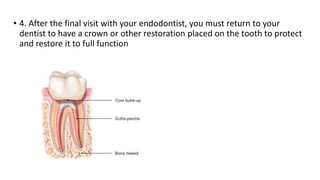
• 4. After the final visit with your endodontist, you must return to your
dentist to have a crown or other restoration placed on the tooth to protect
and restore it to full function
Advantages of Root Canal Treatment
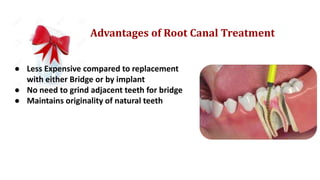
● Less Expensive compared to replacement
with either Bridge or by implant
● No need to grind adjacent teeth for bridge
● Maintains originality of natural teeth
Reference
• WWW.GOOGLE.COM
American Association of Endodontists
endodontic treatmet & filling root

endodontic treatmet & filling root

  • 1.
    The university ofGeorgia Pediatric Dentistry IV (Endodontics) Atheer Ahmed 1330129 Root canal filling materials in pediatric dentistry
  • 2.
    ● Treatment fortooth which have deep cavity ● In this procedure, the infected pulp is removed and the inner portion of the tooth is cleaned and sealed. ● If not treated in time, the tissue surrounding the tooth will become infected and abscesses may form. Root Canal Treatment
  • 3.
    ● Making asmall opening in the affected tooth. ● Removing the pulp and the blood supply. ● The inside part is sterilized. ● Root space is filled by using the filling material. Procedures of Root Canal Treatment
  • 4.
    Step-by-Step Endodontic Procedure •1. The endodontist examines and x-rays the tooth, then administers local anesthetic
  • 5.
    2 The endodontistmakes an opening in the crown of the tooth. Very small instruments are used to clean the pulp from the pulp chamber and root canals and to shape the space for filling.
  • 6.
    • 3. Afterthe space is cleaned and shaped, the endodontist fills the root canals with a biocompatible material, usually a rubber-like material called gutta-percha. The gutta-percha is placed with an adhesive cement to ensure complete sealing of the root canals. In most cases, a temporary filling is placed to close the opening. The temporary filling will be removed by your dentist before the tooth is restored.
  • 7.
    • 4. Afterthe final visit with your endodontist, you must return to your dentist to have a crown or other restoration placed on the tooth to protect and restore it to full function
  • 8.
    Advantages of RootCanal Treatment ● Less Expensive compared to replacement with either Bridge or by implant ● No need to grind adjacent teeth for bridge ● Maintains originality of natural teeth
  • 9.