The universiTy of GeorGia
1
aTheer ahmed 1330129
Professional CommuniCaTion
The endoCrine sysTem
Overview of the Endocrine System
 System of ductless glands that secrete
hormones
 Hormones are “messenger molecules”
 Circulate in the blood
 Act on distant target cells
 Target cells respond to the hormones for which they
have receptors
 The effects are dependent on the programmed
response of the target cells
 Hormones are just molecular triggers
 Basic categories of hormones
 Amino acid based: modified amino acids (or amines),
peptides (short chains of amino acids), and proteins
(long chains of amino acids)
 Steroids: lipid molecules derived from cholesterol2
Endocrine Organs
 Purely endocrine organs
 Pituitary gland
 Pineal gland
 Thyroid gland
 Parathyroid glands
 Adrenal: 2 glands
 Cortex
 Medulla
 Endocrine cells in other
organs
 Pancreas
 Thymus
 Gonads
 Hypothalamus 3
Two divisions:
 Anterior pituitary
(adenohypophysis)
4
Sits in hypophyseal fossa: depression in sella turcica of sphenoid bone
Pituitary secretes 9 hormones
The Pituitary
TSH: thyroid-stimulating hormone
ACTH: adrenocorticotropic hormone
FSH: follicle-stimulating hormone
LH: luteinizing hormone
GH: growth hormone
PRL: prolactin
MSH: melanocyte-stimulating hormone
5
-ADH: antidiuretic hormone
Posterior pituitary
(neurohypophysis
antidiuretic hormone vasopressin) stimulates
the kidneys to reclaim more water from the
urine, raises blood pressure
-Oxytocin
Oxytocin prompts contraction of smooth muscle in reproductive
tracts, in females initiating labor and ejection of milk from breasts
The Thyroid Gland
 Anterior neck on
trachea just inferior to
larynx
 Two lateral lobes and
an isthmus
 Produces two hormones
 Thyroid hormone:
tyrosine based with 3 or
4 iodine molecules
 Calcitonin involved with
calcium and phosphorus
metabolism
6
Some Effects of Thyroid Hormone
(Thyroxine)
 Increases the basal metabolic rate
 The rate at which the body uses oxygen to
transform nutrients (carbohydrates, fats
and proteins) into energy
 Affects many target cells throughout
the body; some effects are
 Protein synthesis
 Bone growth
 Neuronal maturation
 Cell differentiation
7
The Parathyroid Glands
 Most people have four
 On posterior surface of thyroid gland
(sometimes embedded)
8
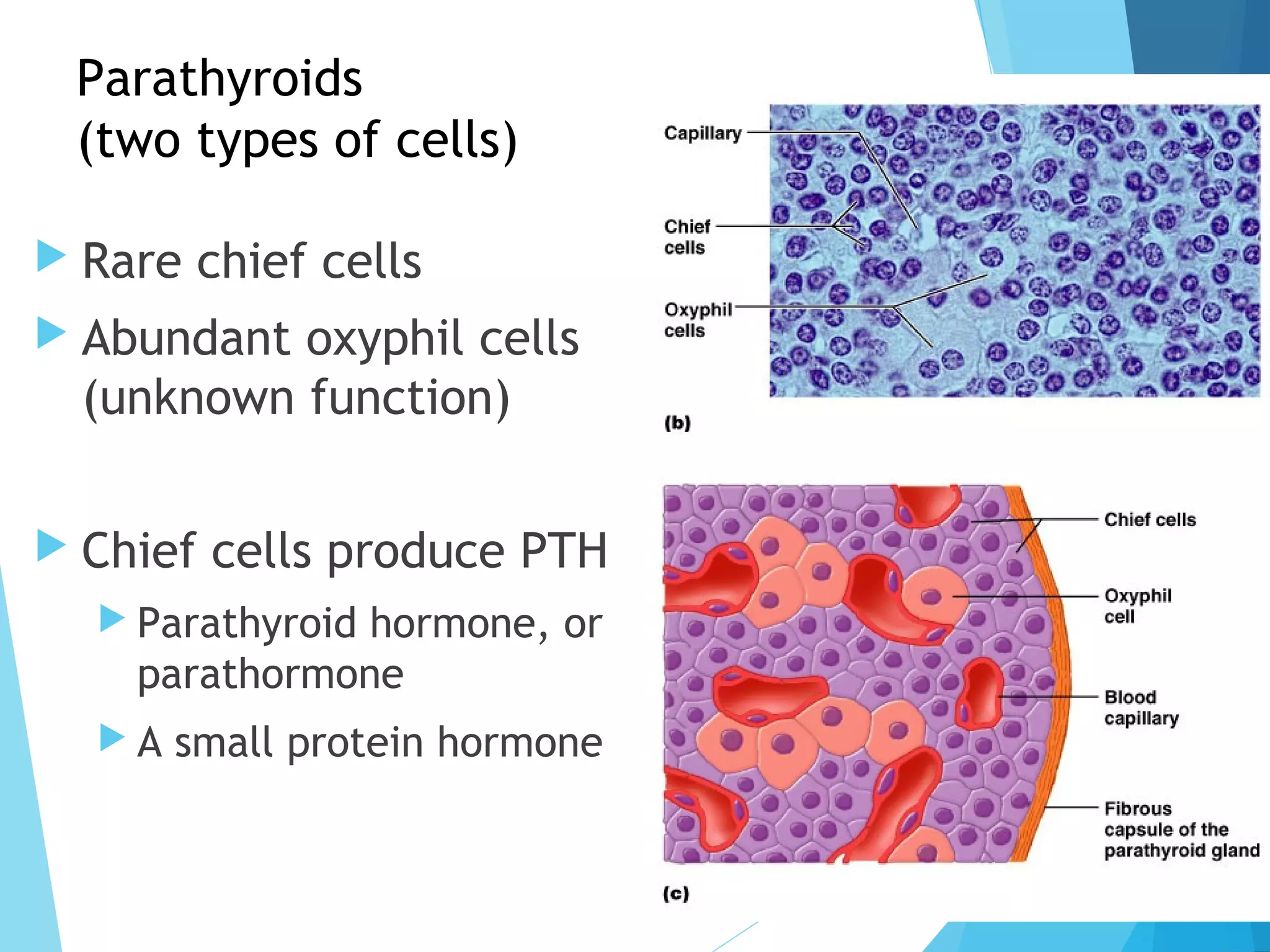
Parathyroids
(two types of cells)
 Rare chief cells
 Abundant oxyphil cells
(unknown function)
 Chief cells produce PTH
 Parathyroid hormone, or
parathormone
 A small protein hormone
9
Function of PTH
 Increases blood Ca++ (calcium)
concentration when it gets too low
 Mechanism of raising blood calcium
1. Stimulates osteoclasts to release more Ca++ from
bone
2. Decreases secretion of Ca++ by kidney
3. Activates Vitamin D, which stimulates the uptake
of Ca++ from the intestine
 Unwitting removal during thyroidectomy was
lethal
 Has opposite effect on calcium as
calcitonin (which lowers Ca++ levels)10
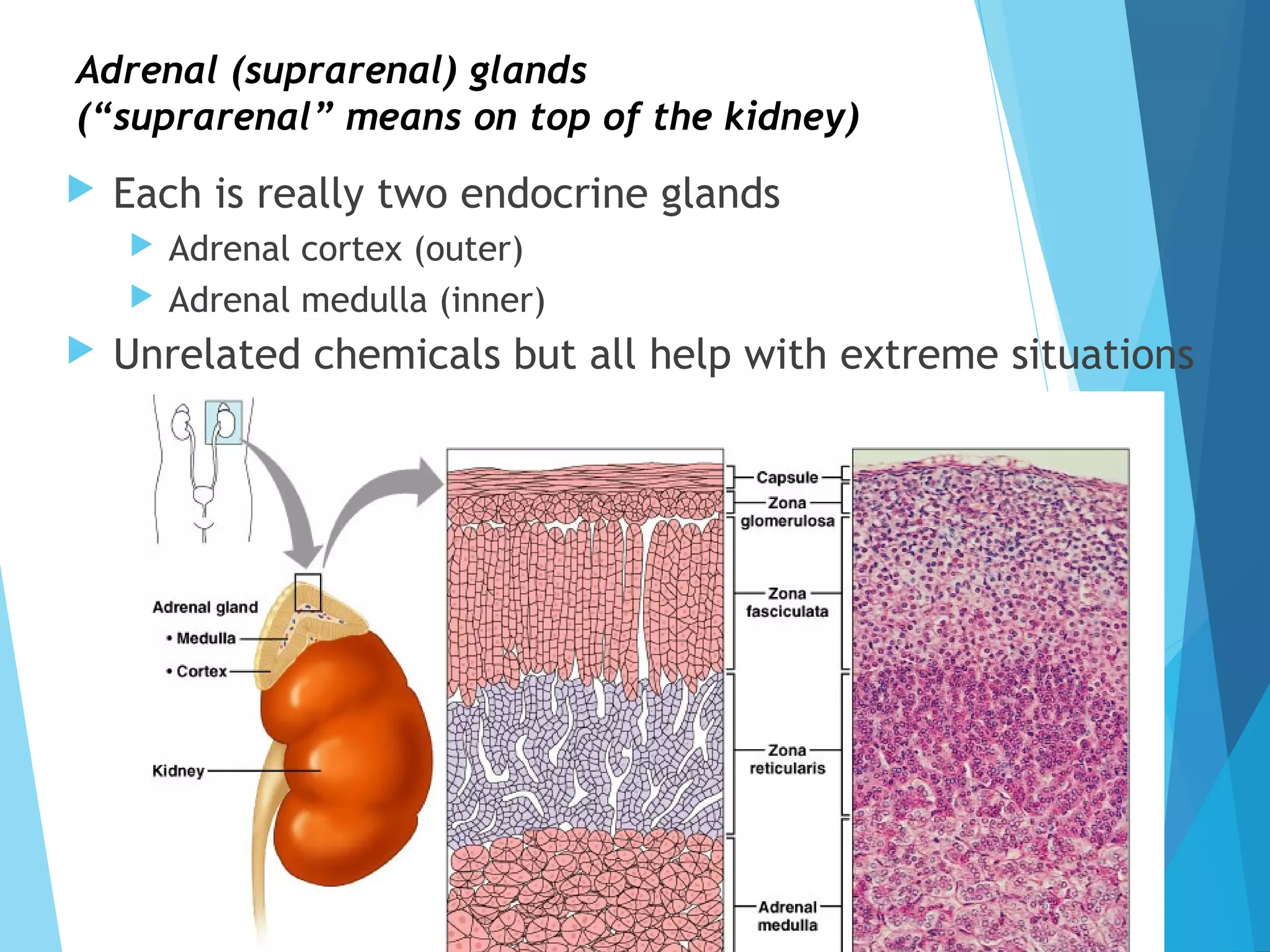
Adrenal (suprarenal) glands
(“suprarenal” means on top of the kidney)
 Each is really two endocrine glands
 Adrenal cortex (outer)
 Adrenal medulla (inner)
 Unrelated chemicals but all help with extreme situations
11
Adrenal Gland
 Adrenal cortex
 Secretes lipid-based steroid hormones, called “corticosteroids” –
“cortico” as in “cortex”
 MINERALOCORTICOIDS
 Aldosterone is the main one
 GLUCOCORTICOIDS
 Cortisol (hydrocortisone) is the main one
 Adrenal medulla
 Secretes epinephrine and norepinephrine
12
Aldosterone, the main
mineralocorticoid
 Secreted by adrenal cortex in response to a decline in
either blood volume or blood pressure (e.g. severe
hemorrhage)
 Is terminal hormone in renin-angiotensin mechanism
 Prompts distal and collecting tubules in kidney to
reabsorb more sodium
 Water passively follows
 Blood volume thus increases
13
Adrenal medulla
 Part of autonomic
nervous system
 Spherical chromaffin
cells are modified
postganglionic
sympathetic neurons
 Secrete epinephrine
and norepinephrine
 Amine hormones
 Fight, flight, fright
 Vesicles store the
hormones
14
The Pineal Gland
 At the end of a short stalk on the roof of the
diencephalon
 Pinealocytes with dense calcium particles
 Can be seen on x-ray (because of Ca++)
 Melatonin helps regulate the circadium rhythm
 The biological clock of the diurnal (night/day) rhythm
 Complicated feedback via retina’s visual input
15
The Gonads (testes and ovaries)
main source of the steroid sex hormones
 Testes
 Interstitial cells secrete androgens
 Primary androgen is testosterone
 Maintains secondary sex characteristics
 Helps promote sperm formation
 Ovaries
 Androgens secreted by thecal folliculi
 Directly converted to estrogens by follicular granulosa cells
 Granulosa cells also produce progesterone
 Corpus luteum also secretes estrogen and progesterone16
ANY question ??
Referance
 Marieb, Elaine (2014). Anatomy & physiology. Glenview,
IL: Pearson Education, Inc. ISBN 978-0321861580.
Colorado State University – Biomedical Hypertextbooks –
Somatostatin Endo K, Matsumoto T, Kobayashi T, Kasuya
Y, Kamata K (2005). "Diabetes-related changes in
contractile responses of stomach fundus to endothelin-1
in streptozotocin-induced diabetic rats". J Smooth
Muscle Res. 41 (1): 35–47. doi:10.1540/jsmr.41.35. PMID
15855738. Kaushansky K (May 2006). "Lineage-specific
hematopoietic growth factors". N Engl J Med. 354 (19):
2034–45. doi:10.1056/NEJMra052706. PMID 16687716.
Physiology: 5/5ch4/s5ch4_17 - Essentials of Human
Physiology
19

the endocrine system

  • 1.
    The universiTy ofGeorGia 1 aTheer ahmed 1330129 Professional CommuniCaTion The endoCrine sysTem
  • 2.
    Overview of theEndocrine System  System of ductless glands that secrete hormones  Hormones are “messenger molecules”  Circulate in the blood  Act on distant target cells  Target cells respond to the hormones for which they have receptors  The effects are dependent on the programmed response of the target cells  Hormones are just molecular triggers  Basic categories of hormones  Amino acid based: modified amino acids (or amines), peptides (short chains of amino acids), and proteins (long chains of amino acids)  Steroids: lipid molecules derived from cholesterol2
  • 3.
    Endocrine Organs  Purelyendocrine organs  Pituitary gland  Pineal gland  Thyroid gland  Parathyroid glands  Adrenal: 2 glands  Cortex  Medulla  Endocrine cells in other organs  Pancreas  Thymus  Gonads  Hypothalamus 3
  • 4.
    Two divisions:  Anteriorpituitary (adenohypophysis) 4 Sits in hypophyseal fossa: depression in sella turcica of sphenoid bone Pituitary secretes 9 hormones The Pituitary TSH: thyroid-stimulating hormone ACTH: adrenocorticotropic hormone FSH: follicle-stimulating hormone LH: luteinizing hormone GH: growth hormone PRL: prolactin MSH: melanocyte-stimulating hormone
  • 5.
    5 -ADH: antidiuretic hormone Posteriorpituitary (neurohypophysis antidiuretic hormone vasopressin) stimulates the kidneys to reclaim more water from the urine, raises blood pressure -Oxytocin Oxytocin prompts contraction of smooth muscle in reproductive tracts, in females initiating labor and ejection of milk from breasts
  • 6.
    The Thyroid Gland Anterior neck on trachea just inferior to larynx  Two lateral lobes and an isthmus  Produces two hormones  Thyroid hormone: tyrosine based with 3 or 4 iodine molecules  Calcitonin involved with calcium and phosphorus metabolism 6
  • 7.
    Some Effects ofThyroid Hormone (Thyroxine)  Increases the basal metabolic rate  The rate at which the body uses oxygen to transform nutrients (carbohydrates, fats and proteins) into energy  Affects many target cells throughout the body; some effects are  Protein synthesis  Bone growth  Neuronal maturation  Cell differentiation 7
  • 8.
    The Parathyroid Glands Most people have four  On posterior surface of thyroid gland (sometimes embedded) 8
  • 9.
    Parathyroids (two types ofcells)  Rare chief cells  Abundant oxyphil cells (unknown function)  Chief cells produce PTH  Parathyroid hormone, or parathormone  A small protein hormone 9
  • 10.
    Function of PTH Increases blood Ca++ (calcium) concentration when it gets too low  Mechanism of raising blood calcium 1. Stimulates osteoclasts to release more Ca++ from bone 2. Decreases secretion of Ca++ by kidney 3. Activates Vitamin D, which stimulates the uptake of Ca++ from the intestine  Unwitting removal during thyroidectomy was lethal  Has opposite effect on calcium as calcitonin (which lowers Ca++ levels)10
  • 11.
    Adrenal (suprarenal) glands (“suprarenal”means on top of the kidney)  Each is really two endocrine glands  Adrenal cortex (outer)  Adrenal medulla (inner)  Unrelated chemicals but all help with extreme situations 11
  • 12.
    Adrenal Gland  Adrenalcortex  Secretes lipid-based steroid hormones, called “corticosteroids” – “cortico” as in “cortex”  MINERALOCORTICOIDS  Aldosterone is the main one  GLUCOCORTICOIDS  Cortisol (hydrocortisone) is the main one  Adrenal medulla  Secretes epinephrine and norepinephrine 12
  • 13.
    Aldosterone, the main mineralocorticoid Secreted by adrenal cortex in response to a decline in either blood volume or blood pressure (e.g. severe hemorrhage)  Is terminal hormone in renin-angiotensin mechanism  Prompts distal and collecting tubules in kidney to reabsorb more sodium  Water passively follows  Blood volume thus increases 13
  • 14.
    Adrenal medulla  Partof autonomic nervous system  Spherical chromaffin cells are modified postganglionic sympathetic neurons  Secrete epinephrine and norepinephrine  Amine hormones  Fight, flight, fright  Vesicles store the hormones 14
  • 15.
    The Pineal Gland At the end of a short stalk on the roof of the diencephalon  Pinealocytes with dense calcium particles  Can be seen on x-ray (because of Ca++)  Melatonin helps regulate the circadium rhythm  The biological clock of the diurnal (night/day) rhythm  Complicated feedback via retina’s visual input 15
  • 16.
    The Gonads (testesand ovaries) main source of the steroid sex hormones  Testes  Interstitial cells secrete androgens  Primary androgen is testosterone  Maintains secondary sex characteristics  Helps promote sperm formation  Ovaries  Androgens secreted by thecal folliculi  Directly converted to estrogens by follicular granulosa cells  Granulosa cells also produce progesterone  Corpus luteum also secretes estrogen and progesterone16
  • 17.
  • 19.
    Referance  Marieb, Elaine(2014). Anatomy & physiology. Glenview, IL: Pearson Education, Inc. ISBN 978-0321861580. Colorado State University – Biomedical Hypertextbooks – Somatostatin Endo K, Matsumoto T, Kobayashi T, Kasuya Y, Kamata K (2005). "Diabetes-related changes in contractile responses of stomach fundus to endothelin-1 in streptozotocin-induced diabetic rats". J Smooth Muscle Res. 41 (1): 35–47. doi:10.1540/jsmr.41.35. PMID 15855738. Kaushansky K (May 2006). "Lineage-specific hematopoietic growth factors". N Engl J Med. 354 (19): 2034–45. doi:10.1056/NEJMra052706. PMID 16687716. Physiology: 5/5ch4/s5ch4_17 - Essentials of Human Physiology 19